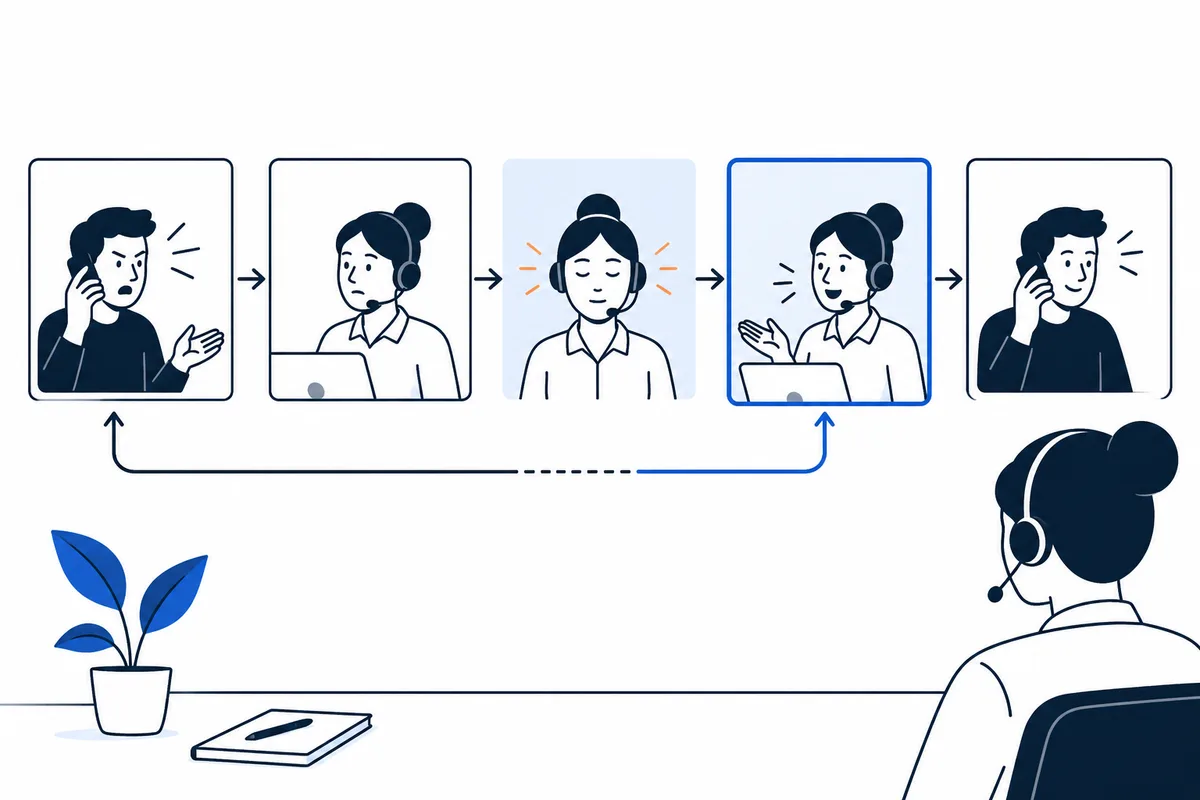
A workplace-specific emotion-regulation measure can be useful when you want to understand how you tend to manage emotion across customer-facing work. For one recurring interaction, though, it is usually a second step. First record the exchange itself: what happened, what you felt, what you did, and what followed. That event-level view points more directly to a behavior you can try. A workplace measure such as the Workplace Emotion Regulation Preference Inventory (WERPI) adds a broader picture of regulation preferences; a general EQ profile offers wider reflection across emotional skills. None of these, by itself, establishes why a particular customer exchange repeats or proves that a strategy will improve the outcome.
When one recurring customer exchange keeps going wrong
A workplace-specific measure sounds like the right tool when the problem happens at work. If a customer repeatedly challenges a policy, disputes a charge, or asks for an exception, a questionnaire about emotion regulation at work seems more relevant than a general EQ test. But the decision is narrower than the setting: you want to change one recurring interaction. The closest evidence is therefore the interaction, not a summary of how you usually behave.
Suppose the same kind of complaint tends to end with a long explanation, a clipped reply, or a promise you cannot keep. Those are different observable patterns. The useful first question is where the exchange shifts: when the customer repeats the complaint, when you hear an accusation, when you realize you lack authority, or when you try to close the call. A broad measure may help name a tendency, such as trying to change the meaning of a situation or managing the outward display. It will not tell you which sentence or decision is the hinge in this particular exchange.
The answer is conditional. Use a work-focused measure when you want a structured reflection on patterns that may recur across many customer encounters. For a single repeated situation, begin with a short record of several instances and select one action to test. Add the measure if it helps explain what you notice across those records. This order keeps a tendency score in its proper role: a prompt for inquiry, not a verdict on the employee or a promise about customer satisfaction.
What does a workplace-specific measure actually tell you?
The Workplace Emotion Regulation Preference Inventory (WERPI) was designed to ask about preferences for regulating emotion in work situations. Its workplace framing matters because an employee may act differently when required to display patience, warmth, or calm than in a generic emotional situation. In the 2015 instrument-development study, researchers introduced a broader range of regulation strategies than the familiar focus on cognitive reappraisal and suppression, and examined how strategy patterns related to customer-service performance.
The publisher abstract reports preliminary validity evidence and says four groups identified in the analysis differed significantly on customer-service performance. The full article record also describes a sample of 413 undergraduates, most of whom had recent employment experience, rather than a representative sample of experienced customer-service workers. That is relevant evidence that workplace regulation preferences can be studied alongside service outcomes. It is not evidence that a personal WERPI result predicts your next interaction, or that taking the measure causes performance to improve. The accessible report does not justify quoting detailed reliability estimates, a score threshold, or an individual interpretation rule.
The word preference is important. A self-report preference measure asks people to describe what they are inclined to do. It does not put them into a customer encounter and observe their maximum ability to recognize or regulate emotion. The critical review “The Measurement of Emotional Intelligence” separates ability-based measures, trait self-reports, and mixed competency approaches because their methods and claims differ. A work-specific self-report remains a report of typical tendencies, even if its scenarios refer to a job.
That distinction helps explain what the result can do. If a profile suggests that you often alter your outward expression after feeling irritated, you might ask whether the response protects the conversation or leaves the underlying problem untouched. The profile can suggest a topic for reflection; an event record can check whether that topic appears in the recurring exchange. Neither source should be treated as proof that an employee caused a difficult customer’s behavior.
A WERPI-like measure is more useful when your question concerns a pattern across customer contact: for example, whether you tend to hide irritation, redirect attention, or reinterpret a complaint. Its occupational fit can make reflection more relevant. It remains a relatively broad lens. The question “What do I tend to do at work?” differs from “At which moment in this exchange can I respond differently?” The latter needs observations tied to the exchange itself.
Sources: Development and validation of a measure for emotion regulation at work: Introducing the Workplace Emotion Regulation Preference Inventory (WERPI); Development and validation of a measure for emotion regulation at work: Introducing the Workplace Emotion Regulation Preference Inventory (WERPI), university repository record; The Measurement of Emotional Intelligence: A Critical Review of the Literature and Recommendations for Researchers and Practitioners
Why two workplace measures may answer different questions
A measure can mention customers and still be measuring something other than emotion-regulation preference. Emotional labor is the work of managing feelings or expression to meet the demands of a role. Some measures ask how often an employee displays an expected emotion, how long interactions last, or whether the employee uses surface acting (changing the display while the feeling remains) and deep acting (trying to shift the feeling itself). Those are related questions, not interchangeable labels for EQ.
The Emotional Labour Scale, for example, is described by the European Agency for Safety and Health at Work as a 15-item measure covering six facets: frequency, intensity and variety of display; interaction duration; surface acting; and deep acting. Its target includes demands and practices of emotional display. It does not provide a complete portrait of emotional intelligence or identify the exact turning point in a particular customer exchange. A workplace-specific emotion regulation inventory and an emotional-labor scale can therefore both be relevant while answering different questions.
A Chinese-context scale-development study makes the boundary even clearer. Across five studies, its researchers used observations of 15 frontline employees, interviews with 35 employees, open-ended responses from 110 workers, a scale study with 166 service workers, and multi-wave data from 403 Chinese participants. They developed a measure with four related dimensions: surface acting, deep acting, expression of naturally felt emotion, and emotion termination. The authors explicitly situate the instrument in Chinese service settings. The design shows why context and construct matter; it does not establish that the scale transfers unchanged to every culture, occupation, or customer exchange.
These differences matter in practice. If your recurring difficulty is that you must remain friendly while policy prevents a solution, a measure of display demands or emotional dissonance may reveal that job conditions are central. If your question is how you typically regulate feelings, a preference inventory is closer. If your aim is to change the point at which you start arguing or overexplaining, neither broad scale is as direct as reviewing the exchange and identifying a replacement behavior.
Do not choose by which questionnaire sounds most professional or most specific. Read what its items ask about, what population it was studied with, and what conclusions its authors report. A test aimed at job demands may identify pressure on the worker; one aimed at preferred regulation strategies describes the worker’s self-reported response. Confusing the two can turn a work-design problem into an apparent personal deficit.
Sources: Emotional Labour; Emotional Labor: Scale Development and Validation in the Chinese Context
Where in the exchange could a change happen?
Emotion regulation can happen at several points in an exchange. A worker might choose to pause before replying, direct attention to the account details, reconsider what a repeated question means, or modulate a visible response. The WERPI study uses a broad workplace strategy taxonomy rather than limiting its focus to the familiar pair of reappraisal and suppression. In practice, the possible change points matter because a response can begin before irritation becomes visible.
The model is useful as a map, not a prescription. It cannot tell you which strategy is best for your role or situation. If the customer is abusive, leaving or escalating may be more appropriate than searching for a kinder interpretation. If the employee lacks authority to change a charge, reappraisal cannot supply that authority. A practical record should include the conditions around the exchange, not just the emotion felt inside it.
Take a repeated complaint about a delayed refund. A brief note after each relevant contact could record the trigger, the first feeling you noticed, the response you chose, what the customer did next, and what constraint applied. Keep the description observable: “I repeated the timeline twice and interrupted the third question” is more useful than “I was bad at empathy.” Also note whether the case involved a missing record, an unclear rule, or no available escalation path. This is an illustrative method, not a research finding or a substitute for a company’s documentation rules.
After a few comparable instances, look for a specific point to work on. Perhaps the interruption happens when you assume the customer has not listened. A small alternative might be to pause and ask which part of the timeline remains unclear, then state the next available action. That change can be evaluated by whether you asked the question and whether the exchange stayed understandable. It cannot guarantee the customer will be satisfied, and a favorable outcome would not by itself prove the new response caused it.
This is the main advantage of event-level reflection for a one-interaction goal: it gives the practice target a location and a visible form. A general score may prompt awareness, but practice needs a cue and an action. Avoid logging sensitive customer details outside approved systems; a learning note can describe the interaction pattern without retaining names, account numbers, or private information.
Sources: Development and validation of a measure for emotion regulation at work: Introducing the Workplace Emotion Regulation Preference Inventory (WERPI); Emotional Labour
Why one recurring exchange needs event-level evidence
Workplace interactions vary from one encounter to the next. A general tendency can hide those differences. In a field study, Totterdell and Holman followed 18 call-center employees over two weeks, gathering repeated ratings every two hours for 537 occasions. Their analysis connected emotion-regulation approaches with outcomes in the work setting and emphasized that organizational goals shape the process. The small, context-specific observational study cannot show that a commercial questionnaire fixes a recurring exchange, but it illustrates why repeated observations can tell a different story from one overall rating.
A later event-centered study examined 7,331 customer-service interactions rated by 246 call-center employees. Multilevel latent-profile analysis identified eight patterns of customer mistreatment, felt affect, and regulation at the event level. Those profiles were associated with emotional exhaustion and psychological vitality, with concurrent and longitudinal relationships reported. The authors’ point is not that workers should calculate a profile for themselves. It is that actual service events do not always fit one assumed pattern in which difficult customer behavior, employee distress, and regulation neatly rise together.
For an individual, the implication is modest but practical: record more than one comparable encounter before concluding that a behavior is stable. One customer may arrive angry about a policy; another may be confused; a third may be reacting to a delay caused upstream. If the same behavior appears only when the employee has no escalation option, the next intervention may concern authority or process. If it appears even when a clear option exists, a communication practice may be worth trying. These are hypotheses to check, not causal conclusions from the studies.
Event records also help separate what the employee can influence from what they cannot. You may be able to pause, clarify, or set a boundary. You cannot control a customer’s tone, the company’s refund rules, staffing levels, or system outages. A useful learning target is therefore an action within your control, paired with an outcome you can observe without making customer satisfaction the sole measure of success. For example: “Did I explain the next step once, in plain terms, and check what remained unclear?”
Sources: Emotion regulation in the context of customer mistreatment and felt affect: An event-based profile approach; The Moment of Truth: A Review, Synthesis, and Research Agenda for the Customer Service Experience
What the measure cannot tell you about the customer or workplace
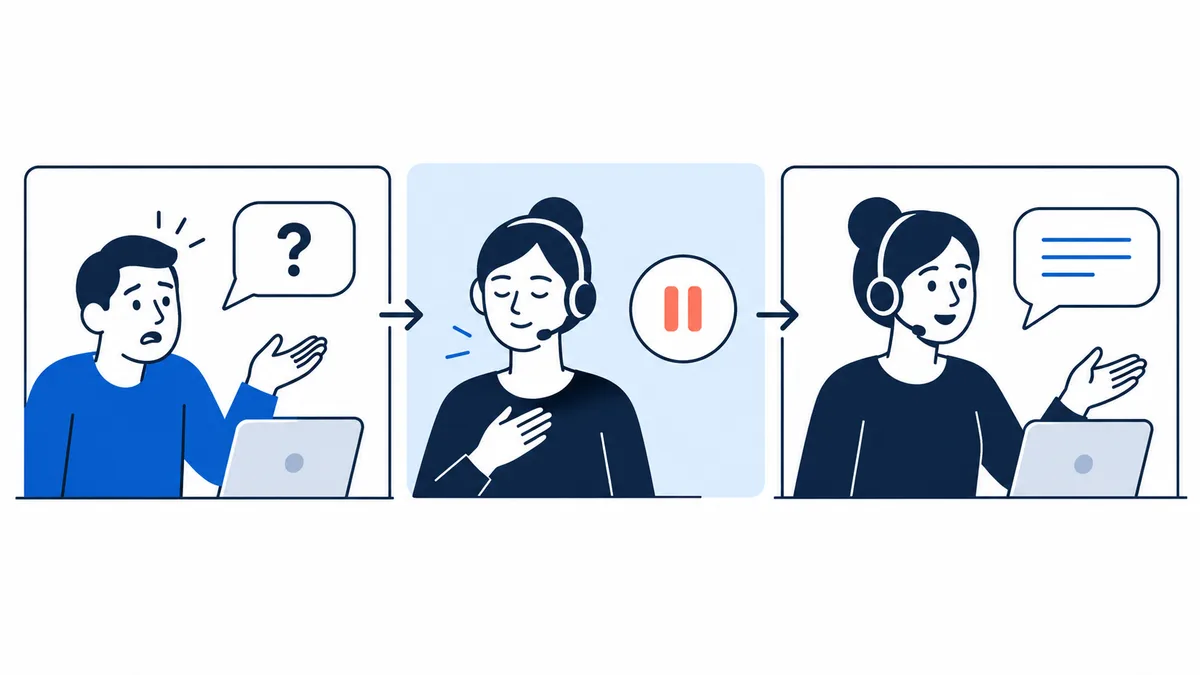
A personal regulation result cannot assign responsibility for the whole interaction. Customer conduct, organizational display rules, workload, autonomy, tools, and service recovery options all shape the exchange. A review of customer-service research in Annual Review of Organizational Psychology and Organizational Behavior treats customer service as an interactional process involving employee emotion, customer mistreatment, and service behavior. It gives a wider frame than a single worker tendency score.
An observational survey study by Johnson and Spector examined 176 participants in eight customer-service organizations. The study tested whether autonomy changed relationships between emotional-labor strategies and personal outcomes; its abstract reports that autonomy moderated some relationships, while emotional intelligence did not moderate them as hypothesized. The design is correlational and does not settle how to improve a particular service interaction. It does caution against assuming that more EQ automatically buffers the effects of demanding work.
This matters when a repeated exchange involves a broken process. If a customer calls because the same account error keeps recurring, changing the worker’s tone may make the conversation smoother while leaving the cause untouched. If policy requires the worker to absorb anger without authority to resolve the issue, an individual measure may reveal strain but cannot create discretion. Workplace assessment can be a prompt to inspect the setting as well as the employee’s response.
The same care applies to emotional-labor findings. Associations between strategies and well-being or service outcomes do not mean every person should use one strategy in every encounter. Surface acting, deep acting, and naturally felt expression describe different ways of handling display demands. Whether a response is workable depends on the task, the employee’s authority, customer behavior, and organizational support. The reader should not convert a group-level association into a rule about what one person must feel.
If the interaction includes threats, discrimination, or repeated abusive conduct, follow workplace safety and escalation procedures. Emotional skill does not require tolerating mistreatment. A measure may help someone reflect on how they respond under pressure, but it is not a substitute for clear boundaries, managerial support, adequate staffing, or a policy that lets employees disengage when needed.
The practical consequence is that a score should not become an explanation simply because it is measurable. A manager who sees a low self-rating on regulation might be tempted to coach the employee to remain calmer. Before doing that, examine what the employee is expected to absorb, whether the rules are consistent, and what happens when a customer crosses a boundary. If the role requires workers to promise outcomes they cannot deliver, emotional composure alone will not repair the service design. A measure may help start that conversation, but the follow-up needs evidence about work conditions and the actual exchange.
Sources: Emotion regulation in the context of customer mistreatment and felt affect: An event-based profile approach; The Moment of Truth: A Review, Synthesis, and Research Agenda for the Customer Service Experience
So which next step fits one repeated customer interaction?
For one recurring customer exchange, use the closest tool first. A brief event record is the best starting point when you need to identify a moment and select one action. A workplace-specific preference measure is a reasonable addition when you want to understand whether the same regulation tendencies appear across many kinds of customer contact. An emotional-labor scale fits a different question: how the role requires emotional display and what that demand may be costing. A broad EQ profile can help you reflect across skills such as recognition, understanding, regulation, and responding to others.
The evidence behind WERPI gives it a genuine reason to consider: it was designed for workplace regulation preferences, and its development study reports differences in customer-service performance across four identified groups. Yet the source available here does not provide enough detail for an individual prediction, and its sample was undergraduate-heavy. Event-level field research, meanwhile, shows that real interactions vary and that patterns across events can connect to worker well-being. Those findings support observation as a useful companion, not a claim that self-monitoring is a proven treatment.
The 32-item Emotional Skills Profile at EQ Test is another kind of tool. It asks about recent emotional behaviors and judgments in authored situations to support private educational reflection. It has no validated population norms or established ability-test validity. It can help organize questions about one’s habits and possible practice priorities; it is not a workplace-specific regulation instrument, job-performance predictor, hiring score, or proof that a customer interaction will improve. Use its reflection alongside the actual situation rather than treating its output as an explanation of that situation.
So the answer is yes, conditionally: a workplace measure is worth using when the question is about a recurring pattern across work, the measure’s construct fits that question, and its result will lead to a concrete reflection or practice. If the goal is to change one repeated exchange, first track a few comparable instances and choose one observable response to practice. Add a broader assessment only if it helps interpret that pattern. Revisit the action after several opportunities and ask whether the exchange changed in a way you can describe. If it did not, check the process, authority, and support around the interaction before deciding that the worker needs a different score.
A fair comparison also asks what each option costs in attention. A questionnaire gives a structured snapshot and may surface an unfamiliar pattern, but responding to it takes time and interpretation. Event notes are less standardized; their value depends on choosing comparable situations and recording them consistently. A broader EQ profile can organize self-reflection across several skills, though its breadth may be less precise for this one problem. These are practical tradeoffs inferred from what the tools ask and the evidence described above, not results from a head-to-head trial. If the reader already has a trusted workplace measure available, completing it can be reasonable. The key is to pair the result with a concrete example and avoid making the score the endpoint.
Sources: Development and validation of a measure for emotion regulation at work: Introducing the Workplace Emotion Regulation Preference Inventory (WERPI); Emotion regulation in the context of customer mistreatment and felt affect: An event-based profile approach; The Moment of Truth: A Review, Synthesis, and Research Agenda for the Customer Service Experience
Turn the pattern into one practice question
Keep the next step small enough to observe. Choose a recurring situation you are allowed to discuss or document. After several comparable instances, write down the trigger, your emotion, your response, the customer’s next move, and any constraint that shaped the exchange. Look for a moment you can influence, then select one alternative behavior, such as asking a clarifying question before restating a policy. Revisit what happened after you have had more than one chance to try it.
A workplace-specific measure becomes worthwhile if it adds a useful pattern to that record: a tendency you recognize and can connect to a particular moment. A general EQ reflection profile may widen the questions you ask about awareness, regulation, or response. If neither changes what you can observe or practice, the tool is not answering the immediate problem. The decision is whether you need a map of your broad tendency or a closer look at the exchange; for one repeated customer interaction, start close to the event.
Questions readers ask
Is a workplace-specific emotion-regulation measure better than a general EQ test?
It is more directly framed around regulation at work, but that does not make it better for every goal. For one recurring customer interaction, an event record is closer to the behavior you want to change. A workplace measure can add context about tendencies across work situations; a general EQ profile offers a broader reflection across emotional skills.
Can a workplace emotion-regulation score predict how I will handle a customer?
A self-report preference score describes reported tendencies. The WERPI development study examined group differences in customer-service performance, but that does not establish an individual prediction or show that completing the measure changes behavior. Use the result as a reflection prompt and compare it with observed interactions.
What should I track in a recurring customer exchange?
Record the trigger, what you felt, what you did, what happened next, and any constraint such as policy or lack of authority. Keep notes factual and follow workplace privacy rules. After several comparable instances, choose one response within your control to practice and observe.
Sources
- Development and validation of a measure for emotion regulation at work: Introducing the Workplace Emotion Regulation Preference Inventory (WERPI)
The abstract describes WERPI development, preliminary validity evidence, and reported group differences in customer-service performance; it does not establish individual prediction or causal effects.
- Development and validation of a measure for emotion regulation at work: Introducing the Workplace Emotion Regulation Preference Inventory (WERPI), university repository record
The accessible repository record confirms the instrument purpose, abstract findings, publication details, and that the full text is not freely available there.
- The Measurement of Emotional Intelligence: A Critical Review of the Literature and Recommendations for Researchers and Practitioners
This critical review distinguishes ability, trait self-report, and mixed EI measures and supports describing self-report as reported typical tendencies rather than observed maximum ability.
- Emotional Labour
The European occupational-safety resource describes Emotional Labour Scale facets and workplace emotional demands, distinguishing them from a general emotional-intelligence profile.
- Emotional Labor: Scale Development and Validation in the Chinese Context
The study reports five development samples and four emotional-labor dimensions in Chinese service settings, demonstrating the importance of construct and cultural scope.
- Emotion regulation in the context of customer mistreatment and felt affect: An event-based profile approach
The study reports eight event-level profiles from 7,331 interactions rated by 246 call-center employees and links profiles to emotional exhaustion and psychological vitality.
- The Moment of Truth: A Review, Synthesis, and Research Agenda for the Customer Service Experience
This integrative review frames customer service through employee emotion, customer mistreatment, and service behavior as connected interactional processes.
- Workplace Emotion Regulation Preference Inventory article record (publisher abstract)
The publisher abstract names workplace strategies and customer-service performance as the study focus; used only for the bounded comparison of purpose and evidence.
Apply it to the real situation
Turn an emotional-skills reflection into one practical next step
From this guide: A general profile can help you notice patterns, while the recurring customer exchange still needs a specific behavior to observe and practice.
The private 32-item Emotional Skills Profile organizes reflection around recent emotional behaviors and judgments in situations, including recognition, understanding, regulation, and responding to others. Use it to identify a question worth exploring, then connect that reflection to an observable moment in your work. It is an educational development profile without validated norms or established ability-test validity, so treat it as a starting point for reflection rather than a workplace score or prediction.