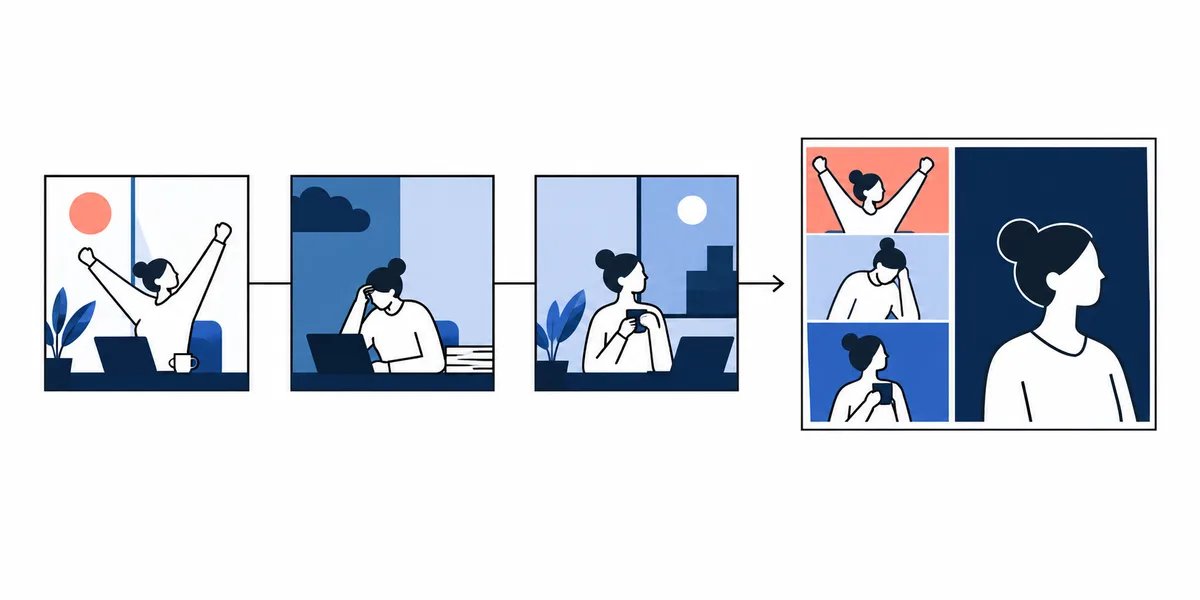
Workplace emotion-regulation studies measure both usual reported tendencies and experience across days or work occasions. The prompt’s recall period shows what respondents are asked to report; repeated assessments can show variation across sampled occasions when the analysis separates those reports from a person’s average. A one-time global self-report cannot establish what happened in a particular interaction.
Do workplace emotion-regulation studies measure daily experience or usual style?
A workplace emotion-regulation result can describe a person's usual reported tendency, experiences across days, or both. A questionnaire about how someone generally responds summarizes their view of their typical style. A diary asks again with a particular day in mind; experience sampling repeats questions during the day. To know what a finding can support, check the prompt's recall period and whether the analysis compares people, occasions within a person, or both. The distinction matters when a score is treated as a record of conduct. A global self-report can suggest how often someone believes they use a strategy in general. It cannot show what happened in a particular meeting. Repeated reports can reveal whether the same participant describes more or less use on sampled occasions than on their own average. That is a within-person comparison. A between-person comparison asks whether participants with higher averages differ from those with lower averages. Separate patterns matter: a difference between colleagues does not show that one person's strategy changes with the situation. “Emotion Regulation, Subjective Well-Being, and Perceived Stress in Daily Life of Geriatric Nurses” makes the time distinction visible. Its authors describe the Emotion Regulation Questionnaire as measuring dispositional strategies, then adapted four items for daily reporting. Eighty-nine geriatric nurses completed paper diaries at each day's end for three weeks, averaging 18.2 days of reports and supplying 85 percent of possible observations. The prompt asked them to think back over that day. This is repeated self-reported daily experience, not observation of every interaction; the sample also included workdays and days off. “Managing your feelings at work, for a reason” paired a baseline survey about typical work behavior with twice-daily reports of morning and afternoon experience across two workweeks. Its design shows that usual-style and occasion-level measures can coexist. Repeated answers alone do not establish that the analysis separates daily variation from stable differences among people. So the answer is both, depending on what was asked and how reports were compared. A usual-style result can be a starting hypothesis for reflection, but it is not a log of every workday. When a claim concerns change from one occasion to another, look for repeated reports and an analysis that distinguishes a person's occasions from their average. First ask: what period did the item ask the respondent to remember?
Sources: Emotion Regulation, Subjective Well-Being, and Perceived Stress in Daily Life of Geriatric Nurses; Managing your feelings at work, for a reason: The role of individual motives in affect regulation for performance-related outcomes at work
What does the wording tell you about the time being measured?
Look for the time anchor before interpreting an emotion-regulation result. A question about how someone generally responds asks for a judgment about usual style across a broad span. A question tied to today, this morning, or a recent event narrows the report to that period. Repeating a broad question does not make each answer a record of a specific event. A daily prompt remains a person's account, not an outside observation of every interaction.
The geriatric-nurse diary study, “Emotion Regulation, Subjective Well-Being, and Perceived Stress in Daily Life of Geriatric Nurses,” makes this distinction visible. Researchers used four items from the Emotion Regulation Questionnaire (ERQ), which they describe as measuring dispositional strategies, and reworded them for daily use. Eighty-nine nurses completed paper diaries at each day's end for three weeks. The study reports an average of 18.2 diary days per nurse and 85 percent of potential observations. A familiar strategy measure was paired with a defined reporting window; the global and daily forms were not interchangeable.
A construct is what a measure intends to ask about; a reference period is the time respondents should consider. The strategies here were cognitive reappraisal, changing how one thinks about a situation, and suppression, holding back emotional expression. Those labels identify the behavior, not whether a response summarizes a general tendency or one day's experience. Instructions supplied that second piece: participants were asked to think back about that day. Since they completed diaries at day's end, these were retrospective reports, not prompts delivered during each interaction.
“Daily” means reports were collected repeatedly with a day as the reference period; it does not mean researchers observed each emotional episode as it happened. A respondent may recall the most demanding exchange or the overall feel of a shift more readily than other moments. This general limit of retrospective self-report does not show that participants answered inaccurately. It places the result at the level the method supports: what respondents reported about a day under the study's instructions.
The diary was not confined to work hours. The authors assessed workdays and days off, and modeled the distinction. Participants were geriatric nurses recruited from four institutions near Zurich, a specific occupational sample rather than a map of all workplaces. A “daily” result may refer to a workday or a non-work day; assuming every report describes a shift would extend the evidence beyond its stated window.
When reading another study, check the item stem or description, its instructions, and when respondents completed it. Ask what they were meant to recall: a usual pattern, whole day, part of a day, or named event. Check whether reports concern work only and which emotion or strategy is specified. Also note whether prompts arrive during the period or after it, since timing changes how much recall is required from respondents. A shared strategy name can appear with different recall periods; the prompt and administration identify the report, while a headline label cannot.
In the nurse study, the ERQ supplied the strategy content while the daily instruction set a one-day window. Answers describe recollections of regulation across work and non-work days. That is more time-specific than a one-time global report, yet still self-report gathered at day's end. Keeping both features in view clarifies whether a finding concerns a usual tendency or a particular day's experience.
Sources: Emotion Regulation, Subjective Well-Being, and Perceived Stress in Daily Life of Geriatric Nurses
What can a daily diary show inside one worker's average?
With repeated daily reports, researchers can ask whether a worker reports a strategy more on some days than on their own average, and whether that difference travels with a day-level outcome. In the geriatric-nurse study, associations differed by strategy and whether the target was positive or negative emotion. A diary adds a view of variation: rather than reducing a person to one usual-style answer, it records how reports move across sampled days and compares those reports with outcomes from the same days.
In “Emotion Regulation, Subjective Well-Being, and Perceived Stress in Daily Life of Geriatric Nurses,” 89 nurses from four institutions around Zurich completed paper diaries at the end of each day for three weeks. They reported an average of 18.2 days each, and the researchers received 85 percent of the possible daily observations. The study adapted four items from the Emotion Regulation Questionnaire, which the authors describe as a measure of dispositional strategies, for daily use. The questions asked participants to think back over that day and report on reappraisal and suppression in relation to positive and negative emotion. Thus, the study did not simply repeat an unchanged usual-style score. It asked for daily recollections of specific strategies.
The analysis asked whether reports on a given day differed from each nurse’s own average and accompanied that day’s well-being and perceived stress. This within-person comparison asks whether a nurse’s higher-than-usual report on one day coincides with outcomes that also differ from that nurse’s average. It differs from asking whether nurses who report more strategy use overall also report better well-being than other nurses. One comparison concerns changes within people; the other, differences among them.
The nurse study’s pattern also resists a simple verdict that one strategy is helpful and another harmful. On days when nurses reported more reappraisal intended to increase positive emotion, they also reported higher subjective well-being and lower perceived stress. More suppression of positive emotional expression was associated with lower well-being and higher stress. The corresponding associations were not found for reappraisal intended to reduce negative emotion or suppression intended to inhibit negative expression. The target mattered alongside the named strategy. Treating all reappraisal or all suppression as one undifferentiated total would conceal that difference.
These are associations in daily self-reports, not evidence that a strategy caused the outcome. A difficult day could affect both emotion-regulation reports and well-being ratings. The sample is also narrow: geriatric nurses in four institutions, with workdays and days off included. Off-days were rated as higher in well-being and lower in stress than workdays. The diary therefore covers daily life around this occupation, not every work interaction or other jobs.
A second example pairs daily reports with a work-period outcome. The Ghent University record for “When Regulating Emotions at Work Pays Off: A Diary and an Intervention Study on Emotion Regulation and Customer Tips in Service Jobs” describes a diary of Dutch waiters and taxi drivers. Across 166 measurement occasions nested within 34 people, daily self-reported deep acting and automatic regulation were positively associated with customer tips. This is a specific association in these service settings. Tips are not a general measure of collaboration or job performance, and the diary does not establish that regulation produced higher tips. The record also describes a separate hairdresser intervention; that experiment is distinct from the diary finding.
Together, the studies show what diaries add: comparison of one person’s reports across sampled days, sometimes linked to an outcome measured over the same period. A daily average can hide changes associated with the emotion being regulated or the situation. Yet it summarizes only the observations collected, and associations remain tied to each study’s sample, prompts, and outcomes. A diary sharpens the question from “What is this person usually like?” to “What varied across these days, and what varied with it?” It cannot establish what every worker should do in a difficult exchange.
Sources: Emotion Regulation, Subjective Well-Being, and Perceived Stress in Daily Life of Geriatric Nurses; When Regulating Emotions at Work Pays Off: A Diary and an Intervention Study on Emotion Regulation and Customer Tips in Service Jobs
Can one work study measure both usual style and daily experience?
Yes. A workplace study can ask about a person's typical behavior once and then ask what happened during particular work periods. In *Managing your feelings at work, for a reason: The role of individual motives in affect regulation for performance-related outcomes at work*, the authors did both. Their baseline survey covered typical work behaviors; a later diary phase asked participants to report about their morning and afternoon at work. The design therefore does not place “usual style” and “daily experience” in competing boxes. It gives each a different place in the same investigation: one measure describes a person's broader pattern, while the repeated measures record reports tied to sampled occasions.
The details matter. The study recruited 96 employed professionals across jobs and industries, all enrolled in a part-time executive MBA course at a research university in Western Australia. At the start of the course, participants completed an online baseline survey about demographics, their work environment, and typical work behaviors. One to three weeks later, 81 people entered the diary phase. For two workweeks, Monday through Friday, they were asked to complete two short surveys per workday: one at lunchtime about that morning and another before leaving work about the afternoon. The researchers excluded responses completed outside the assigned time windows. Their final analysis used 821 valid observations from 80 participants, rather than treating all 923 initially submitted diary responses as equivalent. The authors report that the valid observations represented 63 percent of the possible responses while participants were working. That participation pattern matters when reading the results: the study samples repeated occasions, but not every work period from every participant.
The study focused on why people tried to change their feelings at work. It distinguished hedonic motives, such as wanting to feel better; task-related motives, tied to an achievement goal; and social motives, tied to getting along with others. Those motives were reported for the morning or afternoon period. The researchers also asked participants how successful they felt at regulating their feelings during that period and how they rated their own performance and efforts to improve work procedures. The paper reports that hedonic and task-related regulation were associated with performance-related outcomes through perceived success, while social regulation did not predict those outcomes in the tested model. These are associations among participants' reports in this particular study, not direct observations of emotional skill or proof that changing a feeling caused better performance.
The authors analyzed the diary observations at two levels. At the occasion level, a report could be compared with that same participant's own typical level across reported occasions. At the person level, participants' average reports could be compared with one another. These answer different questions. If someone usually reports making more effort to change feelings than colleagues do, that does not tell us whether an afternoon when they made more effort than usual coincided with a better self-rated outcome. A model that separates occasion-level reports from person averages can estimate both patterns; a single overall correlation can blur them. Here the baseline measure of typical behavior and the repeated reports served related but distinct roles, so a reader should check which one supports each claim in the paper.
The study's sample also limits how far to carry its conclusions. The participants were employed professionals, but they were also a specific group taking an executive MBA course; the final diary sample was 80 people, with uneven response completion. Their reports concerned motivated affect regulation and selected self-rated outcomes, not every form of emotion regulation, every workplace, or an all-purpose EQ measure. The study is useful because it makes the measurement distinction visible: a baseline can describe usual behavior while repeated, time-anchored reports capture experiences across selected parts of workdays. When a paper contains both, inspect the wording and timing of each measure, then ask whether its analysis compares people, occasions within people, or both.
Why does the analysis level change the answer?
Repeated reports only answer a within-person question when the analysis compares each participant's occasions with that participant's own average. Comparing averages of different people answers a between-person question. A study may estimate both, but a result at one level does not automatically describe the other. People who usually report more regulation may differ from colleagues, while a particular person may or may not report more regulation on a day when their circumstances differ.
One employee's average across several workdays may be higher than a colleague's. That says something about the difference between their reported patterns. It does not tell us whether the first employee has a better-than-usual day when they use a strategy more than they typically do. To answer that, researchers compare the person's day-level report with their own average, then examine whether the deviation accompanies a change in a day-level outcome. The average is the reference point; the daily deviation is how far one observation sits above or below it. A correlation across people can reflect stable differences even if the day-to-day association within each person is small, absent, or in another direction. Treating the comparisons as interchangeable turns a statement about who tends to report more into a claim about what happens when someone changes behavior.
The design in “Managing your feelings at work, for a reason” makes this concrete. In its second study, 80 employees contributed 821 valid observations across repeated morning and afternoon reports. Researchers modeled occasion-level reports alongside person-level differences, asking how affect-regulation motives and reported outcomes related within occasions and how habitual deep acting differed between participants. Occasion-level hedonic and task-related regulation were associated with perceived success and performance-related outcomes; social motives did not show the same pattern. The link between task-related regulation and perceived success was stronger for people who habitually engaged in deep acting. The study places typical behavior and sampled work experiences in one analysis while keeping their roles distinct. Its self-reports and particular employee sample limit broad application. This demonstrates a comparison, not a universal rule about which strategy works.
“Emotion Regulation, Subjective Well-Being, and Perceived Stress in Daily Life of Geriatric Nurses” also reports within-person findings from daily observations. Eighty-nine nurses completed end-of-day diaries over three weeks, averaging 18.2 days each and 85% of possible observations. The authors found that associations differed by strategy and emotional target: reappraisal aimed at increasing positive emotion was associated with higher daily well-being and lower perceived stress, while suppressing positive expression showed the opposite associations. The corresponding strategies aimed at negative emotion were not associated with those outcomes. The paper also examined between-person differences, including the association between nurses' average negative affect and their reports of positive-emotion suppression. One result concerns variation against a nurse's own daily pattern; the other concerns differences among nurses. The sample was one occupational group and included workdays and days off, so the associations do not establish what happens in every workplace interaction.
When reading a result, ask whether the comparison concerns different people, different occasions for the same person, or both. Repeated measures supply observations across time, but the count alone does not show that analysis separated a participant's average from daily deviations. Multilevel modeling is one way to handle occasions nested within people; the question is what the reported estimate compares. If a paper says people who use a strategy more also report an outcome more, do not translate that into “on days when a person uses it more, the outcome improves.” The latter is a within-person claim and needs analysis at that level.
A well-matched within-person analysis remains observational when participants report their own experiences. A same-day association cannot establish that regulation caused a change; an unmeasured feature of the day may affect both. Repeated sampling also does not make a convenience sample representative of other jobs or situations. Its narrower gain is useful: the estimate can match a question about variation across sampled occasions more closely than a single global score. For a workplace claim, identify whether the paper reports an across-person pattern, a within-person pattern, or both, and keep the conclusion at that level.
Sources: Managing your feelings at work, for a reason: The role of individual motives in affect regulation for performance-related outcomes at work; Emotion Regulation, Subjective Well-Being, and Perceived Stress in Daily Life of Geriatric Nurses
How much workplace evidence is there for repeated prompts?
Workplace studies do use repeated reports, but the evidence base is narrower than the phrase “emotion regulation at work” suggests. A 2024 scoping review, “Emotional labor as emotion regulation investigated with ecological momentary assessment,” searched seven databases and screened 237 publications. Twelve publications met its criteria, covering 13 studies. Those criteria centered on ecological momentary assessment (EMA) of surface acting and deep acting: managing outward expression or trying to change felt emotion in response to workplace display expectations. The review found varied methodological quality and described this research area as early, calling for replication. It is a map of one strand of research, not a census of every strategy, instrument, or occupation. The authors note that scoping reviews map available evidence rather than determine whether findings are robust or generalizable. The review’s boundaries matter because “repeated prompts” can sound like a single standardized method. In the included studies, nine used event sampling, such as reports at the start or end of a shift or after a specified event; three combined event and time sampling. The timing changes which experiences are likely to enter the record. A shift-end prompt can cover a broad period while relying on memory. A prompt after a selected event can focus attention on that occasion, but will miss other events. A scheduled prompt may capture what is happening around that moment while missing an interaction that occurred between alerts. These are design tradeoffs, not a ranking in which more prompts automatically produce a truer account. The review itself calls EMA especially useful for studying dynamic processes and minimizing the memory reconstruction involved in later reports. That is a rationale for asking closer to the experience, not proof that every EMA result is more accurate or representative. Frequent alerts can also interrupt work, and participants may miss prompts. The reviewer should therefore check how often reports were requested, whether workers answered them, and whether sampling followed time, events, or both. The review reports variation across study methods and quality, so its small included set cannot settle how well one schedule works across jobs. A different study helps show why sampling situations may matter without adding a workplace estimate. “Putting the emotion regulation process into person-specific context: An experience sampling and mobile sensing study” followed 164 participants for 14 days. Its abstract reports varied associations between situations and each participant’s regulation process; both self-described and passively sensed features predicted regulation, with more effects for self-reported features. The university record does not identify this as a workplace sample. It therefore supports a narrower point: the link between a situation and regulation may differ by person, and a person-specific design can reveal variation that an across-person average obscures. It cannot tell us how common those patterns are among employees. Read repeated-prompt findings in three steps. First, identify the population and setting: the EMA review concerns emotional labor under work display expectations, while the 14-day study offers adjacent evidence about daily, person-specific variation. Second, identify what the prompt samples: a shift, an event, or a scheduled moment. Third, check the analysis: does it compare a worker’s occasions with their own average, compare average reports across workers, or estimate both? The number of prompts answers none of those questions on its own. Frequency is useful only in relation to what is being sampled and the comparison the analysis makes.
Sources: Emotional labor as emotion regulation investigated with ecological momentary assessment; Putting the emotion regulation process into person-specific context: An experience sampling and mobile sensing study
What does a workday diary connect to an observable outcome?
A workday diary can connect employees’ reports about regulation with an outcome recorded for that work period. In “When regulating emotions at work pays off: a diary and an intervention study on emotion regulation and customer tips in service jobs,” researchers followed Dutch waiters and taxi drivers across 166 measurement occasions nested within 34 people. Their multilevel analysis found that daily self-reported deep acting and automatic regulation were positively associated with customer tips. Deep acting means deliberately trying to change felt emotion; automatic regulation refers to regulation without deliberate control. The finding concerns these reported strategies and tips in this service-worker sample. It does not show that either strategy caused higher tips, or that the same association holds in other jobs or outcomes such as collaboration and feedback quality. The article also reports a separate field experiment with German hairdressers, but that intervention is a different study design and should not be folded into the diary result. This design links reported regulation with a concrete work outcome. When applying a study, keep the outcome in view: tips can illustrate customer response in these jobs, but cannot stand in for every form of work performance.
What is the practical next step?
Match the interpretation to its time window. A report about usual behavior can suggest a pattern to examine; it cannot tell you what happened in one exchange. If you want to see whether your response changes across situations, make notes after relevant occasions. Record what happened, what you noticed, and what you did. These notes give you examples to compare, while still reflecting only the occasions you chose to record. After receiving feedback, for instance, notice whether you paused to understand the concern before proposing a solution. In the next similar conversation, look for that step again and note what made it easier or harder. This is a reflection practice, not a research finding or proof that one response works everywhere. The private 32-item Emotional Skills Profile offers a structured starting point through recent-behavior and authored-scenario reflection across emotional skills. It is an educational reflection tool, not a diary of daily events or a validated ability score. Explore it at /assessment, then use an actual conversation, your notes, or specific feedback to choose one behavior to watch. The next observation can help you compare a stated tendency with what you did in a real moment.
Sources
- Emotion Regulation, Subjective Well-Being, and Perceived Stress in Daily Life of Geriatric Nurses
Supports the distinction between dispositional item wording and daily diary reports, and reports strategy-specific within-person associations among geriatric nurses.
- Managing your feelings at work, for a reason: The role of individual motives in affect regulation for performance-related outcomes at work
Supports the example of a workplace study pairing a baseline typical-behavior survey with twice-daily reports and analyses at occasion and person levels.
- Emotional labor as emotion regulation investigated with ecological momentary assessment
Supports the scoped review of workplace emotional-labor EMA research, its included study count, methodological variation, and call for replication.
- Putting the emotion regulation process into person-specific context: An experience sampling and mobile sensing study
Supports adjacent evidence about person-specific situation links over 14 days; the accessible university abstract does not establish a workplace sample.
- When Regulating Emotions at Work Pays Off: A Diary and an Intervention Study on Emotion Regulation and Customer Tips in Service Jobs
Supports the university-record account of a Dutch waiter and taxi-driver diary linking reported regulation with tips, as an association in that sample.
- EQ Test Emotional Skills Profile
The assignment’s current product specification describes a private 32-item educational reflection profile; it is not a diary or validated ability score.
Apply it to the real situation
Turn an EQ reflection into one behavior to notice
From this guide: A usual-style reflection can suggest what to examine, while a specific conversation or feedback exchange gives you an occasion to observe.
The Emotional Skills Profile offers a private, structured reflection on recent behavior and authored scenarios across emotional skills. It does not track daily events. Use the report to choose one behavior to notice, then compare that reflection with a specific conversation, your notes, or feedback from work.