
An EQ score can disagree with a work episode because tests, colleagues, and single incidents capture different things. A test may report self-perceived habits or performance on structured emotion problems; an incident shows behavior under particular demands. Check what the test measures, compare specific behavior across situations, and give unclear scores little weight.
A score and a difficult meeting can both be accurate
A reassuring EQ result can feel hard to square with a meeting where you snapped, went quiet, or missed what a colleague was trying to say. The two accounts may still be accurate: they can describe different evidence. A test might ask how you usually see your emotional habits, ask you to solve defined problems about emotion, or combine several kinds of response. A difficult meeting, by contrast, is one episode shaped by its immediate demands. Before deciding that the score is wrong or that it exposes your real character, ask what the assessment measured and what happened in the specific exchange.
The difference matters because “EQ test” does not name one uniform measurement. In “The Assessment of Emotional Intelligence: A Comparison of Performance-Based and Self-Report Methodologies,” researchers compared a performance test built around emotion problems thought to have correct answers with a self-report measure in a diverse community sample of 223 people. The two measures were not related to one another in that sample. That result concerns those instruments and participants; it does not show that every EQ measure disagrees with every other one, or explain anyone’s conduct at work. It does show why a score should not be treated as a recording of behavior in a tense conversation.
The workplace moment also has its own conditions. “Frontline Managers’ Task-Related Emotion Regulation, Emotional Intelligence, and Daily Stress” followed 83 frontline managers across 10 working days. The study found that emotion regulation in response to work tasks reflected stable, situational, and personal factors. Its small, occupation-specific group cannot stand for every worker, but it makes a single episode a poor summary of a person’s general habits. A disagreement between score and experience is therefore a prompt to compare the method, viewpoint, time span, and situation. Start with the assessment’s description, then name the particular behavior that concerns you. The rest of the answer depends on that comparison.
Sources: The assessment of emotional intelligence: a comparison of performance-based and self-report methodologies; Frontline managers’ task-related emotion regulation, emotional intelligence, and daily stress
What did the test ask you to show?
A self-report asks how you see your usual emotional habits or competence; an ability test asks you to solve defined emotion problems under test conditions. Those are related but distinct targets, so a score on one cannot be read as a direct recording of what you will do in a tense meeting. Before comparing a result with a workplace episode, find out what the test asked you to do. Did it ask you to rate statements about yourself, choose responses to emotional problems, or answer a broader set of questions combining skills and competencies? The answer changes what the number can reasonably represent. A rating of typical habits depends partly on what the respondent notices and how they interpret the wording; it is not scored like a problem with a keyed answer. In a self-report, you judge yourself. Such answers describe self-perception or reported typical habits. They do not directly show how you would perform on a task designed to test emotional knowledge. That gap can matter at work: someone may believe they listen well, yet a colleague may notice that they interrupt during disagreement. An ability-based measure takes a different route. It presents emotion-related problems and scores responses according to a stated basis, such as expert judgment or agreement among a larger group. The U.S. Office of Personnel Management’s guidance describes tasks such as identifying emotions in faces, anticipating reactions in emotional situations, or choosing a response to a problem. These are answers under test conditions, not a replay of an actual meeting. The review “The Measurement of Emotional Intelligence: A Critical Review of the Literature and Recommendations for Researchers and Practitioners” draws a similar line. It describes ability measures as tests of maximal performance: they ask what a person can demonstrate on emotion-related problems. Self-report measures instead concern typical behavior in emotion-relevant situations and self-rated ability. The review also uses “mixed” for some questionnaires that combine traits, social skills, and competencies. Because the ingredients and response methods differ, a mixed score may summarize a broader model rather than a single emotional skill. A comparison published as “The assessment of emotional intelligence: a comparison of performance-based and self-report methodologies” shows how far apart two methods can be. In a diverse community sample of 223 people, Goldenberg, Matheson, and Mantler compared the performance-based Mayer-Salovey-Caruso Emotional Intelligence Test, which presented problems considered to have correct responses, with the self-report Schutte measure. The abstract reports that the two scales were not related to one another. This is evidence about those two instruments in that sample. It does not establish that every ability test and questionnaire will disagree, nor does it show how any one person behaves at work. A shared EQ label does not guarantee interchangeable scores. This distinction also helps describe the Emotional Skills Profile offered by EQ Test. The current profile has 32 original items and is intended for private educational reflection. It keeps summaries of recent-behavior responses separate from judgments about authored scenarios. Those outputs invite different kinds of reflection: one concerns reported habits, the other a person’s choices in presented situations. The profile has no validated norms and is not an ability test. Its result should therefore be read as a structured prompt for examining emotional habits and possible development priorities, not as a standardized ability score against which a difficult work episode can be checked. For a specific disagreement at work, inspect the item type, instructions, score labels, and the test’s own description of its purpose. If the questions ask how you generally act, read the result as a self-report. If they ask you to solve defined emotional problems, read it as performance on those problems. If the instrument combines several domains, check what contributes to the overall score before treating it as a single skill. Then compare like with like: a broad report of typical habits cannot settle what happened in one conversation by itself. The score can still suggest a useful question to examine, once you know what it asked you to show.
Sources: The assessment of emotional intelligence: a comparison of performance-based and self-report methodologies; Emotional Intelligence Tests — U.S. Office of Personnel Management; The Measurement of Emotional Intelligence: A Critical Review of the Literature and Recommendations for Researchers and Practitioners
A score, a colleague's account, and an episode answer different questions
A score, a coworker’s observation, and one incident are different samples of emotional behavior. A self-rating records how the respondent sees their habits or competence. A colleague can report actions they witnessed, such as whether someone paused, asked a question, or cut off a speaker. An incident captures one bounded exchange, including its particular people, stakes, timing, and demands. These accounts may conflict because they do not cover the same evidence. None automatically cancels the others. The distinction matters because a person can be aware of an emotion and work to regulate it without making that effort visible. A colleague may notice a sharp reply but not the pause that came before it, or the private decision to return later and repair the exchange. Conversely, a person may remember trying to stay calm while missing that their clipped answers left a teammate unable to raise a concern. Each account has a point of view and a field of view. The U.S. Office of Personnel Management’s “Emotional Intelligence Tests” describes self-report as useful when the target is self-perceived competence or self-image. It distinguishes that target from ability tests, which ask respondents to solve emotion-related problems and score responses using expert judgment or group consensus. It does clarify why a questionnaire score and an account of a meeting need not be interchangeable: one may describe a person’s self-view, while the other describes visible conduct. The article “TIE: An Ability Test of Emotional Intelligence” makes the difference concrete. The Test of Emotional Intelligence presents described emotion problems and asks which feeling is likely or what action is appropriate; its responses are scored using experts’ judgments. A correctly or highly scored response to a written problem still does not document how the test taker behaved in a live disagreement with a colleague. A real workplace episode also has boundaries that a general score cannot supply. Suppose, as an illustration, a colleague says that during a project review you interrupted twice before they finished describing a risk. The observation is specific enough to examine: what was said, when you entered, and what happened next. It does not establish what you felt, whether you recognized that feeling, or whether the same pattern appears in other conversations. Your recollection may add information about your intention or effort, but intention alone cannot settle the effect on the other person. Both accounts can be useful without being complete. A practical way to compare them is to ask for the observable exchange rather than a global label. “You are bad at handling emotions” offers little to verify. “When I raised the missed handoff, you answered before I finished, and we did not agree on the next step” names behavior and consequence. The earlier study “The assessment of emotional intelligence: a comparison of performance-based and self-report methodologies” compared two named measures in a community sample of 223 and reported that they were not related to one another in that sample. That result supports caution about treating different methods as alternate readings of one universal quantity. It does not establish that all self-reports and ability tests disagree, or decide which account is right in a particular workplace. When accounts conflict, check who had access to which behavior, in what situation, and whether the feedback names something observable clearly. One score may help you frame a question about your usual habits; a colleague may point to an impact; a single episode can show where to look more closely. Give the most practical weight to specific behavior that can be checked across relevant situations, while keeping each source within the question it can answer.
Sources: Emotional Intelligence Tests — U.S. Office of Personnel Management; TIE: An Ability Test of Emotional Intelligence; The assessment of emotional intelligence: a comparison of performance-based and self-report methodologies
Why can the same person respond differently across work situations?
A behavior can vary with the task, emotional trigger, time pressure, authority relationships, and room to choose a response. That variation can coexist with a broader tendency measured by a questionnaire; it does not by itself reveal which factor caused a particular reaction.
In plain terms, within-person variation means that the same person does not respond identically every time. A questionnaire may ask about typical habits across a span of recent situations. A work episode captures one moment, with its particular stakes, demands, and available choices. The mismatch may point to where a skill is easier to use, where it is harder, or where measure and episode sample different things, but it cannot identify the cause on its own.
A daily study of 83 frontline managers across 10 working days makes this possibility concrete. In “Frontline managers’ task-related emotion regulation, emotional intelligence, and daily stress,” the researchers tracked negative emotions associated with work tasks and examined three regulation strategies: cognitive reappraisal, suppression, and expression. Their abstract reports both between-person and within-person differences, with regulation related to stable, situational, and personal factors. The sample was limited to frontline managers, and the available report is an abstract, so it cannot explain an individual reaction.
Consider an illustration, not a reported case. In a meeting, a colleague publicly challenges a recommendation just before a deadline. The person giving it feels embarrassed and pressed for time, and interrupts before hearing the full concern. Later, in a one-to-one conversation with more time and a chance to ask questions, that same person listens, clarifies the disagreement, and changes part of the plan. The contrast does not prove strong or weak emotional regulation; it shows that “How do I usually handle emotion?” and “What happened in that exchange?” are different questions. Public scrutiny, urgency, and limited room to respond may be relevant conditions to compare; they are possibilities to examine, not established explanations.
The comparison should stay close to behavior. “I am bad at handling conflict” turns one event into a broad label. “I interrupted before my colleague finished explaining the concern” names an action that can be checked. On another occasion, the person can note whether the same trigger was present, whether there was time to pause, and what followed. This applies the study’s distinction; it is not a validated scoring procedure.
A separate study helps show why workplace outcomes are also shaped by what people can do in the job. “Regulating emotions at work: The role of emotional intelligence in the process of conflict, job crafting and performance” analyzed questionnaire data from 293 employees in South Africa using a cross-sectional design. The authors reported that task crafting, meaning changes employees make to their work tasks, mediated a modeled relationship between task conflict and in-role performance; they also found a conditional relationship involving self-focused emotional intelligence. Its cross-sectional design cannot establish cause or time order. The convenience sample was predominantly white, female, and English-speaking, limiting generalization.
For interpreting an individual mismatch, the narrower lesson is that a work response does not arise from a personal tendency alone. The task itself and the latitude to adjust it can matter. A disagreement about the work may leave room to reorganize a task or ask for clarification; a public, urgent exchange may offer less. This is an inference from the studies, not a finding that those precise conditions caused the illustrative interruption. It also cautions against reading an outcome, such as a strained handoff, as a direct measure of someone’s emotional skill without looking at the behavior and circumstances that produced it.
Compare the same behavior across more than one naturally occurring situation before generalizing from a difficult moment. Note the trigger, the visible response, the task demands, and whether the person had a reasonable opportunity to choose another response. If the pattern repeats across different settings, it deserves attention even if a questionnaire score looks reassuring. If it appears only in a narrow set of high-pressure circumstances, that context is part of the development question. Either way, the goal is a more precise account of when the behavior appears and one action to try next, not a fixed judgment about the person.
Sources: Frontline managers’ task-related emotion regulation, emotional intelligence, and daily stress; Regulating emotions at work: The role of emotional intelligence in the process of conflict, job crafting and performance
A work outcome cannot validate one score by itself
Research linking emotional intelligence (EI) measures with work outcomes can show that the subject matters across groups. It cannot tell whether one score explains why a particular person cut off a colleague, went quiet during a review, or repaired a disagreement afterward. Those are different levels of evidence. A pooled association describes a pattern across studies; an individual interpretation asks what happened in a specific setting, how often it happens, and what else shaped the response. Moving from the first claim to the second without checking the steps turns a broad finding into a personal verdict. In “A Meta-Analysis of the Relationships Between Emotional Intelligence and Employee Outcomes,” Doǧru (2022) analyzed studies of organizational commitment, organizational citizenship behavior, job satisfaction, job performance, and job stress. The review considered three streams separately: ability, self-report, and mixed EI. Its abstract reports positive relationships between all three streams and commitment, citizenship behavior, satisfaction, and performance, and negative relationships with job stress. That result is relevant to the question of whether EI research has any workplace connection. It does: across the studies included, the measures were associated with several employee outcomes. But the abstract does not report a single common effect for every instrument, and the meta-analysis does not test whether an individual score predicts a specific emotional exchange. A relationship between measures across groups is not a record of what one worker did in one meeting. Nor does an association show that the score caused an outcome; the abstract summarizes relationships, not an experiment that changed an individual’s score and observed a later conversation. A study of workplace conflict makes the gap between broad outcomes and local behavior easier to see. “Regulating emotions at work: The role of emotional intelligence in the process of conflict, job crafting and performance” examined 293 employees across industries in South Africa using a cross-sectional design. The authors modeled relationships among task or relational conflict, self-focused or other-focused EI, job crafting, and performance. They reported that task crafting mediated the relationship between task conflict and in-role performance, with self-focused EI moderating part of that modeled relationship; relational crafting mediated a relationship between task conflict and extra-role performance. In this study, job crafting means employees changing aspects of tasks or work relationships. The findings put behavior and the shape of the job into the account alongside EI. They do not establish a sequence of cause and effect: the measures were analyzed at one point in time, so the model cannot show that a given score led someone to craft a task or perform better. Its South African employee sample also cannot stand in for every role or workplace. For someone trying to understand a disputed exchange, the practical point is narrower. A good outcome at work cannot certify that an EQ score is accurate, and a difficult outcome cannot by itself disprove it. Broad research can make a construct worth examining; it cannot settle which part of a local event came from emotional skill, task pressure, limited authority, unclear expectations, or another person’s conduct. Those are possibilities to investigate, not explanations to assign automatically. Start with the episode: what was said or done, what happened just before it, and what followed? Then ask whether the same behavior recurs in comparable situations and whether feedback identifies the same observable action. A global score may suggest a topic for reflection, but it does not replace that evidence. When accounts disagree, give the specific, repeated behavior more practical weight than a population-level association, while staying open to what another instance may show.
Sources: A Meta-Analysis of the Relationships Between Emotional Intelligence and Employee Outcomes; Regulating emotions at work: The role of emotional intelligence in the process of conflict, job crafting and performance
When should you question the instrument itself?
Question the score's authority when its provider leaves basic questions unanswered: what emotional ability or tendency is being assessed, how responses become a score, who the measure was designed for, and what conclusion the score is meant to support. A number can look precise while its meaning remains vague. If the report labels a result “emotional intelligence” but does not explain whether it reflects self-perceived habits, answers to emotion problems, or a blend of competencies, it is hard to know what a mismatch with work behavior actually tests. The title “The Measurement of Emotional Intelligence: A Critical Review of the Literature and Recommendations for Researchers and Practitioners” describes more than 30 widely used measures and separates ability, trait, and mixed approaches. Its practical point is that the intended question should guide the measure. A tool's name alone does not establish that its score represents every kind of emotional skill. Two terms help assess the claim a report makes. Reliability means consistency: whether a measure gives sufficiently similar results under conditions where little meaningful change is expected. Validity concerns the evidence for a particular interpretation and use of those results. Reliability does not show that the score captures the workplace behavior that concerns you; a consistent measure can still answer a different question. Nor is validity a permanent stamp attached to a test for every purpose. The critical review examines evidence for named instruments and recommends choosing measures according to the construct and application. That is a reason to look for evidence tied to the actual score and intended use, rather than accepting a general claim that a test is “scientific” or “validated.” If a provider gives no explanation of scoring or evidence, the reader cannot tell whether a low result signals a perceived habit, performance on defined problems, or something else. The U.S. Office of Personnel Management makes the distinction concrete in its overview of emotional-intelligence tests. It describes ability measures that ask people to solve emotion-related problems, with responses scored against expert judgment or consensus. It also notes that self-report can be useful when the question concerns a person's self-perceived competence or self-image. Those methods provide different kinds of evidence. This guidance is written for assessment and selection settings, so it should not be treated as approval for a particular test or as advice to use EQ scores in employment decisions. For an individual reflection exercise, the relevant check is narrower: does the report accurately describe what its own questions and scoring can tell you? A self-report result may prompt reflection on how you see your habits. It cannot, by itself, establish that coworkers experience your behavior the same way. Be especially cautious when a provider turns a small score difference into a firm personal verdict, offers a percentile without explaining the comparison group, or implies that one result settles how you will handle a conflict at work. Before trusting that interpretation, look for a description of the measure, its response and scoring method, the population and purpose for which evidence was gathered, and a clear account of what the score supports. If a claim runs beyond that evidence, set the claim aside. For example, evidence about a named ability test cannot automatically validate a self-report profile, and workplace feedback is not a test score. The current Emotional Skills Profile is a private, educational reflection tool with 32 items; it has no validated norms or established ability-test validity. Its result can help frame a question about habits or scenario judgments, but it should not be treated as a normed EQ rank or an explanation of a particular work incident. When the instrument's method or evidence is unclear, stop using its number to explain the incident. Keep it, at most, as a tentative prompt while you examine the behavior itself.
Sources: The Measurement of Emotional Intelligence: A Critical Review of the Literature and Recommendations for Researchers and Practitioners; Emotional Intelligence Tests — U.S. Office of Personnel Management
Turn the mismatch into one behavior to observe
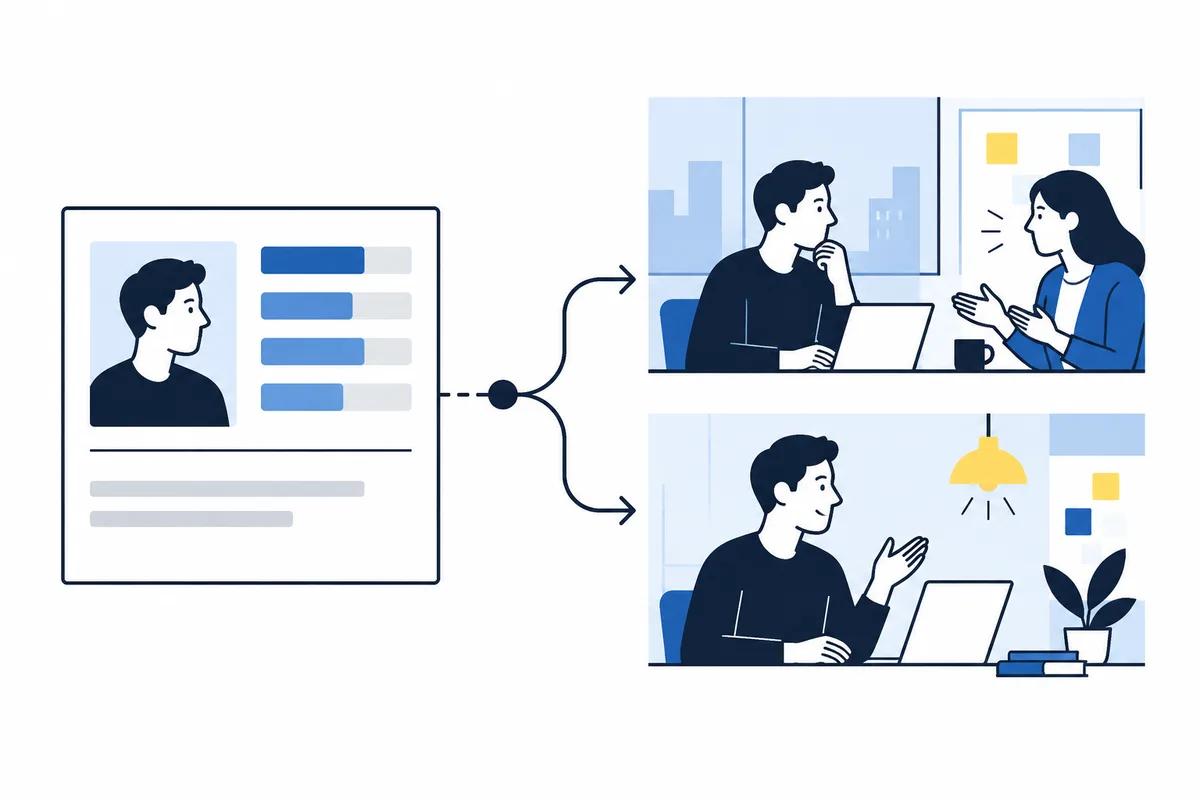
Choose one behavior that can be seen or heard, such as interrupting before a colleague finishes explaining a concern. Write down what was happening just before it, what you did, and what followed. “I am bad at regulating emotions” is a judgment; “during the project review, I interrupted twice while the deadline was being discussed, and we had to return to the unresolved point later” is an observation. Include the conditions that may matter: the task, time pressure, who was present, and whether you had room to pause or ask a question. Then record whether you repaired the exchange, for example by returning to the colleague’s concern or clarifying what you had heard. There is a reason to look beyond one event. In “Frontline managers’ task-related emotion regulation, emotional intelligence, and daily stress,” researchers followed 83 frontline managers across 10 working days. Their abstract reports both between-person and within-person differences in emotion regulation, with task-related negative emotions regulated in ways associated with stable, situational, and personal factors. The managers are a specific occupational group, so the finding does not explain an individual response; it does support checking more than one situation. Compare another instance,. Did you interrupt again when time was short, or were you able to listen when the concern came up in a calmer one-to-one? Ask a colleague who was present what they specifically observed. Keep their description separate from your interpretation: “you answered before I finished” is useful to examine; “you have no empathy” turns a moment into a global label. Research on conflict and job crafting offers a related caution about broad explanations. “Regulating emotions at work: The role of emotional intelligence in the process of conflict, job crafting and performance” analyzed cross-sectional questionnaire data from 293 South African employees and reported modeled relationships among task conflict, task crafting, emotional-intelligence measures, and in-role performance. Because the data were collected at one point in time, they cannot establish that an EQ result caused a particular behavior. Choose one small action for the next similar exchange, such as letting the other person finish and then summarizing their concern before responding. The 32-item Emotional Skills Profile is an educational reflection tool: its recent-behavior responses and authored-scenario judgments are separate, and it has no validated norms or established ability-test validity. Use it at [/assessment](/assessment) to choose a behavior for reflection, then look to repeated evidence to understand how it appears at work.
Sources: Frontline managers’ task-related emotion regulation, emotional intelligence, and daily stress; Regulating emotions at work: The role of emotional intelligence in the process of conflict, job crafting and performance
Let the next exchange refine the interpretation
The score does not have to win the argument for you to learn from it. It can point toward a question worth carrying into the next exchange: what did I notice, what did I do, and what happened afterward? Keep the question small enough to answer from something another person could also describe. “I am poor at managing emotions” is a verdict. “When the discussion moved to the missed deadline, I raised my voice and stopped asking questions” is an observation that can be checked and changed. Choose one response to try next time, such as pausing long enough to ask what concern sits behind the disagreement. Then notice whether you used it and what followed. One exchange will not settle the meaning of a score; a pattern across situations can give you a more useful basis for reflection. If the test does not explain what it measures or how it arrived at its result, give that result little weight. Your practical focus can still be the behavior you want to handle differently. The Emotional Skills Profile offers a private way to reflect on recent emotional habits and judgments about authored scenarios. It is an educational reflection tool, not a normed ability score. Explore the profile at /assessment if you want a structured prompt for choosing what to examine next.
Questions readers ask
Does a high EQ test score mean I handle emotions well at work?
Not by itself. First check whether the test measures self-perceived habits, performance on structured emotion problems, or a broader mix. A score does not record how you behaved in a particular exchange.
Should I trust my EQ score or a colleague's feedback?
They answer different questions. Check whether the feedback describes a specific action and consequence, then compare that behavior across relevant situations. Give an unclear score little weight.
What does the EQ Test Emotional Skills Profile measure?
It is a private educational reflection tool with 32 items. It keeps recent-behavior responses separate from judgments about authored scenarios. It has no validated norms and is not an ability test.
Sources
- The assessment of emotional intelligence: a comparison of performance-based and self-report methodologies
The accessible abstract reports that two named measures were not related in a community sample of 223.
- Frontline managers’ task-related emotion regulation, emotional intelligence, and daily stress
The publisher abstract describes task-related and within-person emotion-regulation variation among 83 frontline managers over 10 working days.
- Emotional Intelligence Tests — U.S. Office of Personnel Management
The guidance distinguishes self-perceived competence from ability tests scored on emotion-related problems.
- The Measurement of Emotional Intelligence: A Critical Review of the Literature and Recommendations for Researchers and Practitioners
The review discusses differing ability, self-report, and mixed approaches and the need to match measures to purpose.
- TIE: An Ability Test of Emotional Intelligence
The article describes the Test of Emotional Intelligence as an ability measure using responses to emotion-related situations.
- Regulating emotions at work: The role of emotional intelligence in the process of conflict, job crafting and performance
The cross-sectional study analyzes modeled relationships among conflict, job crafting, emotional intelligence, and performance in 293 South African employees.
- A Meta-Analysis of the Relationships Between Emotional Intelligence and Employee Outcomes
The abstract reports pooled relationships between three EI streams and several employee outcomes, not explanations of individual incidents.
Apply it to the real situation
Choose one emotional habit to examine at work
From this guide: Use the mismatch as a prompt to identify a specific behavior and compare it across work situations.
A score can raise a question about your emotional habits, while a specific workplace exchange shows one behavior under particular demands. The private 32-item Emotional Skills Profile offers recent-behavior reflections and separate judgments about authored scenarios. Use it to choose a behavior to examine, then compare that prompt with repeated, observable examples from work.