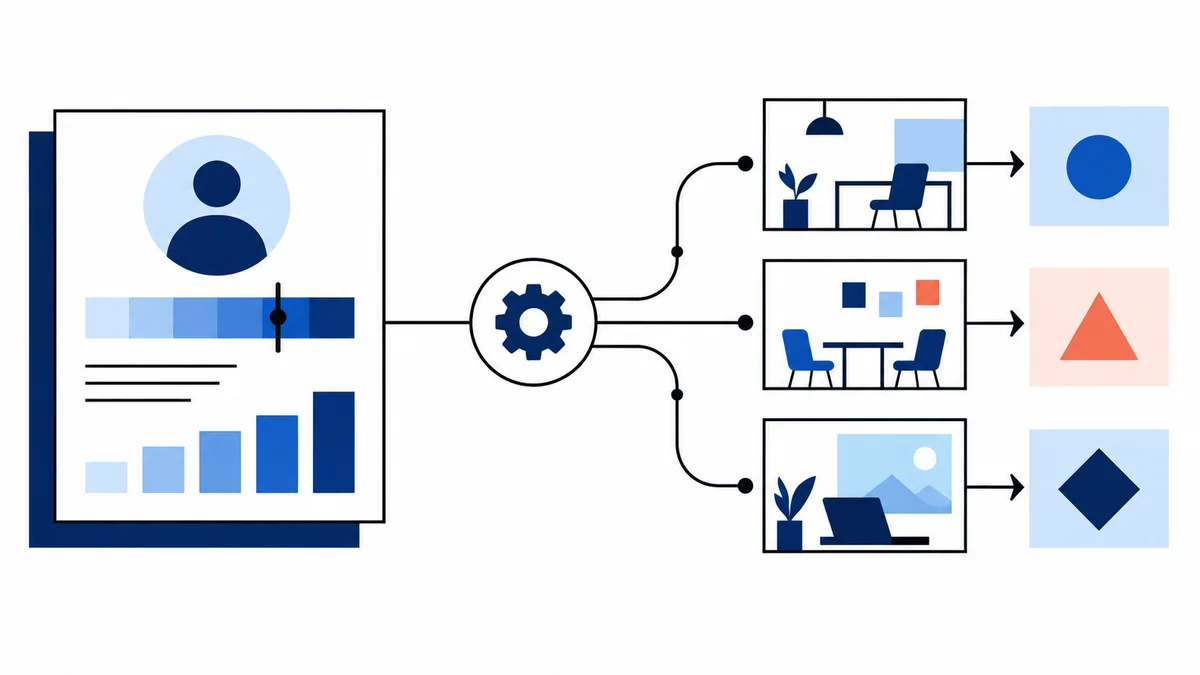
An EQ percentile shows how a particular score compares with scores in a defined group. It does not give the probability that someone will perform well at work. Workplace prediction requires evidence linking that exact measure and score interpretation to a defined job outcome in a relevant population. Research finds group-level associations between some EI measures and job performance, but those findings do not validate every report or forecast an individual result.
Why is a percentile not a workplace forecast?
An EQ percentile tells you where a particular test score sits relative to a comparison group. A workplace forecast estimates an outcome, such as how someone may perform against a defined job criterion. Those are different questions: the percentile describes relative standing on a measure; it does not state the probability that its holder will be an effective teammate, manager, or employee. The ETS Standards for Quality and Fairness defines a percentile rank as the percentage of a specified group scoring below a test score. That definition contains no workplace outcome. A score at the 84th percentile, for example, means the score is above those of 84 percent of that group; it does not mean an 84 percent chance of succeeding at work.
Connecting a score to a job outcome requires evidence for that interpretation of the exact measure, in a relevant population and for a defined outcome. The Standards for Educational and Psychological Testing says each intended score interpretation for a specified use needs appropriate supporting evidence. A general claim that emotional intelligence relates to work is not the same evidence as a forecast from one EQ report. There is a real group-level relationship to take seriously: “The relation between emotional intelligence and job performance: A meta-analysis” reports corrected correlations from .24 to .30 across three EI measurement streams. These are pooled associations across measures and studies, not individual success probabilities. The result cautions against saying EQ has no workplace relevance, while leaving open whether a specific report supports a specific prediction.
So begin with the report’s measure and comparison group, then keep the number within the meaning its evidence supports. If the result is intended for personal development, use it to choose a behavior to notice in a real work situation, such as how you respond when feedback feels uncomfortable. That gives you something concrete to reflect on without treating a relative rank as a verdict about future performance.
Sources: Standards for Quality and Fairness; Standards for Educational and Psychological Testing; The relation between emotional intelligence and job performance: A meta-analysis
What does the percentile compare you with?
A percentile answers a narrow question: where does this score sit among a particular group’s scores? It does not say how likely the person is to meet a workplace standard. ETS’s Standards for Quality and Fairness defines a norm group as test takers whose scores provide the basis for comparison. A percentile rank is the share of that group who scored below a given score. Thus, “84th percentile” means the score is above the scores of 84 percent of the group under the report’s ranking convention. It does not mean an 84 percent chance of succeeding at work. The reference group gives a score its comparative meaning. ETS illustrates this with a score of 36: by itself, the raw count says little, while “36 at the 84th percentile for a national sample of third-grade students” tells the reader how it compares with that sample. For an EQ report, ask who supplied the comparison scores. Different groups may produce different reference distributions. A percentile calculated from one group cannot quietly become a standing among all workers. The report should identify its group clearly enough for readers to judge whether it resembles the people they mean to compare themselves with. The norm group’s composition and recruitment matter. ETS’s standards call for describing how samples were drawn and noting features that could affect interpretation, such as volunteer participation or oversampling of subgroups. A report should make its population and sampling approach visible. Age, occupation, language, location, or self-selection may matter when they distinguish the norm sample from the reader’s intended comparison. These features tell the reader what the percentile represents. If no comparison group is named, the rank can imply more precision than the information supplied. A percentile rests on a score from a particular assessment and administration. ETS recommends giving users information to judge whether scores are consistent enough for their intended interpretation. Its standards describe standard errors of measurement as one way to report score consistency. Look for the assessment’s own precision information; do not invent an uncertainty band or assume every EQ report provides one. When the score is imprecise, small rank differences may be hard to interpret. Ranking against test takers differs from comparing behavior with a work criterion. Completing an agreed handoff by the stated time is an observable criterion. A percentile says how a score compares within its norm group; it does not say whether the person will meet that standard. Before interpreting the number, check the comparison group, score method, and precision information. Without them, a crisp percentile can invite more certainty than the report supports.
Sources: Standards for Quality and Fairness
What does an EQ score actually represent?
“EQ” names a family of measures, not one universal score. Before comparing a percentile with another report or with workplace outcomes, identify what the instrument asks a person to do. An ability-based measure presents emotion-related problems and scores responses as performance. A self-report asks people to describe their usual qualities or behavior; trait emotional intelligence refers to this self-perceived pattern. Mixed competency measures combine emotional and social capabilities in a broader profile. Observer ratings summarize behavior that colleagues can see. These approaches may all use emotional-intelligence language, yet their scores answer different questions. The University of Geneva’s Swiss Center for Affective Sciences outlines this distinction through ability models, self-report trait models, and 360-degree ratings. Its overview is useful for locating the approaches, not for establishing that one instrument is more accurate or better suited to work than another.
The difference is visible in a direct comparison. In “The Assessment of Emotional Intelligence: A Comparison of Performance-Based and Self-Report Methodologies,” researchers compared the Mayer-Salovey-Caruso Emotional Intelligence Test, a performance measure, with a self-report EI scale in a diverse community sample of 223 people. The two scores were not related to one another. Self-reported EI showed a consistent pattern of relationships with self-reported coping styles and depressive affect; the performance measure showed stronger relationships with age, education, and receiving psychotherapy. This single 2006 study does not settle how every instrument behaves, and its community sample was not a workplace validation study. It does show why a report’s method matters: describing how emotionally capable one feels and responding to emotion problems are not interchangeable observations.
A percentile ranks whichever score the instrument produced. If the score comes from a self-report, its percentile describes relative standing on that self-reported pattern in the specified comparison group. It does not silently become a ranking of performance on emotion problems or of visible behavior at work. The 2011 meta-analysis “The Relation Between Emotional Intelligence and Job Performance” makes the same point at the research level by separating ability-based objective items, self-report or peer-report measures, and mixed competency models. Across those streams, the authors reported corrected correlations with job performance ranging from 0.24 to 0.30. Those pooled associations concern varied measures and study outcomes; they do not transfer validation from one stream to every report bearing an EQ label. Two reports can both show a percentile and still rank different things. For a workplace claim, the relevant evidence must match the particular score and intended outcome. Without that match, a percentile remains a comparison on a measure, not evidence that its holder will handle feedback, disagreement, or another defined job demand in a particular way. A test label cannot supply that missing bridge; the score’s interpretation must come from evidence about the same method, population, and criterion.
Sources: The Assessment of Emotional Intelligence: A Comparison of Performance-Based and Self-Report Methodologies; Current Models of Emotional Competence; The relation between emotional intelligence and job performance: A meta-analysis

What does workplace research show—and what does it leave open?
The evidence does not support the blunt claim that emotional intelligence has no connection with work. It supports a narrower point: across studies, several kinds of EI measures tend to be associated with job-performance measures. That finding makes workplace relevance plausible. It does not tell a reader what any single percentile means for their own future performance. In “The relation between emotional intelligence and job performance: A meta-analysis,” the researchers grouped studies into three streams: ability-based tests using objective items, self-report or peer-report measures based on a four-branch model, and mixed models of emotional competencies. Across those streams, the corrected correlations with job performance ranged from .24 to .30. These are pooled relationships across the studies included in the analysis, not probabilities that a person with a given score will succeed. The result also matters because the streams were not identical: the paper reports that they differed in their relationships with cognitive ability and personality measures. The category “EI score” therefore does not point to one uniform measure or one uniform workplace signal. A later synthesis, “A Meta-Analysis of the Relationships Between Emotional Intelligence and Employee Outcomes,” included 253 effect sizes from 78,159 participants. For job performance, its corrected correlations were .28 for ability EI, .33 for self-report EI, and .31 for mixed EI; the authors reported a positive overall relationship. This broader evidence makes it harder to dismiss all EI measures as unrelated to work. It still summarizes average relationships across many samples and measures. It cannot establish that a particular report, with its particular questions and scoring, forecasts a defined outcome for a particular employee. The later paper also names limits that affect how confidently its pooled result can travel. Some included studies used self-reports for job performance or organizational citizenship behavior, which the authors say may reduce accuracy. Only English-language sources were included, and the analysis did not include contextual moderators. Those omissions matter because “job performance” can refer to different criteria, and work settings can differ in what they ask people to do. The authors themselves call for future research to include more moderators and contextual factors. So the positive average should be read as evidence of a recurring relationship in the literature, with the size and meaning of that relationship still dependent on what was measured and where. Nor does a group average specify how accurately scores distinguish individuals within that group. To make a forecast, the relevant question is not just whether EI and work performance move together in published studies. It is whether the exact test score has been linked to an explicit work outcome in a relevant population, with enough evidence to interpret the prediction. The fair conclusion is therefore neither “EQ predicts workplace success” nor “EQ has nothing to do with work.” The meta-analyses support an association between several EI measure families and job-performance criteria in their included research. They do not turn a percentile into a personal success probability. That claim requires evidence about the specific measure and the outcome it is being used to predict.
Sources: The relation between emotional intelligence and job performance: A meta-analysis; A Meta-Analysis of the Relationships Between Emotional Intelligence and Employee Outcomes
Why doesn’t a group association forecast one person?
A group association describes how scores and outcomes vary together across a study sample. It does not tell us the probability that one person will meet a workplace standard. A correlation summarizes a pattern across people; an individual forecast needs a dependable link between the exact score and a defined outcome, in relevant conditions. The measure must distinguish that outcome usefully, and its estimate must be calibrated well enough to say what a given score implies. An EQ label or percentile supplies no such probability.
The positive findings deserve a fair hearing. In “The relation between emotional intelligence and job performance: A meta-analysis,” O’Boyle and colleagues grouped studies into ability-based, self/peer-report, and mixed EI streams. They reported corrected correlations from .24 to .30 with job performance across those streams. That is evidence of average relationships in the included research, not an individual success rate. The 2022 “A Meta-Analysis of the Relationships Between Emotional Intelligence and Employee Outcomes” combined 253 effect sizes from 78,159 participants and also reported positive links. Its authors note that some studies used self-reports for job performance or citizenship behavior and omitted contextual moderators. These reviews make a blanket claim that EI has no workplace relevance untenable; they cannot validate every score or job.
A second issue is what a broad self-report score contains. The 2015 meta-analysis “Why does self-reported emotional intelligence predict job performance? A meta-analytic investigation of mixed EI” found substantial overlap between mixed-EI measures and ability EI, self-efficacy, self-rated performance, personality traits, and general mental ability. The authors estimated the association with supervisor-rated job performance at ρ̂ = .29; after their listed covariates, it became β = −.02. This challenges treating that association as a distinct contribution. The finding concerns the measure family, criterion, and controls in that analysis. Beside the positive reviews, it shows why a pooled relationship cannot be carried unchanged to an unfamiliar report.
Consider a disagreement followed by an attempted repair. One colleague returns to clarify a sharp comment, acknowledges its effect, and agrees on a next step. A supervisor’s rating might register that behavior, but depends on whether the supervisor saw the exchange, what the role permitted, and whether the repair addressed the problem. If the colleague had no authority to change the deadline that caused the conflict, the interpersonal response could coexist with an unresolved project outcome. This illustration shows how a rating combines behavior with opportunity and the criterion being judged.
Work outcomes also reflect job demands, workload, authority, team norms, and support. These conditions can shape whether behavior translates into a result; the 2022 review identifies omitted contextual factors as a limitation, rather than estimating each factor’s effect. A supervisor rating is evidence about a defined observation and judgment, not every interaction or a pure measure of personal capacity. Group-level EI associations support studying relevant skills at work, but a correlation cannot become one person’s probability of success or a causal claim about an outcome.
Sources: Why does self-reported emotional intelligence predict job performance? A meta-analytic investigation of mixed EI; The relation between emotional intelligence and job performance: A meta-analysis; A Meta-Analysis of the Relationships Between Emotional Intelligence and Employee Outcomes

What would make a workplace prediction defensible?
A workplace prediction is defensible only when the evidence supports the exact claim being made: that a particular score, interpreted in a stated way, helps estimate a defined work outcome for a relevant population and intended use. The Standards for Educational and Psychological Testing makes this link explicit. A test does not have one all-purpose stamp of validity; its score interpretation must be supported for the proposed use. A percentile beside an EQ result cannot carry a job forecast by itself. Start by naming the outcome. “Good at work” is too broad to test. A team might instead ask whether a person reliably closes agreed handoffs, or whether they repair a disagreement in a way that lets a project continue. These are different criteria, and a result tied to one should not quietly be treated as evidence for the other. The Standards notes that test users determine which criteria matter, while the choice of criterion and how it is measured are central to a test-criterion study. Next, ask whether the evidence connects this exact assessment and score interpretation to that criterion. The Standards says that a relationship between test scores and an employment outcome is ordinarily insufficient on its own. The criterion must be meaningful for the work; the assessment materials and procedures must suit the people taking it; and evidence should support the interpretation across relevant groups. A finding for a different EQ instrument, job, or scoring method does not automatically transfer. The score also needs enough precision for the claim. If small differences in responses can move a person’s result, a report should not present a narrow rank as though it were exact. The Standards discusses score precision and measurement error as part of the evidence users need to interpret results. Users should be able to learn how consistently a score is measured before relying on fine distinctions. The stakes matter, too. A private development conversation can use a result as one prompt for reflection, with the person checking it against observable behavior and context. A consequential decision about hiring, promotion, or performance scoring asks more of the evidence because the score can affect someone’s opportunities. The Standards notes that higher-stakes interpretations may require stronger evidence. A practical test for any forecast claim is therefore simple: Can its proponent name the job outcome, show how that outcome was measured, and point to evidence linking this particular score interpretation to that outcome in a relevant population? Can they explain the score’s precision and the limits on transferring the finding to other jobs or groups? If those steps are missing, the percentile remains a relative score description. The forecast has not been established.
Sources: Standards for Educational and Psychological Testing
What else can shape the behavior a team sees?
Observed work behavior reflects both a person’s tendencies and the conditions in which they can act. A percentile records a position on a score scale; it does not show whether the person had the authority, time, information, or opportunity to demonstrate a behavior. When a team treats a score as a forecast, it can mistake what was possible in one setting for what someone is generally capable of doing. Consider a project handoff. A colleague notices tension rising and wants to clarify a missed dependency. If the deadline has moved forward without their input, they may have little power to reset the plan. If responsibilities are unclear, no one may know who should contact the other team. A delayed response could reflect a missing route for action as much as difficulty regulating emotion. The observation still matters; its meaning depends on the conditions around it. The same caution applies to ratings. A manager who sees a person only in brief status meetings has fewer chances to observe how they handle disagreement than a colleague who works with them through a full project. Someone may repair a sharp exchange privately, outside the manager’s view. A rating can mix the behavior being judged with the observer’s access to it. This is an interpretive point about how workplace observations are gathered, not a finding that ratings are useless. The 2022 meta-analysis, “A Meta-Analysis of the Relationships Between Emotional Intelligence and Employee Outcomes,” pooled studies of different EI approaches and employee outcomes. Its authors report positive relationships with job performance, while also noting limits in the evidence, including some self-reported performance or citizenship outcomes and the absence of contextual moderators. A moderator is a condition that can change how strongly two things are related. The review’s limitation does not prove that workload, role clarity, or a manager’s conduct explains a particular result. It does mean the pooled association cannot tell a reader how a specific workplace condition shaped one observed exchange. The Standards for Educational and Psychological Testing set a practical boundary: evidence for a score interpretation must fit its intended use, and workplace relationships alone do not settle every proposed use. A percentile cannot account for conditions that were never measured. When a behavior is absent, describe the situation first: what was expected, what authority and time were available, who could observe the response, and whether the person had a workable chance to act. Then consider the behavior alongside those facts. This keeps the score from carrying more meaning than the evidence supports while leaving room to examine a pattern across situations.
Sources: A Meta-Analysis of the Relationships Between Emotional Intelligence and Employee Outcomes; Standards for Educational and Psychological Testing
How can a development profile help without pretending to forecast?
Use a development result to choose one behavior to notice or practise, not to rank likely workplace success. A profile can help put a broad intention such as “handle feedback better” into a question that can be observed: what do I do when a colleague points out a problem, and what might I try next time? That is a modest but useful job for self-reflection. It does not require the score to predict what a manager, colleague, or team will do in response.
Consider an illustrative case: after a tense project handoff, a person uses a private reflection profile and decides to pay attention to how they respond when a colleague flags a missed detail. They might pause before replying, ask what consequence the colleague is concerned about, and then agree on who will update the handoff. The observation plan is specific: in the next similar exchange, notice whether they asked a clarifying question before defending the original decision, and whether the conversation ended with a clear next step. This is not a test of whether the profile “called” the person correctly. It is a way to examine an action they can choose and the result of that action in a real setting.
The conditions matter. If the colleague raises the issue in front of a group, the person may respond differently than in private. A tight deadline can leave little room to explore the concern. Recording what happened alongside what the person tried keeps the observation grounded: Was there time to listen? Was responsibility clear? Did the other person explain the impact? These notes describe one episode, not a general ability or a prediction of future job performance.
The Emotional Skills Profile is a private, 32-item educational reflection tool. Its recent-behavior questions and authored scenario judgments are kept as separate parts of the report. The assignment describes it as having no validated population norms and no established ability-test validity; it therefore offers neither a norm-based percentile nor a workplace forecast. Those boundaries still leave room for its intended use: examine emotional habits and scenario judgments, then decide which behavior to observe or practise. A profile result should not be recast as a hiring score, ranking, or measure of who will succeed at work.
For a structured starting point, you can explore the Emotional Skills Profile. Bring one recent moment involving feedback, disagreement, a boundary, or repair to mind, and choose one action to notice next time. Review what happened under those conditions. Whether the behavior generalizes or predicts an outcome at work remains a separate question requiring separate evidence.
Sources: Emotional Skills Profile
What should you do with the percentile now?
A percentile can prompt a useful question about your habits, provided you keep it tied to its measure and comparison group. Look for the assessment name, the skill summarized, and who was included in its reference group. The ETS Standards for Quality and Fairness define percentile rank by comparing a test score with scores in a defined group; they call for information about score precision and the norming sample’s relevance. If the report leaves those details unclear, ask its provider what the number compares and how much confidence it supports. That may clarify the report’s meaning. It will not turn a rank into a forecast of workplace performance. For development, choose one upcoming moment: receiving feedback, disagreeing about a handoff, setting a boundary, or repairing a tense exchange. Pick one observable action, such as checking what you heard before responding. Afterward, note what you did and what the situation allowed. Treat that observation as information for another attempt, not proof of a fixed trait. The private 32-item Emotional Skills Profile offers recent-behavior reflection and authored scenario judgments as separate parts of an educational tool. It has no validated population norms or workplace forecast. If that reflection would help, explore the Emotional Skills Profile at /assessment. Let the percentile begin a question about practice; prediction requires evidence for a specific outcome.
Sources: Standards for Quality and Fairness; Emotional Skills Profile
Questions readers ask
Does an 84th-percentile EQ score mean an 84% chance of succeeding at work?
No. It means the score is above the scores of 84 percent of the report’s comparison group, under its ranking convention. It is not a probability of workplace success.
Can emotional intelligence relate to job performance?
Meta-analyses report positive average associations between several EI measure families and job-performance measures. Those group-level findings do not show that a particular report predicts an individual’s outcome.
What should I check before interpreting an EQ percentile?
Identify the assessment and what its score represents, the group used for comparison, and any information about score precision. Then check whether evidence supports the interpretation you are considering.
Does the Emotional Skills Profile give a workplace prediction?
No. It is a private 32-item educational reflection tool. Its recent-behavior questions and authored scenario judgments are kept separate, and it has no validated population norms or workplace forecast.
Sources
- Standards for Quality and Fairness
Defines norm groups and percentile ranks, and discusses score precision and norm-sample relevance.
- Standards for Educational and Psychological Testing
Sets standards for supporting score interpretations and proposed uses with relevant evidence.
- The relation between emotional intelligence and job performance: A meta-analysis
Reports corrected group-level correlations between three EI measurement streams and job performance.
- The Assessment of Emotional Intelligence: A Comparison of Performance-Based and Self-Report Methodologies
Reports a comparison of performance-based and self-report EI measures in a community sample of 223.
- Current Models of Emotional Competence
Provides an overview distinguishing ability, self-report, trait, and observer-rating approaches.
- A Meta-Analysis of the Relationships Between Emotional Intelligence and Employee Outcomes
Reports positive EI and employee-outcome associations and identifies limitations in outcomes and contextual moderators.
- Why does self-reported emotional intelligence predict job performance? A meta-analytic investigation of mixed EI
Reports construct overlap for mixed EI and a supervisor-rated performance association that changes after listed covariates.
- Emotional Skills Profile
Destination for the individual reflection profile; its product details are supplied by the saved assignment, not independently verified from the page.
Apply it to the real situation
Turn an EQ result into one behavior to notice
From this guide: Choose a specific moment involving feedback, disagreement, a boundary, or repair, and decide what behavior you want to observe.
A percentile cannot tell you how a particular conversation will go. The private Emotional Skills Profile offers recent-behavior reflection and authored scenario judgments as separate parts of an educational tool. Use it to explore a behavior you may want to notice or practise, then compare that reflection with a real work moment. It does not provide population norms or forecast workplace performance.