
An EQ test should not decide who belongs on a team because evidence about a particular measure or team-level pattern does not establish whether one person should be included. For work decisions, define the responsibility and assess relevant behavior under comparable conditions. Keep the Emotional Skills Profile for private reflection and choosing a behavior to practice.
Why a team decision asks more than an EQ score
An EQ test should not decide who belongs on a team because a score and a membership decision answer different questions. A result may help someone notice a pattern in how they handle emotion or respond to others. By itself, it does not establish how that person will perform a particular role, or whether the team should include them.
That distinction matters when a score is used to allocate a real opportunity: a project, a place in a working group, or access to consequential work. Emotional behaviors can matter to collaboration; listening to feedback, for example, may affect an exchange. But naming a relevant behavior is not the same as showing that a test score accurately represents it or supplies a sound rule for excluding someone. First ask what the test actually records. Then ask what evidence would justify the decision attached to it. A membership rule makes a further claim: that using this result to allocate access is appropriate for the work and the people affected. The number alone cannot bridge that gap. Without that distinction, a development prompt can quietly become a verdict about opportunity.
What can the label EQ tell you about a score?
“EQ score” can sound like one measurement with a familiar scale. The label alone does not tell you what a respondent did to produce it. The 2019 review *The Measurement of Emotional Intelligence: A Critical Review of the Literature and Recommendations for Researchers and Practitioners* distinguishes ability, trait, and mixed models, and describes more than 30 measures. Their scores cannot be treated as interchangeable readings of one settled quantity.
An ability measure asks someone to work through emotion problems. The result concerns performance on those tasks under the test’s scoring rules. A trait or self-report measure asks respondents to describe their usual emotional tendencies or perceived behavior. Its result tells you how they see themselves answering those prompts; it is not a direct demonstration of their maximum ability in a task. In a private reflection setting, that account can still be useful: it gives the person a starting point for noticing habits and choosing what to examine in daily interactions.
A mixed model brings emotional skills together with a broader set of competencies. It may describe a wide profile rather than performance on a single kind of emotion problem. That breadth can be useful for development, but the reader needs to know what the profile includes before interpreting a total or subscale. Two tests can use EQ language while asking different questions, so a low result on one cannot automatically be read as a weakness on another. The label “mixed” therefore describes a measurement approach, not a guarantee that every included competency has the same basis or meaning. A reader should look at what the instrument asks and how it combines responses before treating its overall result as a single emotional capacity.
The 32-item Emotional Skills Profile discussed here is an educational reflection profile, not an ability test. It summarizes recent-behavior responses separately from judgments on authored scenarios. Those outputs can prompt a closer look at a habit or a situation; they do not turn the profile into a standardized ability score or a measure of who should join a team. The method is the first piece of interpretation: before asking what a result implies, identify whether the person described typical behavior, completed emotion tasks, or received a broader competency profile.
These differences change what a score can support. A self-report can open a conversation about perceived habits; a task result can describe performance on the emotional problems the task presents; a mixed profile can organize several kinds of behavior or competency. None of those descriptions automatically supplies evidence about every unmeasured situation. If a team decision concerns how someone handles disagreement in a particular role, an EQ label cannot substitute for identifying what the test measured and whether that output speaks to that role. The useful first comparison is therefore not whose number is higher, but what kind of response produced each number and what question that response can answer.
What evidence would make a consequential use defensible?
A score’s meaning and a decision made with it require related but distinct evidence. The American Psychological Association’s *Guidelines for Psychological Assessment and Evaluation* says assessment tools should be appropriate for their intended use and supported by evidence suited to the purpose, population, setting, and context. In plain terms, evidence that a questionnaire consistently describes something does not by itself show that the description is accurate enough for every decision. A measure can support one interpretation while leaving another untested. The question is not simply whether a test has research behind it; it is what that research lets a person conclude in the situation at hand.
Suppose a study finds that an emotional-intelligence score is associated with some work outcome. That relationship may support investigating the score as one source of information. It does not automatically validate a threshold for deciding who gets access to a team or project. A cutoff makes a further claim: people on one side should receive an opportunity and people on the other should not. Evidence for that consequence would need to address the proposed interpretation and use, including the relevant people, work setting, and conditions. The APA guidance also treats test performance as one information source in an assessment, which matters when a single number is being asked to settle a consequential question.
This distinction leaves room for useful measures. Evidence may support using a score to prompt reflection or to inform a broader assessment, while remaining insufficient for a membership rule. For a decision maker, the practical check is to state the inference plainly: what does this result say about this person, and why should it change this particular opportunity? Then look for evidence that directly supports that inference and consequence. The closer the evidence is to the actual proposed decision, the less the decision depends on an untested leap. A general link between emotional skills and collaboration cannot answer whether a specific test separates suitable from unsuitable teammates, or whether its cutoff allocates access appropriately. A relationship across a group also does not tell a decision maker where a defensible boundary lies for an individual, how many people would be wrongly screened out, or whether another source of information would change the judgment. Those are questions about the proposed rule and its consequences, not simply the score’s relationship with a work outcome. If the evidence stops at association or description, the decision should not claim more than that evidence establishes.
Sources: Guidelines for Psychological Assessment and Evaluation

What does a workplace ability test actually establish?
The Geneva Emotional Competence Test (GECo) is a useful counterexample to the idea that emotional ability cannot be measured. Its published abstract describes a performance-based workplace measure, with video-based emotion-recognition tasks and work-scenario judgment items. Rather than asking only how respondents describe their usual behavior, GECo asks them to interpret emotional information and judge responses in situations framed around work. The measure therefore targets performance on specified tasks. That is a meaningful advance over treating every instrument called an EQ test as if it recorded the same thing, and it makes the evidence relevant to workplace emotional ability.
The PubMed abstract for *The Geneva Emotional Competence Test (GECo): An ability measure of workplace emotional intelligence* reports five studies involving 888 participants. It says the subtests showed high measurement precision using item response theory and correlations in expected directions with related variables. For professionals, GECo scores predicted performance on computerized assessment-center tasks. Among students, the test explained academic performance beyond another ability-based EI test. The precision finding concerns how well the subtests measured across their item scales; it is not a team-membership result. Prediction of assessment-center tasks adds a work-related criterion, while the student result adds a separate academic criterion. The criteria are distinct and should be read as separate pieces of evidence. These findings show that a purpose-built measure can produce informative scores and relate to named performance criteria. They are evidence about GECo and those tasks, participants, and academic outcomes; they should not be recast as evidence about any EQ questionnaire or a universal workplace score.
The distinction matters because the membership question asks for something further. The abstract reports no study of whether a GECo cutoff identifies who should join or leave a team, whether excluding people by score improves team results, or how such a rule would work across different teams. Task performance and academic performance are not the same outcome as belonging, contribution across a particular team, or the effect of changing its membership. Even a measure with promising evidence for specified criteria would need evidence suited to the proposed use before its scores could justify allocating access. GECo therefore defeats categorical skepticism about measurement while leaving the generic team cutoff unsupported.
These details come from the PubMed record and abstract; the full article’s methods and results were not available in the reviewed source record. That limits how finely this account can describe the studies, but the abstract is clear enough to credit its reported findings without extending them. The defensible conclusion is specific: workplace emotional ability can be measured through structured tasks, and GECo’s reported results connect its scores to particular assessment-center and academic criteria. That is a real measurement result. It does not answer the separate decision about team membership, because the published criteria named here do not test that consequence.
Sources: The Geneva Emotional Competence Test (GECo): An ability measure of workplace emotional intelligence
Can team-level findings identify who belongs?
The study [The effect of team emotional intelligence on team process and effectiveness](https://doi.org/10.1017/jmo.2017.43) examined 79 teams in South Korean companies. Its abstract reports that team emotional intelligence was associated with lower task and relationship conflict and with higher performance, innovation, and cohesion; it also reports that team EI changed the relationship between conflict and team outcomes. This is relevant evidence that emotional processes at the group level can accompany how a team functions. It gives an individual decision maker a reason to take those processes seriously, especially when considering how a group handles disagreement and coordinates work.
The result describes differences among teams. It does not tell a manager what would happen if one particular member were removed, or whether excluding someone with a lower individual score would improve the group. The unit being compared matters: a team-level score combines people and the conditions in which they work, while a membership decision targets one person. A team may have strong emotional processes because its members share routines, have clear roles, or can repair conflict; the study does not isolate one person as the cause of its outcomes. Nor does a team association establish that the same pattern holds across other organizations, tasks, or measures. Even if a manager knows that several team-level measures move together, that pattern leaves open whether a particular member’s behavior helped, hindered, or made little difference to the result. Removing a person also changes the group being measured, so it is not a simple reversal of the observed association.
To move from this finding to an exclusion rule, evidence would need to connect an individual’s result to that person’s contribution in the relevant role, then show what changes when that person is included or excluded under comparable conditions. The team study does not make that individual-level comparison or test that intervention. An association between team EI and team outcomes can inform questions about group processes; it cannot identify who belongs. A manager can use it to ask how the team handles conflict and coordination, but should not convert its group-level pattern into a cutoff for an individual. That gap is practical, not merely statistical. A membership choice would need evidence about the actual work and the likely consequences of the change: what the person contributes, what the team would lose or gain, and whether the supposed emotional skill is relevant to that task. The cited study offers no comparison of those alternatives. Its findings can support attention to team processes as a subject for discussion or development, while leaving the individual inclusion decision unanswered.
Sources: The effect of team emotional intelligence on team process and effectiveness
What changes when answers affect access to work?
A self-report about emotional habits is given under different conditions when it is tied to access to a job or opportunity. A study titled [Applicant versus employee scores on self-report emotional intelligence measures](https://jlupub.ub.uni-giessen.de/items/b1cd0227-3e72-4d4e-804f-916a78d2c927) compared 109 applicants with 239 incumbent employees at one large ICT organization. On one self-report emotional-intelligence measure, applicants scored higher than incumbents, with a reported standardized difference of d = 1.12, and their scores showed lower variability. The abstract also reports that combining this comparison with earlier research suggested an applicant-condition increase of about one standard deviation.
The pattern matters because a questionnaire response can reflect both a person’s typical self-view and the situation in which the person is answering. When an answer may influence whether someone receives work, an applicant has a different stake in the result than an employee completing a private reflection. The comparison is consistent with response context affecting group scores, but it does not identify why the groups differed. Applicants and incumbents may differ in other ways, and the study’s direct comparison used one measure in one organization. The combined estimate draws on earlier studies as well as that comparison; it should not be mistaken for a measured effect on every instrument or workplace. The lower spread among applicants is also a group-level feature: answers were more clustered in that applicant sample. It does not reveal whether any particular respondent changed an answer, which items mattered, or whether the difference came from impression management, group composition, or another feature of the comparison. Keeping those possibilities open prevents a descriptive contrast from becoming an accusation.
Nothing in the reported group difference establishes that each applicant exaggerated, or allows a reader to infer that a particular person’s answers were insincere. The practical implication is narrower: when a self-description is used to distribute an opportunity, its meaning should be considered in light of that incentive and the decision’s consequences. A private developmental reflection has a different purpose and response context. The finding therefore cannot be carried over as an estimate of bias in the current Emotional Skills Profile, which is offered for individual reflection. It also cannot turn a profile result into evidence for admitting or excluding an individual. In an employment decision, the person interpreting the result should therefore avoid treating a polished self-description as a direct observation of behavior. That does not make self-report useless for its intended reflective purpose: describing one’s own recent habits can help someone notice a pattern and choose what to practice. The boundary is the inference. A result collected for self-understanding cannot inherit a selection interpretation simply because it concerns skills that may matter at work.
Sources: Applicant versus employee scores on self-report emotional intelligence measures
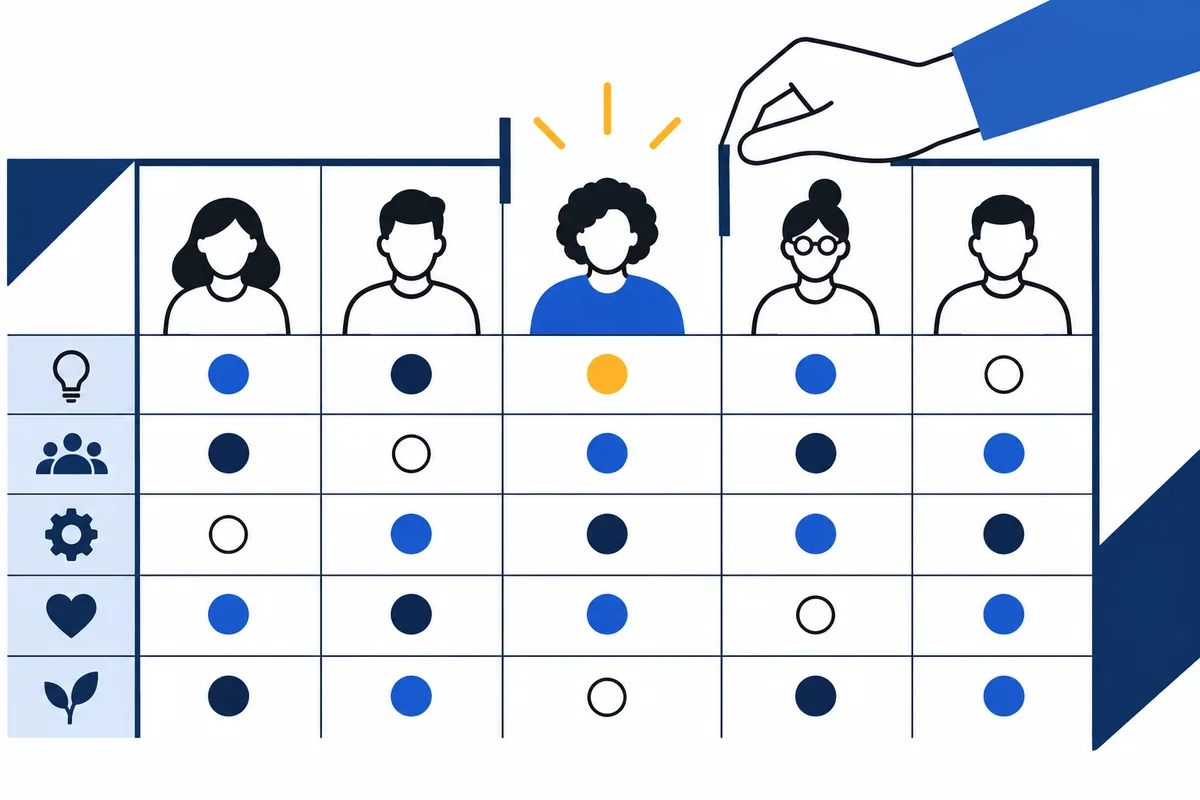
When does team placement become an employment decision?
The word team does not tell you whether a decision is consequential. Ask what changes for the person if the EQ result is used. If the choice determines who may join an optional lunch discussion, it may be a low-stakes collaboration preference. If the same label decides who receives a client assignment, a stretch project, training, visibility with senior leaders, or continued access to a role, it distributes work opportunity. A decision can affect someone’s employment prospects even when no one calls it hiring or a formal selection process.
That distinction matters in the United States because the Equal Employment Opportunity Commission’s *Employment Tests and Selection Procedures* guidance addresses tests and other procedures used to make employment decisions. It explains that a procedure producing disproportionate exclusion of a protected group may raise federal discrimination concerns if the employer cannot provide the justification required under the applicable framework. The relevance is the decision’s function and effect: using a score to gate access to work can make it part of an employment process. The guidance does not establish that every team conversation or assignment is legally a selection procedure, and this article cannot determine how a particular workplace decision would be treated. Material consequences and the governing context matter.
A manager considering an EQ result should therefore name the opportunity at stake before discussing what the score means. Would this person lose a route to demonstrate their work, gain experience, or be considered for later responsibility? If so, calling the decision ‘team fit’ does not make its consequences disappear. It is especially difficult to justify a broad emotional-skills label when the immediate choice distributes access but the score has not been shown to answer that work-specific question. An informal process may still shape who gets noticed and entrusted with important tasks; an official process may have additional requirements. The practical question remains concrete: what opportunity changes if this score is used? If the answer is a meaningful work opportunity, pause the score-based gate and examine the decision as an employment consequence, with advice appropriate to the jurisdiction and circumstances. A group’s preference for familiar communication styles is not itself evidence that another person cannot contribute. Conversely, not every difference in who joins a conversation carries the same employment consequence. The access being distributed is what makes the distinction visible; the label attached to the meeting does not settle it. Consider whether the person can still take part in the work informally while the concern is addressed; a restriction can itself prevent the experience later used to judge readiness. That possibility is another reason to identify the actual access change before treating a score as a neutral sorting aid.
What evidence should replace a broad EQ label?
When a manager is concerned about a work behavior, begin with the work itself rather than a broad EQ label. The U.S. Office of Personnel Management’s *How can I minimize response inflation when using self-report occupational questionnaires?* recommends observable, verifiable wording and follow-up sources such as work samples or structured interviews. The EEOC’s *Questions and Answers to Clarify and Provide a Common Interpretation of the Uniform Guidelines on Employee Selection Procedures* explains why evidence for a selection decision should connect to the actual job: a trait name does not become an observable job requirement just because it sounds relevant. Together, these sources point toward a narrower inquiry: identify the task, then examine behavior that can be seen in that task.
Consider a technical disagreement during a project handoff. This is an illustration, not a reported study. Instead of asking whether someone has ‘low EQ,’ specify the handoff requirement: critical information must reach the next person, uncertainties must be made clear, and unresolved risks must have an owner. Then name observable behavior relevant to that requirement, such as whether the person states the unresolved issue, checks the recipient’s understanding, and records who will follow up. Those actions make the concern discussable. A label about empathy or emotional regulation leaves the manager guessing which moment mattered and what successful performance would have looked like.
Next, choose evidence that gives the person a comparable chance to show the work. A manager might review handoff records from similar projects, or use a work sample that presents the same kind of information and time constraints to each participant. Set the criteria before reviewing responses: which required details must be conveyed, how risks should be raised, and what counts as a complete transfer. Apply those criteria consistently and document the specific evidence, including relevant conditions such as missing information or an unclear owner. OPM’s examples support using verification and confirmatory methods; they do not certify that any particular exercise or record review is valid for every role.
The EEOC guidance also puts a limit on what this method can establish. A work sample is most interpretable when it closely represents important work behaviors identified for the job. A hastily designed exercise may reward familiarity with a particular format, accent, or communication style instead of the task requirement. A documented observation is more concrete than an EQ label, but concreteness alone does not show that the criterion matters to the job or that conditions were comparable. The manager should be able to explain why the behavior belongs in the work requirement and how the same standard was applied. This process narrows the question to evidence that can be inspected and discussed; it does not promise automatic validity or fairness.
Sources: How can I minimize response inflation when using self-report occupational questionnaires?; Questions and Answers to Clarify and Provide a Common Interpretation of the Uniform Guidelines on Employee Selection Procedures
What should a person know before sharing an assessment?
Before sharing an EQ result at work, find out who will receive it, why they want it, and what they plan to do with it. A result completed for private reflection changes meaning once a manager, assessor, or other decision maker can use it. The questions are practical: Will the recipient see the whole report or only a summary? Is sharing optional? Could the information affect an assignment, evaluation, or future opportunity? How long will it be kept, and who else could see it? If those answers are unclear, pause before sending the result and ask for the intended use in plain language.
The American Psychological Association’s *Professional practice guidelines for occupationally mandated psychological evaluations* calls for explaining the scope of an evaluation, confidentiality limits, recipients, and probable uses and outcomes. That guidance concerns clinical and other medical occupational evaluations. An ordinary EQ reflection profile is not automatically such an evaluation, so the guideline does not govern every workplace conversation or establish rules for this product. Its transparency principle still offers a sensible question for a person deciding whether to disclose: can I understand who will see this information and what decisions it may inform before I agree to share it? A request framed as casual curiosity deserves clarification if the result may travel further or affect access to work.
Disclosure also affects how a result should be read. A self-report describes answers given in a particular setting; it does not independently establish why a difficult interaction occurred. If a colleague says a conversation felt dismissive, the report cannot settle whether the cause was emotional awareness, unclear expectations, a rushed handoff, or something else. Keep the observed event and the explanation separate: what was said or done, what effect followed, and what remains an inference? That distinction can support a focused conversation without turning a private profile into proof about another person or a verdict about the relationship. Before sharing, agree on the question the result is meant to help explore and what it cannot answer. A person should be able to decline a broader use than the one originally described; a reflection tool is useful only when its audience and purpose remain understandable to the person completing it. Ask whether a recipient will interpret the answers as self-description, as discussion material, or as evidence for a consequential choice. Those are different uses, and the same page of results cannot silently acquire a new meaning just because someone else now holds it. Knowing the intended audience also helps the person decide which context to share alongside the result and which private details to keep private.
Sources: Professional practice guidelines for occupationally mandated psychological evaluations
What can an individual profile responsibly help you practice?
An individual profile can help turn a general intention—such as handling disagreement more steadily—into one behavior to notice and practice. The Emotional Skills Profile is a private, educational 32-item reflection assessment. Its recent-behavior summaries remain separate from judgments on authored scenarios, and it has no validated norms. Use the result as a prompt to examine your own habits, not as a ranking or a prediction of how you will perform in every situation.
A practical next step is to choose one upcoming conversation and write down the response you want to try: for example, pause before replying to criticism and ask one question to clarify the concern. Afterward, note what you did and what happened; the point is to make your next reflection more specific, not to guarantee improvement from a single exercise. Explore the Emotional Skills Profile at [/assessment](https://eqtest.org/assessment) if you want a structured starting point for that individual reflection. Keep the practice small enough to observe: identify the moment, the response you chose, and one alternative you might test next time. A written note can help you compare intention with behavior over several ordinary interactions without asking anyone else to score you.
Sources: Emotional Skills Profile
Sources
- The Measurement of Emotional Intelligence: A Critical Review of the Literature and Recommendations for Researchers and Practitioners
The review distinguishes ability EI, trait EI, and mixed-model EI, notes more than 30 widely used measures, and discusses different purposes, methods, strengths, and limitations; it does not make all EQ scores interchangeable.
- Guidelines for Psychological Assessment and Evaluation
APA guidance says tools should have evidence suited to their use and be fair and appropriate for the purpose, population, setting, and context; it also treats test performance as one information source in assessment.
- The Geneva Emotional Competence Test (GECo): An ability measure of workplace emotional intelligence
The abstract reports five studies (N=888) of a performance-based workplace EI measure using video emotion recognition and work-scenario judgment items; subtests showed high IRT measurement precision, expected correlations, prediction of computerized assessment-center task performance in professionals, and incremental explanation of student academic performance over another ability EI test.
- The effect of team emotional intelligence on team process and effectiveness
A study of 79 teams in South Korean companies reports team EI associated with lower task and relationship conflict and higher performance, innovation, and cohesion, with moderation effects; it concerns team-level relationships, not an individual exclusion rule.
- Applicant versus employee scores on self-report emotional intelligence measures
The repository abstract reports 109 applicants and 239 incumbents at one large ICT organization; applicants scored higher (d=1.12) with lower variance on one self-report EI measure, and a meta-analytic combination with prior research suggested about a one-SD applicant-condition increase.
- How can I minimize response inflation when using self-report occupational questionnaires?
U.S. Office of Personnel Management recommends observable and verifiable question wording, verification sources, and confirmatory procedures such as work samples or structured interviews when using occupational questionnaires.
- Questions and Answers to Clarify and Provide a Common Interpretation of the Uniform Guidelines on Employee Selection Procedures
The EEOC guidance explains that job-related selection evidence must match the procedure and job; close resemblance to observable work can reduce inferential distance, while a measure of an underlying trait is not itself supported by content validity merely by being labeled a work requirement.
- Employment Tests and Selection Procedures
EEOC explains that selection procedures used for hiring or employment decisions can raise federal discrimination concerns, including disproportionate exclusion absent required justification.
- Professional practice guidelines for occupationally mandated psychological evaluations
APA guidance for occupationally mandated clinical evaluations calls for explaining evaluation scope, confidentiality limits, recipients, and probable uses and outcomes.
- Emotional Skills Profile
The first-party assessment page is the destination for the individual Emotional Skills Profile; assignment records define the current offer as a private 32-item educational reflection profile with recent-behavior summaries separated from authored-scenario judgments and no validated norms.
Apply it to the real situation
Turn an EQ reflection into one behavior to practice
From this guide: A profile can help you choose a personal practice question; it cannot decide who belongs on a team.
If you want to reflect on how you handle feedback, disagreement, boundaries, or repair, the Emotional Skills Profile offers a private starting point for examining emotional habits and choosing a behavior to practice. Use the result to guide your own reflection, not as a ranking or verdict about your place at work.