
A general EQ score is not appropriate as a hiring cutoff because a reflective result does not, by itself, show that the score predicts a defined behavior in a particular job or supports ranking applicants. Workplace relevance is plausible; the missing link is evidence for this measure, this decision, and this role. The same profile can still help an individual notice a habit and choose what to practice.
Why does a score change when it decides who gets the job?
A score changes its meaning when an employer uses it to decide who gets an interview or an offer. In private reflection, a result can prompt someone to notice a habit and choose what to practice. In selection, the same number becomes a claim about applicants and their likely performance in a particular job. That claim needs evidence connecting the measure, a relevant behavior or outcome, and the hiring decision. A broad label such as “EQ” cannot supply that link on its own. The fifth-edition Principles for the Validation and Use of Personnel Selection Procedures treats validity as evidence for the interpretation and use being proposed. A result that helps describe a perceived habit therefore does not automatically justify ranking candidates by it. Emotional intelligence may still matter at work. The Relation Between Emotional Intelligence and Job Performance: A Meta-Analysis examined distinct ability, self-report or peer-report, and mixed-model research streams in relation to performance. Those associations make the topic worth examining; they do not establish a universal EQ scale or passing score. The practical distinction is between using a profile to guide reflection and using it to allocate an opportunity. The second requires a much stronger evidentiary chain.
Sources: Principles for the Validation and Use of Personnel Selection Procedures; The Relation Between Emotional Intelligence and Job Performance: A Meta-Analysis
Start with the behavior the job actually requires
A defensible hiring assessment starts with the work, not with a score label. The hiring team first needs to identify tasks that matter, the conditions under which people perform them, and the competencies those tasks require. Only then can it ask whether a measure captures relevant behavior or supports an inference about performance. “High EQ” sounds like a job requirement, but it leaves the key question unanswered: what must a person do, in which situations, and to what standard? The U.S. Office of Personnel Management’s “Job Analysis” describes this starting point as examining the tasks performed, competencies required, and connection between them. Its guidance says the resulting information can establish competencies, identify job-related tasks and requirements, and inform assessment decisions. This is federal HR guidance, not a claim that every employer follows one mandated procedure. Its practical point is broader: an assessment needs a traceable connection to the work it is meant to inform. Consider two illustrative situations. In a customer-facing role, an employee may need to hear a frustrated customer’s concern, clarify the problem, and explain a boundary without escalating the exchange. In a quiet technical handoff, the important behavior may be noticing that a colleague lacks a necessary detail and communicating it clearly before work proceeds. Both situations involve other people, but they create different demands and different opportunities to show skill. A general score that rewards broad claims about empathy or confidence may not show whether someone can perform either task. A score can be relevant in principle while still leaving the role-specific question unsettled. This is why “validity” should be understood as support for a particular interpretation and use of scores. It is not a permanent quality stamped onto a test name. The fifth edition of “Principles for the Validation and Use of Personnel Selection Procedures,” adopted as an APA policy statement in 2018, says evidence should support the inferences required by proposed selection uses and that claims need documented research. It asks whether the evidence fits the conclusion an employer wants to draw. Evidence that a measure reflects a broad emotional tendency, for example, would not by itself establish that a particular total score predicts success in a particular role. The inference chain has several links: a job demand is identified; the assessment represents that demand or samples the relevant behavior; responses are scored in a defined way; and the score is used to make a decision. Each link matters. If the task is “de-escalate a customer complaint,” a selection exercise might present a job-relevant exchange and assess observable actions such as asking clarifying questions and explaining next steps. If the tool instead asks applicants to rate generalized statements about their own emotional habits, the employer would need evidence showing why that self-description supports the same inference. The format alone cannot answer that question. A hiring team that cannot name the work behavior it wants an EQ score to represent has no clear basis for deciding why one applicant’s total should change the outcome. Start by writing the task and behavior in observable terms. Then ask whether the proposed measure actually represents them and whether the score interpretation is supported for that decision. If those links are missing, “high EQ” remains an impression, not a defined selection criterion.
Sources: Job Analysis; Principles for the Validation and Use of Personnel Selection Procedures
One EQ label can hide different kinds of evidence
An EQ score might summarize self-perceived habits, performance on emotion problems, or a broader mix of competencies. These approaches do not measure an interchangeable quantity, so evidence about one cannot automatically justify using another as a hiring rank. The label “EQ test” tells an employer too little to interpret a result. Start with what a person actually does to produce the score. In an ability measure, the applicant answers questions about emotion-related problems, and responses are scored against a key based on expert judgments or group consensus. The resulting score concerns performance on those tasks. It is not simply a report of how emotionally capable the person feels. A self-report asks applicants to describe their typical behavior or perceived competence. Someone might indicate how well they notice a feeling, stay composed, or understand another person. That report can be useful when the question is how a person sees their own habits. It answers a different question from a task scored for performance. The Office of Personnel Management’s “Emotional Intelligence Tests” overview makes this distinction directly: self-report can suit self-perceived competence or self-image, while it may not be the best method when the employer intends to measure ability. A questionnaire about typing speed, the overview suggests, cannot demonstrate how quickly or accurately someone types. The same gap appears when a person’s claim about emotional skill is treated as a demonstration of it. Some assessments combine self-descriptions with a wider set of competencies, such as interpersonal conduct, motivation, or emotion management. Such a composite may be called a mixed model. Its breadth can sound attractive to a hiring team, especially when a job involves cooperation or customer contact. Yet a total assembled from several domains needs a clear account of what each part contributes and why those parts belong together for the decision at hand. The name on the report does not settle that question. Observer ratings add another source of information: colleagues, supervisors, or other raters describe behavior they have seen. Agreement among raters would not turn a general impression into proof of ability or job fit. A study reported in “Emotional Intelligence in Selection Contexts: Measurement Method, Criterion-Related Validity, and Vulnerability to Response Distortion” illustrates why measurement method changes interpretation. The authors examined two studies of self-report and performance-based EI measures in relation to personnel selection. In the first, a two-factor model separating the two kinds of measures fit better than a model treating them as one factor. The performance-based factor related more to cognitive ability than to personality; the self-report factor related far more to personality than to cognitive ability. In that analysis, the performance-based factor had a stronger correlation with job performance than self-report EI, but contributed little beyond cognitive ability and conscientiousness. Those findings describe the measures and samples in that study, not every current assessment or role. Still, they show why “EQ” cannot be treated as one settled signal. The study’s second part also considered applicants’ incentive to shape their answers. Participants completed the measures as if applying for a job, and the researchers compared their average scores with those in the first study. Self-report measures proved more vulnerable to distortion than performance-based measures in that comparison. This is a reason for care with self-description in selection, not evidence that every applicant misrepresents themselves or that any particular method is immune to distortion. That last point is easy to miss when an assessment uses realistic scenarios. The answer key might reward a response that is sensible in general yet unsuitable under the role’s actual constraints. The format describes how evidence is collected; it does not prove that the resulting score means what the hiring team says it means. Before interpreting a number, therefore, an employer would need to know what responses generated it, which abilities or perceived tendencies its total combines, and how those elements relate to the intended hiring inference. A performance task, self-report profile, mixed competency score, and observer rating each begins from a different kind of evidence. The crucial question is whether research supports the proposed interpretation for a defined job and use. Without that link, a numerical total compresses unlike evidence into an appearance of comparability. Knowing that a test concerns emotion is only the beginning; it does not establish that two scores mean the same thing or that either should determine who advances.
Sources: Emotional Intelligence Tests; Emotional Intelligence in Selection Contexts: Measurement Method, Criterion-Related Validity, and Vulnerability to Response Distortion; Emotional Intelligence in Selection Contexts: Measurement Method, Criterion-Related Validity, and Vulnerability to Response Distortion
Does performance research justify a cutoff?
No universal EQ cutoff follows from evidence that some emotional-intelligence measures correlate with job performance. Positive findings make it too simple to say EI has no workplace relevance. But an association and a hiring threshold answer different questions. The first asks whether scores and performance tend to vary together across studies. A cutoff asks whether a particular score should change an applicant’s prospects for a particular job. Evidence for the first is a reason to investigate the second; it does not settle it.
The 2011 meta-analysis “The relation between emotional intelligence and job performance” makes the positive case while showing why the label needs care. O’Boyle and colleagues grouped studies into three streams: ability-based measures using objective test items, self- or peer-report measures based on a four-branch model, and mixed measures of emotional competencies. Across the streams, they reported corrected correlations with job performance ranging from .24 to .30. Their analysis used an expanded evidence base and examined how the streams related to personality and cognitive ability. This supports a qualified claim: several kinds of EI measures have been associated with performance in the research summarized. It does not show that the streams measure the same thing, that every test within a stream behaves alike, or that a threshold sorts applicants well for a particular vacancy. The authors describe three streams, not one interchangeable EQ scale.
A later analysis focused on mixed self-reported EI and reached a more cautious interpretation. In “Why does self-reported emotional intelligence predict job performance? A meta-analytic investigation of mixed EI,” Joseph and colleagues updated the relationship with supervisor-rated performance and examined what the measures contained. The accessible abstract reports a correlation of .29. It also reports substantial overlap between mixed EI and other measured characteristics, including ability EI, self-efficacy, self-rated performance, personality traits, and general mental ability; together, those variables had a multiple correlation of .79 with mixed EI. After controlling for them, the relationship with supervisor-rated performance was near zero (β = −.02). This finding concerns the included mixed self-report literature and those controls. It does not show that every EI model lacks incremental value or that emotional skills never matter at work. It does show why an employer should ask what a broad self-report score adds beyond its overlapping content.
The two meta-analyses do not cancel each other out. O’Boyle and colleagues found associations across three measurement streams. Joseph and colleagues examined a narrower mixed self-report category and showed that its association with supervisor ratings could be accounted for by overlapping characteristics in their analysis. Differences in measure type and analytical question help explain why the results coexist. Neither result tests a proposed cutoff for an unstudied job. A pooled association describes an average pattern across studies; it does not identify a passing point, establish how accurately that point separates applicants, or show that ranking by score improves a hiring decision. Those claims require evidence matched to the measure, job, criterion, and decision rule.
The selection-context study “Emotional Intelligence in Selection Contexts: Measurement method, criterion-related validity, and vulnerability to response distortion” gives another reason not to collapse measurement types. Christiansen and colleagues report two studies in which performance-based and self-report EI were better represented as two factors than one. In those samples, performance-based EI related more strongly to job performance but added little beyond cognitive ability and conscientiousness; self-report EI overlapped more with personality. This concerns those measures and samples, not every current test. It sharpens the practical question: what does this score contribute to this selection decision? An average relationship to performance cannot supply a defensible threshold by itself.
A cutoff makes a stronger claim than a correlation. It divides or orders applicants as if score differences carry consequences for expected work behavior. The studies summarized here do not tell an employer where to draw that line, how many applicants it would misclassify, or whether the score improves decisions after job-relevant evidence is considered. A finding about supervisor-rated performance also does not automatically transfer to every occupation or criterion. A broad rating cannot silently become evidence about handling a specific customer escalation or repairing a strained handoff.
The verdict is conditional. Research gives employers reason to investigate particular emotional abilities or self-perceived competencies when they plausibly matter to defined work. It does not authorize a generic EQ cutoff or validate an unspecified profile by association. A selection team needs evidence connecting its measure and score interpretation to the job and intended decision, including what the score adds beyond other relevant evidence. Until then, performance findings support investigation of a specific measure, not ranking applicants with a universal EQ number.
Sources: The Relation Between Emotional Intelligence and Job Performance: A Meta-Analysis; Why Does Self-Reported Emotional Intelligence Predict Job Performance? A Meta-Analytic Investigation of Mixed EI; Emotional Intelligence in Selection Contexts: Measurement Method, Criterion-Related Validity, and Vulnerability to Response Distortion
A threshold can overstate what the evidence says
A hiring cutoff turns a score difference into a consequential claim: applicants below this point are unsuitable, while those above it may proceed. That decision requires more than evidence that emotional intelligence matters at work. It assumes that the specific score represents a relevant job behavior, that the distance between scores carries meaning for performance, and that the chosen boundary separates applicants in a defensible way. A total can look precise while leaving each of those assumptions untested.
The EEOC’s Questions and Answers to Clarify and Provide a Common Interpretation of the Uniform Guidelines makes a useful distinction between using a procedure to screen and using it to rank. Its 1979 guidance says a ranking claim requires support for the inference that people with higher scores are likely to perform better; a procedure that reflects an essential behavior may support pass/fail use without showing that more of the measured quality means better job performance. The guidance illustrates this with lifting: evidence that a job requires lifting 50 pounds could support a minimum, while ranking people by how much more they can lift would need an additional job-related reason. The example is about physical capacity, not EQ, but the logic applies to the inference: evidence that a behavior is relevant does not automatically justify ordering candidates by a broad score. The document explains U.S. federal selection guidance and expressly says it does not itself have the force of law, so it is a technical reference rather than universal legal advice.
For an EQ measure, the gap can be substantial. Suppose a self-report profile asks how someone generally handles emotion or conflict. A high total may reflect the person’s self-view, their interpretation of the questions, or their willingness to describe socially approved behavior. In a selection setting, applicants have an understandable reason to present themselves well. That possibility does not mean everyone falsifies answers, or that every self-report becomes useless. It means that interpreting the total as a demonstrated level of workplace skill needs evidence about the specific instrument, applicant setting, and intended decision. Reliability, meaning consistency of scores under comparable conditions, would address whether a result is stable enough to interpret. It would not by itself show that the result predicts job performance or warrants a cutoff. The fifth edition of Principles for the Validation and Use of Personnel Selection Procedures makes this distinction practical: evidence should support the intended score interpretation and use, and a change in how a procedure is used can change the inference that its evidence supports.
Attempts to correct self-report bias do not remove the need for that evidence. The PubMed record for Evidence for response bias as a source of error variance in applied assessment reviews response-bias indicators in applied settings and describes the workplace evidence as weak. That finding cautions against a simple fix such as assuming a bias scale can reliably identify and subtract impression management from each applicant’s score. It also does not establish that every self-report is distorted; the review concerns indicators and the evidence available for their use. A hiring team should therefore avoid both extremes: treating self-report as transparent proof of skill, and treating a bias flag as a validated correction unless evidence supports that interpretation for the instrument and setting.
The practical test is whether the employer can defend the actual rule, not merely the questionnaire. Why this boundary? Why should a score just above it count as adequate while one just below it counts against an applicant? What evidence connects those categories to performance in this role, and does the evidence support ranking as well as screening? The selection principles also call for attention to score precision near a cutoff, including the possibility that repeated administrations could classify people differently. A bright line can hide that uncertainty from decision makers and applicants. If the available evidence only supports the relevance of a behavior, the employer should assess that behavior directly and avoid claiming that a general EQ total identifies who will perform best. A passing point should follow evidence for the intended decision, not convenience, convention, or an unexplained score supplied with the test.
Sources: Questions and Answers to Clarify and Provide a Common Interpretation of the Uniform Guidelines; Evidence for Response Bias as a Source of Error Variance in Applied Assessment; Principles for the Validation and Use of Personnel Selection Procedures
Fairness and law add a separate review
A hiring assessment needs a fairness review alongside the question of whether its score means what an employer says it means. A questionnaire can be delivered to every applicant in the same way and still fail to measure a requirement of the job, create barriers unrelated to that requirement, or screen people unevenly. Equal access to a link is only one part of fair administration. For an EQ measure, words such as empathy or composure can sound job-related while leaving the assessment’s actual basis unclear. A scenario test asks an applicant to understand a written prompt and select a response; a self-report asks for an account of typical behavior. The employer still has to examine what the procedure measures and whether its demands belong in the selection decision. The U.S. Equal Employment Opportunity Commission’s *Employment Tests and Selection Procedures* guidance says that a neutral test may raise federal discrimination concerns if it disproportionately excludes people on a protected basis. Its account of Title VII describes a job-relatedness and business-necessity inquiry and asks whether an equally effective alternative with less adverse impact is available. The same document says that the ADA requires tests to be administered so results reflect the skill or other factor being measured rather than an applicant’s disability, and that reasonable accommodations may be required in test administration. These are descriptions of U.S. federal guidance, not a worldwide rulebook; the EEOC itself says this technical assistance document does not have the force and effect of law. Administration is part of the assessment. A fixed timer, small text, inaccessible interface, or language demand may affect performance. Whether a feature creates a barrier depends on the test and job, so uniform online delivery does not establish neutrality. Accommodations should make a test accessible while preserving the factor being measured. A reading obstacle, for example, could muddy a result intended to represent workplace judgment. That is an illustration, not a finding about a particular EQ test. Group outcomes raise another question. The EEOC’s *Section 15: Race and Color Discrimination* compliance manual says that, under its account of Title VII and the Uniform Guidelines, a test with significant disparate impact may need professional validation tied to important elements of job performance. It also notes that a less discriminatory alternative may matter. Issued in 2006 and focused on race and color, this is dated guidance; it does not show that EQ tests generally cause disparate impact or explain any particular disparity. It does show why a neutral appearance or vendor label cannot establish fairness. There is also a current disagreement in federal legal guidance that readers should not mistake for settled resolution. On June 9, 2026, the Department of Justice Office of Legal Counsel issued *Constitutionality of Disparate-Impact Liability Under Title VII*. The opinion argues that the EEOC’s disparate-impact framework is unconstitutional and describes a narrower view of liability and business necessity than the EEOC’s published guidance. That is the OLC’s stated legal position; the page does not erase the EEOC materials or establish here how courts will treat the disagreement. The sources identify competing institutional positions, not a basis for this article to decide their legal effect. For an employer, a neutral online questionnaire is not a complete fairness review. Before screening candidates, examine the procedure’s language and access demands, outcomes in the applicant pool, the job inference it supports, and whether a less exclusionary method can assess the same requirement. Applicable duties depend on jurisdiction and current law; an employer considering a selection system should seek qualified assessment and legal review. This is not legal advice. Even apart from litigation, equal delivery cannot make an unsupported score-to-hiring inference sound.
Sources: Employment Tests and Selection Procedures; Section 15: Race and Color Discrimination; Constitutionality of Disparate-Impact Liability Under Title VII

Replace the EQ cutoff with evidence closer to the work
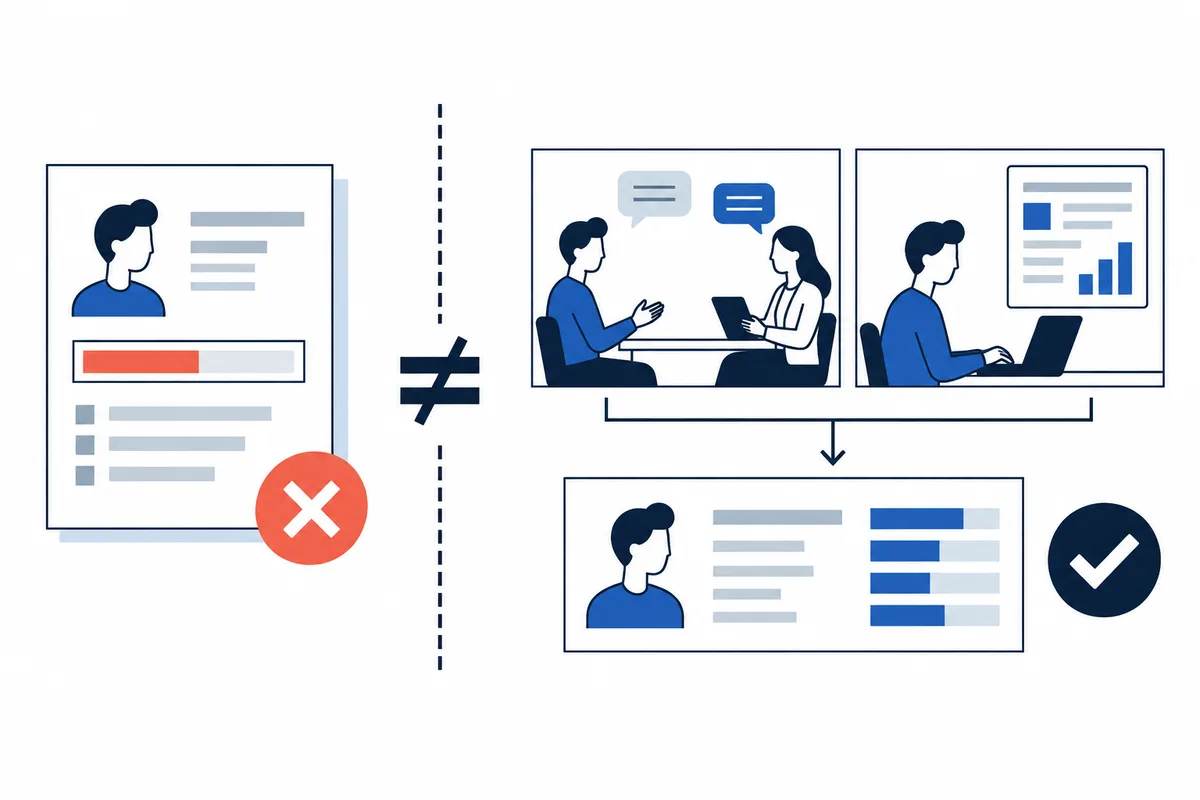
When a job calls for a particular emotional behavior, assess that behavior as close to the work as practical. A structured work sample or situational exercise can show how an applicant handles a defined task, with the same prompt and explicit scoring criteria applied consistently. Its realistic feel is not proof that the score predicts job performance. That link starts before anyone writes a test. The U.S. Office of Personnel Management’s “Job Analysis” guidance describes examining a job’s tasks, the competencies needed to perform them, and the connection between the two. For a role involving customer escalations, analysis might identify a sequence such as clarifying the complaint, acknowledging its impact, explaining a constraint, and agreeing on a next step. That list is more useful for assessment than “high EQ,” a broader label that does not say which action matters or how much it counts. Once the work behavior is specific, the assessment can sample it. A prompt might present a customer complaint with incomplete information and ask the applicant to draft a response or explain what they would do first. Define in advance what a competent response needs to accomplish, such as checking facts before promising a remedy and making the next step clear. Apply criteria drawn from the work analysis to every applicant, rather than rewarding a preferred personality or one polished phrase. The Uniform Guidelines questions and answers published by the U.S. Equal Employment Opportunity Commission explain why surface resemblance alone is insufficient. Their guidance says a procedure intended to replicate a work behavior should be similar to the job in behavior, product, and surrounding conditions. It also warns that paper-and-pencil tests of interpersonal effectiveness may not approximate actual work closely enough for content-based support. A written scenario about conflict may look relevant while leaving out the pace, information, tools, or consequences that shape the real interaction. A structured interview can collect useful evidence too, especially when questions are tied to critical tasks and interviewers use common prompts and rating criteria. Shared prompts and rating criteria make answers easier to compare than informal rapport or “culture fit,” but structure alone does not show that an interview predicts performance or validate an unrelated EQ score. Each method needs a stated purpose tied to the job. Scoring deserves the same care as prompt design. Evaluators should agree in advance on behavioral anchors for weak, adequate, and strong responses, using actions rather than impressions such as “warm” or “natural.” Train them to apply the criteria and record evidence behind ratings. A shared rubric can reduce differences in how evaluators read the same response; consistency still does not show that the criteria capture an important job requirement. The decision rule matters as well. An employer might have evidence that a minimum level of a task is necessary without evidence that every point above that level means better job performance. The EEOC’s Uniform Guidelines Q&A treats pass/fail use and ranking as distinct inferences: ranking requires support for the claim that higher procedure scores correspond to better job performance. The 1979 guidance is not a universal statement of current law, but its measurement point remains useful: a cutoff adds a claim that the evidence must support. A score does not earn that claim by appearing on a numerical scale. There is a narrow exception to rejecting every emotional-skill selection measure. A purpose-built procedure could be studied for a defined role, target behavior, applicant group, scoring method, and selection decision. The “Principles for the Validation and Use of Personnel Selection Procedures” likewise frames validity as evidence for score interpretations in their proposed use, not a permanent stamp on a test. Evidence from other jobs or decisions needs a relevance check before transfer. For a hiring team, the practical question is therefore concrete: can you name the important behavior, show how the exercise captures it under relevant conditions, and defend how its score changes the decision? If not, remove the general EQ score from selection. Assess the work behavior directly where an appropriate, supported method exists, and have qualified selection professionals review the procedure and its use. A scenario can be a more relevant starting point than a broad score; it earns a place in hiring only when the evidence supports the inference the employer plans to make.
Sources: Job Analysis; Questions and Answers to Clarify and Provide a Common Interpretation of the Uniform Guidelines; Principles for the Validation and Use of Personnel Selection Procedures
Development gives a result a different and useful job
The private 32-item Emotional Skills Profile gives an individual a place to reflect on emotional habits and choices in situations. Its recent-behavior summaries and judgments about authored scenarios are kept separate, so a response about what someone tends to do is not blended with a response about what they think a situation calls for. The product is educational: it has no validated norms or hiring purpose, and it should not be read as a measure of fixed ability. The assessment page describes this personal-development use (Emotional Skills Profile). A reflective prompt can still be practical. If disagreement tends to narrow attention, the next step might be to pause and restate the other person’s concern before answering. That is a behavior to notice and practice, not a conclusion about someone’s worth or likely performance. After reviewing a result, choose one behavior connected to feedback, regulation, boundaries, or repair. Name the situation where it matters, then notice what you do next time. Keep the observation specific: “I asked one clarifying question before defending my proposal” is more useful than “I have high EQ.” Explore the Emotional Skills Profile at /assessment if a private reflection tool would help you identify a practice focus. The profile can support that reflection; it cannot convert a general score into evidence for selecting an employee.
Sources: Emotional Skills Profile

Questions readers ask
Does research linking emotional intelligence with job performance justify an EQ hiring cutoff?
No universal cutoff follows from those associations. The findings vary by measurement stream and do not establish a passing score or ranking rule for a particular measure, job, and selection decision.
What should an employer assess if emotional behavior matters to a role?
Start with job analysis and define the relevant behavior. A consistent, job-linked work sample or situational exercise can provide closer evidence when its content, scoring criteria, and intended use are supported for that decision.
Sources
- Principles for the Validation and Use of Personnel Selection Procedures
Supports the principle that selection evidence should support the proposed score interpretation and use.
- Job Analysis
Describes connecting job tasks with the competencies required to perform them.
- Emotional Intelligence Tests
Distinguishes ability measures from self-reports and describes their different purposes.
- Emotional Intelligence in Selection Contexts: Measurement Method, Criterion-Related Validity, and Vulnerability to Response Distortion
Reports selection-context studies comparing performance-based and self-report EI measures.
- Emotional Intelligence in Selection Contexts: Measurement Method, Criterion-Related Validity, and Vulnerability to Response Distortion
Supports the comparison of distinct EI measurement methods in selection contexts.
- The Relation Between Emotional Intelligence and Job Performance: A Meta-Analysis
Reports meta-analytic associations between distinct EI measurement streams and job performance.
- Why Does Self-Reported Emotional Intelligence Predict Job Performance? A Meta-Analytic Investigation of Mixed EI
The accessible abstract reports overlap and a near-zero controlled relationship for the analyzed mixed self-report EI literature.
- Questions and Answers to Clarify and Provide a Common Interpretation of the Uniform Guidelines
Explains how job behavior, procedure content, screening, and ranking relate in U.S. selection guidance.
- Evidence for Response Bias as a Source of Error Variance in Applied Assessment
The PubMed record describes a review of response-bias indicators and weak workplace evidence.
- Employment Tests and Selection Procedures
Describes U.S. federal guidance on employment testing, disability access, and selection procedures.
- Section 15: Race and Color Discrimination
Provides EEOC compliance guidance on disparate impact and job-related validation.
- Constitutionality of Disparate-Impact Liability Under Title VII
States the DOJ Office of Legal Counsel's June 2026 position on Title VII disparate-impact liability.
- Emotional Skills Profile
Supports the assigned product description and its individual educational reflection purpose.
Apply it to the real situation
Turn a reflection into one behavior to practice
From this guide: A general score cannot decide who should be hired, but a personal reflection can help you choose what to notice in your own work.
The private Emotional Skills Profile is for individual reflection on emotional habits and scenario judgments. Use the result to identify one behavior around feedback, regulation, boundaries, or repair that you want to observe in a real interaction. Keep the focus on a specific action you can notice and practice; the profile is not a hiring score or a prediction of performance.