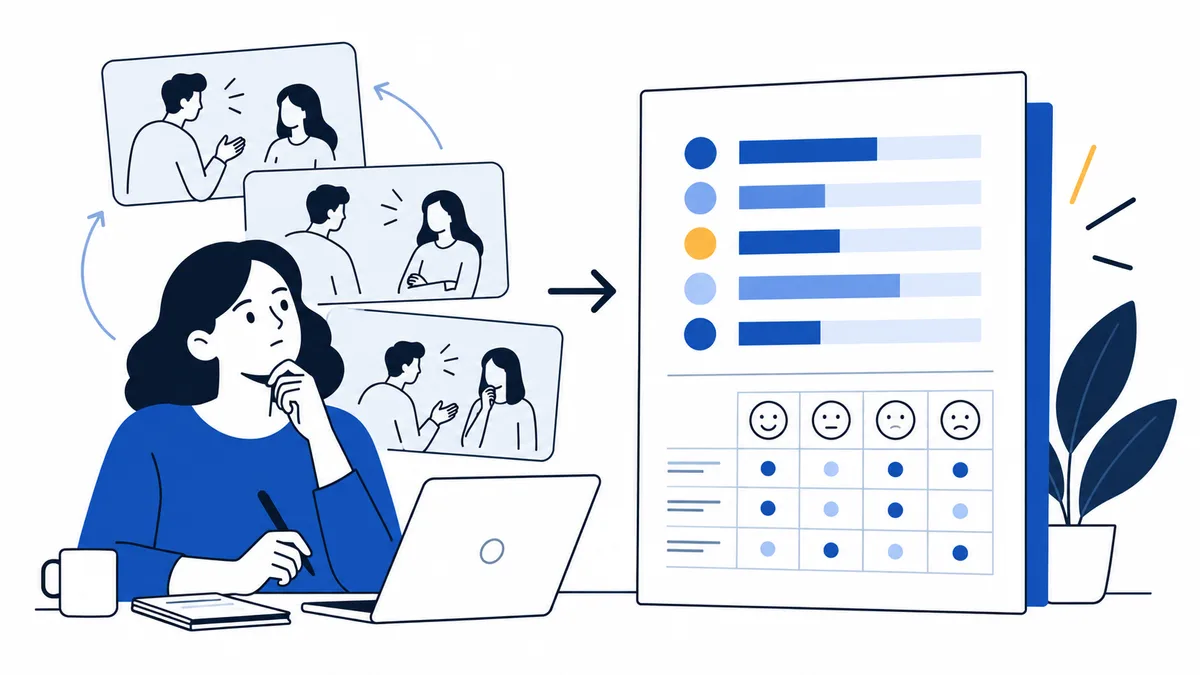
Use an Emotional Skills Profile when several identifiable work episodes leave you asking about your own habits: what you notice, infer, or do next. It can organize self-reflection and help you choose a behavior to examine. For a single exchange, a question about a coworker’s feelings, or unclear work expectations, start with the episode and appropriate clarification.
When does a recurring reading problem justify structured reflection?
Use an Emotional Skills Profile when several identifiable work episodes leave you asking about your own habits: what you notice, what you infer, or how you respond. If one message seemed cold, or you mainly want to know what a colleague felt, start with that exchange. Reconstruct what was said and done, then ask for clarification when it is appropriate and safe. A profile can help organize self-reflection; it cannot read another person’s mind.
Consider a specific pattern: short replies arrive in a project thread, you read them as irritation, and your next message becomes defensive. The useful observation is the sequence: brief reply, interpretation, response. “I’m bad at reading people” turns those separate events into a fixed verdict. The narrower account leaves room to ask whether the replies were actually emotional, whether the channel made tone hard to judge, and whether your response changed the conversation. Those are questions for examination, not conclusions supplied by repetition alone.
Several episodes can give you a reason to look for a recurring habit, but they do not prove that the cause is a personal deficit. A work request may be unclear; people may use different conventions for brief messages; the timing or stakes may matter. The accessible abstract for *Choices and Challenges in Measuring Emotional Intelligence in the Workplace* distinguishes self-report from ability testing and observer reports, and describes self-report as potentially useful for development alongside other measures. That supports a bounded role for reflection, not a claim that a profile can settle what happened in a particular exchange.
So decide first what remains unknown. If you want to examine your own recent way of noticing, interpreting, or responding across situations, structured reflection may help you choose one behavior to examine. If the question is about one colleague’s private emotion, or about unclear expectations in a specific task, investigate that situation directly. This is individual development; an Emotional Skills Profile is not a hiring score or a way to assess a team.
Sources: Choices and Challenges in Measuring Emotional Intelligence in the Workplace
Before choosing a profile, separate the cue from the story
Before deciding that a colleague is annoyed, record the event that prompted the thought. A cue is something you could point to: the message contained three words, the reply arrived later than expected, a person left the call before the discussion ended, or a request received no answer. An interpretation is the meaning you assign to that cue, such as “they are angry with me.” A response is what you do next: send another message, withdraw, ask a question, or change your tone. Keeping these parts separate makes it possible to examine a recurring reading problem without treating a guess about another person's feeling as an observed fact.
A brief note can preserve the sequence without turning the workday into a diary project. Record the setting and task, the exact words or action you noticed, your first interpretation, what you felt or did next, and any information that arrived later. For example: “I sent the revised schedule at 10:00; no reply by noon; I thought the silence meant irritation; I sent a defensive follow-up; the colleague later said they had been in a client meeting.” The two-hour gap is observable. The explanation was a hypothesis, and the later reply adds evidence about this episode. It does not establish why every delayed reply happens.
This distinction fits the process described in “Emotion in Organizations: Theory and Research,” a 2023 Annual Review of Psychology synthesis. The review describes people interpreting events for personal meaning, experiencing emotion, acting, and expressing cues that others may recognize. It also notes that each process can be regulated and that the sequence can continue through interactions. The point for an episode note is modest: a visible cue and the emotion someone experiences are different parts of a sequence. A short message may be read as irritation, while the writer's intention remains unknown until more information is available. A recipient's response can then shape what happens next.
After several notes, look for where the sequence repeatedly becomes uncertain. Perhaps the cue itself was hard to notice; perhaps you noticed it but assigned it a meaning too quickly; perhaps your interpretation led to a reply that made clarification harder. These are different questions for reflection. Repetition gives you examples to compare, not proof that a stable personal weakness caused them. The same record may reveal that the uncertainty appears mainly in one channel, task, or kind of exchange. That pattern can help you decide whether a profile about your own reported habits would add a useful prompt, or whether the missing information belongs to the work situation or the other person's perspective.
Keep any later clarification tied to the episode that produced it. If the colleague says the delay reflected a meeting, that helps explain this delay; it cannot tell you what another colleague meant by a similar pause. In the same way, an episode note is a practical aid for reflection, not a validated diary measure or a causal test.
A profile answers a different question from a live emotion check
The Emotional Skills Profile is useful when the question is about your own recurring habits: what you tend to notice, how you make sense of emotional situations, and how you respond. It cannot tell you what a colleague felt in a meeting or confirm what a short message meant. Those are questions about a particular exchange, and they need evidence from that exchange, including clarification from the other person when it is appropriate and safe to ask.
The profile is a private, 32-item educational reflection tool. Its questions cover recognition, understanding, regulation, and responding to others. The report keeps two kinds of response distinct: summaries about recent behavior and judgments about authored emotional situations. That separation matters. A report about recent behavior gives you a structured prompt to consider how you describe your own habits; a judgment about a written situation records how you respond to that supplied scenario. Neither is a recording of a colleague's feelings or an observation of what you did in a specific meeting. The profile has no validated norms and is not a standardized ability test. Treat its material as a starting point for reflection, not as a score that locates you against a population.
The difference between self-report and ability testing helps explain why. In “The Measurement of Emotional Intelligence: A Critical Review of the Literature and Recommendations for Researchers and Practitioners,” self-report questionnaires ask people to rate typical behaviors or abilities, while ability measures ask them to solve emotion-related problems under test conditions. The review stresses that the methods address related but distinct constructs. A self-report is informative about a person's view of their usual behavior. It does not directly measure how accurately they read a particular person at a particular moment. An ability test, in turn, addresses performance on defined emotion problems; it does not reproduce the pressures, history, or incomplete information of a real workplace exchange.
“Choices and Challenges in Measuring Emotional Intelligence in the Workplace” makes a similar distinction among self-report, ability testing, and observer report. Its 2025 abstract describes self-report as confidence and motivation and says it may serve development when compared with other measures. Observer reports describe competencies other people see in daily use, rather than a person's hypothetical best performance. That comparison can surface a useful difference between self-perception and observed behavior. It still cannot establish another person's private feeling: an observer can report what they saw, such as a pause, a raised voice, or a missed response, but the meaning of those cues may need to be checked with the person involved.
For a recurring difficulty, keep the tools tied to their questions. A brief record of an episode can preserve the words or actions that were observable, your interpretation, your response, and what you learned afterward. The profile can prompt reflection on your own reported habits and scenario judgments. A colleague's specific feedback can add their perspective on your behavior, while a respectful question can help clarify one exchange. An ability-based EI test asks something different about performance on emotion problems. No one source fills in all the others. If your uncertainty is chiefly “What was my coworker feeling?”, a profile cannot settle it. If the uncertainty is “What do I tend to do when signals are ambiguous?”, structured self-reflection may give you a more focused question to carry into the next conversation.
Sources: The Measurement of Emotional Intelligence: A Critical Review of the Literature and Recommendations for Researchers and Practitioners; Choices and Challenges in Measuring Emotional Intelligence in the Workplace
Why accurate noticing is not the same as knowing what to do
Noticing emotional cues can matter at work, but noticing alone does not determine whether an interpretation is right, helpful, or the best basis for a response. A pause, a clipped reply, or a change in expression may draw attention to tension; it does not tell you with certainty what another person feels, why the cue appeared, or what they need from you. Reading emotion is one step; the next is deciding how to respond without treating a guess as fact. A 2002 study, “Predicting workplace outcomes from the ability to eavesdrop on feelings,” makes this distinction concrete. The authors examined “eavesdropping” ability: relatively better recognition of emotion expressed through less controllable nonverbal channels. Their abstract reports an interaction between nonverbal channel and emotional valence in predicting ratings from colleagues and supervisors. Ratings were higher for eavesdropping ability with positive emotion and lower for it with negative emotion. This complicates the idea that more accurate detection must always lead to better workplace ratings. That result has a narrow reach. It concerns one measure of nonverbal emotion recognition and workplace ratings in the study, not every way people read emotion, every workplace, or the private truth of a colleague’s feelings. Nor does the finding describe the Emotional Skills Profile: the profile is an educational self-reflection tool about a respondent’s reported habits and judgments in authored situations, not a test of nonverbal emotion-recognition performance. Carrying the study’s result over to that profile would confuse different measures. For a recurring work difficulty, “notice more” may be too blunt a goal. Suppose a colleague’s brief message seems irritated. The useful move might be to check the inference before replying, or to ask a neutral question about the work issue. The cue alone cannot choose between those responses. Tact includes considering the relationship and the practical purpose of the conversation, while acknowledging that the other person’s state remains theirs to describe. This is why a profile can help frame a question about your own habits without settling what happened in a live interaction. If you often move quickly from an ambiguous cue to a confident conclusion, reflection may help you examine that step. A small practice could be to name the cue separately from the interpretation and check one assumption before acting. Reading emotion better can include knowing when to pause, ask, or leave room for uncertainty. A rating is an evaluation of workplace behavior or contribution, not a direct reading of someone’s inner experience. That distinction matters here: the study links a particular recognition measure with ratings, while the reader’s question concerns what to do with uncertainty in an actual exchange. It offers reason to avoid treating sensitivity as a complete interpersonal skill.
Sources: Predicting workplace outcomes from the ability to eavesdrop on feelings
Check the work conditions before assigning the pattern to yourself
A recurring misunderstanding can arise from a personal habit, an unclear task or role, a communication channel, workload, or several of these at once. The Emotional Skills Profile can prompt reflection on your own reported habits; it cannot identify which factor caused a particular exchange. Before treating the pattern as evidence that you misread people, check what the work situation made possible to notice and clarify. “Emotions in the Workplace,” a review in the Annual Review of Organizational Psychology and Organizational Behavior, organizes workplace emotion research at five levels: within a person over time, between people, in interpersonal perception and communication, in groups, and across organizational culture and climate. This map shows why a personal explanation should be tested alongside task, relationship, group expectations, and wider climate. Use a short alternative-cause check on the episodes you have already noted. Was the request explicit about what was needed and by when? Did the channel carry enough context to interpret tone, or did a brief written message leave that open? Did both people share the same expectation about when a reply was due? Was time pressure or a role conflict affecting what could be done? The check may reveal a missing instruction or shared norm that a personal profile cannot supply. The difference matters in practice. If two colleagues read “send this today” differently because no one agreed whether “today” meant before a meeting or before close of business, practicing greater sensitivity to emotion would not settle the deadline. Clarifying the request could prevent the same friction from recurring. By contrast, when instructions are clear and the same kind of emotional inference keeps shaping your response across different situations, reflection on your own habits may offer a useful next question. That warrants inquiry, not a verdict about cause. “Emotion in Organizations: Theory and Research,” a second review, describes emotion as a sequence: people interpret events, experience emotion, behave, and express cues that others may read. A delayed reply is observable; “the colleague is angry” is an inference. The review helps locate where uncertainty entered that sequence, but cannot identify what caused a particular delay. Power affects what can safely be clarified. When appropriate, ask a concrete work question: “I may be missing context. Is there a change you need in this draft?” If asking directly could carry a cost, look for a safer way to clarify expectations or roles. If the check reveals an unclear instruction, conflicting expectations, or a channel that repeatedly strips away needed context, address that condition before making the profile your main response. If those conditions are reasonably clear and the same difficulty still recurs, the profile may help you reflect on your own habits and choose one behavior to examine. The two reviews support looking at more than one level of workplace emotion; the practical check here is an editorial aid derived from that perspective, not a validated assessment or causal test.
Sources: Emotions in the Workplace; Emotion in Organizations: Theory and Research
What workplace research can and cannot add
Emotional skills are a reasonable subject for deliberate practice, but research on training does not show that taking the Emotional Skills Profile will improve collaboration. The studies ask whether particular programs can change measured emotional competencies on average. They do not test whether this profile identifies the cause of one person's recurring difficulty reading emotion, or whether its results prescribe an effective next step. The 2019 meta-analysis “Can emotional intelligence be trained? A meta-analytical investigation” combined 58 published and unpublished studies using pre-post or treatment-control designs. Its authors reported a moderate positive effect of formal training on emotional-intelligence scores, regardless of design; published studies had larger effects than dissertations. Scores in the included studies could change after training. But the studies covered different programs and measures, and the outcome was score change. It does not establish that this profile causes change or that colleagues will notice a better conversation afterward. A later workplace-focused review narrows the setting and broadens the skills under study. “Training emotional competencies at the workplace: a systematic review and metaanalysis” included employed adults and considered interventions aimed at emotional intelligence, empathy, and emotion regulation. The authors found 50 eligible studies for a pre-post analysis and 27 controlled trials. In the controlled-trial analysis, the mean standardized effect was 0.46, with a 95% confidence interval from 0.30 to 0.63. The average reflects these programs and measures, not what this profile would do for a reader. The spread of results matters as much as the average. The review reports high heterogeneity and low methodological quality among included studies, and calls for more high-quality trials. “Emotional competencies” also gathered together related but distinct targets: emotional intelligence, empathy, and regulation. Researchers do not always define or measure them alike. A positive pooled effect therefore cannot tell a reader whether their own difficulty comes from missing a cue, drawing a quick conclusion from it, or reacting in a way that closes down clarification. Nor does it show which particular practice transfers to that reader’s work. That boundary is especially important because an assessment and a training program are different interventions. A profile may help someone notice how they describe their recent behavior and how they judge authored situations. In the studies above, participants received formal training, then researchers measured emotional-competency scores. The findings support the possibility that some targeted skills can develop; they do not validate this profile as a training method, show that its report selects the right skill to practice, or establish an effect on a particular work relationship. Treating the two as interchangeable would turn evidence about programs into an unsupported product claim. Workplace associations between emotional intelligence and outcomes also cannot settle an individual episode. People may score differently depending on whether a measure asks about typical behavior, perceived ability, or performance on emotion problems. Outcomes such as job performance or relationship quality are shaped by more than emotional skill, and a statistical association across studies does not show that one caused the other. Those findings cannot reveal what a colleague felt in one exchange or whether a misread belongs to one person or the surrounding conditions. For a recurring concern, a sensible next step is consequently small and observable. After reflecting on a pattern, choose a behavior that could change the next interaction, such as pausing before assigning a motive to a short reply and asking a neutral question about the work. Record what happened and what the other person clarified. This is a practical experiment, not a research-proven prescription from the profile. Notice whether the exchange gives you a clearer basis for responding and whether the pattern continues.
Sources: Can Emotional Intelligence Be Trained? A Meta-Analytical Investigation; Training emotional competencies at the workplace: a systematic review and metaanalysis
How should the profile and episode feedback work together?
Use the Emotional Skills Profile to sharpen a question about your own habits, then compare it with work episodes and specific feedback. The three sources answer different things. An episode note preserves the setting and sequence: what was said or done, what you inferred, how you responded, and what you learned later. The profile reflects your account of recent behavior and your judgments about authored situations. Feedback describes another person’s view of behavior they experienced. None stands in for the others, and a mismatch is a reason to investigate rather than a verdict about who is right.
In “Choices and Challenges in Measuring Emotional Intelligence in the Workplace,” a 2025 review organizes workplace measures as self-report, ability testing, and observer report. Its abstract describes self-report as confidence and motivation, and says it can be useful for development when compared with other measures because gaps may reveal blind spots or opportunities. The review characterizes observer reports as reflecting competencies in daily use more than hypothetical best performance. That distinction helps explain why a person may describe themselves as careful in tense conversations while a colleague recalls a rushed interruption: the accounts address self-perception and observed behavior from different positions. Neither establishes the private emotion behind the exchange. The profile’s authored-scenario judgments add another kind of information: how you judge a supplied situation, not a record of what you did in that meeting.
The 2019 critical review “The Measurement of Emotional Intelligence: A Critical Review of the Literature and Recommendations for Researchers and Practitioners” likewise distinguishes self-report questionnaires about typical behavior from ability tests that ask people to solve emotion-related problems. Results from one method should not be read as confirmation from another. If your profile reflection suggests that you may miss signs of frustration, compare it with an episode: Was there a cue you noticed only afterward? Did you ask a clarifying question, or act on an assumption? Keep the example tied to what is known. A short reply can be observed; irritation is an interpretation unless the person says so.
When feedback is appropriate, ask about an action and its effect: “I moved on before you finished explaining the concern. What did that make harder?” This invites information about the exchange without requiring the colleague to name an emotion or endorse your self-assessment. A difference between your account and theirs might reflect a blind spot, a different context, or different standards for what counts as listening. It might also reflect a one-off interaction. Compare the accounts with episode details before drawing a broader conclusion.
Feedback is not always safe or useful to solicit. Consider power, privacy, and whether the other person can answer freely; where those conditions are poor, use an appropriate trusted channel or work from observable records. The aim is to identify one next question, not collect ratings from coworkers. If several episodes and feedback point toward the same behavior, you have a more grounded practice target. If they diverge, preserve the disagreement and examine when it occurs. Either way, use the profile to prompt self-reflection, while the episode and conversation keep the inquiry connected to actual work.
Sources: Choices and Challenges in Measuring Emotional Intelligence in the Workplace; The Measurement of Emotional Intelligence: A Critical Review of the Literature and Recommendations for Researchers and Practitioners
A practical next step: one pattern, one practice, one check
Start with one repeated situation, for example, short replies during project handoffs leave you unsure whether to ask a follow-up or defend your work. Record the cue, your first interpretation, what you did, and what you learned later. Keep the observed message separate from the meaning you assigned to it. If the pattern still raises a question about your own habits, the private 32-item Emotional Skills Profile can give you prompts about recent behavior and judgments in authored situations. It is an educational reflection tool, not a detector of a colleague’s feelings or a prescription for what to do. Choose one response to try in a comparable exchange, such as asking, “Is there anything you’d like me to change before I send the next version?” Then note what happened and whether the question clarified the work. This is an experiment you set for yourself; the profile does not prescribe it. In “Choices and Challenges in Measuring Emotional Intelligence in the Workplace,” self-report is described as potentially useful for development, especially alongside other perspectives. “Can Emotional Intelligence Be Trained? A Meta-Analytical Investigation” found a moderate positive average effect across 58 training studies, but those studies do not establish that this profile produces change. If you want a structured view of your own reported habits, explore the Emotional Skills Profile at /assessment.
Sources: Can Emotional Intelligence Be Trained? A Meta-Analytical Investigation; Choices and Challenges in Measuring Emotional Intelligence in the Workplace
Sources
- The Measurement of Emotional Intelligence: A Critical Review of the Literature and Recommendations for Researchers and Practitioners
Supports the distinction between self-report questionnaires about typical behavior and ability measures that test performance on emotion-related problems.
- Emotion in Organizations: Theory and Research
Supports describing workplace emotion as a sequence involving interpretation, experience, behavior, and expression.
- Choices and Challenges in Measuring Emotional Intelligence in the Workplace
Supports distinguishing self-report, ability testing, and observer reports, and describes a developmental role for self-report alongside other measures.
- Predicting workplace outcomes from the ability to eavesdrop on feelings
The accessible study abstract reports that workplace ratings varied with nonverbal channel and emotional valence for a specific emotion-recognition measure.
- Emotions in the Workplace
Supports examining workplace emotion across within-person, interpersonal, group, and organizational levels.
- Can Emotional Intelligence Be Trained? A Meta-Analytical Investigation
The university-hosted abstract reports a meta-analysis of 58 studies and a moderate positive average effect of training on EI scores.
- Training emotional competencies at the workplace: a systematic review and metaanalysis
The review reports positive average training effects alongside heterogeneity, possible publication bias, and uncertainty about which facets were trained.
Apply it to the real situation
Turn a recurring work pattern into a reflection question
From this guide: If you have identified a repeated situation and want to examine your own reported habits, the Emotional Skills Profile offers structured prompts for that reflection.
A recurring misunderstanding can leave you unsure whether to examine your own response or clarify the work situation. The private 32-item Emotional Skills Profile can help you reflect on reported recent behavior and judgments about authored emotional situations. Use it to frame a question about your own habits, then compare that reflection with specific episodes and appropriate feedback. Explore the profile if structured self-reflection would help you choose one behavior to examine.