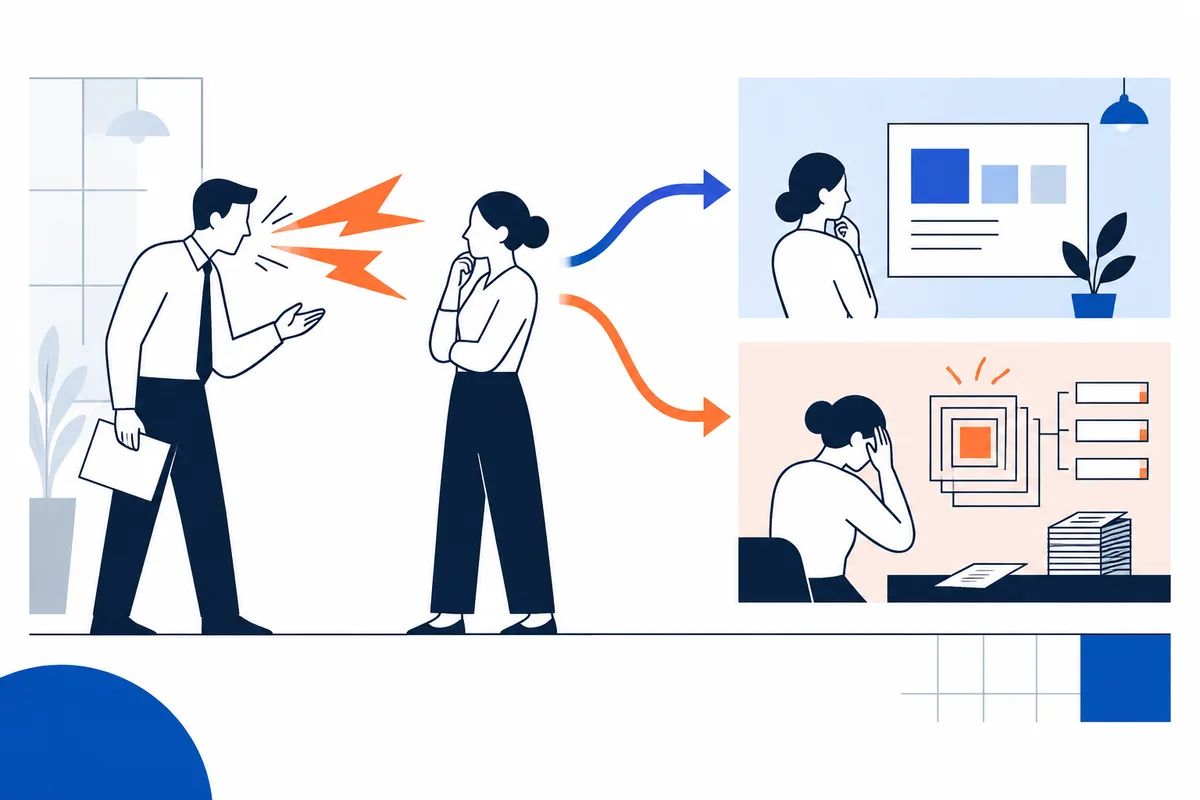
Reappraisal can help when it makes an uncertain interaction easier to read and clarifies a proportionate response. It can add strain when a worker must keep changing or hiding a justified reaction while aggression continues. Evidence from two occupational samples found different aggression–strain associations for organizational insiders and legitimate outsiders; it does not establish a universal or causal rule.
A calmer interpretation can help; a required calm display can cost more
A colleague’s sharp remark may be rushed disagreement, deliberate slight, or part of an unclear pattern. Reappraisal means changing how an event is interpreted to alter its emotional impact. It may help when a more accurate reading reduces needless alarm and clarifies a proportionate response. It adds strain when calm becomes a requirement: the worker must keep revising or concealing a justified reaction while aggression continues. The useful test is whether reframing creates accuracy and choice, not whether it makes the target agreeable.
Regulation strategies showed different relationships with strain in “Does emotion regulation protect employees from the negative effects of workplace aggression?” In two studies of social workers (77) and emergency-services personnel (70), reappraisal during aggression from organizational insiders, coworkers or managers, attenuated the association between aggression and strain. For legitimate outsiders, clients or patients, reappraisal and suppression strengthened it. Suppression limits outward expression; changing an interpretation and hiding an expression are different acts. These associations do not prove that reappraisal protects every target or causes the difference. They suggest examining who is involved and what the role demands before deciding whether to reframe.
Sources: Does emotion regulation protect employees from the negative effects of workplace aggression?
The useful distinction is who the aggression comes from—and what the role requires
In two studies, its association with strain depended on whether aggression came from inside the organization or from a legitimate outsider. The peer-reviewed article “Does emotion regulation protect employees from the negative effects of workplace aggression?” reports samples of 77 social workers and 70 emergency-services personnel. Across both studies, reappraisal during interactions with coworkers or managers was associated with an attenuated link between workplace aggression and strain. During interactions with clients or patients, reappraisal and suppression were associated with a stronger aggression–strain link. The abstract provides no effect sizes or enough methods to judge how large these differences were or whether regulation changed later strain. Association does not prove that a strategy caused protection or harm. Strain means the adverse response examined in relation to aggression and employees’ mental or physical well-being. The abstract does not name the exact measures, so the finding should not be translated into particular symptoms. It does report a contrast: the broad strategy was linked with different aggression–strain patterns across relationship settings. The distinction is between organizational insiders, such as coworkers and managers, and legitimate outsiders, such as clients and patients. The authors interpret the outsider finding as consistent with emotional-labor theory: a worker may have role expectations about responding to clients or patients. The abstract cannot show that display expectations caused the difference or what any employer required. For colleague aggression, the insider result is the directly relevant one. Reappraisal was linked with a weaker relationship between aggression and strain in these two occupational samples. This supports considering a more accurate interpretation when a colleague’s motive is genuinely uncertain and reconsidering it helps clarify what happened and what to do. It cannot support a rule to recast repeated insults, undermining, or a manager’s conduct as benign. These are illustrative situations, not findings reported by the study. Reframing uncertainty may change understanding; minimizing clear behavior changes the account itself. The outsider result helps explain why role demands belong in the decision, but it is not direct evidence about coworkers. A worker expected to stay composed with a client may be managing both the encounter and the visible response. The abstract does not measure display expectations closely enough to attribute the insider finding to their absence. Its contrast still warns against treating reappraisal as a portable shield: source, work role, and available choices may matter, and the abstract cannot separate their contributions. The practical reading is conditional. With aggression from an insider, reappraisal coincided with a weaker aggression–strain association in these samples. It is a plausible short step when it clarifies uncertain meaning and supports a proportionate response. That is not evidence that the target should accommodate the conduct, call it harmless, or keep regulating until it stops. Ask whether a clearer interpretation returns a usable choice. If the worker is changing their account mainly to endure or conceal conduct, this study gives no basis for calling that protection. The relationship offers a clue about demands; it does not settle what the target should accept.
Sources: Does emotion regulation protect employees from the negative effects of workplace aggression?
What does regulation change: the interpretation, the display, or both?
After a colleague’s sharp remark, two different things can happen inside and outside the target. They may decide the remark was rushed rather than hostile, changing what the event means to them. Or they may still feel anger and embarrassment but keep their face and voice neutral. The first is reappraisal: changing an event’s interpretation to alter its emotional impact. The second is suppression: limiting outward expression after an emotion has arisen. A composed reply alone cannot tell us which process occurred, or whether distress has eased.
The visible outcome can look the same while the effort differs. Reappraisal changes the account a person is using: perhaps an interruption reflected impatience, misunderstanding, or an attempt to shut down discussion. It does not require choosing the most charitable explanation. It separates what was observable, such as being interrupted twice, from what remains uncertain, such as the colleague’s motive. The person can then decide whether another interpretation fits and changes the response they want to make.
Suppression changes what others can see. Someone may wait before answering, lower their voice, or hide irritation. That can be a deliberate pause that protects a conversation from escalating. It can also leave the original interpretation and emotion intact while adding the work of controlling expression. Silence does not show that the exchange was harmless or that the person has recovered. A restrained response does not always mean suppression; a person may feel little need to display what they feel.
Work introduces a third question: is the person regulating privately, or managing emotion to meet an expected role? Emotional labor is the management of feeling or expression to meet perceived work-role expectations. In “Affect Regulation and Well-Being in the Workplace: An Interpersonal Perspective,” the authors discuss evidence on managing one’s own and other people’s affect at work. Their abstract gives a specific example: constantly presenting a happy face to customers can contribute to emotional exhaustion, particularly when the display conflicts with the person’s internal state. The chapter is a review of workplace affect regulation, not a study of aggression between colleagues, so it helps explain a possible demand without proving what caused strain in a particular exchange.
After an incident, ask: did my interpretation change, did only my visible response change, or was I expected to do both? If the revised interpretation fits the facts and makes a proportionate next step clearer, reappraisal may have helped. If the feeling remains and the main achievement was looking agreeable because the role demanded it, the worker may be carrying an added display burden. This does not settle whether to confront a colleague; it clarifies what regulation changed.
Sources: Affect Regulation and Well-Being in the Workplace: An Interpersonal Perspective
When managing the display becomes a second job
Emotional labor is the effort involved in managing feeling or expression to meet perceived expectations attached to a work role. The burden is easiest to miss when the visible result looks professional: a steady voice, a courteous reply, a meeting that continues. Those signs describe what others could see. They do not tell us whether the person felt calmer, whether the interpretation changed, or whether the underlying conduct stopped. The chapter “Affect Regulation and Well-Being in the Workplace: An Interpersonal Perspective” brings together research on regulating one’s own and other people’s emotions at work. It gives a clear example of the possible cost: constantly presenting a happy face to customers may contribute to emotional exhaustion, particularly when that display conflicts with the person’s internal emotional state. This is a chapter’s synthesis of workplace research, not a trial of a specific response to colleague aggression. Its relevance here is the mismatch it identifies. A role may ask someone to sound warm at exactly the moment their anger or apprehension is carrying useful information about how they have been treated. That mismatch can make regulation feel like a second task: the worker attends to the exchange and monitors whether their expression meets the expected standard. This is a practical interpretation of the chapter, not a measured sequence or a claim that every display demand produces exhaustion. A brief, chosen adjustment may help a conversation continue. Repeated reassurance while the conduct continues manages the interaction’s appearance while its cause remains in place. The aggression studies make role expectations a plausible part of the story, but do not establish them as the cause. In “Does Emotion Regulation Protect Employees from the Negative Effects of Workplace Aggression?,” two studies examined social workers (77 people) and emergency-services personnel (70 people). Reappraisal during aggression from organizational insiders, such as coworkers or managers, attenuated the aggression–strain link in both samples. During interactions with legitimate outsiders, such as clients or patients, reappraisal and suppression instead strengthened that link. The abstract reports these associations; it does not show that display rules produced them, or that every colleague interaction follows the same pattern. The contrast matters when a worker is pressed to remain pleasant. A client-facing role may make courtesy explicit; a colleague’s aggression does not become acceptable because the target can regulate a response. Ask what the demanded display accomplishes. If it creates space to choose a next step, it may serve the worker. If others simply see less discomfort while the behavior recurs, consider what boundary, support or work change is available. “Stay pleasant” is also a question about expectations and support, not only personal skill.
Sources: Affect Regulation and Well-Being in the Workplace: An Interpersonal Perspective; Does emotion regulation protect employees from the negative effects of workplace aggression?
Why severity, power and visibility change the decision
A sharp emotional reaction does not tell you, by itself, whether you have misread an exchange. The conduct and the conditions around it matter. In *Seeking Clarity in a Linguistic Fog: Moderators of the Workplace Aggression-Strain Relationship*, a cross-sectional study of 579 nurses, perceived aggression intensity, the target’s attribution of intent, the perpetrator’s power relative to the target, and perceived visibility each intensified various associations between aggression and strain. The outcomes included depression, physical symptoms, job satisfaction, and accidental contagious disease exposure. The reported three-way interactions also point to a complicated pattern: these factors did not operate as one simple severity scale. The study measured associations at one point in time, so it cannot establish that any single factor caused strain or show that reappraisal would have changed it.
That qualification matters when deciding whether to reinterpret an incident. If a colleague speaks abruptly once during a pressured handoff, the intent may be genuinely unclear. Considering another plausible explanation could reduce a mistaken conclusion and leave room for a direct request. If the same colleague repeatedly humiliates someone in front of others, or controls access to shifts, information, or evaluation, the facts already carry more weight. Telling oneself that the behavior was probably harmless may make the moment easier to endure while leaving the pattern untouched. This is an editorial application of the study’s moderators, not a result the study directly tested: intensity, power, visibility, and perceived intent give a worker reasons to check whether reframing is improving accuracy or just softening the account.
Visibility can also alter what a response costs. A public remark may affect how others understand the exchange, while a private incident may leave the target without witnesses; the study’s record does not say that visibility always makes aggression worse in every case. Power changes the available options too. A worker may be able to ask a peer to stop interrupting, yet hesitate to challenge a supervisor who controls assignments. In the latter case, “just respond calmly” leaves out the practical constraint. A written record of what happened, when, who was present, and how the work was affected can preserve specifics for a later conversation or support request.
Use the study as a prompt to assess the situation, not as a formula for judging a colleague. Ask whether the behavior was isolated or repeated, how serious its work impact was, who had authority, and whether others could see it. When the conduct is severe, repeated, public, or tied to a power imbalance, internal reinterpretation may be insufficient; that is a practical inference, not a treatment finding. If a direct conversation seems difficult or unsafe, consider a trusted support person or an appropriate workplace channel. The aim is not to produce a perfectly calm reaction before acting. It is to retain a clear account of what occurred and choose a proportionate next step that the circumstances actually allow.
Sources: Seeking Clarity in a Linguistic Fog: Moderators of the Workplace Aggression-Strain Relationship
Can reframing protect composure while narrowing what gets said?
Positive reappraisal can soften one pathway from abusive supervision to cynicism, but the evidence does not show that a calmer interpretation makes speaking up easier. The study “Abusive supervision and employee voice: The roles of positive reappraisal and employee cynicism” surveyed employees and their immediate supervisors in manufacturing companies in five South Korean cities. Researchers used two waves: employees reported abusive supervision, reappraisal and cynicism, while supervisors rated employee voice. They analyzed 427 matched responses after excluding 258 incomplete questionnaires from 685 initially contacted dyads. This design separates some reports by source and time, but it remains an observational survey; it cannot establish that reappraisal caused a change in cynicism or voice.
In the study, positive reappraisal moderated the association between abusive supervision and cynicism. At higher reported reappraisal, abusive supervision was associated with lower cynicism; at lower reappraisal, it was associated with higher cynicism. Cynicism, in turn, was negatively associated with promotive voice: suggestions or ideas intended to improve how a work unit functions. The researchers also reported an indirect association from abusive supervision through cynicism to promotive voice. That pattern matters because keeping a constructive tone or finding a less damaging interpretation may help someone continue proposing improvements. Yet the study measured a pattern across employees, not a guaranteed sequence inside any one person. Reappraisal might accompany other differences in how people experience supervision, and the survey cannot tell us which explanation accounts for the association.
The result did not extend to every kind of speaking up. Prohibitive voice means warning about practices or behavior seen as harmful to the work unit. Cynicism’s association with prohibitive voice was nonsignificant, and the proposed indirect association through cynicism was also nonsignificant. This is not evidence that employees felt safe to raise concerns; it means this study did not establish the predicted relationship. The distinction cautions against treating “speaking up” as one outcome. Offering an improvement and naming a risk can carry different interpersonal stakes, and the study’s measures do not establish how safe either act was in a particular workplace.
For a worker deciding what to do after a supervisor’s hostile conduct, the useful limit is practical: use a more balanced interpretation to check uncertain motive or regain composure, while keeping the observable behavior and its impact in view. Do not make a positive reading a condition for describing what happened. If the concern involves harm or repeated conduct, a factual account still needs a safe route to be heard, whether through a direct conversation, documentation or an appropriate support channel. That is an editorial application of the study, not a result it tested. The findings complicate an always-helpful verdict: reappraisal may coincide with less cynicism, yet this survey offers no basis for asking a target to reinterpret abuse as acceptable or to remain silent about it.
Sources: Abusive supervision and employee voice: The roles of positive reappraisal and employee cynicism
A strategy that works in one task may fail in another
A response that helped in one difficult exchange can become a poor rule for the next. A colleague’s sharp comment during a routine handoff may leave room to pause, reconsider what was meant, and ask a clarifying question. A public rebuke from a manager, or the same conduct repeated after a boundary has been stated, presents different demands. Reappraisal may still help someone think clearly, but the situation may call for a record, support, or a direct request for change. The emotional skill lies partly in noticing that the task has changed. The study “Frontline managers’ task-related emotion regulation, emotional intelligence, and daily stress” followed 83 frontline managers across 10 working days. The researchers examined how managers responded to negative affect while doing different tasks, measuring cognitive reappraisal, suppression, and expression alongside daily stress. Their abstract reports that regulation was shaped by stable, situational, and personal factors. That finding complicates the idea that a person simply has one regulation style that works everywhere: choices varied with the work and the person’s circumstances. The study is useful evidence about daily variation among managers, not a test of colleague aggression. It cannot tell us that reappraisal prevents harm in a conflict, or that suppression necessarily raises strain after a particular exchange. This distinction matters when a workplace treats composure as a standing requirement. Choosing to pause before replying to a tense message is different from being expected to absorb every slight without showing a reaction. In the first case, a pause may create room to decide what the facts support. In the second, “stay calm” can become a demand placed on the target while the source of the problem remains in place. That interpretation is an application of the study’s emphasis on situational demands, not a result it directly measured. After a difficult interaction, review the event rather than assigning yourself a fixed label. What was the task? What did the other person actually say or do? Did reconsidering the meaning make the account more accurate and the next step clearer, or did it only make the reaction less visible? Did you have a real choice about how to respond? Those questions help separate flexible regulation from a workplace expectation to regulate every negative feeling. One response can be useful in a private misunderstanding and inadequate when conduct is repeated, public, or backed by authority. The daily study supports attention to those changing demands; it does not supply a universal technique or a score for how well someone handled aggression.
Sources: Frontline managers’ task-related emotion regulation, emotional intelligence, and daily stress
What newer workplace intervention evidence adds—and cannot settle
A randomized workplace study gives reappraisal a specific, limited case. In “Cognitive reappraisal emotion regulation interventions in the workplace and their impact on job performance,” employees were assigned to an intervention group (88 people) or a control group (88 people). Over three workweeks, they completed two activities each day and answered three surveys on workdays: two captured affect around the activities, and a later one asked about work outcomes. Researchers measured outcomes again one month after the activities ended. Random assignment in ordinary work settings gives stronger grounds for causal interpretation than a survey of naturally occurring strategy use.
The activities tested two ways to reappraise: reconsider the situation, or view one’s emotional response as normal and temporary. Compared with control, the intervention reduced negative affect and increased positive affect. The study’s models linked lower negative affect to less counterproductive work behavior, and higher positive affect to better overall performance, in the short term and at follow-up. These indirect paths describe a possible route through affect, rather than a direct guarantee that a prompt improves performance. The situation-focused activity was more effective than the emotion-focused one for immediate affect. This supports the possibility that timely reinterpretation can help with some ordinary work events.
The outcomes set a firm boundary. The study did not recruit people because colleagues had been aggressive or test whether reappraisal changed an aggressor’s conduct. Its “counterproductive work behavior” measure does not show whether a target spoke up, set a boundary, or obtained support. Nor did every proposed pathway reach statistical significance: negative affect did not mediate the intervention’s relationship with overall job performance, and the intervention had no significant direct effect on short-term overall performance. A one-month follow-up cannot show how a strategy works during repeated or severe mistreatment, or whether prompts build lasting skills.
This helps place the trial beside “Does emotion regulation protect employees from the negative effects of workplace aggression?” In two samples, social workers (77) and emergency-services personnel (70), reappraisal during aggression from coworkers or managers was associated with a weaker aggression–strain link. Reappraisal and suppression during aggression from legitimate outsiders, such as clients or patients, were associated with a stronger link. Those occupation-specific findings concern aggression and strain; the randomized trial tested reappraisal for affect and general work outcomes. They answer different questions. The trial challenges the claim that regulation always adds burden, but does not erase the possibility that managing a reaction amid aggression coincides with greater strain.
For a manageable disagreement or setback, reconsidering what happened may lower emotional intensity enough to choose a useful next step. When a colleague’s aggression is repeated, that pause should not become an instruction to reinterpret the behavior until it feels acceptable. Keep the factual account, assess what response is feasible, and consider a boundary or suitable support. The intervention supports reappraisal as one possible tool for ordinary work affect; a response to aggression still depends on the conduct, its repetition, and the worker’s available choices.
Sources: Cognitive reappraisal emotion regulation interventions in the workplace and their impact on job performance; Does emotion regulation protect employees from the negative effects of workplace aggression?
How can you tell whether reappraisal helped after this exchange?
Keep reappraisal only if it leaves a more accurate account of what happened and a clearer next move. If it mainly makes you hide a justified reaction, shift toward a boundary, a record of the pattern, or suitable support. This is practical inference, not a tested treatment rule. Two studies of social workers (77 people) and emergency-services personnel (70 people) found reappraisal associated with a weaker aggression–strain link during interactions with organizational insiders. The abstract for “Does emotion regulation protect employees from the negative effects of workplace aggression?” does not establish that reframing caused less strain in a particular exchange. Use the finding to examine what changed, not as an instruction to endure conduct.
Start with the observable event and its work impact. During a project handoff, for example, a colleague repeatedly talks over you and the next person leaves without the information you were trying to pass on. Record the interruptions and missed handoff; keep guesses about motive separate. Reappraisal means reconsidering an event’s meaning. It is useful only if there is real uncertainty: perhaps the colleague thought the meeting had moved on, or perhaps interruption is a pattern. Treat an alternative reading as something to check, not a reason to erase the event or its consequence.
Ask what changed in your account. Does that make a feasible response easier to choose? If the colleague interrupted once and the handoff can still be completed, a direct request to let you finish may fit. Repeated, public or severe conduct, especially from someone with power over your work, may require more than reframing. A cross-sectional study of 579 nurses, “Seeking Clarity in a Linguistic Fog: Moderators of the Workplace Aggression-Strain Relationship,” found intensity, intent attributions, perpetrator power and visibility altered various aggression–strain associations. It did not test reappraisal. These features matter because they can change how much choice a worker has.
Finally, check whether your response preserves information that may need to be heard. A two-wave survey of 427 manufacturing employees and supervisor reports, “Abusive supervision and employee voice: The roles of positive reappraisal and employee cynicism,” found cynicism related to lower promotive voice, or suggestions for improvement; its relation to prohibitive voice, or warnings about harmful practice, was not significant. The study does not show that reappraisal silenced employees. It does suggest a useful check: did reframing help you speak clearly, or make you feel you should swallow a concern? If no workable request is safe or likely to help, record what happened and consider suitable support. Reappraisal has helped when it restores a clearer view and usable choice. When it only makes aggression easier to conceal, the next step belongs in the work relationship or its conditions.
Sources: Does emotion regulation protect employees from the negative effects of workplace aggression?; Seeking Clarity in a Linguistic Fog: Moderators of the Workplace Aggression-Strain Relationship; Abusive supervision and employee voice: The roles of positive reappraisal and employee cynicism
Make one specific conversation easier to have
If a direct conversation feels safe and useful, name something the other person could verify. You might say: “In yesterday’s handoff, you interrupted before I finished the risk update. I could not explain why the deadline was at risk. Please let me finish, then I’m glad to hear your concerns.” This names the behavior, its work effect and a change the colleague can make.
Reappraisal may help you prepare by separating what happened from what you can only infer. “Does emotion regulation protect employees from the negative effects of workplace aggression?” reports two studies: social workers (77 people) and emergency-services personnel (70). Reappraisal during aggression from organizational insiders was associated with a weaker aggression–strain link. The abstract reports an association, not proof of cause. If direct discussion could expose you to harm, or conduct repeats or involves a power imbalance, record it and seek appropriate support.
The private 32-item Emotional Skills Profile is an educational reflection tool for considering recent habits and responses to authored scenarios. It has no validated norms and does not measure ability to handle aggression or establish fault. It may help you notice a pattern to examine; the conversation still needs to address the work behavior. Explore it at /assessment as you consider a request or support step.
Sources: Emotional Skills Profile; Does emotion regulation protect employees from the negative effects of workplace aggression?
Questions readers ask
When can reappraisal help after workplace aggression?
It may help when there is genuine uncertainty about what an interaction meant and reconsidering it makes the account more accurate or clarifies a proportionate next step. Evidence from two occupational samples found an association between reappraisal and a weaker aggression–strain link for organizational insiders, but does not establish that reappraisal caused the difference.
How is reappraisal different from suppression?
Reappraisal changes how an event is interpreted. Suppression limits outward expression after an emotion has arisen. A composed reply alone does not show whether distress changed or which strategy was used.
When can regulating emotion add strain?
Managing feeling or expression can add burden when it is repeatedly required to meet work expectations while aggression continues. The evidence discussed here suggests role demands may matter, but it does not establish a single cause or universal effect.
What can I do if reframing mainly makes aggression easier to hide?
Keep a factual account of the behavior and its work impact. If a direct conversation seems safe and useful, ask for a specific change. For repeated, severe, public, or power-imbalanced conduct, consider documentation, suitable support, or an appropriate workplace channel.
Sources
- Does emotion regulation protect employees from the negative effects of workplace aggression?
The abstract reports two occupational samples and different associations between aggression, regulation strategies, and strain for organizational insiders and legitimate outsiders.
- Seeking Clarity in a Linguistic Fog: Moderators of the Workplace Aggression-Strain Relationship
The record describes a cross-sectional study of 579 nurses and reports that intensity, intent attributions, perpetrator power, and visibility altered various aggression–strain associations.
- Affect Regulation and Well-Being in the Workplace: An Interpersonal Perspective
The repository abstract describes workplace affect regulation and discusses how conflicting emotional display expectations may contribute to exhaustion.
- Abusive supervision and employee voice: The roles of positive reappraisal and employee cynicism
The open article reports a two-wave survey of 427 analyzed employee–supervisor responses and associations involving positive reappraisal, cynicism, and distinct forms of employee voice.
- Frontline managers’ task-related emotion regulation, emotional intelligence, and daily stress
The publisher abstract describes a 10-working-day study of 83 frontline managers examining regulation strategies across tasks and daily stress.
- Cognitive reappraisal emotion regulation interventions in the workplace and their impact on job performance
The publisher full text reports a randomized workplace reappraisal intervention with affect and work outcomes; it did not target aggression from colleagues.
- Emotional Skills Profile
The assessment page supports describing the private 32-item profile as an educational reflection tool for emotional skills.
Apply it to the real situation
Turn emotional reflection into a clearer next step
From this guide: Notice whether your response to a difficult exchange clarified what happened and what you want to do next.
The same reaction can serve different purposes across situations. The private 32-item Emotional Skills Profile offers a way to reflect on recent emotional habits and judgments about authored scenarios. Use those reflections to identify a pattern to examine and a behavior to practice; they do not measure your ability to handle aggression or establish fault. Explore the profile as one step toward a clearer conversation or support request.