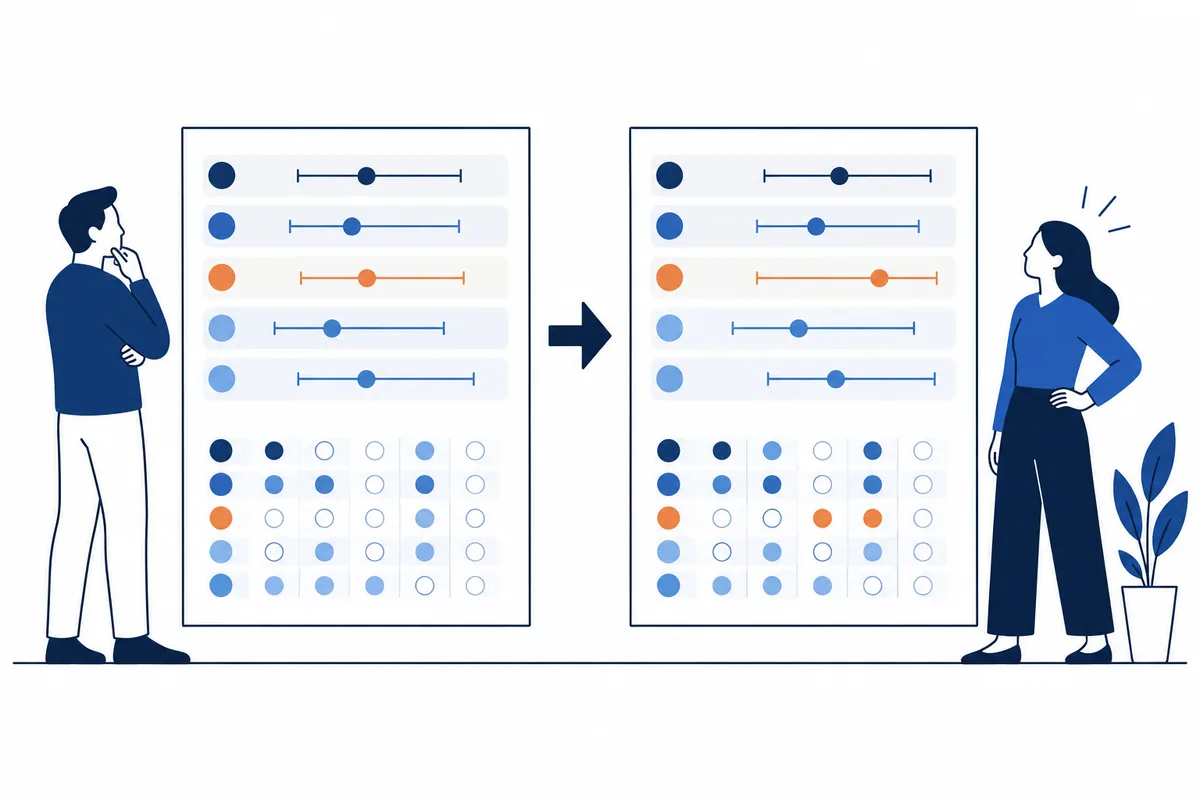
Workplace emotional-skills training can improve measured competencies on average. Evidence is less certain that a particular course will produce lasting changes in a specific work interaction: studies measure different skills, use different raters, and vary in follow-up and design. Choose training for a defined behavior you can practice, then seek specific feedback from someone who can observe it.
What changes when a course is measured?
The first question is what “improvement” refers to. A course can leave participants with a higher score on a skill measure; that change may remain at a later follow-up; a learner may then use the skill in a real exchange; and the exchange may contribute to a consequential result, such as clearer coordination or better care. These are four different steps in an outcome ladder. Transfer means applying what was learned in the job. Evidence at one step does not automatically establish the next: a post-course score can show that measured responses changed, but it cannot by itself show that a worker handled a tense handoff differently months later, or that the team’s work improved. The workplace review, “Training emotional competencies at the workplace: a systematic review and metaanalysis,” gives a useful starting point because it asks whether emotional competencies can change in working adults. It combined 50 studies in its pre-to-post analysis and analyzed 27 controlled trials separately. Across the broader set, the authors reported an average improvement in measured competencies; in the controlled-trial analysis, the estimated difference between training and control groups was also positive. The review’s scope matters: it grouped programs aimed at emotional intelligence, empathy, and emotion regulation under an umbrella term. Those targets overlap in some courses, but they are not interchangeable skills. A pooled result therefore supports the general claim that workplace training can improve assessed emotional competencies on average. It does not tell a reader which single skill changed in every course, or how much a particular employee should expect to change. The study pool included employees from different professions and training programs, while the measures also varied. Most programs targeted emotional intelligence, fewer focused on empathy, and only two of the 50 trained emotion regulation. The review found no statistically significant differences in average effects by profession or training construct. That is a comparison across the included studies, not proof that every approach works equally well in every role; the groups and evidence behind each estimate were uneven. A broad average can be encouraging while still leaving the practical question open: will a course help with the moment that keeps recurring in this person’s work? Keeping that question open does not erase the evidence of learning. The controlled comparison is more informative than a simple before-and-after change because it gives researchers another group against which to compare the trained participants. Yet even a positive group-level contrast describes an average across participants, programs, and measures. It is not an individual forecast, and it is not direct evidence of better teamwork. A learner can reasonably take the result as evidence that emotional skills are teachable in workplace settings, then ask what the course measured and whether that measure matches the behavior they want to practice. A program that improves a general competency score may be a promising starting point; evidence about a changed feedback conversation, meeting, or handoff requires looking further along the ladder. For example, noticing irritation earlier is a skill-level change; pausing before replying in a real disagreement is a behavior claim. The second needs evidence about what happened at work, not just a score collected after class.
Sources: Training emotional competencies at the workplace: a systematic review and metaanalysis
Why the measure changes the meaning of improvement
A higher questionnaire score, a better performance-task result, and a changed work behavior are different outcomes; each supports a different claim. A questionnaire asks people to describe their usual emotional habits or how they see themselves. A performance-based task presents a defined emotional problem and scores a response against the task’s scoring method. Neither is a direct record of what happens in a tense meeting. The distinction matters because a course can change what someone notices about their habits, what they can do with a structured problem, or what they actually do with a colleague; evidence for one does not automatically establish the others.
The randomized study Can emotional intelligence be improved? A randomized experimental study of a business-oriented EI training program for senior managers makes this difference visible. It assigned 54 senior managers in one private company to a seven-week, 30-hour program or a wait-list control. Researchers measured self-perceived emotional intelligence with the EQ-i questionnaire, then used two situational tests: one asked participants to infer emotions from described situations, and the other to choose a response to hypothetical emotion-management scenarios. The study compared reports about typical tendencies with performance on defined tasks, rather than treating “EQ” as one interchangeable score.
The results show why timing and skill matter. After training, the intervention group improved on several EQ-i dimensions and on the situational measures. At the one-year follow-up, intrapersonal EI, self-perception, general mood, self-expression, and stress management remained improved; emotional understanding and management scores had increased further. Interpersonal and adaptability scores did not show significant improvement. The authors describe change on their measures, and note they did not assess whether those gains improved job satisfaction, performance, or leadership. A year-later task score is evidence of retained or increased task performance; it is not proof of a changed feedback conversation.
This is stronger evidence than an immediate questionnaire alone for whether this program changed measured outcomes: the study used random assignment, a comparison group, several measures, and a one-year follow-up. Its boundary is concrete. It involved senior managers in one company, and its measures did not directly observe routine interactions at work. In Training emotional competencies at the workplace: a systematic review and metaanalysis, 50 studies contributed to the pre-post analysis, but only seven used ability tests; most relied on self-report. That breadth helps estimate whether measured competencies can change across programs, while the measurement mix limits what the pooled result says about conduct. When a course evaluation reports only a broad questionnaire immediately after class, it supports a claim about reported self-perception at that time. To claim a skill was retained, the measure needs a later check; to claim behavior changed, the measure must examine behavior. Ask what instrument changed, when it was used, and whether it captures the interaction the employee wants to improve.
Sources: Can emotional intelligence be improved? A randomized experimental study of a business-oriented EI training program for senior managers; Training emotional competencies at the workplace: a systematic review and metaanalysis
Which gains reach beyond the score?
Some targeted studies report communication, care, well-being, or related outcomes, but evidence for these is narrower than evidence of change on emotional-skill measures. The outcomes describe different things: a worker may feel less strained, a colleague may notice a different response in a tense exchange, or a resident may rate the care received. Each can matter, but one cannot stand in for another.
The systematic review Emotional intelligence training among the healthcare workforce: a systematic review and meta-analysis examined 17 longitudinal studies of healthcare workers. Every included study reported an increase in emotional intelligence after training, but the authors warn that methodological limitations may have exaggerated the effects. The review also considered secondary outcomes including burnout, well-being, and mental health. A worker’s improved well-being is relevant, yet it does not establish that a particular conversation became clearer or that service quality improved. The review is bounded by healthcare settings, where emotional demands and patient contact differ from many jobs. It maps outcomes studied in one sector rather than providing a forecast for workplace training generally.
A more concrete step toward a work outcome appears in The effects of emotional intelligence training on the job performance of Australian aged care workers. This quasi-experimental study compared training and nontraining groups at two geographically separate facilities. Each began with 60 participants; by post-study assessment, 27 remained in the training group and 17 in the control group. Over six months, researchers examined well-being and psychological empowerment alongside job performance, measured as self-rated and client-rated quality of care. The abstract reports significant improvement in the training group in emotional-intelligence scores, quality of care, general well-being, and psychological empowerment, with no significant differences in the control group. This is broader than a course-end questionnaire, and client ratings add a care recipient’s perspective.
The design leaves uncertainty about cause and reach. Participants were not randomly assigned, final groups were small, and fewer than half of each starting group contributed to the post-study sample. Facility differences, who remained, or other changes over six months could have influenced the results. The study concerns aged-care workers and resident care; it cannot tell an office employee what to expect from a course on disagreement, feedback, or project handoffs. A care-quality rating also does not identify which emotional behavior changed. The finding is a promising signal in one setting, not proof that training generally raises productivity or improves every interaction.
For a course chosen to improve a difficult handoff, general well-being is too distant to answer the practical question. Evaluation should name an observable handoff behavior, such as whether the receiver can restate the decision and unresolved issue, then check it after practice. Care-quality research shows broader outcomes can be measured, but its result does not transfer automatically to another job or goal. Keep the levels distinct: emotional-skill measures concern what a course teaches; well-being describes workers’ experience; interaction ratings concern conduct; service-quality measures concern what another person receives. The nearer the measure is to the desired outcome, the more directly it answers the question, while population and design still limit the inference.
Sources: Emotional intelligence training among the healthcare workforce: a systematic review and meta-analysis; The effects of emotional intelligence training on the job performance of Australian aged care workers
Why can learner and supervisor accounts diverge?
A change can look different from inside a conversation and from a manager’s desk. The learner may notice pausing before replying or deciding to ask a clarifying question. A supervisor may see only whether the employee interrupted, followed through, or changed how a disagreement ended. Those accounts answer related but distinct questions. Self-report can capture an intention or choice that was not visible; an observer can describe conduct they witnessed. Neither alone settles whether a course caused lasting change.
The study “Does Social and Organizational Support Moderate Emotional Intelligence Training Effectiveness?” followed 176 government officials in Sri Lanka after emotional-intelligence training. It assessed learning and transfer, defining transfer through changes in organizational citizenship behavior (OCB), such as discretionary helpful conduct, and counterproductive work behavior (CWB), conduct that can hinder work. Participants rated their OCB and CWB, and supervisors supplied evaluations; researchers analyzed the self-evaluation and supervisor-evaluation samples separately. Measurements were taken before training and at later points, including one and three months afterward. This is more informative about behavior over time than an immediate course reaction, though broad behavior scales do not directly measure a single difficult exchange.
The results require care in how they are summarized. The authors reported positive training effects on learning and transfer outcomes in both evaluation samples. In the supervisor sample, however, they did not find a positive effect on learning or transfer in the specific learning-to-transfer analyses, and the link between learning and transfer was not robust overall. The paper’s conclusion describes positive training effects in both samples while also reporting that learning did not consistently account for later transfer. These are different statistical questions: a direct association between taking part in training and behavior change can appear even when measured learning does not explain that change. The findings do not mean supervisors saw no change at all.
The samples should not be described as two people independently rating each same employee and incident. The study reports separate self and supervisor evaluation samples, and the later supervisor sample included 78 responses. A difference between analyses can arise from what each measure captures, which observations are available, and the smaller evidence base in one sample. Self-ratings may register private efforts or conduct outside a supervisor’s view. Supervisors may see a narrower slice of behavior and apply their own expectations. The study cannot tell us which explanation accounts for any particular divergence, and its authors caution that results from one government organization and one training program may not generalize elsewhere.
A second study illustrates a different measurement limitation. “Online Mindfulness Training Increases Well-Being, Trait Emotional Intelligence, and Workplace Competency Ratings” was a randomized waitlist-controlled trial of an eight-week online mindfulness program among full-time employees at a large U.S. company. The intervention group reported changes in well-being and trait emotional intelligence relative to the waitlist group. The researchers also collected self and colleague ratings of workplace competencies, but only in the intervention group. They described those ratings as preliminary evidence. Because the control group did not provide comparable workplace competency ratings, colleague reports cannot establish that the program caused a change in workplace performance. Mindfulness is also a related intervention, not a stand-in for every emotional-skills course.
For a person applying this evidence, disagreement between self and observer feedback is a reason to sharpen the question. Ask one colleague or supervisor about a specific behavior they had a fair opportunity to see: for example, “In the last two project discussions, did I ask for an example before defending my proposal?” That answer can help identify what to practice next. It remains feedback about observed moments, not a verdict on the learner or a controlled estimate of training impact.
Sources: Does Social and Organizational Support Moderate Emotional Intelligence Training Effectiveness?; Online Mindfulness Training Increases Well-Being, Trait Emotional Intelligence, and Workplace Competency Ratings
What does workplace support change—and what remains unclear?
In a study of 176 Sri Lankan government officials, perceived social and organizational support strengthened some links between emotional-intelligence training and training outcomes in officials’ self-evaluations. The same moderation was not found in supervisor evaluations. The study therefore gives a conditional result: support mattered in one rating sample, but the pattern did not carry consistently across the two sources of evaluation. It does not establish that a supportive manager will make any emotional-skills course effective.
The researchers measured training transfer through changes in organizational citizenship behavior and counterproductive work behavior. In plain terms, these are broad categories of conduct that can help an organization function or work against it. Participants assessed their own behavior, and supervisors supplied evaluations that the researchers analyzed separately. These were not paired judgments that let the study settle which person saw an individual employee more accurately. The supervisor group was also smaller at the later follow-up: the evidence ledger records 78 responses at three months. That makes the difference between samples part of the finding, rather than a reason to discard one set of ratings.
A useful distinction follows from the result. Learning a response in a course and having a realistic chance to use it at work are separate steps. A person may understand how to pause before replying to criticism, for example, yet face a pace or power dynamic that leaves little room to do so. Time to practice, a chance to try the response, and feedback from someone who sees the interaction are practical conditions to consider when choosing a course. They are not each confirmed effects of this study; its support measures and broad behavior outcomes do not tell us which specific workplace condition would change a particular conversation.
The study is relevant to a course decision because it asks whether support changes the relationship between training and later outcomes, rather than measuring only satisfaction at the end of a session. Its setting still matters: the participants were government officials in Sri Lanka, and the outcomes were broad behavior ratings. A separate supervisor result does not mean feedback from a supervisor is useless. It means this study did not find the same support pattern in that sample, and a supervisor can rate only conduct they have had a fair chance to observe.
When considering training for a recurring difficulty, name one behavior the course teaches and identify a plausible place to practice it afterward. If workload or the surrounding interaction makes that impossible, the barrier is not simply a gap in the employee’s skill. A useful question to raise with a manager is: “Where could I try this response in the next few weeks, and who could give me specific feedback afterward?”
Sources: Does Social and Organizational Support Moderate Emotional Intelligence Training Effectiveness?
How uncertain are the gains in a new workplace?
The pooled result is positive, but it is a poor forecast for any one workplace course. “Training emotional competencies at the workplace: a systematic review and metaanalysis” combined 50 studies of emotional-intelligence, empathy, and emotion-regulation training, then analyzed 27 controlled trials separately. In those controlled comparisons, the average difference between trained and comparison groups was 0.47 standard deviations (95% confidence interval 0.31 to 0.62). A standardized mean difference expresses a gap in units of score variation, allowing results on different scales to be combined. It is an average, not a forecast for one conversation. The spread around that average matters. For the controlled estimate, the review reported I² of 68%, indicating substantial variation between study results beyond sampling noise. Its 95% prediction interval ran from -0.34 to 1.29 standard deviations. A confidence interval estimates uncertainty around the pooled average; a prediction interval estimates where an effect from a new, comparable study may fall. Here that range includes a small result in the opposite direction and a much larger positive one. The average cannot settle what will happen in another setting. The evidence itself is uneven. Across the 50 studies, 18 were judged at critical risk of bias and 28 at serious risk, often because before-and-after designs could not separate training from other changes over time, or because participants and assessors knew an intervention had occurred. Most studies relied on self- or peer-report; only seven used ability tests. Removing critically rated studies changed the estimate only modestly, but the prediction interval remained broad and heterogeneity high. The positive pooled result did not depend entirely on those studies, but the evidence remains imprecise. The review also found statistical signs consistent with publication bias in both its before-and-after and controlled analyses. Studies with positive findings may be more likely to appear in the published record; the signal calls for caution, but does not prove the pooled effect is false. The controlled estimate fell from 0.47 to 0.40 after removal of one influential outlier, while heterogeneity declined from 68% to 47%. The positive average remained, though individual studies can move the summary. Time is another limit. The abstract reports effects persisting beyond three months, but follow-up was available in only 11 of the 50 studies. Follow-up results were extremely heterogeneous, and the authors found no significant difference between studies with earlier and later first follow-up assessments. A later positive result is evidence that gains may last for some participants; it is not a dependable estimate of durable change across courses. The review also combined related constructs and often averaged subscales into an overall score, which can conceal whether a specific skill improved. No eligible studies focused on emotional-awareness or conflict-management training, despite the search for them. For a new workplace, the safest conclusion is bounded: training can improve measured emotional competencies on average, while the size and persistence of change from a particular course remain uncertain. Evidence is more direct for changes on the measures used in studies than for durable change in a specific work interaction. When weighing a course, look for evidence tied to its target skill, an appropriate comparison, and follow-up that matches when the behavior matters. The pooled average establishes a credible possibility of learning; it cannot promise that an employee will handle feedback, disagreement, or repair differently months later.
Sources: Training emotional competencies at the workplace: a systematic review and metaanalysis
What counts as a fair comparison of training results?
A fair comparison asks whether two results concern the same thing. A course may raise a self-report score after participants learn the questionnaire’s language. Another may test emotion understanding months later or ask colleagues whether behavior changed. Before saying one course works better, check the skill taught, measure, timing, population, and rater. “Training emotional competencies at the workplace” combined 50 studies of emotional intelligence, empathy, or emotion regulation, then estimated effects across 27 controlled studies. The pooled estimate was a standardized mean difference of 0.46 (95% confidence interval 0.30 to 0.63). This supports an average difference in measured competencies; it does not rank courses. The estimate speaks to measured change, not which program teaches a specific behavior. A before-and-after score leaves open what else changed. Participants may have gained experience or encountered events affecting their answers. In the review, 18 studies were judged at critical risk of bias, largely because uncontrolled designs could not rule out confounding; 28 more were judged at serious risk. Removing critical-risk studies changed the pooled estimate only marginally, but that does not make remaining comparisons equally strong. A comparison group measured at the same times gives a better reference for what might have happened without training. “Does Social and Organizational Support Moderate Emotional Intelligence Training Effectiveness?” analyzed government officials’ self-evaluations and supervisor evaluations in separate samples. The study reported training effects on learning and selected behavior outcomes, while some relationships differed by rater; the three-month supervisor sample included 78 responses. These were not paired ratings of each employee. The findings cannot say whether a colleague would notice a conversation changing. They show why a provider should name who rated behavior and when. A randomized mindfulness trial, “Online Mindfulness Training Increases Well-Being, Trait Emotional Intelligence, and Workplace Competency Ratings,” offers another caution. Colleagues rated competencies for intervention participants, but the control group supplied no comparable ratings. The authors describe these findings as preliminary. A colleague may notice conduct that a questionnaire misses, yet this comparison cannot isolate a training effect on observed conduct. An observer needs a real opportunity to see the behavior. For a quick appraisal, ask whether the same skill was measured at baseline and follow-up, whether follow-up allowed time to use it, and whether a comparison group was measured at the same points. Ask who rated behavior and whether that person could observe it. A supervisor who rarely attends a difficult handoff cannot judge it well. The learner can report pausing before reacting; a colleague can describe whether that pause changed the exchange. Neither view captures private effort and visible conduct. Keep the study average separate from an individual prediction. A group difference does not establish that every participant improved or another workplace will see the same result. A useful comparison holds the intended skill and outcome steady, follows participants long enough to test retention or use, and includes a credible reference group. If a provider offers only an immediate before-and-after score, conclude only that answers changed after the course. Ask for later, behavior-specific evidence before concluding that work interactions changed.
Sources: Training emotional competencies at the workplace: a systematic review and metaanalysis; Does Social and Organizational Support Moderate Emotional Intelligence Training Effectiveness?; Online Mindfulness Training Increases Well-Being, Trait Emotional Intelligence, and Workplace Competency Ratings
How can you tell whether one skill is showing up at work?
Choose one recurring situation, name a behavior the training asks you to practice, and invite feedback from someone who can actually observe it before and after practice. Keep the question small enough to answer from what happened: in a feedback conversation, did you ask for a specific example before explaining your position? “Am I better at handling criticism?” asks for a broad judgment; “Did I ask one clarifying question before replying?” gives both people something they can recall.
Describe the situation and action in ordinary language. When a colleague raises a concern about your work, for example, pause to ask which moment or result they mean. Before practice, note how the exchange usually goes in a brief factual description. After trying the new response in comparable conversations, ask the same colleague what they noticed. Invite a concrete instance and allow “I didn’t notice” as an answer. The aim is to learn whether the behavior is becoming visible, not to persuade someone it has improved.
There is a reason to keep self-observation and outside feedback separate. In “Does Social and Organizational Support Moderate Emotional Intelligence Training Effectiveness?”, an experimental longitudinal study of 176 Sri Lankan government officials, researchers analyzed self-evaluations and supervisor evaluations in separate samples. They reported training effects on learning and transfer outcomes, while support moderated some relationships in the self-evaluation sample but not the supervisor sample; the three-month supervisor sample contained 78 responses. That design does not tell us whether one employee changed one habit. It shows why learner and supervisor reports should not be collapsed into one verdict.
A randomized waitlist-controlled mindfulness study offers a related caution about observer ratings. “Online Mindfulness Training Increases Well-Being, Trait Emotional Intelligence, and Workplace Competency Ratings” found preliminary self and colleague rating evidence among intervention participants, but comparable competency ratings were not collected from the control group. Its authors therefore could not use those ratings to establish a controlled change in workplace performance. A colleague’s account can help identify behavior that you may miss; it cannot, by itself, show what caused that behavior.
Treat this check as reflection and feedback, not an experiment. One exchange cannot separate practice from workload, the other person’s response, or ordinary variation between conversations; one observer also sees only some moments. A specific behavior and fair observer make the next step clearer. If the question came too late, try asking it earlier. If the colleague did not observe enough exchanges, choose a setting where they can. This gives useful developmental information while keeping claims about training’s effect modest.
Sources: Does Social and Organizational Support Moderate Emotional Intelligence Training Effectiveness?; Online Mindfulness Training Increases Well-Being, Trait Emotional Intelligence, and Workplace Competency Ratings
What should you do with the evidence for your own practice?
Choose a course whose promise names a behavior you can practice: pausing before replying to criticism, for example, or asking what a colleague needs before proposing a fix. “Training emotional competencies at the workplace” found average gains across measured skills, but its mix of programs and outcomes cannot predict whether one course will change that exchange. “Does Social and Organizational Support Moderate Emotional Intelligence Training Effectiveness?” shows why setting matters: learning and later behavior are separate outcomes, and practice opportunities matter. Before enrolling, name the situation you want to handle differently and ask whether the course rehearses that skill. Then ask someone who sees the situation to discuss one behavior after you have practiced. EQ Test’s private 32-item Emotional Skills Profile at /assessment can prompt reflection on recent habits and scenario judgments; it is an educational tool, not proof that training worked. Start with one conversation: “Could you tell me whether I pause and ask a clarifying question when feedback is difficult?”
Sources: Emotional Skills Profile
Questions readers ask
What does workplace emotional-skills training improve?
A workplace meta-analysis found average improvement in measured emotional competencies across programs focused on emotional intelligence, empathy, and emotion regulation. Some narrower studies also report outcomes such as well-being or care quality. Those findings do not establish that every course improves every skill or work behavior.
Do training gains last?
Some studies report gains at later follow-up, but follow-up evidence is limited and varies across programs and measures. A later score can support a claim about retained measured change; it does not by itself show a lasting change in daily work behavior.
Why might a learner and supervisor report different results?
Learners can report intentions and choices that may not be visible to others. Supervisors can rate only behavior they have a chance to observe. Differences between ratings can reflect these distinct perspectives and measures; they do not, by themselves, establish which account is correct.
How can I check whether one skill is showing up at work?
Name a specific behavior in a recurring situation, practice it, and ask someone who can observe that situation what they noticed. Treat the response as developmental feedback, not proof that training caused a change.
Sources
- Training emotional competencies at the workplace: a systematic review and metaanalysis
Supports the pooled workplace-training findings and the review's reported heterogeneity, risk-of-bias concerns, publication-bias signal, and limits on follow-up and outcomes.
- Can emotional intelligence be improved? A randomized experimental study of a business-oriented EI training program for senior managers
Supports the comparison of self-perceived and situational-measure outcomes in a randomized, seven-week training study of senior managers.
- Emotional intelligence training among the healthcare workforce: a systematic review and meta-analysis
Supports the healthcare-specific review findings, including its 17 longitudinal studies and the authors' caution about methodological limitations.
- The effects of emotional intelligence training on the job performance of Australian aged care workers
Supports the aged-care study's quasi-experimental design, participant counts, and reported outcomes in its accessible abstract.
- Does Social and Organizational Support Moderate Emotional Intelligence Training Effectiveness?
Supports the longitudinal study's separate self and supervisor evaluation samples, reported training effects, and differing support patterns.
- Online Mindfulness Training Increases Well-Being, Trait Emotional Intelligence, and Workplace Competency Ratings
Supports the randomized waitlist design and the authors' description of intervention-only workplace competency ratings as preliminary.
- Emotional Skills Profile
Supports the assigned destination and the product's role as a private educational reflection profile.
Apply it to the real situation
Choose one emotional skill to practice at work
From this guide: Use reflection on recent habits and scenario judgments to identify a behavior to explore; seek feedback from someone who can observe it.
Training research can show average changes across groups, but it cannot tell you which behavior will matter in your own next difficult conversation. The private 32-item Emotional Skills Profile offers a way to reflect on recent habits and scenario judgments, then choose a question to practice. Use it as an educational development tool, not as evidence that training worked.