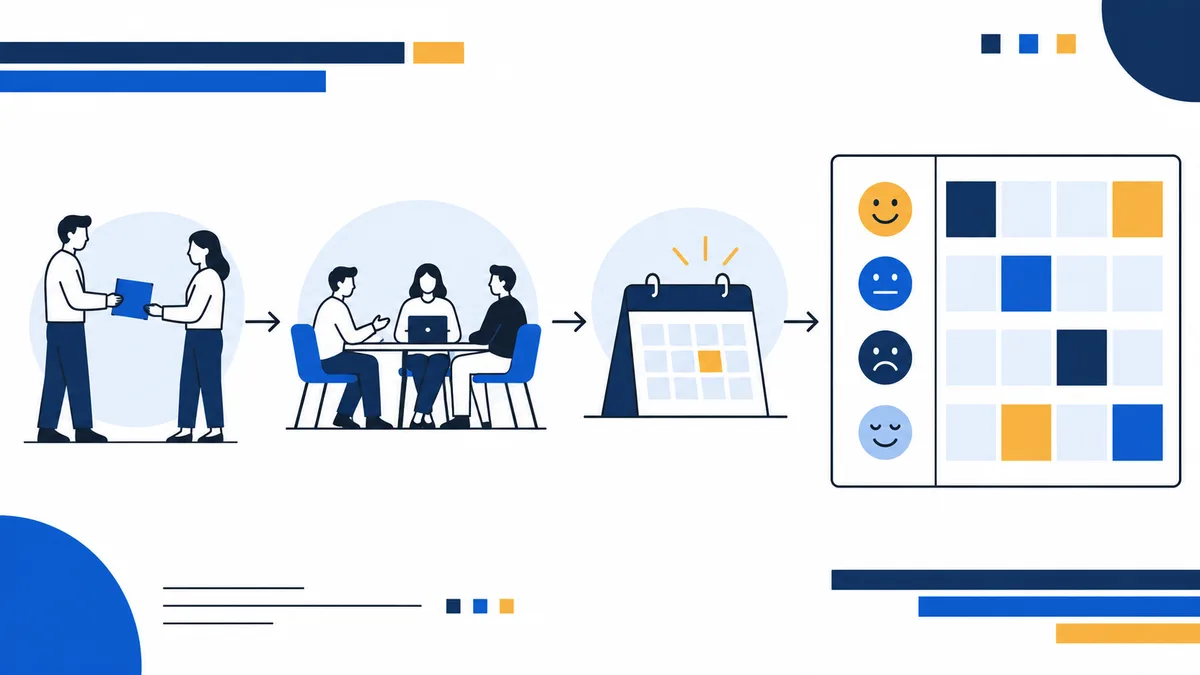
The Workplace Affective Events Survey (WAES) asks respondents to recall selected positive and negative workplace events from the previous two to three weeks, then rate the associated emotion’s intensity. It records remembered event occurrence and reported feeling, not moment-to-moment change or proof that an event caused an emotion. Its pilot evidence supports a structured research measure in the tested context, not an emotional-intelligence score or employee ranking.
What the WAES records—and what it does not
The Workplace Affective Events Survey (WAES) records whether a respondent recalls selected positive and negative events at work during the previous two to three weeks, then asks how intense the associated emotion felt. In the pilot form, each event first receives a yes-or-no occurrence response. When the respondent marks yes, they rate intensity from 0, meaning no emotion, to 4, meaning very pleasant or unpleasant. The survey therefore keeps two things visible: which listed situations the person remembers encountering, and the strength of the feeling they associate with an endorsed event. The paper, “Development and Validation of the Workplace Affective Events Survey,” describes 30 positive and 29 negative event items in the pilot. That structure makes WAES a retrospective event inventory. It can help someone notice which kinds of listed work situations recur in memory and whether those endorsed situations carried stronger or milder feelings. But the answer is bounded by the events the survey includes and the respondent’s recollection of the stated window. It does not record emotions as they unfold, establish that an event caused a feeling, or measure emotional intelligence. A high intensity response is a report about an event-linked feeling, not a score for emotional skill or ability. Nor should the pilot format be assumed to describe every later version called WAES unless that version’s form is checked. Read the result as a prompt to ask what happened and what the respondent remembers feeling, then investigate the circumstances.
Sources: Development and Validation of the Workplace Affective Events Survey
How did researchers decide which events belonged on the list?
The WAES list began with workers describing what happened in ordinary workdays, then researchers organized those accounts into a survey. That matters when judging whether a result fits a particular role: the items have an empirical starting point, but they represent a selected set of recurring situations rather than every possible source of emotion at work. In “Development and Validation of the Workplace Affective Events Survey,” the item-generation phase drew on five focus groups and nine individual interviews, involving 31 working people. Participants discussed the emotions they encountered and the events that prompted positive or negative feelings. The researchers used those accounts to ground the instrument in workers’ reported experience, rather than constructing the list solely from abstract definitions.
They next compared the collected themes with an existing taxonomy of workplace affective events, a classification scheme for situations linked to emotional responses at work. The taxonomy helped sort categories such as recognition, goal achievement, workload, feedback, and autonomy. It did not dictate the final list. Some taxonomy categories, including company policies and organizational reputation, were omitted because the study focused on day-to-day events. Conversely, themes that did not fit the predefined categories were retained for possible items.
The first item pool was limited to everyday events, rather than major, infrequent work changes, and situations expected to evoke a fairly clear positive or negative feeling. Three experienced psychological and affect researchers reviewed item clarity, relevance, and difficulty. After overlapping and infrequently reported items were removed, two rounds of pre-pilot feedback led to further revisions. One practical problem surfaced: some people interpreted the same situation as positive while others saw it as negative. The researchers deleted or revised disputed items to make the positive or negative classification clearer. That makes categories clearer, though an event whose meaning depends on role or circumstances may not be represented in all its ambiguity.
The final pilot involved 300 entry- and mid-level service-sector employees recruited across 29 organizations and nine industries in Bengaluru, India. Participants were 25 to 55 years old and had to be able to read, write, and speak English; the study also required at least six months in their current workplace. A reader in a different language, country, industry, or job structure should ask whether the listed events resemble the situations they actually face. If a central source of emotion is missing or classified in a way that does not fit, the WAES result cannot fill that gap by itself. It can still prompt a useful question: which recurring events on this list match my work, and which important ones fall outside it?
Sources: Development and Validation of the Workplace Affective Events Survey
Why separate event occurrence from emotional intensity?
The WAES keeps two questions apart: did a listed event happen during the recall period, and how intense was the emotion the respondent associated with it? In the final pilot form, a “yes” to an event triggered an intensity rating from 0, “did not feel any emotion,” to 4, “felt very pleasant/unpleasant.” As Development and Validation of the Workplace Affective Events Survey describes, occurrence and reported feeling are separate layers. A list of frequent events does not show how strongly people reacted; an intensity summary does not show how often situations arose. This separation changes the follow-up. If a positive event occurred repeatedly but received modest intensity ratings, one might ask whether it was routine and welcome without being especially moving. If a negative event was endorsed rarely but linked to high intensity, the question becomes what made that instance stand out. These are reflection prompts, not findings about any particular employee. The survey alone cannot establish that a frequent event is trivial, that a rare one matters more, or that either pattern reflects emotional skill. “Positive” and “negative” describe the event groups in the final instrument, not a person’s full emotional vocabulary. The paper says researchers first considered asking participants to rate event valence, then removed that step to simplify responses and reduce burden. Instead, items are organized as positive or negative events, with intensity rated after an occurrence is reported. The grouping is built into the item set; the rating adds information about the respondent’s reported experience. The scale’s endpoints run from no emotion to feeling “very pleasant/unpleasant,” reflecting the positive or negative event section. They do not name a particular emotion such as gratitude, irritation, relief, or worry. A high rating is a retrospective intensity judgment within that event category. It should not be translated into a universal emotional-strength score or treated as a direct measure of regulation, empathy, or emotional intelligence. The pilot results show why the layers should stay distinct. Among 300 service-sector employees in Bengaluru, India, the authors reported averages of 22.95 of 30 positive events and 9.45 of 29 negative events. Aggregate positive and negative intensity totals were 63.96 and 19.39. Since these totals combine different item sets, they do not directly compare how intensely an individual felt one positive event with one negative event. The sample and pilot design also bound what this pattern can say. For reflection, occurrence can prompt a question about work conditions that repeatedly bring a listed situation into view. Intensity prompts a different question: what did the respondent experience, and what detail might be worth revisiting? The WAES structures these two inquiries; it does not decide which event mattered most or what the response means for a person’s next action.
Sources: Development and Validation of the Workplace Affective Events Survey
What does the pilot evidence actually establish?
The pilot evidence gives the Workplace Affective Events Survey (WAES) a credible starting point as a research measure, with results that should be read inside the sample and design that produced them. In “Development and Validation of the Workplace Affective Events Survey,” the researchers tested it with 300 entry- and mid-level service-sector employees, ages 25 to 55, recruited across 29 organizations and nine industries in Bengaluru, India. Participants completed the WAES alongside measures of trait affect, or how they generally feel, and workplace social companionship. This was a cross-sectional pilot: it offers an initial check on consistency and expected relationships, not a final standard for interpreting every worker’s responses. The authors report internal-consistency coefficients (Cronbach’s alpha) of .94 for both positive and negative emotion-intensity subscales. Internal consistency describes how closely items within a subscale tend to move together. Those coefficients support treating each set of intensity items as a coherent summary in this sample. They do not show that the survey captures every important workplace event, that scores stay stable across time, or that a given response has the same meaning in another occupation or language. The occurrence summaries were counts of endorsed events, and the paper did not report alpha coefficients for those counts. The study also found associations in directions the authors expected for convergent evidence: whether WAES scores related to other measures of nearby ideas. Trait positive affect correlated with positive emotion intensity at r=.30 and with positive-event occurrence at r=.15. Trait negative affect correlated with negative-event occurrence at r=.41 and negative intensity at r=.42. Workplace social companionship correlated with positive intensity at r=.37, while its associations with negative-event occurrence and negative intensity were r=-.23 and r=-.19. These are correlations, so they show that scores varied together in this sample; they do not identify why. A supportive workplace might shape experience, a person’s broader affect might shape recall or interpretation, or both could reflect other conditions. The design cannot separate those explanations. That is useful evidence for a proposed map of remembered events and associated feelings. It is not a population norm, a universal EQ score, or evidence that WAES can rank employees. The pilot authors themselves state that snowball recruitment may have introduced sampling bias, that findings primarily apply to English-speaking service-sector workers at entry or middle levels, and that diverse samples are needed to confirm the tool’s psychometric properties. They also note that the cross-sectional design cannot establish causality. In practical terms, the paper supports using WAES as a structured research instrument in contexts resembling its pilot, while further studies test its performance elsewhere.
Sources: Development and Validation of the Workplace Affective Events Survey
Why does the two-to-three-week recall window change the record?
A two-to-three-week window lets the Workplace Affective Events Survey (WAES) cover more than one busy or quiet day. In the 2023 development paper, respondents indicated whether each listed event had occurred during that period, then rated the intensity of the associated emotion. The result is a retrospective inventory. It does not preserve the order of events, the time between an event and a reaction, or changes in feeling from moment to moment. The window shapes the question the record can answer: it summarizes remembered occurrence and intensity across a stretch of work, while leaving much of the emotional sequence unseen. (Development and Validation of the Workplace Affective Events Survey) Memory over that interval is not simply a longer recording. “Retrospective Ratings of Emotions: the Effects of Age, Daily Tiredness, and Personality” distinguishes episodic knowledge, tied to particular moments, from semantic knowledge, the broader beliefs a person has about themselves. Its account proposes that immediate reports draw on current experience, short-term reports can draw on specific memories, and reports over a week or several weeks rely more on generalized knowledge. Salient incidents and current emotional state can also affect which details come readily to mind. Someone may recall a sharp disagreement vividly while routine interactions blend into a general impression of work. This illustrates the proposed mechanism; it is not a documented WAES response. That emotion-recall study used experience sampling across two weeks. Participants rated momentary emotions seven times a day, gave end-of-day ratings, and later rated the prior two weeks. The findings linked daily tiredness and age to some retrospective ratings over a day, and personality traits to longer-term ratings. The authors conclude that tiredness and personality can influence how past feelings are viewed. This suggests that retrospective reports may reflect experience and the lens through which it is remembered. It does not quantify error in WAES, which asks about selected work events and associated intensity rather than repeated ratings of basic emotions. Nor does it show that every two-week account is inaccurate. The practical distinction is breadth versus timing. A structured window lets someone consider many listed event types without stopping work to report after each one. This can surface a pattern worth examining. But if the question is whether a tense exchange preceded a mood change, or how a feeling shifted during a meeting, later recall cannot supply the same temporal detail as a closer record. Repeated event sampling asks people to report near the moment or at set intervals. It can preserve timing and variation, while requiring repeated attention and responses. The methods answer related but different questions. When reading a WAES pattern, retrieve a few concrete instances before drawing a conclusion. Ask what happened, roughly when, and what was felt; then consider whether those memories fit the broader summary or whether one vivid episode dominates it. This is a reflective check, not a validated WAES procedure. If timing matters, closer-in-time notes better match the question. If the aim is a broad view of selected events over recent work, the recall window offers a useful summary, with some chronology necessarily smoothed.
Sources: Development and Validation of the Workplace Affective Events Survey; Retrospective Ratings of Emotions: the Effects of Age, Daily Tiredness, and Personality
When is a diary a fair comparison with WAES?
Choose a diary when the question depends on timing: what happened shortly before a reaction, whether reactions change from one workday to another, or what tends to follow a particular event. The Workplace Affective Events Survey (WAES) asks people to look back across a stated period and report selected event types and associated emotional intensity. In its pilot form, respondents marked whether listed events had occurred in the previous two to three weeks, then rated the emotion’s intensity for events they endorsed. This gives a broad sweep of remembered events in one sitting. A diary trades some of that retrospective breadth for a closer record of experience as it unfolds. The designs answer different questions, so neither is a direct accuracy benchmark for the other.
Experience sampling, a diary method that prompts people repeatedly during daily life, can record events near the time they occur or at planned moments. In a study of 83 healthcare professionals, “Daily Negative Work Events and Employees’ Physiological and Psychological Reactions” used scheduled and optional event-triggered reports; participants recorded work events from the prior 30 minutes across three workdays. More reported negative work events were associated with higher negative affect and emotional exhaustion after work, while the study found no predicted association with cortisol measures. A close-in-time record still does not prove cause. The sample, setting, measures, and short observation period limit what can be carried to another workplace.
The added detail has a cost. Ten prompts a day may interrupt work, so a diary design should be justified by a question that needs repeated observations. A pooled analysis of seven experience-sampling studies, “Perceived Disturbance and Predictors Thereof in Studies Using the Experience Sampling Method,” included 1,319 participants who received ten prompts daily for four to six days. Participants reported no disturbance at 37% of occasions, and average disturbance was relatively low; reported disruption also varied with activity and social setting. Those findings describe those protocols and participants, not a guaranteed burden level for a workplace diary. More prompts can capture finer changes while also asking people to stop and report more often; fewer prompts ease that demand but may miss brief events or transitions.
Use WAES for a structured retrospective inventory of selected event categories across its recall window. Use repeated sampling when sequence or fluctuation matters enough to justify extra reporting. A broad inventory may reveal a recurring kind of interaction; a diary can ask whether the reaction appears immediately, later, or under particular conditions. The WAES pilot and healthcare diary study used different samples and methods, and did not compare the instruments head to head. Choose a diary for a timing question only when repeated observation could change the answer; otherwise, the WAES’s compact retrospective view may be sufficient.
Sources: Daily Negative Work Events and Employees’ Physiological and Psychological Reactions; Development and Validation of the Workplace Affective Events Survey; Perceived Disturbance and Predictors Thereof in Studies Using the Experience Sampling Method
What can a WAES result not tell you about cause?
A WAES result can show that a respondent remembers a listed workplace event and reports an emotional intensity associated with it. It cannot, by itself, show that the event caused the feeling. Move from “this event caused this feeling” to a testable inquiry: what happened, how was it interpreted, what else was present, and what followed? The pairing is informative, but it does not establish the order of thoughts and reactions or isolate the event from what was happening around it. Affective Events Theory offers a useful way to frame the question. In “Affective Events Theory,” workplace events are situated in a broader process: events may prompt affective reactions, which can relate to work attitudes and behavior. Work conditions and a person’s appraisal also matter. It helps frame questions about a work incident and an emotional response; it does not make a recalled pairing proof of the chain. A survey that asks respondents to look back over a period does not observe the event, appraisal, unfolding emotion, and subsequent behavior. The WAES development study itself describes a cross-sectional pilot with 300 service-sector employees in Bengaluru, India. Respondents reported events from the preceding two to three weeks and, when an event had occurred, rated the associated emotion’s intensity. The retrospective survey can describe patterns and examine associations. It cannot determine whether the event produced the emotion, whether an existing mood shaped how the event was recalled, or whether a third condition influenced both. A difficult exchange, for example, might coincide with workload pressure or an unresolved earlier disagreement; the WAES response alone cannot separate those possibilities. This illustrates what the design leaves open; it is not a reported case. A different study shows why emotional association should not be read as a simple universal effect. In “Daily Negative Work Events and Employees’ Physiological and Psychological Reactions,” an experience-sampling study followed 83 German healthcare professionals. Reported negative work events predicted greater end-of-day negative affect and emotional exhaustion in the study’s analyses, while the researchers did not find a corresponding association with cortisol measures. Its sample and repeated, closer-to-time observations differ from WAES, so it neither validates nor invalidates that survey. It shows that event-linked relationships can vary by outcome. For an employee using a WAES pattern for reflection, keep the event and the explanation distinct. First name the observable occurrence; then note the reported feeling and intensity. Ask what interpretation was present, what other conditions may have contributed, and what happened afterward. A recurring association can guide a closer question or a conversation, but it is not a causal verdict about a colleague, a manager, or a person’s emotional ability. A causal claim needs evidence that establishes timing and tests alternatives.
Sources: Affective Events Theory; Development and Validation of the Workplace Affective Events Survey; Daily Negative Work Events and Employees’ Physiological and Psychological Reactions
Why event lists are useful but incomplete maps
An event list can make workplace experience easier to inspect. It also draws a boundary around what gets noticed. In the WAES development study, the researchers began with five focus groups and nine individual interviews, then compared the themes with an existing taxonomy of workplace events. Their categories included recognition, goal achievement, challenging tasks, colleagues’ and managers’ actions, task problems, workload, mistakes, feedback, teamwork, misunderstandings, and autonomy or its absence.
The researchers focused on day-to-day events likely to evoke clear positive or negative feelings. They set aside some categories from the reference taxonomy, including company policies and organizational reputation, because those did not fit that focus. Participants’ accounts brought autonomy into view, including having room to express an opinion or feeling constrained. The final inventory therefore represents a considered selection informed by workers in the study, rather than a complete catalogue of everything that can shape emotion at work. The main pilot involved 300 service-sector employees in Bengaluru, India, so the list’s fit for other occupations and cultural settings remains an open question for other readers. Someone focused on policy changes, long-term insecurity, or rare major events should not assume a list of ordinary daily occurrences captures those influences equally well.
Suppose a report shows frequent endorsement of events involving task problems. That pattern describes recalled events in the available categories; by itself it cannot tell whether the source was unclear instructions, a technical obstacle, competing demands, or another condition. The relevant next question is whether the category fits the actual work situation and what important condition the list leaves outside the frame.
The University of Sheffield repository’s record for *Workplace Moods and Emotions: A Review of Research* describes research on momentary affect, distinguishing moods from discrete emotions, and on methods for studying within-person fluctuations. A checklist can summarize selected event types across a recall period, while a momentary record can ask what someone felt at a particular point. Those records answer different questions. One identifies situations recurring in memory; the other can preserve shifts smoothed over by broad categories.
Check whether the event types match the role, notice relevant conditions they do not name, and resist extending a pattern beyond those boundaries. That approach preserves what a structured list offers: a way to ask more precise questions about work experience, without mistaking its coverage for the full emotional landscape.
Sources: Development and Validation of the Workplace Affective Events Survey; Workplace Moods and Emotions: A Review of Research
How can a person turn the record into a better work question?
A WAES pattern is useful when it leads to a question about a situation, rather than a label for its respondent. The study “Development and Validation of the Workplace Affective Events Survey” describes recording workplace events and the intensity of associated emotional responses over a recall period. These are two reports: what the respondent remembers encountering, and how strongly they remember feeling. Neither says by itself what another employee intended or what the respondent can do. Start with the event as described. If a respondent marks a missed handoff, the observation is that the handoff was missed; “my colleague does not respect my time” is an interpretation needing separate evidence. Keeping those apart makes a follow-up more specific: “Can we agree who owns the handoff and when it is due?” is easier to discuss than an accusation about motive. This is an illustrative use, not a prescribed WAES procedure. Treat intensity as the respondent’s account of their reaction. A strong response can signal that the event deserves attention, but the survey does not explain why it felt strong. The meaning may depend on what was at stake or what else was happening. A useful next question is, “What mattered to me in that moment?” If the answer points to a recurring work condition, the next step may concern the process or boundary around it, rather than correcting someone’s emotion. Check one instance before generalizing. Ask whether the event type appeared again, whether circumstances were comparable, and what happened afterward. This is a reflection aid, not a validated scoring rule or proven intervention. A pattern across remembered events can help someone decide what to observe more closely, request feedback about, or raise in conversation. It cannot establish that an event caused a feeling or that a person has a stable weakness. The WAES pilot’s reported associations do not turn an individual response into a diagnosis or employment judgment. Match the tool to the remaining question. A retrospective record can organize reflection on recurring work events; a closer-in-time record better suits a question about sequence. Reflecting on emotional habits calls for a separate tool. EQ Test’s 32-item Emotional Skills Profile is an educational reflection product about emotional skills, with no WAES scoring or validation connection. Someone seeking that separate reflection can explore it at /assessment. The aim is a clearer question and an observable next step.
Sources: Development and Validation of the Workplace Affective Events Survey
What should you do next with a WAES pattern?
Take the next step that matches the uncertainty you need to resolve; keep the WAES result as a prompt for inquiry. If the question is which listed events recur in your memory, the Workplace Affective Events Survey offers a structured retrospective inventory: return to the specific event and ask what was observable, what you felt, and what you would want to understand better. The survey’s development paper describes reported events and associated emotional intensity over its stated recall window. That record can focus reflection, but it does not establish why an event occurred or what another person intended. If timing is the unresolved part, a close-in-time record may be more useful. Note an event and a later emotional response near when each happens, rather than asking one retrospective survey to supply the sequence. Repeated prompts take effort, so use them only when the timing could change what you conclude. If your question concerns your own emotional habits, treat that as a separate reflection task: the WAES is not an emotional-intelligence test, and its findings do not validate an EQ profile. The private 32-item Emotional Skills Profile at /assessment can offer a separate educational reflection on emotional skills and possible development priorities; it does not explain or score a WAES pattern. Keep the result as a starting point for one grounded question, then choose the kind of reflection that can answer it.
Sources: Development and Validation of the Workplace Affective Events Survey
Questions readers ask
Is the WAES an emotional-intelligence test?
No. The WAES records respondents’ retrospective reports of selected workplace events and associated emotional intensity. It does not measure emotional intelligence.
Sources
- Development and Validation of the Workplace Affective Events Survey
Supports the WAES format, item development, Bengaluru pilot sample, reported reliability, and associations with related measures.
- Retrospective Ratings of Emotions: the Effects of Age, Daily Tiredness, and Personality
Supports discussion of how memory and generalized self-beliefs can shape retrospective emotion reports; it is not WAES-specific.
- Daily Negative Work Events and Employees’ Physiological and Psychological Reactions
Reports associations between negative work events and psychological reactions in a study of 83 healthcare professionals, with no corresponding cortisol association.
- Perceived Disturbance and Predictors Thereof in Studies Using the Experience Sampling Method
Supports the bounded discussion of prompt burden across pooled experience-sampling datasets.
- Affective Events Theory
Provides a theoretical account connecting workplace events, affective reactions, and work attitudes or behavior.
- Workplace Moods and Emotions: A Review of Research
Provides review context on workplace affect, momentary emotion, and methods for studying within-person fluctuations.
Apply it to the real situation
Turn a work pattern into a clearer reflection question
From this guide: The WAES can organize recalled work events; reflecting on your own emotional habits is a separate question.
A WAES pattern can help you identify situations worth examining, while leaving open how your emotional habits show up across them. The private 32-item Emotional Skills Profile offers a separate educational reflection on emotional skills and possible development priorities. It does not score or validate WAES results. Explore it if you want a distinct starting point for personal reflection.