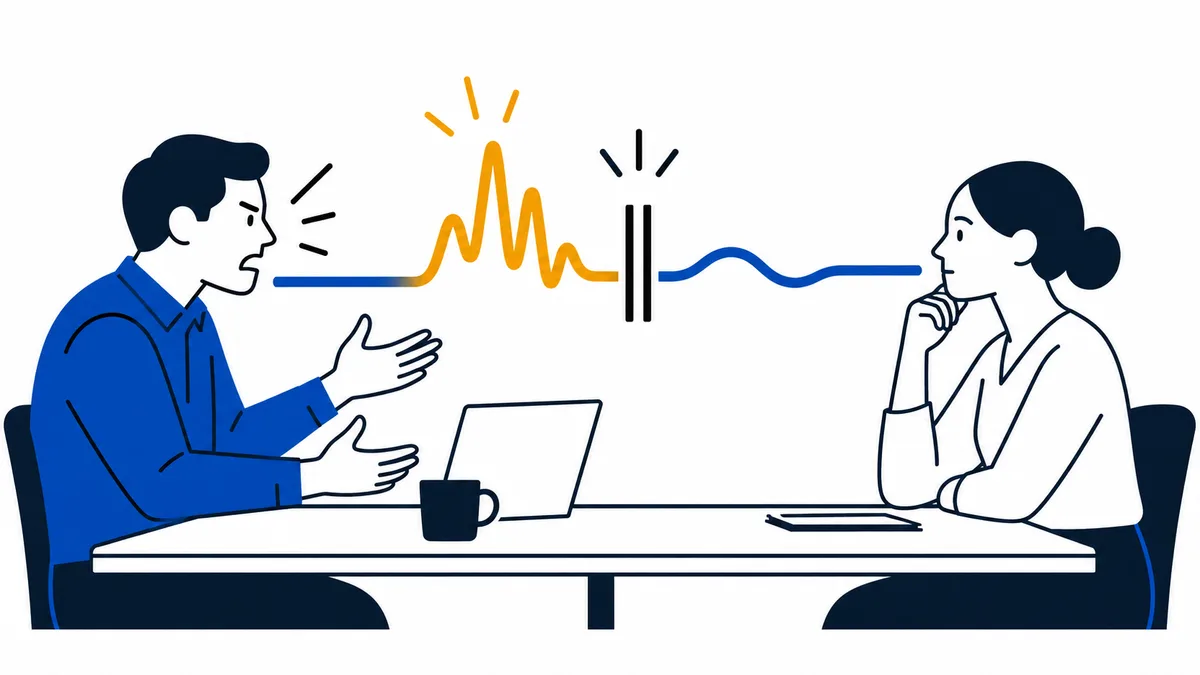
When anger rises before you can answer, pause long enough to choose the first sentence. Name the disputed point, ask for a short break with a return time, and use the interval to separate what happened from what you assume it meant. Then return with a question, request, or boundary. This is a practical sequence informed by emotion-regulation and workplace-conflict research; the exact pause sequence has not been tested as a workplace intervention. The goal is to make a considered response possible, not to erase anger or excuse harmful conduct.
When anger gets there first
A colleague dismisses a proposed schedule as ‘unworkable’ in front of the project group. Anger may signal that the comment felt unfair or that important work was overlooked. It may also make the next sentence arrive before you have checked what the colleague meant. Both facts can be true: the feeling deserves attention, and an immediate reply can make the underlying issue harder to address.
The decision is not whether you are entitled to feel angry. It is whether continuing now is likely to serve the work issue. If your next sentence is forming as an accusation, retort, or blanket refusal, a short pause can protect the point you want heard. Try: ‘I want to answer the schedule concern properly. I need ten minutes, and I can come back at 2:30.’ The interval is an example, not a research-backed dose. Naming when you will return signals that you intend to resume the issue.
This article examines one claim: delaying a reply and returning to the substance can be a better first move than answering while anger drives the wording. Research does not certify a particular number of minutes or guarantee calm. The evidence includes bargaining experiments, field studies, an intervention, and practical guidance. A routine disagreement over a deadline is different from bullying, threats, discrimination, or repeated aggression.
This opening distinction helps avoid two common mistakes. The first is treating anger as proof: because I feel wronged, the other person must have intended harm. The second is treating anger as disqualification: because I am angry, my concern cannot be legitimate. Neither follows. A feeling reports something about the encounter as experienced; the facts and the other person’s account still need examination. A pause helps create the conditions for that examination. It does not settle the dispute in advance.
Consider the likely consequence of speaking now, rather than asking whether anger is justified. If the other person needs an immediate safety-critical answer, give the necessary fact in plain terms and postpone the disagreement about responsibility. If the decision can wait, asking for a pause may prevent an impulsive sentence from becoming the meeting’s new subject. This is a decision rule inferred from the evidence and the practical constraints of work; no cited study randomized employees to continue immediately or take this exact break during an argument. Naming that limit keeps the guidance proportionate.
It can help to distinguish a pause from a cooling-off demand imposed by someone else. ‘Calm down’ can sound like the other person is judging the feeling instead of answering the concern. A self-chosen pause names what you need and when you intend to continue. You can also invite a pause together: ‘We are talking past each other. Can we take ten minutes and come back to the missed handoff?’ If the other person refuses and the conversation is not safe, you are still entitled to end your participation or get support.
Sources: Anger at Work; Managing Your Emotions; Colleagues in conflict? How to defuse workplace disagreements
What should you do in the first minute?
Notice one early sign you can reliably recognize: a tightened jaw, faster speech, heat in your face, the urge to interrupt, or the thought ‘I need to make them admit this now.’ Silently label it: ‘I’m angry, and I’m about to defend the timeline.’ The cue gives you a choice point; it does not prove the other person is wrong or that you are overreacting.
If you can safely pause, state your intention, duration, and return point. ‘I want to respond to the actual concern, and I’m too wound up to do that well this second. Can we take ten minutes and pick this up at 2:30?’ You do not have to disclose private feelings or apologize for having them. If leaving is impractical, slow the exchange with one factual question: ‘Are you saying the launch date is at risk because testing needs another day?’ That question buys time and identifies the claim at issue.
Use the interval to make a small record, not a prosecution brief. Write what was said or decided, what you think it means, and what you need clarified. For example: ‘Testing was removed from Friday’s plan. I think the team expects me to sign off without a full check. I need to know whether the release criterion changed.’ The first line is an observation; the second is an interpretation; the third gives the conversation somewhere useful to go. If you cannot separate them yet, write down the words you remember and delay assigning motive.
The University of Minnesota workplace guide recommends delayed response, attention to physical cues and surroundings, and leaving an angry email in drafts before deciding whether to send it. This is institutional practical guidance, not a controlled test of one universal sequence. Harvard Business Review’s workplace conflict episode with Amy Gallo likewise discusses labeling feelings, noticing bodily cues, and taking a break when needed. Those sources make the suggestions accessible, but neither establishes a validated pause duration.
If you cannot pause, reduce the size of your next move. Ask one factual question, request that the decision be recorded, or say, ‘I disagree and want to check the figures before I answer.’ Avoid a permanent promise, a reply-all message, or a judgment about character while details are unclear. A pause is optional when it is unsafe to stay; leave or seek support rather than negotiating for a return conversation.
A return time need not be exact to the minute if the work setting makes that impossible. Give the other person the clearest commitment you can keep: ‘I need a short break; I’ll message you by the end of the hour about when we can continue.’ Then follow through. A vague exit can reasonably be read as withdrawal, especially when the other person needs a decision too. If you discover that you cannot resume safely or productively, update them and state the next route rather than disappearing. Reliable follow-through is part of the pause, not a courtesy added afterward.
Some employees cannot simply step away. They may be presenting to customers, working on a production line, or in a meeting where the decision must be documented before people leave. A pause can be conversational rather than physical: ask for the disputed point to be restated, request that the decision be held for review, or say you need to verify a figure before responding. These options preserve a moment for thought without implying that every role allows a walk or private break. Choose a form that does not jeopardize safety or leave essential work unattended.
When you record the exchange, separate quotation from memory and inference. Put exact words in quotation marks only if you remember them clearly; otherwise describe the substance without pretending it is verbatim. Mark your interpretation as your interpretation. This helps when you later need to explain the issue to a manager or another support person. A record is not a score of the other employee and does not settle intent by itself. It preserves information so the appropriate person can assess the pattern and context.
A pause should not become a demand that you wait until all emotion disappears. Anger may remain while you can still speak accurately and listen. If you find that a break makes you more agitated, shorten the mental review and focus on the decision, not the imagined argument. If you remain too activated to continue, tell the other person when you will update them. The point is to choose a safe next action, not pass a test of serenity.
Sources: Managing Your Emotions; Managing Your Emotions During an Argument at Work
Why does replaying the argument make a reply harder?
After a sharp exchange, attention can keep returning to the provocation: the exact phrase, the imagined insult behind it, and the answer you wish you had given. Repetitive provocation-focused thought is often called angry rumination. It differs from a short factual review that helps prepare. A factual review asks what was decided and what evidence is missing. Rumination rehearses the offense without necessarily improving the next decision.
A primary bargaining study by van’t Wout and colleagues compared strategies after staged provocation in two Ultimatum Game experiments. In the game, participants decided whether to accept or reject offers and made offers themselves. The authors review earlier work in which, after a longer 2.5-minute delay, participants writing about what they felt punished more than those writing about thoughts or doing a distracting task. In their own second experiment, reappraisal was associated with less anger during bargaining than distraction. This is a laboratory economic game, not a workplace meeting; punishment and offer fairness are not measures of project quality or relationship repair.
The same paper describes why distraction and reappraisal may serve different moments. Moving attention away from the provocation may give quick relief, but the issue can return when bargaining resumes. Reappraisal processes the event and can change its meaning, though that takes effort. In the experiment, reappraisal reduced anger during bargaining relative to distraction, while the authors did not find that it improved every behavioral outcome. The distinction suggests a modest pause practice: first stop feeding the provocation, then inspect the work question when you can think about it.
If your notes keep expanding with imagined motives, return to details another person could check. Which deliverable, date, decision, or sentence is disputed? What would change your view? Which question can the other person answer? A neutral task or attention to the room may interrupt replay briefly. When you return to the issue, do not use reappraisal to invent a nicer motive. Keep the observable conduct in view.
A practical way to check whether review has turned into rumination is to ask what new information the thought produced. If the same sentence is playing again with no new detail, it is probably not helping you prepare. Switch to a small task that gives attention a neutral anchor, then return to a written description of the decision. This is not a demand to distract yourself from a real problem indefinitely. The purpose is to stop rehearsing the provocation long enough to decide what information or action the problem requires.
The bargaining experiment illustrates why a delay alone may not resolve the problem. The researchers compared writing about feelings, thinking, or a neutral trip while participants waited before making a bargaining decision. Time passed in each condition, but the content of attention differed. This makes ‘just wait’ an incomplete summary. A pause can be used to rehearse the insult, to avoid it, or to examine it. The study offers clues about these strategies in a game; it does not tell us the ideal combination at work. The article’s recommendation to note facts and questions is an application, not a tested protocol.
Sources: The Effects of Intrapersonal Anger and Its Regulation in Economic Bargaining
What does reappraisal change, and what must it leave intact?
Reappraisal means reconsidering how you understand an event. If a coworker says, ‘Your estimate is unrealistic,’ you may hear ‘You are incompetent.’ Perhaps they mean the vendor lead time makes the date impossible. You can test that possibility by asking which assumption is at issue. But a more charitable interpretation does not erase the words or an impact that actually occurred.
The bargaining experiment reports that reappraisal can reduce anger in the experimental task, but the result has a narrow setting. Participants were provoked and then made game decisions. The study provides evidence about anger and behavior within that design; it does not show that an employee should reinterpret every insult or that reappraisal resolves a work disagreement. A useful reframe opens an information question: ‘I read the change as a judgment about my work. Is your concern the test coverage or the release date?’ If the answer reveals a constraint, address it. If it confirms disrespect or a broken process, address that too.
A workplace experiment by Zhu and colleagues offers a different kind of evidence. They randomized 176 full-time US workers, 88 to an intervention and 88 to a control group, for a three-week ecological momentary program. Participants received repeated daily reappraisal or control activities during the work period. The authors report improved daily affect and associations through affect with counterproductive work behavior and self-reported job performance. The trial studied structured repeated practice, not a ten-minute break during a live argument. Its sample and intervention place limits on generalizing the result to every occupation or individual.
The intervention supports the possibility that repeated emotional practice can matter at work; it does not validate the pause sequence in this article. Nor does it establish which element of a combined package drives change. Reappraisal can be useful when it tests an uncertain interpretation. It is a poor fit when it asks you to pretend a clear insult, unsafe decision, or repeated mistreatment was harmless. The aim is accurate interpretation, not forced optimism.
One guardrail is to keep the alternative interpretation provisional. ‘Maybe the colleague is worried about compliance’ is a hypothesis. It becomes useful if it leads to a question. It becomes self-silencing if you use it to cancel an observed fact before checking. Write down what would distinguish the explanations: did the colleague identify a concrete requirement, or did they make a personal remark unrelated to the work? Evidence can support more than one reading, and the conversation may clarify which one deserves attention.
Reappraisal is also different from disputing your own emotion. You need not argue yourself out of being angry before you can act carefully. It may be enough to recognize anger, notice the conclusion it is pushing toward, and postpone that conclusion until you have checked the facts. ‘I am angry’ can coexist with ‘I do not yet know why the plan changed.’ This distinction avoids making emotional comfort a prerequisite for a useful response. People can raise a concern while still feeling unsettled.
The workplace intervention’s self-reported outcomes matter when interpreting its findings. Participants reported affect and job performance, which are meaningful experiences but are not the same as independently observed performance. Random assignment strengthens claims about the intervention compared with an uncontrolled before-and-after observation; it does not remove all limits of sample, measure, or package. Keeping both parts visible lets the reader learn from a promising study without converting it into a promise that reappraisal will improve every worker’s results.
Sources: Cognitive reappraisal emotion regulation interventions in the workplace and their impact on job performance; The Effects of Intrapersonal Anger and Its Regulation in Economic Bargaining
When is calming yourself the wrong-sized answer?
A disagreement can be difficult because you are angry, because the issue is serious, or both. For a one-off dispute about task ownership, stepping back and clarifying expectations may help. For repeated humiliation, threats, harassment, discrimination, retaliation, or unsafe conduct, the need may be a boundary, documentation, a manager, worker representative, or formal reporting route. The employee should not carry sole responsibility for regulating the atmosphere.
Niven, Sprigg, and Armitage examined two workplace-aggression samples: 77 social workers and 70 emergency-services personnel. The university record reports that reappraisal during interactions with coworkers or managers attenuated the aggression-strain association. During interactions with legitimate outsiders such as clients or patients, reappraisal and suppression strengthened that association. This context-sensitive finding complicates a universal ‘reappraise and carry on’ rule. The accessible record is an abstract; its occupational samples faced aggression, and the associations do not prove that a strategy caused strain or apply automatically to an ordinary task disagreement.
Ask what regulation is being asked to accomplish. If you are preparing to raise a concern with a colleague, reappraisal might help separate the decision from your inference about motive. If you are expected to absorb repeated aggression while appearing untroubled, suppression or forced reframing may add emotional labor without changing the source. A supervisor or organization may need to intervene. Composure is not consent, and self-management is not a remedy for misconduct.
A boundary can be brief and observable: ‘I’ll discuss the decision, but I won’t continue while you call me names. I’m leaving this meeting now and will follow up with the project lead.’ It states conduct, action, and next step. When appropriate, keep a dated account of what happened, who was present, what was said or done, and its work impact. Follow relevant policy and local rules; the suitable channel depends on the organization and conduct.
Power changes what is feasible. A junior employee may not be able to pause a discussion with a senior manager as freely as a peer can. A worker responsible for immediate safety may not be able to leave. Ask to continue with a third person present, request a written decision, schedule the discussion, or involve suitable support. If immediate safety is at risk, prioritize safety over finishing the argument. A pause is useful only when safe and when the issue can still be discussed.
The context distinction also protects against blaming the person experiencing aggression. In the two occupational samples, employees interacted with both people inside their organization and legitimate outsiders. The reported pattern differed by that relationship. This does not say that coworkers’ aggression is easy to regulate or that client-facing workers should endure abuse. It shows why a broad strategy label cannot be detached from who is acting, what the role requires, and what support is available. If the organization has a process for repeated mistreatment, an individual pause is not a substitute for using it.
When deciding whether an interaction is aggression rather than ordinary disagreement, avoid relying on one heated word alone. Consider the behavior, its repetition, power relationship, impact, and relevant policy. The sources cited here do not provide a workplace misconduct test, and this article does not make legal classifications. The practical point is that repeated insults, threats, or retaliation change the response needed. Ask a trusted workplace resource what process applies instead of repeatedly trying to solve a pattern through better phrasing in one-to-one conversations.
The simple response rule is conditional. Pause when the conversation can safely wait and your likely reply would attack, defend without listening, or shut the issue down. Continue briefly when an immediate factual response is necessary, but avoid deciding motive or blame before you have checked the record. Leave and seek help when there is danger or a pattern of abuse. These branches are not a diagnostic classification; they are practical ways to match the next action to the problem in front of you.
Sources: Does emotion regulation protect employees from the negative effects of workplace aggression?
How do you keep the disagreement about the work?
When you return, state the issue in terms another person could check. ‘You never listen’ is a character judgment. ‘The testing line was removed after we agreed to keep it; I need to know whether the release standard changed’ names a decision, prior agreement, and question. This does not guarantee agreement. It makes the disagreement more specific.
A field study of 39 teams, reported in the abstract of a Journal of Organizational Behavior article, found that individuals with stronger emotion-regulation skills could use task conflict more effectively and limit negative effects of relationship conflict. Teams with highly skilled members also made effective use of conflict. Task conflict concerns the work; relationship conflict concerns interpersonal friction. The finding connects regulation and conflict in real teams, but it does not establish that one employee’s pause caused better performance. Nor does it mean all disagreement is productive.
Make one claim and one request: ‘Moving the test to Monday creates a risk because the vendor file arrives Friday. Can we keep the release gate until the file is checked?’ If you do not know why the other person holds a position, ask what constraint they are working around. Listen for information that changes the decision. If their answer misses your concern, restate it with the evidence that matters. Firmness does not require judging the colleague’s competence or intentions.
Workload, unclear authority, conflicting goals, short deadlines, status differences, and missing information shape responses. In one team, disagreement about a schedule may catch a real risk. In another, it may expose an impossible workload or a process that excludes people bearing the consequences. If the explanation shrinks to ‘I got angry, so I must stay calmer,’ the conditions around the task disappear.
For a recurring issue, make the decision process explicit: who owns the decision, what evidence is required, when can the decision change, and where will unresolved objections be recorded? A written summary can prevent a later dispute about what was agreed. It may also show the substance remains unresolved. The aim is not frictionless interaction. It is to attach the disagreement to the decision that needs work.
A clear work statement can include impact without making the discussion personal. ‘When the final file arrived after the review cutoff, I could not check the figures before approval. Can we agree who sends the final version and by what time?’ The sentence names an event, consequence, and request. It avoids a claim such as ‘You do not respect my time,’ which asserts motive and invites a dispute about character. If disrespect is the issue, name the specific behavior separately and decide what boundary is needed.
The 39-team finding is not an argument for seeking conflict. Teams may differ in what they call task conflict and how they measure performance. The accessible abstract does not provide enough detail to turn the result into a numerical estimate or a formula for an individual. It supports a more limited observation: emotion regulation and conflict handling were connected in that field study. The employee can use that as a reason to keep a substantive disagreement specific, while recognizing that role design, resources, and decision authority may matter as much as personal skill.
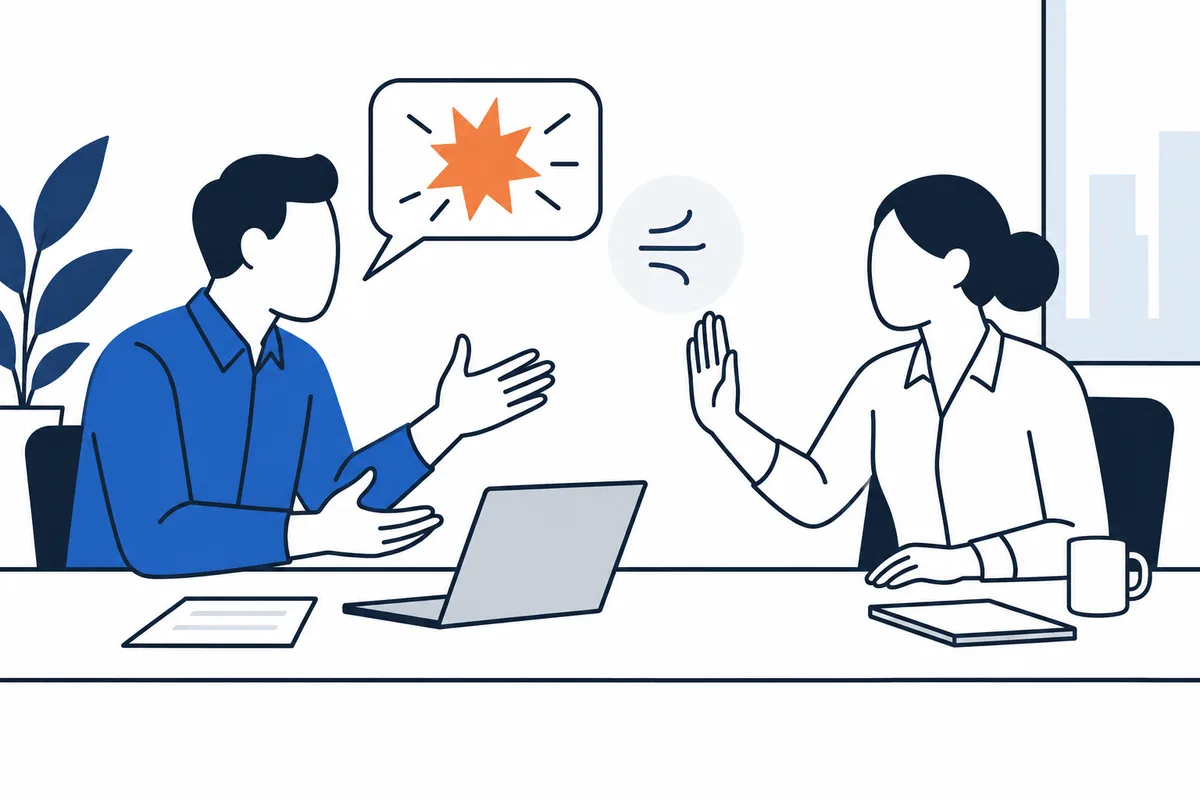
Does expressing anger help you get heard?
Anger can communicate seriousness, but being noticed is not the same as being judged competent, trusted, or persuasive. A sharp reply can shift attention from a sound concern to the manner in which it was raised. This risk matters when you want colleagues to examine evidence rather than reward whoever sounds most forceful.
The 2024 paper ‘Anger at Work’ revisited claims about anger and status in four preregistered US experiments with 3,852 participants. The authors report that workers expressing anger were sometimes viewed as powerful but consistently viewed as less competent; angry workers received lower status than workers expressing sadness or no emotion. These experiments assessed judgments in scenarios, not long-term outcomes of authentic workplace disagreements. They challenge the claim that anger expression reliably earns status, while leaving open how expression functions across roles, cultures, and relationships.
This is not evidence that employees should hide anger. A harmful act does not become acceptable because the person affected could phrase the objection more smoothly. The narrower inference is that an attack can create a second issue about behavior and distract from the work concern. A deliberate pause offers a chance to state the concern without diluting it.
Compare three options. An immediate retort may put alleged disrespect at the center and leave the schedule issue untouched. Suppressing every sign of anger may preserve appearances while leaving unclear what needs to change. A time-bounded pause followed by a concrete claim gives the employee a chance to state both impact and request. This third option is an inference from different kinds of evidence, not a direct trial comparing these exact packages.
For instance: ‘I disagree with calling the estimate unrealistic before we check the vendor lead time. It assumes delivery Thursday. Do you have information that changes that assumption?’ This example is an illustration of wording, not a report of an observed meeting. If the remark was part of repeated humiliation, document the pattern and choose a boundary or support route too.
The anger-at-work experiments also leave an important question open: people can be judged unfairly for expressing an emotion, and that penalty may vary with identity and context. The paper’s scenario judgments cannot tell an individual how a particular coworker will respond. Its value here is narrower. It cautions against assuming that visible anger automatically persuades observers. The employee can still express the concern firmly, and should not be required to hide evidence of harm merely to satisfy a standard of pleasantness.
Status judgments in the anger experiments are not the same as the quality of the argument. An observer may judge a worker as less competent even when the worker has identified a real mistake. That is a limitation of the social setting, not proof the worker lacks competence. The experiments therefore help explain a communication risk, but they cannot tell employees to optimize for observers’ approval at any cost. A clear record, direct request, and appropriate escalation may matter more than persuading every listener in the room.
A workplace disagreement may also involve an audience. In a meeting, you might say only, ‘I disagree with that summary; I’ll send the figures after I verify them,’ then ask to discuss the impact with the decision owner. This protects the record without turning the room into a trial of motives. In a private follow-up, state what you need and ask for the missing explanation. The best channel depends on the sensitivity of the issue, the authority of the participants, and whether a written record is needed.
Sources: Anger at Work
How can you return with a question instead of a verdict?
A return does not require perfect calm. It requires enough room to choose what you want to ask. Summarize the issue in one sentence, then invite information that could alter the decision: ‘I understood that we are dropping the second review. I’m concerned the compliance check will be uncovered. What changed in the plan?’ This states your understanding and impact without assuming why the change happened.
An open study of coworker emotion regulation reported two online experiments with 216 and 471 participants and a dual-perspective field study involving 277 coworkers regulated by 143 employees. Goals focused on improving coworkers’ feelings predicted receptive listening, which was associated with lower relationship conflict. Appearance-focused goals were associated with expressive suppression and poorer coworker relationship outcomes. This concerns attempts to regulate someone else’s emotions, not an employee’s own pause; it cannot prove that asking a question settles conflict. It does distinguish listening to understand from trying to manage another person’s display for your comfort.
Show that you heard the point without accepting the conclusion: ‘You’re concerned the team can’t test the new flow before Friday. Have I got that right?’ Then: ‘I agree the window is tight. I still think we need one check before release. What option would preserve it?’ Listen for the actual constraint. Understanding and agreement are separate steps.
A question can also set a boundary: ‘When you called my estimate ridiculous, I heard a personal judgment rather than a concern about the assumptions. Are you willing to discuss those without insults?’ If the answer is no, do not keep applying conversation technique as though it replaces a boundary. End the exchange and use suitable support.
If your first reply already came out sharply, repair the manner without withdrawing the point: ‘I raised my voice and called the proposal careless. That was not useful. I still disagree with removing the check, and I want to explain the risk.’ A repair takes responsibility for the behavior that obscured the concern; it does not require apologizing for having a concern. Trust depends on what happens next, including whether both people change their conduct.
Questions work best when they are sincere and bounded. ‘What information would make you comfortable keeping the test?’ is answerable; ‘Why are you always trying to undermine me?’ embeds an accusation and invites denial. A sincere question leaves room for an answer that changes your view. If no answer could alter your conclusion, state the boundary or disagreement instead of using a question as a disguised charge. This is especially useful after a pause, when you have had time to decide what you actually need to know.
If you hear an answer that does not address the issue, you can name the gap without restarting the argument. ‘That explains why the date matters. I still need to know whether the check can be completed before sign-off.’ If the colleague changes the subject to your tone, decide whether a brief repair will clear the way: ‘I sounded sharp. I’ll restate it. The check is still missing.’ Do not let a tone discussion erase a substantive risk, but acknowledge your own conduct when it is fair to do so.
How can you make a pause easier to use next time?
A pause is easier to request before a meeting becomes heated. Prepare a sentence that fits your role: ‘I need a few minutes to check the figures’; ‘I want to think about that and come back after this call’; or ‘Let’s continue with the decision owner present.’ A prepared sentence reduces the burden of inventing words while attention is narrowed. It does not mean you expect every disagreement to go badly.
The three-week workplace intervention offers support for repeated practice, but it was not a test of one prepared sentence. Zhu and colleagues randomized 176 full-time US workers between an intervention and control group, then gave repeated daily activities or control prompts during workdays. The study measured affect and later work outcomes. It cannot show that rehearsal alone prevents angry replies. It does show why skill development is better understood as practice than as a personality label or one-time insight.
After a difficult exchange, review only enough to learn a usable cue. What first sign did you notice? Which phrase increased the heat? What would have given you an opening to pause? What question would have clarified the issue? Keep the review concrete. If it becomes another replay, return to what can be checked or changed.
Practice with a low-stakes disagreement: ask someone to challenge a project assumption, state what you heard, and request time before answering if needed. Rehearse the return too; otherwise delaying may become avoidance. If the exchange is unsafe or a boundary has repeatedly been crossed, preparation should include support and a plan for ending the interaction.
EQ Test’s 32-item Emotional Skills Profile is a private educational reflection tool about recent emotional habits and judgments on authored situations. It offers practical development guidance, but has no validated population norms or established ability-test validity. It does not measure this incident or determine what you should say. The article’s evidence comes from the separately cited studies, not from the profile. Use it only if reflecting on general habits would help you prepare for future exchanges.
A useful practice review includes what happened after you returned, not only whether you felt calmer. Did the other person answer the question? Did the decision become clearer? Did you state the boundary you intended? Did the issue require a different person or process? These observable outcomes help you adjust the strategy without treating one difficult meeting as a verdict on your emotional skill. A pause that prevents an impulsive attack may still be followed by an unresolved dispute; those are separate outcomes.
Preparation can include noticing what conditions make a pause possible: whether you can leave the room, whether another person can cover an urgent duty, and what channel is suitable for resuming. If prior disagreements have become personal, a neutral facilitator or manager may be appropriate. These are practical contingencies, not features demonstrated by the reappraisal trial. The study’s repeated prompts suggest that regular exercises can be examined systematically; they do not authorize claims about coaching, certification, or guaranteed workplace gains.
Do not treat an assessment result as proof that you will react a certain way. The Emotional Skills Profile offers private reflection prompts about tendencies and scenarios; it cannot validate the account of a specific incident. If an item makes you think of a recurring difficulty, translate it into a behavior you can observe: for example, whether you ask a clarifying question before defending a decision. Then notice what happens in an actual conversation. Keep the observation specific and allow circumstances to matter.
Sources: Cognitive reappraisal emotion regulation interventions in the workplace and their impact on job performance; Managing Your Emotions
Try one pause, then decide what the disagreement needs
Notice the cue and decide whether continuing now is safe and useful. If a reply is likely to attack or shut down, ask for a brief, defined pause and give a return point. During it, separate observation from interpretation and check one alternative explanation without erasing the facts. Return with a specific question, request, or boundary. If the issue involves repeated aggression or unsafe conduct, document it and seek suitable support. The measure of success is not whether you looked calm; it is whether your next action addressed the real disagreement and protected what needed protecting.
The response sequence is deliberately small because the evidence does not support a universal protocol. Notice the cue; request a pause if safe; identify one observation and one uncertainty; return with a question, request, or boundary. The order can change if the situation changes. An urgent operational decision may require a short factual response now and a fuller discussion later. A threat may require ending the exchange immediately. Use the step that protects safety and clarity, not a checklist for its own sake.
Once you have chosen the next step, stop reviewing the exchange for now. Send a concise follow-up only if it helps record the decision, request a meeting, or document a boundary. Avoid writing a long message while still rehearsing the offense. If you have to send an urgent operational note, keep it to verifiable information and the needed action. Later, revisit whether the issue was resolved or needs formal attention. This separates the immediate regulation task from the longer decision about the work relationship or process.
After trying the sequence once, judge it by what became clearer. Did the pause prevent you from sending a message you would have had to repair? Did you return when promised? Did you learn what constraint drove the other position? Did the exchange reveal conduct that calls for support? No one result proves a stable trait. A specific observation can guide the next attempt: prepare a pause phrase, ask for the decision criterion, or document the boundary. Repeated harm calls for a response to the pattern, not endless refinement of your calming routine.
The colleague may disagree after you return. That does not mean the pause failed. The aim was to make a better next move available, not to guarantee agreement or warmth. If you have explained the issue, asked for relevant information, and still cannot reach a decision, identify who owns the choice and how an objection should be recorded. If the conduct crossed a boundary, deal with that separately. The exchange ends when the work has a next step, a boundary is clear, or responsibility moves to an appropriate process.
There is no obligation to conduct this sequence perfectly. You might notice the cue only after interrupting, or discover that the issue was more serious than it first seemed. You can still stop, correct a factual error, acknowledge an unhelpful phrase, or move the discussion into a more appropriate channel. A small correction is often more useful than silently replaying the exchange and hoping the other person inferred your intent. If the pattern repeats, bring a specific account of what happened and what you need to the person or process able to address it.
When you choose a pause, be explicit about what it is for. ‘I need time to check the figures’ is concrete and easy to honor. ‘I need to calm down’ can imply that the emotion itself is the only problem, even when the disputed decision still needs attention. If you would rather not explain, ‘I need a few minutes before I respond’ is enough. Make the commitment realistic for your role and workload, then either return or send an update before the stated time.
If the other person needs an answer before you are ready, say what you can responsibly confirm now and what remains uncertain. ‘I can confirm the current test status; I cannot approve the release until I check the missing file.’ This keeps the work moving without pretending the disagreement is resolved. Follow with the pause or escalation route that fits the remaining question.
A return point gives both people a concrete next step.
Keep that commitment realistic for the work in front of you.
Sources: Anger at Work; Does emotion regulation protect employees from the negative effects of workplace aggression?; Managing Your Emotions
Questions readers ask
How long should I wait before responding when a disagreement makes me angry?
There is no evidence-backed universal number of minutes. Take enough time to make a considered reply, name when you will return, and use the interval to identify the observable issue and the question or boundary you need. If the exchange is unsafe or involves repeated aggression, prioritize support and safety.
Sources
- Anger at Work
Supports the experimental finding about observers' judgments of angry workers in four US studies; it does not establish long-term consequences.
- Does emotion regulation protect employees from the negative effects of workplace aggression?
Supports context-specific abstract findings from aggression-exposed social workers and emergency-services personnel.
- Emotion regulation as a boundary condition of the relationship between team conflict and performance: A multi-level examination
Supports the abstract's reported field association between regulation skills and conflict handling across 39 teams.
- Cognitive reappraisal emotion regulation interventions in the workplace and their impact on job performance
Supports the three-week randomized intervention design and findings among 176 full-time US workers.
- The Effects of Intrapersonal Anger and Its Regulation in Economic Bargaining
Supports experimental comparison of reappraisal and distraction in Ultimatum Game bargaining after provocation.
- Managing Your Emotions
Supports practical guidance on delayed response, grounding, boundaries, and unsent angry emails; not causal effects.
- Colleagues in conflict? How to defuse workplace disagreements
Supports university conflict expert's practical guidance on problem focus, listening, emotion acknowledgment, and pausing.
- Managing Your Emotions During an Argument at Work
Supports workplace expert Amy Gallo's practical discussion of labeling feelings, body cues, and taking a break.
Apply it to the real situation
Find the response you want available under pressure
From this guide: A general guide offers a pause sequence; your recurring habits may show which cue deserves practice.
The private 32-item Emotional Skills Profile offers a structured way to reflect on emotional habits and authored workplace situations, with practical development guidance. It is an educational reflection tool, not a score for this disagreement or a measure of fixed ability. Use it to choose one habit to notice in a future difficult conversation.