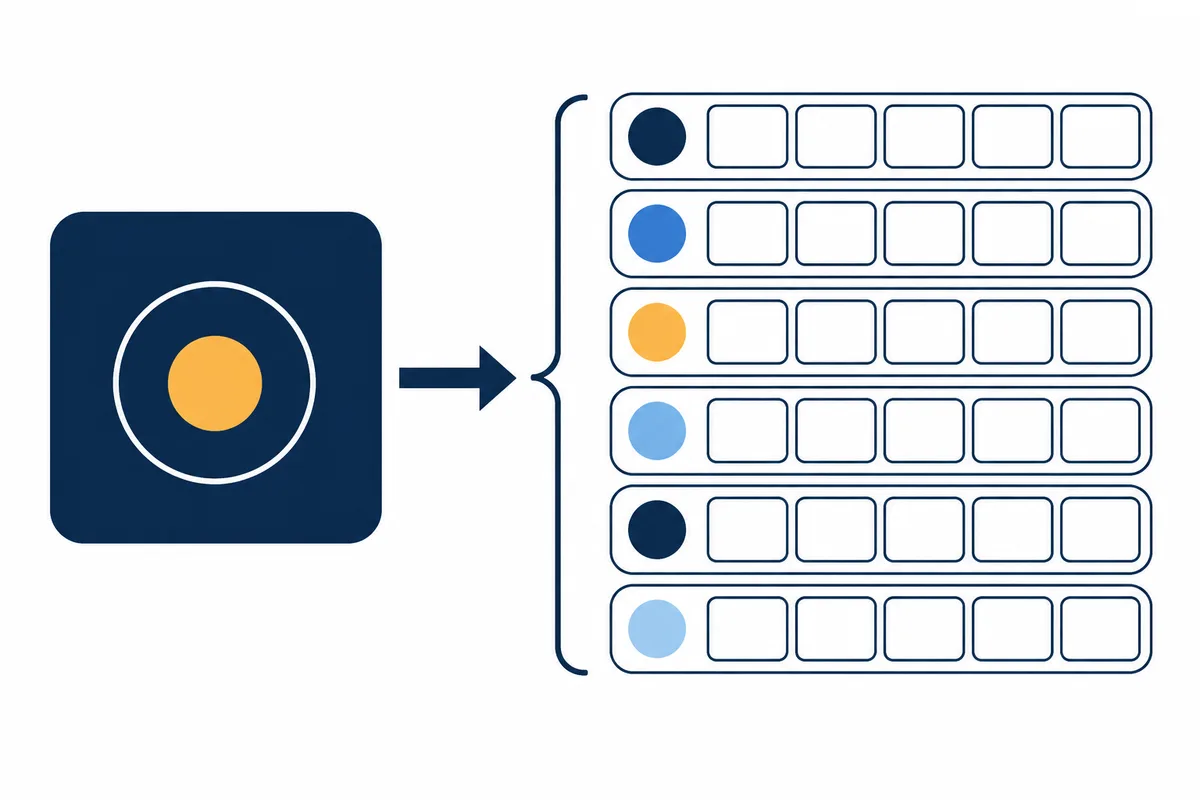
The TEIQue-SF samples two items from each of the full TEIQue’s 15 facets, but reports a global score and four factor scores rather than separate facet scores. Its global score can suit a broad question; the full form adds facet-level detail when a reflection or analysis depends on distinguishing specific self-perceived tendencies. Neither form shows what someone did in a particular interaction.
The short form samples the facets; its report does not separate them
The TEIQue-SF is brief, but its 30 items are drawn across the same territory as the full questionnaire. The overview, “Trait Emotional Intelligence Questionnaire (TEIQue),” says two selected items represent each of the 15 facets, with selection based mainly on how each item relates to its facet total. That is broad sampling, not 15 separate results. The short form reports one global trait emotional-intelligence score and four factor scores: Well-Being, Self-Control, Emotionality, and Sociability. Trait emotional intelligence refers here to self-perceived emotional tendencies and dispositions. A global score gathers those perceptions into a broad summary; it does not show a person’s performance on emotion problems or document what they did in a particular workplace exchange. The sample “TEIQue-SF Corporate Report” describes the structure as 15 facets, four factors, and one global score, and says facet scores require the full form. Questions from across the facets contribute to the short form, but the report does not separate those contributions into 15 estimates. A broad question about overall self-perception may need only the global result. If the question is which narrower tendency deserves attention, the short-form report cannot identify that facet; the full form supplies that level of detail.
Sources: Trait Emotional Intelligence Questionnaire (TEIQue); TEIQue-SF Corporate Report
What is lost between a global score and a facet profile?
A global score answers a broad question: how does someone generally perceive their emotional tendencies? It does not show the particular self-perceptions that sit behind that summary. The full TEIQue reports scores at three levels: 15 facets, four factors, and global trait emotional intelligence. The TEIQue-SF samples two items from each facet, yet its report returns only the global score and four factor scores. As the Consortium for Research on Emotional Intelligence in Organizations’ TEIQue overview explains, the short form was designed primarily to measure global trait EI. Sampling across the facets gives it breadth; it does not give the reader a separate reported result for each facet. That distinction is about score resolution, not whether the short form contains any items related to a particular domain. A summary combines responses, so different patterns in the narrower tendencies can contribute to a similar broad result. The score alone cannot tell which combination produced it. The short form’s four factor results add some structure, but each factor still gathers several related facets together. A factor can point toward a broad area for reflection without identifying the precise self-perception that may matter to a particular question. That matters when the next step depends on choosing one behavior to observe or discuss. Consider an explicitly illustrative case, not a TEIQue result: someone wonders why tense conversations feel difficult. A broad Self-Control result would not separate their self-view about managing pressure from their self-view about pausing before acting on an urge. Those are different questions. Does the person tend to feel overwhelmed under strain, or do they tend to respond quickly before considering the effect? A global score cannot distinguish between them. Even the Self-Control factor, which brings together Emotion Regulation, Impulse Control, and Stress Management, does not provide an individual score for each of those facets on the short-form report. The full-form report lists them separately, offering more specific self-descriptions to consider. The difference is easier to see in the full-form sample report, “TEIQue Analysis.” Its structural diagram describes a 15–4–1 hierarchy: the 15 facets sit below four factors, which in turn sit below global trait EI. The report states that the full form returns scores for all 20 domains, while the short form returns five: the four factors and the global score. Its example profile also displays distinct facet results beneath a factor. That example is an illustration of how the report is organized, not evidence about typical respondents or proof that facet scores explain actual workplace behavior. The useful point is the output format: the full form lets a reader inspect distinctions that the short form’s report combines. So a broad result cannot answer a narrow question merely because the short form sampled items across that area. If the question is whether someone’s self-perception about stress differs from their self-perception about impulse control, the global score does not resolve it, and the factor score remains broader than either facet. The short form can still serve a purpose when a general estimate is enough. When a reflection depends on which specific tendency to examine, the full profile supplies a more relevant set of leads. Those remain self-reported tendencies; the score does not establish what happened in a particular interaction.
Sources: Trait Emotional Intelligence Questionnaire (TEIQue); TEIQue Analysis
A factor narrows the question but still combines different facets
The four factor scores can narrow a broad result to an area worth considering, but each still combines several distinct self-perceptions. In the TEIQue’s hierarchy, 15 facets sit beneath four factors, with global trait emotional intelligence summarizing at the top. A facet is a narrower description; a factor gathers related facets; the global score is a broader composite. The short form reports the global score and four factors, not 15 separate facet scores, though its items sample across them. So a Self-Control factor result cannot tell a reader whether emotion regulation, impulse control, or stress management contributed most to that result. The sample TEIQue-SF report describes the four factors as Well-Being, Self-Control, Emotionality, and Sociability. It says there are three to four facets within each factor, while Adaptability and Motivation feed directly into global trait EI. This matters because the four factor labels do not partition every facet into a neat four-box chart. A factor is a useful middle layer, but it is still a summary: its label cannot identify which component tendency is most relevant to a particular question. For example, the developer report groups happiness, optimism, and self-esteem under Well-Being; it groups emotion expression, emotion perception, empathy, and relationships under Emotionality. Sociability has its own cluster, while Self-Control brings together the three pressure-and-impulse facets. These groupings show why a factor can orient attention without isolating a single answer. A broad label represents shared territory among facets, and the exact facet question remains unresolved until a report supplies that level of detail. Consider a reader wondering why they sometimes respond sharply under pressure. A Self-Control factor could point toward a broad area for reflection, but it does not separate a tendency to act quickly on an impulse from a self-perception about managing stress or regulating emotion. They are related questions, not interchangeable explanations. The full report can offer separate facet scores as self-reported leads. This illustrates reporting resolution, not a typical profile or cause of a real exchange. There is also a reason to be restrained with the short form’s factor scores beyond their broadness. Each factor draws on fewer item responses in the short form than the corresponding full-form profile. The developer’s sample report says short-form factor scores tend to be somewhat less accurate than corresponding full-form scores. This is instrument guidance, not an independent estimate of an individual result’s error. Fewer responses can leave less information for distinguishing narrower tendencies, but item count by itself does not establish whether a score is valid for a given purpose. The 2025 Swedish multicenter study adds a qualified measurement concern. It discusses generally lower internal consistency for most standard short-form dimensions than corresponding full-length scores, with Well-Being as an exception, and then evaluates a revised 12-item model among Swedish healthcare professionals. Internal consistency describes how consistently items within a score relate to one another. Its 12-item revision is neither the standard short form nor a direct full-versus-short comparison. It cannot support a universal penalty for every short-form factor or population. It does reinforce that a brief-form factor should not be stretched into a precise account of one habit. Factor scores remain useful when read at their proper level. A Self-Control result may guide reflection on pressure or quick reactions, but it does not show which tendency explains an event. Facet-level output offers a more focused prompt; behavior and context still need examination.
Sources: Trait Emotional Intelligence Questionnaire (TEIQue); TEIQue-SF Corporate Report; Item response theory modelling of the trait emotional intelligence questionnaire-short form
A strong correlation answers a narrower question than readers often assume
A correlation of .83 sounds like a close match, but it answers a specific question: across this sample, did people who scored relatively high on one form also tend to score relatively high on the other? Correlation describes how scores vary together. It does not say that each person's two results were identical, nor that the forms provide the same detail. For the reader deciding whether a global TEIQue-SF result can stand in for the full TEIQue, those are separate issues. The direct comparison, “Construct and concurrent validity of the short- and long-form versions of the trait emotional intelligence questionnaire,” involved 1,889 Spanish university students aged 18 to 37. Participants completed both Spanish forms, with the order counterbalanced, so one form was not always taken first. The study reported a global-score correlation of .83. The four corresponding factor correlations were .76 for Well-Being, .69 for Self-Control, .78 for Emotionality, and .71 for Sociability. The authors also found that both forms fit the expected four-factor structure, with marginally stronger factor loadings for the full form. These results support substantial association between the forms in this sample. They do not turn .83 into an “83 percent match”: correlation is not an agreement percentage, and the study did not report that interpretation. The study offers a real reason to use the shorter form. Its authors judged the TEIQue-SF a viable alternative for research under time restrictions, when a long questionnaire may be impractical. That conclusion matters. If a study needs a broad estimate and has many measures to administer, the short form may preserve useful global information while reducing the questionnaire burden. The evidence does not require treating every short-form result as too weak to use. It supports a bounded choice for a particular purpose and sample. But the same paper draws a line around that choice. The authors note that the long form had somewhat higher factor loadings and may provide more reliable estimates of global trait emotional intelligence. It also reports facet-level scores that the short form does not provide. The researchers say those narrower results can give researchers more refined information for predictions and targeted interventions; that is a rationale for collecting facet scores, not a finding that those scores improved an intervention in this study. The paper tested the forms’ structure and concurrent score relationships. It did not test whether a person who sees facet results changes a workplace behavior, or whether the detailed report explains a particular disagreement. The population matters as well. This was a large student sample, but the authors caution that it consisted largely of undergraduates and that the correlation values came from a single sample at one time point. They call for further work in other populations and contexts. The study therefore cannot establish that the same score relationship holds for every language, age group, or individual decision. Its strength is a direct, counterbalanced comparison of both Spanish forms in one substantial sample; its boundary is generalization beyond that sample and design. For a broad research question, the .83 global association supports using the short form when time is limited. For a question about which specific self-perceived tendency may be relevant, the correlation settles nothing: a closely associated global result does not restore the full form’s facet-level output. Decide first whether the task needs broad association across participants or distinctions among facets. The first may fit the short form; the second requires information the global correlation was never designed to supply.
Sources: Construct and concurrent validity of the short- and long-form versions of the trait emotional intelligence questionnaire; Construct and concurrent validity of the short- and long-form versions of the trait emotional intelligence questionnaire
Why a short-form factor deserves more restraint than the global estimate
A factor score can look specific because it has a name such as Self-Control. In the TEIQue-SF, however, that label summarizes several tendencies, and the short form was designed chiefly to estimate global trait emotional intelligence. Its publisher’s sample report says the short form yields five scores: one global score and four factors; facet scores require the full form. It also cautions that short-form factor scores tend to be somewhat less accurate than corresponding full-form scores. The report describes intended interpretation rather than independently testing the accuracy difference, so read a factor as a broad pointer, not a finely resolved account of one habit. “Internal consistency” is one way researchers examine whether items intended to represent a scale tend to work together. It is not the same question as whether two versions rank people similarly. A short factor is built from fewer responses than the corresponding full-form factor; that leaves less information to distinguish narrow tendencies. Adding items alone does not establish that a score measures the intended construct well, but fewer items can make a subscale summary less precise. This matters if a reader turns a broad Self-Control result into a claim about a particular behavior. The 2016 study “Construct and concurrent validity of the short- and long-form versions of the trait emotional intelligence questionnaire” clarifies what evidence settles. In a counterbalanced study of 1,889 Spanish university students aged 18 to 37, the versions’ corresponding factor scores correlated: .69 for Self-Control, .76 for Well-Being, .78 for Emotionality, and .71 for Sociability. The global-score correlation was .83. Those numbers show association across participants: people with relatively higher scores on one version generally tended to score higher on the other. They do not show that the scores are interchangeable for each individual or that either short-form factor isolates a specific facet. The authors found support for the four-factor structure of both forms, with marginally stronger factor loadings for the long form, and regarded the short form as viable for time-restricted research. A 2025 Swedish study adds a different kind of evidence. “Item response theory modelling of the trait emotional intelligence questionnaire-short form” examines the standard short form and a revised 12-item version with healthcare and social-work students. Its item-level analyses and proposed shorter version concern how items perform in that Swedish setting. They are not a direct comparison of standard short-form and full-form factor scores. The results therefore cannot settle whether the usual short-form Self-Control score is sufficiently precise for a particular person’s question, nor overturn the 2016 comparison. The studies ask different questions, use different populations and methods, and the newer study changes the item set it evaluates. A factor’s cross-form correlation should not be read as proof of narrow precision. Correlation asks whether scores move together across people; internal consistency asks how closely items within a scale relate. Neither tells a reader which part of a factor explains a recent interaction. The publisher’s sample report makes the reporting distinction concrete: Self-Control groups emotion regulation, impulse control, and stress management under one factor. The short-form factor result does not disclose separate scores for those facets. If a decision depends on which tendency deserves attention, use a measure that reports the relevant facet or gather other evidence, such as specific account of what happened and focused feedback. Treat the short-form factor as a prompt for a better question. It is not a diagnosis of a work habit, and a longer questionnaire does not itself establish what caused an event.
Sources: TEIQue-SF Corporate Report; Item response theory modelling of the trait emotional intelligence questionnaire-short form; Construct and concurrent validity of the short- and long-form versions of the trait emotional intelligence questionnaire
When does the full form earn its extra time?
The full form earns its extra time when the question requires separate facet results or when an analysis needs to examine both factor and facet levels. A broad estimate may be enough when the purpose is to describe trait emotional intelligence across a large study, especially if questionnaire time is limited. Choose by the question the result must resolve; extra output matters only if it informs interpretation or analysis. The Trait Emotional Intelligence Questionnaire (TEIQue) overview describes a 30-item short form intended chiefly to measure global trait emotional intelligence and a 153-item full form that reports 15 facets, four factors, and a global score. The full form therefore lets a researcher ask questions at the facet level that the short-form report cannot answer. It takes 123 more items, so that additional resolution carries a real burden for respondents. If a project needs only a broad comparison, collecting all 153 responses may add effort without serving its stated question. If it needs to distinguish among narrower self-perceived tendencies, the short form’s global and factor outputs leave that distinction unavailable. The direct Spanish comparison gives a useful example of when the shorter measure may be proportionate. In “Construct and concurrent validity of the short- and long-form versions of the trait emotional intelligence questionnaire,” 1,889 Spanish university students aged 18 to 37 completed both Spanish forms, with the order counterbalanced. The researchers found a .83 correlation between global scores and correlations from .69 to .78 between corresponding factor scores. They concluded that the short form could be a viable alternative for research under time restrictions, when a long questionnaire may be infeasible. That conclusion concerns broad score association in this sample. It does not mean the two forms return the same detail, or that the short form can answer facet-level questions. The study used one university sample at one time point; its authors also noted that transfer to other populations and replication of those correlations remained open questions. The same paper explains the other side of the choice: the full form’s facet-level output may provide researchers with information for more refined questions about the trait. That is a reason to collect the longer form when the research design actually analyzes those facets. It is not evidence that a fuller questionnaire improves workplace interactions or produces better interventions by itself. In an individual reflection, too, a facet result can give a narrower lead for inquiry, but it remains a self-description. The reader still has to decide whether that lead fits the situation they want to understand. A practical choice can be made before selecting the form. Write down the intended question and the level of answer it needs. If the question concerns a broad trait-EI estimate, the short form may fit a time-limited study or reflection. If it asks which specific tendency within that estimate deserves examination, choose the full form or another measure that provides that facet-level output. If no planned analysis or reflective question will use the extra detail, the additional completion time has no clear purpose. The full form earns its length through a question that needs its resolution; the short form earns its place when broad information is sufficient and time matters.
Sources: Construct and concurrent validity of the short- and long-form versions of the trait emotional intelligence questionnaire; The Assessment of Trait Emotional Intelligence: Psychometric Characteristics of the TEIQue-Full Form in a Large Italian Adult Sample; Trait Emotional Intelligence Questionnaire (TEIQue)
A facet can suggest what to observe; it cannot supply the observation
A facet score can sharpen a question about a disagreement, but it cannot replay the disagreement. The TEIQue is a self-report inventory: its full form asks people to rate statements about emotional perceptions and tendencies. The Consortium for Research on Emotional Intelligence in Organizations’ “Trait Emotional Intelligence Questionnaire (TEIQue)” overview describes facets in terms of how high scorers perceive themselves. A result about emotion expression reflects that self-description. A broad self-description cannot reveal whether the other person felt heard or what they intended. It does not establish which words someone used in a meeting, how a colleague heard them, or what caused an exchange to become tense. The broad story “I handle conflict poorly” can conceal different questions. In one disagreement, the useful observation might be whether someone noticed frustration before speaking. In another, the question may be whether they stated a boundary clearly, stayed curious about a concern, or returned to the conversation later. These are possible points of attention, not TEIQue findings about a particular respondent. A facet-level description can help select one question to examine; it cannot decide which moment occurred or explain another participant’s reaction. Suppose, as an illustration, a person’s full-form profile raises a question about assertiveness. They could revisit one disagreement and write down what was said, what request or limit they made, and what happened next. If their recollection is uncertain, they might ask someone present: “When I disagreed with the plan, what did you hear me ask for?” That seeks an account of one exchange. “Was I emotionally intelligent?” invites a broad judgment and is less likely to clarify the behavior. The other person’s account adds perspective, not an infallible verdict. The full-form Italian validation study, “The Assessment of Trait Emotional Intelligence: Psychometric Characteristics of the TEIQue-Full Form in a Large Italian Adult Sample,” examined questionnaire responses from 1,343 adults and reports facet, factor, and global scores. The authors describe the full form as useful for in-depth factor and facet analysis, while noting its length may not suit research with limited time. Their study was cross-sectional and based on self-report; it did not test whether facet scores improve workplace disagreements. Its relevance is narrower: a facet result offers a specific self-description to investigate, while the interaction remains separate evidence. A practical follow-up can stay small. Choose one facet connected to a real concern, identify one recent exchange, and separate what you remember doing from what you infer about your motive or effect. Then, when appropriate, ask for feedback on that behavior: whether your disagreement was understandable, for example, rather than whether you are “good at conflict.” Pick one action to try next time and later check what happened. This reflection method follows from the self-report boundary; it is not an outcome established by TEIQue studies. A facet profile earns its value when it directs attention toward behavior that can be examined. The score offers a prompt; the exchange, its conditions, and carefully framed feedback supply evidence about what happened. Keep those sources distinct, and the fuller report can make the next question more precise without answering it for you.
Sources: Trait Emotional Intelligence Questionnaire (TEIQue); The Assessment of Trait Emotional Intelligence: Psychometric Characteristics of the TEIQue-Full Form in a Large Italian Adult Sample
The practical choice is about resolution, not a better person-score
The practical choice is about how much resolution your question needs. The 30-item TEIQue-SF returns a global estimate of trait emotional intelligence and four factor scores. The 153-item full TEIQue returns those levels plus separate scores for 15 facets. Both are self-report forms describing perceived tendencies, not a rank of worth or evidence of conduct. | Form | What it reports | When that output may fit | |---|---|---| | TEIQue-SF, 30 items | Global trait EI and four factor scores | A time-limited study or reflection asking for a broad estimate | | Full TEIQue, 153 items | Global trait EI, four factors, and 15 facet scores | An inquiry that needs to distinguish specific self-perceived tendencies | The Consortium for Research on Emotional Intelligence in Organizations describes the short form as designed to measure global trait EI. It selects two items from each of the 15 facets in the full form. This samples the domain; it does not produce 15 facet results. The full form reports those separately. Each returns a different level of detail. A broad estimate can be enough when the question is broad: for example, a study may need a brief trait-EI measure and have little time for a longer questionnaire. The 2016 study “Construct and concurrent validity of the short- and long-form versions of the trait emotional intelligence questionnaire” compared both forms in 1,889 Spanish adults aged 18 to 37, with order counterbalanced. Their global scores were strongly associated (r = .83), and factor-score associations ranged from .69 to .78. The authors described the short form as a viable alternative for research under time constraints. This supports the short form for a similar broad purpose, not identical scores or equal detail for every person. A narrower question calls for narrower output. If someone wants to examine whether a recurring difficulty concerns emotion expression, assertiveness, impulse control, or stress management, a global score cannot distinguish among those possibilities. A factor score may point toward a broad area, but it still combines facets; facet scores make finer distinctions. The full-form report offers distinct self-descriptions to consider. That is an inference from the reporting structure, not proof that detail improves decisions. The distinction also keeps the TEIQue in its proper lane. Trait EI concerns self-perceived tendencies; ability-based emotion tests ask respondents to solve emotion-related problems. A global trait-EI estimate should not be read as a demonstration of maximum emotional ability. The longer form remains self-report. If the practical concern is what happened in a difficult conversation, the report alone cannot establish whether someone noticed tension, expressed disagreement clearly, or repaired the exchange. Use the shortest form that actually returns the information your question needs. When a broad estimate is enough, the TEIQue-SF’s lower item burden may be proportionate. When the next step depends on distinguishing specific facets, the full TEIQue offers the relevant reporting detail, with substantially more items to answer. If the real question is about behavior, pair either result with a concrete interaction and specific feedback. The better choice is the form whose output can support the inquiry, not the one that produces a more impressive-looking person-score.
Sources: Trait Emotional Intelligence Questionnaire (TEIQue); Construct and concurrent validity of the short- and long-form versions of the trait emotional intelligence questionnaire
What should you do after reading either result?
Translate the result into a question about one recent behavior. If a TEIQue-SF global score raises a concern about handling pressure, identify an interaction in which it mattered. Describe what was observable: when you noticed your reaction, what you said or did, and how the exchange ended. The score starts reflection; it cannot establish what happened there. The Consortium for Research on Emotional Intelligence in Organizations’ overview describes the TEIQue as a self-report inventory, so treat the result as one perspective with the event.
Ask someone who took part for feedback on one behavior, such as whether you made room for disagreement or returned to the conversation after tension eased. A colleague’s account is also shaped by what they saw and the conditions around the exchange. Compare descriptions to identify a behavior worth practicing, rather than turning either account into a verdict. If the question concerns a narrower tendency, use a form that reports the relevant facet and check it against observable behavior.
EQ Test’s private 32-item Emotional Skills Profile offers reflection on recent habits and judgments about authored scenarios. It is a distinct educational tool, not a TEIQue substitute or standardized ability measure. Explore the Emotional Skills Profile at [/assessment](/assessment); the [/report](/report) guide helps interpret it. Choose the short form when a broad estimate answers the question. When it depends on a particular facet, seek facet-level detail, then examine the interaction directly.
Sources: Trait Emotional Intelligence Questionnaire (TEIQue)
Questions readers ask
Does the TEIQue-SF measure all 15 TEIQue facets?
It samples two selected items from each of the 15 facets, but its report does not provide 15 separate facet scores. It reports a global score and four factor scores.
When should someone use the full TEIQue instead of the TEIQue-SF?
The full form may fit when a reflection or analysis needs separate facet scores. The short form may fit a time-limited question that needs a broad trait emotional-intelligence estimate.
Sources
- Trait Emotional Intelligence Questionnaire (TEIQue)
Describes the full form's 15 facets, four factors and global score, and the short form's item sampling and global focus.
- TEIQue-SF Corporate Report
Describes short-form reporting and the distinction between global, factor and facet scores.
- TEIQue Analysis
Illustrates the full-form report's 15-facet, four-factor and global-score structure.
- Construct and concurrent validity of the short- and long-form versions of the trait emotional intelligence questionnaire
Reports a direct comparison of Spanish short and full forms in 1,889 university students, including global and factor score correlations.
- Construct and concurrent validity of the short- and long-form versions of the trait emotional intelligence questionnaire
Accessible university record and abstract describing the direct study's population, comparison and time-limited research rationale.
- Item response theory modelling of the trait emotional intelligence questionnaire-short form
Discusses short-form dimension consistency and evaluates a revised item model among Swedish healthcare professionals.
- The Assessment of Trait Emotional Intelligence: Psychometric Characteristics of the TEIQue-Full Form in a Large Italian Adult Sample
Reports a full-form study in 1,343 Italian adults and discusses facet-level analysis and self-report limitations.
Apply it to the real situation
Turn a broad result into one behavior to examine
From this guide: A TEIQue profile offers one perspective; the next question is how a relevant tendency appears in a specific interaction.
EQ Test’s private 32-item Emotional Skills Profile offers reflection on recent habits and judgments about authored scenarios. It is a distinct educational tool, not a TEIQue substitute or standardized ability measure. Use it to identify a behavior to examine, then connect that reflection to a concrete work interaction and specific feedback.