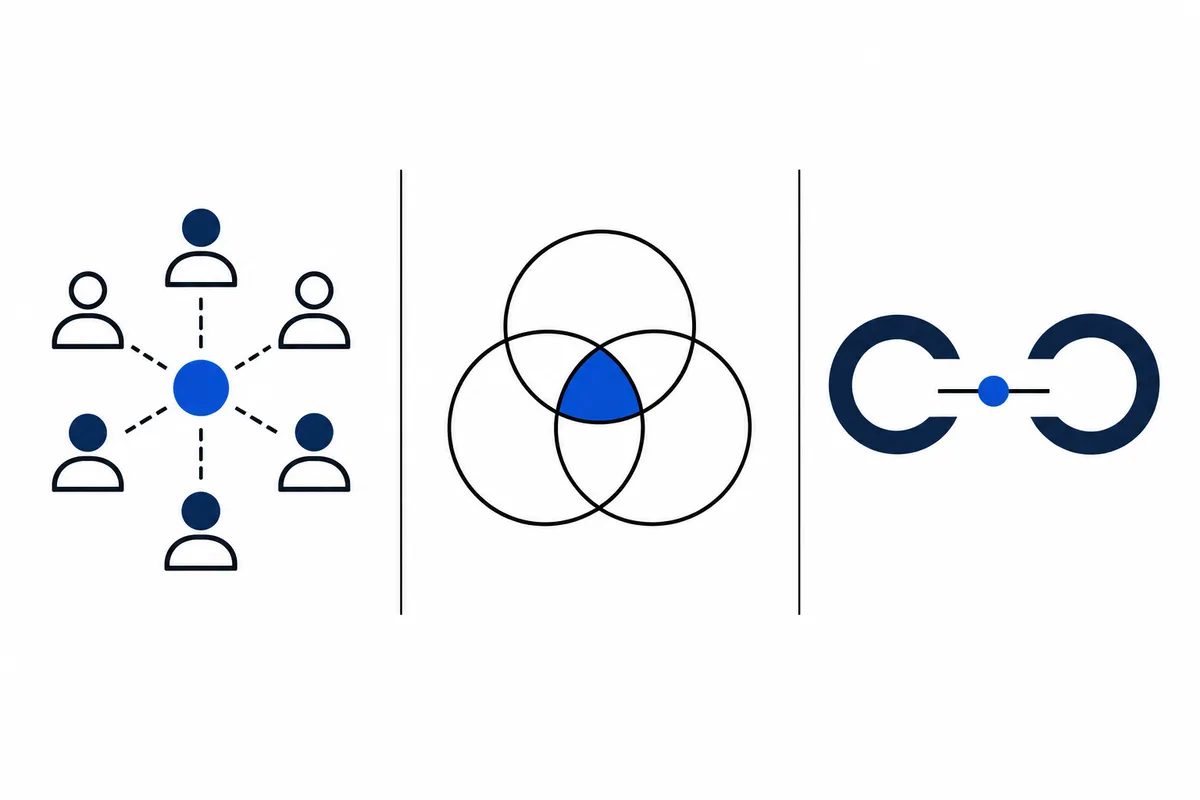
The nine-item Team-Trait Meta-Mood Scale (T-TMMS) asks leadership-team members how they perceive their team’s attention to emotion, emotional clarity, and efforts to regulate negative group mood. These are separate dimensions, not steps in a sequence. Its validation supports a focused reading in the studied cooperative leadership context; a team average still needs to be read alongside who responded and how their views differ. “Repair” concerns mood regulation, not proof that conflict was resolved.
What does the T-TMMS measure?
The Team-Trait Meta-Mood Scale (T-TMMS) is a nine-item team-referent self-report: each respondent describes perceived emotional processes in their team. In “Team Emotional Intelligence in Working Contexts: Development and Validation of the Team-Trait Meta Mood Scale (T-TMMS),” the authors organize those reports into three dimensions—Attention, Clarity, and Repair. They are distinct parts of the measure, not stages in a sequence. Repair refers to regulating group mood; a score alone does not establish that a disagreement was resolved. And an average represents a shared team account only when members’ reports support that interpretation. The response is therefore about perceived team functioning, not an ability score assigned separately to each member. The three labels identify what the questionnaire groups together; they do not say that a team must first notice feelings, then understand them, and finally regulate them. Nor does the name Repair mean that the underlying disagreement, decision, or harm has been repaired. For interpreting an average, the practical question is whether members’ answers are sufficiently aligned to describe a common perception, rather than simply whether a numerical mean can be calculated.
What changes when the question says ‘this team’?
The change is the object of the answer. In an individual EQ self-report, a person describes their own usual emotional habits or abilities. With a team referent, that person is asked to report on emotional processes attributed to the team as a whole. The respondent is still one individual; only the target described by the question has changed. “Team Emotional Intelligence in Working Contexts: Development and Validation of the Team-Trait Meta Mood Scale (T-TMMS)” presents the adaptation as a team-based construct, using members’ reports about their team rather than treating the scale as a direct test of each member’s personal emotional intelligence. This is a change of referent, sometimes called a change-of-reference approach: the item asks about “we” or “this team,” not “I.” It alters what an answer is intended to describe, but does not make the response collective at the moment it is submitted. The scale’s structure can therefore be team-oriented even though the initial observation is a member’s individual report.
That distinction matters when someone reads a response. A member’s answer can describe what they perceive in the group while another member perceives the same interactions differently. One person’s report tells you about that person’s view of the team; it cannot establish by itself that the perception is shared. The instrument’s team-level aim and the evidence available from one respondent are separate. For example, an answer that the team notices emotional signals records one respondent’s judgment; it does not show that everyone noticed the same signal or understood it similarly. Agreement among people is a further question, not something a single completed form can settle.
“The Importance of Team Health Climate for Health-Related Outcomes of White-Collar Workers” illustrates this distinction in another research area. Its multilevel treatment separates an employee’s perception of health climate from a team-level climate represented through shared perceptions. The study says nothing about T-TMMS validity; it is useful here for the measurement principle. A question may refer to a group, while researchers still need evidence that individual reports can be interpreted together. The T-TMMS has a team referent, but a particular set of answers supports a common account only to the extent members’ responses align. The named unit in a question and the unit represented in an analysis need to match: an employee’s experience is informative without automatically becoming the group’s shared climate. A T-TMMS response can contribute to a picture of team processes without settling what the whole team experiences. That distinction is especially important when a manager or researcher is tempted to describe the score as a property every member experiences equally.
Sources: Team Emotional Intelligence in Working Contexts: Development and Validation of the Team-Trait Meta Mood Scale (T-TMMS); The Importance of Team Health Climate for Health-Related Outcomes of White-Collar Workers
What do Attention, Clarity, and Repair each describe?
In “Team Emotional Intelligence in Working Contexts: Development and Validation of the Team-Trait Meta Mood Scale (T-TMMS),” Attention, Clarity, and Repair name three related but distinct ways respondents characterize emotional processes in their team. Attention concerns attending to feelings: whether emotional signals in the group are noticed and given weight. It is about what receives notice, not whether the feeling has already been interpreted correctly. A team may register that frustration is present, for example, while its members remain unsure what caused it.
Clarity concerns understanding what feelings mean. In the scale’s team framing, this is the perceived ability to make sense of emotional states in the group—what a mood may signal about the situation or how people are responding. Noticing tension and interpreting its meaning are different judgments: the first is about awareness; the second is about making sense of what has been noticed. A clear interpretation need not mean everyone agrees on the explanation, and the factor label itself does not settle whose interpretation is right.
Repair concerns attempts to regulate negative group mood. The study’s factor description uses Repair for this mood-regulation process: what the group is perceived to do when an unpleasant emotional climate needs attention. The label does not turn the dimension into a record of whether a specific dispute was settled. Here, its scope is the emotional process of responding to negative mood, not a general rating of accountability, good communication, or successful conflict resolution. Those outcomes require evidence about what people said and did beyond the factor name.
The original T-TMMS study reports a nine-item, three-factor structure. That finding groups related responses under three dimensions; it does not test a timeline in which a team must first attend, then gain clarity, and only afterward repair its mood. A team could be attentive to feelings while still disagreeing about their meaning, or try to shift a strained mood before members share a clear account of its cause. Those combinations are compatible with treating the factors as distinct dimensions. They are illustrations of how the labels can coexist, not scenarios tested by the scale.
The labels can tempt a reader to turn them into a neat process story: notice, understand, improve. That is an intuitively plausible way to describe some conversations, but the T-TMMS factor model does not establish that order or show that one dimension causes another. A visual with arrows or a loop would therefore say more than the evidence does. The more faithful picture is three peer dimensions—Attention, Clarity, and Repair—each naming a different aspect of perceived team emotional functioning, with no directional path implied between them.
Keeping the distinctions separate also prevents one favorable impression from answering three different questions at once. A group may be quick to notice that a meeting has become tense; that observation belongs to Attention. Members may then have competing explanations for the tension, which concerns Clarity. They might attempt to lower the group’s negative mood, the process named by Repair, without resolving why the tension arose. These are useful ways to understand the vocabulary, not claims about a particular team or a recipe for producing a better outcome. In reading the factor names, ask what kind of emotional process is being described before inferring what caused it or whether it worked. This separation also keeps the dimensions from becoming three grades on one scale.
What does ‘Repair’ leave unresolved after conflict?
A Repair result does not tell whether a disagreement was resolved. In “Team Emotional Intelligence in Working Contexts: Development and Validation of the Team-Trait Meta Mood Scale (T-TMMS),” Repair refers to attempts to regulate negative group mood. That is a meaningful part of what can happen during conflict: people may try to lower the temperature enough to continue. But the label does not record whether the underlying concern was heard, whether responsibility was assigned, or whether anyone followed through on a remedy.
Consider an invented work handoff, offered only as an illustration and not as an observed event or a T-TMMS item. A colleague points out that a report was sent with a missing figure. The group agrees to pause, listens without interrupting, and the irritation in the room eases. Yet no one confirms who will correct the report or when the revised version will reach the client. The mood has become easier to manage; the factual concern and ownership question remain open. Calling that exchange repaired would confuse a calmer conversation with a completed response.
The reverse can happen too. The team may agree who will fix the figure and send it by a specific time, while one colleague still feels dismissed because the original concern was brushed aside. A concrete task decision has been made, but the interpersonal impact remains. These outcomes can move separately: regulating the mood may help people stay in the conversation, while accountability, a decision, or a repair between colleagues calls for its own response. That distinction gives mood regulation its proper weight without asking one factor to stand in for every consequence of conflict.
So after a disagreement, look at the exchange and what followed before describing it as repaired: Was the concern answered? Is responsibility clear? Did the promised action happen, and did the people involved have a chance to address the strain between them? These are practical questions about the event, not extra meanings contained in a Repair result. A score can name a perceived group-mood process; the account of the conflict and its aftermath tells whether the issue, decision, and relationship received the attention they needed. This keeps the dimension useful in its own right: a group’s effort to regulate a negative mood may shape whether people can keep talking, even when the practical outcome still needs to be checked.
What did the original validation actually test?
The original T-TMMS paper, “Team Emotional Intelligence in Working Contexts: Development and Validation of the Team-Trait Meta Mood Scale (T-TMMS),” reports empirical validation work, not just a proposal for a new questionnaire. Its setting was leadership teams in cooperatives in Spain’s Basque Country. Managers completed surveys about their teams, and the researchers examined whether the responses formed a defensible measure of perceived team emotional processes. The main study was cross-sectional: its broad set of measurement and association analyses used data collected at one period, rather than following all teams through a sequence of later outcomes. That design can test whether item responses hang together in the expected ways; it cannot by itself establish what caused a team’s emotional climate or how it changes over time.
The authors began with more items and used confirmatory factor analysis to assess whether response patterns fit the proposed dimensions. They then retained a nine-item version organized around Attention, Clarity, and Repair. This evidence addresses the organization of the questionnaire: whether its items behave as indicators of the factors the authors intended to measure. It supports the reported three-factor structure in this study’s setting. It does not turn the factor labels into a sequence, nor show that the same structure must hold unchanged in every kind of team. The result is meaningful structural evidence, bounded by the population and conditions in which it was examined.
The paper also examined internal consistency, asking whether items grouped within each dimension gave sufficiently coherent responses to be treated as a scale. That is one reliability question about the items’ performance together; it is not, on its own, evidence that the questionnaire captures every important feature of team emotional life. For stability, the researchers administered the measure again after eight weeks to a smaller retest group. The scores’ relationship across those two occasions addresses whether team-level results were relatively steady over that interval. This second analysis adds a time comparison, but it does not change the overall cross-sectional character of the study or establish long-term change patterns. In other words, consistency concerns the pattern among items at a given assessment, while stability concerns the relationship between results at two assessments. Neither alone answers whether the scale predicts a specific member’s behavior or whether an individual team member’s view matches the group’s shared experience. Those questions require evidence suited to those interpretations, rather than a stronger reading of the same reliability checks.
To see whether the T-TMMS related to measures grounded in nearby emotional-intelligence frameworks, the authors compared its team scores with selected dimensions from the Workgroup Emotional Intelligence Profile (WEIP-3) and the Group Emotional Intelligence survey. Correlations with these other measures provide convergent evidence: the T-TMMS was compared with constructs it should have some relationship to if it is capturing relevant group emotional processes. The relationships were not identical across every comparison; the authors noted a more moderate association with the WEIP-3 Expression dimension. That variation matters because communicating emotion and attending to or regulating group mood are related questions, not interchangeable observations.
Taken together, these analyses give the instrument a real evidence base for its intended use with leadership teams in the studied cooperative context: item and factor structure, coherence among items, relations with other measures, and a limited retest of stability. The paper also examined cohesion, but that result answers a separate question about association with an outcome and is considered below. Keeping the evidence types distinct helps show what validation contributes: the scale’s structure and relationships were investigated rather than assumed. It also keeps the scope clear. The study gives readers grounds to take the T-TMMS seriously as a measure developed for that setting, while its design and population do not establish that every team elsewhere will interpret or use the questionnaire in the same way.
What can the reported cohesion result support?
In the original T-TMMS paper, “Team Emotional Intelligence in Working Contexts: Development and Validation of the Team-Trait Meta Mood Scale (T-TMMS),” team emotional-intelligence scores were associated with team cohesion in the studied sample. The authors compared the T-TMMS with the WEIP-3, a workgroup emotional-intelligence measure, to ask whether each accounted for variation in cohesion. In their initial regression comparison, T-TMMS accounted for a larger share of the sample’s cohesion variance than WEIP-3. In the hierarchical comparison, adding T-TMMS after WEIP-3 contributed additional explained variance, whereas adding WEIP-3 after T-TMMS contributed little additional variance. This is a useful comparison: in that setting, the team-referent scale carried information about cohesion that the alternative measure did not add to the model in the same way. The distinction between the measures is relevant to the comparison: the T-TMMS asks respondents to describe the team, while WEIP-3 represents an individual-referent approach to group emotional intelligence. A team-referent score may align more closely with a team-level cohesion outcome because both concern the group, which is one plausible interpretation of the difference the authors observed. That is an interpretation of the model comparison, not a separate mechanism tested by the study. The result indicates added statistical contribution under the authors’ analysis; it does not establish that the T-TMMS is universally superior for every emotional-intelligence question or outcome.
The authors describe this as predictive validity, but “predict” here refers to a statistical model’s ability to account for an outcome measure. The reported design was cross-sectional, so the study does not show that T-TMMS scores came first and cohesion changed afterward. Nor did the researchers assign teams to take the questionnaire as an intervention and then compare their teamwork. A regression can estimate how measures relate within observed data; it cannot make administering one of those measures the cause of the relationship. The cohesion finding therefore supports a bounded conclusion about association and incremental statistical information in the validation sample, not an effect of testing.
For someone considering the scale, that distinction changes what the result can reasonably promise. The cohesion analysis strengthens the case that the T-TMMS is relevant to its intended team context: its scores were related to an important feature of how teams work together, and the comparison with WEIP-3 showed added explanatory value in the reported model. It does not show that completing the questionnaire will improve a team’s cohesion. Treat the finding as evidence of a relationship in that studied setting, not as a guaranteed result of administering the scale or a forecast for a particular team. The comparison is therefore useful when judging whether a group-focused measure has evidence tied to a group outcome. Its value lies in the observed relationship and the incremental comparison, with the inference stopping at the evidence collected.
Why can one team average hide different experiences?
A team mean compresses several individual reports into one value. That can be useful when responses describe a reasonably shared perception, but the mean does not show how closely members agree. Imagine two teams whose average response is similar. In one, most members answer near that average; in the other, some report much more strongly and others much less strongly. The summary number can look alike while the underlying pattern is different. This is a hypothetical illustration, not a T-TMMS result or a claim about any actual team. The spread of answers can itself matter to interpretation.
“Identifying the Structure of Within-Team Variance in Ratings of Team Constructs” examined variation in ratings of several team constructs. Its reported results distinguish constructs by how much members’ ratings varied: relationship-conflict ratings showed higher within-team variance, and consensus on that construct declined over time in the study’s time subsample. This finding concerns conflict ratings, not Attention, Clarity, or Repair. It gives no T-TMMS rule for deciding when agreement is sufficient. It does show why team researchers may inspect the pattern within a mean rather than assume that one summary describes every member’s experience equally.
The pattern has practical consequences for a conversation about a team result. If a summary suggests one shared view, first establish whose reports are included and whether the responses actually cluster. A mean based on only some members, or one that combines sharply different views, answers a narrower question than “How does the team experience this?” Response coverage and response spread affect what the number can represent. A manager or facilitator can therefore use the mean as a starting point for asking about the pattern, rather than treating it as the complete account. This is a practical inference from the measurement problem, not a procedure tested by the variance study.
When reports diverge, the next useful question is what members had in mind as they answered. They may be recalling different meetings, different stages of a project, or different interactions with colleagues. Asking for the concrete event can reveal whether people are describing one shared episode from different positions or talking about separate experiences that were folded into one team score. It can also make disagreement discussable without presuming that one person’s account is mistaken. These are possibilities to investigate in conversation, not explanations established by the mean itself.
A practical reading therefore keeps two pieces of information visible: the average response and the degree to which members’ reports resemble one another. If the average is moderate but reports are widely spread, a group discussion can ask which experiences account for the difference before anyone names the result as a common team pattern. If answers cluster, the mean may be a more compact description of what respondents share, while still representing perceptions rather than an objective record of every interaction. The distinction helps leaders choose a proportionate follow-up: clarify whose views are present and what they refer to, then discuss the events members identify.
Disagreement alone does not establish dysfunction, and the cited study does not show that every difference in ratings carries equal meaning. Some variation may be hard to interpret without knowing who responded, what period they considered, or which team construct the item concerns. The study supports attention to within-team variation as information worth examining; it cannot diagnose a particular group or supply a cutoff for aggregating T-TMMS responses. Treating the spread as a prompt for inquiry preserves what the average summarizes while making visible the experiences it can leave out.
Sources: Identifying the Structure of Within-Team Variance in Ratings of Team Constructs
How is the team scale related to the individual TMMS?
The T-TMMS has a conceptual predecessor in the individual Trait Meta-Mood Scale (TMMS). The T-TMMS development paper, “Team Emotional Intelligence in Working Contexts: Development and Validation of the Team-Trait Meta Mood Scale (T-TMMS),” describes adapting that parent measure to ask about the team. The earlier framing is also named in the 1995 chapter “Emotional Attention, Clarity, and Repair: Exploring Emotional Intelligence Using the Trait Meta-Mood Scale.” This is a lineage of ideas and labels. It does not mean a person answering about a team is reporting the same target as a person answering about their own emotional experience.
That difference in target matters when comparing factor evidence. A structural result for the individual TMMS concerns how respondents’ answers about themselves organize; a result for the T-TMMS concerns answers framed around the team. The respondent, item referent, and analysis therefore differ. Shared factor names can identify a conceptual connection, but the names alone cannot transfer the individual scale’s measurement evidence to a team-referent instrument. The original T-TMMS paper reports its own three-factor findings, which stand on that team-scale study rather than being established by the parent measure’s structure.
The abstract for “Examining the Structure of the Trait Meta-Mood Scale” reports a study of 310 people from the general population. Its exploratory factor analysis and structural equation modelling replicated support for the three familiar factors and also found some support for a fourth. That result complicates any simple claim that the parent TMMS structure is universally settled. Because the accessible record provides the abstract rather than confirmed full text, the finding should be stated at that level: the study reports both replication and additional fourth-factor support, without treating the latter as a settled replacement structure.
The fourth-factor finding does not decide whether the T-TMMS’s team-based structure is valid, just as the individual study’s three-factor replication does not validate the team adaptation. They are evidence from different respondent targets and analyses. The fair comparison is narrower: the team measure inherits a conceptual vocabulary from the individual TMMS, while claims about how either version’s responses group together must be supported by evidence on that version. The individual structural study therefore makes the lineage more nuanced, but the team scale’s reported findings remain a separate empirical question. A similar label can survive an adaptation even when the question now asks a person to summarize interactions among colleagues; that change may alter what respondents consider and how their answers are analyzed. The individual result is thus useful context for reading the scale’s history, not a shortcut around examining the team-referent evidence.
Sources: Examining the Structure of the Trait Meta-Mood Scale; Emotional Attention, Clarity, and Repair: Exploring Emotional Intelligence Using the Trait Meta-Mood Scale
What does later workplace research add?
A later workplace study asks a broader question than whether a team-referent scale has a coherent structure: how might emotional processes in a management team relate to employees’ experience of working together? “Team Emotional Intelligence: Emotional Processes as a Link Between Managers and Workers” examined that question across 90 firms in one Spanish corporation. The researchers collected reports from management teams and from workers in the same firms, then modeled links among management-team transformational leadership, team emotional intelligence, employees’ passion, and cohesion. It is a separate research application, not a validation study of the Team-Trait Meta-Mood Scale.
The model placed management-team emotional intelligence between transformational leadership and employees’ emotional experience, with passion in turn linked to cohesion. The reported pattern was consistent with an indirect pathway: leadership related to team emotional intelligence; team emotional intelligence related to employees’ passion; and passion related to cohesion. The authors reported that team emotional intelligence mediated the leadership–passion relationship and passion mediated the relationship between team emotional intelligence and cohesion. In plain terms, the analysis examined a possible bridge between how a management group handles emotional processes and how workers feel and perceive their connection with one another. It did not treat a leadership team’s emotional intelligence and an employee’s emotional state as the same variable.
Here, “mediation” describes the structure of statistical relationships the researchers tested. It means the observed association between an earlier variable in the proposed model and an outcome was accounted for through one or more modeled variables. It does not show that leadership first changed team emotional intelligence, which then caused passion, which then produced cohesion. The measures were not an intervention, and the study did not follow a longitudinal sequence capable of establishing that chain over time. Its value is the explicit cross-level question: researchers modeled a management-team process alongside individual workers’ feelings and perceptions, rather than collapsing both into one undifferentiated EQ result.
The design drew on two respondent sources, but both the authors’ stated limits and the data structure matter. The study was observational, conducted in one corporate setting, and lacked longitudinal data; self-report and common-method concerns also remain for relationships measured from the same sources. So the pathway is a useful account of how team and employee processes may be related in that setting, not a general causal recipe for improving cohesion. For a reader interested in the T-TMMS, it supplies context for why researchers examine emotional processes at more than one level. It contributes no direct evidence that the named scale measures this model or that administering it would alter workplace relationships.
Sources: Team Emotional Intelligence: Emotional Processes as a Link Between Managers and Workers
What should an individual do next?
Choose one recent exchange connected to the dimension you are discussing. If the question is Attention, for example, identify a moment when someone’s feelings seemed relevant to the work and ask what different people noticed. Keep the discussion tied to that event: what was said, what was understood, and what remains unclear? An average result cannot settle those accounts for the people involved, so make room for differences in what members remember or perceived.
If the conversation is about Clarity or Repair, name the specific exchange and the next observable response—such as checking what a colleague meant or confirming who will follow up—rather than treating the label as an outcome. The purpose is to understand the interaction, not to score individuals, rank colleagues, or make a hiring or team-deployment decision. A useful follow-up is to ask what each person would want handled differently in a similar exchange, then agree on one concrete next step.
If your next question is about your own emotional habits, the private 32-item Emotional Skills Profile offers individual self-reflection on recent behavior and emotional situations. It is a separate individual product, not the T-TMMS and not a report of what a whole team experienced. [Explore the Emotional Skills Profile](/assessment).
Sources
- Team Emotional Intelligence in Working Contexts: Development and Validation of the Team-Trait Meta Mood Scale (T-TMMS)
Original development and validation of the team-referent T-TMMS; nine retained items and Attention, Clarity, Repair factors; psychometric analyses and team-cohesion association in leadership teams from Basque Country cooperatives. It does not test a sequence among the factors or prove causal effects.
- Identifying the Structure of Within-Team Variance in Ratings of Team Constructs
A study of five team constructs examined sources of within-team variance in 20,183 people across 4,313 teams, plus change over time in a subsample of 3,720 people across 731 teams. More observable constructs showed less idiosyncratic perceiver variance; relationship conflict showed higher variance and declining consensus over time. This illustrates why disagreement can matter, not a T-TMMS-specific agreement threshold.
- Examining the Structure of the Trait Meta-Mood Scale
The individual TMMS structural study abstract reports exploratory factor analysis and structural equation modelling with 310 general-population participants; it replicated Attention, Clarity, and Repair and found some support for a fourth factor. This is evidence about the parent individual measure, not the team adaptation.
- Team Emotional Intelligence: Emotional Processes as a Link Between Managers and Workers
Workplace study models management-team emotional intelligence, transformational leadership, worker passion, and cohesion using leader and subordinate reports in 90 firms; reported mediation associations. This is a separate research application, not a T-TMMS validation or evidence that administering T-TMMS changes outcomes.
- The Importance of Team Health Climate for Health-Related Outcomes of White-Collar Workers
A separate multilevel team-health-climate study distinguishes individual perceptions from a shared team-level construct, useful for explaining why one member’s team-referent response is not itself the team’s settled account. It says nothing about T-TMMS validity.
- Emotional Attention, Clarity, and Repair: Exploring Emotional Intelligence Using the Trait Meta-Mood Scale
The original 1995 TMMS chapter is the bibliographic lineage for the Attention, Clarity, and Repair framing later adapted by T-TMMS; use only to identify lineage, not to claim the team version has identical properties.
Apply it to the real situation
Reflect on your own emotional habits
From this guide: A T-TMMS result concerns perceived team processes; personal habits call for individual reflection.
If your question has shifted from how a team experiences emotion to how you handle your own recent emotional situations, the private 32-item Emotional Skills Profile offers a separate way to reflect on those habits and authored scenarios. It is an individual development tool, not a team measure or standardized ability score. Explore it when personal reflection is the next question you want to pursue.