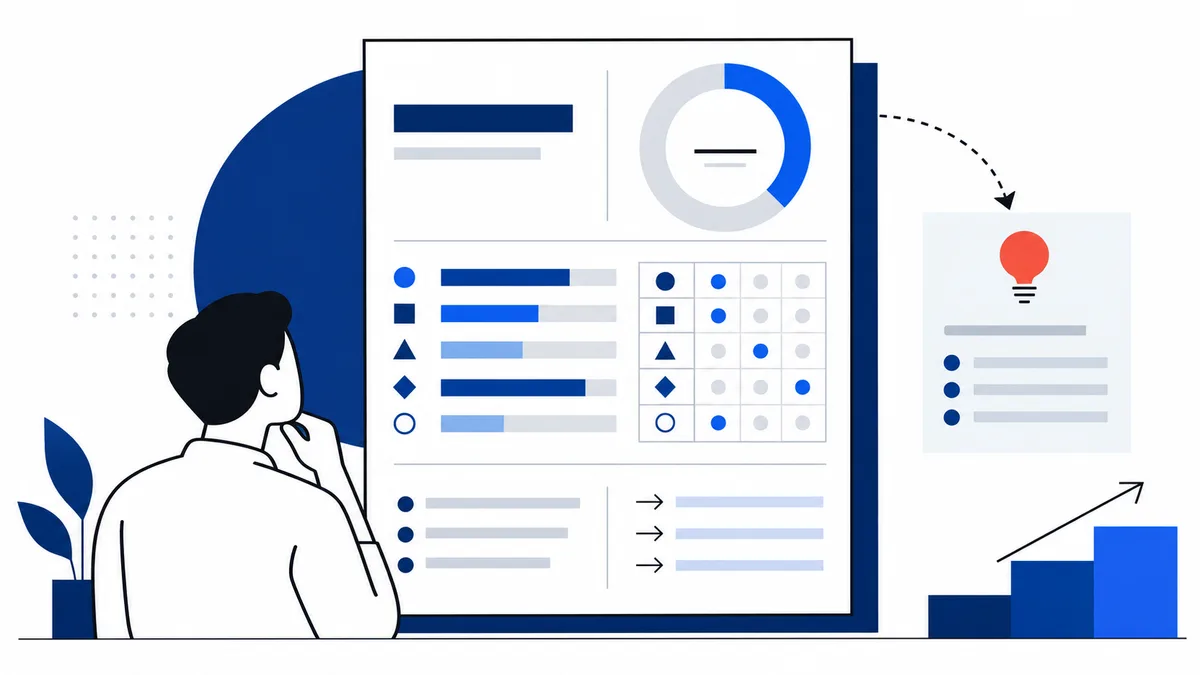
An EQ report should show what was measured, how the result was obtained, what its dimensions mean, and how much confidence the reader can place in small differences. Its best practical feature is a link from one pattern to one observable workplace behavior, so the score starts a conversation without pretending to settle it.
An overall score hides the measurement choice
After a difficult project handoff, a manager sees a single EQ number and has to decide what to discuss next. Does the result concern noticing tension, understanding what happened, or regulating a reply? Without the test's model and method, the number cannot answer that workplace question.
Emotional intelligence has been measured through different traditions. Ability tests ask people to solve emotion-related problems. Self-report measures ask about typical behavior or perceived capability. Mixed workplace tools can combine competencies, self-ratings, and sometimes other people's observations. A systematic review identified 40 instruments and found that ability, trait, and mixed models differ in both what they mean by EI and how they measure it. Many produce a total beside dimension scores, which is why the report's structure matters more than the size of its headline number. [1]
Sources: Emotional Intelligence Measures: A Systematic Review
Dimensions are useful only when they name a work moment
A dimension earns its place when it helps locate a behavior. In the Mayer and Salovey ability model, the four areas are perceiving emotion, using emotion to support thought, understanding emotion, and managing emotion. Perception concerns detecting emotional information; understanding includes emotion language and likely changes; management concerns adjusting responses toward a goal. [2]
Those labels become practical only when a report connects them to the kind of task it actually sampled. Perception might involve reading tone or facial expression. Understanding might involve distinguishing irritation from disappointment before revisiting a missed handoff. Management might concern choosing a response that lowers heat without avoiding the issue.
A workplace report may use different dimensions, such as self-awareness, stress management, empathy, assertiveness, or relationship management. Familiar labels do not make two instruments equivalent. The report needs to define its own framework and show how its dimensions were formed.
The ability model itself supplies a useful caution: its four branches describe areas of emotional problem-solving, but the authors report that research on ability measures has not consistently reproduced four matching mental factors. A report can therefore explain a model clearly while still treating its score structure as an empirical question. [2]
Sources: The Ability Model of Emotional Intelligence: Principles and Updates

Self-report and ability results answer different questions
An ability-based assessment presents emotion-related problems and scores the responses against its scoring approach. A self-report asks how a person usually behaves or how capable they believe themselves to be. A 360-degree format adds observations from colleagues, managers, or direct reports. These are different evidence streams, even when the report places them under one EQ heading. The Springer overview makes the same point: maximum-performance ability tests and self-report questionnaires can produce different results because they ask different questions. [3]
That difference matters in a meeting. A person can recognize a constructive response in a written scenario and still interrupt when a live disagreement feels threatening. Another person can rate their listening highly because they intend to listen, while colleagues notice that they begin preparing a rebuttal before the speaker finishes. A self-report can make a useful private hypothesis; an observed exchange is a separate check. Reviews of EI measures also identify self-judgment and socially desirable responding as limits, especially where people expect an employer to see their answers. [1, 3]
Observer feedback adds context, rather than a final answer. A colleague may see repeated interruptions while a manager sees careful listening in one-to-one conversations. The difference could reflect role, meeting format, power, or opportunity to observe. A report that includes 360-degree ratings should identify the raters, the setting they know, and how disagreement among them is handled. It should also state who can access the result, because confidentiality affects whether an employee can answer candidly and what a low or high result may trigger. Developmental use gives the person room to examine a pattern; employment decisions attach a different burden of evidence.
Sources: Emotional Intelligence Measures: A Systematic Review; Emotional Intelligence as an Ability: Theory, Challenges, and New Directions
Numbers need a comparison and a margin of trust
A displayed number needs a reference point. The report may compare a result with a norm group, a criterion, other dimensions within the same person, or only the possible responses in that instrument. A percentile requires a named comparison group. A band such as low, typical, or high requires an explanation of how the boundary was set. Without that information, a dial can look more exact than the evidence behind it.
Precision is the other missing piece in many summaries. In this setting, reliability means how consistently a score is produced under specified conditions. It does not mean that every small difference reflects a real difference in emotional functioning. Shorter dimensions can carry more uncertainty than a total, and a careful report tells the reader when a change is too small to interpret confidently. Validity is similarly tied to an interpretation, not stamped permanently onto a test: evidence for a dimension as a reflection prompt does not automatically support a claim about leadership, hiring, or future performance. The conclusion should stay as narrow as the evidence.
The International Test Commission places these questions inside the intended use of the test. Its guidance asks users to consider reliability and validity for relevant populations, possible bias, fairness, the testing setting, who receives results, and the risk of misunderstanding them. For a manager, that information determines whether a result can support a development discussion or whether it is being stretched into a decision the evidence does not cover. [4] A useful report makes this visible without asking every reader to become a psychometrician. It can say what the comparison is, identify the population or criterion behind it, and explain what range of difference is too small to read as change. When those details are unavailable, the responsible interpretation becomes narrower: use the pattern to select a question for reflection, then gather behavioral evidence over time.
Sources: ITC Guidelines on Test Use

Make the next interpretation testable
Consider a self-report profile that points to confidence in difficult conversations and less confidence in noticing early frustration. A useful report would turn that pattern into a small observation: before a feedback meeting, note what signs might indicate that the other person is rushed or defensive; during the meeting, ask one checking question before arguing for a solution; afterward, compare the prediction with what occurred. The exercise tests a reading of one situation. It does not turn the profile into a permanent weakness. The observation should be specific enough to review. Instead of writing “improve empathy,” record whether you named the concern accurately, asked for correction, and changed your response when the first reading was wrong. If the conversation becomes unsafe because of a power imbalance or retaliation risk, the score cannot solve that structural problem. The next step may be a clearer feedback process, a pause, or support from someone with authority. A report can suggest a question, but the scene supplies the evidence needed for learning. It can also reveal a mismatch between the report's language and the actual problem. “Low regulation,” for example, may lead to a different practice when the scene shows unclear priorities or repeated interruptions from someone with more power. In that case, the useful intervention belongs partly to the team's design, not solely to the individual.

Know when it belongs in team development
A report has earned a place in development when a reader can trace the path from method to dimension to an upcoming behavior. If it offers only an impressive total, undefined labels, and no account of comparison or uncertainty, the missing information is itself the conclusion. A polished chart cannot repair an unclear measurement design. [4]
For personal reflection, keep the result private and test one dimension against one recent or upcoming exchange. Write down the behavior before the meeting, review what happened while the details are fresh, and decide whether the practice should be repeated, changed, or dropped. For a company rollout, keep individual answers private by default and discuss shared practices such as clarifying intent before evaluating a proposal or repairing an interruption. A team lead can ask where the workflow made the practice difficult, so the group learns about its conditions for good communication rather than comparing employees' scores. EQ Test's browser assessment is a non-validated self-report with seven-position workplace continuums and a local report; it is suitable only as a developmental prompt. Teams that want a structured conversation can explore /teams.
Sources: ITC Guidelines on Test Use
Questions readers ask
Is the overall EQ score the most important part of the report?
Usually not. Start with the instrument's model and method, then read the dimensions, comparison basis, precision information, and suggested behavior. The total can summarize the assessment, but it cannot tell you which emotional process or workplace moment deserves attention.
Sources
- Emotional Intelligence Measures: A Systematic Review
Supports the distinction among ability, trait, and mixed EI models, their methods, dimensions, and measurement limitations.
- The Ability Model of Emotional Intelligence: Principles and Updates
Supports the four-branch ability model and the authors' caution that its content branches need not match the observed factor structure.
- Emotional Intelligence as an Ability: Theory, Challenges, and New Directions
Supports how performance tests and self-report questionnaires produce different evidence and why method changes interpretation.
- ITC Guidelines on Test Use
Supports checking reliability, validity, relevant populations, fairness, context, confidentiality, and the risk of score misuse.
Apply it to the real situation
See how you respond when work gets emotionally difficult.
From this guide: Choose one behavior from this guide to observe in the next relevant conversation.
Build a private profile across ten emotional-work continuums, then choose one observable behavior to practise.