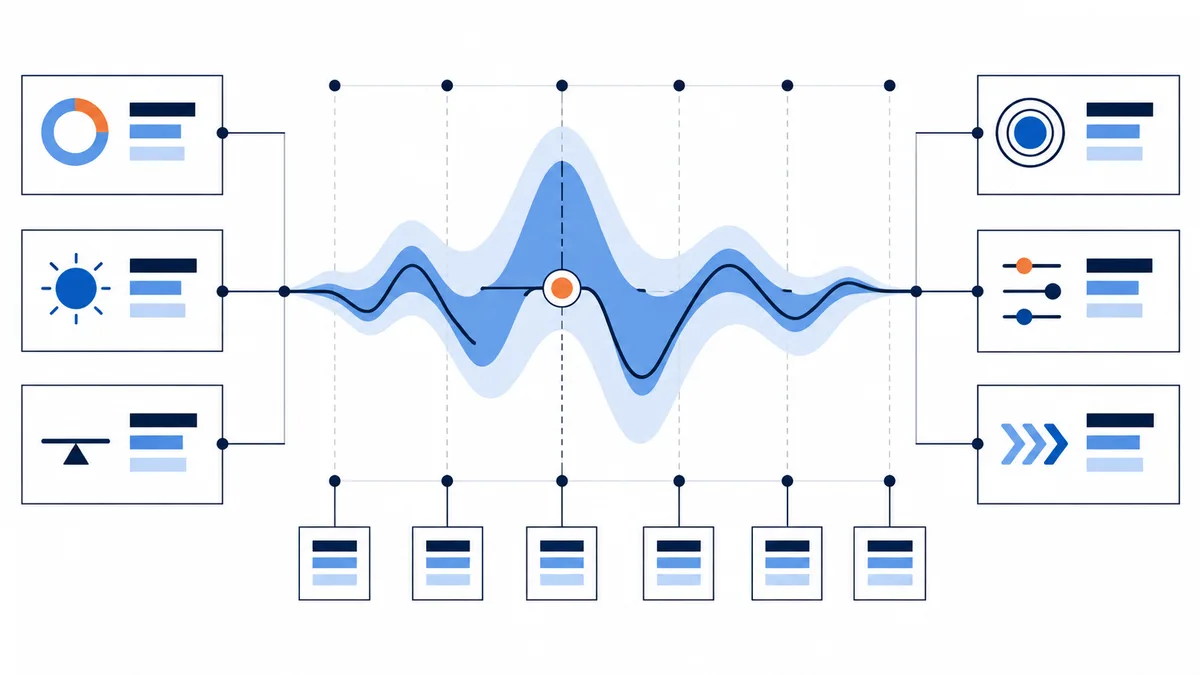
The State Difficulties in Emotion Regulation Scale (S-DERS) asks people to report perceived difficulties regulating emotion in a specified emotional state. Its original domains describe different kinds of difficulty within that episode. A response describes the respondent’s report in that window; it does not establish a stable EQ level or independently document workplace behavior.
What does one S-DERS response describe?
The State Difficulties in Emotion Regulation Scale (S-DERS) asks a person to report how difficult emotion regulation feels in a specified emotional state. In the original development study, “Development and Validation of a State-Based Measure of Emotion Dysregulation: The State Difficulties in Emotion Regulation Scale (S-DERS),” the scale was designed to capture state-based difficulty: the respondent’s account of their experience in the episode or state being referenced. A response therefore describes perceived difficulty in that window, as the person reports it. The emphasis is on the respondent’s own appraisal while referring to that state, rather than an outside rating of the same moment. The answer is consequently anchored to a time-bound experience: it concerns how regulation felt in the referenced episode, not a summary averaged across the person’s work or relationships.
That answer is narrower than a general EQ ability score. The S-DERS does not, by itself, establish how skilled someone is across situations, diagnose a condition, or tell a colleague what the respondent looked or sounded like. Nor does one response provide a complete record of the event: it gives the respondent’s account of an internal experience, not every action, trigger, or consequence surrounding it. The scale’s state reference is part of the meaning of the answer, not incidental wording to discard after scoring. If another person saw the same interaction, that observer could describe visible conduct, but could not directly supply the respondent’s private account. Likewise, a respondent’s report can clarify what the moment felt like without settling what caused the emotion or how another person experienced the exchange. Those are different kinds of information, and the S-DERS response supplies the first.
The original development study found relationships with trait measures and other outcomes, including predictive relationships. Those associations give the state report a place in a broader pattern of evidence; they do not erase its episode reference. A report tied to a particular state can relate to other measures without becoming a stable estimate of how that person usually feels or regulates emotion. The useful interpretation stays close to the question asked: what difficulty did the respondent perceive in the referenced state?
What do the four original domains separate?
The original S-DERS study organized reported difficulty into four domains: Nonacceptance, Modulate, Awareness, and Clarity. These labels distinguish different ways an emotional episode may become hard to manage. They name patterns in the original study’s model, not four universal EQ abilities or a complete map of emotional intelligence.
Nonacceptance concerns difficulty accepting the emotion that is present. A person may experience an unwanted feeling and also struggle with having that feeling at all. Modulate concerns difficulty changing the intensity of the emotional response or regulating behavior while the emotion is active. These are separate questions: one concerns the response to having the feeling; the other concerns what happens to the feeling and behavior as the episode unfolds. A report under Nonacceptance is about how the person relates to the emotion, not whether the emotion is justified by the situation. Modulate shifts attention to regulation once the feeling is underway: a person may find it hard to alter emotional intensity or keep behavior within the response they intend. The domain concerns perceived difficulty doing so, not whether the person actually acted badly in every episode. Keeping those questions apart prevents “I dislike feeling this” from being collapsed into “I cannot change what I do.”
Awareness concerns difficulty noticing or attending to the emotion. Clarity concerns difficulty identifying or understanding what the emotion is. The distinction is between registering that something is happening and making sense of what it is. In an explicitly illustrative feedback moment, someone might notice a strong reaction as a colleague challenges a proposal yet remain unsure whether the feeling is embarrassment, anger, or worry. Noticing the reaction and naming it are related, but they are not the same report. Awareness and Clarity can therefore diverge. A person may detect a bodily or emotional shift but have trouble distinguishing among possible feelings; another may be able to name an emotion once they notice it, while missing its early signs. The original labels make that difference legible without treating it as a ranking of emotional skill. In the feedback illustration, the uncertainty over the feeling’s name is a Clarity question; whether the reaction was noticed at all is an Awareness question.
The four-domain account gives the original scale a more specific structure than a single undifferentiated report of distress: it separates acceptance, modulation, attention, and identification as reported difficulties. The original development study supports those distinctions in its proposed factor structure. Later studies of language versions provide a further test of whether the same organization carries over cleanly, so the original labels should not be assumed to settle how every adaptation performs. That distinction matters when reading the labels: “awareness” is not a synonym for insight, and “clarity” is not simply the presence of emotion. They describe different reported obstacles within the same state. The study’s four factors are a proposed organization of those reports, and the subsequent adaptation evidence asks whether the structure remains persuasive when the scale is used in other language versions.
When is a typical-tendency measure a better fit?
The State Difficulties in Emotion Regulation Scale (S-DERS) and the Difficulties in Emotion Regulation Scale (DERS) place the respondent at different distances from a feeling. The S-DERS asks about difficulty in a specified emotional state; the original DERS asks about a person's typical difficulties regulating emotion. The DERS-16 validation paper describes that typical reference frame for the original DERS. One question points toward an episode; the other toward a recurring tendency across ordinary experience.
Imagine the difference between prompts framed as “During this moment, how hard was it to stay with what you felt?” and “In general, how often is it hard for you to stay with what you feel?” These are illustrative paraphrases, not test items. The first invites recall of one named state; the second asks the respondent to summarize what is usual. A tense project meeting could be an occasion to reflect on an episode, while a question about repeated difficulty across many situations calls for a typical-pattern frame. The wording changes the evidence the answer can contain: a moment-specific report can preserve when the difficulty occurred, whereas a typical-level answer compresses experience across occasions.
Choose by the reflection you need. If the question is what felt difficult in a particular emotional episode, use a state-framed measure. If it is whether difficulty tends to recur across situations, a typical-tendency measure better matches that purpose. A response about one meeting cannot establish that the same response is usual for the person. Conversely, a broad typical-level answer cannot reconstruct exactly what happened in that meeting, which feeling was present, or how difficult regulation felt then. Each can help examine emotion regulation, but they answer at different time scales.
Those time scales can still be related: a person’s usual difficulties may inform what happens in a particular state, and repeated episodes may shape a summary of what feels typical. The practical distinction is not a claim that state and trait phenomena are unrelated. It is that the respondent is asked to report against a different reference window, so the answers should not be read as interchangeable records. Match the measure to whether the intended reflection concerns this episode or a broader tendency.
What did the original validation establish—and leave open?
The original paper, “Development and Validation of a State-Based Measure of Emotion Dysregulation: The State Difficulties in Emotion Regulation Scale (S-DERS),” began with a substantial but specifically bounded group: 484 community-dwelling young adult women recruited at four sites. The researchers used exploratory factor analysis, which examines how responses group together, and reported a four-factor solution for the proposed scale. That result gives the four-domain account an empirical starting point in the population and study conditions examined. It is evidence that the responses in this sample could be organized in that way, not a demonstration that every group or setting will yield the same structure. Because the analysis was exploratory, its role was to identify a plausible organization in those responses, rather than to independently confirm a structure already fixed in advance. The four-factor finding is therefore a reasoned proposal grounded in those data and a starting point for subsequent tests.
The paper also reported preliminary support for internal consistency, construct validity, and predictive validity. In practical terms, its results offered early evidence that items within the proposed measure worked together and that scores related to other measures or outcomes in ways the authors expected. The study further reported associations with state laboratory measures. These findings support taking the S-DERS seriously as an initial state measure: its proposed structure did not rest on labels alone, and its responses showed relationships to other evidence collected in the research. They do not establish how precisely an individual score should be interpreted beyond the study’s measure, sample, and design.
The four recruitment sites add breadth to scale development, and the sample size gave the exploratory analysis a meaningful base. Neither feature makes the participants a representative norm group. The reported work does not supply population cutoffs or a basis for ranking one respondent against all others. Nor does a factor solution establish an objective emotional ability: the S-DERS records reported difficulty in a referenced state. The study’s contribution is initial structural and validity evidence for that kind of report, with the relevant evidence tied to the group and methods actually studied.
That boundary matters when interpreting later language versions. An exploratory structure in the original sample gives researchers a concrete account to test; it does not settle whether translated or adapted versions preserve the same organization in different populations. The initial paper therefore supports a defined conclusion: the original English S-DERS had meaningful early evidence as a state-based self-report measure, including a four-factor result and reported validity-related findings. Questions about transfer require examining the later studies on their own samples and methods, rather than treating the original result as universal validation.
What does translation evidence establish in Turkish and German?
The Turkish adaptation offers a positive test of the original four-domain account under a defined laboratory procedure. In “State-based measurement of emotion regulation: The Turkish versions of SERI and S-DERS,” 167 undergraduates first completed trait measures, then responded to a negative-emotion induction and completed the state scales. The university record’s abstract reports confirmation of the four-factor structures and acceptable validity evidence for the S-DERS. This matters because the result does not fit a blanket story in which adapting the scale to another language necessarily breaks its domain organization. It supports the Turkish version as studied, with emotion reports collected after an induced negative state; it does not establish that the same structure has been demonstrated for every Turkish-speaking group or in unprompted daily episodes.
A separate German study made the model contest more explicit. “Translation, validation and extended factor models of the German State Difficulties in Emotion Regulation Scale (S-DERS)” examined 214 participants aged 18 to 61 who completed the 21-item German version after a negative-mood induction. The sample was predominantly female (89%) and university students (93%). The authors compared confirmatory factor models and exploratory structural equation models, including extended alternatives. Their reported result favors the correlated four-factor model over both higher-order and bifactor alternatives. In a correlated-factor model, the four dimensions remain distinct while being allowed to covary. A higher-order model tests whether their correlations can be represented through a broader factor; a bifactor model tests a general factor alongside domain-specific factors. The comparison therefore asks how best to represent these responses in this sample, rather than whether the four labels can be collapsed by definition.
The German report also says ESEM needed extensive cross-loadings to achieve good fit. Cross-loadings allow an item to relate to more than its designated factor, so this finding complicates an overly neat picture in which every item belongs cleanly to one domain. It does not cancel the reported preference among the tested models: the correlated four-factor solution still outperformed the higher-order and bifactor options. Nor does the ESEM result alone show that a particular translation choice caused the pattern. It describes how the German responses behaved under the analyses reported; establishing why would require evidence beyond this model comparison.
Taken together, these studies provide positive but bounded replication evidence: the Turkish abstract reports confirmation of four factors, and the German study reports the correlated four-factor model as the strongest of its tested alternatives. Their procedures and samples matter to that conclusion. Both collected state responses following induced negative emotion, and the German sample was heavily university-based and female. The evidence supports retaining the four-domain account as a serious description of these studied versions, while leaving open how consistently it applies across different populations, languages, and ordinary emotional episodes. It does not make translation itself the explanation for either result, or turn one model contest into a universal verdict on all versions.
For a reader interpreting a study, the practical distinction is between replication of a broad arrangement and proof of identical measurement everywhere. The Turkish result supports the former in its reported procedure. The German comparison goes further by evaluating competing representations and favoring related, separable domains over a single broader account in that sample. Neither abstract provides a basis here for claiming exact equivalence of item meanings across languages or settings. The findings thus strengthen the case that the four original dimensions can remain useful after adaptation, while making the population and testing conditions part of what the evidence actually says.
Sources: State-based measurement of emotion regulation: The Turkish versions of SERI and S-DERS; Translation, validation and extended factor models of the German State Difficulties in Emotion Regulation Scale (S-DERS)
Why does Clarity remain the pressure point in Argentine studies?
Two Argentine reports place Clarity under pressure, but they do different kinds of work. “Validación argentina de la Escala de Dificultades en la Regulación Emocional Estado (S-DERS)” is an exploratory adaptation reported in a CONICET repository record. Its summary says the original four-factor structure was not replicated; after items were removed, the resulting exploratory solution had three factors, with Clarity underrepresented. This is evidence about how an exploratory analysis organized responses in that adaptation. Item removal and factor exploration help propose a local structure; they do not test, by themselves, whether a pre-specified four-factor version fits a new sample or whether Clarity should be discarded in other versions.
The later “Análisis factorial confirmatorio de la Escala de Dificultades en la Regulación Emocional Estado en una muestra argentina” addresses a different question. Its report describes 178 Argentine university emerging adults aged 18 to 28 and compares the original four-factor form with a three-factor form omitting Clarity. The abstract reports satisfactory fit for both proposed forms, with better fit for the reduced version, and identifies Clarity as an exception in the internal-consistency results. That is not the same conclusion as the exploratory adaptation: here researchers compared specified structures, and the report says the four-factor form was also satisfactory. The shared pressure point is Clarity; the analytic procedures and their conclusions are not interchangeable.
Fit and internal consistency answer separate questions. A model’s fit concerns how well its proposed organization accounts for the observed response patterns in the study. Internal consistency concerns how coherently items assigned to a domain behave together. A satisfactory overall four-factor fit can therefore coexist with a concern about the consistency of one domain. Neither result automatically resolves whether that domain captures a meaningful distinction: model fit and item coherence contribute different information, and a decision to retain, revise, or omit Clarity would need to consider both along with the intended interpretation of the scale. The distinction also prevents a common shortcut: treating a weaker consistency result as if it were itself a direct test of the four-factor structure. It is relevant to confidence in that subscale’s item grouping, but the reported comparison of candidate structures is a separate result. Keeping both findings visible preserves the tension in the Argentine evidence instead of letting one stand in for the other.
One plausible reason a short domain may be sensitive to individual items is that each item contributes a larger share of the available evidence for that domain. That is an interpretation of why Clarity’s consistency might deserve close inspection, not an explanation established by either Argentine report. The available repository and abstract summaries do not provide coefficients for this account, so they cannot support a numerical comparison of consistency or fit. The defensible statement is narrower: the exploratory adaptation produced an item-reduced three-factor solution with Clarity underrepresented, while the later confirmatory comparison reported acceptable fit for both candidate structures, relatively better fit for the reduced one, and a consistency exception involving Clarity.
These results qualify portability rather than overturn the original structure or the positive Turkish and German findings. The Argentine exploratory and confirmatory studies differ in purpose, and their summaries do not provide the same depth of accessible detail as a full methods and results review. Their convergence around Clarity is a reason to examine how that domain performs in a particular version and sample, not evidence for a universal deletion rule. For anyone reading an adapted S-DERS study, the useful question is therefore local: what structure was tested, in which respondents, and what did the evidence say about Clarity separately from the overall model?
Sources: Validación argentina de la Escala de Dificultades en la Regulación Emocional Estado (S-DERS); Análisis factorial confirmatorio de la Escala de Dificultades en la Regulación Emocional Estado en una muestra argentina
What can one response support in a work disagreement?
When colleagues disagree about a handoff, an episode report can describe how difficult the moment felt to the person answering. It cannot, by itself, settle the shared event or establish what another person intended. Keep the two kinds of information separate: the respondent’s account of an inner state, and the participants’ accounts of what was said or left undone. This is a practical way to use a state report in reflection, not a validated S-DERS procedure or a rule for scoring workplace behavior.
Consider an explicitly illustrative project handoff. One person says, “I felt overwhelmed when the request changed.” A colleague recalls that no one was assigned to confirm which version should go to the client. The first statement reports a felt difficulty; the second identifies a possible gap in coordination. The ownership gap does not prove that the first person was not overwhelmed, and the feeling does not show who was responsible for the missing confirmation. Both accounts may be sincere and still leave parts of the sequence unclear.
A useful conversation can begin by locating the moment each person means: which request, message, or decision are they recalling? Then preserve the state report in the respondent’s own terms, without translating it into a verdict such as “couldn’t cope” or “overreacted.” Next describe an action that participants can check against the shared record—for example, whether anyone explicitly named who would confirm the final version—and its practical effect, such as uncertainty about the next step. The aim is a more precise account, not a contest over whose memory is authoritative.
It also helps to separate description from interpretation while the disagreement is still live. “The approval field was blank at 3 p.m.” is a checkable description if the record confirms it; “you ignored the handoff” assigns motive. The respondent can add that uncertainty about approval made the episode harder to manage, while the colleague can explain what they understood the blank field to mean. This keeps the emotional report available as useful information about the person’s experience without asking it to decide a factual dispute it cannot answer. If the record is incomplete, the account should remain incomplete rather than being rounded into a confident story.
Before deciding what to change, ask what remains uncertain about the sequence and let each participant clarify it. People can remember timing, wording, and consequences differently; an observable action is not automatically an objective account in every detail. Once the event is clearer, choose one behavior worth discussing or trying next time, such as naming an owner and confirmation point before the handoff closes. That is an illustrative reflection sequence for a work disagreement. It does not turn an episode response into proof, a performance judgment, or an S-DERS scoring guide.
If the disagreement persists, it may be more useful to agree on what can be checked and what remains each person’s experience than to force a single account. A clear handoff record can answer who confirmed the version; it cannot retrospectively measure how overwhelmed someone felt.
What changes when the same state question is asked repeatedly?
One episode response can locate a reported difficulty in one specified emotional state. It cannot show, on its own, whether that difficulty was unusual for the person or tends to recur. Repeated answers could support a different comparison: how the same person describes difficulty across defined occasions. That comparison becomes interpretable only when the occasions and prompts are clear enough to know what is being compared.
Imagine a conceptual schedule that asks the same state-framed question after several separately defined work situations. If the wording and reference point stay clear, a reader could compare their own reports across those occasions: perhaps difficulty was reported in one situation and less in another. This would describe variation in the recorded answers. It would not establish why the reports differed, prove that the situations caused the difference, or predict how the person will respond next time. This is a conceptual example, not a study or a claim about an S-DERS research protocol.
The design question is what counts as an occasion and when to ask. Prompts tied to different kinds of events may capture different contexts; prompts answered long after the event may instead rely on a broader reconstruction. A repeated set can therefore investigate within-person patterns only in relation to its sampling choices and the context it records. More entries do not automatically make the record more representative. They may simply describe the occasions selected and the moments when the person could answer.
A planned series would also need to distinguish an occasion from a prompt. Asking at a fixed interval samples what is present at those times; asking after a specified kind of event samples that event category, if it occurs and the person responds. Neither schedule is inherently the full picture. The first may miss a short-lived episode between prompts, while the second may overrepresent the selected situation. These are design consequences to consider when interpreting a repeated record, not findings about how any particular S-DERS study sampled participants.
Informal retrospective notes may help someone remember what felt difficult in particular episodes, especially if they record the situation alongside the response. Those notes are not equivalent to a scheduled research protocol: timing, prompts, and occasions may vary, and the person chooses what to remember and write down. Repeated reports also remain self-reports. Their useful scope is a comparison of answers under the chosen conditions; more observations alone do not establish causation or turn state reports into a stable measure of emotional ability.
The comparison is strongest when readers keep those limits attached to the schedule they actually used.
What should you do with the result next?
Choose one behavior that would make the next similar moment easier to handle, then make it observable. After a tense handoff, for example, you might ask whether task ownership was clear before everyone left the conversation. If it was not, try naming who will confirm the final version and when. That gives you something specific to discuss or practice; “be better at regulating emotion” is too broad to guide what happens in the next meeting. Keep the behavior connected to the episode that prompted the reflection, and revisit it only when a similar situation gives you a meaningful chance to try it. A useful next step is a question or action you can actually bring into the work, not a prediction about how you will respond in every setting.
If your question is about what you tend to do across situations, look for a trait-framed measure rather than treating one episode as a usual pattern. EQ Test’s private 32-item Emotional Skills Profile offers a separate educational reflection on recent emotional habits and responses to authored scenarios. It is not an S-DERS substitute and does not produce a validated S-DERS score. You can explore the profile at [/assessment](/assessment) if that broader self-reflection is useful. Whatever you choose, take one concrete question back to the next handoff: who owns confirmation, and by when?
Questions readers ask
How is the S-DERS different from the DERS?
The S-DERS asks about perceived difficulty in a specified emotional state. The original DERS asks about typical levels of emotion-regulation difficulty. They address related questions with different reference windows, so their scores are not interchangeable.
Sources
- Development and Validation of a State-Based Measure of Emotion Dysregulation: The State Difficulties in Emotion Regulation Scale (S-DERS)
Original scale development: state framing, 21-item final measure, four domains, and initial psychometric findings.
- Development and Validation of a Brief Version of the Difficulties in Emotion Regulation Scale: The DERS-16
The original DERS is a 36-item self-report of typical emotion-regulation difficulties, distinguishing its reference frame from the S-DERS.
- State-based measurement of emotion regulation: The Turkish versions of SERI and S-DERS
Turkish adaptation evidence for the S-DERS four-factor structure under a laboratory negative-emotion induction.
- Translation, validation and extended factor models of the German State Difficulties in Emotion Regulation Scale (S-DERS)
Corrected rejected claim: the German study reports a robust four-factor structure, with the correlated four-factor model outperforming higher-order and bifactor alternatives; ESEM required extensive cross-loadings for good fit.
- Análisis factorial confirmatorio de la Escala de Dificultades en la Regulación Emocional Estado en una muestra argentina
A confirmatory Argentine study compared the original four-factor form with a three-factor form omitting Clarity; the abstract reports satisfactory fit for both and better fit for the reduced model, with Clarity noted as an internal-consistency exception.
- Validación argentina de la Escala de Dificultades en la Regulación Emocional Estado (S-DERS)
A separate exploratory Argentine adaptation reports that the original four-factor structure was not replicated and that an item-reduced three-factor solution left Clarity underrepresented.
Apply it to the real situation
Turn an emotional moment into a clearer practice question
From this guide: The S-DERS describes perceived difficulty in a specified emotional state; a separate reflection on recent habits and scenario judgments can help identify a behavior to consider next.
The S-DERS describes perceived difficulty in a referenced emotional state. If you want a separate reflection on recent emotional habits and judgments about authored scenarios, the private 32-item Emotional Skills Profile offers that route. It is an educational reflection tool, distinct from the S-DERS. Use it to identify a behavior to consider in your next difficult conversation.