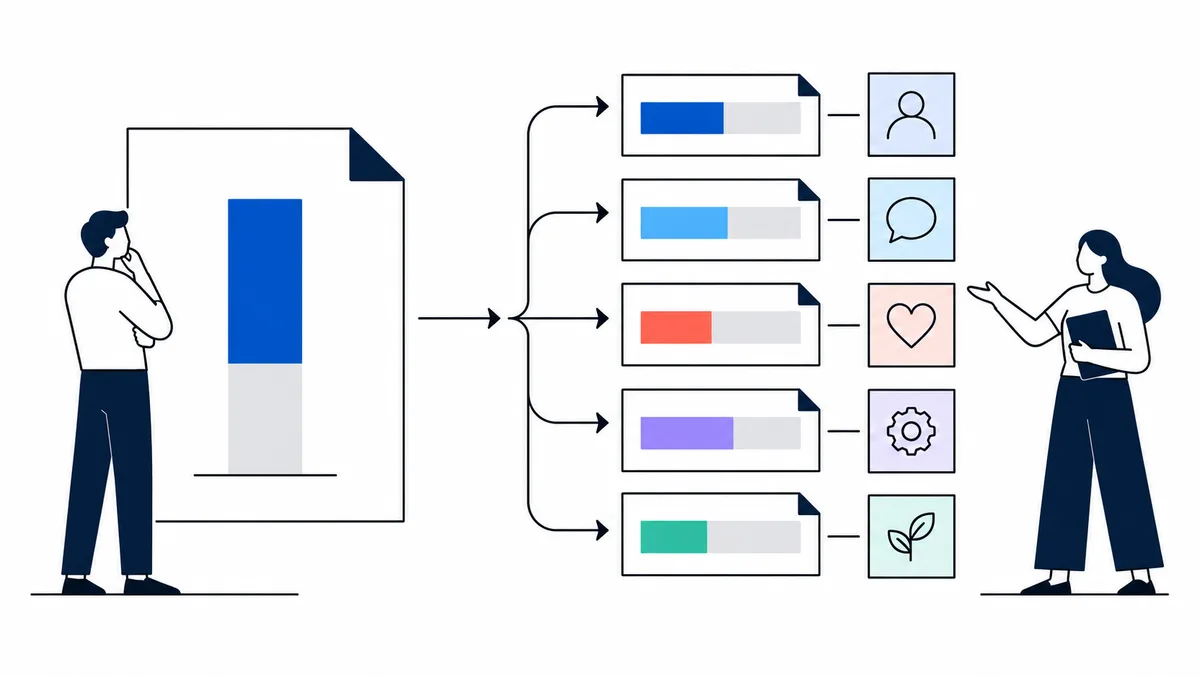
A single EQ score can hide the emotional skills being combined, the method used to measure them, the uneven pattern underneath, and the uncertainty around its meaning. That matters at work because a useful development decision is behavioral: what should someone notice, say, pause, or repair in a real exchange? A total can be a reasonable summary when its model and intended use support it. It becomes a weak guide when readers treat it as a universal measure of emotional ability, character, or job value.
A total cannot tell you what to practice next
When a workplace report leads with one EQ score, the eye goes to the verdict. The useful question is smaller: in the next difficult exchange, what should the person notice, say, pause, or repair? A total shows that several pieces have been combined. It does not point to the moment where a change might begin.
That missing link matters in feedback, handoffs, and disagreement. A person may notice a change in tone but misread its cause, understand the tension but become defensive, or read the exchange accurately and still avoid naming the problem. Those are different behaviors with different remedies.
Sources: Emotional Intelligence Measures: A Systematic Review; Emotional Intelligence: New Ability or Eclectic Traits?
First find out what the number is made of
Emotional-intelligence tests use different measurement traditions. A performance-based test presents emotion-related problems and scores the responses. A self-report questionnaire asks about usual behavior or perceived capacity. Trait measures focus on emotion-related dispositions and self-perceptions, while mixed measures may combine emotional skills with wider competencies. An observer or 360-degree report adds what other people have seen in a role.
The label EQ does not make these outputs interchangeable. Goldenberg, Matheson, and Mantler reported that a performance-based measure and a self-report measure were not related in their study and showed different relationships with other variables. A score that represents confidence in one's usual behavior cannot quietly be read as a direct measure of performance on an emotion problem.
The systematic review by Pérez-González and colleagues also found a field containing many instruments and models. A total without a named method therefore loses its first piece of meaning: whether it describes perceived behavior, observed behavior, or performance on a task.
Sources: Emotional Intelligence Measures: A Systematic Review; The assessment of emotional intelligence: a comparison of performance-based and self-report methodologies; Emotional Intelligence: New Ability or Eclectic Traits?
Even one model may contain several skills
The Mayer, Salovey, and Caruso ability model describes four related branches: perceiving emotion, using emotion to support thinking, understanding emotion, and managing emotion. Those branches are close enough to belong in one model, yet distinct enough to produce different workplace questions. Detecting a shift in expression is not the same task as working out whether it signals disappointment, anger, or uncertainty.
A single total compresses those distinctions. It also hides whether the report treats one branch as more important, averages the branches, or supports a higher-order score at all. The model's authors explicitly distinguish this ability conception from broader mixtures that include qualities such as optimism, self-esteem, and persistence. The method is part of the result, not a footnote.
Sources: Emotional Intelligence Measures: A Systematic Review; Emotional Intelligence: New Ability or Eclectic Traits?
The same total can lead to different work
Imagine two reports built from the same four component areas and ending at the same total. In one, the components are fairly even. In the other, emotion recognition is stronger while managing a heated exchange is weaker. The number is identical, but the sensible next observation is not. One person might study a demanding conversation broadly; the other might watch the pause between noticing tension and replying.
This is not a claim about a particular person's result. It is a property of aggregation. Once component information is discarded, the reader cannot recover whether the total came from a balanced pattern or from strengths and difficulties that offset one another. A report that shows interpretable components preserves a route from score to behavior.
The loss becomes larger when two totals come from different instruments. A self-rating, a task result, and a colleague's report answer different questions. Their numbers should not be compared merely because each is printed under the same two letters.
Sources: Emotional Intelligence Measures: A Systematic Review; The assessment of emotional intelligence: a comparison of performance-based and self-report methodologies; Emotional Intelligence: New Ability or Eclectic Traits?

What disappears in a feedback conversation
Suppose a feedback discussion stalls. A total cannot distinguish a softened message that leaves the issue unclear, a solution offered before the other person has finished, an interruption after surprise, or a failure to return to the issue later. Each pattern calls for a different experiment. The report becomes useful only when someone translates it into one of those observable possibilities.
A short record can supply the missing middle: what changed in the other person's words or tone, what did you infer, what did you say, and what happened next? That record is not proof that the score is correct. It is a way to check whether the score suggests a pattern that appears across more than one exchange.
Sources: Emotional Intelligence Measures: A Systematic Review; Standards for Educational and Psychological Testing
A total also hides the limits of the evidence
A score has precision only for the conditions and purpose studied. Internal consistency, for example, describes how items relate to one another at a point in time. It does not by itself show that a result will be stable on another day or that the total measures the workplace skill a manager has in mind. The review found that internal-consistency information appeared more often than test-retest information across the instruments it examined.
Self-report adds a person's view of their typical behavior. That view may be informed by self-knowledge, recent feedback, confidence, mood, or the wish to present oneself favorably. None of those possibilities can be separated by looking at a total alone.
The Standards for Educational and Psychological Testing place validity on the interpretation and use of scores. In practice, this means asking what claim the evidence can carry. A result might support private reflection while leaving a manager without grounds to infer leadership capacity, team value, or selection suitability.
Sources: Emotional Intelligence Measures: A Systematic Review; Standards for Educational and Psychological Testing
Context can change the meaning of a behavior
Silence in a meeting has more than one plausible explanation. It may reflect careful regulation, a power difference, work in a second language, limited information, or a deliberate choice to let another person finish. A total score cannot decide which explanation fits. The meeting's structure and the person's role remain part of the evidence.
That is why a workplace rollout should discuss team practices rather than turn private scores into public labels. Ask whether people can request clarification, disagree safely, and repair a missed handoff. If the setting gives someone little opportunity to speak or makes disagreement costly, a score cannot isolate an individual skill from that condition.
Sources: Emotional Intelligence Measures: A Systematic Review; Standards for Educational and Psychological Testing

One score is not automatically a bad summary
More detail is not always better. A compact score can orient a reader and make a repeated development conversation easier, provided the instrument explains its model, scoring, and intended use. The useful test is not whether the report has a dial or a decimal. It is whether the summary has earned the interpretation attached to it.
Joseph and colleagues' meta-analysis shows why broad mixed self-report totals need careful wording. Their content overlapped with ability EI, self-efficacy, self-rated performance, personality, and general mental ability; after those covariates were considered, the relationship with supervisor-rated job performance was no longer present in their analysis. That finding does not settle every self-report question. It does show why a total should not be sold as a stand-alone explanation of work performance.
Sources: Why does self-reported emotional intelligence predict job performance? A meta-analytic investigation of mixed EI; Standards for Educational and Psychological Testing
Read the report, then choose one observable test
Start with the method and purpose printed in the report. Look for component areas before interpreting the total, and ask how they were combined. If those details are missing, keep the number descriptive rather than building a strong story around it.
Next, write one behavior-and-setting hypothesis: during tense discussions, I move to solutions before checking that the concern is understood. Choose one upcoming exchange and try one small change, such as asking a clarifying question before defending a proposal or returning to an unresolved point at the next meeting.
Afterward, note what changed in the exchange. If the observation does not fit, revise the hypothesis. If it recurs, choose the next practice. For teams, keep individual results private and use the shared conversation to agree on behaviors that make feedback, disagreement, pressure, and repair easier.
Sources: Emotional Intelligence Measures: A Systematic Review; Standards for Educational and Psychological Testing
Questions readers ask
Is one overall EQ score meaningful?
It can be a useful summary when the model, scoring method, evidence, and intended use support that interpretation. It cannot show which component pattern produced the result or which workplace behavior deserves attention.
Why can two people with the same EQ score behave differently?
The total may combine different component patterns, and different tests may measure self-perception, performance, or observed behavior. The same-looking number can therefore lead to different development questions.
Does a self-report EQ total measure emotional ability?
It mainly describes how a person views their usual behavior or capacities. Performance-based tasks and observer reports provide different information, so a self-report total should not be treated as a direct ability score.
How should a team use an EQ score responsibly?
Use it for private reflection and development, then discuss observable team practices such as clarification, disagreement, feedback, and repair. Do not use individual scores to hire, rank, promote, diagnose, or decide who belongs on the team.
Sources
- Emotional Intelligence Measures: A Systematic Review
Supports distinctions among ability, trait, and mixed measures, multidimensional models, and limits of available reliability evidence.
- The assessment of emotional intelligence: a comparison of performance-based and self-report methodologies
Supports the finding that performance-based and self-report EI measures can capture different information and need not be related.
- Why does self-reported emotional intelligence predict job performance? A meta-analytic investigation of mixed EI
Supports caution about broad mixed self-report totals because their content overlaps with several established constructs.
- Emotional Intelligence: New Ability or Eclectic Traits?
Supports the four-branch ability model and the distinction between ability-based EI and broader trait or mixed approaches.
- Standards for Educational and Psychological Testing
Supports judging validity through evidence for a specified score interpretation and use, including construct and contextual considerations.
Apply it to the real situation
See how you respond when work gets emotionally difficult.
From this guide: Choose one behavior from this guide to observe in the next relevant conversation.
Build a private profile across ten emotional-work continuums, then choose one observable behavior to practise.