
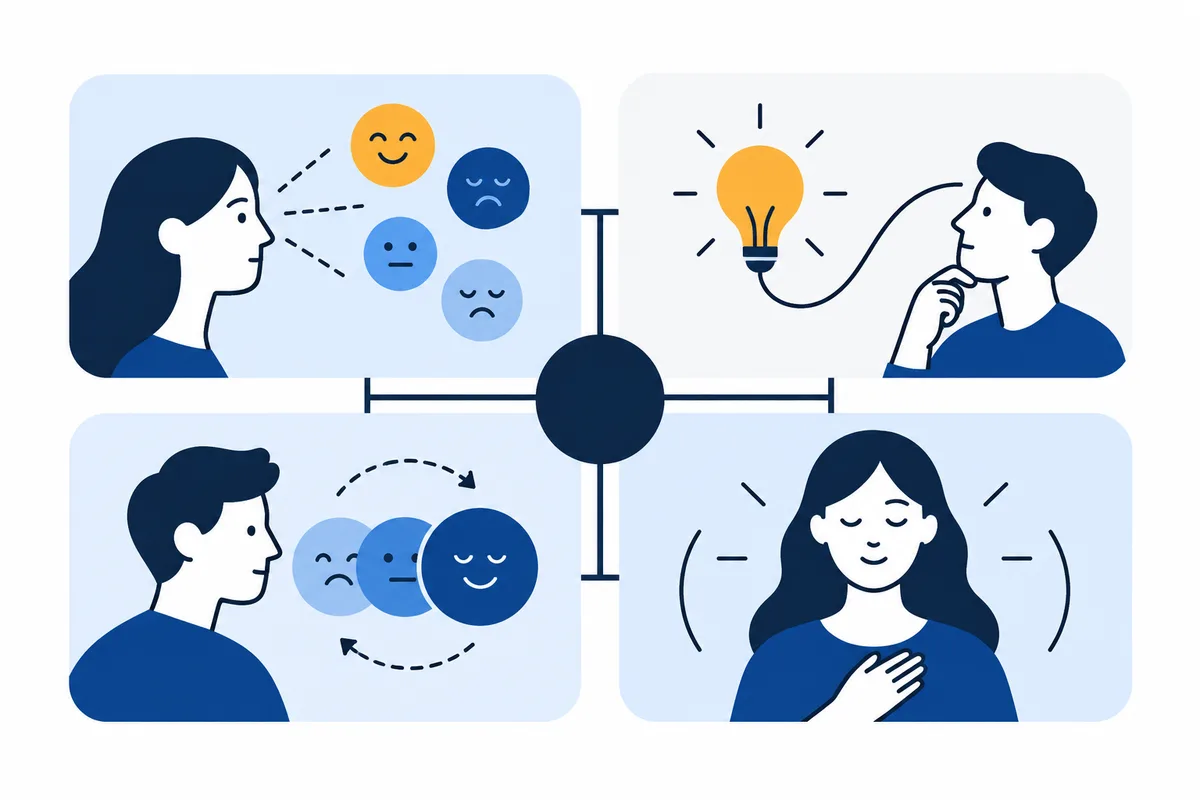
The four-branch model is Mayer and Salovey’s ability-based account of emotional intelligence. It describes four related kinds of emotional information processing: perceiving emotion, using emotion to support thought, understanding how emotions develop and combine, and managing emotion. A performance assessment aligned with the model asks someone to solve emotion-related problems. A self-report questionnaire asks how that person sees their usual behavior or skill. Those methods can point toward different development questions. In workplace use, the model is most useful for examining a specific exchange, not for turning four scores into a permanent verdict about a person.
The choice is between kinds of evidence
A team is reviewing an emotional-intelligence assessment after feedback conversations have become defensive. One proposal uses four branches. Another asks employees how often they stay calm, listen carefully, or handle disagreement well. The labels overlap, but the evidence does not.
Before looking at a report, decide what needs to be known. Is the question about solving a defined emotion problem, a person’s view of their usual behavior, or a team habit that makes feedback harder? The four-branch model was designed as an ability model: a theory that emotional information can be processed through related mental abilities. It is not, by itself, a questionnaire, a workplace behavior checklist, or a claim that one number captures emotional intelligence.
This matters because a result can be technically clear and still answer the wrong question. A performance task offers evidence about responses to the problems presented. A self-report offers evidence about self-perception, confidence, or reported habits. A manager who treats either result as a recording of the next tense meeting is asking more of the measure than it can provide.
Sources: Emotional Intelligence, Noba Psychology module; Emotional Intelligence as an Ability: Theory, Challenges, and New Directions
What the four branches describe
The first branch is perceiving emotion. It concerns noticing and identifying emotional information in oneself and other people, including expression, tone, or bodily signals. In a meeting, a colleague’s shorter answers may be worth noticing. They do not announce a single cause. Frustration, fatigue, caution, and concentration can look similar from a distance.
Using emotion to facilitate thought is the second branch. It asks how feeling states affect attention, judgment, and the kind of thinking a task requires. Urgency can help a group act; high activation can also make careful listening more difficult. The relevant question is not whether an emotion is good or bad. It is what the emotion is doing to the work in that moment.
Understanding emotion adds meaning and movement. A person distinguishes disappointment from anger, considers what produced each feeling, and follows how one state may intensify, soften, or combine with another. Management concerns the choices that keep emotion available as information while guiding the exchange toward a workable outcome. That may involve pausing, changing the setting, acknowledging impact, or setting a clear boundary.
Mayer and Salovey’s account presents the branches in an order that moves from more basic processes toward more integrated ones. The ordering helps explain why a response strategy can fail when the signal was misread. It is better treated as a proposed relationship among abilities than as a four-step script for every conversation.
Sources: Emotional Intelligence, Noba Psychology module; Emotional Intelligence as an Ability: Theory, Challenges, and New Directions
A feedback conversation, read closely
Consider a project review in which a manager says that a handoff was unreliable. The contributor becomes quiet. The four-branch model slows down the leap from observation to judgment. First ask what was actually perceived. Then check it. A private question such as “What part of that feedback landed hardest?” may reveal embarrassment about the public setting, anger about an unclear requirement, or time needed to think.
The next questions concern the work of the emotion. Did defensiveness narrow attention to disproving the criticism? Did urgency push the manager toward a quick conclusion? Did either person misunderstand how the missed handoff, the public correction, and the later reaction connected? The answers point to different repairs: clarify the process, move the conversation, name evidence more precisely, or agree on a pause before replying.
The framework has done useful work without assigning a branch score. It has kept an observation separate from an interpretation and an interpretation separate from a response. It has also left room for the team’s design to be part of the explanation. A clearer handoff or safer feedback process may change the next exchange more than asking one person to become calmer.
Why the model does not settle its own measurement debate
A neat diagram can suggest that the four branches are four separate shelves, each with a score. The research picture is less orderly. A review of ability emotional intelligence describes challenges to the original hierarchical structure and notes that facilitating thought has sometimes failed to appear as a distinct factor. A factor is a pattern of relationships among test results that researchers use to examine whether proposed abilities hang together as expected.
The 2019 meta-analysis by Olderbak, Semmler, and Doebler combined 352 effect sizes from a total of 15,333 participants. Understanding emotion had the strongest combined relation with fluid and crystallized intelligence in that review, while the other three branches showed smaller, similar relations. The authors also found that the relation for perceiving emotion varied with the kind of stimulus used. Those findings describe patterns across studies. They do not establish a cutoff for a workplace result or prove that a branch causes performance.
There is a second practical complication: the samples in that meta-analysis were mostly students, and most came from North America or Australia. It tells a buyer to inspect the population and setting behind an interpretation before moving it into a multilingual, cross-functional workplace.
A model proposes what may belong together. An instrument turns that proposal into observations through particular items or tasks, a scoring rule, a sample, and an intended use. The same branch names printed on two reports do not make their results interchangeable.
Sources: Emotional Intelligence as an Ability: Theory, Challenges, and New Directions; Four-Branch Model of Ability Emotional Intelligence With Fluid and Crystallized Intelligence: A Meta-Analysis of Relations
Performance tasks and self-report are different instruments
The best-known performance measure associated with the model is the Mayer-Salovey-Caruso Emotional Intelligence Test, or MSCEIT. Its tasks ask respondents to work through emotion-related problems. The 2003 study of its second version examined agreement among a standardization sample and emotion experts, reliability, and possible factor structures. The reported findings support a particular instrument’s measurement study; they do not validate every test that uses four branch labels.
Performance scoring requires a basis for deciding which response is stronger. The MSCEIT study compared answers with expert and general agreement approaches. That is a substantive choice, because an emotion problem may have several plausible responses and because clearer expression cues can make agreement easier. A responsible report makes its scoring basis visible enough for the reader to understand what the result represents.
A self-report questionnaire asks a different question: how someone describes their typical behavior, confidence, or perceived skill. That information can open a useful conversation. Someone may recognize a pattern of avoiding tension in meetings or of feeling able to pause before replying. It remains evidence about the person’s report of themselves, rather than a direct demonstration of accurate emotion perception in a new task.
The reverse limitation applies to performance tasks. Solving a written or visual problem can show what a person did under those conditions. It cannot by itself show whether they will use the same reasoning when a senior colleague is angry, the deadline is moving, or speaking up feels unsafe. The Springer review discusses this ecological-validity concern: test situations may not reproduce the cues, pressure, and consequences of ordinary interaction.
For a team-development decision, the method should follow the question. If the aim is private reflection and a behavior conversation, a self-report may be a suitable development aid. If the claim is about emotional ability, the buyer needs performance evidence and a defensible interpretation for the intended population.
Sources: Emotional Intelligence, Noba Psychology module; Emotional Intelligence as an Ability: Theory, Challenges, and New Directions; Measuring emotional intelligence with the MSCEIT V2.0
What the branches can change in practice
The framework is useful in the feedback example because it gives the team several places to investigate instead of one global label. Was a signal missed? Did the emotional state narrow attention? Was the sequence misunderstood? Did the chosen response protect the task while respecting the people involved? Those questions can lead to different actions: clarify the handoff, move feedback into a private setting, name evidence more precisely, or set a boundary about public criticism.
The same questions can structure a review after disagreement or repair. Start with one observable exchange and record what was said, what changed, and what each person inferred. Keep the questions voluntary and specific. A quiet employee is not automatically disengaged, and visible calm is not automatically good regulation. Role, language, status, workload, and the safety of speaking openly affect what a behavior means.
EQ Test’s own assessment sits in a different category from an ability measure. It is a private, non-validated self-report with seven-position workplace continuums and a local report. It has no total EQ quotient, population norm, type code, or ability score. A reader can use it to notice a reported pattern and choose one practice to examine. A company rollout should keep individual reflection private and use shared discussion for observable behavior, never hiring, promotion, ranking, diagnosis, or deciding who belongs on a team. Teams can explore that format at /teams.
Read a four-branch result without overreading it
When a report uses the four-branch model, begin with its method. Ask whether the result came from emotion-related problem solving, self-description, or observation by other people. Then ask what the tasks, respondents, scoring basis, and evidence allow you to infer in the setting that matters. A branch score can help select a question for reflection; it cannot explain a whole person or remove the need to examine the exchange itself.
For the team considering an assessment, the most productive next move is modest: choose one recent feedback, pressure, disagreement, or repair moment, and identify the uncertainty before choosing a measure. If the uncertainty is about a self-described habit, reflection may be enough to begin. If it is about a proposed ability, look for an assessment built to test performance. The four-branch model earns its place when it makes that choice more precise.
Sources: Emotional Intelligence, Noba Psychology module; Emotional Intelligence as an Ability: Theory, Challenges, and New Directions; Four-Branch Model of Ability Emotional Intelligence With Fluid and Crystallized Intelligence: A Meta-Analysis of Relations
Sources
- Emotional Intelligence, Noba Psychology module
Supports the four branch descriptions, performance-measure explanation, and distinction from mixed and trait self-report models.
- Emotional Intelligence as an Ability: Theory, Challenges, and New Directions
Supports the model’s branch definitions, measurement formats, ecological-validity concern, and factor-structure challenges.
- Four-Branch Model of Ability Emotional Intelligence With Fluid and Crystallized Intelligence: A Meta-Analysis of Relations
Supports the reported meta-analysis design, sample, effect-size count, and differing relations across the four branches.
- Measuring emotional intelligence with the MSCEIT V2.0
Supports the original MSCEIT study’s examination of answer agreement, reliability, and possible factor structures.
Apply it to the real situation
See how you respond when work gets emotionally difficult.
From this guide: Choose one behavior from this guide to observe in the next relevant conversation.
Build a private profile across ten emotional-work continuums, then choose one observable behavior to practise.