
Consensus scoring builds an ability emotional-intelligence test’s answer key from responses by a defined reference group. Mode scoring gives credit to the most common answer; proportion scoring gives graded credit based on how many people chose each answer. The result shows how a response compares with that group under that scoring rule, not whether it is universally correct or how someone behaves in everyday life.
What does the scoring key actually do?
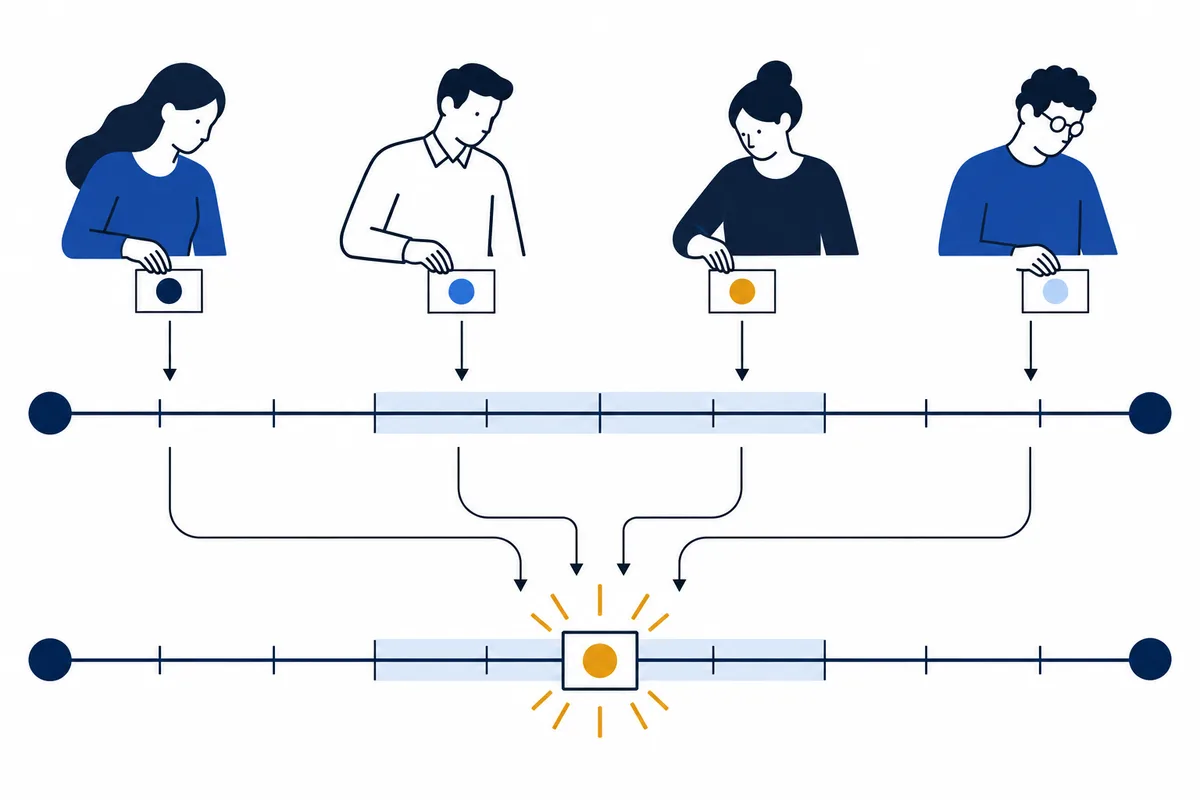
Consensus scoring builds an answer key from a reference group: the sample whose responses set the scoring rule. The test taker selects a raw response; the key assigns that option credit, which may contribute to the eventual test score. Barchard and Russell’s “Bias in Consensus Scoring, with Examples from Ability Emotional Intelligence Tests” describes this method as useful when experts may disagree about correct answers to ability-test items. The frequency rule is set before an individual response is scored, separating the group’s pattern from the test taker’s answer.
Consider a hypothetical item answered by 100 people: 50 choose A, 30 B, 15 C, and 5 D. With proportion scoring, each option earns credit equal to its share: A .50, B .30, C .15, D .05. Choosing B earns .30. With mode scoring, the most frequent choice, A, earns 1 point; every other choice earns 0. Choosing B earns 0. These figures illustrate the rules, not study findings. The same response can therefore receive graded credit or none, depending on the scoring variant. “Consensus” says how the key was set; it does not make the most common answer a universal emotional truth.
Sources: Bias in consensus scoring, with examples from ability emotional intelligence tests
Why use agreement when emotion has no simple answer key?
A conventional test can mark an answer against a settled criterion: a calculation has a result, or a factual question has a verifiable answer. Emotion-related tasks can be harder to key. A response that helps in one situation may be poorly suited to another. Test designers may also lack a recognized group whose answers count as expert, or know the actual feeling of the person represented in an item. Consensus scoring makes that rule explicit by using the response pattern of a defined reference group. It measures match with that group’s pattern, not universal emotional correctness. In “Bias in Consensus Scoring, with Examples from Ability Emotional Intelligence Tests,” the authors describe consensus as an alternative for ability-test items where experts disagree about correct answers, including emotion and emotion perception. They note there may be no agreed criterion group, no record of the pictured person’s feeling, or no individual target for the task. Even when a target is available, that person’s account may not be an unquestionable standard. A response-frequency key offers a repeatable procedure and a visible source for the credit assigned to answers. It makes the key’s source inspectable. Imagine a response selected by most members of the reference group: under a mode key it may receive full credit because it was most common. That is a fact about the key’s construction; the item still needs separate evidence if the score is to support a broader claim about emotional ability. The procedure does not convert frequency into truth. A common answer may be a useful convention for a particular instrument, but frequency alone cannot establish that the answer is best across cultures, goals, or circumstances. The sample and rule remain consequential choices. The MSCEIT V2.0 comparison gives a useful test of the assumption that public consensus and expert judgment must be wholly separate. In “Measuring Emotional Intelligence with the MSCEIT V2.0,” the authors report that 21 emotion experts and 2,112 people in the standardization sample endorsed many of the same answers. Expert agreement was stronger particularly on questions where research offered clearer answers, such as facial emotion perception. Their overlap supports some shared keys; it does not show consensus resolves every ambiguous item. Agreement is a workable scoring criterion when another criterion is missing or contested. Its meaning remains tied to the group, item, and test for which the key was built.
Sources: Bias in consensus scoring, with examples from ability emotional intelligence tests; Measuring emotional intelligence with the MSCEIT V2.0
What did the original MSCEIT comparison establish?
In 2003, the MSCEIT V2.0 developers tested a question central to consensus scoring: would a general standardization sample and emotion experts identify the same test answers as correct? The study included 21 experts and 2,112 members of the standardization sample. In the abstract of “Measuring emotional intelligence with the MSCEIT V2.0,” the groups are reported to have endorsed many of the same answers. The experts showed stronger agreement especially on questions where research offered clearer answers, such as perceiving emotion in faces. This is evidence of overlap between the two answer sources, alongside a difference in how consistently experts agreed. It does not show that every frequent answer was correct or that experts and the larger sample used an identical rule.
The pattern makes the comparison item-sensitive. Where research offers clearer support, expert judgments may converge more readily. Where evidence is less clear, a broad group's agreement can supply a scoring convention, but does not independently establish correctness. The abstract gives no item-by-item agreement figures, so readers cannot tell how often the groups diverged or which ambiguous answers warrant the most caution. It also does not establish that the pattern holds for other tests, later MSCEIT versions, or different reference samples. The narrower finding is that, for MSCEIT V2.0, the developers compared expert and standardization-sample answers and found overlap, with expert agreement strongest on clearer questions.
The paper also reports reasonable reliability for the MSCEIT and says confirmatory factor analysis supported theoretical models of emotional intelligence. Reliability concerns score consistency; factor analysis examines whether patterns among test results fit a proposed structure. These findings address score consistency and the test's organization, not whether a consensus key identifies the uniquely correct response to an emotional problem. The abstract supplies no coefficients or model details, so those results should not be made more specific here.
For readers, the study shows that the original MSCEIT consensus approach was compared with expert judgment, rather than resting only on the assumption that a large group's most common answers must be right. Overlap lends support where both groups converge; stronger expert agreement on clearer items also shows that evidence is not equally strong for every question. A report should identify its instrument, version, and scoring basis. This comparison concerns MSCEIT V2.0, not every consensus-scored emotional-intelligence test.
Sources: Measuring emotional intelligence with the MSCEIT V2.0
When can the reference group's size change the result?
The reference group's size matters most when a test uses mode scoring and subgroups tend to choose different most common answers. In that case, a combined key can favor the response preferred by the larger subgroup. Proportion scoring reduces this particular effect because it gives each response graded credit based on how many people selected it, though it does not eliminate every possible bias. This is a scoring-rule effect, not evidence that a named population has been harmed by a particular test. Consider a hypothetical item with two responses. Among 80 people in Group A, 60 choose option 1 and 20 choose option 2. Among 20 people in Group B, 8 choose option 1 and 12 choose option 2. In the combined sample, option 1 is the mode: 68 of 100 chose it. Under mode scoring, a person selecting option 1 receives full item credit and a person selecting option 2 receives none. Group B's most frequent response is therefore keyed as wrong, even though it is the majority response within Group B. If Group B were the larger group, the combined mode could instead favor option 2. This follows from the mode key; it does not show which subgroup has better emotional understanding. Under proportion scoring in the same illustration, option 1 receives credit of .68 and option 2 receives .32, reflecting their combined response shares. Group B's option 2 answer earns some credit rather than zero. Barchard and Russell's “Bias in Consensus Scoring, with Examples from Ability Emotional Intelligence Tests” explains why this variant is not necessarily biased against the smaller group in the same way as mode scoring. Their analysis also identifies extreme cases where proportion scoring can still disadvantage a smaller group, such as strong within-group agreement paired with sharp disagreement between groups. It would be too simple to say that proportion scoring fixes subgroup bias. The paper analyzes scoring mechanics, not the effect of language or translation in a named population. They require separate evidence for the instrument. The PubMed abstract for “Cross-cultural adaptation of the MSCEIT: an international scoring system for the MSCEIT-ME” describes work on an international scoring system for the Managing Emotions branch. This branch-specific adaptation treats cross-cultural scoring as an empirical task; it does not establish that every consensus key is culture-fair or that adaptation removes differences in how people understand an item. So when a report describes consensus scoring, ask which version and variant it used, and how its reference group was formed. Group size alone does not invalidate a score. Without these details, the comparison is unclear.
Sources: Bias in consensus scoring, with examples from ability emotional intelligence tests; Cross-cultural adaptation of the MSCEIT: an international scoring system for the MSCEIT-ME
Consensus, experts, and targets answer different questions
Imagine an ability test asks which response would help someone understand a colleague’s reaction. Specialists may not agree on one correct answer, and the colleague’s actual intention may be unknown. Consensus scoring takes the response pattern of a defined reference group; expert scoring takes judgments from selected specialists; target scoring uses information tied to the person or situation represented in an item, when available. These methods may yield similar scores while answering different questions. “Bias in Consensus Scoring, With Examples from Ability Emotional Intelligence Tests” describes the difficulty of using an expert key: specialists may disagree about emotion and emotion perception. Selecting who counts as an expert also involves judgment, and a small expert group may not represent every relevant perspective. Expert judgment is a distinct criterion, not an automatic route to an unquestionable answer. Barchard and Russell also discuss expert-consensus keys, where a larger group of specialists supplies response frequencies. This can draw on relevant knowledge, but depends on how experts are selected and whether their answers vary in meaningful ways. A target key has another limitation. If an item depicts a person, the test maker might ask that person what they felt. The information may never have been collected. Some items, such as emotion vocabulary or metaphor questions, have no individual target whose state could settle the answer. Even when a target reports an emotion, that report is evidence about one person’s understanding of their state, not an infallible standard for everyone interpreting the item. “Measuring Emotional Intelligence with the MSCEIT V2.0” compared responses from 21 emotion experts with those from 2,112 people in the standardization sample. Its abstract reports substantial overlap in the answers the groups endorsed, with stronger expert agreement especially on questions where research offered clearer answers. The groups can converge on clearer material. It does not make their criteria identical or settle every ambiguous item. Barchard and Russell add a further complication: an expert group can contain subgroups, and mode consensus scoring may favor the larger subgroup when their most common answers differ. So ask who supplied the key and by what rule. A report that names only a “correct” response hides the distinction. Was correctness based on population response frequencies, specialists’ judgments, or a genuinely known target? Interpret the score within that stated basis.
Sources: Bias in consensus scoring, with examples from ability emotional intelligence tests; Measuring emotional intelligence with the MSCEIT V2.0
What makes one scoring variant preferable for a particular test?
No scoring variant wins in the abstract. It earns preference when evidence shows how it works for a particular instrument and whether its score supports the intended interpretation. MacCann and colleagues tested two MSCEIT subtests, Faces and Designs, using responses from 102 participants. They compared proportion, mode, lenient mode, distance, and adjusted distance scoring. The study assessed reliability, discriminability, and validity, then applied Method of Reciprocal Averages scaling where possible. Their abstract identifies proportion and mode as the most promising techniques and says this scaling eased some weaknesses in both. That finding concerns these subtests, not a universal ordering of scoring rules. The criteria matter because a method can produce consistent scores while offering weak support for what a test claims to measure. Reliability concerns whether scores hold together with limited measurement noise; it does not establish that their interpretation is right. Validity concerns evidence for that interpretation. Discriminability asks how usefully scores spread people across an ability range. A method that bunches respondents together may offer little distinction, even if its rule is easy to explain. MacCann et al. considered these properties together instead of treating the most popular key as automatically best. Their comparison complicates a simple preference for proportion scoring. Barchard and Russell’s “Bias in Consensus Scoring, with Examples from Ability Emotional Intelligence Tests” explains how mode scoring can lower a smaller subgroup’s average when its most common response differs from the larger group’s. They describe proportion scoring as less prone to that effect, while noting extreme cases where it too may be biased. Yet MacCann et al. found both proportion and mode promising. The findings can coexist: one paper compares properties on two subtests; the other analyzes how group composition can affect scores under particular conditions. Neither resolves every question about item quality or intended use. The study’s scope sets a boundary. Faces and Designs are two components of one assessment, tested with 102 participants; they do not represent every emotional judgment, instrument, language, or reference group. “Promising” is a reason to inspect scoring evidence, not assume either method guarantees a sound result. A useful comparison asks which properties were examined, whether evidence supports the intended interpretation, and what weaknesses remain. If a provider offers only a method label or says an approach is widely used, ask for evidence on the exact test and version. Popularity describes uptake; it cannot establish whether a score is consistent, discriminating, or interpretable for its stated purpose.
Sources: Consensus scoring on the MSCEIT: How is it related to emotional intelligence?; Bias in consensus scoring, with examples from ability emotional intelligence tests
Why does a scoring key not settle whether a test measures well?
A scoring key can be explicit and still leave a harder question unanswered: do the items distinguish people across the range the test claims to measure? A key determines how answers earn credit. It cannot by itself show that each item works well, that scores are equally precise at different levels, or that the total supports its intended interpretation. In “What Is the Ability Emotional Intelligence Test (MSCEIT) Good for? An Evaluation Using Item Response Theory,” Fiori and colleagues examined the French MSCEIT V2.0 using responses from 729 French-speaking adults in Belgium. Item response theory examines how answer probabilities change with estimated ability and how informative items are at different levels. The researchers asked whether items distinguished respondents across that range, including at the high end. The analysis found the test appeared better able to distinguish people toward the lower end of the measured trait. Many items gave similar results under expert and consensus keys, while a smaller set did not. Of 141 items, 97 had a correlation above .90 between the two scoring systems; 12 had correlations near zero or below. This overlap means the keys often yielded similar item scores in this sample. It does not show that the items themselves separated people well. Differences on some items show that the criterion for a keyed answer can matter, without proving either key universally correct. The study did not find that every item failed. Fiori and colleagues reported no particular model misfit for most items, although 12 had unsatisfactory fit parameters, mainly in the Perceiving Emotions branch. They also found that items did not appear difficult enough to challenge people with higher estimated ability. Their conclusion was specific to this test version, French-speaking sample, and analysis. It does not establish the same pattern for every ability-EI test. That result sits beside the 2003 paper “Measuring Emotional Intelligence with the MSCEIT V2.0.” Its authors compared answers from 21 emotion experts with those from 2,112 people in the standardization sample. The groups endorsed many of the same answers, and experts agreed more strongly where research offered clearer answers, such as perceiving emotion in faces. The paper also reported reasonable reliability and factor support for theoretical EI models. Those findings support the instrument's scoring rationale and structure; they do not test item precision across the ability range, as Fiori and colleagues later did. The studies address different links in the chain. Agreement between experts and a reference group bears on whether a key has a defensible basis. Item-level analysis asks how responses behave across estimated ability. When a report names a consensus key, ask whether the exact test version has evidence on item quality and score precision relevant to its interpretation. A transparent key is useful, not a complete quality check.
Sources: What Is the Ability Emotional Intelligence Test (MSCEIT) Good for? An Evaluation Using Item Response Theory; Measuring emotional intelligence with the MSCEIT V2.0
What can an ability score say about life outside the test?
An ability emotional-intelligence score describes performance on emotion-related problems under test conditions. It offers evidence about what a person can demonstrate when asked to interpret an emotion or reason through an emotional situation. It does not record how that person behaves when a colleague challenges a decision, a handoff becomes tense, or feedback arrives at a difficult moment. The Measurement of Emotional Intelligence: A Critical Review of the Literature and Recommendations for Researchers and Practitioners draws this boundary between maximal performance, what a person can show on a test, and typical behavior, what they tend to do in ordinary emotion-relevant situations. A self-report asks about the latter through the respondent’s own account; an ability test asks them to solve problems judged as having better or worse answers. Those methods produce distinct kinds of information. The difference matters because knowing a useful response and choosing it under pressure are separate observations. A person may recognize that a colleague’s frustration calls for clarification, yet still answer sharply when a deadline is close. That example illustrates an interpretive gap, not a result established by an EQ score. The Measurement of Emotional Intelligence review notes that ability measures assess understanding of emotions and how they work, while self-report measures typically ask about behavioral tendencies or perceived ability. It also cautions that maximal-performance tests do not tend to predict typical behavior as well as trait measures. One samples problem-solving under structured conditions; the other depends on a person’s report of usual conduct. A work conversation adds conditions that a test item may not capture: the relationship between colleagues, the stakes of the decision, available time, and the options someone believes they have. The same response may serve one goal and frustrate another. The review’s distinction helps keep an inference proportionate: a score can prompt a question about how someone understands emotions, but it cannot show that they consistently listen, regulate frustration, or repair a strained exchange. A self-description alone is not direct observation. For development, connect a result to a behavior that can be noticed. If a score raises a question about emotion management, ask what happens in a disagreement: does the person pause, check what the other person means, state a boundary, or return to repair after tension? Compare that question with a recent example and, where appropriate, request concrete feedback from someone involved. This is a practical way to investigate a result, not a proven intervention or a promise that a test predicts workplace conduct. Test performance can suggest what to examine; everyday collaboration needs evidence from everyday behavior.
Sources: What Is the Ability Emotional Intelligence Test (MSCEIT) Good for? An Evaluation Using Item Response Theory; The Measurement of Emotional Intelligence: A Critical Review of the Literature and Recommendations for Researchers and Practitioners
Does newer veridical scoring make consensus obsolete?
The 2025 paper “Measuring emotional intelligence with the MSCEIT 2: theory, rationale, and initial findings” presents veridical scoring as an alternative to keys based on expert consensus or a single emotion theory. Its keys draw on emotion research and expert deliberation, the authors say. Credit is therefore tied to reviewed evidence and a panel’s interpretation rather than answer frequency in a reference group. That still leaves choices about which research counts and which items have clear enough answers.
The paper reports five development studies. Eight PhD experts helped develop item keys; later studies included a 523-person pilot, a normative sample of 3,000, and a 221-person comparison with the original MSCEIT. The authors report factor-supported subscales, good overall-test reliability, acceptable reliability for three of four subscales, and adequate precision across most test-takers’ ability range. These are initial findings for the revised instrument. The work was funded by the test publisher, and several authors report employment or royalties connected to it, relevant context for a developer-led evaluation rather than a definitive finding about all tests.
Does this make consensus obsolete? The comparison is current, but these findings do not establish universal superiority. Nor does a new key rewrite an earlier MSCEIT V2.0 result: that score came from its own version and scoring procedure. If a report says only “MSCEIT,” ask which edition it names, how that edition keyed responses, and what evidence supports the interpretation. Version and scoring method are part of what the number means.
Sources: Measuring emotional intelligence with the MSCEIT 2: theory, rationale, and initial findings
What should you do with a consensus-scored result?
Before interpreting a consensus-scored result, check the report for the instrument and version, whether it used mode or proportion scoring, who supplied the reference responses, what evidence supports the score interpretation, and what decision the score is meant to inform. These details identify the comparison. If they are missing, the defensible conclusion is narrow: your answers were scored against an unspecified rule. A number alone cannot show whether the reference group fits the item or whether the result describes your ordinary behavior. For development, pick one behavior that could be observed in a real exchange and ask for specific feedback. If a result raises a question about handling disagreement, notice whether you clarify the other person’s concern before replying. Treat that as something to examine, not proof that you routinely do it well or poorly. Fiori and colleagues’ item-response analysis of the French MSCEIT V2.0 illustrates why performance on emotion problems under test conditions should not stand in for everyday conduct. EQ Test’s 32-item Emotional Skills Profile serves a different purpose: it is an educational reflection tool, with recent-behavior summaries kept separate from judgments on authored scenarios. Neither output is a validated-norm ability score, and consensus scoring does not apply. To reflect on emotional habits and choose a behavior to observe next, explore the Emotional Skills Profile at /assessment.
Sources: What Is the Ability Emotional Intelligence Test (MSCEIT) Good for? An Evaluation Using Item Response Theory; Emotional Skills Profile
Questions readers ask
Does consensus scoring mean the most popular answer is emotionally correct?
No. It means the answer key uses a defined reference group’s response pattern. A consensus score reflects that group and the scoring rule; it does not establish universal emotional correctness or directly measure everyday behavior.
Sources
- Bias in consensus scoring, with examples from ability emotional intelligence tests
Defines consensus, mode, and proportion scoring and analyzes conditions under which subgroup composition can affect scores.
- Measuring emotional intelligence with the MSCEIT V2.0
Reports the MSCEIT V2.0 comparison of 21 emotion experts and 2,112 standardization-sample members, including overlap in endorsed answers.
- Cross-cultural adaptation of the MSCEIT: an international scoring system for the MSCEIT-ME
Describes development of an international scoring system for the Managing Emotions branch and its cross-cultural adaptation.
- Consensus scoring on the MSCEIT: How is it related to emotional intelligence?
The publisher abstract reports a comparison of five scoring methods on the MSCEIT Faces and Designs subtests using 102 participants.
- What Is the Ability Emotional Intelligence Test (MSCEIT) Good for? An Evaluation Using Item Response Theory
Analyzes the French MSCEIT V2.0 and reports item discrimination concerns and differences between expert and consensus keys on some items.
- The Measurement of Emotional Intelligence: A Critical Review of the Literature and Recommendations for Researchers and Practitioners
Reviews distinctions among ability, trait, and mixed emotional-intelligence measures, including differences between test performance and typical behavior.
- Measuring emotional intelligence with the MSCEIT 2: theory, rationale, and initial findings
The abstract describes the MSCEIT 2 veridical-scoring rationale and initial findings from five development studies.
- Emotional Skills Profile
Assigned product reference for the private 32-item Emotional Skills Profile and its educational reflection purpose.
Apply it to the real situation
Turn an EQ result into one behavior to notice
From this guide: A consensus score describes performance under a particular test rule; your everyday habits call for reflection on recent behavior and specific situations.
If you want to connect emotional-intelligence ideas to your own habits, start with the behavior you want to notice in a real conversation. The Emotional Skills Profile offers a private, educational reflection on recent behavior and authored scenarios, presented separately so you can consider them on their own terms. Use it to identify a question for reflection, not as a standardized ability score.