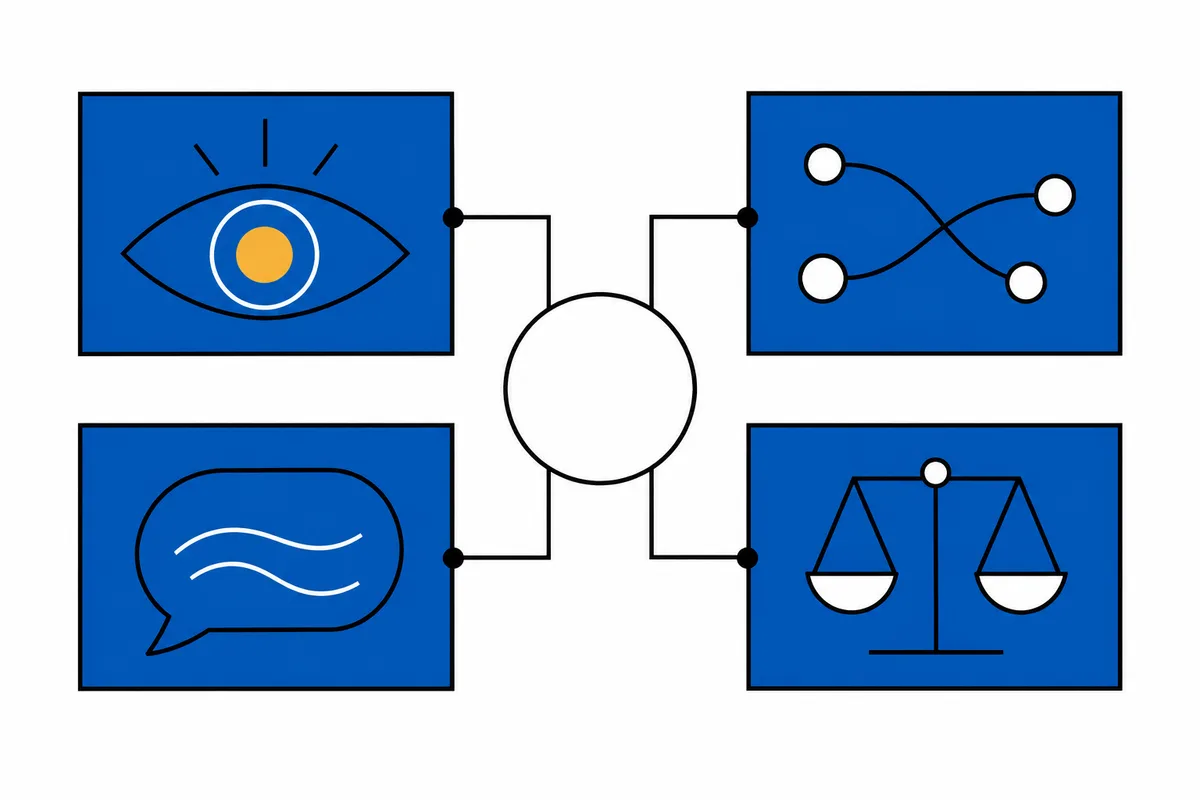
The Emotional Self-Efficacy Scale (ESES) measures how capable people believe they are at emotional functioning. That self-belief is different evidence from performance on emotion problems, such as the MSCEIT. In the 2012 ESES study, 264 participants completed the comparison measures; the study reported no overall ESES–MSCEIT association in that subset, alongside weak links to two MSCEIT branches. Keep the results instrument-specific: neither one records what someone did in a particular workplace conversation.
What does ESES ask a person to judge?
The Emotional Self-Efficacy Scale (ESES) asks people how confident they are in their ability to understand and manage emotion. Its score is therefore about perceived capability: a person’s belief that they can handle emotional demands. That belief may affect whether someone speaks up, seeks help, or attempts a difficult conversation, so it is meaningful in its own right. But the response task is a confidence judgment, not a report of what the person did last Tuesday and not a demonstration that they solved an emotion problem correctly.
That distinction matters because ESES draws on the same four-branch emotional-intelligence model often used to describe abilities such as perceiving, understanding, and managing emotion. Shared concepts can make the measures sound interchangeable. The task separates them. A respondent estimating confidence is reporting how capable they feel; a performance test asks them to work through emotion-related problems and scores their answers under that test’s method. One result cannot be read as a transcript of the other. The scale’s wording therefore locates the answer in the respondent’s appraisal of their own emotional functioning, rather than an observer’s account or a scored solution to a test item.
For example, in an illustrative workplace situation, someone may feel ready to ask a clarifying question after receiving ambiguous feedback, yet find a test problem about interpreting an emotional change difficult. The confidence rating tells us something about the person’s expectation of coping; the test response tells us how they handled that particular problem. Neither alone establishes exactly what they would say in the meeting. A gap between them is not necessarily a scoring error: confidence and demonstrated performance are different kinds of information, even when they concern related emotional situations.
The original 2008 paper, “Development and preliminary validation of an emotional self-efficacy scale,” describes 207 participants rating their confidence in emotional functioning. Its abstract reports a one-component initial result and associations with dispositional emotional intelligence, performance emotional intelligence, and mood. Those preliminary findings place ESES among measures of perceived emotional capability and suggest it may relate to other emotional-intelligence measures. They do not turn its confidence responses into direct demonstrations of ability or observed behavior. The study’s sample and abstract-level evidence belong to that initial report; they should not be used to presume that every later ESES comparison must show the same association.
So, in plain terms, an ESES score is about how capable a person believes they are in emotional functioning. That belief can inform reflection on where they feel prepared or hesitant, while a performance result answers a different question. Keeping those questions separate makes it possible to take self-belief seriously without treating it as proof of what someone can do in every situation.
Sources: Development and preliminary validation of an emotional self-efficacy scale
What did the 2012 ESES study actually compare?
The 2012 paper “The dimensional structure of the emotional self-efficacy scale (ESES)” involved 1,085 participants overall. Its factor analyses used two halves of that sample: 543 people in the calibration group and 542 in the validation group. The comparison with other emotional-intelligence and individual-difference measures had a narrower base: 264 participants completed the additional measures, including ESES and the Mayer–Salovey–Caruso Emotional Intelligence Test (MSCEIT). The reported ESES–MSCEIT relationship belongs to that 264-person comparison, not to all 1,085 participants.
That distinction is easy to lose when the study is summarized by its total recruitment figure. The larger sample supports the paper’s analyses of ESES structure; it does not mean every participant took every comparison instrument. For the question of how ESES related to MSCEIT, the relevant denominator is the subset with both sets of scores. The detailed results report no overall ESES–MSCEIT correlation in those 264 participants, while noting weak correlations with the MSCEIT Using and Managing branches. Those branch-specific results qualify the overall pattern; they do not change which participants supplied the comparison data.
The abstract’s broad description of participants should not blur this distinction between analyses. When an abstract introduces the study’s overall participant group and then summarizes a comparison, a reader can easily carry the larger number forward. The methods and detailed results in “The dimensional structure of the emotional self-efficacy scale (ESES)” show why that reading is too broad: the additional comparison measures were completed by 264 people. The paper’s full-sample figure describes the project; it is not the denominator for every reported association.
The paper’s factor result answers a separate question. Its analysis identified four ESES dimensions involving confidence in one’s own emotional functioning, confidence concerning others’ emotions, and confidence in reading facial expression and body language. These dimensions describe how confidence responses clustered in the study. They did not simply reproduce the four branches of ability-based emotional intelligence. The number four in both models can invite a neat one-to-one mapping, but the paper’s findings do not support treating the ESES factors as four direct ability scores. A factor pattern describes groupings among responses to ESES items; a correlation asks whether scores on two measures vary together. One result cannot stand in for the other.
Read together, the results show why the sample flow and the factor labels both matter. The paper examined a broad sample to study the scale’s dimensional structure, then used a smaller completed-measures group to examine relations with MSCEIT and other measures. Those are distinct analyses with distinct denominators. Citing the total sample beside the correlation can make the finding appear more widely tested than it was; citing the four factors as ability branches can make a confidence scale appear to have measured performance. Neither shortcut follows from the paper.
The defensible description is specific: the 2012 study reported its four-factor ESES structure from the factor analyses of the larger study sample, and its overall null ESES–MSCEIT result from 264 participants who completed the comparison measures. Within that subset, the paper also reported weak links to two MSCEIT branches. The result is evidence about those completed comparisons, not a conversion rule between scores or an observation of workplace conduct.
Sources: The dimensional structure of the emotional self-efficacy scale (ESES)
Why is an EQ score not automatically comparable to ESES?
A score is interpretable only in light of the task that produced it. ESES asks a respondent to rate confidence in emotional functioning: the answer reports perceived capability. The Mayer–Salovey–Caruso Emotional Intelligence Test (MSCEIT), by contrast, presents emotion-related problems and scores the respondent’s answers. In “Measuring emotional intelligence with the MSCEIT V2.0,” the test is described as a performance measure; a higher or lower result therefore concerns performance on that instrument’s problems. It is not simply another way of asking how capable a person feels. The broad label “EQ” can hide this difference because it is used for measures with unlike prompts and response formats. A confidence rating and a scored problem-solving response can concern overlapping emotional concepts while still representing different observations. Neither format supplies the missing information in the other: the confidence answer does not reveal how a respondent solved a particular test problem, and the test answer does not record the respondent’s belief about coping in daily life. This task distinction is the relevant psychometric point here; it does not require treating either measure as the complete definition of emotional intelligence. That difference matters even before asking whether either test is “better”: the prompt defines what counts as evidence in the first place. ESES elicits a judgment about the respondent’s own capability; MSCEIT elicits answers to a standardized set of emotion problems, which are evaluated as test performance. A report reader can therefore compare the constructs cautiously, but should not treat a point on one scale as the same quantity as a point on the other. The cited validation report describes the MSCEIT task; it does not establish an ESES equivalence.
The distinction also appears among measures that all carry an emotional-intelligence label. “Convergent, discriminant, and incremental validity of competing measures of emotional intelligence” compared MSCEIT with the EQ-i and SREIT. Its abstract reports minimal relations between the ability measure and self-reports, moderate relations between the two self-reports, and differing associations with external criteria. The pattern shows that the measures did not share one uniform interrelation pattern in that comparison. It does not establish how ESES relates to MSCEIT: ESES was not one of the three instruments tested. Nor does it support a conversion formula between any pair. A reader comparing two reported results should retain each instrument’s name and ask what the respondent actually did: judge confidence, answer emotion problems, or complete a different self-report. The inference should stay close to that task. A confidence result can speak to perceived capability; an MSCEIT result can speak to performance on MSCEIT problems. Calling both “EQ scores” does not make their units common, so a numerical difference between them has no shared-scale meaning supplied by these studies. The methods may illuminate related parts of emotional intelligence, but conceptual overlap alone is not evidence that their scores can be placed on one ruler. The 2004 result is useful as a warning against assuming that a shared subject label guarantees close score relationships, not as a universal law about all instruments. For this article’s question, the key omission is decisive: since ESES was absent, that comparison cannot settle whether confidence on ESES tracks MSCEIT performance. It only shows why an instrument name and response task matter when someone says “my EQ score.” Without those details, the apparent comparison may join a belief rating to a problem-solving result as if both were readings from the same measure.
Sources: Measuring emotional intelligence with the MSCEIT V2.0; Convergent, discriminant, and incremental validity of competing measures of emotional intelligence
Why do the ESES studies appear to disagree?
The accessible reports point in different directions, and both findings need to remain attached to their own study. “Development and preliminary validation of an emotional self-efficacy scale” reports that, among its 207 participants, ESES was associated with performance emotional intelligence. The abstract supports describing a positive association in that sample; it does not provide enough detail in the accessible record to identify the performance measure and analysis as identical to those in the later comparison. The 2012 paper “The dimensional structure of the emotional self-efficacy scale (ESES)” reports a different result: in the 264 participants who completed ESES and the additional comparison measures, there was no overall ESES–MSCEIT correlation. Its detailed results also note weak correlations with the MSCEIT Using and Managing branches. Those branch results sit alongside the null overall comparison; they do not erase it or turn it into a universal finding of no relationship. The contrast is real at the level of what the reports say. It does not, by itself, show that one paper disproves the other, because the available descriptions do not establish that the same performance instrument, participants, or analysis were used.
A group-level association answers whether scores varied together in a study’s sample under that study’s method. It does not determine what a particular person’s confidence rating means beside their performance score, and neither study establishes an individual conversion. One reader might have high confidence and strong test performance; another might have a gap. These reports do not give a rule for predicting either individual pattern from the overall association. To explain why the reported findings differ, a fuller comparison would need the relevant instrument and version used for performance EI in 2008, the exact measures and analytic choices in both studies, and comparable information about who completed each measure. The accessible 2008 abstract does not supply enough detail to establish those matches, and the 2012 comparison is specifically bounded to its 264 completed cases. Differences in samples, instruments, or analyses are possible explanations, but the records available here do not demonstrate that any one caused the pattern. The sound conclusion is narrower: ESES has shown a positive association with performance EI in the original report and no overall association with MSCEIT in the later subset comparison, with weak links to two MSCEIT branches reported there. That combination makes it especially important not to presume that perceived emotional capability and emotion-test performance are interchangeable. More method detail could sharpen the comparison; until then, the findings remain study-specific rather than a verdict about every person or population. A direct resolution would require checking whether the 2008 performance measure was MSCEIT, whether comparable ESES and performance scores were analyzed in the same way, and whether the populations and completion patterns were sufficiently alike for the association estimates to answer the same question. The accessible records do not settle those points, so listing them identifies what evidence is missing rather than proposing a cause. Even a close methodological match would make the estimates easier to compare; it would not guarantee identical findings across samples. A positive association and a null overall association can both be faithfully reported when they arise in distinct study settings.
Sources: Development and preliminary validation of an emotional self-efficacy scale; The dimensional structure of the emotional self-efficacy scale (ESES)
How far does an EQ test result support a claim about ability?
A performance score supports a claim about how someone answered a particular set of emotion problems. The further claim—that the score reflects an underlying emotional ability beyond those problems—depends on an argument linking the test task to that ability. In “The Validity of the Mayer–Salovey–Caruso Emotional Intelligence Test (MSCEIT) as a Measure of Emotional Intelligence,” Maul’s 2012 critical review questions whether that inferential step had been examined comprehensively. The review raises a question about what the score represents; it does not report that the MSCEIT is invalid. For a reader, the distinction is practical: a score can describe performance under the test’s rules while leaving open how broadly that performance should be interpreted.
The MSCEIT developers answered that critique in “The validity of the MSCEIT: Additional analyses and evidence.” Their response presents reanalyses of a 5,000-person standardization sample and evidence from four articles as support for the test’s validity. This is a substantive counterargument: the authors argue that the case for interpreting MSCEIT scores as emotional intelligence is stronger when those analyses and findings are considered. Because it is the developers’ response, it belongs in the debate as their defense, rather than as an independent replication that closes it. The dispute therefore concerns the warrant for a particular interpretation, not whether a test can produce consistent scores or whether its items have a coherent structure.
That distinction helps explain why reliability and factor support do not alone answer Maul’s question. “Measuring emotional intelligence with the MSCEIT V2.0” reported reasonable reliability and confirmatory-factor support. Those findings bear on consistency and the pattern of relationships among test components. A claim about underlying ability reaches further: it asks whether performance on the instrument justifies saying that the score captures the ability named by the test. Consistency matters to that case, but a repeatable result could still require evidence connecting the task to the broader interpretation. The validation findings and the review therefore address related but non-identical parts of the argument.
One empirical complication appears in “Exploring the validity of the Mayer-Salovey-Caruso Emotional Intelligence Test (MSCEIT) with established emotions measures.” In its sample of 138 participants, the study compared MSCEIT results with two emotion measures and four intelligence tests. Its abstract reports mixed support for the hypothesized model: emotion measures and EI measures did not load on the same factor, and evidence for some components, particularly emotion perception, was described as equivocal. That factor pattern gives a concrete reason to inspect how a proposed model fits the observed measures. It is one sample and analysis, however; it cannot settle every interpretation of MSCEIT scores or establish a conclusion about all test takers.
For someone reading a performance report, the defensible statement should name its reach: this is a result on the MSCEIT, interpreted through the evidence and model being discussed. The review and response leave a live methodological disagreement about how far that performance warrants a claim about underlying ability. The 138-person result adds a specific model-fit challenge to consider, while the validation paper and authors’ response provide supporting evidence in the other direction. None of these sources turns ESES confidence ratings into a measure of actual ability; they concern the interpretation of MSCEIT performance. The prudent reading is instrument-specific and evidence-aware, without promoting either side of this documented exchange into a settled consensus.
Sources: The Validity of the Mayer–Salovey–Caruso Emotional Intelligence Test (MSCEIT) as a Measure of Emotional Intelligence; The validity of the MSCEIT: Additional analyses and evidence; Exploring the validity of the Mayer-Salovey-Caruso Emotional Intelligence Test (MSCEIT) with established emotions measures
What can either result tell you about a real disagreement at work?
Neither a confidence rating nor a performance score can reconstruct a particular workplace exchange. Imagine an illustrative situation: a colleague gives critical feedback, and the recipient later reports high confidence in handling emotions. That self-rating tells us how capable the recipient believes they are; it does not establish whether they listened without interrupting, asked what the colleague meant, or could stay with the discussion when the feedback stung. A strong MSCEIT result would show how they answered that test’s emotion problems, but it would not supply those missing details either. The question “How did this person behave in that conversation?” calls for evidence from the conversation itself.
A useful review starts with the observable sequence. What words did the recipient use after hearing the criticism? Did they ask a clarifying question, challenge a specific point, or move quickly to defend themselves? What happened next: did both people leave with a shared understanding of the issue, or did the disagreement remain unresolved? These questions do not turn one exchange into a general verdict about someone’s emotional skill. They locate the behavior that another conversation can build on. For example, if the response ended the discussion before the feedback was clear, a concrete next attempt might be to pause and ask for one example before answering. That is a practice hypothesis drawn from the exchange, not a conclusion supplied by either score.
This distinction matters when people are tempted to use a test result to settle a disagreement about what happened. A high self-efficacy score cannot prove that someone responded well; a low one cannot prove they failed to regulate themselves. Nor does a performance score tell a colleague which words were said or whether a repair followed. The measures may raise useful questions about perceived confidence or test performance, while the people involved can describe the actual sequence and its consequences. Those are different sources of information, so one should not be used as a proxy for the other.
To choose a next behavior, return to the event: identify the words, the action they represented, and the consequence for the conversation. Then ask what single response might make the next exchange clearer—listening through the full point, checking what the feedback refers to, or acknowledging a misunderstanding and repairing it. The example does not show that either score predicts this particular disagreement, and the cited research does not observe this meeting. It shows why a test result alone cannot answer a question about conduct in one exchange; the practical evidence must come from what the participants remember and can examine together.
What can a reader do with the distinction at work?
Use a confidence result to locate an expectation, then use a specific exchange to decide what to practice. If someone expects to handle disagreement well, that belief can guide a question: what makes them confident, and where do they hesitate? The answer is a useful starting point for reflection, not proof of what happened in a particular meeting. To choose a behavior to try, return to one interaction: identify the response that helped or stalled the conversation and name a small alternative for next time. This keeps the development question concrete. “I want to be better at EQ” gives no next move; “I want to ask one clarifying question before defending my first reaction” can be noticed in a later discussion.
The EQ Test Emotional Skills Profile offers a separate structure for this kind of self-reflection. The product description identifies a private, 32-item profile covering recent behavior and authored emotional situations; it is not the ESES, and it does not determine which ESES or MSCEIT result is right. Its role is to help a person examine emotional habits and scenario judgments, then bring a more specific question to reflection. Someone who wants that structured prompt can explore the [Emotional Skills Profile](/assessment). A reader looking for one definitive ability score may find this less conclusive: the profile organizes reflection rather than resolving whether self-belief matches performance. The useful outcome here is a clearer question about one’s own pattern and a behavior worth observing in the next real exchange, without treating either as a guarantee of change.
Keep the two observations distinct while making them useful together. A confidence response can point toward where someone anticipates coping or doubts their capacity; a remembered interaction can show what they actually said or did in that setting. If those accounts differ, record the discrepancy as a question to investigate rather than forcing one to invalidate the other. What was the situation, what response followed, and what would the person like to try next time? The profile can supply a structured reflection on recent behavior and emotional situations, while the specific exchange gives the person a practical place to focus. Neither source settles the research comparison between ESES and MSCEIT, and the profile does not establish validated emotional ability. It offers a private development prompt for someone who wants to reflect on their own habits, not a verdict about their workplace conduct.
Sources: EQ Test Emotional Skills Profile
What would make a score comparison more informative?
Before comparing two results, preserve four details from each report: the instrument’s name, what the respondent did, who the comparison sample included, and what conclusion the score is meant to support. A confidence rating and answers to emotion problems are different observations; the label “EQ” does not make their numbers interchangeable. Sample details matter too: a relationship reported across a study group is not a prediction about one person, and neither score records behavior in a particular exchange.
A practical note beside the results can be brief: “Measure and response: __. Study population or comparison group: __. Inference intended: __.” If the report does not supply a detail, mark it as unknown instead of filling it in from the other instrument. Manuals or technical documentation may be needed for a fuller judgment. These prompts help keep a side-by-side reading specific; they are not a substitute for that documentation or a formal assessment review.
Start with one conversation you can revisit
Choose one recent conversation where you were trying to handle emotion well: a disagreement, feedback, or misunderstanding. Ask someone who was there, “What did you notice me do when things got difficult, and did that response make the next step clearer?” Invite a description, not a rating. They might recall that you paused or answered before they had finished. Compare that account with your own recollection. This is a practical reflection prompt, not a validated intervention or a way to decide which test result is right.
If the other person remembers a response that helped, ask what made it helpful; if they remember confusion, ask what would have clarified the next step. One person’s memory is limited, so treat it as a perspective on that exchange, not a replacement score or verdict about your general ability. You might leave with one behavior to notice next time, such as checking that you understood the concern before replying.
For a separate, structured prompt about recent emotional habits and scenario judgments, explore the private 32-item [Emotional Skills Profile](/assessment). It organizes self-reflection; the conversation lets you ask what your response meant to someone who was there.
Questions readers ask
What does the Emotional Self-Efficacy Scale measure?
ESES asks people to report how capable they believe they are in emotional functioning. The 2012 study describes four areas: managing one’s own emotions, understanding them, dealing with other people’s emotions, and perceiving emotional cues. These are self-reported beliefs, not observations of behavior.
How does ESES differ from the MSCEIT?
ESES measures perceived capability. The MSCEIT scores answers to emotion-related problems. They produce different kinds of evidence, so a result on one should not be treated as a second reading of the same score or converted into the other.
What did the 2012 ESES study find about MSCEIT scores?
The 2012 study reported no overall ESES–MSCEIT association among the 264 participants who completed those comparison measures. Its detailed analyses also reported weak correlations with the MSCEIT Using and Managing branches. The comparison applies to that subset and those measures; it does not establish a rule for every person or test.
Sources
- The dimensional structure of the emotional self-efficacy scale (ESES)
The primary 2012 study describes the ESES construct, four-factor result, and comparison of ESES with trait EI, MSCEIT ability EI, personality, and cognitive ability. Detailed methods specify an overall sample of 1,085 and a 264-person subset completing the comparison measures; the subset analyses report no overall ESES–MSCEIT association, despite weak correlations with the Using and Managing branches.
- Development and preliminary validation of an emotional self-efficacy scale
The original ESES study reports that 207 participants rated confidence in emotional functioning; its abstract describes a one-component result, internal consistency .96, two-week retest .85, and associations with dispositional EI, performance EI, and mood.
- Measuring emotional intelligence with the MSCEIT V2.0
The MSCEIT validation report describes emotion-problem performance and reports reasonable reliability and confirmatory-factor support; the abstract identifies 21 emotion experts and a standardization sample of 2,112.
- The Validity of the Mayer–Salovey–Caruso Emotional Intelligence Test (MSCEIT) as a Measure of Emotional Intelligence
Maul's 2012 critical review questions whether the interpretive argument from observed MSCEIT performance to underlying emotional ability had been comprehensively examined and calls for a clearer account of score variation.
- The validity of the MSCEIT: Additional analyses and evidence
Mayer, Salovey, and Caruso's response addresses Maul's critique, presents reanalyses of a 5,000-person standardization sample, and organizes additional evidence from four articles supporting MSCEIT validity.
- Exploring the validity of the Mayer-Salovey-Caruso Emotional Intelligence Test (MSCEIT) with established emotions measures
A study of 138 participants who completed the MSCEIT, two emotion measures, and four intelligence tests reported mixed support for the hypothesized MSCEIT model; emotion and EI measures did not load on the same factor, and the authors described evidence for some components, particularly emotion perception, as equivocal.
- Convergent, discriminant, and incremental validity of competing measures of emotional intelligence
The comparison of MSCEIT with EQ-i and SREIT reported minimal relations between the ability measure and the self-reports, moderate relations between the two self-reports, and differing associations with external criteria.
- EQ Test Emotional Skills Profile
The assigned publication's current product is a private 32-item educational Emotional Skills Profile covering recent behavior and emotional-situation judgments; it is separate from ESES and is reached at /assessment.
Apply it to the real situation
Reflect on the emotional habits behind a recent interaction
From this guide: If you want a separate prompt for examining your emotional habits and scenario judgments, the Emotional Skills Profile offers a personal reflection framework.
ESES describes perceived capability, while another EQ result may reflect a different kind of response. If you want a structured prompt for reflecting on recent emotional habits and judgments about authored scenarios, explore the Emotional Skills Profile. Its private report is for educational reflection and practical guidance; it is separate from ESES and does not resolve a difference between scores.