
A trait emotional-intelligence score summarizes how you describe your usual emotional tendencies and perceived capacities on a particular questionnaire. It can suggest a pattern to examine, but it does not record your behavior in a specific interaction or measure demonstrated ability. Its meaning depends on the instrument’s items, scoring, and intended use; compare it with observable behavior before deciding what to practice.
A score describes your reported default, not a scene you passed
A high EQ number can feel like a verdict after a difficult meeting. But if it came from a trait emotional-intelligence questionnaire, it records how you answered its items. It does not replay the meeting or show what you said when a colleague challenged your work. In “Developments in Trait Emotional Intelligence Research,” the authors define trait EI around people’s perceptions of their emotional abilities: how capable they believe they are at understanding, regulating, and expressing emotions. The result is a structured account of self-view. Its meaning depends on the questionnaire and how it combines answers. Suppose a report suggests someone sees themself as good at staying composed. In a feedback exchange, that response pattern may support the modest reading, “I generally believe I manage my reactions well.” It cannot establish, “I stayed composed in that exchange.” To assess the scene, the person would examine what happened: whether they noticed their reaction, what they said, and how the conversation continued. Those details concern the interaction; the questionnaire response concerns the respondent’s reported tendency. Keeping the evidence apart makes the score easier to use. Start with the report’s wording and ask what its items invited you to describe about yourself. Compare that interpretation with an interaction before deciding what to practice. The exact meaning of “trait” depends on the model behind a questionnaire. For now, the point is narrower: a self-rating reports a perceived default, not a pass mark for a particular conversation.
Sources: A Conceptual Framework for the Definition of Emotional Intelligence
What does the word ‘trait’ change?
The word “trait” changes what you should infer from the score. It points to a person’s usual self-perception: how capable they believe they are, or how they say they tend to respond, in emotion-relevant situations. A result may therefore describe a reported pattern such as “I usually notice when tension rises.” It does not show that the person noticed tension in a particular meeting, or what they did next. The distinction is between a typical response and a demonstrated maximum performance. In “The Measurement of Emotional Intelligence: A Critical Review of the Literature and Recommendations for Researchers and Practitioners,” the authors describe trait measures as self-report questionnaires about typical behavior and self-rated abilities. Their examples include how someone responds to stress or to an upset friend. Ability measures, by comparison, ask a person to solve emotion-related problems under the test’s scoring rules. One method asks what you think you generally do; the other samples how you answer a set of tasks. Neither question can stand in for the other. That difference matters when a report’s confident language sounds like direct observation. If someone endorses statements about staying composed, the score records those endorsements as the questionnaire combines them. It does not replay a difficult conversation, measure how long the person paused, or establish whether a colleague experienced the exchange as calm. The result can be a useful account of self-view, but the step from “I see myself as steady” to “I was steady in that disagreement” requires evidence from the situation itself. Researchers do not always sort every questionnaire under the same label. The critical review explains two classification systems: one separates trait from ability largely by measurement method, while another groups measures into “streams.” In that second vocabulary, self-report measures based on an ability model can be called stream two, and broader models that combine emotional content with other traits or competencies can be called mixed or stream three. The review notes that these terms overlap: a self-report mixed measure may count as trait under the method-based distinction. Labels help describe how researchers organize the field; they do not erase what a questionnaire actually asks respondents to report. The review also cautions that self-report measures can overlap with broader personality measures, a point that has fueled debate about what they capture. That debate does not make the response format irrelevant. A questionnaire still records the person’s reported tendencies, while an ability task still samples answers to problems. For an individual reader, the practical question is narrower than settling the field’s taxonomy: identify whether this result came from self-description or task performance, then keep the interpretation within that evidence. If the report uses an unfamiliar label, inspect its method before treating that label as a description of observed skill. So read “trait” as a clue about the source of the evidence. The score comes from a person’s account of their ordinary tendencies, collected through a particular questionnaire. It may help put a name to a pattern worth examining, especially when the report identifies what its items and subscales cover. It cannot by itself establish that the person can demonstrate the same skill under pressure. To make that claim, the evidence would need to match it: for example, a performance task for task performance, or a clear account of behavior in a real interaction. A trait score is a structured description of self-perception, not a pass mark for an unseen scene.
Sources: A Conceptual Framework for the Definition of Emotional Intelligence; The Measurement of Emotional Intelligence: A Critical Review of the Literature and Recommendations for Researchers and Practitioners; The location of trait emotional intelligence in personality factor space
What is inside a global score?
A global score is a summary produced from a questionnaire’s chosen content and scoring rules. The Trait Emotional Intelligence Questionnaire (TEIQue) offers a concrete example: Cambridge Assessment’s Emotional Intelligence Factsheet says its 153 statements produce a global score and 15 subscale scores, organized under well-being, self-control, emotionality, and sociability. Those labels describe this instrument’s map. They are not a universal set of EQ ingredients. That breadth matters. In the factsheet, the facets include emotion perception and regulation, but also optimism, self-esteem, relationships, adaptability, and low impulsivity. A high global result therefore summarizes a wider self-description than “I notice feelings accurately” or “I stay calm in a tense exchange.” It combines several kinds of perceived tendency. The factsheet’s research context was nearly 2,000 British students aged 14–16, whose TEIQue responses were matched with school examination records. That adolescent school sample illustrates the instrument’s structure; it cannot establish adult workplace norms or tell an individual what their score means at work. Another questionnaire can define its territory differently. The Measurement of Emotional Intelligence: A Critical Review of the Literature and Recommendations for Researchers and Practitioners describes more than 30 widely used measures and notes that many produce a total alongside facet scores. The review also explains that their facets overlap conceptually while their models and methods differ. The Measurement of Emotional Intelligence: A Critical Review of the Literature and Recommendations for Researchers and Practitioners and The Measurement of Emotional Intelligence (Frontiers) both make the same practical point: the label “EQ” does not identify a shared ruler. Even where two reports use similar words, their item content and scoring may lead to different totals. Before interpreting a total or percentile, find five details in the report or its documentation: the instrument and version; the construct it says it measures; the facets included; how responses are combined into the score; and the reference group, if the report compares you with one. Item wording and response options shape what a person is being asked to rate. Some instruments also reverse-score selected responses before combining them. That means a total reflects those design decisions, not a direct count of emotional skill. Do not infer a scoring procedure unless the instrument explains it. The reference group changes the meaning of a percentile. It places a result relative to a specified comparison group; it does not add new evidence about what the score measures. If documentation gives no comparison group, the total may still summarize responses, but a percentile claim has no stated benchmark to interpret. Likewise, a global score may be broad enough to hide contrasting facets: someone could describe confidence in social situations and difficulty regulating frustration, with the total smoothing that difference. The report’s subscales, when available, help recover the distinctions that aggregation compresses. So read the global result as an index of this questionnaire’s picture. Ask what it gathered, how it grouped responses, and what comparison it uses. That is enough to tell whether the number summarizes a narrow emotional tendency or a bundle of neighboring self-perceptions; it is not a common unit for comparing people or unrelated tests.
Sources: Emotional Intelligence Factsheet 1 – Cambridge Assessment; The Measurement of Emotional Intelligence: A Critical Review of the Literature and Recommendations for Researchers and Practitioners; The Measurement of Emotional Intelligence
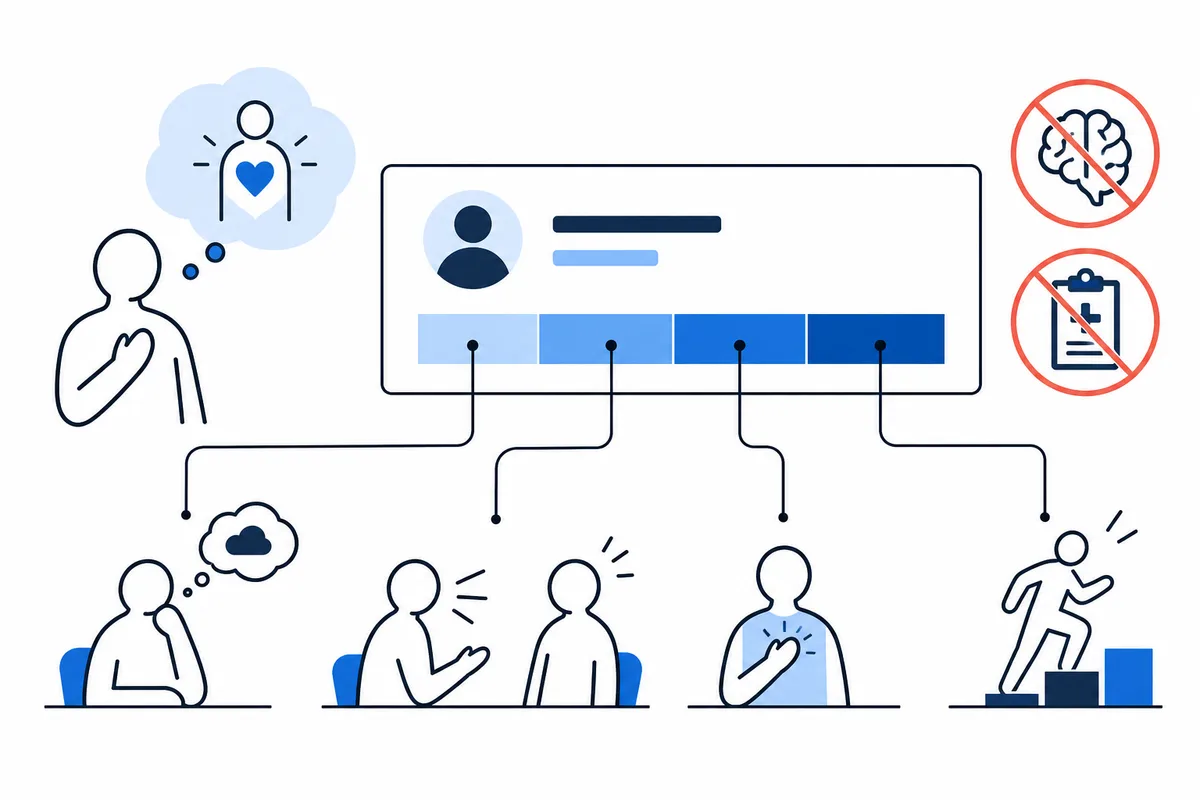
Why can’t two EQ scores be swapped?
A trait questionnaire asks what you believe you usually do or can do when emotions matter. An ability test asks you to solve emotion-related problems under a scoring method. An observer report asks how selected behaviors appear to people who have seen you in particular settings. These approaches can concern similar subjects, such as noticing tension or regulating a reaction, while recording different evidence. A high result on one therefore cannot be converted into a high result on another. The score has meaning only within the question and method that produced it.
The critical review “The Measurement of Emotional Intelligence: A Critical Review of the Literature and Recommendations for Researchers and Practitioners” describes the method distinction directly. Self-report items ask people to rate tendencies or perceived abilities, so the result is close to “what do I think I tend to do?” Performance items instead ask for answers to emotion-related problems. Their scores depend on the task and on how the test decides which answers count as better. That review notes that expert judgment can be needed to score emotional problems, leaving room for disputes about the criteria. An ability result is still a task result, not a recording of every ordinary interaction. Likewise, a self-view may be useful for understanding typical behavior while depending on how accurately someone can judge their own habits.
“Mixed” questionnaires widen the scope: they may combine emotional self-perceptions with personality-related qualities, social skills, or competencies. Some workplace measures also pair self-ratings with reports from colleagues or supervisors. A broad result can therefore summarize more than one kind of content. If it predicts an outcome, that does not make it equivalent to a performance task or a direct observation; the measure’s ingredients still matter. The same review cautions that self-ratings can be imperfect judgments and may be shaped by incentives when someone important will see the result.
Observer feedback changes who supplies the evidence, but it has its own boundaries. The Consortium for Research on Emotional Intelligence in Organizations’ profile of the Profile of Emotional Competence describes a self-report tool that separates intrapersonal and interpersonal competencies. Its page identifies that particular instrument as a research and development tool and says it is unsuitable for hiring or compensation decisions. It illustrates why the instrument’s design and stated use matter: the label “emotional intelligence” alone does not tell you whether a score came from self-ratings, a task, or other people’s reports. Nor does a 360-degree report represent an all-seeing account; it reflects selected observers’ views of behaviors they had a chance to notice.
When two reports disagree, first identify their evidence source. One may summarize your belief about your usual response, another how you solved a test problem, and a third what a colleague noticed in a specific relationship. Those answers need not match because the questions differ. For a practical workplace question, keep the result attached to its method, then check the relevant behavior in a real interaction or ask for specific feedback. That comparison can clarify what to practice; it does not require forcing distinct scores onto a single EQ scale.
Sources: The Measurement of Emotional Intelligence: A Critical Review of the Literature and Recommendations for Researchers and Practitioners; The Measurement of Emotional Intelligence; Profile of Emotional Competence (PEC)
Does predictive evidence make the score objective?
A score can predict something without being an objective record of what a person did. The distinction matters because “predictive” sounds like a test has observed the skill itself. For a trait questionnaire, the starting evidence is a person’s answers about their usual emotional tendencies and perceived capacities. A statistical relationship between those answers and a later outcome can make the score informative. It does not turn the questionnaire into a performance task or a report of a particular meeting.
The systematic review and meta-analysis “The Incremental Validity of the Trait Emotional Intelligence Questionnaire (TEIQue)” examined the two adult self-report forms of the TEIQue. Its authors reviewed 24 articles covering 114 incremental-validity analyses and pooled results from 18 studies, with 105 effect sizes. They asked whether TEIQue scores explained variation in criteria beyond higher-order personality dimensions and other emotion-related variables. The pooled added variance was ΔR² = .06, with a 95% confidence interval from .03 to .08. The authors described the effect as relatively small but statistically and practically significant; at the factor level, the added contribution came mainly from well-being and self-control.
That finding is a serious answer to the claim that trait EI is useless because it overlaps with personality. In the studies pooled, TEIQue scores carried some additional information for the criteria examined. “Incremental” has a precise meaning here: the score accounted for variation after specified predictors were entered into the analysis. It does not mean the questionnaire captured emotional skill independently of every other influence, nor that raising a score would cause an outcome to improve. The analysis tests explanatory contribution within a research model, not demonstrated competence in every situation. The result belongs to these TEIQue forms and the criteria represented in those studies. It cannot be carried over automatically to a short online quiz with different items or scoring.
A different result appears in “Why does self-reported emotional intelligence predict job performance? A meta-analytic investigation of mixed EI.” That analysis concerned mixed emotional-intelligence measures, whose content can combine emotion-related self-perceptions with other characteristics. The authors reported substantial overlap with ability EI, self-efficacy, self-rated performance, personality dimensions, and general mental ability (multiple R = .79). Their updated estimate for the association between mixed EI and supervisor-rated job performance was ρ = .29; after controlling for the listed overlaps, the relationship was near zero (β = −.02). This is not a direct refutation of the TEIQue result: the measure family and statistical question differ. It does show why a broad “EQ predicts performance” headline can conceal what the questionnaire actually gathers.
Taken together, these findings support a narrower conclusion. Self-report scores can carry useful information about a person’s self-view and may relate to outcomes, including after some controls. How much they add depends on the instrument, comparison variables, and outcome. That is the article’s synthesis of the two meta-analyses, not a new empirical result. Predictive evidence is therefore a reason to take a named score seriously, not proof that it objectively measures a person’s behavior or worth. If a report leads to a claim about a specific work interaction, check the interaction itself: what happened, what the person noticed, and what they did next. A questionnaire can suggest what to examine; the score alone cannot settle that observation.
Sources: The Incremental Validity of the Trait Emotional Intelligence Questionnaire (TEIQue); Why does self-reported emotional intelligence predict job performance? A meta-analytic investigation of mixed EI; The Measurement of Emotional Intelligence: A Critical Review of the Literature and Recommendations for Researchers and Practitioners
When does self-report become harder to interpret?
Self-report deserves more caution when you have little access to the behavior being rated, when an item can mean different things, when the situation is unusual, or when someone else may use the result for a consequential decision. Your response records what you chose about yourself; it cannot show what happened in a particular exchange or how another person experienced it. Ask whether the conditions make the answer a useful account of your usual self-view.
The 2019 review “The Measurement of Emotional Intelligence” notes two limits: people are not always good judges of their emotion-related abilities and tendencies, and self-report measures can be susceptible to faking. Imperfect self-knowledge can be sincere: someone may miss that they interrupt when tense, or remember their intention better than the effect of their words. Strategic responding means choosing answers to create a favorable impression. The review says this concern is especially relevant when respondents believe a supervisor or potential employer will see their result. It does not show that everyone changes answers, or quantify how often this happens across questionnaires. Its practical warning is that anticipated scrutiny can make a self-description less dependable as evidence of an ordinary pattern.
Imagine a report says you see yourself as calm under pressure. What did “calm” mean while answering: feeling settled, keeping your voice even, staying focused, or avoiding visible disagreement? Someone can feel rattled and still speak carefully; another can feel composed while dismissing a colleague’s concern. When an item leaves the behavior undefined, the score reflects the respondent’s interpretation too. A high result could reflect confidence or repeated behavior; a low result might reflect a critical self-view or behavior the person has noticed. Check these possibilities against examples rather than assuming one explanation.
The stakes change what a score can support. A private reflection exercise leaves room to consider an answer and compare it with experience. When an employer controls access to the result, a respondent has reason to consider how answers will be judged. The review cautions against using the TEIQue for personnel selection because its self-report format can be faked when job prospects may be affected. That recommendation concerns a named questionnaire and context, yet it shows why a developmental score should not quietly become a hiring verdict. The number alone says nothing about the incentives or behavior at issue.
For development, use the result as a prompt about perceived tendencies. If it points to regulation, choose one recent disagreement and note what you did: noticed tension, paused, asked a question, stated a limit, or returned to the conversation. Ask someone present for a specific observation, not a rating of your EQ. Their account adds a viewpoint; it does not certify the questionnaire. When a result is unexplained or gathered under pressure, treat it as weak evidence about another person. Test its meaning against behavior you can describe.

What can a repeat score tell you?
A repeat score can show whether your answers on the same instrument remain similar over a specified interval. Similar answers support a stable account of how you see your usual emotional tendencies on that measure. They do not prove that your behavior is fixed, or that the questionnaire captures every situation in which you respond to emotion.
The 2024 review “Assessing the temporal stability of a measure of trait emotional intelligence” examined the Trait Emotional Intelligence Questionnaire (TEIQue), a particular measure of trait EI. It brought together evidence across intervals ranging from 30 days to 1,444 days, about four years. The authors reported strong temporal stability at the global, factor, and facet levels across those intervals. In plain terms, people’s TEIQue results tended to retain a similar pattern over the periods studied. The finding supports treating a TEIQue result as more than a momentary mood reading, while keeping the conclusion tied to this instrument and the evidence reviewed.
The review also marks the edges of what it can tell us. Its authors called for research at intervals shorter than one month and longer than four years, as well as comparisons between different trait-EI measures. So the result does not establish how quickly a score might respond to a specific change in someone’s life, whether other questionnaires show the same stability, or whether a stable score means a person behaves identically in every setting. Stability describes the consistency of measured answers across time. Permanence would be a much broader claim about the person.
A broader measurement review, “The Measurement of Emotional Intelligence,” helps explain why that distinction matters. It describes trait-EI questionnaires as self-reports of typical behavior and self-rated abilities. A person can give similar answers each time because their self-view is consistent; that alone does not independently verify the behavior. Conversely, a changed result is not automatic proof of growth or decline. Before drawing that conclusion, check whether the same instrument and response frame were used, what was happening in the situations you had in mind, and whether your actions changed in comparable interactions.
If you repeat a questionnaire for development, pair the score with one behavior you can notice. For example, alongside a facet about managing emotion, record whether you paused before replying during a tense work exchange, then returned to clarify the issue. Keep the observation specific and tied to the situation; it is a useful check on what a self-report can describe, not a new test or a threshold for meaningful change. A repeated score can tell you that your reported pattern persisted. A behavior record gives you a separate view of what happened. Read them together, and let evidence from actual interactions—not score movement alone—shape what you practice next.
Sources: Assessing the temporal stability of a measure of trait emotional intelligence; The Measurement of Emotional Intelligence: A Critical Review of the Literature and Recommendations for Researchers and Practitioners
How should you use the result this week?
Choose one facet named in the report and test its meaning against a recurring, observable interaction. Ask what you tend to notice, say, or do, then seek specific feedback about that behavior rather than asking another person to confirm your score. Turn a broad description into a question that can be answered in a real exchange. If a report points to regulation, do not translate that label into “I stay calm.” Pick a conversation, such as receiving a revision request, and notice the sequence: when did you first register frustration, what did you say next, did you clarify the work issue, and did you return to the discussion after taking a pause? Those are observations; “good at regulation” is a conclusion. Record the observation soon after the conversation, using plain language and without scoring yourself. Keep the record specific. Across a few comparable exchanges, note the situation, the first reaction you noticed, the response you chose, and what happened next. Do not treat a handful of notes as a representative sample of every work setting. They are prompts for a more precise conversation with yourself. If the same moment keeps recurring, ask what conditions were present and which action you want to try next time. This approach helps separate a trait questionnaire’s self-description from evidence about behavior. The Measurement of Emotional Intelligence: A Critical Review of the Literature and Recommendations for Researchers and Practitioners distinguishes self-reported typical tendencies from maximum-performance measures. A self-report can help identify what you believe you usually do; it cannot, by itself, show what happened. An observer can add a different view, though that person sees selected moments and may not know what you noticed internally. Ask a trusted colleague for a description of one exchange, not a rating of your emotional intelligence. A useful prompt is: “In our last feedback conversation, what did you notice me do after I seemed frustrated?” Invite a concrete example and listen for the sequence of actions, rather than asking whether the report is right. Compare their account with your own note. Agreement can make a behavior easier to recognize; a difference is a reason to ask what each of you saw, not proof that one account is false. The Profile of Emotional Competence page from the Consortium for Research on Emotional Intelligence in Organizations illustrates why a measure’s source and purpose matter: it describes a particular self-report profile and says it is suited to research and development, not hiring or compensation decisions. That is information about the PEC, not a universal rule for every instrument. For your development, keep the question voluntary and low stakes. Do not pass a personal score to a manager as if it were a performance rating, or use a colleague’s impression to certify a test result. If you want a structured prompt for reflection, the private 32-item Emotional Skills Profile at /assessment covers recognition, understanding, regulation, and responding to others. Its recent-behavior summaries and authored-scenario judgments are separate parts of the report; it has no validated norms and is not an ability test. Use a relevant result to choose a behavior to examine, then bring it into one conversation you can learn from. You could say, “I’m trying to understand how I respond when feedback catches me off guard. In that conversation, what did you see me do, and what would have made it easier to keep working through the issue?” The answer may sharpen your next observation. It does not certify a score, and it leaves room for the next exchange to show something different.
Sources: Emotional Skills Profile assessment; Profile of Emotional Competence (PEC); The Measurement of Emotional Intelligence: A Critical Review of the Literature and Recommendations for Researchers and Practitioners
Start with the question the number can answer
A trait-EI score answers a bounded question: how you describe your usual emotional dispositions and perceived capacities on this questionnaire. Use it to choose something observable. The review “A Conceptual Framework for the Definition of Emotional Intelligence” frames trait EI as emotion-related self-perceptions; that description does not record what you did in a particular exchange. If you need evidence of task performance or how others experience your behavior, ask a question suited to that evidence.
Choose one recurring interaction and ask a colleague: “In our last feedback exchange, what did you notice me do after I became frustrated?” Listen for actions and sequence: whether you paused, asked for clarification, stated a boundary, or returned to the issue later. This is one person’s account of one exchange, not a new score. Compare it with your recollection and other similar situations before deciding whether the report’s label fits.
The private Emotional Skills Profile at /assessment offers a structured prompt for reflection. Its 32 items keep recent-behavior summaries separate from judgments about authored scenarios, and it has no validated norms. Use a profile or another reflection to select a behavior to examine; let examples and specific feedback inform your view. A number can focus the conversation. It cannot have the conversation for you.
Sources: A Conceptual Framework for the Definition of Emotional Intelligence; Emotional Skills Profile assessment
Questions readers ask
What does a trait emotional-intelligence score measure?
It summarizes how a person rates their usual emotional tendencies or perceived capacities on a particular questionnaire. It does not directly record behavior in a specific situation.
Is trait emotional intelligence the same as ability emotional intelligence?
No. Trait questionnaires capture typical self-perceptions; ability measures sample answers to emotion-related problems under a scoring method. The results answer different questions and cannot be converted into one another.
Does a high trait-EI score prove someone has strong emotional skills at work?
No. A score may relate to outcomes for a particular instrument, but it is not an observation of a person’s behavior in a particular workplace interaction.
How can I use a trait-EI result?
Treat it as a prompt about your self-view. Choose one facet and compare it with a specific interaction or ask someone who was present what they observed.
Sources
- A Conceptual Framework for the Definition of Emotional Intelligence
Defines trait EI through emotion-related self-perceptions and locates it within personality research.
- The Measurement of Emotional Intelligence: A Critical Review of the Literature and Recommendations for Researchers and Practitioners
Reviews distinctions among self-report, ability, and mixed EI measures and discusses self-report limitations.
- The location of trait emotional intelligence in personality factor space
Study abstract defines trait EI as emotion-related self-perceptions and dispositions and reports its location in personality factor space.
- Emotional Intelligence Factsheet 1 – Cambridge Assessment
Describes the TEIQue score and facets in a study involving British students aged 14–16.
- The Measurement of Emotional Intelligence
Reviews distinct emotional-intelligence conceptualizations, measures, and measurement purposes.
- The Incremental Validity of the Trait Emotional Intelligence Questionnaire (TEIQue)
Meta-analysis reports a relatively small incremental effect for the studied adult TEIQue forms.
- Why does self-reported emotional intelligence predict job performance? A meta-analytic investigation of mixed EI
Meta-analysis reports overlap between mixed EI measures and other predictors of job performance.
- Assessing the temporal stability of a measure of trait emotional intelligence
Reviews TEIQue temporal stability across studied intervals from 30 to 1,444 days.
- Profile of Emotional Competence (PEC)
Describes one self-report instrument and identifies its stated research and development use.
- Emotional Skills Profile assessment
Assigned product specification describes the private 32-item profile and its educational reflection purpose.
Apply it to the real situation
Turn an emotional-skills result into one behavior to examine
From this guide: If a report names a tendency, compare it with what you notice and do in a recurring feedback or disagreement conversation.
A questionnaire can help you name a pattern in your self-view. The next step is to connect that pattern to an interaction you can observe: what you noticed, what you said, and what happened next. The private 32-item Emotional Skills Profile offers structured reflection across recognition, understanding, regulation, and responding to others, with recent-behavior summaries kept separate from authored-scenario judgments.