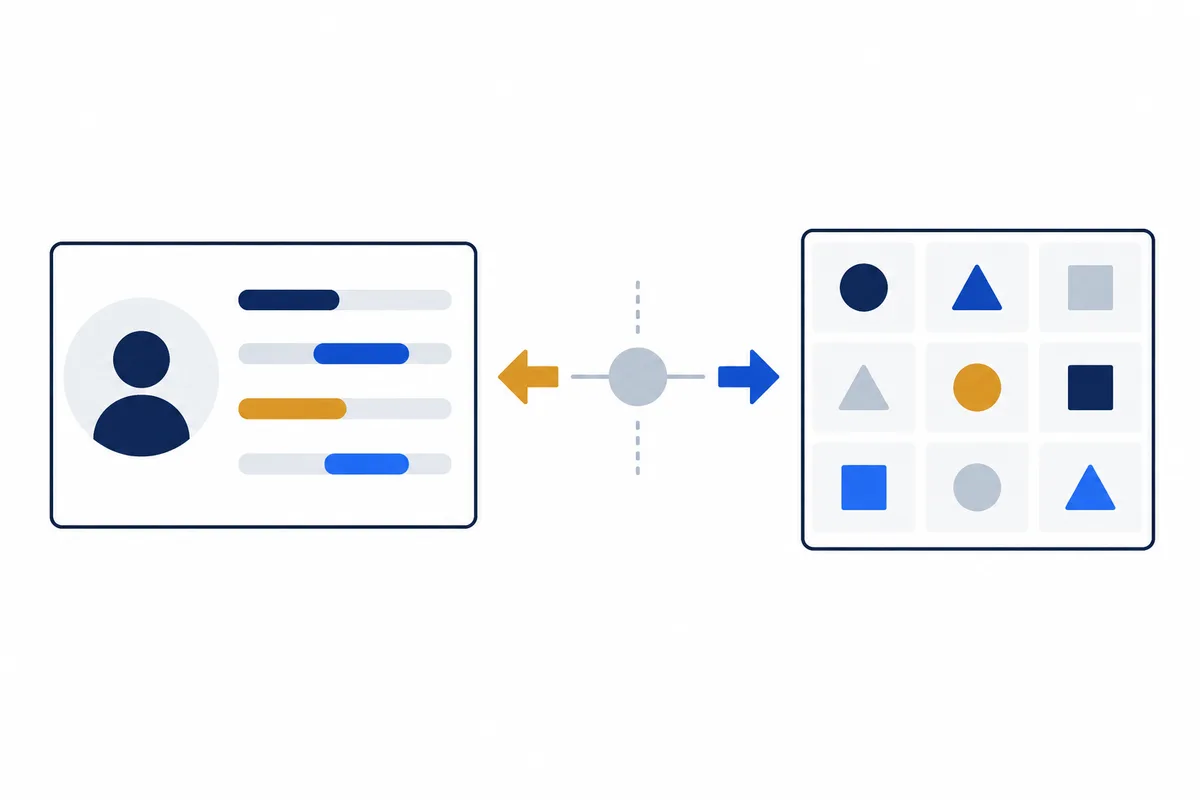
Keep the results separate. One summarizes how you describe recent behavior; the other reflects your judgment of a written emotional situation. Check the prompt and identify one response worth examining in a real interaction. The mismatch can guide that inquiry, but it does not say which result is correct or why they differ.
When the two parts disagree, what should you do first?
Keep the results separate. One summarizes how you describe recent behavior; the other reflects your judgment of a written emotional situation. Check the prompt and identify one response worth examining in a real interaction. The mismatch can guide that inquiry, but it does not say which result is correct or why they differ. The first useful move is to resist the urge to settle the discrepancy by picking the more flattering answer, the more worrying one, or a midpoint between them.
Those choices assume both parts are estimates of the same thing on the same scale. The profile instead keeps its recent-behavior summary apart from judgments on authored emotional situations. A 2019 critical review of emotional-intelligence measures by O’Connor and colleagues distinguishes self-reports of typical tendencies from performance measures designed around emotion-related problems. That distinction helps explain why response formats need not tell the same story. It does not establish that this profile’s scenario section measures ability, or that a gap between its outputs has a known meaning. The product is an educational reflection profile, so the result is a starting point for examining behavior, not a standardized verdict about it.
Imagine the habits summary suggests that you often move quickly to offer advice, while a scenario response favors first asking what the other person needs. The discrepancy does not prove that you lack empathy, that your account is inaccurate, or that the scenario reveals your hidden capacity. It identifies a narrower question: in a relevant conversation, do you pause to clarify before offering a solution? That is observable. Whether it happens can depend on the conversation and what you notice in it; the profile alone cannot explain the difference.
Begin by reading what each result actually asked you to report or judge. Keep the wording of the scenario in view, and translate the contrast into one action you could notice: asking, pausing, naming a feeling, setting a boundary, or repairing a misunderstanding. Then look for a recent interaction that bears on that action. This is a way to investigate the profile’s contrast, not a claim that one workplace episode settles a broad question about emotional intelligence.
The distinction matters because a written situation gives you described details and time to choose a response, while a summary of recent habits asks you to account for conduct across remembered situations. Neither output is an independent observation of what happened at work. Treating them as separate prompts preserves what each can contribute and keeps the question practical: what response should you observe next? The sections that follow examine how wording, recall, and actual interactions can sharpen that check. If the answer is not yet clear, that is a reason to keep the interpretation open and gather a more specific example in your own work, rather than force the profile to produce a single explanation.
What is each part of the profile actually describing?
In the Emotional Skills Profile, the habits summary and scenario judgments answer different prompts. The habits summary is a self-report: a person's account of their recent behavior. The scenario result records a judgment made about an authored emotional situation, using the details and wording provided. One looks back at conduct; the other considers a described choice. Read them as separate kinds of information, not duplicate estimates of one underlying EQ ability. Averaging them would hide the distinction that makes the difference worth examining. This distinction is familiar in emotional-intelligence measurement, though research on other measures cannot certify this profile. “The Measurement of Emotional Intelligence: A Critical Review of the Literature and Recommendations for Researchers and Practitioners” describes self-report measures as asking people to rate behavioral tendencies or abilities. It distinguishes such reports from ability tests that ask respondents to solve emotion-related problems under performance instructions. In the review’s account, trait measures concern typical behavior in emotion-relevant situations, while ability measures are designed around maximal performance. Those labels describe broad measurement approaches; they do not automatically classify every item in every product. Here, the assigned product specification says that its recent-behavior questions and authored emotional-situation questions remain separate. It does not establish that the scenario portion is an objective test of ability. A scenario can resemble an ability test without measuring actual conduct. The response reflects a judgment made with the situation’s limited information and framing, not a record of what the person did in a meeting. A recent-habits response is also an account, not a recording. Each format filters experience differently. A separate study, “Development and Validation of a Situational Judgment Test of Emotional Intelligence,” shows why it is useful to keep the categories distinct. Its authors developed a 46-item EI situational judgment test; an initial analysis of responses from 213 participants yielded three factors. In a later study, the abstract reports that those factors did not correlate with trait EI scores measured by the Trait Emotional Intelligence Questionnaire. That is evidence about one instrument and its study samples. It supports the narrower point that an EI scenario test and a trait self-report need not produce interchangeable information. It does not show that the Emotional Skills Profile has the same structure, that the two sections should disagree, or that one section is more accurate. For reading your own report, name each result in plain terms before asking what the gap means: “This is how I report behaving lately,” and “This is how I judged the described situation.” Then look at the specific skill or response that appears in both. If a scenario answer favors pausing to clarify while the habits summary suggests that you often move quickly to advice, the useful observation is the difference between the stated judgment and the reported recent pattern. That is enough to choose a behavior to notice in a real conversation. It is not enough to conclude that you are inconsistent, that your self-report is mistaken, or that the scenario score reveals your true ability. The labels tell you what each column contributes; the next question is what the scenario actually asked you to judge.
Sources: The Measurement of Emotional Intelligence: A Critical Review of the Literature and Recommendations for Researchers and Practitioners; Development and Validation of a Situational Judgment Test of Emotional Intelligence
What did the scenario ask you to judge?
Before treating the scenario result as a contradiction, look at the instruction that governed your answer. A question asking what someone should do invites a judgment about an effective or appropriate response. A question asking what you would do asks for a prediction about your own likely action. Those answers may differ even when the situation and response options stay the same. Neither wording automatically makes an answer more emotionally skilled; each asks for a different kind of judgment. Ployhart and Ehrhart tested this distinction in “Be Careful What You Ask For: Effects of Response Instructions on the Construct Validity and Reliability of Situational Judgment Tests.” They compared six instruction versions while keeping the situational judgment test (SJT) items the same. In the first phase, 486 participants completed one version; in a later within-person phase, 231 completed all six versions, several weeks after the first phase. The authors found that instructions affected responses, reliability, and validity. In general, versions asking what participants would do showed more favorable measurement characteristics than versions asking what they should do. The correlation between those two response types was relatively low despite the identical items. The authors warn that instruction choice can cloud conclusions about what an SJT measures. The finding gives a practical reason to read the prompt carefully: the words before a scenario help define what the response represents. It does not show why two parts of the Emotional Skills Profile might diverge. The study was about general SJTs, not an emotional-intelligence instrument or this profile, and it did not test whether a scenario answer matches a person's conduct in an actual workplace exchange. Its sample-level results cannot identify the cause of any individual's difference. When reviewing your own result, ask what the scenario section explicitly requested. Did it ask for the best response, the most effective option, what you would probably do, or what feels familiar? Use only the wording shown in your own assessment; do not infer an instruction that is not there. Then check whether your habits summary asked about recent conduct while the scenario asked for a response to a described situation. The answers may be addressing different targets before any deeper interpretation begins. This check is useful even if the instruction is clear. A scenario supplies selected details and a limited set of possible responses. Your actual work moment may contain other pressures, relationships, timing, or information. Endorsing an option therefore tells you how you judged that written situation under its instructions. It does not establish that you would act that way under pressure, or that you routinely do. Treat a mismatch as a prompt to examine one behavior in context, while leaving its cause open until you have evidence from an actual interaction.
Why can two results diverge without either being the answer key?
Different instruments and response formats can emphasize different information. Research has found imperfect alignment between some emotional-intelligence self-reports and between one emotional-intelligence situational test and trait emotional intelligence. Those findings make divergence plausible; they do not diagnose why one person’s recent-habit summary and scenario judgments differ. Keep the two outputs as separate prompts for reflection rather than treating either as an answer key. A 2026 cross-sectional study of allied-health undergraduates at Kuwait University offers a useful example of disagreement between measures. The 489 students in its analytic sample completed the Schutte Self-Report Emotional Intelligence Test and the Kuwaiti-Arabic Trait Emotional Intelligence Questionnaire–Short Form. Both were self-report questionnaires, but they came from different theoretical traditions: one asked about perceived emotional skill, while the other assessed trait emotional intelligence. Their scores correlated modestly (r = 0.35). The researchers’ four-profile analysis also identified a discordant group, 4.9% of this sample, whose self-perceived skill was very low while trait scores were near average. The authors describe the measures as capturing qualitatively distinct configurations. [“When emotional intelligence measures disagree: discordant profiles in allied health students and why classification uncertainty matters”](https://www.frontiersin.org/journals/psychology/articles/10.3389/fpsyg.2026.1929366/full) This finding makes a narrow point: even two questionnaires asking people to report on themselves need not line up closely when their models and item framing differ. The result is specific to these instruments, this student sample, and this study’s analysis. It is not a population rate, and it does not show that a recent-behavior report and a written scenario judgment will diverge in the same way. Both measures in the study were self-reports; neither was the Emotional Skills Profile’s authored-situation format. A different comparison comes from “Development and Validation of a Situational Judgment Test of Emotional Intelligence.” In this 2013 instrument study, a 46-item test was developed from an initial set of 80 situations; a factor analysis using data from 213 participants produced three factors. In a later study, those factors did not correlate with trait emotional-intelligence scores. It does not establish that all scenario tests and self-reports are unrelated, or that this profile’s scenario score measures ability. [“Development and Validation of a Situational Judgment Test of Emotional Intelligence”](https://onlinelibrary.wiley.com/doi/10.1111/ijsa.12017) The formats help explain why a mismatch is possible. A recent-habit answer depends on what a person remembers, notices about their own conduct, and understands the question to mean. A scenario judgment depends on the situation’s stated details, the available responses, the instruction, and the scoring approach. The two studies show that measures with different prompts can yield different emphases; they do not tell us which output is more accurate for one person. It is not evidence by itself of dishonesty, incapacity, or an inner contradiction. It can instead mark a useful distinction: describing what usually happens and judging a response that seems effective in a supplied situation are not identical tasks. Someone may recognize a sound response on paper and still need to notice whether it appears in a rushed conversation. That possibility is an interpretation to check against experience, not a conclusion supplied by either study.
Sources: When emotional intelligence measures disagree: discordant profiles in allied health students and why classification uncertainty matters; When emotional intelligence measures disagree: discordant profiles in allied health students and why classification uncertainty matters; Development and Validation of a Situational Judgment Test of Emotional Intelligence
Does the difference describe a stable pattern or a narrow slice?
A score difference alone cannot tell you whether a behavior is stable or limited to a particular stretch of work. Begin with the time window named in the habits summary. “Recent” behavior covers the period the prompt asked you to recall; it is not automatically a report about every setting or your usual conduct across years. Ask which specific events came to mind as you answered. A tense meeting may be easier to remember than an ordinary exchange, while a quiet week may offer few chances to notice how you respond to disagreement. These are checks on the evidence behind your answer, not explanations established by the profile. The scenario judgment has a different boundary. It comes from a written situation, its details, and the instruction telling you what kind of response to select. A scenario may describe a conversation with enough information to make one option seem sensible, while an actual exchange unfolds with incomplete information, competing demands, and consequences for the people involved. Compare the situation with the work moments that matter to you: does it involve the same kind of feedback, deadline, authority relationship, or need to set a boundary? If not, the scenario may be a poor match for that question. If the wording is unclear, note that before treating your answer as a prediction of what you would do. In “Be Careful What You Ask For,” researchers kept situational-judgment items the same while changing their instructions. Across two study phases with 486 and 231 participants, they found that instructions affected responses, reliability, and validity; “would do” and “should do” versions correlated relatively weakly. The study concerned general situational judgment tests, not this emotional-skills profile. It supports checking what a prompt asks, not assigning a cause to your result. A recent stretch marked by unusually high pressure may also be too narrow a basis for a lasting self-description. That possibility deserves a check when the period was atypical; it does not show that stress produced the answer or that the underlying behavior is stable. The Measurement of Emotional Intelligence: A Critical Review of the Literature and Recommendations for Researchers and Practitioners distinguishes self-reports of typical behavior from tests of maximal performance. That distinction helps explain why a person's account of recent conduct and a response to a presented problem need not describe the same thing. The review covers many instruments, so its general distinction does not establish what any particular reader's gap means. For a useful comparison, write down the recall window, one or two episodes that came to mind, and the scenario feature most relevant to the result. Then ask whether the difference remains when both answers are considered against the same kind of work situation. A short recall period, a salient event, different role demands, missing details, or unclear directions may limit the comparison; these are possible sources of uncertainty, not diagnoses. If you cannot identify a fitting real interaction, keep the interpretation open and wait for one rather than inventing a pattern from the numbers. If you can, the next step is to notice the specific response in that interaction and what happened around it. Keep the setting attached to each observation. The profile can help frame that question. It cannot turn a narrow slice into a permanent account of how you work with people.
Sources: The Measurement of Emotional Intelligence: A Critical Review of the Literature and Recommendations for Researchers and Practitioners; Be Careful What You Ask For: Effects of Response Instructions on the Construct Validity and Reliability of Situational Judgment Tests
Can workplace outcome research tell you which result is right?
No. Evidence that emotional-intelligence measures are associated with job performance across groups cannot decide which of two answers in one person’s Emotional Skills Profile is more accurate. The research makes a fair point: emotional skills can matter at work, and measures of them have shown relationships with work outcomes. But a pooled relationship is not a referee for a particular profile, and it cannot tell you what you will do in your next meeting. In “The relation between emotional intelligence and job performance: A meta-analysis,” O’Boyle and colleagues grouped studies into three streams: ability-based tests, self- or peer-report measures based on a four-branch model, and mixed competency measures. Across those streams, corrected correlations with job performance ranged from 0.24 to 0.30. A correlation describes how two measures tend to vary together in the studies analyzed; it does not show that one caused the other. Nor does that range mean that an individual’s score predicts a corresponding level of performance. The authors combined studies using different EI approaches and job-performance measures. Their result supports a general association across a research base, not a direct comparison of recent-habit reports with authored scenario judgments in this profile. A later review, “A Meta-Analysis of the Relationships Between Emotional Intelligence and Employee Outcomes,” also found positive relationships with job performance across ability, self-report, and mixed EI streams. Its analysis covered 253 effect sizes and data from 78,159 participants, drawing on English-language quantitative studies published from 1990 through early 2020. For overall EI, it reported a corrected correlation of 0.29 across 68 samples. That breadth is useful when asking whether emotional intelligence has any relation to work outcomes. It still pools unlike measures and samples; the authors also note that some included studies relied on self-reports of job performance and that unpublished work was included. The summary cannot isolate the response someone gives to a particular colleague in a particular conversation. The tempting leap is to use workplace relevance as a reason to trust the result that seems more flattering, more uncomfortable, or more consistent with a hoped-for outcome. Neither meta-analysis tests this profile’s two sections against workplace behavior, and neither establishes which account is right for a reader. Group-level links cannot settle whether a person usually pauses before offering advice, or whether they would choose that response when a scenario describes someone under strain. Those questions concern the prompts and the person’s actual episodes, not pooled job-performance correlations. So keep the outcome research in its proper place. It helps explain why noticing emotional habits and considering responses to emotional situations can be useful areas for reflection at work. It does not convert the profile into a performance forecast or a hiring measure. To examine a mismatch, return to one observable action named by the contrast and look for it in a relevant interaction. The evidence can justify taking the question seriously; only a specific behavior check can help you understand how that action appears in your own work. Broad relevance is a reason to reflect, not a tie-breaker between unlike answers.
Sources: The relation between emotional intelligence and job performance: A meta-analysis; A Meta-Analysis of the Relationships Between Emotional Intelligence and Employee Outcomes
What can an actual work interaction add?
An observed episode can test whether a behavior appears in the situation you care about. Specific colleague feedback can add another view, but no single observer or interaction settles a broad question about emotional intelligence. The profile’s contrast is most useful when it points toward something visible: what you said or did, what happened next, and what the situation required. Consider an illustrative handoff, not a reported case. A person endorses asking a clarifying question in an authored scenario, yet recalls moving straight to advice during recent work. The two answers do not show that the person is insincere or incapable. They suggest a question to check: in a real exchange where someone brings an unfinished problem, does the person pause to ask what help is wanted, or begin offering solutions? The answer requires an interaction, not another interpretation of the same profile. Choose a recent exchange and separate the action from its explanation. “I gave advice before asking what was needed” describes an action. “I was impatient” is an interpretation; it may be right, but the event alone does not establish it. Notice the other person’s next move as well. A brief note soon after the exchange can preserve details that are easy to blur when recalling a whole week. Did they clarify their request, accept the suggestion, or return to the original concern? That response adds context, not a verdict about your character. Outside perspective can help because people do not have complete access to how their behavior lands. In “The Social Perception of Emotional Abilities,” researchers examined observer ratings across three studies using real-world colleagues and data from 2,521 participants. They reported significant agreement among observers and moderate, significant agreement between self-ratings and observer ratings. Observer ratings also predicted interdependent task performance after controls. The study did not test this profile or an informal feedback request. Its relevance here is narrower: another person may notice something you miss, while disagreement between accounts remains possible. If you ask a colleague, make the request small and tied to an event you both remember. For example: “In yesterday’s handoff, did I ask what the other person needed before suggesting a fix? What did you notice?” This invites an account of observable behavior rather than a general rating such as “How empathetic am I?” Ask someone who saw the interaction; their account remains one perspective. Skip a request that would feel unsafe. Compare the accounts without forcing them to agree. If accounts differ, keep both and look for another relevant opportunity. The scenario result can help name a response worth noticing; the interaction and any specific feedback can show whether it appeared in that instance. Together, they support a grounded reflection question, not a new score. The practical gain is a focused practice choice: decide whether to pause for one clarifying question in the next suitable handoff, then notice whether that changes what the other person says or does.
How can you turn the gap into one useful check?
Turn the difference into a small observation, not a verdict about which result is “really you.” Restate each result in its prompt’s terms: one summarizes reported recent habits; the other judges an authored situation. Then choose one behavior that connects them. If the scenario favors asking a clarifying question while the habits summary suggests you often move quickly to advice, the check is not “Am I empathetic?” It is whether you ask before advising in a conversation where another person has brought you a problem. The example is illustrative, not a report of a study participant or a claim about your profile. Choose a verb that someone could notice: pause, ask, clarify, name, or repair. A broad label such as “be more understanding” gives you little to look for. Before the next relevant interaction, write down one recent occasion when this response mattered. Note the setting and what happened just before your response: Was a deadline close? Had the other person asked for a decision, advice, or simply a chance to explain? These details do not reveal the cause of a score difference. They help you compare like with like instead of treating a remembered event as a complete account of how you usually act. In a fitting conversation, watch for the chosen action in that kind of conversation and its immediate consequence. Did you ask a question before suggesting a solution? Did the other person add information, correct your understanding, or move on? Compare what you intended, what you did, and what followed. It is to make a claim such as “I asked before advising in this handoff” testable against something that happened. If the behavior does not arise in the next interaction, there is no evidence either way; wait for a relevant occasion rather than manufacturing one. Outside feedback may add a useful angle when timing makes an honest answer safe. Ask a trusted colleague for one recent, concrete instance: “Can you recall a time I asked questions before offering advice?” This is narrower than asking whether you are a good listener, and it gives the colleague a behavior to recall rather than an identity to rate. In their three studies of real-world colleagues, Elfenbein, Barsade, and Eisenkraft reported moderate self-observer agreement alongside observer consensus. That finding supports treating another person’s account as additional perspective; it does not show that one colleague can settle your profile’s discrepancy or validate an informal feedback request. This sequence is a reflective method derived from the measurement distinctions and observer research, not a tested intervention or a guarantee of change. If you cannot tell what the scenario asked you to judge, return to its instructions before selecting a behavior. Ployhart and Ehrhart’s study found that changing instructions while keeping situational-judgment items the same affected responses, including the relationship between “would do” and “should do” versions. Their study was not about this emotional-skills profile, so it gives a reason to check wording, not an explanation for your result. If the wording remains unclear, or you have no relevant recent example, leave the gap open for now. When you do have an example, use it to decide whether the behavior deserves attention in the next conversation.
Sources: Be Careful What You Ask For: Effects of Response Instructions on the Construct Validity and Reliability of Situational Judgment Tests; The Social Perception of Emotional Abilities
What should you carry forward from the profile?
Carry forward a question, not a verdict: does the response you endorsed in a scenario show up in the interaction that matters to you? Keep the recent-habits summary and scenario judgment in their own terms. Choose one observable action, such as asking a clarifying question before offering advice. In a relevant meeting or handoff, notice whether you do it and what follows. One episode can sharpen the question; it cannot settle a broad claim about your emotional skills.
If another perspective would help, ask a trusted colleague for one specific example, rather than a general rating. “Colleague Ratings of Emotional Intelligence” found moderate agreement between self-ratings and colleague ratings across its studies. Outside feedback can add a perspective; it is not an answer key for this profile. Compare the example with your account, then decide whether the behavior is worth practicing or watching in another situation.
The Emotional Skills Profile at /assessment offers a structured starting point for reflection, with separate views of recent habits and judgments about emotional situations. It cannot determine whether a response will appear in your meetings, feedback conversations, or handoffs. Notice what you do. Take one behavior into a fitting interaction, look for an example, and choose a practice focus only if the evidence gives you a reason.
Sources
- The Measurement of Emotional Intelligence: A Critical Review of the Literature and Recommendations for Researchers and Practitioners
Distinguishes self-reports of typical emotional tendencies from ability measures designed around emotion-related problems.
- Development and Validation of a Situational Judgment Test of Emotional Intelligence
Reports findings from one EI situational judgment instrument, including that its factors did not correlate with trait EI scores in a later study.
- Be Careful What You Ask For: Effects of Response Instructions on the Construct Validity and Reliability of Situational Judgment Tests
Reports that changing instructions on the same situational judgment items affected responses and measurement characteristics.
- When emotional intelligence measures disagree: discordant profiles in allied health students and why classification uncertainty matters
Reports a cross-sectional comparison of two self-report EI measures in allied-health undergraduates, including modest correlation and a discordant profile.
- When emotional intelligence measures disagree: discordant profiles in allied health students and why classification uncertainty matters
Provides an institutional record for the study comparing two self-report EI measures in allied-health undergraduates.
- The relation between emotional intelligence and job performance: A meta-analysis
Reports pooled associations between several EI measurement streams and job performance, not a way to adjudicate one person's profile.
- A Meta-Analysis of the Relationships Between Emotional Intelligence and Employee Outcomes
Reports pooled relationships between EI measurement streams and employee outcomes across studies and samples.
- The Social Perception of Emotional Abilities
Reports observer consensus and moderate self-observer agreement in studies using real-world colleagues.
Apply it to the real situation
Turn a profile difference into one behavior to observe
From this guide: The profile can frame the question; a relevant interaction can show how the response appears in your work.
The profile keeps recent habits and scenario judgments separate. If they point in different directions, choose one observable response and watch for it in a relevant meeting, handoff, or feedback conversation. The Emotional Skills Profile offers a structured starting point for that reflection; your own examples can help you decide whether the behavior is worth practicing.