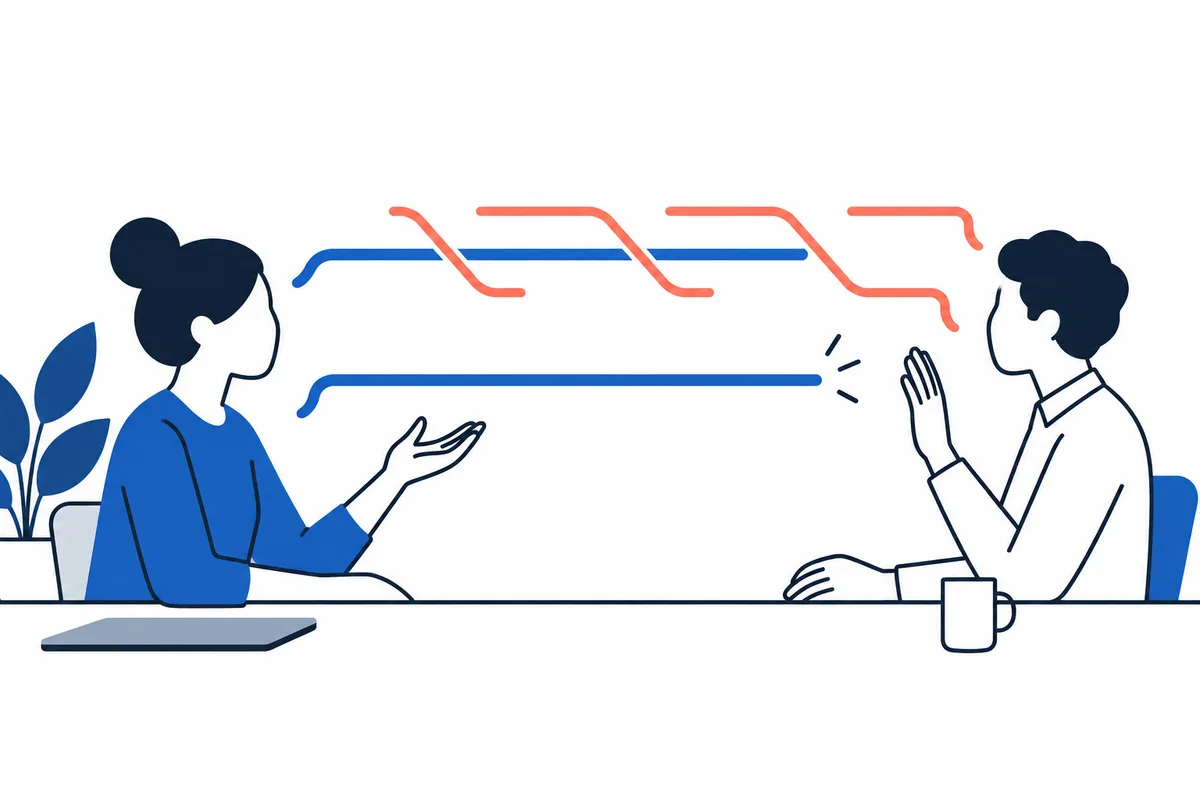
Describe one or two recent interruptions, explain what you could not finish and that you felt unheard, then ask for a specific change, such as letting you finish before responding. This names the effect without claiming to know why the coworker interrupted. Their reply and later turn-taking can help you decide what to do next.
Answer: name the pattern, its effect, and the change you need
When a coworker repeatedly speaks before you have finished, focus the first conversation on the interruption’s effect and the change you need. Choose one or two recent moments you can describe clearly. Say what you were trying to contribute, what happened to that point, and how it landed for you. Then ask for a visible adjustment, such as letting you finish before responding. You can be direct about feeling unheard without deciding why the coworker cut in. That distinction keeps the conversation focused on something both people can address. “You interrupted me because you don’t respect my ideas” treats an explanation as settled. “When you began speaking before I finished my update, I lost the chance to explain the risk and felt unheard” reports an event and its effect. The coworker may remember the exchange differently or explain what they intended; neither possibility requires you to deny your experience. The request gives the discussion a next step: leave space for the point to finish, then respond. Before deciding whether to raise it privately, prepare one example and one specific request.
Why is the impact worth naming even when intent is unknown?
An interruption can matter even when nobody can establish why it happened. In a meeting, the immediate loss may be simple: you do not finish the recommendation, explain the risk, answer the question, or add the information your colleagues need before the discussion moves on. You can name that loss without claiming the coworker meant to dismiss you. The point of raising it is to make the effect visible and give the other person a chance to respond to a specific account. “Being heard” here does not require agreement. It means having enough of a turn to complete the relevant thought and having the conversation make room for that contribution. A coworker can hear a proposal and reject it; that is different from the proposal never reaching its end. This distinction helps keep feedback grounded. “I felt unheard when the discussion moved on before I could finish the handoff risk” reports an experience tied to an observable moment. “You do not value my input” adds a conclusion about the coworker’s attitude that the moment alone cannot establish. There is a practical reason to take listening seriously at work. A registered systematic review and meta-analysis, “A Meta-analytic Systematic Review and Theory of the Effects of Perceived Listening on Work Outcomes,” combined 664 effect sizes from 400,020 observations. The authors reported an average correlation of .39 between perceived listening and work outcomes. The association was stronger for relationship quality (.51) than for job performance (.36). The association was stronger for relationship quality than for performance, but these averages do not estimate what one interruption did in one meeting. The review also gives reasons to be measured about that evidence. It found substantial variation among studies, and 75% of the literature relied on self-reports. The authors noted that estimates became smaller when listening and outcomes came from different sources or methods. Even after removing data based only on self-reports, the reported association between perceived listening and job performance remained positive at .21, but that still describes an association across studies. It cannot show that an interruption caused a missed deadline, that a particular coworker caused a performance problem, or that one feedback conversation will improve results. For this conversation, the useful point is narrower: listening is connected to work relationships and, less strongly, to performance, so the speaker’s experience is relevant information rather than a demand to prove intent. A separate study offers a view of the conversational mechanics, with a different setting and a more limited reach. In “Perceived Conversation Quality in Spontaneous Interactions,” researchers analyzed the MatchNMingle dataset of in-the-wild mingling conversations. External raters tended to associate more equitable speaking turns and fewer interruptions with higher perceived conversation quality. The study concerns spontaneous social mingling, not project meetings, task decisions, or coworker relationships over time. It reports associations, so it cannot establish that turn equity caused the higher ratings. Still, it gives a concrete way to understand why an interruption may affect a conversation: who gets the floor, and whether contributions can be completed, are visible parts of how an exchange is experienced. Together, these findings support a modest claim. Repeatedly losing the chance to finish a relevant point can affect both the work contribution and the speaker’s sense of participation. Naming that impact does not require a numerical estimate or a diagnosis of the relationship. You might say that you could not finish explaining a customer risk, that the group moved to the next agenda item before you had answered, or that you lost your place when someone began speaking over you. Those details give the coworker something they can recognize, correct, or ask about. That account should remain proportionate to what you know. A single unfinished sentence may have little practical consequence; a recurring pattern that leaves important information unspoken may deserve a direct request. It cannot tell you which case you are in or assign motive. Your concrete example does that local work: it shows what was left incomplete and why you want a different turn-taking pattern. You can take the effect seriously while leaving the explanation open, then see whether the coworker makes room for you in the next conversation.
Sources: A Meta-analytic Systematic Review and Theory of the Effects of Perceived Listening on Work Outcomes; Perceived Conversation Quality in Spontaneous Interactions
How do you separate the event from the story about motive?
When an interruption keeps happening, the mind often supplies a reason before the conversation has even begun: “They think my ideas do not matter,” or “They are trying to take control.” Those explanations may feel convincing, especially after several meetings. But they describe an account of the coworker’s purpose, not something directly observed. A useful way to prepare is to keep three things separate: what happened, what it did to you or the work, and what you think it meant. The first two can be reported plainly. The third can remain open. The Center for Creative Leadership’s “Situation—Behavior—Impact” guidance makes a similar distinction. It asks a speaker to locate the situation, describe observable behavior rather than an interpretation, and explain the impact. The University of Iowa’s performance-conversation guidance uses the same sequence and advises sticking to observable actions instead of assumptions. These are workplace practice guides, not controlled trials showing that a particular script reliably changes a coworker’s behavior. Their value here is narrower: they help make feedback specific enough for another person to understand and answer. For example, “In yesterday’s project meeting, you began speaking while I was still explaining the recommendation” identifies a setting and an action. “I lost my place, and I felt unheard because I could not finish the point” describes an impact. It does not require the coworker to agree that the interruption was intentional. Nor does it require you to soften or withdraw the feeling. “I felt unheard” names your experience; “you made me feel unheard” can sound like a verdict about what the other person meant to do. That phrasing may pull the discussion toward disputing blame instead of addressing the interruption and its effect. Being precise also leaves room for a correction without making your experience disappear. The coworker might remember a pause before they started, or say they thought the point was complete. If the pause matters, you can acknowledge that your recollection may differ. You can still explain that you were trying to continue and lost your place when they entered. A factual disagreement about timing does not automatically settle the impact; likewise, a real impact does not by itself prove a motive. Keeping those statements apart lets both people add information without requiring one person to confess to an unobserved intention. Choose details that make the event recognizable: which meeting, what point you were making, when the other person entered, and whether you got to finish later. Avoid “you always interrupt” if what you can recall is two recent occasions. A broad label invites an argument over exceptions; a specific account gives the coworker something concrete to confirm, correct, or explain. You might say, “In Monday’s planning meeting, you started responding while I was explaining the handoff risk. I lost my place and felt unheard. I’d like to finish the point before we discuss it.” The last sentence is a request, not evidence about motive. This distinction is useful even when you later ask what was happening for the coworker. The Center for Creative Leadership recommends remaining open to another perspective and notes that understanding motivation may change how feedback is perceived; that possibility does not erase the effect already described. You can invite their account after stating yours: “Did you realize I was still speaking?” or “What did you hear in that moment?” If they offer a different explanation, consider it as new information rather than proof that your experience was mistaken. If no explanation resolves the practical problem, return to the visible change you need: enough room to complete your thought before the reply begins. The point is not to avoid discussing intent forever. It is to begin with what both people can examine, then let the conversation add context without turning a guess into a fact.
Sources: Addressing Performance Concerns; Situation—Behavior—Impact
What can interruption research tell you about motive?
It can show why guessing is unreliable. In “Reasons for interruptions at work: Illuminating the perspective of the interrupter,” employees described interrupting for different reasons: to get task help, offer it, connect with a coworker, or provide support. Those reports make several explanations possible. They do not identify why one colleague cut into your sentence, and a helpful aim would not cancel the effect on you. The study’s framework separates two questions: what an interruption concerns and whose goal it serves. A task interruption may help the person asking for information or the colleague receiving an offer of help. A social interruption may serve the interrupter’s wish to connect, or an effort to include the other person. Emotional support adds another possible purpose. The researchers call these self-focused and other-focused reasons. The labels describe the reported aim; they do not say whether the interruption was welcome, well timed, or useful to the person whose turn stopped. The first study gives a sense of why a single explanation is hard to infer from the outside. Sixty employees in German-speaking countries who worked on site or in a hybrid arrangement wrote down reasons for their last three interruptions of coworkers. They supplied 391 descriptions, which two raters coded. Most descriptions fit one of the proposed types or a combination, but some fell outside the framework, and the raters could not classify others because there was not enough information. The accounts sometimes combined a reason to advance the interrupter’s own task with a reason to help the coworker. That result is about people explaining their own past actions in a survey; it does not establish that every interruption has a benevolent purpose, or that a recipient can reliably read the purpose from the behavior. The later studies developed and examined a scale for those reported reasons, then looked at their relationships with social-exchange measures. This adds structure to a research area that often starts from what the interruption costs the person whose work or turn is interrupted. It still measures reported motives. A scale can sort answers into categories; it cannot tell you what a particular coworker meant before you ask. “Assume positive intent” goes further than these findings warrant. The evidence supports leaving intent open, which also means leaving open the possibility that the reason was self-serving, careless, mixed, or unclear. A separate study makes the interaction itself more complicated. In “Excuse me, do you have a minute? An exploration of the dark- and bright-side effects of daily work interruptions for employee well-being,” 111 participants completed a three-week experience-sampling study. The researchers reported within-person support for two pathways: interruptions could consume self-regulatory resources through switching and returning to work, while the interaction could also satisfy belongingness needs; belongingness further buffered the negative relationship between resource depletion and job satisfaction. This is evidence about daily work intrusions and job satisfaction, not about conversational interruptions specifically or the intention behind one. It shows why an encounter can contain a social benefit and a task cost at once. It cannot decide which mattered more in your meeting. That distinction leaves room for the coworker to explain what they were trying to do without asking you to revise what happened for you. Perhaps they thought the point was finished, wanted to add information, or were trying to help. Those are possibilities to hear, not conclusions to supply on their behalf. You can invite their account while keeping the request concrete: make room for you to finish the thought before responding. The conversation does not need a verdict about character or motive to set that boundary. If their explanation adds useful context, you can take it into account; whether later turns change is separate evidence about whether the interruption pattern is being addressed.
Sources: Reasons for interruptions at work: Illuminating the perspective of the interrupter; Excuse me, do you have a minute? An exploration of the dark- and bright-side effects of daily work interruptions for employee well-being
Which wording gives both people something they can answer?
A useful opening gives the coworker something they can respond to: a particular moment, the action you noticed, and its effect on your contribution. “You don’t respect my ideas” may express how the pattern feels, but it also presents a conclusion about the coworker’s attitude as though it were an observed fact. The conversation can then become a dispute about whether they are respectful, rather than about what happened and what would help you finish a thought. Naming impact directly keeps the concern clear without asking the other person to agree with your explanation of their motive. For example: “In Tuesday’s planning meeting, you began speaking before I finished the risk point. I felt unheard, and I didn’t get to explain the handoff concern. Could you let me finish the point before responding?” The first sentence gives a time and an observable action. The second describes the effect on the speaker and the work contribution. The final sentence asks for a behavior both people can recognize in a future meeting. “I felt unheard” does not require the coworker to accept that they intended to exclude you; it tells them how the exchange landed and why you are raising it. University of Iowa Human Resources presents a related situation-behavior-impact approach for performance conversations: identify when and where something occurred, describe an observable action rather than an interpretation, then explain its effect. Its guidance also recommends inviting dialogue and agreeing on action. This is institutional practice guidance, not a controlled test showing that this wording will work between peers. Still, its structure helps separate details the other person might remember differently from the impact you can report for yourself. If you say “you cut me off because you think my ideas are stupid,” the coworker can deny the motive without addressing the interruption. If you describe the turn and its effect, they can clarify what they saw while still hearing the concern. An experiment reported in “I understand you feel that way, but I feel this way: The benefits of I-language and communicating perspective during conflict” offers narrower evidence about openings. Participants read hypothetical conflict scenarios and rated how likely a recipient would be to react defensively. The researchers varied whether statements used I- or you-language and whether they communicated perspective; I-language and perspective communication reduced perceived hostility. The situations were written scenarios, not live conversations, and the study does not show that a particular sentence prevents defensiveness during a repeated workplace interruption. Its result supports a modest choice: start with your experience and leave space for the other person’s perspective, rather than announce what they meant.
The distinction is in the substance, not merely the pronoun. “I think you are selfish” begins with “I,” yet still assigns a character judgment. “I felt unheard when I was interrupted before finishing” reports an experience tied to an event. The coworker may remember the exchange differently, perhaps believing the sentence had ended. That factual difference can be discussed without requiring you to deny the effect. After describing the example, ask, “How did you read that moment?” If the coworker thought you had finished, you can acknowledge the mismatch and restate the request: “I see that. I still need a moment to complete the point before we move on.” An invitation makes room for information; it does not require you to withdraw the request. University of Iowa Human Resources recommends inviting dialogue after the behavior-and-impact message. This is practical guidance for performance conversations in its institutional setting, not evidence that every coworker will welcome feedback. The conflict-language experiment also measured ratings of imagined openings, so it cannot predict this colleague’s response. A concise version might be: “In the last two project meetings, you started responding while I was still explaining my recommendation. I felt unheard and lost my place. Could you let me finish the point before weighing in? I want to hear your concerns afterward.” “Let me finish the point before responding” is concrete enough for both people to recognize.
Sources: I understand you feel that way, but I feel this way: The benefits of I-language and communicating perspective during conflict; Addressing Performance Concerns; Situation—Behavior—Impact
How do you prepare a request without rehearsing an accusation?
Choose a recent example, decide what you need to finish, and ask for one visible turn-taking change. For example: “In the last two project meetings, you started speaking while I was still explaining my recommendation. I felt unheard and lost my place. Could you let me finish the point before responding? I want to hear your concerns after.” This keeps the exchange anchored in something the coworker can recognize while showing what the interruptions cost you.
“The last two project meetings” is more useful than “you always interrupt me.” The broad version invites a dispute about whether “always” is literally true; recent examples give both people something specific to check. If you recall only one incident, name that meeting and the point you were trying to make. You do not need a case file before raising a recurring concern. Describe what you remember without claiming certainty about what the other person meant.
Name the unfinished work as well as the feeling. “I lost my place” tells the coworker what happened to your contribution; “I felt unheard” tells them how the exchange landed for you. If the recommendation included a risk or handoff detail, identify it in ordinary terms. You are not proving that the interruption caused a project failure. You are making the effect clear enough for the coworker to understand what you could not complete. A feeling statement reports your experience without requiring agreement about intent.
The request should describe an action both people can recognize. “Could you let me finish the point before responding?” gives the coworker a practical change to try. “Please respect my ideas” may express a real concern, but leaves the immediate behavior unclear. If the thought is interrupted again, “Let me finish this point, then I’m happy to hear that” can reclaim the floor. It handles the current turn; it does not explain the repeated pattern, so a later conversation may still be needed.
The Australian Fair Work Ombudsman's Employees' Guide to Difficult Conversations recommends identifying the outcome you want, writing down the concern and why it matters, considering the other person's position, and speaking clearly and concisely. Here, preparation means deciding what a workable exchange would look like: you complete the thought, then the coworker responds. Considering their position leaves room for an explanation, such as a mistaken cue that you had finished. It need not soften the request or erase the impact. This is practical guidance, not a tested script or guarantee of a good response.
Harvard Business Review's advice on stopping a colleague who interrupts also recommends a private conversation, describing observed behavior and its effect, and allowing for a good-faith explanation. A favorable explanation is not the measure of whether the conversation helped. The concrete request lets you notice whether the coworker makes room for your completed point in later meetings. If appropriate, choose a private, calm moment when neither of you is rushing. Keep the opening focused on the pattern and requested change; broader judgments can wait unless they become necessary.
A proportionate opening leaves room for conversation while remaining direct: “Could we talk about something from the last two project meetings? When you began responding before I had finished my recommendation, I lost my place and felt unheard. Next time, could you let me finish the point first? I do want to hear your concerns.” It names a pattern, an effect, and a request. Use a short floor-reclaiming phrase in the meeting when you need to finish immediately; use the later private conversation to explain why the repeated interruption matters.
Sources: Employees' Guide to Difficult Conversations in the Workplace; How to Stop That Colleague Who Always Interrupts You
How should you read the coworker's reply?
Treat the reply as information about the exchange, not as a ruling on whether you were entitled to feel unheard. A coworker might say they thought you had finished or needed to add something urgent. You can take that explanation seriously without withdrawing the effect you described. You might say: “I may have paused. I still had another part to explain, and I lost my place when you came in. Could we leave a beat so I can finish?” This accepts a possible mismatch about what each person noticed while keeping the practical need visible. Listen first for whether the coworker has understood the specific event and its effect. They may remember the sequence differently. If so, check the detail you can:which meeting, where your turn stopped, and what remained unfinished. It is to find out whether you can discuss the same moment and agree on a small adjustment. A factual disagreement such as “I thought you had finished” gives you something to clarify. A reply that skips the example and mocks, dismisses, or argues away the fact that you felt unheard is a different response. You can say, “We may remember the pause differently. I had more to say, and I’d like to finish before we move on.” Then return to the work point that was cut off, if it still matters. If the concern was a recommendation, risk, or answer, finish it now and ask whether the coworker has questions. You might agree on a simple signal or a pause before replies,. Keep the adjustment observable: in a later discussion, could you complete the point before the other person responds? The purpose is not to secure a confession about what they meant. It is to make the next exchange easier to participate in. Research makes room for more than one possible motive, but it cannot tell you which one applied here. In “Reasons for interruptions at work: Illuminating the perspective of the interrupter,” employees in German-speaking countries who worked face to face described their own reasons for interrupting. In the first study, 60 employees supplied 391 descriptions; many descriptions combined categories, and some did not fit the typology. The later studies developed and examined a scale of reported reasons. The findings leave an individual motive uncertain. They do not establish that your coworker meant well, or that a helpful intention would cancel the interruption’s effect. An explanation adds context; subsequent behavior shows whether the request has been taken up. Do not treat one polished apology as proof that the pattern has changed, or one later slip as proof that repair is impossible. Notice whether the coworker acknowledges the concrete example, makes room for your turn in later conversations,. That judgment is a practical inference from the situation, not a protocol tested by the research. The study of hypothetical conflict openings summarized in the accessible record for “I-Language and Perspective-Taking: Should I or You Statements Be Used in Conflict?” found that participants rated first-person language that communicated perspective as less likely to provoke defensiveness. It tested written openings and anticipated reactions, not real conversations about recurring interruptions. owning your perspective can give a discussion a less accusatory start, but it cannot predict this coworker’s reply. If the interruptions continue after a clear request, you have evidence that the behavior remains a problem, regardless of the original explanation.
Sources: I understand you feel that way, but I feel this way: The benefits of I-language and communicating perspective during conflict; Reasons for interruptions at work: Illuminating the perspective of the interrupter
What if a direct conversation feels unsafe or the pattern continues?
A private conversation is one option, not an obligation. If the coworker has influence over your work, you fear retaliation, or interruptions accompany harassment or intimidation, consider a safer route: ask a meeting chair to manage turns, speak with a trusted manager, or use a workplace channel you trust. The right route depends on your role. “Confronting Co-workers: Role Models, Attitudes, Expectations, and Perceived Behavioral Control as Predictors of Employee Voice in the Military” surveyed 374 employees of the Netherlands Ministry of Defense. Their intention to speak up was associated with perceived ability and whether they thought the workplace expected it. Since this was a survey in a hierarchical institution, it cannot predict the safest choice in a civilian workplace. It does show why the speaker's conditions matter alongside the wording.
If a direct approach feels safe and the pattern continues, bring one fresh example and repeat the specific request. You can ask a manager or meeting chair to help establish workable turn-taking. The private 32-item Emotional Skills Profile can prompt reflection on your own awareness and responses during difficult exchanges; it cannot assess your coworker or establish what happened. Prepare one example and one request, then choose a setting where you can say them plainly.
Sources
- A Meta-analytic Systematic Review and Theory of the Effects of Perceived Listening on Work Outcomes
Supports the reported associations between perceived listening and work outcomes, including the differences between relationship quality and performance.
- Perceived Conversation Quality in Spontaneous Interactions
Supports the reported association between equitable speaking turns, fewer interruptions, and perceived quality in spontaneous mingling conversations.
- Addressing Performance Concerns
Supports using a situation, observable behavior, and impact sequence in workplace feedback practice.
- Situation—Behavior—Impact
Supports distinguishing the situation, observable behavior, and impact when giving feedback.
- Reasons for interruptions at work: Illuminating the perspective of the interrupter
Supports the finding that employees report different and sometimes combined reasons for workplace interruptions.
- Excuse me, do you have a minute? An exploration of the dark- and bright-side effects of daily work interruptions for employee well-being
Supports distinct reported pathways linking daily work intrusions with resource depletion and belongingness.
- I understand you feel that way, but I feel this way: The benefits of I-language and communicating perspective during conflict
Supports the limited finding that first-person perspective language reduced ratings of likely defensiveness in hypothetical conflict openings.
- Employees' Guide to Difficult Conversations in the Workplace
Supports practical preparation steps such as identifying the desired outcome and speaking clearly and concisely.
- How to Stop That Colleague Who Always Interrupts You
Supports advice to discuss a recurring interruption privately and describe observed behavior and its effect.
- Confronting Co-workers: Role Models, Attitudes, Expectations, and Perceived Behavioral Control as Predictors of Employee Voice in the Military
Supports the study-specific association between employees' stated willingness to confront coworkers, perceived ability, and workplace expectations.
Apply it to the real situation
Reflect on your responses in difficult conversations
From this guide: Consider how you notice and respond to feelings when you need to raise a concern or hold a boundary.
A clear request gives you a next step, but it cannot settle how you respond under pressure. The private 32-item Emotional Skills Profile offers a way to reflect on your own emotional habits and development priorities. Use it to consider your responses in difficult exchanges, not to assess a coworker or predict how a conversation will go.