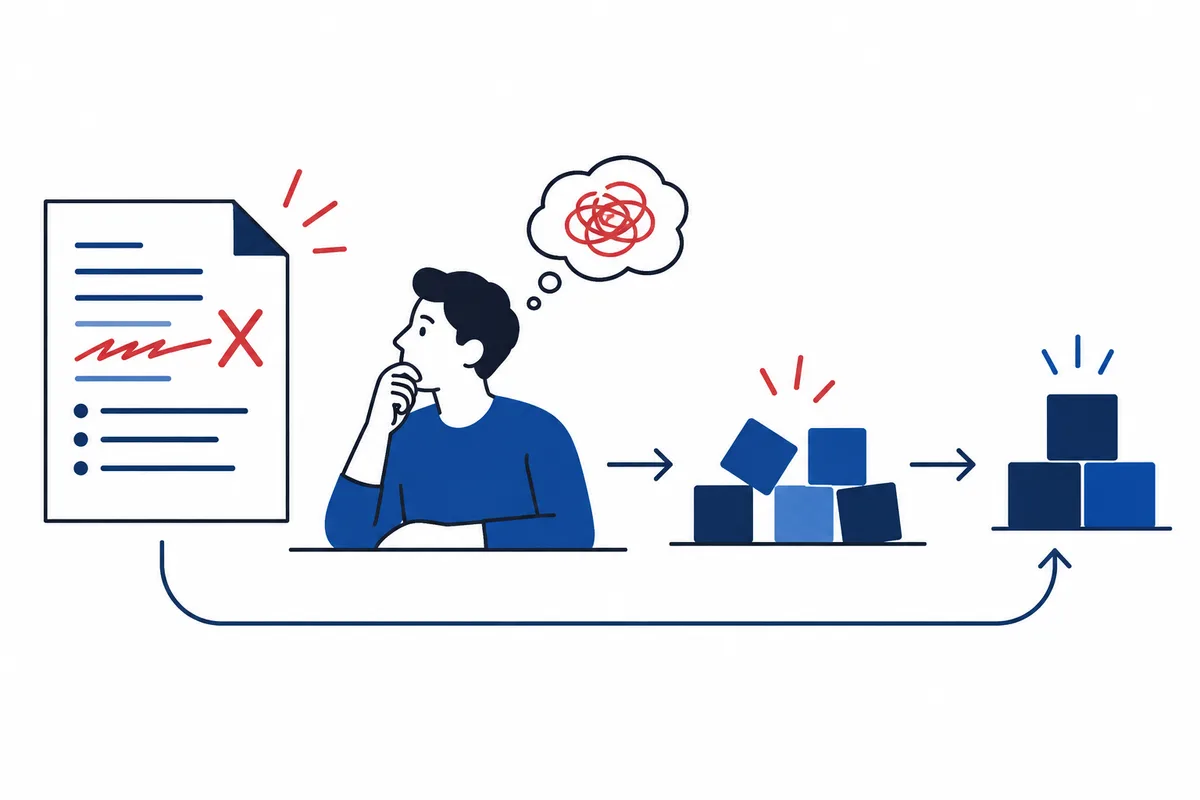
A supervisor’s emotional tone can affect how a recipient processes criticism, but there is no single performance effect of “negative tone.” Experiments report different results depending on the emotional cue, comparison message, task, and recipient. Keep the checkable work correction separate from what you infer about the relationship; ask for an example or standard when the requested change is unclear.
The emotional signal and the work instruction
A supervisor’s emotional tone can change how a recipient processes criticism, even when the work information stays the same. Here, tone means the emotional signal in the wording, such as contempt or anger. It is distinct from feedback valence (whether an evaluation is favorable or unfavorable), civility (how respectfully the recipient is treated), and task clarity (whether the requested change is specific enough to carry out). These features can overlap in real messages, but studies that vary them separately answer different questions.
The concise answer is conditional. Some experiments find that a negative written exchange can coincide with lower short-term task performance or energy. Other results depend on the emotional cue, comparison message, task, and recipient. In “Supervisor beware: Contemptuous feedback harms low performers and taxes working memory of rejection sensitive persons,” 124 participants were randomly assigned to neutral, angry, or contemptuous written feedback during copyediting tasks. The abstract reports poorer performance under contempt among participants with lower baseline copyediting performance, and greater working-memory deficits among rejection-sensitive participants. In “What a rude e-mail! Examining the differential effects of incivility versus support on mood, energy, engagement, and performance in an online context,” an experiment with 84 participants found worse math-task performance in an uncivil-email condition than in a supportive one. That contrast combines incivility with less support, so it does not isolate tone alone.
Neither result licenses a forecast from one sharp sentence. The work claim and relationship meaning inferred from its wording are distinct: a correction may identify a checkable omission while sounding dismissive, or leave its meaning uncertain. The sections that follow compare these outcomes without treating task performance, emotional response, and interpretation as interchangeable. The question is which signal was tested, against what alternative, and with what consequence.
Sources: Supervisor Beware: Contemptuous Feedback Harms Low Performers and Taxes Working Memory of Rejection Sensitive Persons; What a rude e-mail! Examining the differential effects of incivility versus support on mood, energy, engagement, and performance in an online context
Why do experiments on contempt reach different performance results?
The studies do not support one dependable performance effect of contempt. In the 2011 three-experiment study *Held in Contempt: The Psychological, Interpersonal, and Performance Consequences of Contempt in a Work Context*, participants took part in a business strategy simulation with a virtual partner programmed to deliver different feedback. In Study 1, recipients of contempt performed better on the task than recipients of failure, angry, or neutral feedback, while also showing more interpersonal aggression toward their virtual partners. The performance gain and the relationship cost appeared together. The result therefore does not show that contempt is constructive; it shows that task output and how a recipient treats the other party can move in different directions.
The 2023 study *Supervisor Beware: Contemptuous Feedback Harms Low Performers and Taxes Working Memory of Rejection Sensitive Persons* moved closer to a supervisor-subordinate exchange. Its 124 participants were randomly assigned to scripted neutral, angry, or contemptuous written feedback delivered through an online messaging platform. They completed three copyediting tasks and received three rounds of feedback. The authors report that participants with lower baseline copyediting performance consistently did worse under contempt than participants in the other feedback conditions. They also report greater working-memory deficits under contempt among participants with higher rejection sensitivity. Working memory is the limited capacity used to hold and work with information in mind; taxing it could matter when a person must keep instructions and edits active at once. These findings describe conditional differences in this task, not a fixed response shared by everyone who receives sharp criticism.
It is tempting to call the 2023 result a failed replication of the earlier finding. The authors describe their work as an independent constructive replication and generalizability study, but the studies differ. The earlier work used a business strategy simulation with a virtual partner and several feedback categories. The newer experiment placed participants in an online supervisor-subordinate setting, measured copyediting across repeated rounds, and examined baseline performance and rejection sensitivity. A difference in results is informative; it does not identify which design feature explains it. The accessible publisher record provides the later study's abstract, not its full article, so the comparison remains limited.
The outcomes also need to stay distinct. Task performance is not working memory, and neither is interpersonal aggression toward a virtual partner. The 2011 study reports a performance advantage in one experiment alongside greater aggression; its abstract also says status moderated outcomes in a later experiment. The 2023 study reports a cost for lower-baseline copyeditors and a working-memory cost for rejection-sensitive participants. Neither study establishes what a particular employee will do after one real email from a supervisor.
Taken together, the evidence rules out two easy conclusions: that contempt reliably boosts output by provoking effort, or that it invariably reduces everyone's task performance. One study found an immediate task gain in a simulation, accompanied by an interpersonal cost; the later supervisor-message experiment found poorer copyediting among participants who began with lower performance, with a separate working-memory pattern for rejection-sensitive participants. Differences in task, feedback setup, and recipient conditions leave the reason for the divergence unresolved. The practical point is modest: do not treat a single performance result as proof that contempt motivates, harms, or reveals a recipient's ability. Keep the work correction available for inspection, while treating the emotional signal and its possible effects as part of the exchange. This conclusion concerns two controlled experiments, not a general forecast for ordinary workplace email.
Sources: Supervisor Beware: Contemptuous Feedback Harms Low Performers and Taxes Working Memory of Rejection Sensitive Persons; Held in Contempt: The Psychological, Interpersonal, and Performance Consequences of Contempt in a Work Context
From incivility to a short-term energy cost
A short supervisor email can leave the next task harder to do, even when its criticism contains information the recipient could use. In “What a rude e-mail! Examining the differential effects of incivility versus support on mood, energy, engagement, and performance in an online context,” 84 participants completed math tasks in a simulated workplace while interacting by email with an uncivil or supportive supervisor. The uncivil condition was followed by higher negative affect and lower reported energy. Participants also performed worse on the math tasks and reported lower engagement than in the supportive condition. The study compared an uncivil exchange with a supportive one. That matters because the contrast does not isolate the effect of rude wording from the effect of receiving support. It shows what happened across two different interaction climates in this experiment; it cannot tell us how the same critical information would have affected performance if only its emotional wording had changed. Nor was this a measure of a full workday, a demanding project, or a lasting change in performance. The outcome was a short task completed in a laboratory-based simulation. The researchers reported that energy statistically mediated the differences in task performance and engagement. In plain terms, the measured energy difference helped account for the relationship between supervisor condition and those outcomes in the study’s statistical model. That is consistent with a short-term pathway: an uncivil interaction may leave a person with less energy available for the task that follows. Mediation in one experiment does not establish that reduced energy was the sole cause, or that every recipient will respond this way. It describes how the measured variables related in this design. The study also measured cardiac activity and found no difference between the two conditions. The contrast therefore appeared in participants’ reported mood and energy and in task and engagement outcomes, while this physiological measure did not differ. That result keeps the finding specific. It does not support a claim that an uncivil email creates a measurable bodily stress response, much less a chronic health effect. For someone receiving criticism, the practical implication is modest but useful: a message can contain a valid correction and still make the next piece of work more difficult in the moment. Preserving attention may mean pausing before replying, then locating the checkable work issue and the standard for fixing it. If the email does not say what to change or what a successful revision requires, ask for that missing detail. These steps are a reasoned application of the evidence, not an intervention tested by this experiment. The study supports concern about immediate task conditions; it does not predict long-term performance or show that a recipient can remove the effect simply by regulating their response.
Does disrespect differ from feedback that is simply hard to use?
A 2025 randomized vignette study suggests that disrespect and poor organization can affect recipients in different ways. In “The emotional and motivational costs of poorly delivered academic feedback,” 148 undergraduates imagined receiving an email from a professor after submitting an assignment. The researchers independently varied two features: whether the message conveyed respect and whether it created “hassle” through unclear requests and disorganized presentation. Students then rated the professor, their emotional response, and how they expected to engage. The respect contrast was substantial in the students’ ratings. On a four-point scale, those who read the high-respect version rated the professor more positively on average than those who read the low-respect version: 3.37 compared with 2.16. They also reported stronger negative emotions and greater willingness to engage and participate in class, with average ratings of 3.35 versus 2.67. The low-respect messages used harsh, discouraging criticism, emphasized mistakes, and offered no constructive feedback; the respectful versions acknowledged effort and progress while giving constructive criticism. These are responses to the assigned messages, not observations of students completing a task after receiving real feedback. “Hassle” meant something more specific than a generally unpleasant tone. The high-hassle vignette placed feedback in a substantial, disorganized block and left requests unclear; low-hassle messages were organized and clear. Across respect conditions, high hassle modestly lowered students’ ratings of the professor, and it affected engagement and motivation measures. But the pattern depended on respect. For students reading respectful feedback, the high-hassle version received lower engagement ratings than the low-hassle version, 3.09 versus 3.59. Within the disrespectful condition, the study did not find a significant simple effect of hassle on engagement. In other words, clarity mattered, yet its effect was not a uniform penalty added in the same way to every tone. That interaction complicates a simple “be polite and all is well” reading. A respectful opening cannot make an unclear request easy to carry out: if the recipient cannot tell which passage needs revision or what standard applies, the relationship signal and the work instruction pull in different directions. Conversely, a clear message can make the requested change easier to locate while leaving the recipient with a poor impression of the person who wrote it. In the study, hassle also interacted with respect in students’ emotional responses and perceptions of the professor. The two features were separately manipulated and sometimes combined in their reported effects. The outcomes also put a limit on what “performance” means here. The study asked students to imagine a professor’s email and report likely feelings, class participation, and resubmission behavior. It did not assign an actual academic revision task and measure its quality or completion. Respect and hassle did not significantly affect stated willingness to resubmit a high-stakes assignment, although respect did affect reported willingness for a low-point assignment. Those intentions should not be presented as observed productivity, much less as evidence about employees receiving supervisor criticism. For a workplace reader, the useful distinction is diagnostic rather than predictive. When criticism is hard to process, ask two separate questions: what does the wording communicate about how I am being treated, and what exact change is the sender asking me to make? If the request is buried or vague, asking for a concrete example or standard can address the usability problem. That clarification does not decide whether the tone was respectful, nor does it excuse a pattern of demeaning messages. The academic vignette gives a reason to keep clarity and respect distinct when interpreting feedback; whether the same effects appear in workplace tasks requires direct workplace evidence.
Sources: The emotional and motivational costs of poorly delivered academic feedback
Two routes through negative feedback
A supervisor’s negative feedback can be followed by either a work-focused response or an effort to manage the emotional impact, and those paths were associated with different performance outcomes in a field study. The distinction matters because criticism does not arrive as an isolated sentence: its content, the recipient’s room to act, and the demands of the job all shape what can happen next. Still, this evidence concerns negative feedback broadly. It does not tell us that an angry, contemptuous, or otherwise emotionally charged email caused a particular employee’s performance to change. In “The double-edged sword: investigating when and why supervisor negative feedback promotes versus inhibits employee performance,” researchers analyzed time-lagged field-survey data from 389 employee-supervisor dyads in five companies in China. They report two indirect pathways. Negative feedback was linked to emotion-focused coping, which in turn was associated with impaired job performance; it was also linked to problem-focused coping, which was associated with improved performance. Emotion-focused coping means dealing with the emotional response to the criticism. Problem-focused coping means addressing the work problem the criticism identifies. The study’s central contribution is this split: the same broad category of feedback can be connected to responses with different directions, rather than a single demotivating effect. That result should not be translated into an instruction to suppress emotion and “just fix the work.” An employee may first need to steady attention before they can decide whether the criticism identifies a real gap. Equally, a practical response may be unavailable if the feedback is vague, the requested standard is unknown, or the recipient lacks the authority or time to make the change. These are reasonable applications of the two pathways, not outcomes tested by this survey. The results therefore show reported associations and modeled indirect paths; they cannot establish that emotional wording itself produced the performance differences. The authors also report that proactive personality moderated the indirect path through emotion-focused coping. In other words, the modeled relationship varied with participants’ measured tendency toward proactive behavior. It also does not erase workplace conditions: a person cannot solve a task whose requirements remain unclear or whose constraints are outside their control. For someone receiving criticism, the useful distinction is observable. Ask whether the message gives a specific work gap and a standard that can be checked. If it does, a next action may be available even while the emotional response takes time to settle. If it does not, asking for an example or the expected standard may be more useful than treating distress as evidence of poor resilience. Neither a performance dip nor a strong reaction, on its own, measures emotional intelligence. This field study concerns negative feedback and coping associations, not a validated EQ score, a written-tone experiment, or a guarantee that emotional regulation improves output.
Why can the same email carry different meanings?
A supervisor’s email can contain a clear work correction and still leave its relationship meaning uncertain. In *Hypernegative Interpretation of Negatively Perceived Email at Work*, researchers asked participants to provide coworker emails they had experienced as negative, share the message text, and describe their perceptions. The recipients rated those emails more negatively than outside observers did. Their ratings were only weakly related to message features such as negative language and flaming. The finding concerns interpretation of messages selected because recipients already perceived them as negative; it does not show how every workplace email is read, whether recipients were mistaken, or what any sender intended.
The researchers call this pattern negative intensification: in this sample, recipients’ perceptions of already negatively perceived emails were more negative than observers’ perceptions. That distinction matters because a reader can accurately notice a sharp phrase while still having limited evidence about why it was written. The study does not establish which perspective is more accurate. It shows that recipient and observer judgments can differ, and that the visible message features examined did little to explain those differences on their own.
The gap was greater among participants in subordinate positions and in poorer communication climates. Those findings make the surrounding relationship relevant: a terse correction from a supervisor arrives within a power difference, and a workplace where communication is already poor may give ambiguous wording a different weight. They do not prove that subordinates systematically misread criticism or that a difficult climate caused a particular interpretation. The study used negatively perceived coworker emails and was not a randomized experiment assigning supervisors different tones. Its evidence is about reported interpretation, not a measured effect on the recipients’ task performance.
That outcome distinction prevents an easy but misleading conclusion. Experiments that assign people different feedback messages can test whether a particular message condition changes performance on a short task. This email study instead compared recipients’ and observers’ evaluations of messages from workplace experience. Neither kind of evidence answers the other question: performance differences do not reveal what a recipient concluded about the sender, and a perception gap does not establish a performance cost. The practical conclusion is therefore modest. One email’s emotional tone may be meaningful, but its wording alone cannot reliably settle intent; the effect of tone on task performance must be assessed from evidence that actually measures performance.
A useful reading practice is to separate the checkable work proposition from the relationship inference. ‘The revised date is missing from the report’ identifies something that can be inspected. ‘My supervisor thinks I am careless’ interprets what the omission means about the supervisor’s view. That inference may be reasonable, particularly when similar exchanges recur, but an ambiguous sentence by itself cannot confirm it. A concise follow-up can gather task information without denying the reaction: ‘Which section needs the revised date, and what should the final version include?’ The answer may clarify the standard; a repeated pattern of personal criticism calls for addressing the pattern itself. This two-track approach is an editorial application of the evidence, not an intervention tested by the email study.
Sources: Hypernegative Interpretation of Negatively Perceived Email at Work
Where task disagreement can move next
A discussion about criticism can leave the two sides farther apart on what happened. In “The future of feedback: Motivating performance improvement through future-focused feedback,” the first study asked managers to recall a recent work incident involving positive or negative feedback. Of 419 respondents, 382 remained in the analysis after exclusions. Recipients of negative feedback rated it as less accurate and its provider as less qualified than providers rated their own feedback. The survey concerns remembered incidents, not written-message tone. The researchers then used two role-play performance reviews. These scenarios let them examine how disagreement and motivation related to the feedback conversation, while remaining simulated workplace encounters rather than actual appraisals. In these exercises, providers and recipients discussed performance information. Across the studies, recipients of mixed or negative feedback questioned both its accuracy and the provider’s qualifications. Disagreement about past performance grew after discussion, which the paper links to recipients’ increased self-protective and self-enhancing explanations of events. Reviewing the past together did not automatically create agreement in these studies. The same paper reports a different association around what comes next: managers’ motivation to improve was higher to the extent that they perceived the feedback conversation as focused on future actions rather than past performance. The studies support a relationship between perceived future focus and reported motivation; they do not show that changing a sentence’s tone causes better performance, nor that future-oriented wording erases the effect of contempt or disrespect. These were performance-review discussions, not email exchanges. Still, the distinction offers a practical way to make criticism more usable. A statement such as “you are careless” assigns a broad judgment but gives little direction for the next piece of work. “The revised report is missing the new delivery date; include it in the summary before sending the next version” identifies a checkable gap and an action. That contrast is an editorial illustration, not language tested in the study. For a recipient, asking “Which part should change, and what should the completed version include?” can uncover the missing instruction. For a supervisor, naming the gap and the expected next action gives the recipient something concrete to assess and do. This is a reasoned application of the findings, not a proven technique for improving output or neutralizing a harsh message. It can, however, keep the task question distinct from the disagreement about character or intent. When the standard remains unclear after a direct question, the unresolved issue is the standard itself; when the criticism repeatedly targets character, the pattern deserves attention beyond one task correction.
Sources: The future of feedback: Motivating performance improvement through future-focused feedback; The future of feedback: Motivating performance improvement through future-focused feedback
Separate the correction from its inferred meaning
Read written criticism on two tracks. First, extract the work claim: what is missing, incorrect, late, or below the stated standard? Then separate the meaning you infer about the relationship: does the supervisor respect your work or trust your judgment? The first track can often be checked. The second may matter, but one ambiguous sentence rarely settles it. Readers do not always experience a message as its writer expects. In “Hypernegative Interpretation of Negatively Perceived Email at Work,” participants supplied coworker emails they had experienced as negative. Recipients rated them more negatively than outside observers did; ratings had only weak relationships to features such as negative language and flaming. The pattern was stronger in poor communication climates and among people in subordinate positions. Because the study began with emails already perceived as negative, it cannot show that recipients were wrong or establish the sender’s intent. It does show why an inference should not be silently treated as another fact in the correction. Consider an illustrative message: “The report omits the revised date. You are careless.” The first sentence names a checkable omission; the second judges the person. A hostile sentence can still contain accurate task information, so the date may need correcting. That does not make the personal judgment useful or fair. If the work claim is clear, check it. If the message gives no example, standard, or next step, ask: “Which section should include the revised date, and what should the finished version show?” This seeks missing work information without requiring agreement with a character judgment. This question is a practical application, not a proven way to neutralize emotional tone. “The Future of Feedback: Motivating Performance Improvement Through Future-Focused Feedback” reports three studies: managers described recent work experiences, and pairs role-played performance reviews. Recipients of mixed or negative feedback doubted its accuracy and the provider’s qualifications. Motivation to improve was associated with perceiving more focus on future actions than past performance. The studies did not test clarification after hostile email. The connection is an editorial inference: a concrete future standard gives the recipient something actionable to evaluate when past criticism is disputed. Before replying, notice your reaction and pause long enough to identify what the work itself leaves unanswered. This is not a duty to excuse disrespect. If criticism repeatedly attacks character, or expectations remain unclear after a direct request, raise the recurring pattern and ask for clear work standards. A recipient should not have to solve a persistent power problem by interpreting each message more generously.
Sources: Hypernegative Interpretation of Negatively Perceived Email at Work; The future of feedback: Motivating performance improvement through future-focused feedback
A personal reflection tool has a narrower role
A personal reflection profile can help you examine how criticism tends to affect your responses. It cannot decide whether a supervisor’s comment is fair, establish your emotional ability, or predict your next task performance. Those questions require different evidence: the work itself, the standard you were given, and what happens when the requested change is made. A self-reflection result can prompt a question about your habits; it cannot settle a disagreement about facts or another person’s intent.
The Emotional Skills Profile is a private, 32-item educational tool. Its questions cover recent behavior and judgments about authored emotional situations, with guidance for reflection and development. The two kinds of response remain distinct. Neither is a validated ability test, and the profile has no validated norms. It may prompt reflection on whether you pause, seek clarification, or react quickly when criticism feels sharp. Those are tendencies to examine, not fixed traits or a verdict about how you will handle every exchange.
For the message in front of you, write down the specific correction and its implied standard. Separate that from any conclusion about respect, credibility, or your supervisor’s view of you. If the requested change is unclear, ask for an example and what the finished work should include. If criticism repeatedly targets your character or the standard stays unclear after you ask, raise the pattern in a conversation rather than treating one more careful reading as the solution. To reflect on your emotional habits, explore the [Emotional Skills Profile](/assessment).
Questions readers ask
Does a harsh email always reduce task performance?
No. The studies report different results across tasks and recipients. One contempt experiment found better task performance alongside more interpersonal aggression; a later study found poorer copyediting among participants with lower baseline performance. An uncivil-versus-supportive email experiment found worse short-term math-task performance in the uncivil condition.
What should I do when written criticism feels personal or unclear?
Separate the checkable work claim from your interpretation of what the message means about the relationship. If the requested change or standard is unclear, ask for an example and what the finished work should include. Repeated personal criticism or unclear expectations may call for addressing the broader pattern.
Sources
- Supervisor Beware: Contemptuous Feedback Harms Low Performers and Taxes Working Memory of Rejection Sensitive Persons
Supports the randomized copyediting study’s conditional performance and working-memory findings under contemptuous feedback.
- What a rude e-mail! Examining the differential effects of incivility versus support on mood, energy, engagement, and performance in an online context
Supports the simulated supervisor-email comparison and its short-term mood, energy, engagement, and math-task results.
- Held in Contempt: The Psychological, Interpersonal, and Performance Consequences of Contempt in a Work Context
The validated plan assigns this study as evidence about task performance and interpersonal aggression under contempt in a work simulation.
- The emotional and motivational costs of poorly delivered academic feedback
Supports the randomized student-vignette comparison of respect and message hassle, with reported perceptions, emotions, and intentions.
- The double-edged sword: investigating when and why supervisor negative feedback promotes versus inhibits employee performance
Supports the time-lagged survey findings on negative feedback, coping pathways, and job-performance associations.
- Hypernegative Interpretation of Negatively Perceived Email at Work
Supports the reported recipient-observer rating difference and its associations with communication climate and subordinate position.
- The future of feedback: Motivating performance improvement through future-focused feedback
The validated plan assigns this accessible record to evidence about disagreement over past feedback and future-focused motivation.
- The future of feedback: Motivating performance improvement through future-focused feedback
Supports the three-study findings on recipient doubts about negative feedback and the association between perceived future focus and motivation to improve.
Apply it to the real situation
See how criticism shapes your response at work
From this guide: Use the article’s distinction between a checkable correction and an inferred relationship meaning to reflect on your own habits when feedback feels sharp.
Written criticism can leave a work question and a relationship question tangled together. The private 32-item Emotional Skills Profile offers a way to reflect on recent emotional habits and judgments about authored situations, then consider a practical development priority. It cannot decide whether a supervisor’s feedback is fair or predict your task performance. Explore it if you want a clearer view of how you tend to respond when criticism arrives.