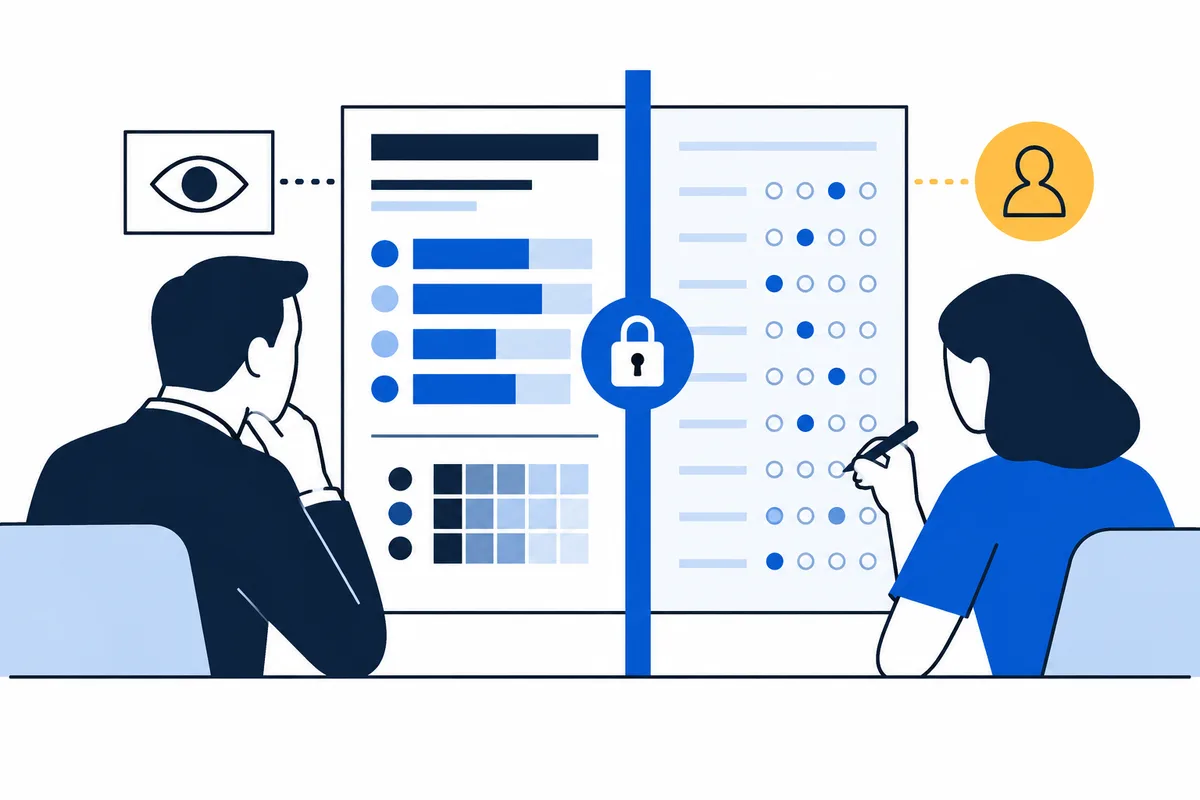
For development, an employer should not automatically see an employee’s individual EQ answers. The employee should control whether to share a reflection or practice goal. If an assessment is required for an employment evaluation, explain its purpose, recipients, confidentiality limits, and possible consequences before it begins. Legal duties vary by jurisdiction and evaluation type.
Should an employer see an employee's individual EQ test answers?
An employer asks employees to complete an EQ questionnaire before a development session. Before answering, an employee may ask whether a manager will read each response. For development, individual answers should not automatically go to the manager. The employee should choose whether to share a reflection or practice goal. If the assessment is required for an employment evaluation, its purpose, recipients, confidentiality limits, and possible consequences should be explained first. Rules vary by jurisdiction and evaluation type. Access is not one switch. A provider may hold responses, an employer administrator receive a report, and a manager see only selected information. An item-level answer, scored report, and chosen development goal are different disclosures. “The company sees results” does not say which one is meant. The American Psychological Association’s *Professional Practice Guidelines for Occupationally Mandated Psychological Evaluations* calls for psychologists to clarify scope, confidentiality limits, report recipients, and probable outcomes in that high-stakes setting. Its *Disclosure of Test Data and Test Materials: Just the FAQs* notes exceptions in some mandated contexts. These materials guide questions; they do not establish one privacy rule for every workplace EQ questionnaire. Ask what is collected, who sees each layer, and what decision may follow.
Sources: Professional Practice Guidelines for Occupationally Mandated Psychological Evaluations; Disclosure of Test Data and Test Materials: Just the FAQs
What does an individual answer actually tell a manager?
An individual answer tells a manager what the employee selected for that particular question, under the conditions in which they completed the assessment. Its meaning depends on what the test asks and how the test defines emotional intelligence. A self-report is a person’s account of their own usual behavior, feelings, or capability. It can offer a useful starting point for reflection: someone who says they tend to pause before responding to tense feedback is describing how they perceive their own pattern. The response does not establish that they paused in a particular meeting, that colleagues experienced the exchange the same way, or that they can do so reliably under every kind of pressure. In the critical review “How Should We Measure Emotional Intelligence? A Critical Review of the Current Approaches,” O’Connor and colleagues distinguish ability measures, trait self-reports, and mixed measures because they ask different questions and produce different kinds of evidence. That distinction matters before anyone interprets a single answer as a workplace fact. An ability measure presents an emotion-related problem and evaluates a response according to a scoring approach. A self-report asks a person to describe typical behavior or self-perceived capability. Mixed instruments may combine emotional traits with broader competencies or social skills. A manager who receives a response cannot know which interpretation is warranted without knowing the instrument’s model, its wording, and the purpose for which it was designed. Even then, one item is only one piece of that instrument’s output; it is not a miniature observation of the employee at work. This makes a question such as “I stay calm when priorities change” especially easy to overread. The employee may be reporting an ideal, a frequent tendency, or what they think the wording means. They may recall one kind of change, while their manager imagines another. The question might concern feeling calm, appearing calm, or choosing a useful action despite feeling unsettled. Unless the measure defines and supports one of those meanings, the answer alone cannot settle which one the respondent had in mind. The disagreement could reflect different situations, different interpretations of “usually,” or a gap in self-awareness. The answer does not tell the manager which explanation is correct. Nor does the critical review establish that every self-report is inaccurate; its point is that self-reports and performance tasks measure different aspects of emotional intelligence and should be selected for a stated purpose. A manager should therefore resist turning an isolated response into a description of character: “does not handle pressure,” “lacks empathy,” or “cannot take feedback.” Those statements go beyond what a self-report answer can show. They also shift a development conversation from a specific skill to a broad judgment about the person. If the concern is an actual work interaction, begin with the observable event. What was said or done? What effect did it have on the handoff, decision, or conversation? What would the employee like to try next time? This does not require the employee to prove or defend an EQ answer. It gives both people something concrete to discuss, while leaving the self-report in its proper role as the respondent’s account. The distinction is useful even when an assessment includes more than one item or produces a summary. A pattern across responses may suggest a topic worth exploring, but the summary still reflects the measure and response method. It does not independently verify conduct. An ability-task result also has a different meaning from a self-rating; it concerns answers to the task presented, not a record of how someone behaved with a colleague on Tuesday. An instrument that combines emotional and broader workplace competencies makes its own model choices, so its label cannot make each component interchangeable with direct observation. O’Connor and colleagues’ review supports comparing measures by what they ask and how they score answers, rather than treating “EQ” as one universal ability. The practical boundary for a manager is simple: an answer can prompt a question, not close one. If an employee reports finding disagreement difficult, a manager can ask what part of disagreement they want to handle differently and what support would make that possible. If a particular disagreement caused a problem, they can discuss the words, timing, and impact of that exchange. In either conversation, the assessment response may help the employee choose a topic for reflection. It cannot, on its own, show what happened or predict what the employee will do next.
Sources: How Should We Measure Emotional Intelligence? A Critical Review of the Current Approaches
Raw answers, scores, reports, and work evidence are different things
An employer can receive raw responses, a scored profile, a summary, an aggregate theme, or a development goal selected by the employee. Those are different disclosures. The more detail an organization receives, the more it must interpret and protect, Ask what “the company sees results” means: which information, visible to whom, and for what purpose?
The APA Ethics Code uses “test data” to include a person’s responses to test questions or stimuli, as well as raw and scaled scores. That matters because an answer is already personal assessment information; it does not become harmless simply because it is not the final report. The code also addresses test materials and the professional handling of assessment information. Its rules apply to psychologists in their professional work, and do not establish a universal employer-access rule for every workplace questionnaire. Still, the definition helps make the layers concrete: an answer record, a score derived from answers, and the explanation attached to a report are not interchangeable things.
A manager who can inspect every response has a different view from one who receives a short profile, and both have more than a manager needs to hear an employee’s chosen development aim. For example, an employee might decide to practice asking one clarifying question before responding to tense feedback. Sharing that aim gives a one-to-one meeting something practical to discuss. It does not require the manager to see each answer that led the employee to choose it. The goal belongs to the employee’s account of what they want to try; it is not proof that they have a particular weakness or that a past exchange happened in a certain way.
A summary can reduce detail, but its label alone does not tell you how much it reveals. An individual score remains tied to one person even if the underlying answers are hidden. An aggregate theme is different only if it genuinely describes a group without making a participant recognizable. In a small team, a theme linked to a distinctive role or familiar incident may point back to its source. That is an access-design concern: removing names does not necessarily remove identifying context. Ask the sponsor how the output is produced and who can connect it to an individual.
The distinction also matters when a report uses compact labels. A score may summarize responses according to the instrument’s method; it does not turn those responses into a record of workplace behavior. The APA’s test-data guidance recognizes that assessment information can be misunderstood or misused, which is one reason the person interpreting it and the purpose of release matter. A manager might see a result suggesting that an employee reports difficulty pausing during conflict. That result describes the assessment’s account of the responses. To discuss an actual disagreement, the manager still needs to talk about the observable exchange and hear the employee’s view, rather than treating the profile as a transcript of what occurred.
APA’s “Disclosure of Test Data and Test Materials: Just the FAQs” adds a useful advance question: test takers should generally be told the purpose of testing and who will or will not have access, while the FAQ recognizes exceptions in some mandated or employment-screening settings. It is professional testing guidance, not a promise that every employee can refuse disclosure or a legal rule covering all employers. For a developmental exercise, though, the distinction supports a straightforward conversation before participation: will a manager see item-level answers, an individual result, a group summary, or only a reflection the employee elects to share?
The practical boundary is simple to state. Ask the sponsor to name each layer and recipient rather than relying on “results” or “confidential” as broad assurances. Raw answers are the most detailed record; an individual score or report still identifies a person; a group theme should be checked for recognizability; and a chosen practice goal can support a development conversation without transferring the answer file. The employee can judge whether access fits the purpose.
Sources: Ethical Principles of Psychologists and Code of Conduct; Disclosure of Test Data and Test Materials: Just the FAQs
Why raw-answer access creates a larger privacy and interpretation burden
An individual answer contains more detail than a person-selected development goal. A manager who needs to support better feedback or repair may learn little from reading every response, yet gain a record that can be interpreted later in ways the employee did not expect.
The UK Information Commissioner’s Office (ICO) frames worker monitoring around purpose limitation: an employer should be clear about why it is gathering information and what it intends to do with it. In its guidance, it says workers should not be monitored “just in case” a useful purpose appears later. The ICO’s examples concern workplace monitoring, not EQ questionnaires specifically, so applying that principle to assessment answers is an editorial inference. Still, when an organization collects individual EQ responses, the same planning question is useful: what exact decision or support activity requires the raw answers, rather than a less detailed summary or no individual record at all? [Data protection and monitoring workers](https://ico.org.uk/for-organisations/uk-gdpr-guidance-and-resources/employment/monitoring-workers/data-protection-and-monitoring-workers)
The answer matters because information collected for one purpose can drift into another. The ICO calls this “function creep”: data gathered for a stated reason is later used more broadly. Its example concerns office network connection data collected to plan workspace capacity and later considered for performance management. The guidance says a new use needs its own assessment of lawful basis, necessity, and proportionality. An EQ response file could travel along a similar path: a development exercise is presented as a way to reflect on communication, then a manager consults the answers while preparing an appraisal. That scenario is illustrative, not a reported case. It shows why a promise about the original purpose is weaker if later access and use have not been bounded in advance.
More collection also creates a larger accuracy burden. The ICO says workers should be able to see and, where needed, explain or challenge monitoring results, including alongside performance reviews or grievance procedures. That guidance does not establish that any particular EQ answer is inaccurate. a self-report answer describes a person’s response to a question, and a manager may lack the surrounding context needed to interpret it. An employee might answer differently depending on what “usually” means, which work situation comes to mind, or how they understand the wording. If that isolated answer later appears in a personnel discussion, the employee needs a fair chance to explain what it did and did not mean. [Data protection and monitoring workers](https://ico.org.uk/for-organisations/uk-gdpr-guidance-and-resources/employment/monitoring-workers/data-protection-and-monitoring-workers)
A legitimate purpose can still require an employer to hold some worker information. UK rules do not prohibit monitoring or employment records; the ICO says organizations may keep information they need, provided they handle it consistently with data protection principles. The relevant limit is fit: information should be adequate for the declared purpose and limited to what is needed. If the goal is to agree on a team practice for responding to tense feedback, a participant’s chosen goal—such as asking one clarifying question before replying—may give the group something actionable without placing the underlying response history in a manager’s file. Whether that narrower option is sufficient depends on the actual purpose; it should not be assumed to resolve every operational or legal need. [Collecting and keeping employment records](https://ico.org.uk/for-organisations/uk-gdpr-guidance-and-resources/employment/employment-practices-and-data-protection-keeping-employment-records)
Access and retention are part of the same decision. ICO guidance on employment records says access should be limited to authorized people, with managers seeing information they need for their responsibilities. Its worker-monitoring guidance says information should not be kept longer than necessary for the stated purpose and should not be retained in case a future use turns up. The ICO currently marks both guidance areas as under review following changes made by the Data (Use and Access) Act, so these pages should be treated as current UK regulatory guidance that may change, not a timeless or global legal rule. If a development conversation can proceed from an employee-chosen practice point, retaining raw answers “just in case” adds a privacy and interpretation burden without a clear additional benefit. [Collecting and keeping employment records](https://ico.org.uk/for-organisations/uk-gdpr-guidance-and-resources/employment/employment-practices-and-data-protection-keeping-employment-records) [Data protection and monitoring workers](https://ico.org.uk/for-organisations/uk-gdpr-guidance-and-resources/employment/monitoring-workers/data-protection-and-monitoring-workers)
Sources: Data protection and monitoring workers; Collecting and keeping employment records
When an assessment is required, disclosure must come first
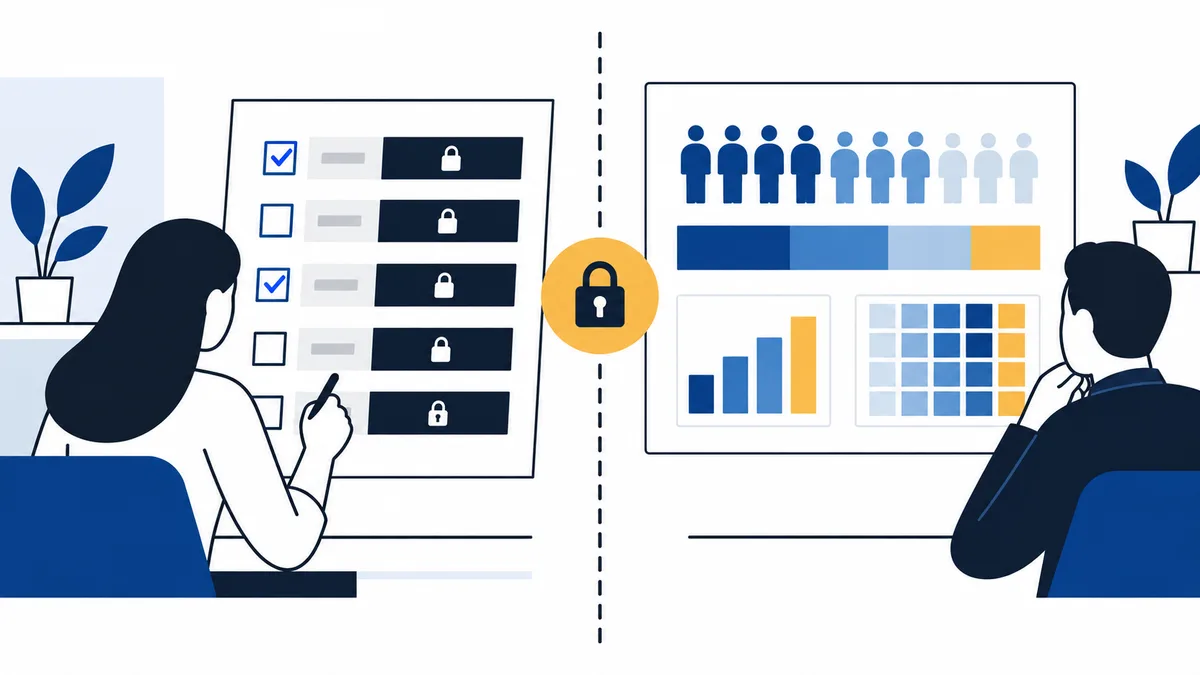
A required occupational evaluation is a different arrangement from an employee choosing to complete a reflection exercise for personal development. When the assessment may affect employment, the employee should know before answering what question the evaluation is meant to address, who will receive its findings, what confidentiality limits apply, and what may happen as a result. The American Psychological Association’s *Professional Practice Guidelines for Occupationally Mandated Psychological Evaluations* addresses psychologists conducting evaluations for employment suitability, fitness, licensing, or related occupational questions. It calls for explaining the evaluation’s nature and scope, confidentiality limits, report recipients, whether the examinee will receive a copy, and probable uses and potential outcomes. That guidance matters because “consent” can sound more voluntary than the situation feels. An employee may be told that participation is required, or may reasonably believe refusal could affect a job. A signature alone does not tell the person whether a manager receives raw responses, whether a psychologist sends a written report, or whether the report informs a defined decision. The APA guidelines say psychologists should be honest about the nature, purpose, intended uses, and possible outcomes of an evaluation. They specifically note the consequences of failing to cooperate in some fitness-for-duty situations, including possible loss of employment. Scope is important here. APA’s guidelines are professional recommendations for psychologists carrying out occupationally mandated psychological evaluations; they are not a universal privacy statute or a rule for every online EQ questionnaire. The document itself says guidelines are aspirational, are not mandatory or exhaustive, and do not provide legal advice. It points practitioners toward the law, policies, and collective agreements that may govern a particular referral. Applying this framework to a general EQ exercise is a prudent design choice, not a claim that the guideline legally controls it. The APA’s *Disclosure of Test Data and Test Materials: Just the FAQs* makes a related distinction. Psychologists generally obtain informed consent before testing, but the FAQ identifies exceptions, including some employment testing and testing required by law. It says that when consent is not required, test takers should still generally be told the purpose, intended use, possible consequences, what information may be released, and to whom. It also describes exceptions: in some employment screening or court-ordered settings, the psychologist’s role or the nature of the test may prevent some explanations. After testing, release or explanation of results may likewise not be required in certain mandated, screening, organizational consulting, security, or forensic contexts. These exceptions complicate an easy promise that an employee can always refuse or keep every result from an employer. The FAQ is guidance about psychologists’ professional responsibilities and testing practice. It does not settle every employer’s legal authority, an employee’s rights in every jurisdiction, or the terms of every assessment service. Its practical message is narrower: clarify purpose, use, access, and role before testing wherever professional responsibilities allow. The APA’s *Ethical Principles of Psychologists and Code of Conduct* adds a useful data distinction for psychologists. Its Standard 9.04 defines test data to include raw and scaled scores, a test taker’s responses to questions or stimuli, and certain notes or recordings about statements and behavior during an examination. Standard 9.10 says psychologists generally take reasonable steps to explain results unless their role precludes doing so, as can occur in some organizational consulting, preemployment, security, or forensic evaluations; that limitation should have been explained in advance. These standards govern psychologists’ conduct. They do not, by themselves, establish that every employer owns an employee’s answers or that every employee can prevent disclosure. For an employee facing a required assessment, the useful step is to ask for the arrangement in writing before beginning: What is the evaluation’s purpose? Is it developmental, screening, fitness-related, or tied to another employment decision? Does the manager receive item-level answers, a report, or a limited conclusion? Who else may see the information, and what consequences can follow? The sponsor should explain the process and identify the policy or professional role that sets those limits. If the assessment could affect employment, local rules and specific circumstances matter. Surprise access after completion undermines the employee’s understanding of the arrangement.
Sources: Professional Practice Guidelines for Occupationally Mandated Psychological Evaluations; Disclosure of Test Data and Test Materials: Just the FAQs; Ethical Principles of Psychologists and Code of Conduct
The moment an EQ result affects a job decision, the stakes change
A conversation about development starts with a question the employee wants to work on: for example, how to pause before replying to tense feedback. The employee can use a reflection profile to consider that habit, then decide whether to discuss a practice goal with a manager. The manager may help make room for practice without receiving the employee’s full answer record. In that arrangement, the profile prompts a conversation; it does not supply a verdict about performance. The purpose changes when an employer uses an EQ result to select, promote, rank, or penalize someone. Now the result can affect access to a job or an employment opportunity. That is a different claim from “this may help me notice a habit.” It asks whether the measure provides evidence relevant to a particular decision, whether the employer may lawfully use it for that purpose, and what happens to people who receive different results. A development tool does not acquire those properties simply because an organization paid for it or can view a report. The U.S. Equal Employment Opportunity Commission’s *Employment Tests and Selection Procedures* guidance describes tests used to screen applicants and employees for hire or promotion. It says tests can raise federal anti-discrimination issues when intentionally discriminatory or when they disproportionately exclude a protected group without the legal justification required for that context. The guidance also says employers should validate tests for the positions and purposes in which they use them, and that a test’s results should be appropriate for the employer’s purpose. This is technical assistance about U.S. federal employment rules, not a general privacy ruling and not a finding about EQ tests in particular. Its practical point is narrower: once a result influences a personnel decision, the employer has to defend the decision procedure, not merely say the assessment is useful. That distinction matters because a self-report answer is a person’s account of their typical behavior or perceived emotional capability. It is not a record of what they did in a specific meeting, nor a direct demonstration of job performance. The critical review *The Measurement of Emotional Intelligence* distinguishes self-report measures of typical behavior and self-rated ability from ability measures that ask respondents to solve emotion-related problems; it also discusses mixed measures combining broader traits or competencies. The review examines established approaches, not the Emotional Skills Profile or employer access. Still, the measurement distinction exposes an interpretive gap: reading “I find it hard to stay calm” as proof that someone mishandled a particular disagreement adds a conclusion the answer itself does not contain. An employer might reasonably want to improve how a team handles disagreement. A chosen practice goal could help the employee ask for a pause, check what feedback refers to, or return to a conversation after emotions settle. A manager can support those observable steps and talk about what happened at work. Receiving each questionnaire response adds private self-description, but it does not establish that the employee performed the practice or failed to do so. If the concern is a concrete work event, discuss that event through the organization’s normal feedback process; do not use an EQ answer as a substitute witness. The EEOC’s guidance on *Preemployment Disability-Related Questions and Medical Examinations* sets a separate boundary in U.S. hiring. It explains that some psychological examinations count as medical examinations depending on their purpose and whether they seek information about mental health or impairment. It does not classify every EQ questionnaire as medical, and its central scope is pre-employment ADA rules. A nonclinical reflection profile should not be casually treated as diagnostic evidence. If an assessment is designed or used to elicit health information, or is used in a selection process, the organization needs to examine the applicable rules rather than assume the EQ label resolves the issue. The assigned 32-item Emotional Skills Profile is an educational reflection tool. It has no validated population norms and no established ability-test validity for employment decisions. It therefore should not be used as a hiring score, promotion rank, performance penalty, or predictor of who will succeed. A person’s answers about recent behavior can help them choose what to reflect on, while a consequential employment claim needs evidence fit for that specific purpose. The legal question depends on jurisdiction and use; the measurement question remains whether the assessment can support the inference being made.
Sources: Employment Tests and Selection Procedures; Enforcement Guidance: Preemployment Disability-Related Questions and Medical Examinations; How Should We Measure Emotional Intelligence? A Critical Review of the Current Approaches
Design access, retention, and correction before collecting answers
A sponsor makes privacy meaningful by describing the arrangement before an employee starts: why answers are collected, what is kept, who can see each layer, how long it remains available, and whether sharing an individual report is optional. “Confidential” is too broad. Different roles may have different access to responses, scores, and reports; state those permissions separately. Start with the intended outcome and ask what information it needs. If the aim is to help an employee notice a habit and choose a practice, the manager may need only the behavior the employee elects to discuss. Someone might choose to pause and ask a clarifying question when feedback feels abrupt. The employer can support that practice without retaining the answers that led to it. The UK Information Commissioner’s Office (ICO), in “Data protection and monitoring workers,” says organizations must define why worker information is processed and what they intend to do with it; they should not monitor workers “just in case.” It also says to choose the least intrusive means for a purpose and limit collection to relevant information. The guidance concerns worker monitoring under UK data-protection rules, not EQ questionnaires specifically. Applying its purpose-and-minimization logic here is a design implication: if the goal is a development conversation, explain why raw answers, rather than a participant-chosen goal, are needed. Access should follow the same logic. A manager may need to discuss work behavior, and a provider may need technical access to operate a service; neither fact explains why the manager needs every response. Identify which roles can access raw answers, individual scores, reports, and group summaries. “The company receives results” leaves the crucial point unclear. A named employee’s report and a genuinely non-identifying theme have different consequences. Retention is a design choice, not a detail to settle after collection. The ICO’s “Collecting and keeping employment records” says retention should relate to the purpose and legal obligations, and organizations should document a schedule. It also describes restricting access to authorized people who need the record. This UK guidance sets no universal period for EQ answers. Ask what continuing need justifies keeping identifiable responses after the purpose has been met. Set a review or deletion point and explain exceptions. A correction route matters when an employee sees an interpretation that seems inaccurate. Under the ICO’s UK worker-monitoring guidance, employees may request access to personal information and raise accuracy concerns; organizations should consider whether information is accurate and fair. The employee should know how to inspect relevant information and explain a material error or missing context before someone relies on it. A report that can affect a conversation but cannot be questioned gives the employee little control over how it is understood. For an occupationally mandated psychological evaluation, the American Psychological Association’s “Professional practice guidelines for occupationally mandated psychological evaluations” calls for advance discussion of the evaluation’s nature and scope, confidentiality limits, report recipients, whether the examinee can get a copy, and probable uses or outcomes. This is professional guidance for psychologists in that evaluation context, not universal privacy law for workplace EQ tools. For a consequential process, explain the arrangement before participation. A required assessment should not be called optional merely because the employee clicks an agreement form. The arrangements differ in who sees information and what follows. In private reflection, the employee sees answers and report; the next step is theirs. In employee-led sharing, they select an insight or practice goal to discuss; the sponsor need not hold the response file. In a mandated occupational evaluation, recipients depend on the process, so purpose, confidentiality limits, report access, and likely consequences should be explained in advance. It requires jurisdiction-specific review; neither source establishes a global rule for EQ assessments. Before collecting answers, an employer should describe the path from response to use: what enters the system, who can see it, what the employee can inspect or challenge, when it is deleted, and what decision it may inform. If observable behavior or an employee-selected practice meets the developmental aim, keeping raw answers out of routine manager access is more proportionate. Discuss the work and a chosen practice; keep underlying answers behind a clear, disclosed access rule.
Sources: Data protection and monitoring workers; Collecting and keeping employment records; Professional Practice Guidelines for Occupationally Mandated Psychological Evaluations
What should you ask before taking the assessment?
Before starting, ask the sponsor: Is this for development or an employment evaluation? Who sees my answers, scores, and report? How long are they kept, and what decisions could follow? The American Psychological Association’s “Disclosure of Test Data and Test Materials: Just the FAQs” recommends informing test takers beforehand about purpose, use, possible consequences, and who will receive information. It notes exceptions, including some employment screening, and says practice depends on setting and applicable rules. Its “Professional Practice Guidelines for Occupationally Mandated Psychological Evaluations” concerns psychologists’ formal evaluations; neither source creates a universal privacy rule for every workplace questionnaire. For development, propose keeping answers and your individual report private, while offering to share one practice goal you choose. You might say: “I’m willing to use this for reflection. Before I start, can we confirm who sees my answers and report, how long they’re kept, and whether I can choose one practice point to discuss?” If disclosure is required, request the policy, recipients, and consequences in writing, then check the rules where you work. An employer can support emotional-skill development without receiving every answer. To reflect privately on your habits, explore the Emotional Skills Profile at /assessment.
Sources: Disclosure of Test Data and Test Materials: Just the FAQs; Professional Practice Guidelines for Occupationally Mandated Psychological Evaluations
Questions readers ask
Should an employer automatically see an employee’s EQ test answers?
For a development exercise, individual answers should not automatically go to a manager. The employee should choose whether to share a reflection or practice goal. A required employment evaluation needs advance explanation of its purpose, recipients, confidentiality limits, and possible consequences.
Are EQ test answers the same as observed workplace behavior?
No. A self-report answer describes how someone sees their usual behavior or capability. It does not establish what happened in a particular meeting or how colleagues experienced it.
What should I ask before taking an employer-sponsored EQ assessment?
Ask whether it is for development or employment evaluation; who sees answers, scores, and reports; how long the information is kept; and what decisions could follow. If it is for development, you can propose keeping your individual result private and sharing only a practice goal you choose.
Sources
- Professional Practice Guidelines for Occupationally Mandated Psychological Evaluations
Supports advance explanation of evaluation scope, confidentiality limits, report recipients, and probable uses in occupationally mandated psychological evaluations.
- Disclosure of Test Data and Test Materials: Just the FAQs
Describes advance information about test purpose, use, and access, while noting exceptions in some mandated and employment-screening contexts.
- How Should We Measure Emotional Intelligence? A Critical Review of the Current Approaches
Distinguishes ability measures, trait self-reports, and mixed measures, which produce different kinds of evidence.
- Ethical Principles of Psychologists and Code of Conduct
Defines test data to include test responses and scores and addresses professional handling of assessment information.
- Data protection and monitoring workers
Provides UK worker-monitoring guidance on purpose limitation, data minimisation, access controls, accuracy challenges, and retention.
- Collecting and keeping employment records
Provides UK guidance on purpose-based retention schedules and restricting employment-record access to people who need it.
- Employment Tests and Selection Procedures
Describes U.S. federal discrimination and job-relatedness concerns for tests used in employment decisions.
- Enforcement Guidance: Preemployment Disability-Related Questions and Medical Examinations
Explains U.S. hiring-context boundaries for disability-related questions and when some psychological examinations may count as medical examinations.
Apply it to the real situation
Reflect on your emotional habits privately
From this guide: If the assessment is for development, decide which practice goal—if any—you want to share with a manager.
An employer can support a useful conversation without receiving every answer. The Emotional Skills Profile offers a private way to reflect on recent emotional habits and consider a development priority. Use it to explore what you might want to practice, then choose whether to bring that goal into a workplace conversation.