
If you cannot yet name your recurring response, a self-report EQ profile can give you language for the habits you notice in yourself. If you already know the moment and behavior you want to change, ask a coworker who witnessed it for one specific observation. A profile records self-perception across its questions; a colleague can describe what they saw in a particular exchange. Neither settles the other person’s motives or proves a fixed EQ level. For one working relationship, the most useful next step is usually a small, observable behavior to try, followed by attention to what happens. Use both sources only when you need to understand both your own pattern and how it appears to someone else.
A score cannot answer what happened in one exchange
A coworker pushes back on a handoff, you reply quickly, and the conversation tightens. Later, you wonder whether to take an EQ profile or ask the coworker what they experienced. The choice depends on what is still unclear. A profile may help you examine habits you believe you bring to emotionally charged situations. A colleague can describe a behavior they directly saw, such as being interrupted, receiving a clipped reply, or having a concern summarized before disagreement. The first is a structured account of your self-view; the second is a situated account of an exchange.
The goal in this example is narrow: change one response with one coworker. It is not to determine who is emotionally intelligent, whose interpretation is universally correct, or who caused all the tension. A result or comment can suggest what to inspect. It cannot supply the whole history of a working relationship. If the response you want to change is already visible to you, broad reflection may add little before you act. If you are unsure what your part tends to be, a profile can help you form a clearer question before asking for feedback.
That distinction keeps the decision practical. Choose a profile when your missing information concerns your own perceived tendencies; choose a focused conversation when you need an account of a specific behavior another person witnessed. Treat either as a starting point for a modest experiment. The evidence that matters next is whether you can make the response differently and whether the conversation changes in a way that matters to the work.
Sources: Choices and Challenges in Measuring Emotional Intelligence in the Workplace
What kind of uncertainty are you trying to resolve?
A self-report EQ profile asks you to describe your own experience or usual behavior. The time frame depends on its prompts: some ask about typical tendencies, others about recent actions or feelings. Observer feedback asks another person to report behavior they had a chance to see. These methods differ in what they put in front of the respondent. A person describing their habits may draw on many situations and a general self-picture; a colleague recalling one meeting has a narrower view but may remember details the person missed.
Emotional intelligence, or EI, is not one universal quantity measured the same way by every test. Ability-based tests ask people to solve emotion-related problems under a scoring method. Self-report instruments ask about perceived tendencies or competencies. Mixed competency tools may include broader work habits and self-beliefs. Observer reports collect another person’s assessment of behavior. These outputs can be related, but they are not interchangeable readings of a single hidden EQ number. The method changes what a result means and what decision it can support.
In a study comparing the MSCEIT ability test with the EQ-i and SREIT self-reports, the ability test had minimal relations to the two self-reports, while the self-reports were moderately interrelated. The authors described the measures as yielding different measurements of the same person. That finding concerns those three instruments in their study; it does not establish that every self-report disagrees with every ability test, or tell us which coworker was right in a particular meeting. It does show why a disagreement between a profile and another kind of evidence should not automatically be treated as a scoring error.
A second comparative study assessed 223 people from a diverse community sample using the MSCEIT performance measure and the Schutte self-report. The two scales were not related in that sample. Their associations with other measures also differed: self-report related consistently to self-reported coping styles and depressive affect, while the performance measure showed stronger relations with age, education, and having received psychotherapy. The study’s authors discuss validity and utility; the sample and instruments limit generalization. The useful point here is methodological: what people say about their tendencies and how they perform on emotion problems can diverge because the tasks are different.
Use one question to choose your next step: “Do I need language for a pattern I perceive in myself, or an account of what I did in this exchange?” This is a practical decision rule derived from the measurement distinction, not a validated scoring algorithm. It puts the tool behind the action you want to improve.
Sources: Choices and Challenges in Measuring Emotional Intelligence in the Workplace; Convergent, Discriminant, and Incremental Validity of Competing Measures of Emotional Intelligence; The Assessment of Emotional Intelligence: A Comparison of Performance-Based and Self-Report Methodologies
What can a self-report profile tell you about your part?
A self-report profile can organize the emotional habits you recognize in yourself. Depending on its model and prompts, it may help you reflect on noticing feelings, making sense of them, regulating your reactions, or responding to other people. This can be useful when the same kind of moment keeps troubling you but you have not yet found a precise description for your contribution. You might realize that you usually notice irritation only after sending a reply, or that you can identify another person’s frustration but hesitate to ask what they need. Those are prompts for observation, not conclusions a profile can verify about a particular exchange.
The distinction between self-report and demonstrated performance matters. Elfenbein’s 2025 workplace measurement overview describes self-reported EI as closer to confidence and motivation than intelligence, while noting its potential developmental value when considered alongside other EI information. A response to a questionnaire is evidence about how you answered its items. It may reflect experience, self-concept, memory, goals, and the item wording. It does not directly establish your maximum ability or show how you sounded in a conversation that was not asked about.
A meta-analysis of mixed EI measures illustrates why broad workplace claims need care. It examined relationships between mixed EI and supervisor-rated job performance across studies. The updated average association was ρ = .29; after the authors controlled for ability EI, self-efficacy, self-rated performance, personality traits, and general mental ability, the relationship was near zero (β = −.02). The analysis also found extensive overlap in the content captured by those mixed measures and the other constructs. This is evidence about mixed EI measures and broad job-performance ratings, not every self-report profile and certainly not the assigned 32-item Emotional Skills Profile. It cannot tell us whether that profile accurately captures a specific reader or predicts their next response.
The takeaway is not that a profile lacks value. It can make a private reflection more structured and help you name what you want to watch. But keep the conclusion at the level the method supports: “I tend to see myself as able to pause when tense” is different from “I stayed open when this colleague challenged me.” The first can come from self-report. The second needs an account of that exchange, preferably a concrete one you can examine without turning the feedback into a verdict about your character.
If you use the Emotional Skills Profile at /assessment, use it for that educational purpose: a private reflection on emotional skills and possible development priorities. Its 32 items do not have validated norms or established ability-test validity. The profile can help you decide what to observe or practice, but it should not be presented as a standardized EQ rank or as proof of how you behaved with one coworker.
Sources: Choices and Challenges in Measuring Emotional Intelligence in the Workplace; Why Does Self-Reported Emotional Intelligence Predict Job Performance? A Meta-Analytic Investigation of Mixed EI
What does workplace feedback add, and what can it miss?
A coworker who was present can report details you may not have noticed: that you started answering before they finished, that your voice became louder, that you summarized their concern accurately, or that you asked a question before defending your proposal. Specific details give you something to examine. Ask for what the person observed and the work effect they noticed. “What did you see me do when we discussed the handoff?” is more answerable than “Am I good at empathy?” The first points toward behavior; the second asks for a broad judgment that the observer may not be equipped to make.
An observer’s view is also partial. One coworker may have seen only one part of the conversation, may remember its most frustrating moment, or may interpret the same direct wording differently from you. Relationship history, role expectations, power and willingness to speak openly can affect what is said. A colleague’s perspective can surface information that a self-report cannot, but it cannot disclose another person’s inner motives as fact. If they say they felt dismissed, you can take that impact seriously and ask what wording or timing contributed without agreeing that you intended to dismiss them.
Formal multisource or 360-degree feedback is a different process from an informal conversation. A 2016 review in Industrial and Organizational Psychology defines 360 feedback as collecting, quantifying and reporting coworker observations about specific behaviors, with meaningful comparisons across multiple raters or groups and attention to change over time. The authors distinguish this from interviews and looser feedback activities. In the review’s account, rater selection, the chance to observe, confidentiality, the behaviors being rated, and follow-up all affect how a formal process should be understood. It is therefore inaccurate to borrow the authority of a structured multi-rater program for one colleague’s comment.
An earlier article in Europe’s Journal of Psychology describes a workplace 360-degree EI instrument designed for development and reports workplace studies comparing self-ratings with other-ratings. That work concerns a formal instrument and leadership development. Its accessible abstract does not establish that an informal conversation with one colleague has the same properties or usefulness.
That review also emphasizes observable behavior over guesses about internal states. A coworker can describe “you answered before I finished explaining the risk.” They cannot directly observe “you did not care about my input.” The latter attributes motive. The practical distinction is not a demand to dismiss the coworker’s experience; it gives both of you a question you can answer together. You can acknowledge the impact, clarify what happened, and decide whether a different action is worth testing next time.
One useful request is: “When I responded to the handoff concern, what did you notice in my wording or timing? I’m trying to understand one thing I could change.” This is a suggested conversation opener, not a quotation from a study. It gives the other person room to decline, keeps the request small, and signals that you are asking for an observation rather than a rating of your whole character.
Sources: The Evolution and Devolution of 360° Feedback; Multi-Rater or 360-degree Emotional Intelligence Assessment
When does combining them help rather than confuse?
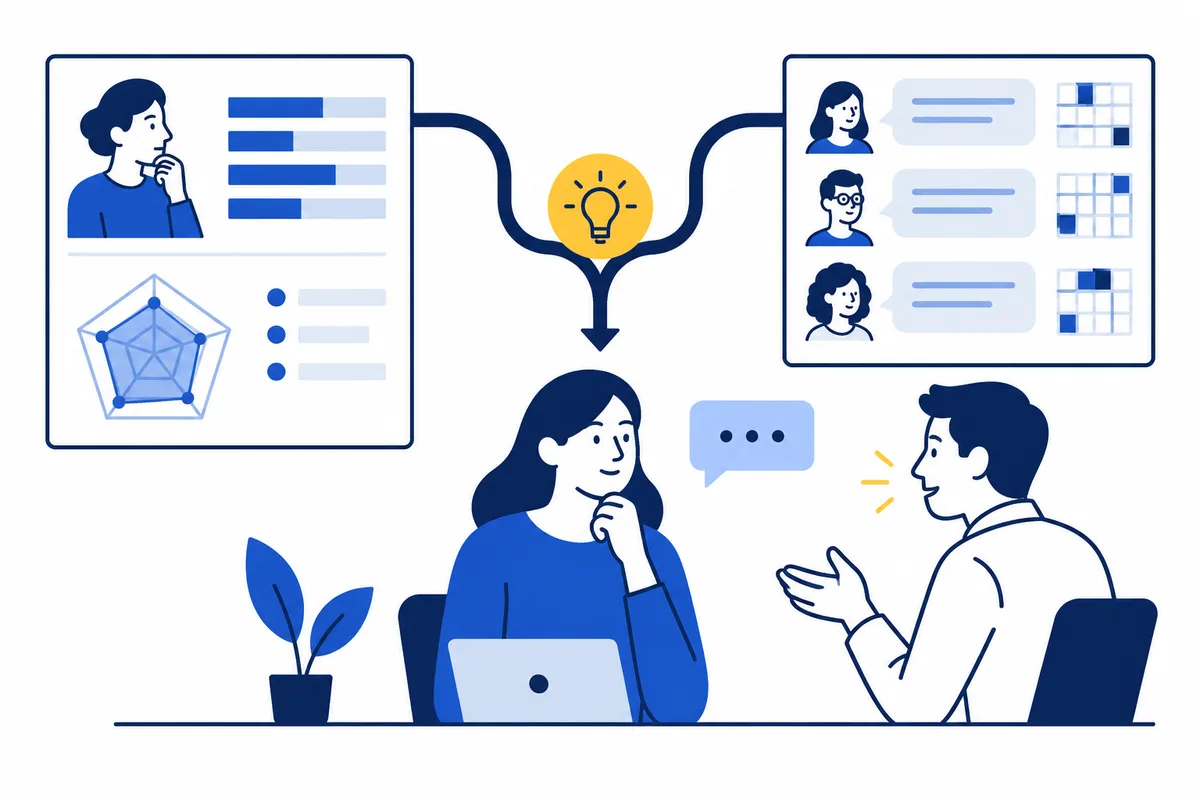
Use both sources when you have two separate questions: what habits do I perceive in myself, and what did another person experience in this specific interaction? A profile can supply a wider reflection frame. A colleague can supply an account of one moment. Their difference may be informative, but it does not automatically reveal which source is correct. The methods have different views and different blind spots, so keep their records distinct before deciding what to do.
For example, suppose a private profile encourages you to consider whether you see yourself as calm under disagreement, while a coworker recalls that a particular reply arrived quickly and ended the discussion. This is an illustrative contrast, not a report of an actual profile result or a real colleague’s testimony. It does not show that the profile is false or that the coworker has measured your emotional ability. It creates a narrower inquiry: do quick replies happen in this kind of disagreement, and what changes if you wait, check your understanding, or state your disagreement after the other person finishes?
The difference between self-perception and observation can point toward a blind spot, but it can also reflect context. Perhaps the profile prompts concern how you usually respond, while the colleague is remembering one unusually pressured meeting. Perhaps you were calm internally but your clipped timing looked impatient. The sources do not settle these alternatives by being placed side by side. Ask what each source actually covers: which items or time period informed the profile, and which specific exchange informed the feedback?
The workplace measurement overview by Elfenbein recommends matching measurement to purpose and describes developmental value in juxtaposing different EI measures. Brackett and Mayer’s comparison supports a narrower point: an ability test and self-report can capture different measurements of the same person. Neither source tests the particular sequence proposed here for one coworker relationship. The synthesis is an editorial application: when self-view and an observer’s account differ, use the gap to choose a behavior to check, rather than averaging unlike inputs into a more authoritative-looking number.
A useful combined record can be brief: “My profile prompts me to consider pausing under pressure. In the Tuesday handoff discussion, a colleague noticed I began my response before they finished. Next time I will summarize the concern first.” Keep the sources labeled as self-report and observation. Then review the one action after a relevant exchange. The combination is worthwhile only if both perspectives change what you will pay attention to; collecting more opinions merely to settle who is right can make the disagreement harder to repair.
Sources: Choices and Challenges in Measuring Emotional Intelligence in the Workplace; Convergent, Discriminant, and Incremental Validity of Competing Measures of Emotional Intelligence
What makes feedback useful enough to act on?
Feedback becomes more useful when it gives you a behavior you can change, a reason the change matters, and a realistic opportunity to try something different. A sweeping statement such as “you are defensive” can be hard to work with because it names an identity-like judgment without locating the moment. A comment such as “you began rebutting before I had finished describing the risk” identifies a point in the exchange. You can ask what the other person needed you to hear, then choose whether to let them finish before responding next time.
A meta-analysis by Smither, London and Reilly reviewed 24 longitudinal multisource-feedback studies. It found that improvement in direct-report, peer and supervisor ratings over time was generally small. Their theoretical model and review of evidence suggest greater improvement is more likely when feedback indicates a need for change, the recipient accepts its relevance, sees change as feasible, sets suitable goals, and takes action. This is a valuable counterweight to the idea that simply receiving feedback produces change. Its evidence concerns organized multisource feedback and ratings over time; it does not estimate the effect of a single coworker conversation or prove a specific script will work.
A small action makes the evidence easier to read. Choose one response connected to the exchange: wait until the other person finishes; ask one clarifying question before defending a decision; state the point of disagreement without assigning intent; or name a limit on what you can take on and suggest a next step. Do not try to improve every aspect of your communication at once. A broad aim such as “be more emotionally intelligent” gives you no clear moment to notice, while a behavior can be recalled and discussed.
After the next relevant conversation, look for two things. First, did you perform the action you chose? Second, did it affect the exchange in a way that matters, such as making the concern clearer or allowing disagreement without ending discussion? A single attempt cannot establish a stable change. It can tell you whether the action was possible and what you might adjust. If the behavior did not happen, consider whether the cue was unclear or the situation was too fast. If it happened but the exchange remained tense, that does not automatically mean the action was pointless; the coworker may have other concerns that require a separate discussion.
This is where evidence from a broad profile and evidence from one conversation should remain in proportion. A profile might help you select an area to practice. A colleague can help you see how one action landed. Neither guarantees an outcome or gives you control over the other person’s response. The change you can test is your own next move.
Sources: Does Performance Improve Following Multisource Feedback? A Theoretical Model, Meta-Analysis, and Review of Empirical Findings; Choices and Challenges in Measuring Emotional Intelligence in the Workplace
A proportionate choice for one coworker
When the behavior is already clear, start with the feedback request. If the goal is to change how you answer a coworker’s concerns and you can name the moment, a private conversation about that moment is usually more directly relevant than a broad self-report profile. Ask someone who was there, if you trust them enough to speak candidly and the relationship makes the request appropriate. Invite an example of what they saw, and listen for the action rather than adopting every interpretation attached to it.
When you cannot yet identify your pattern, a self-report profile can be a reasonable first step. It offers structure for thinking about habits across emotional situations, and the private setting may make it easier to reflect without performing for a colleague. Keep the result as a prompt: “What behavior should I pay attention to?” If you already know what to observe, skip the profile for now. A questionnaire cannot add direct evidence about the exchange simply because it has many questions or produces a polished report.
There is also a practical exception: perhaps direct feedback would carry too much risk, or you do not have a trusted observer who saw the interaction. In that case, a profile can still help you reflect and choose an experiment on your own. You might review the conversation, write down the words you used, and decide what you could try differently. Conversely, if a profile would distract you from a concrete behavior you already want to change, go directly to the behavior. Choice depends on access and the uncertainty that remains, not on a universal ranking of assessment methods.
A stronger argument for a broader observer process would require more than one willing coworker and a well-defined purpose. Formal 360 feedback has procedures for gathering and comparing observations; a quick request to one peer does not. In many ordinary workplace situations, a carefully bounded conversation is enough to surface one useful detail. You need not turn a repair attempt into a workplace assessment exercise.
The publication’s 32-item Emotional Skills Profile at /assessment fits the reflective side of the decision. It gives a private educational report about emotional skills and observable development priorities. It does not provide validated norms or established ability-test validity, and it is not a coworker rating. Explore it if a structured self-reflection would help you decide what to notice next. If the specific behavior and desired change are already clear, a focused conversation and a small practice step may be all you need.
Sources: Choices and Challenges in Measuring Emotional Intelligence in the Workplace; The Evolution and Devolution of 360° Feedback
Start one conversation about one behavior
The verdict is straightforward: for a known response in a specific coworker exchange, focused workplace feedback is the closer match; use a self-report EQ profile when you first need a structured view of your own perceived habits. Combine them when both questions matter, while keeping self-perception and observation separate. Neither is a ruling on the relationship, and formal multisource research should not be treated as proof that one informal comment will change behavior. The clearest progress is one small action you can attempt and revisit.
If a private framework would help you name an area to watch, the Emotional Skills Profile offers a 32-item self-reflection route at /assessment. Its report supports educational reflection on emotional skills and possible practice priorities. It is not a validated ability measure, hiring tool, or score for ranking yourself against other people. The next step is proportionate: choose the evidence you need, then act at the scale of one interaction.
You could ask: “I’ve been thinking about how I respond when we disagree about a handoff. Would you be willing to tell me one thing you noticed in my response, and one moment when it happened? I’m going to try summarizing the concern before I answer next time.” That request is specific, gives the coworker room to decline, and ends with a behavior you can test in the next relevant conversation.
Sources: Choices and Challenges in Measuring Emotional Intelligence in the Workplace; Does Performance Improve Following Multisource Feedback? A Theoretical Model, Meta-Analysis, and Review of Empirical Findings
Questions readers ask
Is a coworker’s feedback more accurate than a self-report EQ profile?
It is more directly relevant to behavior that coworker witnessed, while a self-report profile describes how you answered questions about your own habits. Relevance depends on the question. One colleague has limited access to your behavior and motives; a profile does not verify a particular exchange. Treat each as evidence for a different purpose.
Can I use the Emotional Skills Profile to prepare for feedback?
Yes. You can use its private educational reflection report to identify an emotional-skill area you want to observe or practice before asking a coworker about a specific interaction. The profile has no validated norms or established ability-test validity, so use it to shape a question, not as proof of what happened.
Sources
- Choices and Challenges in Measuring Emotional Intelligence in the Workplace
The opened 2025 workplace measurement overview distinguishes self-report, ability testing and observer report, and recommends matching method to developmental purpose.
- Convergent, Discriminant, and Incremental Validity of Competing Measures of Emotional Intelligence
The university-hosted abstract reports minimal relations between MSCEIT ability scores and EQ-i or SREIT self-reports in the compared study.
- The Assessment of Emotional Intelligence: A Comparison of Performance-Based and Self-Report Methodologies
The opened PubMed abstract describes 223 community participants and reports no relation between the MSCEIT and Schutte self-report in that sample.
- Why Does Self-Reported Emotional Intelligence Predict Job Performance? A Meta-Analytic Investigation of Mixed EI
The accessible full text reports a meta-analytic association of ρ=.29 with supervisor-rated performance and near-zero association after listed covariates.
- The Evolution and Devolution of 360° Feedback
The opened review defines formal 360 feedback around quantified, multiple-rater observations of specific work behaviors and discusses process limitations.
- Multi-Rater or 360-degree Emotional Intelligence Assessment
The opened article discusses a developmental workplace 360 EI instrument and presents studies comparing self and other ratings in leadership development settings.
- Does Performance Improve Following Multisource Feedback? A Theoretical Model, Meta-Analysis, and Review of Empirical Findings
The publisher abstract reports 24 longitudinal studies with generally small rating improvements and describes conditions associated with follow-through.
Apply it to the real situation
Turn emotional-skill reflection into one behavior to practice
From this guide: If you know you want to respond differently but need help naming the habit to observe, a private profile can give your reflection a structure.
A coworker’s feedback can clarify how one exchange landed; the Emotional Skills Profile gives you a private way to reflect across emotional-skill areas and identify a development priority. Keep those perspectives distinct, then choose one observable response to practice in the next relevant conversation. Explore the profile when you want a structured starting point for your own reflection.