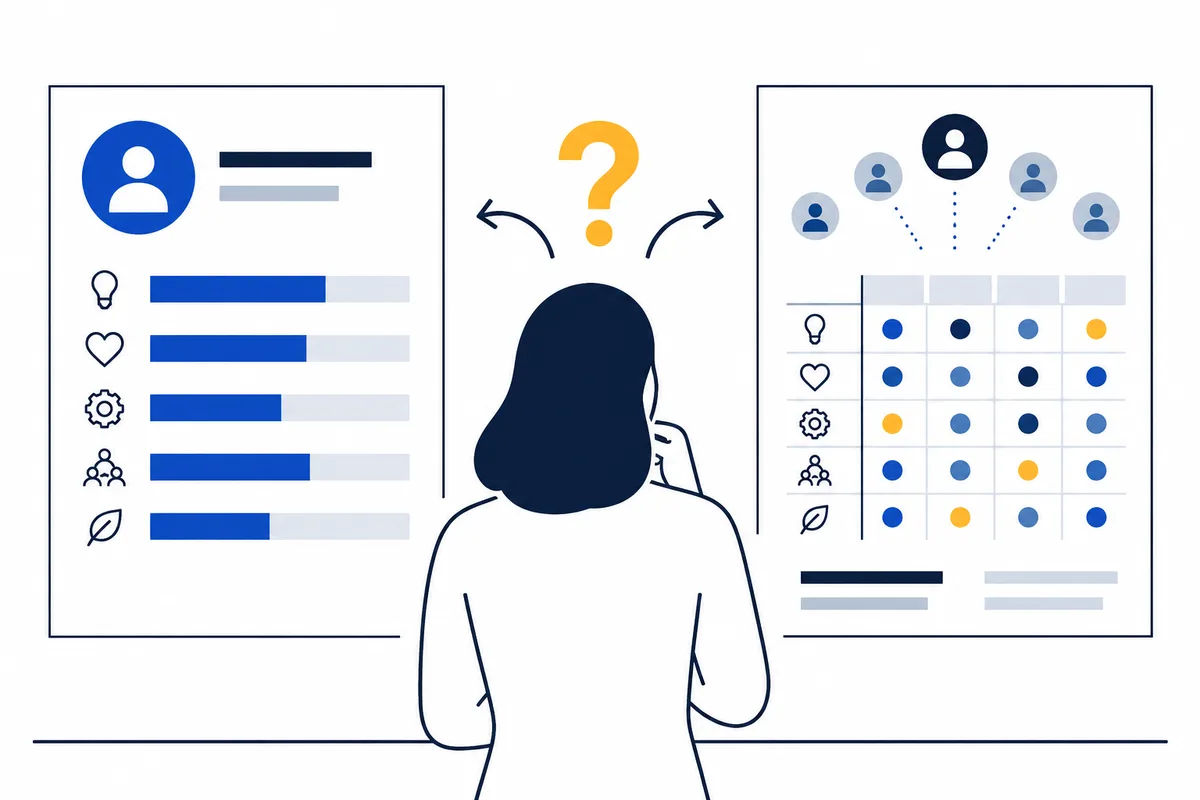
Choose a self-report EQ assessment when you want structured reflection on what you notice and how you usually respond. Choose 360 feedback when your question is about how a specific, visible behavior affects people who have actually seen it in relevant situations, and when the process is safe enough for candid feedback. These methods collect different evidence. A larger circle of raters does not automatically make the result more accurate, and neither approach guarantees change. For private reflection, start with self-report; add carefully bounded outside observations only when they can answer a question your own account cannot.
A score cannot answer every development question
A person trying to work better with others can face two different uncertainties. One is inward: What happens in me when tension rises, and what do I usually do next? The other is interpersonal: When I interrupt, go quiet, or offer a correction, how does that action land with people who work with me? A self-report questionnaire can organize the first question. A 360 process can gather others’ accounts of the second.
The choice matters because emotional intelligence is not one universally measured quantity. Instruments define and observe it in different ways. More raters supply more viewpoints, but viewpoints are not automatically interchangeable or independent. A manager may see a deadline conversation; a peer may see a handoff; a direct report may experience the same person’s response to disagreement differently. That difference can be useful if the question is about context. It can mislead if all the answers are compressed into a verdict about the person.
For an individual’s development, the practical test is simple: name what you do not know, then choose the source that could know it. If you want language for a pattern you experience privately, begin with self-report. If you need to learn how a specific behavior is experienced by other people, consider multisource feedback. In either case, treat the result as the beginning of an inquiry into behavior, not a final score of your worth or capacity.
Sources: Emotional Intelligence Measures: A Systematic Review; Multisource Assessment for Development Purposes: Revisiting the Methodology of Data Analysis
What question are you trying to answer?
Before comparing formats, separate three common meanings of an EQ result. Ability-based emotional intelligence tests ask a person to solve emotion-related problems, with performance scored against a specified key or consensus. Trait emotional intelligence questionnaires ask people to describe typical emotional tendencies or perceived skills. Mixed competency measures may combine emotional skills with broader work behaviors or personal characteristics. A self-report format usually tells you how a person sees their typical behavior; it does not directly demonstrate maximum ability. A 360 label, meanwhile, describes who supplies ratings, not a single theory of emotional intelligence.
The distinction changes what evidence is available. If a questionnaire asks how often you notice tension before replying, you report your recollection and interpretation of your own experience. You have privileged access to the felt tension, but your answer still depends on noticing and remembering it. If colleagues rate whether you make room for questions during disagreement, they report what they have observed and inferred. They cannot see your private intention, and each has seen only some interactions.
The systematic review Emotional Intelligence Measures: A Systematic Review searched Web of Science and analysed 40 instruments drawn from eligible items. It grouped most tools under skill-based, trait-based, or mixed models and noted that the models differ in how they define and measure emotional intelligence. Its authors also identify limits, including reliance on a single database. The review supports a modest conclusion: an EQ label does not guarantee that two tools measure the same thing. It does not establish which tool is best for every individual.
A fair comparison therefore asks five questions. What behavior or experience is the tool meant to capture? Who can observe it? In which contexts? What would a result let you do next? What could make the result hard to interpret? A self-rating and an other-rating may both concern emotion regulation, for example, yet one can describe self-perceived habits and the other the visible effect of a response. Treating them as rival estimates of one hidden EQ quantity loses that distinction.
Suppose your concern is that you become tense before answering criticism. You may be best placed to notice the first emotional signal, and a self-report can prompt you to examine that pattern. But if your question is whether your reply leaves room for a colleague to explain the criticism, someone who has been in those exchanges can describe what they saw. The methods address related but different parts of the question.
Sources: Emotional Intelligence Measures: A Systematic Review
What can a self-report EQ assessment show you?
Self-report is useful when the subject is your account of your own recurring emotional habits: what you tend to notice, how you say you respond, and which situations you find difficult. A structured set of prompts can make a diffuse concern more specific. ‘I am bad at conflict’ might become ‘I often delay naming a concern until I feel frustrated.’ That sharper description gives you something to observe in the next conversation, even before you ask anyone else for feedback.
This access is a real strength. Other people may see a pause, a short reply, or a change in tone; they cannot directly know whether you felt confused, embarrassed, tired, or worried about the consequences of speaking. You can report those experiences. A self-reflection tool can also make it easier to consider emotional recognition, understanding, regulation, and responding to others as separate parts of everyday behavior rather than one global label.
Self-report also has a particular interpretive burden. A person has to notice the relevant event, recall it, decide what a question means, and map a complicated experience onto a response option. Someone may answer from an especially recent incident, or from the person they intend to be. Terms such as ‘calm’ or ‘empathetic’ can mean different things to different respondents. These are reasons to read an answer as a self-description, not as independent verification of how others experience the behavior.
The systematic review of EI measures describes a broad mix of tools, with trait-based questionnaires forming one model family. That distinction matters more than whether an assessment looks polished or returns a precise-looking number. A report can be helpful if it explains its model and turns a response pattern into a reflective question. The format alone cannot establish that the reader has a specific ability level, nor does a questionnaire automatically answer every question about behavior at work.
The current EQ Test Emotional Skills Profile is a private 32-item educational reflection tool. It asks about recent behavior and emotional situations, and its report separates habit reflection from judgments on authored scenarios. It can give an individual a structured starting point for noticing emotional skills and possible development priorities. It has no validated population norms or established ability-test validity, so it should not be treated as a standardized EQ ranking or as a replacement for colleagues’ observations.
For instance, after reflecting on a tendency to react quickly, you might track what you noticed immediately before responding in several real situations. The useful outcome is not proving that a profile is right. It is forming a question you can examine: Did I recognize irritation early enough to choose a response? Did I ask what the other person meant before defending my position? If your uncertainty concerns your own experience and intended practice, this private route is proportionate.
Sources: Emotional Intelligence Measures: A Systematic Review
What does 360 feedback add that a questionnaire cannot?
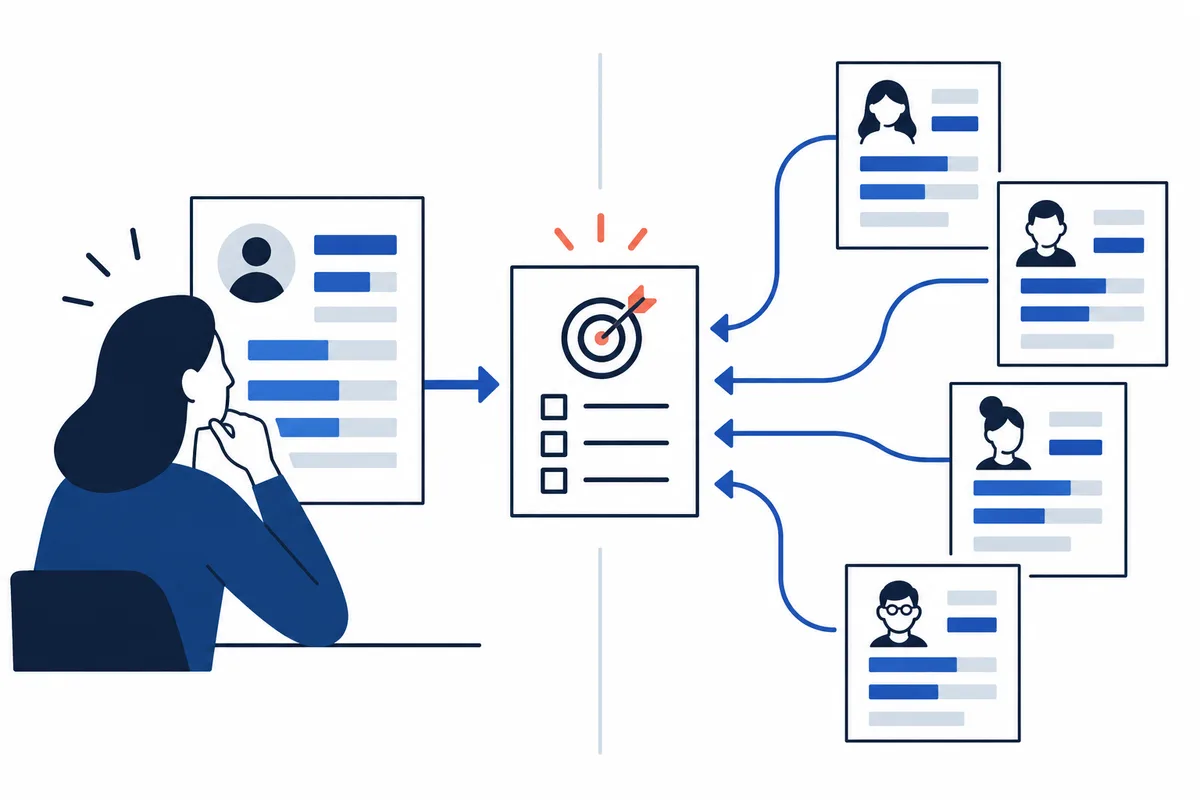
Multisource or 360 feedback gathers behavior ratings from more than one relevant group or relationship, often alongside a self-rating. It can add observations that the person cannot supply alone: whether they invite questions in a meeting, acknowledge a colleague’s concern, or return to repair a strained exchange. The value comes from other people having witnessed specific behavior, not from the number of arrows in a diagram.
The method works best when the behavior is clear enough for observers to recognize and when those observers have had a fair chance to see it. ‘Be more emotionally intelligent’ is too broad to rate consistently. ‘When we disagree, do I ask a question before I argue for my view?’ is more concrete. Even then, one coworker may have seen a few intense meetings, while another has mostly seen routine work. Their ratings can describe different slices rather than competing accounts of one identical scene.
A 2019 paper in Frontiers in Psychology argues that context is central to developmental multisource assessment. It describes 1,194 MBA students in a leadership-development program whose behavioral emotional-intelligence competency survey data were collected from 2006 to 2017; after excluding cases without enough rater responses, the final analytical sample was 887. The authors argue that different rater contexts can be complementary and that comparing mean scores requires checking whether the measure functions comparably across groups. The sample and program are specific; the paper does not show that all 360 tools handle context well.
An EI-specific example appeared in Multi-Rater or 360-degree Emotional Intelligence Assessment. Its abstract describes development work on a workplace 360 measure and research examining consistency among rater forms and relationships between self- and other-ratings. The authors discuss its use in leadership development. This is a precedent for treating multi-rater EI as a distinct measurement design, but it is not evidence that every commercial 360 product is validated or appropriate for an individual’s situation.
There is another boundary to keep clear: developmental feedback differs from multisource ratings used for pay, promotion, or formal performance decisions. The 2019 methods paper makes this distinction because the purpose affects how data should be interpreted. When people believe their answers will be used to judge employment, their incentives and candor may differ. A personal-development conversation should make clear who will see the results, how comments will be summarized, and whether the process can be kept separate from a personnel decision.
So ask prospective raters about an observable interaction, not your whole character. If the question is how you respond when someone challenges a proposal, invite feedback from people who have actually seen that exchange. Do not ask a person to rate a skill they have not observed. That turns the additional perspective into a guess, however neatly the report aggregates it.
Sources: Multisource Assessment for Development Purposes: Revisiting the Methodology of Data Analysis; Multi-Rater or 360-degree Emotional Intelligence Assessment
Why do self-ratings and other-ratings disagree?
A difference between your rating and a coworker’s rating is a question to investigate. It does not automatically show that your self-view is wrong, or that the coworker is unfair. One explanation is context: you may stay composed in one-to-ones but become abrupt in a rushed group meeting. Another is opportunity: the observer may have seen only the group meetings. A third is that you and the observer are using different standards for what counts as listening or assertiveness.
The Frontiers paper’s central methodological point is that context can be part of what a developmental feedback score means. It describes behavior in relation to a context rather than assuming every observer has an identical view of a fixed trait. The authors propose that raters from different settings may provide complementary perspectives. That is an argument supported by a particular study design, not proof that every discrepancy is meaningful or that context explains any inconvenient rating.
A systematic review of multisource feedback studies involving doctors found that feedback acceptance and use depended in part on whether recipients considered raters knowledgeable and credible. The review included 16 studies; its authors described variable evidence and called for further research. This does not determine how any one employee will react. It does suggest that a difficult gap between self-view and outside feedback should be examined with care rather than converted immediately into a trait label.
For the reader, the next step is to move from labels to an example. If someone says, ‘You shut people down,’ ask which recent exchange they mean, what you said or did, and what happened next. Then compare that account with your own memory and with the conditions around the exchange. A request for an example does not put the other person on trial. It makes the observation specific enough to consider and, if useful, test in a future interaction.
Do not average away every difference too quickly. If one group sees you ask clarifying questions and another sees you interrupt, the gap may point to different conditions that call for different responses. If comments are vague, inconsistent, or based on little direct contact, the result may be too thin to support a conclusion. The practical goal is a more precise development question, not a contest to determine which observer owns the truth.
Sources: Multisource Assessment for Development Purposes: Revisiting the Methodology of Data Analysis; Factors influencing the effectiveness of multisource feedback in improving the professional practice of medical doctors: a systematic review
When is outside feedback worth the added exposure?
Consider 360 feedback when three conditions meet: you can name an observable behavior, the people invited have seen enough of it, and the process gives them a credible way to answer candidly. Before agreeing, find out who will see individual comments, how results will be delivered, and what support exists for interpreting them. If those details are unclear, narrow or postpone the request.
Inviting raters involves their time and judgment, and it may expose them to pressure if a manager can identify their comments. The label ‘anonymous’ is not a guarantee: in a small group, a distinctive example or writing style can reveal a source. Ask what confidentiality means in practice and whether participation or comments could affect a work relationship.
A systematic review of physician multisource assessment examined 43 eligible articles from literature searched through January 2013. In those medical settings, some assessment systems used ratings from about eight medical colleagues, eight coworkers, and 25 patients to reach specified reliability and generalizability levels. These figures describe particular physician assessment systems; they are not a recommended headcount for your workplace. They show why a small set of ratings should not automatically be treated as a dependable group estimate, especially without knowing the instrument and its design.
Developmental feedback and ratings used for pay, promotion, or formal performance decisions also carry different stakes. The 2019 Frontiers methods paper distinguishes these purposes. If a workplace process blurs them, ask whether comments could enter a personnel decision and who will have access. EQ Test does not offer a team 360 service, and its individual profile is not for hiring, ranking, promotion, or performance scoring.
If raters have little opportunity to observe the behavior, privacy terms are unclear, or there is no time to discuss the result, a broad exercise may add exposure without useful information. A narrower request to one trusted colleague for a recent example may be a proportionate first step.
Sources: Multisource Assessment for Development Purposes: Revisiting the Methodology of Data Analysis; Factors influencing the effectiveness of multisource feedback in improving the professional practice of medical doctors: a systematic review; The reliability, validity, and feasibility of multisource feedback physician assessment: a systematic review
Will more perspectives improve your behavior?
Receiving information and changing a habit are separate events. A meta-analysis of 24 longitudinal studies, Does Performance Improve Following Multisource Feedback?, found generally small improvements over time in direct-report, peer, and supervisor ratings. Its authors reviewed evidence that change may be more likely when recipients recognize a need, respond constructively, see a feasible path, set goals, and act.
This finding is a reason to avoid expecting a report to change behavior by itself. The studies concern multisource feedback and performance ratings in leadership-related settings, much of the evidence published before 2005. They do not estimate what happens after an EQ self-report assessment or predict one reader’s outcome. The limited conclusion is that receiving ratings and improving later ratings are not the same result.
To make a comment usable, turn it into a small, observable trial. Choose one behavior, ask for a recent example and its context, then try one alternative in a relevant conversation—for example, summarize the other person’s point before replying. Afterwards, note what happened and whether the alternative was workable. This is a practical reflection method, not an intervention tested by the cited meta-analysis.
Self-report can inform the same experiment from your own perspective. You might notice that tension rises before you speak and track whether naming the concern earlier changes your response. A profile can prompt that question; it cannot establish that colleagues experience the conversation differently. Outside ratings can describe an observed pattern, while leaving your private experience and reasons for it unreported.
Set a modest aim rather than a promise to become ‘better at EQ.’ A useful result may be one exchange that went differently, or evidence that the requested behavior depends on conditions outside your control. Either gives you a concrete basis for deciding what to practice, ask, or change next.
Sources: Does Performance Improve Following Multisource Feedback? A Theoretical Model, Meta-Analysis, and Review of Empirical Findings; Factors influencing the effectiveness of multisource feedback in improving the professional practice of medical doctors: a systematic review
Which should you choose for your next development step?
For private reflection on your own emotional habits, choose self-report first. It is proportionate when you want a structured way to notice tendencies, separate parts of an experience, and choose a practice question. The Emotional Skills Profile at /assessment serves this reflective purpose: it has 32 items about recent behavior and emotional situations, with a report that separates habit summaries from judgments on scenarios. It is not a normed ability test, a 360 process, or a validated employment score.
Choose multisource feedback when your question is about the effect of a defined behavior on other people and those people have actually observed it. Before starting, find out who will respond, what they are asked to judge, who can see their responses, and how you will discuss the results. If answers will be used for a high-stakes workplace decision, do not treat the exercise as private development feedback. If there is no trustworthy process, gather one specific observation through a direct conversation instead.
A useful sequence can be self-reflection, then selective outside input. First decide what you want to understand about your own experience. Then identify the part others could observe and ask whether their perspective would change what you do. This staged approach is an editorial synthesis of the measurement and feedback evidence, not a tested rule that everyone should follow. Some readers will need external observations first because the concern is already about how their behavior affects colleagues; others may prefer private reflection before inviting comments.
The distinction is not about which method is superior in the abstract. It is about matching a source to an unknown. A questionnaire cannot tell you exactly how a colleague experienced a specific exchange. A colleague cannot report your internal experience across situations they never witnessed. Neither source alone settles what you should conclude, but each can help you choose a more useful next question.
If you want a private starting point, explore the Emotional Skills Profile and use its reflection prompts to identify one behavior you want to examine. If your unresolved question concerns how that behavior lands, bring one real example to a trusted colleague and ask: ‘In our last disagreement, what did I do that made it easier or harder to keep talking?’ Listen for the concrete action and setting. Then decide what, if anything, you want to try differently next time.
Sources: Does Performance Improve Following Multisource Feedback? A Theoretical Model, Meta-Analysis, and Review of Empirical Findings; Multisource Assessment for Development Purposes: Revisiting the Methodology of Data Analysis
Questions readers ask
Can I use a self-report EQ assessment and 360 feedback together?
Yes, if each answers a different development question. Use self-report to reflect on your perceived habits and internal experience. Use 360 feedback when relevant people have observed a specific behavior and can comment through a trustworthy process. Treat differences as prompts to examine context, not as competing scores that must be averaged.
Sources
- Emotional Intelligence Measures: A Systematic Review
This systematic review identified 40 professional EI instruments across skill-based, trait-based, and mixed models, supporting the distinction between measures rather than a universal EQ score.
- Multisource Assessment for Development Purposes: Revisiting the Methodology of Data Analysis
The paper describes 1,194 MBA students in a leadership-development program; its final analytical sample was 887 after excluding cases without enough rater responses. It argues that context matters in developmental multisource feedback.
- Multi-Rater or 360-degree Emotional Intelligence Assessment
This abstract describes an EI-specific workplace 360 instrument developed for leadership development and studies of rater-form consistency and self-other ratings.
- Factors influencing the effectiveness of multisource feedback in improving the professional practice of medical doctors: a systematic review
The review included 16 physician studies and reports that credibility of raters, narrative comments, and facilitated feedback influenced acceptance and use.
- The reliability, validity, and feasibility of multisource feedback physician assessment: a systematic review
This review included 43 eligible articles on practicing physicians and reports the rater counts associated with its reliability and generalizability criteria.
- Does Performance Improve Following Multisource Feedback? A Theoretical Model, Meta-Analysis, and Review of Empirical Findings
The abstract reports a meta-analysis of 24 longitudinal studies with generally small improvements in direct-report, peer, and supervisor ratings.
Apply it to the real situation
Turn reflection into one practical development question
From this guide: Use a private profile to identify an emotional habit or scenario response you want to examine.
The Emotional Skills Profile offers a private, 32-item reflection on recent emotional behavior and scenario judgments. Use it to name a pattern and choose one question to explore in daily work. If you also need to know how a behavior lands with colleagues, the profile cannot supply their observations; ask for a specific example through a conversation you trust.