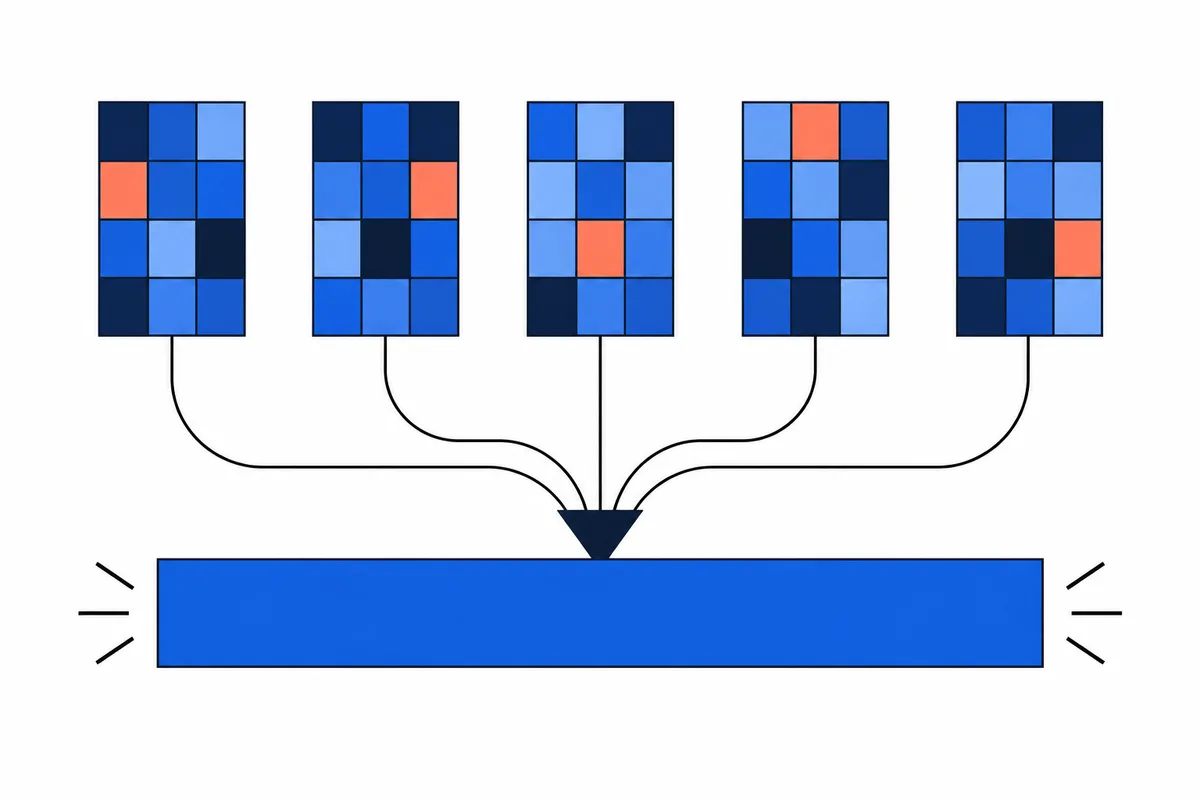
The SSREI total has a historical basis in the original 33-item scale, and later studies sometimes support a broad factor alongside narrower response patterns. But factor structures vary with the sample, item set, and analysis. Read the total as a broad summary of self-described emotional tendencies; check the exact form before interpreting subscales, and use a specific exchange to investigate workplace behavior.
Why was a single total defensible at the start?
The original 33-item total has a clear historical rationale: it was the form produced by the scale’s development process. In “Development and Validation of a Measure of Emotional Intelligence,” Schutte and colleagues describe building a 62-item pool to represent different dimensions of the Salovey and Mayer model, then factor-analyzing responses from 346 participants. That analysis suggested retaining 33 items. The university record also summarizes later reliability and validation studies, but its abstract does not establish that every later sample must reproduce one identical structure. A factor, in this context, is a pattern in which answers to some items tend to vary together. The original item pool was deliberately broad, while the factor analysis supplied an empirical way to reduce it. The result gave the authors a workable overall score: answers across the retained items could be combined into a summary reflecting the intended emotional-intelligence model. This is a reasonable basis for using the total as a broad description of what respondents reported about themselves. It is a narrower claim than saying the questionnaire measures one pure, unitary capacity, or that each emotional domain can be read reliably from a separate score. That distinction matters because item selection and a final theory of measurement are different decisions. The development study shows how its authors arrived at a 33-item scale in that sample. It does not, on the information available in the abstract, settle whether another sample, language version, or analysis would group the same responses in precisely the same way. Nor does a total score reveal which specific behavior produced a response pattern. A reader can therefore recognize why the original SSREI reports one total while remaining careful about what that total means: it is a broad self-report summary with a documented development history, not by itself a final verdict on the scale’s dimensional structure or an observation of conduct at work.
Sources: Development and validation of a measure of emotional intelligence
Why did later studies split the total differently?
Later studies split the SSREI total because they asked different questions of the same questionnaire. Some explored which groups of answers tended to move together; others specified a proposed structure in advance and tested how well it matched a new set of responses. Those procedures answer related but distinct questions. Exploratory analysis suggests a possible map. Confirmatory factor analysis (CFA) tests a chosen map against observed response patterns. A good fit in one study does not establish that the same map will fit every version or population.
In “On the Dimensional Structure of Emotional Intelligence,” the 33-item SSREI was given to 260 university students. A CFA testing one general factor did not fit those responses adequately. The researchers then used an exploratory principal-components analysis and interpreted four components: optimism, appraisal of emotion, social skills, and use of emotion. This result challenged the single-factor account, but it did not settle on four enduring subscales: the components were derived after the one-factor test failed, and their interpretation depended on the researchers’ choices about extraction and rotation. The study therefore gave later researchers a candidate structure to test, rather than a final answer about how every SSREI score should be divided.
The four-part map did not hold uniformly when later work tested it. “An Examination of the Factor Structure of the Schutte Self-Report Emotional Intelligence (SSREI) Scale via Confirmatory Factor Analysis” examined responses from 367 adults recruited from the general population in Victoria and New South Wales, Australia. The researchers tested the published four-factor arrangement alongside dimensions drawn from the theory behind the questionnaire. They found that two proposed dimensions, regulating other people’s emotions and expressing emotion, could not be identified separately in their analysis. Their final nested model included a general factor plus four narrower factors, but it relied on selecting 28 of the 33 items. That is evidence about a modified item set in this sample, not confirmation that the untouched questionnaire has a universal four-subscale structure.
A later test made the version issue especially clear. “Factor Structure Analysis of the Schutte Self-Report Emotional Intelligence Scale on International Students” used CFA with 640 international students at U.S. universities. The original 33-item one-factor model and several previously proposed arrangements did not fit that sample well. The authors supported a revised, nested 21-item model: four related dimensions sat beneath a broader self-reported emotional-intelligence factor. Their comparison with the 33-item form is useful because it shows how a general score can coexist with narrower patterns in a particular model. It is not a like-for-like confirmation of the original total, since the item set had changed and the participants were international students studying in the United States.
Together, these studies explain why the literature can report both a broad common factor and different narrower maps. The total may summarize covariance shared across many answers, while proposed subscales depend more heavily on which items are retained, how the factors are defined, and who completed the form. A reader seeing a four-factor SSREI report should therefore ask which study and item version its labels follow. A familiar set of names alone does not show that the same dimensions have been established for the form in hand.
Sources: On the Dimensional Structure of Emotional Intelligence; An Examination of the Factor Structure of the Schutte Self-Report Emotional Intelligence (SSREI) Scale via Confirmatory Factor Analysis; Factor Structure Analysis of the Schutte Self-Report Emotional Intelligence Scale on International Students
What does a hierarchical result actually license?
A hierarchical result allows an overall SSREI score and narrower response patterns to coexist in one model. It does not show that every subscale is a dependable measure of a separate emotional skill, or that this arrangement applies unchanged to every version and population. The distinction matters because “one factor” and “several factors” are not always direct opposites. A general factor can account for covariance shared across many answers, while narrower factors describe additional clustering among some answers. Whether those narrower patterns are strong and clear enough to interpret as separate scores is another question. A model may accommodate both levels without showing that each subscale can stand alone as a precise description of an individual. In “Factor Structure Analysis of the Schutte Self-Report Emotional Intelligence Scale on International Students,” researchers used confirmatory factor analysis to test previously proposed arrangements with 640 international students at U.S. universities. Their abstract reports that a modified nested model proposed by Gignac and colleagues fit the sample, but was not parsimonious; the researchers then proposed a new model that also fit. The article’s detailed text describes its selected two-level model: a broad factor alongside four narrower dimensions, plus a factor associated with reverse coding. This is evidence that a hierarchical account could describe responses in that study. It is not a test of every original 33-item interpretation: the authors’ final model used a modified 21-item set, and the participants were international university students. The form and population are part of the finding, not incidental details. A separate sample offers some support for the same broad arrangement. “Validation of the Schutte Self-Report Emotional Intelligence Scale With American College Students” reports an online study of 404 U.S. college students, 322 of them women and 88.9% White. The researchers used confirmatory analyses to compare previously proposed models and found that the Ng two-level model fit these data best. That is a replication of relative fit among the models tested in this particular sample, not a demonstration that the model is universal. The Ng study also reports a .70 correlation between its SSREI total and total scores on the Wong and Law Emotional Intelligence Scale. That association is relevant because it shows convergence between two questionnaires that ask people to describe themselves. It does not independently verify performance on emotion problems or behavior in a difficult conversation; both measures rely on self-report. Agreement between two summaries of self-perception cannot answer whether a person listened, regulated a reaction, or repaired a specific disagreement at work. So a hierarchical result licenses a bounded reading: a total may summarize common response tendencies, while a particular tested model may support more focused patterns. Before treating a displayed subscale as a separate skill profile, ask which SSREI item set produced it, which factor model was tested, and whether evidence comes from a population relevant to the interpretation. A total’s general factor does not automatically validate every component beneath it. For an individual reader, the responsible conclusion is modest: regard the subscale as a model-based prompt to investigate, then seek behavior-specific evidence before saying what happened in a real interaction.
Sources: Factor Structure Analysis of the Schutte Self-Report Emotional Intelligence Scale on International Students; Validation of the Schutte Self-Report Emotional Intelligence Scale With American College Students
When item wording changes the pattern
Reverse-keyed items ask respondents to disagree with a positively framed statement when the underlying tendency is present, or otherwise reverse the direction of scoring. In the original 33-item SSREI, only three items were negatively keyed. The study “Validity and Reliability of the Emotional Intelligence Scale in Pre-Service Physical Education Teachers” tested the SSREI with two samples of Greek pre-service physical-education teachers, numbering 516 and 335. The researchers compared previously proposed structures using confirmatory factor analysis. Among their candidates, Ng’s two-level model fit best. They then examined the effect of excluding reverse-coded items; without them, the resulting higher-order four-factor structure was more stable and easier to interpret in those data. The finding concerns the tested responses and analysis. It cannot establish that removing negative wording will improve every version or population. A wording effect is plausible because answering a negatively phrased item requires more than judging whether a statement describes you: the respondent must also follow the reversal in meaning. Respondents may miss that reversal or react differently to negative phrasing. Either pattern could add shared response variation among the few reverse-keyed items. That is a possible mechanism, not a demonstrated explanation for all disagreements among SSREI studies. The study shows that item treatment changed model behavior in its samples, but does not isolate why or explain broader disagreement. The language and population also matter. A translation can preserve the intended concept while changing how a sentence is read in practice, so evidence should follow the actual wording. A translated or locally adapted form may preserve the intended meaning, but it is still a distinct item set until its structure has been examined. Results from Greek pre-service teachers do not settle how the wording behaves among employees or users of another adaptation. Different studies propose different groupings; a shared “four-factor” label does not make them interchangeable. When a report gives an SSREI total alongside dimensions, check which form it used, whether items were translated or altered, and how reverse-keyed items were handled. Trace each dimension to evidence on that item set. If those details are unavailable, the total can still be read as a broad summary of self-described tendencies, while the named dimensions should remain tentative. For a practical question about a disagreement or a missed cue, ask about the specific exchange and seek concrete feedback; a factor label cannot tell you what happened in that conversation.
Sources: Validity and Reliability of the Emotional Intelligence Scale in Pre-Service Physical Education Teachers; Validity and Reliability of the Emotional Intelligence Scale in Pre-Service Physical Education Teachers
What can a total score say about one person?
An SSREI total summarizes how a respondent described their emotional tendencies across the questionnaire. It does not identify what happened in a particular conversation or establish what that person will do next. The distinction matters because the scale is self-report: its evidence begins with a person’s account of themselves, while a workplace question often concerns a specific action another person could have seen.
In “Development and Validation of a Measure of Emotional Intelligence,” the original scale emerged from a factor analysis of responses by 346 participants to an initial pool of 62 items. The authors retained 33 items, and the university record reports later evidence of internal consistency and test-retest reliability. Those results describe properties of questionnaire responses over items or time. Internal consistency concerns how coherently the answers relate within a scale; it does not show that the total directly measures listening, emotional regulation, repair, or boundary-setting in a live exchange. Nor does a reliable summary reveal which of those behaviors is at issue for one person.
Factor structure concerns patterns in how items vary together across respondents. A total score, by contrast, combines a person’s answers according to the scale’s scoring rules. A broad factor can therefore make an overall summary plausible without turning that summary into an observation of behavior. The evidence from “Factor Structure Analysis of the Schutte Self-Report Emotional Intelligence Scale on International Students” illustrates the boundary: the study tested models with 640 international students at U.S. universities and supported a modified SSREI model for that population. Its reported association between SSREI scores and scores on another self-report emotional-intelligence measure is convergence between questionnaires. Both ask people to report about themselves; neither directly records what they did in a disagreement at work.
Suppose someone reads a total and wonders whether they interrupt when a colleague raises a concern. The number cannot answer that question by itself. A more grounded inquiry starts with a recent exchange: What did the colleague say? Did the person ask a question or move quickly to a solution? What did the colleague notice? This is an illustrative way to investigate a behavior, not a finding tested by the factor studies. It replaces a broad inference about the person with a question that can be checked against a concrete interaction and specific feedback.
Use the SSREI total at the level it supports: as a summary of self-described tendencies on that form. If the concern is a work behavior, name the behavior, recall one exchange, and ask for feedback about what was observable. The total can start that reflection; it cannot settle the account of what happened or predict the next conversation.
Sources: Development and validation of a measure of emotional intelligence; Factor Structure Analysis of the Schutte Self-Report Emotional Intelligence Scale on International Students
How should readers compare a total with subscales?
The total has the clearest historical basis in the original 33-item form; later subscales depend more heavily on a particular analysis and version. A hierarchical model can support a broad score alongside narrower patterns in the sample where it was tested. That does not make every subscale equally secure across forms or populations.
| Score shown | What it summarizes | Relevant evidence | Interpretive boundary | |---|---|---|---| | Original 33-item total | Responses combined into a broad self-report summary | *Development and Validation of a Measure of Emotional Intelligence* describes selecting 33 items from a 62-item pool after factor analysis of 346 participants | The development study supports why the total was introduced; its abstract does not establish one invariant structure across later samples | | Later subscale solution | A proposed grouping of items into narrower response themes | *Validation of the Schutte Self-Report Emotional Intelligence Scale With American College Students* found the Ng two-level model fit best among tested models in an online sample of 404 students | The result concerns those tested models and that college sample; “best” is comparative within that analysis, not universal | | Modified hierarchical score | A general factor plus narrower groupings for a revised item set | *Factor Structure Analysis of the Schutte Self-Report Emotional Intelligence Scale on International Students* reported support for a revised 21-item nested model among 640 international students at U.S. universities | The revision and sample matter; findings do not directly validate the original 33-item form or every dimension displayed elsewhere |
The original selection is a defensible route to a usable total, not proof that the same item relationships recur unchanged whenever the scale is administered.
Later papers ask a more conditional question: which proposed arrangement best matches the responses in this dataset? Gong and Paulson’s American college study tested models proposed earlier and found the Ng two-level model fit best. Ng and colleagues tested a revised 21-item form with international students and reported support for its nested structure. They concern different samples and, in Ng’s case, a modified item set, so they cannot be ranked as if the analyses used identical responses.
The population differences reinforce that limit. The evidence ledger also records a modified general-plus-four-factor solution in an Australian sample and a two-level model in two samples of Greek pre-service physical-education teachers, where excluding reverse-coded items improved stability and interpretability. College students, international students studying at U.S. universities, an Australian sample, and Greek teacher trainees do not stand in for one another. That is a reason to check transfer, not to infer a weakness in any group.
A reader holding a report that shows both a total and named dimensions can ask two precise questions: which exact item set produced each number, and what study supports interpreting those dimensions for this form? A broad factor can explain why answers share something in common; narrower groupings may still vary with wording, item selection, and sample. Until evidence matches the form and intended population, treat the total as a broad description of self-reported tendencies and subscales as more conditional clues, not independent readings of specific workplace skills.
Sources: Development and validation of a measure of emotional intelligence; Validation of the Schutte Self-Report Emotional Intelligence Scale With American College Students; Factor Structure Analysis of the Schutte Self-Report Emotional Intelligence Scale on International Students; Validity and Reliability of the Emotional Intelligence Scale in Pre-Service Physical Education Teachers
How can a total become a useful work question?
An SSREI total can start a work question, but it cannot answer one by itself. The score summarizes how a respondent described their emotional tendencies across the questionnaire. Factor analysis asks how answers to its items vary together; it does not record what happened in a particular exchange. In “Factor Structure Analysis of the Schutte Self-Report Emotional Intelligence Scale on International Students,” the authors tested competing structures with 640 international students at U.S. universities. Their final modified model fit those data, and the authors reported a .70 correlation between SSREI total scores and scores on another self-report emotional-intelligence scale. That relationship is evidence that two questionnaires share some pattern in respondents’ self-descriptions. It is not an observation of how those respondents listened, handled disagreement, or repaired a strained conversation.
This distinction matters when a score feels like it explains a recurring workplace difficulty. A broad total may prompt a useful hypothesis, such as “I may find it hard to stay open when someone is upset.” The next step is to make that hypothesis specific enough to examine. Choose one recent interaction, name an action someone could have seen or heard, and ask for feedback about that action. For example, after a colleague raised a concern in a project discussion, the question might be whether you let them finish before suggesting a fix. The colleague may recall that you interrupted, or may say you listened and that the tension came from a deadline or an unclear decision. Either way, the conversation is about a shared event rather than what a questionnaire total seems to imply about character.
That example is illustrative, not a reported case or a tested intervention. Its value is practical: “I should improve my emotional intelligence” gives no clear behavior to notice, while “I proposed a solution before the concern was finished” can be checked against what happened. A second person’s account is also one perspective, shaped by what they noticed and remember. Treat it as information to consider alongside your own account and the circumstances of the exchange. If the question is whether you understood the other person’s concern, ask what they were trying to convey and whether your response addressed it. If the question is whether you managed your own reaction, look at the observable pause, words, or decision that followed. These are separate inquiries; the total does not tell you which one deserves attention.
The plan for using a score is therefore modest and concrete. First, keep the SSREI total at the level of a broad self-description. Next, select one recent exchange that matters to you and write down the behavior you want to understand, without treating the score as proof that it occurred. Then ask someone who was present what they noticed, leaving room for a different account. Finally, decide whether there is one response you want to try in a similar situation and what you would watch for. This sequence does not guarantee improvement; it turns a general result into a question that can be discussed and revisited. If the accounts do not agree, that is a reason to clarify the event and the behavior, not to use the total as a tie-breaker.
What should the reader do with the result next?
Keep the SSREI total at the level it can support: a summary of how you described your emotional tendencies on that form. Before interpreting a subscale, check the report or source that supplied it. Confirm the item version, whether wording changed, and which factor model supports those labels. The studies above tested different forms and populations; a factor pattern in one does not settle what another report’s subscales mean. Translate one concern into a question about an observable exchange. If the result makes you wonder how you respond to disagreement, choose a conversation and ask: “Did I let you finish explaining the concern before I proposed a solution?” The score cannot answer that question by itself. A concrete example gives you and the other person something to examine. Keep any conclusion about that exchange rather than turning it into a verdict about your character. This is a reflection step, not an outcome tested by the SSREI factor studies. EQ Test’s 32-item Emotional Skills Profile offers a separate educational reflection route at [/assessment](https://eqtest.org/assessment). Its recent-behavior summaries and authored-scenario judgments are distinct from the SSREI; SSREI research does not validate this profile. Use it to organize reflection on your answers, not as a normed ability score or a way to rank, hire, or predict performance. Evidence on the exact SSREI version and population relevant to your question could change the interpretation. For now, verify the form and take one behavior-specific question into a conversation.
Sources: Emotional Skills Profile
Questions readers ask
Does the SSREI factor structure prove that its total measures one emotional-intelligence ability?
No. The original 33-item total has a documented development rationale, and some later studies support a broad factor. Findings vary by sample, item set, and analysis, so the total is best read as a broad summary of self-reported tendencies rather than proof of one unitary ability.
Sources
- Development and validation of a measure of emotional intelligence
Supports the original scale’s development from a 62-item pool and factor analysis of 346 participants that suggested a 33-item measure.
- On the Dimensional Structure of Emotional Intelligence
Supports the reported one-factor CFA challenge and subsequent exploratory four-component interpretation in a sample of 260 university students.
- An Examination of the Factor Structure of the Schutte Self-Report Emotional Intelligence (SSREI) Scale via Confirmatory Factor Analysis
Supports the reported modified general-plus-four-factor model based on selected items in an Australian sample of 367 participants.
- Factor Structure Analysis of the Schutte Self-Report Emotional Intelligence Scale on International Students
Supports the revised nested 21-item model tested with 640 international students at U.S. universities and the reported .70 correlation with another self-report EI scale.
- Factor Structure Analysis of the Schutte Self-Report Emotional Intelligence Scale on International Students
Supports the revised nested 21-item model tested with 640 international students at U.S. universities and the reported .70 correlation with another self-report EI scale.
- Validation of the Schutte Self-Report Emotional Intelligence Scale With American College Students
Supports the finding that the Ng two-level model fit best among tested models in an online sample of 404 American college students.
- Validity and Reliability of the Emotional Intelligence Scale in Pre-Service Physical Education Teachers
Supports the reported comparison of SSREI factor models in two Greek pre-service physical-education teacher samples.
- Validity and Reliability of the Emotional Intelligence Scale in Pre-Service Physical Education Teachers
Supports the full-text account that excluding reverse-coded items produced a more stable and interpretable higher-order structure in those samples.
- Emotional Skills Profile
Supports the separate EQ Test assessment destination and the product description supplied for the current 32-item educational reflection profile.
Apply it to the real situation
Turn a broad result into a clearer reflection
From this guide: The SSREI total cannot identify what happened in a particular exchange; a behavior-specific question can help focus personal reflection.
The SSREI can offer a broad view of how you describe your emotional tendencies, while a work question usually concerns a particular response. EQ Test’s private 32-item Emotional Skills Profile is a separate educational reflection tool, with recent-behavior summaries and authored-scenario judgments. Explore it to organize your own reflections and identify a behavior to consider next.