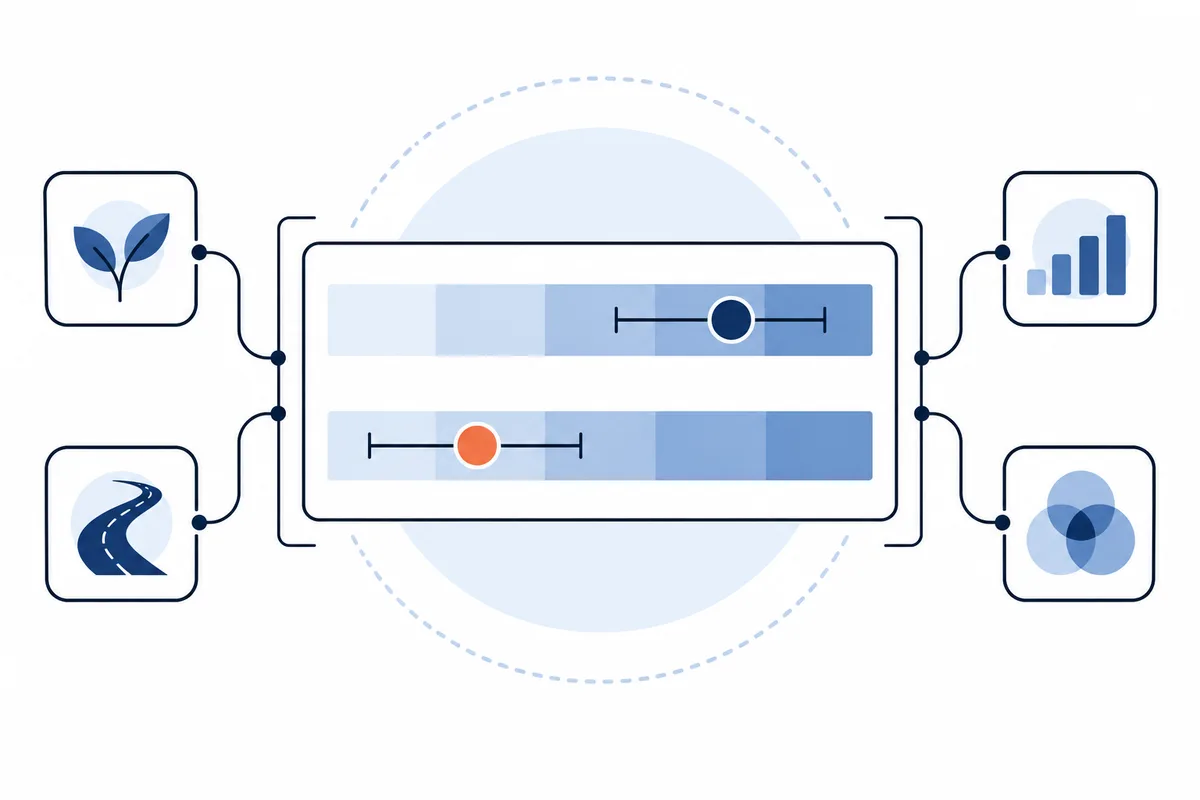
An EQ-i 2.0 subscale compares your self-reported emotional-social functioning with the reference group named in your report. Treat a high or low result as a prompt to examine a behavior, not as a fixed strength or deficit: check the scale description and response context against specific examples and relevant feedback, then choose one behavior to observe.
A score can start a question
Read a high or low EQ-i 2.0 subscale as a summary of how you described your emotional-social functioning, then ask what it looks like in a particular work interaction, rather than in every setting. A high result may point you toward a behavior you report using readily; a low one may help you notice where that behavior feels less available. Neither settles whether it is a fixed strength or weakness. The EQ-i 2.0 manual describes the inventory as self-report and recommends considering behavioral observations alongside its results ([Introduction (EQ-i 2.0 Manual)](https://cdn.mhs.com/mhsdocs/EQi20Manual/part1/Intro.html)). Use the named subscale description to choose one relevant exchange, then compare the score’s suggestion with what you actually did and what followed. The number places your report in a comparison; it does not forecast the next conversation.
Sources: Introduction (EQ-i 2.0 Manual)
What is the number comparing?
Before interpreting a high or low result, check which EQ-i 2.0 report you have and which reference group it names. The same-looking score can answer different comparative questions when it comes from a different edition or norm selection. This is why the report label belongs in your interpretation: “high” is relative to a stated frame, not a universal rank that applies to everyone. Keep the scale name beside the norm label when you make a note for yourself; “high” by itself loses the information needed to revisit the result later. If the report does not make its norm selection clear, ask the person who administered it which comparison was used before comparing your result with someone else’s.
The EQ-i 2.0 is a self-report inventory. In its manual, raw responses are converted to standard scores and compared with a normative sample; the manual describes standard scores using a mean of 100 and a standard deviation of 15 ([Introduction (EQ-i 2.0 Manual)](https://cdn.mhs.com/mhsdocs/EQi20Manual/part1/Intro.html)). In plain terms, the conversion expresses where a person’s reported result sits in relation to the reference sample used for that report. It does not turn the answers into a direct observation of behavior. The report still summarizes responses to the inventory, while a conversation, handoff, or disagreement is something to observe in context.
Look for the norm type and population shown on the report. MHS’s “Choosing a norm type (EQ-i 2.0 Help)” describes options that include general-population and professional comparisons, overall or age-and-gender groupings, and regional norms where available ([Choosing a norm type (EQ-i 2.0 Help)](https://tap.mhs.com/webhelp/EQi20/SingleUser/Generating_Reports/Choosing_a_norm_type.htm)). Those labels tell you which group anchors the comparison. A professional norm, for example, makes the reference population different from an overall general-population norm; it does not mean that the result describes how well you perform in your particular profession. Read the option printed on your own report rather than assuming that every EQ-i 2.0 output uses the same reference group.
Also check the edition or norm-version information. MHS’s “EQ-i 2.0 Updated Norms: reference guide” identifies updated norms as a distinct edition, with region-specific norm samples, and says the updated version does not replace the existing EQ-i 2.0 ([EQ-i 2.0 Updated Norms: reference guide](https://cdn.mhs.com/mhsdocs/Marketing_Files/Talent/EQ-i/UpdatedNorms/EQ-i2_NormsUpdate.pdf)). If you are comparing reports completed at different times, confirm whether their editions and norm labels match before reading a score change as a personal change. The guide describes the editions and samples; it does not establish how much an individual score would shift between them. A named norm group clarifies the comparison, while the self-report remains a report of responses rather than an observation or guarantee of conduct.
Sources: Introduction (EQ-i 2.0 Manual); Choosing a norm type (EQ-i 2.0 Help); EQ-i 2.0 Updated Norms: reference guide
Why can a high score still need context?
No. A high subscale can point to a behavior you regard as readily available, but it does not show that the behavior helps in every situation or at every intensity. The scale description gives the behavior a name; the work interaction shows what that behavior did there. Reading the result as a fixed strength skips that second question. A practical interpretation asks both what the behavior made possible and what it may have delayed, obscured, or made harder for someone else. That is a way to examine a report against experience, not a finding that EQ-i scores predict a particular trade-off.
Consider an illustrative work exchange: a colleague signals concern about a plan, and you notice the concern but postpone making a needed decision so the conversation can stay calm. Attending to the colleague may have kept their objection from being ignored and preserved room to explain it. The delay may also have left the group without a decision, shortened the time available for the next step, or shifted uncertainty onto others. These are questions to ask about the example, not facts about a real employee or a likely consequence of a score. The same attentive response could be useful when a concern contains information the group needs; it could become costly when repeated discussion prevents a decision that the group is responsible for making. The relevant threshold depends on the task: a reversible choice may tolerate more discussion than a time-sensitive handoff.
The distinction is not whether care or patience is good. It is what the behavior enabled in this exchange, what it postponed, and whether that cost mattered to the task or relationship. A high result can still be a useful prompt: it may identify a response you experience as available or frequent. Keep that signal in view while checking the moment, the other people involved, and the outcome. If the behavior helped and the delay was reasonable, the context supports the strength interpretation. Ask whether the decision had a deadline, who needed to act, and whether the colleague had a genuine chance to add what mattered. Those details help distinguish a deliberate pause from an open-ended postponement. If the delay repeatedly gets in the way of a decision, the useful next question concerns when to pair attention with a clear decision point. Neither reading turns one score into a permanent verdict about how you act.
What can a low score support you in asking?
No. A low subscale does not establish that you lack the skill it names. Because the result summarizes your report, use it to ask where the behavior may be less available, then look for the conditions around that pattern. This is practical reflection, not a diagnosis of inability. It also does not require you to dismiss a result that feels important: a low score may point toward a real area for development. The useful response is to turn that possibility into a question about behavior that can be examined in a specific situation.
For example, if a report leads you to wonder whether you speak up when you disagree, ask: under what pressure, with which people, or during what kind of task is it hardest to state my view? When has it been easier? Think of the circumstances around each instance: the time available, the stakes of the decision, how clear your role was, and whether disagreement could be raised safely. This is an illustrative reflection prompt, not an EQ-i item or a claim about what any particular score means. It helps separate a broad concern from the situations in which a behavior is more or less accessible.
A concrete answer should leave you with something you could check. Perhaps you want to notice whether you raise a concern before a decision is final, or whether you wait until you have a workable alternative to offer. Choose one observable action and watch for it in a relevant conversation; note what made it easier or harder and what happened next. If the pattern repeatedly blocks an important conversation, that is a reason to work on it, not to reassure yourself that the score is meaningless. If it appears only under particular conditions, those conditions tell you where to focus practice or seek specific feedback. You can make the question testable by choosing a near-term situation in which disagreement is likely, deciding what speaking up would look like, and afterward recording whether you did it and what followed. This does not require a dramatic confrontation; a timely question or a clear statement of a concern may be the relevant action. The low result begins an inquiry; your examples determine the next question.
How should you use the scale description and item feedback?
Start with the scale description, then translate its broad language into an action someone could notice. The EQ-i 2.0 manual describes the inventory as self-report and recommends considering behavioral observations alongside its results ([Introduction (EQ-i 2.0 Manual)](https://cdn.mhs.com/mhsdocs/EQi20Manual/part1/Intro.html)). That gives you a practical route: identify the behavior the scale names, choose a recent situation where it might matter, and describe what you did in terms that another person could recognize. “I adapt well” is a conclusion. “When the delivery date changed, I asked what had changed, revised the next steps, and told the people affected” is a sequence that can be checked against an actual exchange.
Here is an invented example, not an EQ-i question or result. Suppose a scale description points you toward adapting when plans change. Make the behavior observable: after a schedule shifts, do you clarify the new priority, update your plan, and communicate the change to someone relying on your work? Then add the context that could explain the response. Was the change small or disruptive? Did you have authority to reset the plan, enough information to do so, and time to alert the others? Those details distinguish a difficulty adjusting from a situation where the next step was genuinely unclear or depended on someone else.
If your report gives item-level feedback, that means commentary tied to a particular response or item rather than only a broader scale summary. Use that detail as a narrower prompt, without copying the question into notes or trying to reverse-engineer how it is scored. Compare the feedback with examples from more than one relevant situation: a changed meeting agenda, a revised deadline, or a handoff whose requirements shifted. Look for what you did and what followed in each case. A counterexample matters too: perhaps you adapted quickly in one project but stayed with an old plan when roles or priorities were ambiguous. That difference may tell you which condition deserves attention. Keep the description and your example at the same level. If the report points to flexibility, for instance, an example of changing a work sequence is closer evidence for reflection than a general judgment that you are easygoing. Record the action, the cue that prompted it, and the immediate effect on the work. This makes the comparison specific enough to revisit, without treating your notes as a second assessment or a tally that should be converted into a score.
This comparison is a reflection method, not a validated scoring procedure. Each item response remains self-report, and one memorable example may be atypical. Repeated examples can help you make the question more precise; they do not independently confirm the subscale or establish a new score. The useful result is a behavior you can watch for again, together with the circumstance that seemed to shape it.
Sources: Introduction (EQ-i 2.0 Manual)
What does validation evidence let you conclude?
The South African study titled “The psychometric properties of the Emotional Quotient Inventory 2.0 in South Africa” examined secondary standardization data from 1,144 South African working adults in a cross-sectional, non-experimental analysis. Van Zyl used Rasch analysis and classical test and factor methods. The researchers reported that almost all items fit the Rasch model and described reliability estimates as satisfactory; their composite-level confirmatory factor analysis showed acceptable fit for the examined composites, with an exception for the total-EQ model ([The psychometric properties of the Emotional Quotient Inventory 2.0 in South Africa](https://sajip.co.za/index.php/sajip/article/view/1192)). This is meaningful evidence about EQ-i 2.0 measurement in that sample and setting. The exception belongs in the same account as the positive results: the study does not support a blanket statement that every level of the model fit equally well.
Reliability concerns whether scores or item responses behave consistently enough under the study’s measurement procedures to support interpretation. In this paper, satisfactory reliability estimates support consistency within the analyzed data. They do not show that a person behaved consistently in every meeting, or that a high subscale guarantees effective conduct. Model fit addresses a different question: whether the data align reasonably with the proposed structure. The acceptable composite-level results offer support for that structure in the studied context, while the total-EQ exception limits a claim about the model as a whole. Neither analysis observed participants handling a disagreement, receiving feedback, or adapting to a deadline. These findings answer related but non-interchangeable questions: consistency concerns the dependability of measurement, whereas fit concerns how well the proposed organization accounts for the observed responses. A favorable answer to one does not automatically supply the other. That is why the paper’s reliability result cannot erase the total-model exception, and the model exception should not be rewritten as if the reliability estimates failed too.
That distinction marks how far the result travels. A study can test response patterns and evaluate whether a measurement model fits those patterns without recording the workplace behavior a reader wants to understand. The South African analysis was cross-sectional and used existing standardization data; it was not a study of what an individual did after receiving a particular score. So its findings can inform how cautiously we describe EQ-i 2.0’s measurement properties in the studied working-adult context. They cannot settle whether your own scale description matches your actions in a specific exchange, nor can that one exchange retroactively verify the study’s model. The population and design also matter to the scope of any inference: the data came from South African working adults and a particular standardization analysis. The result should therefore remain attached to that setting instead of being silently generalized to every language, norm group, or report reader. That boundary keeps the positive findings useful while preventing them from doing work the study did not perform.
For an individual report, keep the conclusions separate: the study offers bounded psychometric support, including satisfactory reliability estimates and mostly fitting items, while retaining a stated weakness in the total-EQ model. Your report’s score still needs interpretation against its own norm frame and the behavior you are trying to understand. To decide whether a subscale description is useful for you, examine the concrete response across relevant situations; the South African study supplies context about the instrument’s measurement, not a verdict about your conduct.
Sources: The psychometric properties of the Emotional Quotient Inventory 2.0 in South Africa
What does the earlier EQ-i gender study actually show?
First, keep the versions distinct. The study “The location of emotional intelligence measured by EQ-i in the personality and cognitive space: Are there gender differences?” examined the earlier 133-item Emotional Quotient Inventory (EQ-i), not EQ-i 2.0. Its sample comprised 1,063 Italian participants: 330 were employed, 702 were university students, and employment status was missing for 2.9%. The study used the earlier EQ-i’s five broad dimensions and total score to examine associations with personality and fluid intelligence, and to test whether the measure operated comparably across women and men. Its sample and instrument define what its findings can address; it did not examine a reader’s EQ-i 2.0 subscale or workplace conduct. ([The location of emotional intelligence measured by EQ-i in the personality and cognitive space: Are there gender differences?](https://www.frontiersin.org/journals/psychology/articles/10.3389/fpsyg.2022.985847/full))
For the group comparison, measurement invariance asks whether a measure represents the same underlying dimensions in the groups being compared. The study first found metric support: the factor loadings were sufficiently similar across gender groups for relations between the measured dimensions to be compared. That step alone does not make average scores comparable. Scalar invariance also requires the factors’ starting points, or intercepts, to be equal; otherwise, a group’s score difference may partly reflect how the items or factors function rather than a difference in the underlying level. The study’s initial scalar test did not meet its criterion, so full scalar invariance was not supported at first. Put simply, matching loadings mean that a given factor is linked to its indicators in a sufficiently similar way across groups; it does not mean the two groups have identical scores. Intercepts matter when researchers ask whether group means differ, because unequal starting points can make a raw mean gap misleading. The staged test therefore asks a narrower question than whether the inventory is fair in every respect or whether an individual result is accurate. It checks a condition needed for interpreting group averages.
The researchers then tested partial scalar invariance, which allows selected intercepts to differ while requiring the remaining comparison structure to hold. Freeing the intercepts for the Intrapersonal and Interpersonal factors still did not meet the study’s criterion. After also freeing the Stress Management factor intercept, the partial scalar model did meet it. In other words, the study found support for some group comparisons under that adjusted model, while identifying three factors whose intercepts varied between groups. This is a specific statistical result about the earlier EQ-i in this Italian sample. It is not evidence that women or men behave in a particular way, nor a rule for adjusting an individual’s score. The study reports that sequence; it supplies no individual adjustment for a current report.
The result is relevant as a reason to ask whether group score comparisons have been supported for the particular version and population at hand. It cannot settle how an EQ-i 2.0 subscale should be read: the instrument differs, the study tested gender-group measurement properties, and the question here concerns one person’s report and behavior. The study’s partial result therefore supplies context for careful interpretation, not a direct transfer of its conclusion to an EQ-i 2.0 report.
What if self-report and feedback do not match?
The EQ-i 2.0 and EQ-360 provide different views: the EQ-i 2.0 is completed by the person being assessed, while EQ-360 adds information from people who work with that person. The Emotional Intelligence Consortium’s overview describes combining observer ratings with the self-report as a more detailed profile; it also says listing an instrument is not an endorsement. That distinction makes feedback a possible second source to examine, not a deciding vote on what someone is like. Colleagues see actions in the settings they share with you, which may include important work moments and omit others. Their account can add useful detail without establishing ground truth. ([Emotional Quotient Inventory (EQ-i 2.0)](https://www.eiconsortium.org/measures/eqi.html))
When your report and workplace feedback seem to conflict, choose one behavior both could describe and compare like with like. If the concern is how you handle disagreement, look at comparable moments: Was the decision already made? Did you have the same role and time to respond? Did you state your concern, ask a question, or hold back? Then ask for one specific example of what the other person saw and what happened next. “You never listen” gives you no scene to examine; “I raised the deadline risk, and you moved to the next agenda item before I finished” identifies an exchange you can discuss. You might remember the same moment differently, so clarify what each person noticed before deciding what it means. For instance, feedback that you interrupted in a planning meeting can be explored by asking what you said, when you entered the conversation, and whether the group had moved on. That description is more workable than accepting a character label or countering it with your own general self-description. You can check whether the same behavior appears in another comparable meeting and what effect it had there.
Repeat the comparison across relevant situations rather than trying to settle a broad judgment from one exchange. If feedback concerns a pattern, ask when the behavior appeared and when it did not; differences in task, timing, or relationship may help explain the mismatch. Your own account can miss effects visible to someone else, while an observer’s view is limited to the occasions they saw and the meaning they assigned to them. The practical aim is a more precise question about an action and its conditions, not a tally of who is more accurate. Keep the question narrow enough to answer from examples: what cue did you notice, what did you do, and what response followed? A difference between accounts may point to a missed effect, different expectations, or simply different views of the moment; the examples help decide which possibility deserves follow-up.
EQ Test’s Emotional Skills Profile does not provide EQ-360 ratings or collect feedback from coworkers. If you want a second perspective, you would need to seek it directly from someone who observed the relevant behavior, and ask about a concrete exchange. Keep that feedback alongside your own account as context for reflection; neither source by itself decides whether a subscale describes a fixed strength.
Sources: Emotional Quotient Inventory (EQ-i 2.0); The Assessment of Emotional Intelligence: A Comparison of Performance-Based and Self-Report Methodologies
How can a high and a low scale coexist?
A high Empathy result alongside lower Assertiveness can prompt two separate questions about the same exchange: what did you notice about the other person’s concern, and how clearly did you state your own position? In “The EQ-i 2.0 Framework,” MHS defines Empathy around recognizing and understanding another person’s feelings and perspective. It defines Assertiveness around expressing one’s thoughts, beliefs, and rights openly in a socially acceptable way. Those descriptions name different behaviors. One concerns attending to another person; the other concerns communicating your own view. The pair therefore does not describe a single scale with a high end and a low end, as if more of one must mean less of the other. It can help you look at both sides of a particular interaction without turning either result into a permanent label.
Consider an illustrative work exchange, not a report item or a claim about what any particular score predicts. A colleague asks to add another request to a handoff that is already close to its deadline. You might notice their concern: the request could prevent a problem for a customer or the next team. What did you ask to understand that concern? Did you check what was urgent, who depended on the handoff, or what would happen if the request waited? Those are observable ways to examine the Empathy side of the question. The scale label alone cannot tell you whether you listened well in this exchange; the words and attention you brought to it are what you can inspect.
Then look at what you communicated about the constraint. Did you say which work could fit by the deadline, name what would need to move, or ask the colleague to choose between priorities? Those actions make the Assertiveness side concrete: they show whether you expressed your position while keeping the conversation workable. Note the consequence too. Perhaps the two of you agreed on a smaller handoff and a follow-up date; perhaps the unresolved request delayed the work. Either outcome gives you a more useful question than “Am I empathetic but not assertive?” You can ask whether you recognized the other person’s concern and made your own limit clear enough to reach an explicit agreement. The paired profile organizes that reflection, but MHS’s scale definitions do not establish an additive rule or predict how the pair will play out in your next conversation. Your example supplies the behavior to examine.
The distinction matters when you review the outcome. If the colleague felt heard but left unsure what would actually be delivered, attention to their concern did not by itself settle the handoff. If you stated the limit but skipped their reason for asking, clarity alone may have left an important risk unaddressed. These are possibilities to check against the exchange, not conclusions encoded in the score pair. Ask what each person could repeat afterward: the concern, the limit, and the agreed next step. That gives you a concrete basis for deciding which behavior to keep and which one to adjust in a similar conversation.
Sources: The EQ-i 2.0 Framework
Choose one behavior to observe next
For your next relevant interaction, choose one behavior that would make the question observable: asking what matters most before agreeing, stating a constraint, or checking that both people understood the decision. Afterward, write down what you did and its immediate effect on the conversation or work. A specific example or useful feedback can help you revisit your interpretation; a broad label alone cannot tell you what happened in that exchange. Keep the note brief enough to use again, and look for another comparable moment before treating it as a recurring pattern. If no such conversation is coming soon, choose a recent one and reconstruct only what you can remember, marking uncertainty rather than filling gaps with assumptions. Keep the observation tied to this task and setting.
If you want a separate prompt for reflection, EQ Test’s private 32-item Emotional Skills Profile explores recent emotional habits and judgments on authored scenarios. It is an educational reflection available at [/assessment](/assessment), not EQ-i 2.0, a comparable norm-referenced score, or a predictor. Use it to consider what you might practice next, then bring that question back to a real interaction you can observe.
Questions readers ask
What does a high EQ-i 2.0 subscale mean?
It means your self-reported answers compare high within the reference frame named in your report. The scale description can suggest a behavior to examine, but the score alone does not show how that behavior appears in a particular exchange.
Does a low EQ-i 2.0 subscale mean I lack that skill?
A low result is a prompt to examine the behavior and situations where it may be harder to access. Compare the scale description with examples that fit and examples that complicate it before drawing a conclusion.
Can I compare EQ-i 2.0 scores from different report versions?
Check each report’s edition and norm labels. MHS describes updated norms as a distinct EQ-i 2.0 edition, so do not assume reports with different version or reference labels use an unchanged comparison frame.
How can I check whether a subscale interpretation fits?
Read the scale description and any item-level feedback provided. Compare them with specific behavior across relevant situations, including counterexamples, and seek concrete feedback when it can add another perspective.
Sources
- Introduction (EQ-i 2.0 Manual)
The EQ-i 2.0 is a self-report inventory; its raw scores are converted to standard scores for comparison with a normative sample, and the handbook recommends considering collateral information including behavioral observations.
- Choosing a norm type (EQ-i 2.0 Help)
Different general-population and professional reference groups and regional options are available; the selected comparison group frames what a norm-referenced score means.
- EQ-i 2.0 Updated Norms: reference guide
Updated norms are a distinct edition with region-specific samples and product coverage; MHS says the updated version does not replace the existing EQ-i 2.0.
- The psychometric properties of the Emotional Quotient Inventory 2.0 in South Africa
Secondary standardization data for 1,144 South African working adults were analyzed cross-sectionally with Rasch and classical test/factor methods; most items fit, reliability estimates were satisfactory, composite-level CFA fit was acceptable except for the total-EQ model.
- The location of emotional intelligence measured by EQ-i in the personality and cognitive space: Are there gender differences?
A study of the earlier EQ-i tested links with personality/fluid intelligence and gender measurement invariance; full scalar invariance was not supported initially, while partial scalar invariance was supported after freeing intercepts for three factors.
- The EQ-i 2.0 Framework
MHS defines named subscales within a related emotional-social framework; Empathy concerns recognizing and understanding another’s feelings and perspective, while Assertiveness concerns expressing thoughts, beliefs, and rights openly in a socially acceptable way.
- Emotional Quotient Inventory (EQ-i 2.0)
The consortium’s instrument overview distinguishes EQ-i 2.0 self-report from EQ-360 observer information and explicitly says listing a measure is not an endorsement.
- The Assessment of Emotional Intelligence: A Comparison of Performance-Based and Self-Report Methodologies
This review/article record identifies methodological differences between performance-based and self-report emotional-intelligence assessment, relevant to avoiding claims that a self-report score directly demonstrates maximum ability.
Apply it to the real situation
Turn an EQ reflection into one behavior to observe
From this guide: Use a separate structured reflection to identify emotional habits and scenario judgments, then compare the idea with your own examples.
An EQ-i 2.0 interpretation depends on its report version, norm group, and the situations you want to understand. EQ Test’s private 32-item Emotional Skills Profile offers a separate educational reflection on emotional habits and scenario judgments. It is not the EQ-i 2.0 and does not provide an equivalent norm-referenced score. Use it to choose a behavior to examine in your own work or everyday life.