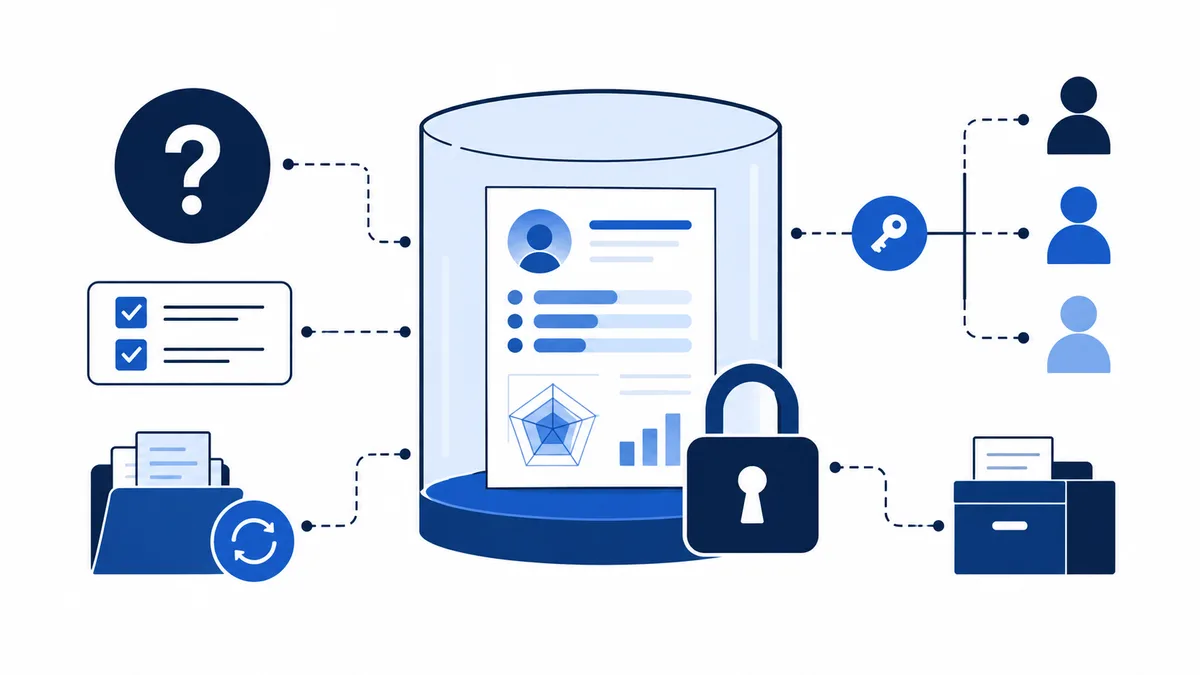
Before submitting responses, ask the sponsor to explain the assessment’s purpose, who can access your answers and report, whether results may be reused, how long records remain, and what happens if you decline. If a material part of that data path or a possible employment consequence is unclear, ask for clarification before deciding.
What is the assessment for, and what happens if I decline?
Before answering an EQ questionnaire, establish what process it belongs to. The same set of questions about noticing emotion, managing reactions, or responding to others could be used privately to guide self-reflection, offered as an optional workplace development exercise, or included in a formal occupational evaluation commissioned by an employer. The label “EQ assessment” does not tell you which process you are entering. Ask who commissioned this specific assessment, what they want to learn, and what they plan to do with the result. Those answers set the stakes: a private prompt for reflection gives the sponsor no employment decision to make, while a formal evaluation may be designed to inform a defined occupational judgment.
The American Psychological Association’s “Disclosure of Test Data and Test Materials: Just the FAQs” identifies purpose, intended use, possible consequences, and access to test information as matters psychologists should address around testing. Its advice is professional guidance for psychologists, not a privacy statute that automatically governs every online EQ quiz. The APA’s “Professional Practice Guidelines for Occupationally Mandated Psychological Evaluations” has a narrower scope: formal evaluations conducted by psychologists for occupational purposes. It calls for clarity about referral authority, responsibilities to the examinee and referral source, confidentiality limits, report communication, and consequences. A self-directed educational profile is not transformed into that kind of evaluation merely because someone takes it at work.
For a workplace invitation, ask what decision, if any, could follow: Is the result intended only to inform a development conversation, or might it enter a separate employment process? Then ask what happens if you decline. Does nothing change, is an alternative offered, or does the organization record nonparticipation? A clear development purpose and a clear notice can make a workplace exercise reasonable and useful; checking the purpose is not an accusation that the sponsor is acting improperly. The practical issue is whether the stated purpose matches the consequence attached to participation or refusal. If the answer is vague, narrow the question: is participation tracked, who receives that information, and is there a stated alternative? This keeps a discussion about the assessment’s purpose separate from assumptions about pressure or consent.
Legal disclosure duties depend on where you are and how the data is processed. The UK Information Commissioner’s Office page “What privacy information should we provide?” describes information such as processing purposes and recipients under UK GDPR rules; it does not establish a global right to a particular answer in every setting. The APA materials likewise express professional guidance within their stated scope. Treat them as useful standards for questions to raise, then assess legal rights under the law that applies to you. Before submitting, you should be able to explain in ordinary terms who is asking, what they seek to learn, what action may follow, and what changes if you say no.
Sources: Disclosure of Test Data and Test Materials: Just the FAQs; What privacy information should we provide?; Professional Practice Guidelines for Occupationally Mandated Psychological Evaluations
Who can see the answers, reports, and group summaries?
“Confidential” is incomplete unless it names the records and the people who can access each one. An EQ process may create item-level responses, an individual result or report, a summary prepared for a manager, and notes from a follow-up conversation. These are different records, and access to one does not automatically answer who can see the others. Ask whether the employer receives raw answers or only a report; whether a manager, HR staff, or the person who commissioned the assessment sees it; whether the participant gets a copy; and whether the assessment provider or its authorized staff can access identifiable records to administer the service. Also ask whether access is limited by job role and whether the sponsor can forward or discuss the report beyond the original referral. A promise that only named recipients receive a file is more informative than a general assurance that the process is confidential.
Role names matter because “the company” can conceal several distinct recipients. A referral source may commission a formal occupational evaluation, a psychologist may conduct it, and an organization may receive a report for a stated purpose. The APA’s “Professional Practice Guidelines for Occupationally Mandated Psychological Evaluations” addresses the need to clarify responsibilities to the examinee and referral source, limits of confidentiality, and communication of results in that specific professional setting. It does not establish the access rules for every self-administered EQ product. APA’s “Disclosure of Test Data and Test Materials: Just the FAQs” also supports discussing access to test information, but that professional advice should not be mistaken for a guarantee about a provider’s systems or an employer’s policy.
A useful answer names each record and recipient rather than repeating that information is “private.” For example, ask: “Will my manager receive my individual report, or only a group summary? Can HR see my item responses? Does the provider retain identifiable answers? Will I receive the same report the sponsor sees?” The sequence matters: a group summary can coexist with individual reports, and an employer might receive one record while the provider handles another. The UK ICO’s “What privacy information should we provide?” treats recipients as a distinct privacy-notice topic under UK GDPR; whether particular disclosure duties apply depends on jurisdiction and circumstances.
Illustrative data flow: a participant completes a questionnaire through a provider; the provider generates an individual report for that participant and sends a separate summary to the sponsor. In that example, the sponsor’s access to a group summary says nothing by itself about who can inspect the individual answers or whether the participant’s report is shared. Ask the sponsor or assessor to confirm the actual path for each record, including any notes created in a conversation. A legitimate referral or administrative need may involve more access than a participant expects; having the scope explained before responding lets the participant understand who will see what.
Sources: Disclosure of Test Data and Test Materials: Just the FAQs; Professional Practice Guidelines for Occupationally Mandated Psychological Evaluations
Does an anonymous or group result still identify me?
Ask what “anonymous” means in the actual data flow. Removing a name from a response is one step; replacing it with a code is another. If a provider or sponsor keeps a table that connects that code to a participant, the record is coded or pseudonymous in practical terms: someone with access to the key may still reconnect it. Ask who creates and holds any linking key, whether it is retained, and which roles can use it. If the answer is that no key exists, clarify whether another record—such as an invitation list, login, or device identifier—can connect a response to you. The word on a notice matters less than the identifiers and access routes the process actually uses.
NIST’s “IR 8053, De-Identification of Personal Information” describes de-identification as transforming information to reduce the risk that it can be associated with individuals. That framing makes anonymity a question about residual linkage risk, not simply whether a name appears in a spreadsheet. A response may contain no direct name yet remain recognizable through a combination of details: a rare role, a small work unit, a distinctive event, or demographic categories reported together. Ask whether those details are collected, whether results are broken out by team or subgroup, and who can see the underlying records. NIST provides general technical guidance; it does not establish that a particular employer can identify a respondent, define a safe group size for EQ reporting, or supply a threshold that applies to every team. The relevant disclosure should explain its own audience and level of detail.
A group average can reduce exposure by withholding individual scores and showing only a combined result. It still does not answer whether an individual report exists separately, whether the assessor or provider can see it, or whether a small or unusually described group makes a person recognizable. Ask both questions: what will the group receive, and what happens to each participant’s record? A useful answer specifies whether individual reports are generated, who receives them, and how results are grouped or suppressed when the described context could point to someone. Aggregation is a meaningful safeguard when it limits what recipients can learn; it is not, by itself, proof that item-level responses or individual reports are inaccessible.
Brambin EQ’s “Privacy Policy | Brambin EQ” offers one provider-specific example: its policy says responses and results are associated with a random device ID. That is a disclosure about the service’s stated data handling, not evidence that responses are impossible to link, and not an independent audit of implementation. A device ID is not the same thing as a participant name; the practical question is whether the provider or another party can connect it with other information. Do not generalize this policy to other EQ assessments. Before relying on any provider’s promise, ask what its identifier is, whether it can be matched to an account or invitation, who can access that connection, and whether a separate individual result is delivered. Removing direct identifiers and reporting summaries can lower exposure; the notice should let you understand what connection paths remain.
Sources: IR 8053, De-Identification of Personal Information; Privacy Policy | Brambin EQ
Where are the records processed, and who handles them?
The employer or assessor may not be the only organization involved once an EQ questionnaire is submitted. The service that hosts the form, stores responses, generates a report, or supports account administration may handle data under its own role in the process. Ask which organization decides why the information is collected, which assessment provider and hosting or support services process it, and whether subcontractors can access identifiable responses or reports. Then ask where storage and processing take place, including whether data may be accessed from another location. The answer should distinguish the organization responsible for the processing from the vendors carrying it out; a list of brand names without their roles leaves the data path unclear.
The European Commission’s “Information for individuals” explains that GDPR information may include the controller’s identity, purposes, recipients, retention, rights, and international transfers. That is EU GDPR guidance for its applicable context, not a global checklist imposed on every assessment. It gives a practical way to read a notice: look for the organization accountable for the stated processing, the categories of recipients, and an explanation of international handling where relevant. If the provider says it uses a hosting or assessment vendor, ask what that vendor does and whether it can see identifiable answers, reports, or only technical data. Also ask whether the sponsor receives data from that vendor and in what form. Clear responsibilities make it possible to understand who to contact about the records and which organization has access at each stage.
A server’s location and the legal question of a restricted transfer are related but not identical. The UK Information Commissioner’s Office page “International transfers” explains that transfers of personal data outside the UK can fall under UK transfer rules and may require appropriate safeguards. The location of a server abroad alone does not show that a restricted transfer has occurred, that a rule has been breached, or that a vendor is unsafe. The relevant facts include who sends or makes data available, where the recipient is, and what transfer mechanism or safeguard applies. The ICO source speaks to the UK framework; it should not be used to state the EU rules or a reader’s obligations in another jurisdiction.
If the notice names overseas processing or several providers, ask the sponsor to describe the chain in plain terms: which organization controls the purpose, which service providers handle the information, what each can access, and where processing happens. Under the relevant regime, the notice or responsible organization should explain the applicable transfer information and safeguards where required. A provider can use established vendors and appropriate safeguards; outsourcing alone is not a reason to assume exposure. The useful test is whether the assessment sponsor can explain the responsibilities and handling clearly enough that you know who receives the records and what protections govern cross-border processing.
Sources: Information for individuals; International transfers
Can I really say no at work?
A workplace assessment is voluntary in practice when an employee can decline without a meaningful penalty or loss of an opportunity they would otherwise have. A label in an invitation is only one part of that answer. Before starting, ask directly: Is participation optional? Will anyone record who completes it or declines? Will my manager be told that I said no? Could declining affect access to a development conversation, training, a project, or another work opportunity? These questions focus on the cost of refusal, not on whether a manager has a legitimate reason to offer development. They also make it easier to distinguish taking part by choice from taking part because the employee believes refusal will be noticed or held against them.
That concern has a basis in workplace power, though it cannot settle any individual case by itself. The UK Information Commissioner’s Office discusses the employer-worker power imbalance in its guidance [“Data protection and monitoring workers”](https://ico.org.uk/for-organisations/uk-gdpr-guidance-and-resources/employment/monitoring-workers/data-protection-and-monitoring-workers/), explaining why consent may not be freely given in some employment data-processing situations. The guidance concerns UK data-protection analysis, including worker monitoring; it does not establish that every workplace EQ assessment is involuntary, or that consent must always be the lawful basis. An employee’s reasonable perception of pressure is a practical signal to investigate the arrangement, not a legal conclusion about the sponsor’s obligations.
Consider an illustrative situation: a manager calls an emotional-skills questionnaire optional, while also asking the team to report who has completed it before a development workshop. The employee can ask whether nonparticipants may still attend, whether the manager needs completion information, and whether anyone will follow up individually about refusal. If the sponsor says the exercise is low-stakes and no opportunity depends on completion, that may make declining straightforward. If the answers suggest that refusal will be singled out or could close a development route, the employee has learned something material even if no formal penalty is stated. The relevant test is the concrete consequence the sponsor describes and the employee reasonably anticipates—not the adjective in the invitation.
A clear answer can also distinguish routine administration from pressure: perhaps the provider needs to know who has received a link, while the manager receives no response data and completion has no bearing on workshop access. The employee can ask for that distinction in writing and decide whether it resolves the concern. Where participation is genuinely optional, low-stakes, and unrelated to work opportunities, the mere existence of a manager-worker power imbalance does not mean every employee experiences coercion. Where the practical answer remains unclear, the employee can request an alternative way to develop the same skills or simply defer the assessment. Whether a particular arrangement satisfies applicable law depends on jurisdiction, processing purpose, and other facts; the choice questions help clarify the situation without pretending to decide that legal issue.
Sources: Data protection and monitoring workers
How long are answers kept, and what can happen to them later?
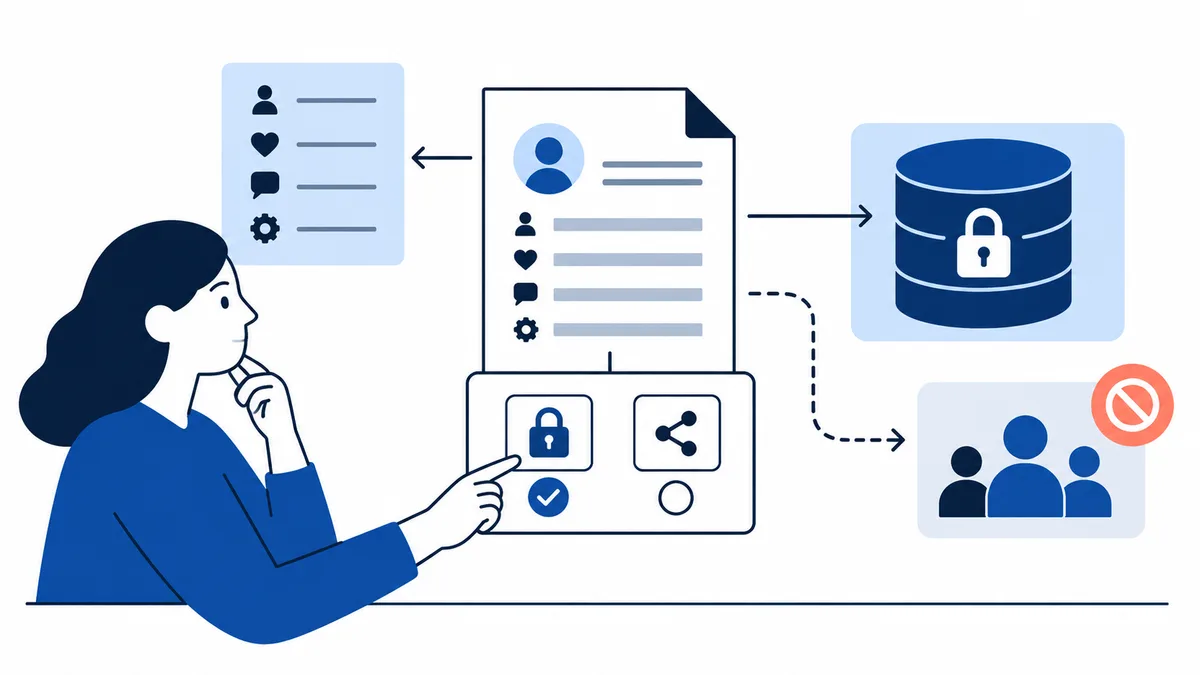
Retention is the period an organization keeps identifiable assessment information before deleting it or changing how it is held. “We keep data only as long as necessary” does not tell a participant when that period ends. Ask what starts the clock: completion of the assessment, delivery of a report, the end of a course, closure of an account, or another event. Then ask whether the schedule differs for item-level responses, an individual report, a group summary, and administrative records. A response set may be removed after report delivery while a derived report remains available for a stated period; a single general schedule can hide that distinction. Ask for the trigger and duration for each record that can still be linked to you.
The UK Information Commissioner’s Office includes retention periods among the privacy information described in [“What privacy information should we provide?”](https://ico.org.uk/for-organisations/uk-gdpr-guidance-and-resources/individual-rights/the-right-to-be-informed/what-privacy-information-should-we-provide/). The European Commission’s [“Information for individuals”](https://commission.europa.eu/law/law-topic/data-protection/information-individuals_en) likewise explains that GDPR information can cover how long data is kept or the criteria used to set the period. These are jurisdiction-specific summaries, subject to the applicable rules and exceptions; they do not promise one retention term for EQ records everywhere. They do support a useful follow-up: if a sponsor cannot give a fixed date, what event or criterion determines when each identifiable record is removed?
Deletion needs the same level of specificity. Ask whether a participant can request deletion, which organization receives the request, what information the requester must provide, and which records the process covers. Would it reach both the provider’s identifiable responses and the employer’s copy of a report? What happens to backup copies, audit records, or documents retained under a stated operational or legal requirement? A deletion route in a notice describes a way to make a request; it does not by itself establish that every copy will disappear immediately or that a particular legal entitlement applies. If some copies remain, ask which category is kept, for how long, and whether it remains identifiable or available for ordinary use.
The record may also outlive the original development exercise in another form. Ask whether identifiable answers or reports can later be reused for research, product development, service improvement, or a separate workplace decision. If reuse is proposed, does the sponsor need identifiable responses, or would a genuinely de-identified dataset suffice? Who approves that use, and is it covered by the notice or a separate choice? These are questions about the planned data path, not claims that assessment providers commonly reuse answers. The ICO’s UK guidance and the Commission’s GDPR explainer describe retention and related processing information within their respective frameworks; the actual scope of a person’s rights depends on where and how processing occurs.
Some records may have a stated operational or legal reason to remain after the assessment has served its immediate purpose. That possibility is compatible with a useful, bounded schedule: the sponsor should identify the record category, the reason it remains, who can still access it, and the event or period that ends retention. A practical answer could distinguish responses deleted after a defined reporting step from reports kept through a course or administrative cycle, while explaining any limited backup or record copies. The reader does not need a blanket promise that nothing persists; they need to know what persists, why, for how long, and whether later use is allowed. If the schedule, deletion scope, or reuse terms are missing, ask for that specific detail before deciding whether to submit responses.
Sources: What privacy information should we provide?; Information for individuals
Can an EQ score be reused in another decision?
Ask what happens to the result after the report is delivered. Will it stay with you as a reflection aid, or might someone combine it with performance records, feedback, attendance, or other information? Could it inform a later assignment, review, development opportunity, or another decision? These are questions about the intended data path, not claims that employers commonly use EQ scores this way. A sponsor should be able to describe whether a result has any role beyond the original assessment and what that role is.
The UK Information Commissioner’s Office explains in “Rights related to automated decision-making, including profiling” that special rights and safeguards concern certain decisions made solely by automated means where they produce legal or similarly significant effects. A calculation performed by software is not, by itself, enough to show that such a decision has occurred. The relevant issue is whether an automated process makes the consequential decision without meaningful human involvement and whether the decision and its effects fall within the guidance’s scope. The ICO’s “What privacy information should we provide?” identifies relevant automated-decision information as a privacy-notice topic in the UK GDPR context. Neither page means that every generated score triggers a right to human review.
If a sponsor says that a score may influence a later decision, ask who actually makes that decision, what other information is considered, and whether a person reviews the result. Ask what that person can do: can they disregard the score, check whether it belongs to the right person, or correct an inaccurate record before acting? A human name in a workflow is not enough to explain the process if the person cannot examine or change the outcome. Conversely, where the result is shown only to the participant for reflection and is not passed into another decision, ask the sponsor to state that boundary and how it is maintained. It is useful to ask this before completing the assessment, because the same answer can have different significance depending on whether it is merely discussed with the participant or copied into a record used by someone else. Ask whether the sponsor can identify the recipients and the decision point in advance, rather than relying on a general statement that results may support development. If the intended use changes later, ask how participants will be informed and whether they can decline that additional use.
These questions matter even when no automated-decision rule applies. They distinguish a private learning exercise from a record that may shape how someone is assessed or assigned. The UK ICO guidance is jurisdiction-specific and conditional; it does not establish what rights apply to a reader elsewhere, or classify a particular EQ process without its facts. The assessment itself is intended for individual development, not hiring, promotion, ranking, or performance scoring. If a proposed process would put the profile into those decisions, that is a substantive boundary to raise with the sponsor rather than a use to infer from the privacy notice.
Sources: Rights related to automated decision-making, including profiling; What privacy information should we provide?
Do the questions or the result carry health or employment stakes?
Look at both the questions and the decision around them. Ask whether the assessment asks only about recent emotional behavior and choices, or also requests health, disability, treatment, or medical-history information. Then ask what the result can affect: a personal development conversation, an employment review, hiring, promotion, fitness for a role, or an accommodation decision. The letters “EQ” do not settle what kind of evaluation is taking place. Purpose, item content, who administers the process, its stage, and the jurisdiction all matter. Ask whether participation is part of a voluntary learning activity or a required step in a formal process, and whether the assessor is expected to make a clinical, fitness, or employment recommendation. The answer should describe what the assessment is intended to do, not simply repeat its product name. A skills profile that asks about recognizing frustration or responding to feedback has a different apparent purpose from an evaluation that requests medical history or is commissioned to answer a fitness question; the full context still determines how the process should be understood.
The American Psychological Association’s “Professional Practice Guidelines for Occupationally Mandated Psychological Evaluations” concerns formal occupational evaluations conducted by psychologists. It addresses matters such as the referral purpose, responsibilities to the examinee and referral source, confidentiality limits, communication of results, and potential consequences. That scope makes it relevant when an employer commissions a formal psychological evaluation; it is professional guidance for that setting, not a rule that every online emotional-skills questionnaire is an occupational evaluation. Ask who commissioned the process, who is conducting it, and what kind of report the organization expects before treating the label on the questionnaire as decisive.
For a U.S. pre-employment process, the Equal Employment Opportunity Commission’s “Pre-Employment Inquiries and Medical Questions & Examinations” addresses when disability-related inquiries and medical examinations are restricted under the Americans with Disabilities Act. Its relevance turns on the nature and purpose of the question or examination and the employment stage. A question about how someone usually responds to disagreement does not automatically become a medical inquiry because it concerns emotion. If items ask about a diagnosis or are designed to reveal a medical condition, however, the reader has a concrete reason to ask the sponsor how the information is classified and why it is needed. This narrow U.S. distinction should not be generalized to other jurisdictions or every employment situation.
Before responding, ask the sponsor to identify the assessment’s purpose, the kinds of information requested, the professional role of the assessor if one is involved, and the decisions the report may inform. If the answers reveal a formal occupational evaluation or a significant health, fitness, accommodation, or employment consequence, and the applicable rules remain unclear, seek advice specific to the relevant jurisdiction and process. An ordinary educational reflection on recent emotional habits is not automatically a medical examination; the questions above help establish whether the surrounding use has changed the stakes.
Sources: Professional Practice Guidelines for Occupationally Mandated Psychological Evaluations; Pre-Employment Inquiries and Medical Questions & Examinations
What should I do with the answers I get?
Use the answers to make a proportionate choice. Proceed if you understand why the assessment is offered, who can see your responses or report, whether information may be reused, how long identifiable records remain, and what happens if you decline. “Clear” does not mean risk-free; it means you can describe the arrangement and decide whether it fits your purpose and comfort. If one point is missing, ask a focused follow-up, such as whether a manager receives completion status or whether a report is retained after the exercise. Give the sponsor a chance to answer before treating uncertainty as a reason to abandon the assessment.
Pause when you still cannot tell where your answers go or when an unexplained employment consequence could follow from participating or refusing. That is a practical judgment about stakes, not a legal ruling. You may accept some residual uncertainty when the likely value is worth it; the choice should reflect your circumstances, not a promise of zero risk. For private reflection on emotional habits, you can explore the Emotional Skills Profile at [/assessment](/assessment). It is an optional self-reflection route, not a requirement for resolving a workplace concern.
Questions readers ask
What privacy questions should I ask before taking an EQ assessment at work?
Ask who can see your answers, individual report, or group summary; whether a code or other details could link responses to you; how results may be used and retained; whether they can inform another decision; and what happens if you decline. The sponsor’s answers help you judge the arrangement, while legal rights depend on jurisdiction and context.
Sources
- Disclosure of Test Data and Test Materials: Just the FAQs
APA guidance supports asking in advance about a psychological assessment's purpose, intended use, potential consequences, and who may receive test data. It addresses psychologists' professional duties and does not create universal privacy rights.
- What privacy information should we provide?
UK ICO guidance describes privacy notice information including purposes, recipients, retention periods, rights, and relevant automated decision-making details, subject to the facts and UK GDPR rules.
- Professional Practice Guidelines for Occupationally Mandated Psychological Evaluations
The APA's 2017 professional practice guidelines apply to psychologists conducting formal occupationally mandated evaluations, including employment, credential, and fitness evaluations. They recommend clarifying referral purpose and authority, responsibilities to examinee and referral source, limits of confidentiality, recipients, report communication, and relevant consequences. The document is aspirational professional guidance, not a universal privacy law or a standard for every online EQ questionnaire.
- IR 8053, De-Identification of Personal Information
NIST's technical report describes de-identification as transforming personal information to reduce the risk of associating data with individuals. It supports asking what linkage risks remain; it supplies no EQ-specific anonymity guarantee or minimum group-size threshold.
- Data protection and monitoring workers
UK ICO employment guidance identifies the employer-worker power imbalance as relevant to whether consent is freely given in data processing. This supports asking whether workplace participation is genuinely optional, while the legal analysis depends on purpose, lawful basis, and circumstances.
- Information for individuals
The European Commission's GDPR explainer describes information individuals may receive about controller identity, purposes, recipients, retention, rights, international transfers, and automated decision-making, with legal conditions and exceptions. It supports jurisdiction-specific questions, not a universal rule for all readers.
- International transfers
UK ICO guidance explains that transfers of personal data outside the UK can be subject to transfer rules and safeguards. It supports asking where data is processed and whether a restricted transfer occurs; location alone does not establish noncompliance.
- Pre-Employment Inquiries and Medical Questions & Examinations
The U.S. EEOC explains that ADA restrictions apply to disability-related inquiries and medical examinations at specified employment stages. This supports distinguishing questions about recent emotional behavior from questions or procedures designed to reveal medical conditions; it does not classify every EQ assessment as a medical examination.
- Privacy Policy | Brambin EQ
Brambin EQ's own policy gives a product-specific example of how its service says it associates responses and results with a random device ID, identifies service recipients, and handles retention or deletion. This is evidence only of that provider's stated practices at access; it cannot be generalized to other EQ assessments or treated as independently audited behavior.
- Rights related to automated decision-making, including profiling
UK ICO guidance describes rights and safeguards related to certain solely automated decisions with legal or similarly significant effects, with conditions and exceptions. It supports asking whether assessment results enter profiling or consequential automated decisions, without implying that every calculated score triggers human-review rights.
Apply it to the real situation
Turn self-reflection into one behavior to notice next
From this guide: Once you understand where assessment responses go, consider whether a private reflection profile could help you identify an emotional habit or development priority.
The Emotional Skills Profile offers a private, 32-item educational reflection on emotional habits and authored scenarios. It can help you consider which behavior to notice or practice next. It is not a hiring score or standardized ability measure. Explore the profile if that kind of personal reflection would be useful.