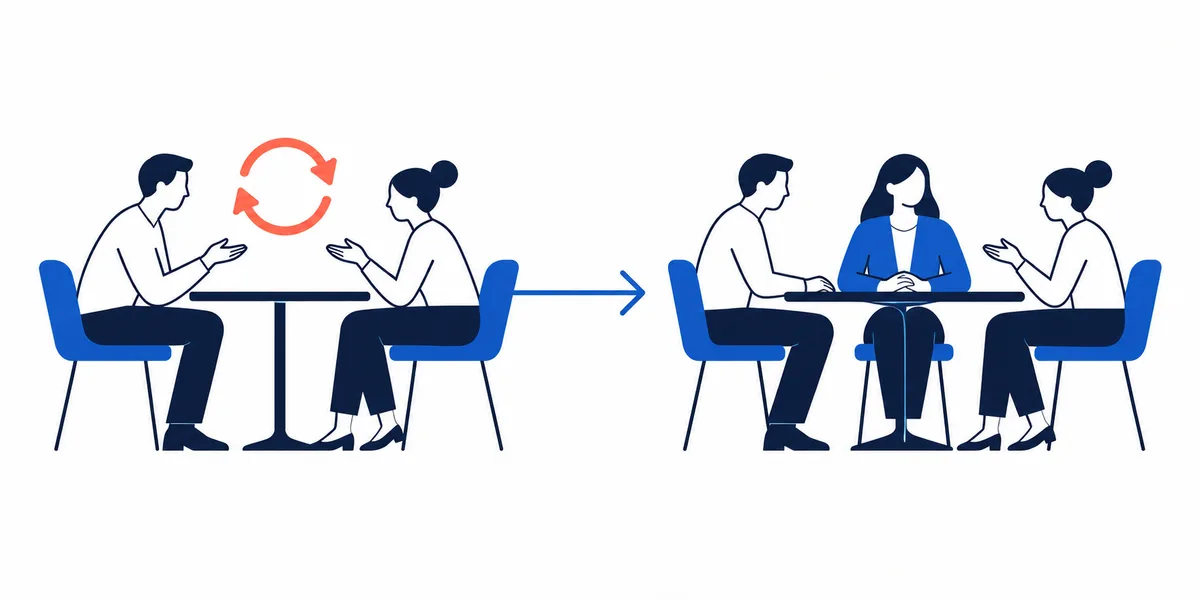
Try one more direct conversation only if the earlier one lacked a clear, behavior-specific request or a safe chance for both people to respond. If a clear attempt failed and the issue is about how you will work together, ask your employer about voluntary mediation before paying personally. Use formal procedures for allegations or problems that need investigation, accountability or protection.
Should I try one more conversation first?
A disagreement returning after a conversation does not automatically mean you failed to communicate. It may mean the earlier talk never produced an agreed request, the other person could not respond safely, or the underlying problem is not a relationship misunderstanding at all. The useful first question is narrower: did both of you have a fair chance to describe what keeps happening and agree on what should change at work?
If the previous exchange was rushed, vague, or dominated by replaying who started it, one more direct conversation can be a reasonable step. It should be a different conversation, with a specific behavior and a request about future work. If you already made that request clearly, heard the coworker’s view, and the same pattern continues, another attempt to persuade them may simply reproduce the same exchange. At that point, ask your manager or HR about mediation or another route. Acas presents informal resolution as a sensible starting point where appropriate and mediation as an option when that does not resolve the problem.
This is a UK-specific guide because the practical sources here are Acas, GOV.UK and CIPD. Policies, access to mediators, confidentiality rules and legal procedures vary by country and employer. In the UK, the employer may also be the right first contact even when you have not decided whether to make a formal complaint: Acas says an employer should take a raised problem seriously and consider an informal meeting if it cannot resolve the matter straight away.
Sources: What mediation is and how it can help; How to raise a problem at work
What does a useful direct attempt need to include?
A useful conversation moves from a recurring scene to a work request. Name what happened in observable terms, describe its effect on the task or handoff, and say what you would like to happen next. For example: “When the project decision changes after our handoff, I have to redo the schedule and the team gets two versions. Could we put changes in the shared channel and confirm who owns the final version?” This is an illustrative example, not evidence that a particular script works for every conflict.
Keep the distinction between observation and motive. “The last two updates arrived after the agreed handoff” is something both people can check. “You are trying to make me look unreliable” is an explanation of intent, and the other person may reject it before the practical issue is even discussed. You do not have to pretend that impact is small. You can say the repeated change is costing time or leaving you accountable for a decision you did not make, while staying open to a different account of why it happens.
Emotional awareness helps here in a modest, practical way: notice whether irritation or embarrassment is shaping the first sentence; pause long enough to choose words that make the issue discussable. Regulation does not mean suppressing a legitimate concern. It means deciding whether this is the moment and format in which you can state it clearly. Empathy is not agreement either. Ask what constraint the coworker sees, then check what you heard: “So you need room to revise the plan after client feedback, and I need to know which version is current. Have I got that right?”
A request should describe an action both people can recognize later. “Respect me more” expresses a real concern, but it gives neither person a shared test. “Please raise the change with me before sending the revised schedule” is more specific. A boundary may be necessary when the behavior continues: “If the deadline changes without a handoff, I will flag the risk to the project lead rather than absorb the missed time.” A boundary names what you will do to protect the work; it is not a threat to force agreement.
Before ending, summarize any points of agreement, name what remains unsettled, and choose a time to check whether the arrangement is working. Acas’s guidance supports informal discussion and employer-supported meetings, but it does not establish that a particular communication technique resolves all recurring disagreements. The test is whether the conversation produced a clear next step and whether the other person had a genuine opportunity to answer. If that has already happened without change, move the process forward instead of repeating your case at greater volume.
Sources: How to raise a problem at work; What mediation is and how it can help
What can mediation change that another conversation may not?
Workplace mediation is a voluntary, facilitated process in which an impartial third person helps coworkers discuss a dispute and work toward their own agreement. The mediator is not there to decide who was right about the past. Acas describes the focus as finding a way to work together in future. That makes mediation most relevant when the relationship or communication pattern is obstructing ordinary work and both people can take part freely.
The added value is structure. A mediator can speak with each person separately before a joint meeting, give each a chance to explain what they want from the process, and help keep the discussion on workable arrangements. Acas’s own mediation service describes these separate meetings followed by a joint meeting in its usual format. That sequence can matter when an unstructured conversation repeatedly slides into interruptions, accusations or a deadlock over the original incident.
The parties retain control over whether they agree to an outcome. Possible arrangements might concern communication, division of tasks or how future changes are raised. An agreement may include a review date, so the coworkers can see whether it is usable in practice. A mediator can help them identify the unresolved point and keep each response specific; the mediator cannot make either person sincerely accept the other’s account or guarantee that an agreed behavior will continue.
Mediation therefore differs from adjudication. An investigation gathers evidence and reaches findings under an applicable procedure. Mediation helps participants negotiate how to work together; it does not ordinarily establish what happened or impose a penalty. If your main question is “Who made this decision, and did they breach a policy?” mediation may leave the question unanswered. If the question is “How can we handle the next handoff without restarting this argument?” the facilitated discussion may fit better.
Confidentiality also needs a precise explanation. Acas says the mediator agrees with everyone what information can be shared outside mediation. That is not the same as assuming that nothing can ever be disclosed or recorded. Before agreeing, ask what the employer will be told, whether any written agreement is kept, who can see it, and what exceptions apply. The answers depend on the service and its terms.
A useful mediation request is not “make my colleague admit they were wrong.” It is “help us agree on a reliable way to handle changes to the work.” If the other person will not participate voluntarily, or if the process cannot address the needed decision, mediation may not be the right next step. Ask what happens if there is no agreement and what workplace process remains available.
Sources: What mediation is and how it can help; How Acas mediators work
When is mediation the wrong tool?
Use the employer’s formal route when the concern needs investigation, a conduct decision, or protection from harm. An allegation of serious harassment or discrimination should not be redirected into a private conversation simply because mediation sounds less confrontational. GOV.UK distinguishes mediation from formal procedures and says it is not suited to disputes that need formal investigation, including harassment or discrimination. CIPD likewise advises that serious harassment complaints should be handled through formal procedures.
The distinction is about the job the process must do. A disagreement about the timing of a handoff may be a relationship and coordination problem. A claim that someone repeatedly targeted a colleague with discriminatory conduct raises questions of evidence, policy and accountability. A facilitated discussion may sometimes help workplace relationships at a later stage, but it does not replace the process that must establish facts or decide a complaint. Follow the employer’s applicable policy and seek appropriate advice if the facts or rights at stake are unclear.
Pay, dismissal, disciplinary action and safety can also call for routes with powers mediation does not have. The exact division depends on the issue and local rules. If you need a decision about a contractual entitlement, a finding about alleged misconduct, or steps to prevent immediate harm, say that explicitly when contacting HR or a manager. Ask what process applies and whether a formal report is needed. Do not accept an informal meeting as a substitute for a required procedure without understanding the consequences.
Power differences deserve attention, even when the disagreement sounds interpersonal. A voluntary invitation is not meaningful if one participant believes refusal will damage their job, or if the proposed mediator is not seen as impartial. The official materials reviewed describe voluntary participation and impartiality as central features; from that, it is reasonable to check whether both people can speak freely and whether the facilitator has a conflict of interest. This is a practical suitability check, not a claim that every hierarchy makes mediation impossible.
You can separate routes without deciding the whole case alone. Tell the employer what happened, what continues, what outcome or protection you need, and what you have already tried. Ask whether the issue should be handled formally, whether mediation is appropriate alongside another step, or whether no contact or work adjustments are needed while the concern is reviewed. Keep dates and relevant messages according to workplace policy. That record helps you describe the issue accurately; it does not turn your account into a formal finding.
When the dispute is safe, narrow and centered on working arrangements, mediation remains a possible option. When it concerns alleged wrongdoing or requires someone with authority to make a finding, ask for that formal process. The label “conflict” should not flatten those different needs into one solution.
Sources: Solve a workplace dispute: Mediation, conciliation and arbitration; Mediation: An approach to resolving workplace conflict; How to raise a problem at work
Does paying for mediation buy a dependable result?
No evidence reviewed here establishes a dependable resolution rate for an individual coworker dispute, or shows that an employee should pay privately. The available guidance supports mediation as one possible process; it does not promise a result. Before spending your own money, ask whether the employer has an internal mediator, a standing relationship with an external provider, or a policy that covers the cost.
There is a useful example of why evidence must be read by what it actually evaluates. IFF Research’s independent evaluation for Acas examined its Certificate in Internal Workplace Mediation training. The Acas summary reports survey results from 125 delegates who took the course between July 2021 and June 2022, plus case studies in four organisations involving interviews with four delegates and three senior leaders. Those participants and organisations can describe training experience and its perceived application. The study design does not compare mediated disputes with unmediated ones, and it cannot establish that paying for a mediator will resolve your dispute.
Acas guidance for employers considering external mediation says to check that the mediator will not take sides and to discuss the contract, costs and timings with the provider. Those are practical questions for an employee too, though the employer may be the contracting party. Ask who selects the mediator, how independence is protected, whether each participant can decline, whether separate preparation is included, how long the process may take, and what the fee covers. Ask who will pay before anyone books a session.
Do not infer that the absence of a public price means the service is free, or that a provider’s quoted cost predicts value. The price alone cannot tell you whether the process fits the problem. An inexpensive mediation that cannot address a policy complaint is a poor match; an employer-funded process with a neutral facilitator may be worth exploring where the ongoing relationship is the problem. The right comparison is between the actual service, its cost to you, and the alternative route your workplace makes available.
Also ask what happens if mediation stops before a joint meeting, if one person declines, or if no agreement is reached. Acas’s support process allows people to decide after an initial separate meeting whether they want to continue. Confirm what the mediator will tell the employer if someone opts out and whether either person can seek formal action afterward. These details affect whether you can consent with a clear understanding of the process.
The commercial decision is therefore conditional. Paying personally may make sense only after you know the employer will not arrange or fund a suitable process, the issue is appropriate for mediation, both parties are willing, the provider is independent, and the fee and terms are clear. No source reviewed supports skipping those checks because mediation is generally described as beneficial.
Sources: Evaluation of Acas Certificate in Internal Workplace Mediation training; Introducing mediation at work; Solve a workplace dispute: Mediation, conciliation and arbitration
Where do emotional skills fit in the decision?
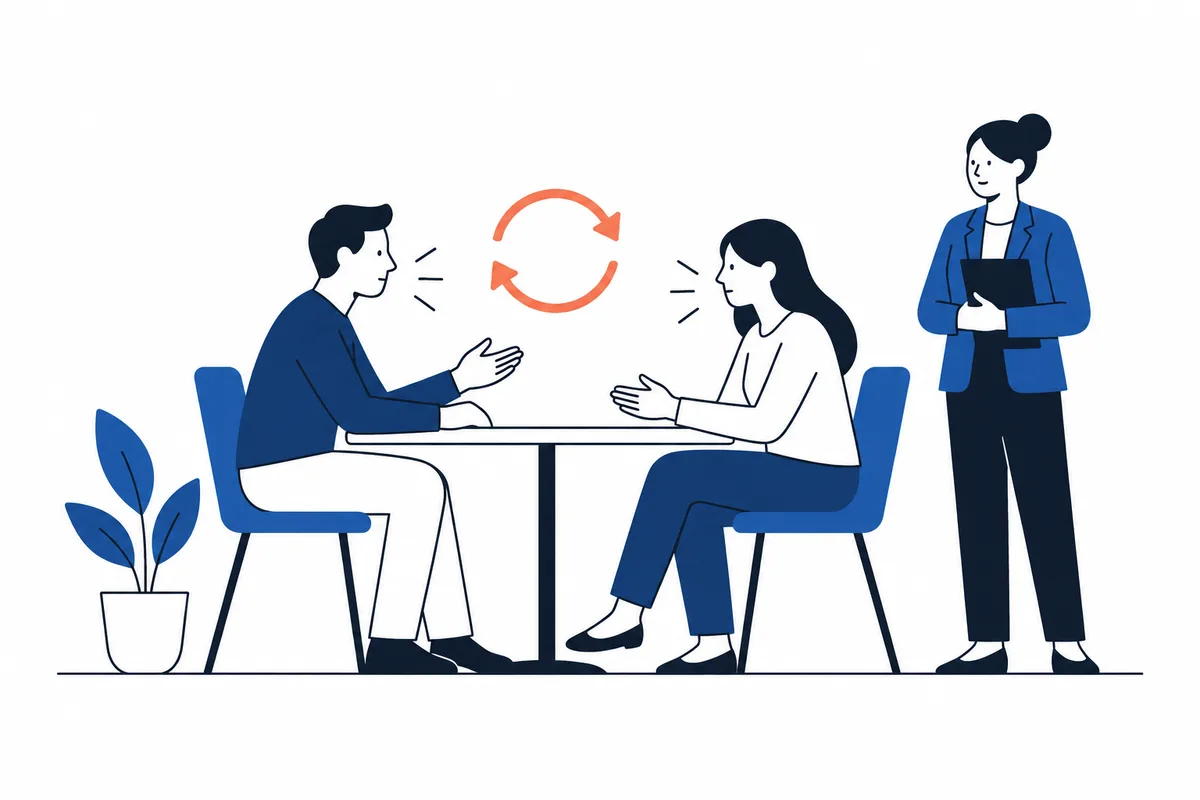
Emotional intelligence (EI or EQ) refers to a family of approaches to emotion-related abilities or tendencies, such as noticing emotion, understanding what may be driving it and managing a response. Tests do not all measure the same thing. A self-report asks how someone sees their usual behavior; an ability test asks them to solve emotion-related problems. Neither should be mistaken for a verdict on who caused a workplace disagreement.
One systematic literature review covered 29 studies of emotional intelligence and conflict management. Its abstract reports that geography and culture influenced how conflicts were resolved. This matters because a behavior that signals directness in one setting may be read differently in another, and because conflict practices are shaped by workplaces as well as individuals. The review maps varied organizational conflicts; it does not compare mediation with another direct conversation or show that a particular EQ score predicts who will reach agreement.
A separate systematic review and meta-analysis by Mehler and colleagues examined workplace training in emotional intelligence, empathy and emotion regulation. It included 50 studies in its pre-to-post analysis and 27 controlled trials in a separate comparison. The controlled-trial analysis found a standardized mean difference of 0.46 (95% CI 0.30 to 0.63), while the authors also reported high heterogeneity and low methodological quality. The finding concerns measured competencies after training, not prevention of coworker disputes or success in mediation. It suggests that skills may be developed, while leaving the practical conflict decision to the circumstances and workplace process.
The practical place for emotional skills is preparation and reflection. You might notice that you become defensive when a colleague challenges your plan, ask one clarifying question before defending it, or state a boundary without guessing at motive. Those actions may help you communicate your position. If the disagreement keeps recurring, the two-person process may still need a facilitator; if there is a formal allegation, the organisation may need to investigate. Self-management cannot carry the entire responsibility for a workplace problem.
The distinction between training research and test evidence is important here. A group-level improvement after training does not validate every short quiz, prove that one person's self-report reflects maximum ability, or show that an assessment can identify the right intervention. The workplace training review itself notes that the studies varied considerably and were methodologically limited. Applying that pooled result to the Emotional Skills Profile, or to a coworker dispute, would go beyond what the review examined. For a personal choice, use the profile as a prompt to consider a behavior, then judge that behavior against what actually happens in your work.
Sources: Systematic literature review on emotional intelligence and conflict management; Training emotional competencies at the workplace: a systematic review and metaanalysis
What can a private EQ reflection add after the process choice?
After you have identified the process the disagreement needs, a private reflection can help you prepare your part. The 32-item Emotional Skills Profile is an educational tool for reflecting on reported recent behavior and judgments about authored scenarios. It can offer a structured prompt to consider how you notice emotions, understand situations, regulate your responses and respond to other people. It does not tell you whether mediation is appropriate, assess your coworker or determine who is at fault.
Keep the result close to observable examples. If a reflection suggests that you sometimes respond quickly under pressure, look back at a specific exchange: what did you notice, what did you say, what happened next, and what would you try in a similar situation? If your account differs from what a trusted colleague observed, treat that difference as a question to explore rather than proof that either person is correct. Reports of behavior and judgments on scenarios are separate kinds of information; neither makes a population ranking available.
The profile has no validated norms or established ability-test validity. That means its output should not be read as a percentile, a fixed capacity, or evidence that you are more or less suited to handle conflict than other people. It is a private development aid, not a hiring score, diagnosis or performance predictor. Use it only for your own reflection, and keep organizational responsibility with the employer and the relevant workplace process.
If you want a structured way to examine your own emotional habits before a difficult conversation, you can explore the [Emotional Skills Profile](/assessment). It may help you choose one behavior to observe or practice. The decision between another direct conversation, mediation and a formal route still depends on what happened, what the issue requires, and what your employer’s process can do.
What should I ask for next?
If a clear, behavior-specific conversation has already failed and the disagreement concerns how you will keep working together, ask your manager or HR: “Could we explore voluntary mediation, and what internal or external option does our policy provide?” Add that you would like to understand who pays, who selects the mediator, how confidentiality works and what happens if either person does not agree to continue.
If the earlier conversation never included a specific request, try that once if it feels safe and the issue is suitable for an informal discussion. If the concern requires fact-finding, a conduct decision or protection, raise it through the formal route instead. The recurrence is a reason to change the process when the necessary conversation has already happened; it is not by itself proof of intent, fault or mediation suitability.
Before you make a private purchase, get the employer’s answer about its route and cost. A facilitator can structure a difficult exchange, but nobody can guarantee agreement. Your next step can be one practical question about the work arrangement you need and one clear request for the process that can address it.
Sources: How to raise a problem at work; What mediation is and how it can help
Questions readers ask
Should I pay for workplace mediation myself?
First ask your employer whether it can arrange or fund an internal or external mediator. Consider paying privately only if mediation fits the issue, both people can participate voluntarily, the mediator is independent, and the costs and terms are clear. No reviewed source establishes a guaranteed outcome or universal price.
Sources
- What mediation is and how it can help
Acas describes voluntary impartial mediation as future-focused relationship repair, not a decision about past fault, and gives examples of possible agreements.
- How to raise a problem at work
Acas explains informal steps and employer support routes, including meetings and mediation when a worker raises an unresolved problem.
- Solve a workplace dispute: Mediation, conciliation and arbitration
UK government guidance describes workplace mediation and distinguishes it from formal investigation routes for some serious allegations.
- Mediation: An approach to resolving workplace conflict
CIPD's professional guide describes circumstances for workplace mediation and cautions that serious harassment complaints need formal procedures.
- Evaluation of Acas Certificate in Internal Workplace Mediation training
IFF Research evaluated mediator training using 125 delegates and four organisational case studies; it was not a controlled trial of dispute outcomes.
- Introducing mediation at work
Acas advises employers setting up external mediation to check impartiality and discuss the contract, costs and timings with the provider.
- How Acas mediators work
Acas describes separate preparation meetings, a possible joint meeting, and the voluntary decision to continue after an initial meeting.
- Systematic literature review on emotional intelligence and conflict management
The opened abstract reports a review of 29 EI studies and says geography and culture influenced conflict resolution; it does not compare mediation with direct conversations.
- Training emotional competencies at the workplace: a systematic review and metaanalysis
The open review reports workplace emotional-competency training findings, substantial heterogeneity and evidence of publication bias in some included studies.
Apply it to the real situation
Turn a difficult exchange into one behavior you can practice
From this guide: If you are preparing for another conversation or mediation, the part you can examine is your own response: what you notice, how you regulate it and what you ask for.
The private 32-item Emotional Skills Profile offers a structured reflection on recent reported behavior and scenario judgments, with practical prompts for considering what to practice next. It does not determine who is right or choose the workplace process. Use it to focus your own preparation, then ask your employer about mediation or the formal route that fits the disagreement.