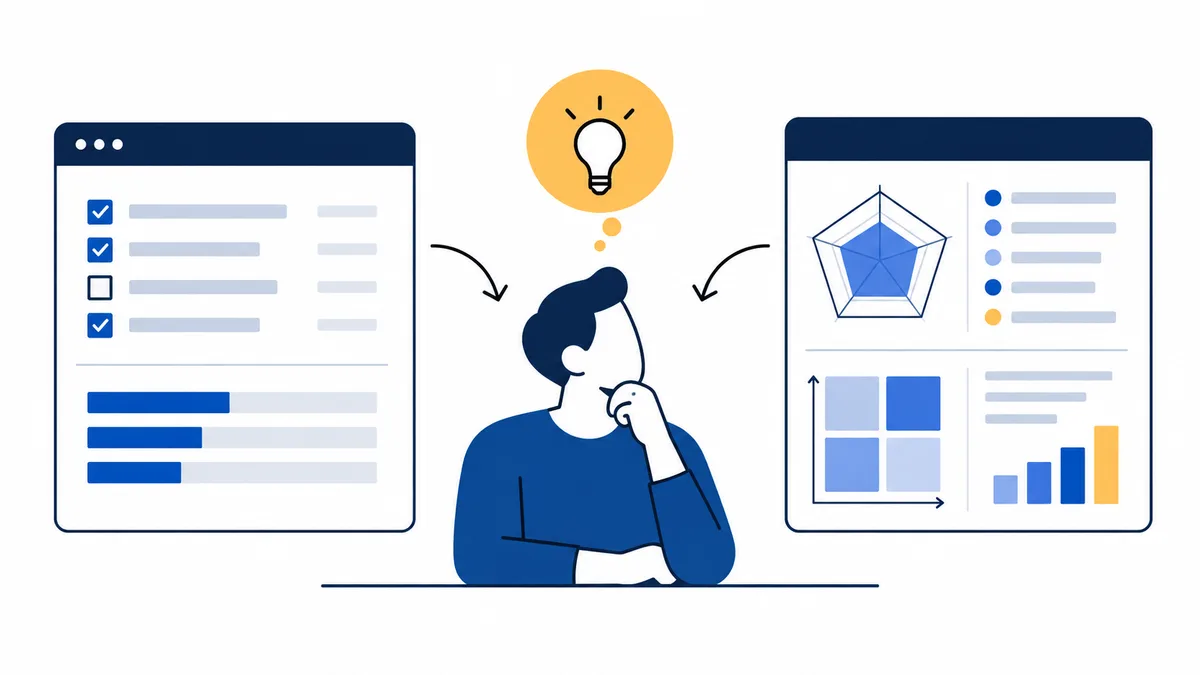
Sometimes, but payment itself tells you nothing about whether an EQ result is sound or useful. Pay only when the specific tool explains what it measures, gives evidence for the interpretation it offers, and helps you turn a recurring work or relationship difficulty into a behavior you can practice. A free quiz may be enough to prompt reflection. No direct study establishes that paid online EQ quizzes outperform free ones, so compare the actual instrument, report, privacy terms and next step rather than the price or size of the score.
A paid EQ assessment is worth it only when it changes the next step
Start with the situation that made you consider a test. Perhaps feedback in one-to-ones leaves you defensive, or you notice that disagreement ends with silence instead of a clear repair. The useful purchase is the one that helps you examine that behavior more clearly. A price tag cannot do that work on its own.
There is no head-to-head evidence in the sources reviewed here showing that paid online EQ quizzes produce better personal-development outcomes than free ones. The answer is therefore a decision rule, not a universal verdict: pay when a named instrument has a clear method, its interpretation is supported for the purpose you have, and the report offers something practical that a free prompt does not. If you only want a question to think about, a free self-reflection tool may serve just as well.
The distinction matters because “EQ assessment” covers different things. Some tools ask how you usually see your own behavior. Others give emotion-related problems and score responses. A longer report may add coaching or a debrief, but those features have value only when they improve the reader’s next action. The following comparison starts with the kind of answer each assessment produces, then asks whether its evidence and report justify a cost.
Sources: Guidelines for Technology-Based Assessment; The assessment of emotional intelligence: a comparison of performance-based and self-report methodologies
A price tag cannot tell you what the quiz measures
An EQ quiz may summarize your view of your usual habits, or sample how you answer emotion-related problems. Those are different kinds of information. A self-report asks you to endorse statements about yourself; its result reflects perceived typical behavior or capacity. A performance-based test asks you to solve tasks, then scores the answers using a stated rule. Neither should be mistaken for one universal EQ quantity.
The 2021 review “Emotional Intelligence Measures: A Systematic Review,” which searched Web of Science for research published through 2020, identified 40 emotional-intelligence instruments used with professionals. It grouped measures under ability, trait and mixed models, and described different strengths and limitations across them. Its scope was instruments for adults in workplace settings, not a consumer comparison of free and paid quizzes. The practical point is narrower: before comparing cost, find out whether two tools are even trying to answer the same question.
An especially useful check comes from a study of 223 people in a diverse community sample. The researchers compared the Mayer-Salovey-Caruso Emotional Intelligence Test, which presents problems with responses treated as having correct answers, with the Schutte self-report measure. The two scores were not related to one another in that sample. Self-report scores showed a consistent pattern of associations with self-reported coping styles and depressive affect; the performance measure showed stronger associations with age, education and having received psychotherapy. This does not make one format the winner. It shows why a self-description cannot stand in for performance on a task.
The difference becomes concrete when someone is interrupted during a tense meeting. A self-report item might ask how often they stay calm or notice what they feel. A performance task might ask them to interpret a fictional emotional situation. The first concerns their account of ordinary behavior; the second concerns answers under test conditions. Neither records what happened in that meeting. A result can give the reader a hypothesis to check, but it cannot establish what a colleague intended or explain every response.
There is also no simple “objective test versus biased survey” shortcut. An older review of the competing methods, catalogued by ETS, describes performance-based tests as having their own scoring challenges. In “Does emotional intelligence meet traditional standards for an intelligence? Some new data and conclusions,” a study of 704 participants using the earlier Multi-Factor Emotional Intelligence Scale found contradictory results from expert and consensus scoring protocols, alongside issues in factor structure and subscale reliability. The authors questioned whether that instrument reliably represented EI. A performance format may feel more test-like, but the scoring basis still deserves inspection.
Sources: Emotional Intelligence Measures: A Systematic Review; Training emotional competencies at the workplace: a systematic review and metaanalysis; Does emotional intelligence meet traditional standards for an intelligence? Some new data and conclusions
What does a useful personal-development result look like?
A useful result gives the reader a bridge from a broad skill label to an action that can be noticed in a real situation. “Improve empathy” is too vague to guide a difficult conversation. “After hearing a concern, summarize what you think the other person means and invite a correction before proposing a fix” describes something a person can try and later review.
Imagine an unnamed employee receives critical feedback about a draft shortly before a deadline. They notice irritation, wait before replying, ask which part needs revision, and restate the request to check their understanding. The exchange makes several behaviors visible: recognizing an emotional response, regulating the urge to defend, and responding to another person’s concern. One exchange does not define someone’s character. It supplies a specific example that can be compared with other situations.
A report can help if its language directs attention to such behavior rather than making the reader memorize a flattering or discouraging label. It might distinguish noticing emotion from understanding what may have caused it, or separating a feeling from the action chosen in response. Those distinctions matter in practice. Feeling frustrated is not itself evidence of poor regulation; what happens next, and what conditions shaped it, give the reader more to examine.
A credible interpretation also marks the boundary between an answer and an inference. If the result says a respondent often avoids difficult conversations, that is a self-description. It does not prove that a specific colleague is unsafe to speak with, or that avoidance is the only cause of a stalled discussion. A new manager, unclear roles, time pressure or prior conflict could matter. A helpful report gives the user a behavior question to test, such as whether they state a boundary clearly when a deadline is at risk.
This is why report depth should be judged by what it lets a reader do, not by page count. A useful account may show how the score was formed, what each area means and where a person can begin. More charts or subscales add little if they do not change the interpretation. For personal development, the practical output is a well-framed question and an observable next step, not an impressive-looking number.
Sources: Emotional Intelligence Measures: A Systematic Review; Guidelines for Technology-Based Assessment
What evidence should a paid report show?
Ask what supports the meaning the report assigns to its answers. In measurement, validity evidence is evidence for a proposed interpretation and use of scores. It is not a permanent stamp that makes every use appropriate. Reliability refers to how consistently a measure produces results under relevant conditions; consistency alone does not show that the score means what a provider says it means.
The systematic review applied a framework that considers evidence from item content, response processes, internal structure, relationships with other variables and testing consequences. A reader does not need to audit statistical tables to use that idea. Look for an explanation of what the questions cover, how responses become scores, what group was studied, and how those findings support the claims made in the report. If the provider cites a study, check whether it tested the same instrument and version, rather than a longer or differently translated measure with a familiar name.
The International Test Commission and Association of Test Publishers’ 2022 guidelines for technology-based assessment cover design, scoring, validation, privacy, fairness and accessibility. They are professional guidance for developers and users, not a certification scheme. A polished mobile experience does not show that an assessment follows them. Still, the guidance points to practical questions for a consumer: can you understand what happens to your answers, use the assessment accessibly, and see how the digital result is produced and explained?
Be careful with norm language, too. A norm group is the set of people whose scores are used as a comparison reference. If a provider gives a percentile, ask who was included, when the sample was collected, and whether it matches the people and language for which the tool is being offered. A percentile may describe position within that sample; it does not mean the person has a corresponding amount of emotional skill or will behave that way in every setting. Without a suitable comparison group, an exact-looking percentile can mislead more than a broad descriptive result.
A bibliography is not enough by itself. One study may show that items cluster into expected areas; another may show that scores relate to a separate measure in a predicted way. These support different parts of an interpretation. A large sample also does not automatically validate every claim a provider makes. The important chain is: what was measured, in whom, by what version, what result was found, and what does the report infer from it? A provider that answers those questions gives you more to evaluate than one that only displays a total score.
Language and population matter. The 2021 review noted limited translation of newer instruments and a research imbalance toward English-language measures. A tool’s validation in one language or group does not automatically establish comparable meaning in another. For a private reflection exercise, this may simply make a result less certain. If the report claims precise comparison with a broad population, the source and relevance of that comparison become more important.
The evidentiary standard should also fit the stakes. A tool used to prompt private reflection does not need to prove that it predicts job performance. Conversely, claims that a score ranks employees or identifies who should be promoted require evidence relevant to those consequences. This article concerns individual development: a score should not become a hiring verdict, clinical label or measure of a person’s worth. When a seller makes claims outside development, the burden of supporting them rises.
Sources: Emotional Intelligence Measures: A Systematic Review; Guidelines for Technology-Based Assessment; The assessment of emotional intelligence: a comparison of performance-based and self-report methodologies
Free can be enough for a first reflection
A free quiz can be a reasonable first step when you want a prompt, its claims are modest and you are willing to compare the result with concrete examples. No cost makes it easier to begin. It does not prove that a quiz is careless, any more than a payment proves that a report is rigorous.
The live market illustrates why the categories blur. Psychology.me currently offers a free 30-item emotional-intelligence self-report and says that an optional paid report adds an exact score, percentile and development suggestions. A separate EQ-i 2.0 listing from Performance Insights displayed a $175 assessment package and described coverage of 15 areas. These are examples of what sellers offer, not an independent evaluation of either instrument or a direct comparison between them. The Psychology.me page also cites general research on self-report measures; that literature does not validate its particular questionnaire or percentile claims.
This matters when a free result is used as a doorway to paid interpretation. Before entering payment details, find the total price, what the report adds, whether a subscription renews, and whether any claimed percentile has a documented comparison group. A larger number of pages is not a measure of accuracy. A promised “exact score” can sound more precise than the evidence available for that instrument supports.
The free option is likely enough when your aim is modest: to notice that you want to listen better during disagreement, or to think about whether you pause before replying to critical feedback. Use the result as a prompt, then write down what you observed in a real exchange and what you want to try next. You do not need to upgrade just to make the reflection legitimate.
The limitations of a free tool deserve the same specific scrutiny as those of a paid product. Does it name its model? Does it describe whether it asks about self-perception or gives scored tasks? Does it explain what the result can support? Does its privacy notice say what happens to responses? If those details are missing, the result may still prompt a useful question, but its score should carry little authority.
Payment can buy a longer report, access to a trained debrief, a more established instrument, or simply a commercial presentation. These are different things. A debrief may help a person examine a result against examples; that service can be useful without making the underlying measure more valid. The purchase decision should therefore name the added feature and ask whether it changes the reader’s understanding or practice enough to justify its cost.
Sources: Guidelines for Technology-Based Assessment; The assessment of emotional intelligence: a comparison of performance-based and self-report methodologies; Emotional Intelligence (EQ) Test: See Your Profile Across Five EQ Skills; Free Emotional Intelligence Test (EQ) - 30 Items, Research-Based
A report can start practice; it cannot do the practice
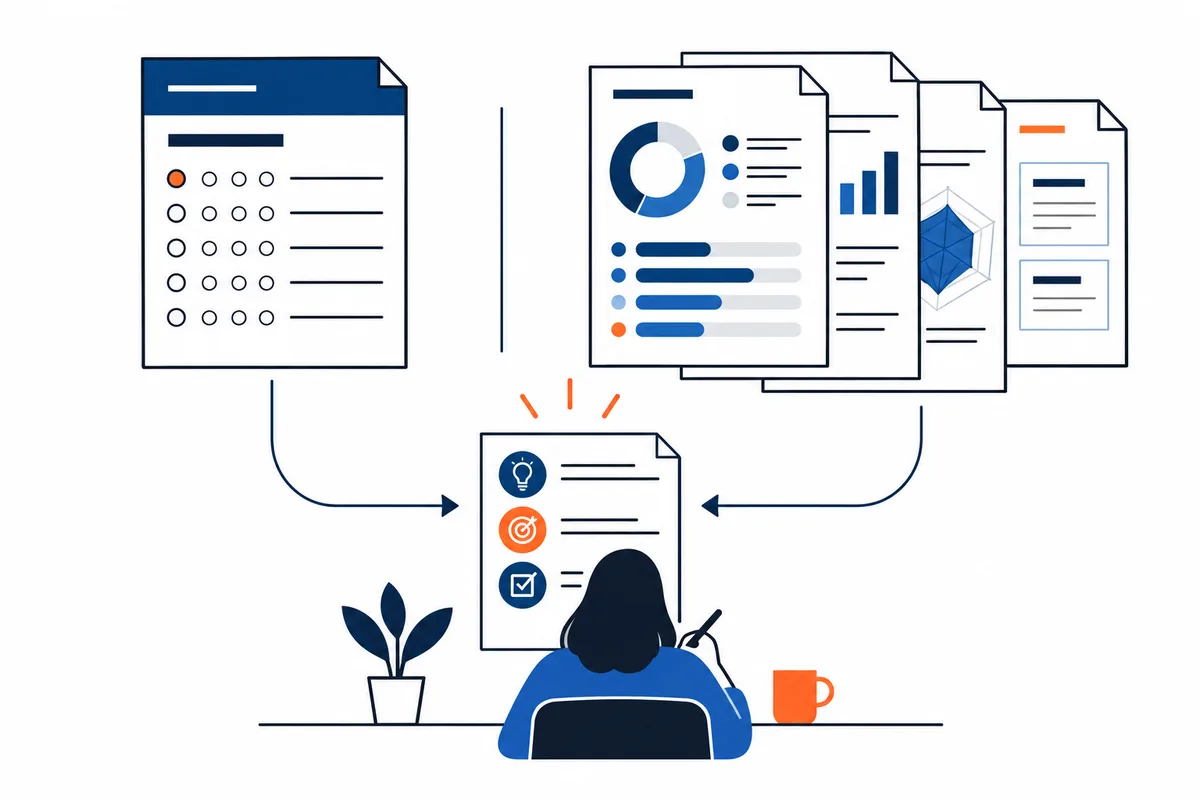
Taking an assessment is not the same as developing a skill. A result may help someone choose what to notice, but change comes through trying behavior, reflecting on its effects and adjusting. This distinction is supported by training research, though that research does not compare assessment products.
The 2024 review “Training emotional competencies at the workplace: a systematic review and metaanalysis” examined workplace training in emotional intelligence, empathy and emotion regulation. It included 50 studies in its pre-to-post analysis and a separate set of 27 controlled trials. The authors reported moderate pooled standardized mean changes: 0.44 from before to after training (95% confidence interval 0.29 to 0.59) and 0.46 in comparisons between intervention and control groups (95% CI 0.30 to 0.63). The effects remained detectable more than three months after training ended. The review also reported high heterogeneity and low methodological quality, and called for stronger studies, including randomized trials.
Those findings suggest that structured workplace interventions can help develop emotional competencies on average. They do not show that taking a quiz causes improvement, that a particular paid report is better, or that one individual will change by a predictable amount. The interventions combined different topics and approaches, while the article’s purchase question concerns an assessment and its personal usefulness. Confusing these findings would give a test credit for work done by practice or training.
A sensible way to use any result is to choose one small behavior and collect examples over time. If the concern is reacting sharply to criticism, the practice might be to pause, ask one clarifying question, then decide what response the work needs. Afterwards, note what you felt, what you did and what happened. A single interaction cannot confirm a stable pattern, but repeated notes may show when the response appears and what conditions make it easier or harder.
Feedback can add another perspective when it is specific and safe to seek. Ask a trusted colleague about an observable behavior, not for a global judgment of your EQ: “In the last project review, did I make room for your concern before explaining my decision?” The answer may differ from your self-view. That disagreement is information to explore, not automatic proof that either party is correct. Do not treat ordinary workplace criticism as if it were the standardized feedback from a validated ability test.
A report earns its cost when it helps select a useful practice, gives enough explanation to keep the interpretation honest, or includes a debrief that moves the reflection forward. If you are likely to read a score once and file it away, the cheaper option may be the better purchase. In either case, behavior after the assessment is where development actually happens.
Sources: Training emotional competencies at the workplace: a systematic review and metaanalysis
When paying may add something useful, and what this profile offers
A paid assessment may be worth considering when its particular added feature meets a need you already have. That could be a clearer account of recurring habits, a transparent report that connects results to actions, or a private debrief that helps you work through a question. Compare that feature with the cost and with a free alternative that you could use to collect examples or request specific feedback.
For example, a paid instrument with a well-documented purpose may be more useful than a free quiz if it explains how its items and score relate to the interpretation being offered. But that conclusion must be made tool by tool. The 40-instrument systematic review documents wide variation in emotional-intelligence measures; it does not establish that expensive instruments are better. A payment page and a technical manual answer different questions, and a retailer’s description is not an independent validation study.
EQ Test’s Emotional Skills Profile is one option for private reflection. It contains 32 original questions about recent behavior and emotional situations, organized around recognition, understanding, regulation and responding to others. Its report is an educational development profile. It does not have validated population norms or established ability-test validity, so it should not be read as a standardized EQ score or a rank against other people. Its value lies in helping the reader look at habits and scenario judgments separately and identify a behavior to examine.
That distinction is central to an honest offer. A profile can help you ask, “When I notice tension, what do I do next?” It cannot establish that your account matches every coworker’s experience, or promise a particular outcome at work. If you want an exploratory account of your own responses and practical guidance for further reflection, the [Emotional Skills Profile](/assessment) is a proportionate next step. Read the result alongside your own examples; do not use it for hiring, promotion or performance ranking.
If you are comparing a different paid product, look for the specific additional value before buying: a documented measure, a report that explains rather than merely labels, relevant evidence, transparent data handling, or human interpretation. Then ask whether you would use that addition. A service can be well-designed and still be a poor fit for someone who only wants one question to take into a meeting.
Sources: Emotional Intelligence Measures: A Systematic Review; EQ-i 2.0 Assessment
Choose the tool that earns its place in your next conversation
For personal development, pay when the particular assessment gives you a meaningfully clearer and better-supported way to examine a behavior you want to change. Start free when a modest prompt is enough. The evidence reviewed here does not support a general rule that paid EQ tests are superior to free online quizzes, and price alone does not answer what a score means.
Before deciding, name the situation you want to understand. Then check what the tool measures, how it builds its result, what evidence supports that interpretation, what the report gives beyond a label, and how it handles your answers. If the provider cannot explain those basics, you can still use the questions for informal reflection, but do not let a precise-looking number make the decision for you.
The practical test is what happens next. Write down one recent interaction, one behavior you want to observe, and one small response to try in the next relevant conversation. If a report helps you do that more clearly, its cost may be worthwhile. If it only adds a score, keep your money and begin with the example.
Sources: Emotional Intelligence Measures: A Systematic Review; Training emotional competencies at the workplace: a systematic review and metaanalysis; Guidelines for Technology-Based Assessment; The assessment of emotional intelligence: a comparison of performance-based and self-report methodologies
Questions readers ask
Are paid EQ tests more accurate than free online quizzes?
Not as a category. Emotional-intelligence assessments differ in what they measure and what evidence supports their scores. Compare the named tool’s method and documentation; payment alone does not establish accuracy.
Can an EQ assessment improve emotional intelligence by itself?
No assessment result is proof of development. A result can help you choose a behavior to examine, while practice, reflection and useful feedback provide the opportunity to work on it. Workplace training research supports average improvements from structured interventions, not a guaranteed effect from taking a test.
Sources
- Emotional Intelligence Measures: A Systematic Review
Reviews 40 workplace-usable EI instruments and explains that ability, trait and mixed models measure differently.
- Training emotional competencies at the workplace: a systematic review and metaanalysis
Synthesizes workplace EI, empathy and emotion-regulation training effects across 50 studies and 27 controlled trials, while noting heterogeneity and low study quality.
- Guidelines for Technology-Based Assessment
Professional ITC and ATP guidance addresses validity, fairness, scoring, privacy and accessibility in digital assessment.
- The assessment of emotional intelligence: a comparison of performance-based and self-report methodologies
In a community sample of 223, performance-based MSCEIT and Schutte self-report scores were unrelated and associated with different reported variables.
- Does emotional intelligence meet traditional standards for an intelligence? Some new data and conclusions
In 704 participants, MEIS scoring protocols yielded contradictory findings and the authors reported measurement concerns.
- Emotional Intelligence (EQ) Test: See Your Profile Across Five EQ Skills
An opened live free self-report page describes its model, report claims and limitations as a provider example, not independent validation.
- Free Emotional Intelligence Test (EQ) - 30 Items, Research-Based
The live page describes a free 30-item self-report and paid report add-on, illustrating market features rather than verified score quality.
- EQ-i 2.0 Assessment
The retailer page displayed a $175 EQ-i 2.0 package and described 15 areas, an offer example rather than an independent assessment review.
Apply it to the real situation
Turn an EQ result into one behavior to practice
From this guide: You may know the kind of exchange that keeps catching you off guard, yet still need help naming what you noticed and what to try next.
The private 32-item Emotional Skills Profile explores recent emotional habits and judgments about emotional situations, then offers practical reflection on development priorities. It is designed for learning about your own patterns, not comparing yourself with a norm group. Use it to choose one behavior to examine in your next feedback conversation, disagreement or repair.