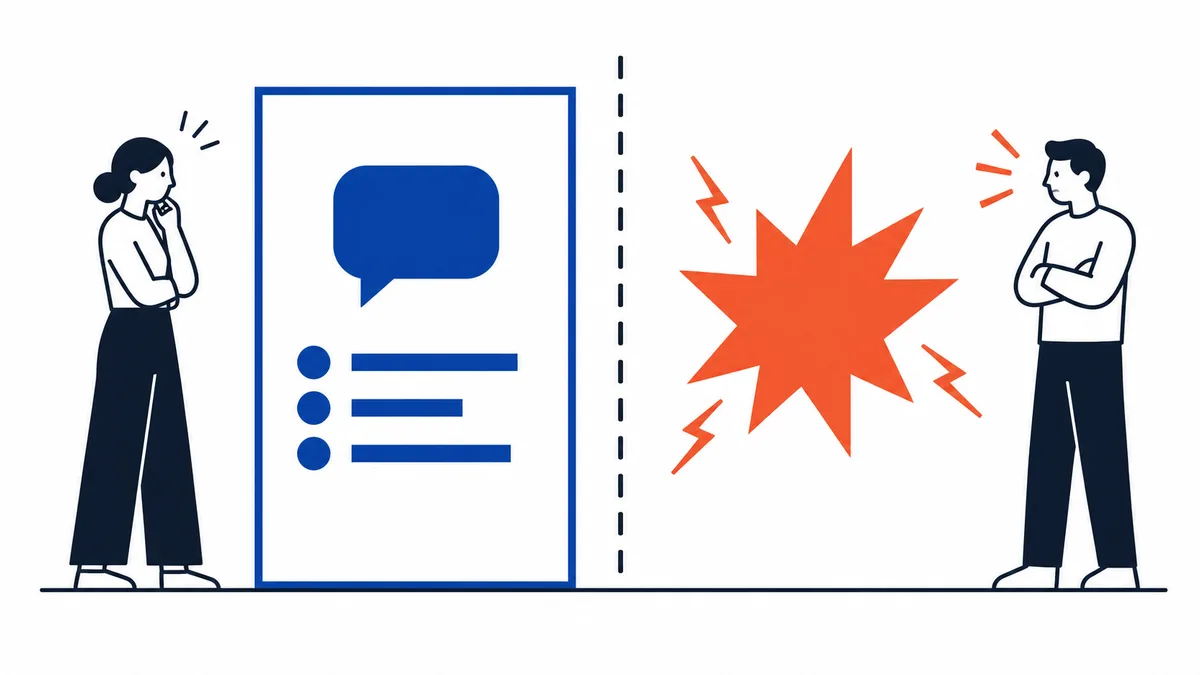
Own the conduct you can describe accurately, ask an open question about impact or facts you do not know, and choose a repair you can complete. Emotional intelligence can help you pause and respond with care; it cannot make you responsible for another person’s reaction.
How can you own your part without owning the other person's reaction?
Name the conduct you can stand behind, ask about consequences you do not yet know, and choose a repair you can complete. Those are separate responsibilities: your action is yours to describe; its impact may need to be learned; a colleague's feelings and response remain theirs. If you discover that your action caused harm, acknowledge that specifically and address its work consequence. If the account is disputed, stay with what you can substantiate while remaining open to new information. This is a practical decision path for a tense exchange, not a validated script or a way to guarantee agreement. The aim is to take responsibility where you have evidence and choice, without treating another person's reaction as proof of fault or as something you must manage. You remain accountable for listening, correcting what you can, and following through on that repair.
An uneasy response can follow a real mistake, a misunderstanding, or a disagreement in which each person has a part. Start by identifying what you did, rather than deciding from tension alone what the whole exchange means.
Which part of the exchange can you substantiate?
Begin with what a neutral record could establish: words spoken, an interruption, a decision made, or information sent. Observable conduct means an action or statement that could be described without guessing at the actor's motive or the listener's inner state. “I interrupted before you finished” identifies conduct. “I shut you down because I wanted control” adds a motive; “you felt humiliated” assigns an impact the speaker may not know. Either inference might later prove accurate, but neither is established by the action alone.
That distinction gives an apology a sound footing. You can acknowledge a clear act without confessing to every conclusion attached to it. You can also avoid using uncertainty about motive or impact to evade an act you recognize. Keep three questions separate: What did I do? What effect might it have had, and what do I need to ask? What work decision or disagreement still needs to be resolved? The answers may overlap, but one does not settle the others. This is a practical reasoning rule developed for this article, not a measured test of whether someone is at fault.
Consider an illustrative project meeting. A colleague is explaining a concern about a handoff; before they finish, you speak over them and restate the deadline. Later, you can substantiate the interruption and the words you used. You do not yet know whether the colleague experienced it as dismissive, whether the deadline was understood differently, or whether the handoff plan itself was sound. Those are distinct questions. You might say, “I interrupted while you were explaining the handoff, then repeated the deadline. I should have let you finish. What did that interrupt in the discussion?” The admission stays specific; the question leaves room for an answer you cannot supply on the colleague's behalf.
The project judgment remains open. Perhaps the timeline was feasible; perhaps a dependency made it unrealistic; perhaps the team had not agreed on who owned the next step. None of those possibilities erases the interruption, and the interruption does not decide which plan should proceed. Return to the relevant notes, messages, or commitments and examine the decision on its merits. If the record changes your understanding, update your account. If it does not, explain the work concern plainly while keeping the interpersonal repair distinct from the dispute over the plan. A repair can therefore proceed while the team checks the plan, rather than making either task a condition for the other. This keeps the conversation useful even when the work question takes longer to settle.
A person's memory may omit a sequence or detail, and a written record can clarify what happened. Even a well-documented act can mean something different in context: speaking over someone to flag an immediate safety issue, for example, has a different purpose from repeatedly cutting off their contribution. Context should inform how you understand and repair the act; it should not turn an unsupported guess about intent into a fact. State what the available evidence supports, ask about the consequence you cannot observe, and let new information revise your view.
What can a pause change before you respond?
A pause can give you a chance to notice what is happening before your first impulse becomes your answer. In [The Emerging Field of Emotion Regulation: An Integrative Review](https://doi.org/10.1037/1089-2680.2.3.271), Gross describes emotion regulation as processes that can shape which situations we enter or change, what we attend to, how we interpret an event, and how we respond. Emotion regulation here means influencing which emotion arises, when it arises, and how it is experienced or expressed. The model is a way to locate possible choices; it does not show that a pause itself resolves a disagreement.
Suppose a colleague says, “You left me out of the decision,” and you feel accused. A fast reply may focus on proving that you sent the calendar invite. A brief pause can redirect attention: What part of the statement is a claim about the work, and what part is my guess about the colleague’s motive? Reconsidering the meaning can open a different response: “I did send the invite, and I hear that you felt excluded. Which decision are you referring to?” The pause has not established that anyone is right. It has made room to answer the concern while checking the facts, rather than using the first piece of evidence as a complete defense.
That is a plausible application of Gross’s process model, not a script tested by the review. A pause can be occupied by rehearsing a rebuttal, suppressing a response until it comes out sharply, or avoiding a necessary conversation. The useful change is narrower: the speaker may have another opportunity to direct attention, question an initial appraisal, and choose what to say. That choice can be as modest as asking for a detail before answering a charge, or requesting time to check a disputed sequence. Whether that opportunity leads to a better exchange depends on what the speaker does with it and what the situation permits.
Evidence on training offers a separate test of whether emotional skills can change at all. [Training emotional competencies at the workplace: a systematic review and metaanalysis](https://pmc.ncbi.nlm.nih.gov/articles/PMC11616120/) synthesized workplace interventions and compared trained groups with controls. Its controlled comparison covered 27 studies. The pooled standardized mean difference was 0.47, with a 95% confidence interval from 0.31 to 0.62; the review described this as a positive average effect on measured emotional competencies. The studies varied substantially: I² was 68%, indicating that results differed across studies beyond what sampling variation alone would usually explain.
The average did not come from one uniform course or one shared outcome measure. Programs and assessed competencies varied, so the pooled result supports the possibility that workplace training improves measured competencies on average. It does not tell a reader how much a particular person will change, or whether a specific conversational habit will improve. The review also reported an indication of publication bias, and the estimated effect became smaller when outlier studies were removed. Those checks matter because unusually large studies can pull an average upward, while a published record may overrepresent positive findings. The estimate remains evidence of potential benefit, but its size and transfer to a particular workplace need caution.
Put together, the theory and training review support a measured conclusion. A pause can create an opening to shift attention, examine an interpretation, and select a response; structured practice may improve emotional competencies as measured across workplace studies. The broader evidence makes development plausible, rather than proving that one deliberate breath or sequence will change the next exchange. A reader can use the pause to choose a specific action—ask what decision the colleague means, check the record, or acknowledge a known act—but the research does not validate that sequence as a tested intervention. Nor does an average training gain guarantee improvement for an individual. The pause is an opportunity to make a more considered move, whose value becomes visible in the question or action that follows.
Sources: The Emerging Field of Emotion Regulation: An Integrative Review; Training emotional competencies at the workplace: a systematic review and metaanalysis
When does an apology describe accountability?
An apology describes accountability most clearly when it names an act the speaker recognizes and accepts responsibility for addressing. Saying “I’m sorry” on its own does not establish that the speaker believes they crossed a line; it may express courtesy, regret that tension exists, or a wish to move on. The distinction matters because the recipient cannot infer the apologizer’s understanding from the apology alone. A specific account gives both people something concrete to discuss: what happened, what responsibility the speaker accepts, and what work consequence may need attention.
The three-study paper [When apologizing hurts: Felt transgression and restoration efforts](https://repositorio.ie.edu/server/api/core/bitstreams/928d4da8-4ea4-4d66-bae3-d1a12c53bbb3/content) examines apologies from the apologizer’s side, including cases with and without felt transgression. Here, felt transgression means the apologizer’s reported sense that they had crossed a line; it is not an independent judgment that the person was objectively at fault. In Study 3, participants recalled a workplace apology and answered questions about the incident and their own response. The researchers invited 200 Prolific participants. They excluded 13 because the recalled recipient was outside the participant’s organization, leaving 187 cases for analysis.
Among those 187 analyzed cases, 77 people, or 41%, reported low felt transgression in the last workplace apology they recalled. That percentage describes this selected study sample and retrospective self-report. It is not an estimate of how often workers generally apologize without responsibility, and it does not verify what happened in any recalled incident. Participants reported their own sense of responsibility after remembering an event; the researchers did not independently adjudicate the disagreement or ask the recipient to confirm the account. The finding therefore identifies a meaningful distinction for studying apologies, while leaving the facts and other person’s experience unresolved.
For a reader deciding what to say, the finding argues against treating an apology as proof that the speaker has examined their part. “I’m sorry you’re upset” can acknowledge visible tension without naming any action the speaker owns. If the speaker recognizes a concrete act, a more accountable apology identifies it and the repair it calls for: “I changed the handoff date without checking with you. I’m sorry; I’ll confirm the revised sequence before I send it to the client.” If the speaker does not yet understand the complaint, they can ask what action or consequence the colleague means instead of using an apology to close the conversation.
That distinction does not let the recipient read sincerity directly from wording, and the study does not show that every apology made with low felt transgression harms a relationship. People may apologize to coordinate, show courtesy, or acknowledge another person’s frustration without making a full moral judgment about the incident. A remembered report of low responsibility is not proof of insincerity, just as another person’s upset is not by itself proof of wrongdoing. The practical test is whether the speaker can name a specific responsibility they recognize and follow through on an appropriate repair. If they cannot yet do that, the honest next step is to learn what happened and what effect is being described, while keeping the factual disagreement open.
The study’s narrow result is still useful: apologies can occur without strong felt responsibility, so the words alone do not settle whether accountability has been taken. The invitation count and analyzed sample also answer different questions. Two hundred were invited; 187 met the study’s inclusion criteria and contributed to the reported result. For an individual exchange, the percentage is not a prediction about a colleague or a verdict about the event. It is a reason to make an apology specific enough that responsibility, uncertainty, and any promised action can be discussed rather than hidden inside a general expression of regret.
Sources: When apologizing hurts: Felt transgression and restoration efforts
How can you ask without writing the colleague's reaction for them?
A useful opening describes what you know about your own position, then leaves the colleague room to describe theirs. That means naming an action or concern without supplying the other person's feeling, motive, or verdict. The distinction is small in wording but consequential in a tense exchange: “You were angry because I ignored your concern” asserts both an emotion and an explanation. Even if either turns out to be right, the speaker has already presented an interpretation as settled. An open question can instead make the missing information answerable by the person who has it.
The study [I understand you feel that way, but I feel this way: the benefits of I-language and communicating perspective during conflict](https://pmc.ncbi.nlm.nih.gov/articles/PMC5961625/) tested ratings of opening statements from 253 university students. Participants considered six hypothetical conflicts. Across the scenarios, the researchers varied whether a statement used I-language or you-language and whether it communicated the speaker's perspective alone or included the other person's perspective as well. Participants rated how defensive the recipient was expected to feel. Statements using I-language and communicating perspective received lower anticipated-defensiveness ratings; the combination that included both self- and other-perspective with I-language received the most favorable ratings.
That is a result about how students judged constructed openings, not a test of what colleagues actually say or feel in live workplace conversations. The participants were rating scenarios rather than responding to a real coworker, and the outcome was expected defensiveness—not whether a person felt understood, whether the account was accurate, or whether the disagreement was repaired. So the study gives a reason to try wording that makes fewer claims about the other person; it cannot establish that a particular sentence will lower defensiveness in your exchange. A colleague may still disagree, correct your description, or decline to discuss the impact.
As an application of that finding—not a script tested in the study—a speaker might say: “I see the schedule differently, and I’m concerned about the handoff. What effect did my change have on your work?” The first clause owns the speaker's view rather than declaring the colleague mistaken. The question asks about a concrete work consequence without deciding whether the colleague felt dismissed, frustrated, or anything else. It also gives the other person a useful opening to identify a consequence the speaker did not anticipate. If the response introduces a factual disagreement, the speaker can ask about the sequence or record after hearing the account; asking does not require adopting an explanation before checking it.
This approach leaves room for a direct answer, including one that challenges the speaker's account. It does not require vague language or an apology for a feeling the speaker cannot verify. A speaker can state a clear concern and remain curious about its impact in the same exchange. The discipline is to mark what is the speaker's view, ask a question whose answer is not already embedded in an accusation, and then attend to what comes back. That makes the opening more informative: the colleague can describe impact in their own terms, and the work disagreement can be examined on its evidence. The speaker remains responsible for listening and for any repair their own conduct calls for; they are not responsible for scripting the response they hope to receive.
Can you acknowledge impact and still dispute the facts?
Yes. You can take seriously that a colleague reports a particular impact while remaining uncertain about the factual explanation they attach to it. Acknowledging the report means recognizing that this is their experience and asking what work consequence they mean; agreement would mean accepting the accompanying claim as accurate. Those are related but different acts. Here, empathy means attending to and acknowledging another person's perspective. It does not require you to certify a timeline, intention, or decision you believe may be wrong. Nor does factual uncertainty make the reported effect irrelevant to the conversation.
In [Denial and Empathy: Partners in Employee Trust Repair?](https://pmc.ncbi.nlm.nih.gov/articles/PMC6349725/), 240 undergraduates judged a hypothetical boss after an integrity-based violation. The factorial scenario experiment varied consequences of the violation, whether the boss apologized or denied responsibility, and whether the response included empathy. Participants then rated trust-repair judgments. Empathy was relevant to those judgments across response conditions. In this constructed case, researchers could examine acknowledgment of the employee's perspective separately from whether the boss admitted the allegation, suggesting that those elements need not be collapsed into one response.
The situation sets a clear boundary on what the result can tell us. Participants evaluated a fictional supervisor after an integrity violation; they did not observe an ordinary peer disagreement, weigh actual workplace records, or establish whose description of a real event was correct. Their judgments show how empathy figured in trust-repair evaluations under those scenario conditions. They do not demonstrate that denial generally repairs trust, that acknowledging impact will settle a factual dispute, or that a colleague's account should be dismissed when it conflicts with your memory. The experiment offers a distinction to use in thinking, not an adjudication procedure for live evidence.
Imagine a colleague says a revised handoff left them unable to complete a client update on time, and you believe the revision was sent after the deadline they cite. You could respond to the reported impact first: “I hear that the change left you without what you needed for the update.” That acknowledges the work problem they describe. Then state the factual question without using it to erase the problem: “My record shows the revision went out Tuesday afternoon. Can we compare the messages and the update deadline?” The records may confirm the colleague's sequence, support yours, or reveal that the two of you were working from different deadlines. Until you check, the timeline remains unsettled.
This order matters because acknowledgment can become hollow if the speaker uses it only as a courteous preface to a verdict already reached. If records support your account, explain what they show and ask what other constraint affected the work; do not use the record to claim the colleague had no reason to describe an impact. If the evidence supports theirs, update the factual account and address the missed handoff consequence. In either case, recognizing the reported experience does not decide the records, and checking the records does not make the experience disappear. The colleague's account can supply information you need even where its proposed explanation is disputed.
Sources: Denial and Empathy: Partners in Employee Trust Repair?
What can an apology offer its recipient?
An apology can give the recipient evidence that the relationship matters to the speaker; it cannot decide what the recipient should feel next. In the experiment reported in [Experimental evidence that apologies promote forgiveness by communicating relationship value](https://www.nature.com/articles/s41598-021-92373-y), 971 US online workers received staged essay feedback that created an offense. The researchers independently randomized whether the transgressor apologized and whether the relationship was presented as valuable. This double-randomization let them examine apology and relationship value as separate influences on forgiveness judgments, rather than relying only on people’s recollections of real conflicts.
The experiment found that apology increased measured forgiveness, with a weaker apology effect when relationship value was already high. The proposed mechanism is relational information: an apology can signal that the connection is worth preserving. When that value is already clear, the apology may add less to the recipient’s judgment. This is a result about the experiment’s forgiveness measure under staged conditions; it does not show that a real colleague will forgive, or that the apology changes the underlying work disagreement. The recipient’s interpretation remains theirs to make.
That distinction gives a practical aim for repair. The speaker can make amends for a consequence they can address—correct a misleading handoff, restore information someone needed, or agree on how a disputed decision will be documented—while leaving forgiveness out of the transaction. These are applications of the study’s distinction, not actions tested by its essay-feedback design. A repair action should answer the work problem itself, rather than function as a request for the colleague to reassure the speaker or resume trust on demand. The recipient may welcome the apology and still need time before working closely again. For example, if an inaccurate summary has already been circulated, correcting the record with the same audience may address a work consequence more directly than sending a private apology alone. If a colleague was left out of information needed to finish a task, restoring access or clarifying the next handoff gives the repair an observable endpoint. The choice follows from what was affected; it is not a formula for earning a particular response. The experiment did not test these workplace actions, but its distinction helps keep an offer of amends separate from a demand for forgiveness.
Measured forgiveness after a staged insult is not restored collaboration after an actual work disagreement. A colleague might accept the acknowledgment but want the process changed; they might continue the project while remaining upset; or they may decline reconciliation. None of those responses determines whether a concrete amends action was worthwhile. The speaker controls whether to acknowledge their contribution and follow through on a relevant correction. They do not control the recipient’s timetable or whether the relationship returns to its earlier state. An apology can communicate value and open a path toward repair; what the recipient does with that signal remains outside the speaker’s control.
Sources: Experimental evidence that apologies promote forgiveness by communicating relationship value
When is a private conversation the wrong route?
A private conversation is a reasonable route when both people can speak plainly, disagree, pause, and leave without an unacceptable work cost. Rank by itself does not answer that question: a manager may be able to hold a candid conversation, while a peer exchange may carry pressure because of repeated hostility or control over essential work. Consider the pattern and the practical consequences. If raising the issue could credibly invite retaliation, or earlier attempts have brought threats or recurring mistreatment, choose a trusted or formal workplace support channel instead of treating a one-to-one conversation as a required first step.
A recent study offers a narrow reason to pay attention to who facilitates repair. [Good Intentions, Bad Outcomes: Manager-Facilitated Moral Repair and Unethical Pro-Supervisor Behavior](https://link.springer.com/article/10.1007/s10672-026-09609-0) used a multi-wave survey of 244 full-time employees who recalled harm they had caused at work. Reported manager restorative behavior was positively associated with employees’ later self-reported unethical behavior directed toward benefiting the supervisor. The researchers modeled gratitude, desire to reciprocate, and identification with the manager as mediators of that association. The finding concerns a particular reported outcome and a manager’s role in repair; it does not establish that restorative behavior caused the later behavior.
Because participants recalled incidents and reported their own behavior in a survey, the study cannot tell us that a manager-led conversation will create pressure in a particular case. Nor does it show that manager-facilitated repair usually harms employees or that a peer conversation is coercive. Its practical contribution is smaller: a facilitator’s authority and the expectations attached to reciprocating deserve attention. Before agreeing to a facilitated meeting, ask what it is meant to resolve, who will attend, and whether you can state disagreement without being asked to signal loyalty or closure. Those questions help identify whether the process fits the concern; they do not require assuming bad intent from the facilitator.
Ordinary tension—a sharp exchange, a disputed handoff, or an apology that has not yet settled matters—can still be addressed directly when both people retain meaningful choice. A repeated pattern or credible concern about work consequences changes the calculation. The relevant test is practical: can you speak, disagree, ask for time, and leave without a cost you cannot reasonably accept? If not, involve an appropriate trusted person or use a formal channel available in the workplace. A supported route can help the issue be heard without making private reconciliation the price of continuing to work. Which route is suitable depends on the actual concern and available support, not on a rule that every disagreement needs mediation. If direct speech feels costly, a written channel or neutral facilitator may make it possible to raise the issue; if those options still feel unsafe, seek an available trusted or formal support route. The survey supplies no danger threshold, so the decision depends on the likely cost of speaking and the support actually available.
What is the next step you can take?
Choose one action that is yours to complete. If you know what you did, name it plainly and make a work-related repair: correct the record, restore information someone needed, or confirm the next handoff and who owns it. If the impact is still unclear, ask one open question about what changed in the colleague’s work. When a direct conversation carries an unacceptable cost, use an appropriate trusted or formal support process available to you.
Then let the colleague decide how and when to respond. A repair can address a work consequence without securing reassurance, forgiveness, or a return to the previous relationship. You remain accountable for the act you can name and the correction you can make; their reaction belongs to them.
For reflection beyond this incident, the private 32-item Emotional Skills Profile offers an educational look at recent behavior and judgments about authored situations. It can help you consider patterns to practice; it cannot decide who was at fault here, diagnose you, serve as a hiring score, or predict a colleague’s response. Explore the Emotional Skills Profile at /assessment.
Questions readers ask
What if I cannot identify anything I did wrong?
Do not confess to an unverified offense just to end the tension. Explain what you remember, ask which action or consequence the colleague means, and keep the factual disagreement open while you compare what each of you knows.
Can I acknowledge a colleague’s impact while disagreeing about what happened?
Yes. You can take seriously the work consequence they describe and ask what it changed for them, while stating which facts remain uncertain and checking the relevant records.
Sources
- The Emerging Field of Emotion Regulation: An Integrative Review
Gross's review offers a conceptual process model in which regulation can occur through situation selection or modification, attention, appraisal, and response; it can frame a pause and reconsideration before speaking, but is not evidence that these moves repair workplace conflict.
- Training emotional competencies at the workplace: a systematic review and metaanalysis
A systematic review and meta-analysis found average gains across workplace emotional-competency training studies, while heterogeneity, study quality, and intervention variation limit transfer to one conversational sequence or an individual reader.
- When apologizing hurts: Felt transgression and restoration efforts
Li and colleagues' three-study paper distinguishes apologizing with versus without felt transgression and examines apologizers' emotions and restoration efforts. In Study 3, 200 Prolific participants were invited; 13 whose recalled recipient was outside the organization were excluded, leaving 187 analyzed participants. Of those 187, 77 (41%) reported low felt transgression in their last workplace apology. This is a self-reported recalled-incident result, not a prevalence estimate for workers generally or proof that low-transgression apologies are always harmful.
- I understand you feel that way, but I feel this way: the benefits of I-language and communicating perspective during conflict
In a study of 253 university students rating opening statements across six hypothetical conflicts, I-language and communicated perspective were rated as less likely to elicit defensiveness; statements combining self- and other-perspective with I-language were rated most favorably. This measures anticipated reactions to scenarios, not actual workplace behavior or repair outcomes.
- Denial and Empathy: Partners in Employee Trust Repair?
A scenario experiment with 240 undergraduates evaluated responses to a hypothetical boss's integrity violation and found violator empathy relevant to trust-repair judgments in the manipulated conditions. It shows that acknowledging another's perspective can be studied separately from admitting the allegation; it does not decide an ordinary coworker dispute or make denial a general repair strategy.
- Experimental evidence that apologies promote forgiveness by communicating relationship value
A staged essay-feedback experiment with 971 US online workers used a double-randomization design to test apology and relationship value; apologies increased measured forgiveness, with weaker effects when the transgressor already had high relationship value. The staged insult and forgiveness measure do not forecast reconciliation after a real work exchange or oblige forgiveness.
- Good Intentions, Bad Outcomes: Manager-Facilitated Moral Repair and Unethical Pro-Supervisor Behavior
A multi-wave survey of 244 full-time employees recalling workplace harm they caused found manager restorative behaviors positively associated with later self-reported unethical pro-supervisor behavior, with gratitude, reciprocation desire, and manager identification modeled as mediators. Because this is a recalled-incident observational survey, it does not establish that restorative behavior caused the outcome or that direct peer repair is unsafe.
Apply it to the real situation
Reflect on the emotional habits you want to practice
From this guide: If a tense exchange leaves you unsure how you notice, regulate, or respond to emotions, structured reflection can help you examine your recent behavior and scenario judgments.
The private 32-item Emotional Skills Profile offers educational reflection on recent emotional behavior and judgments about authored situations. It can give you a structured starting point for noticing patterns and choosing a behavior to practice. It cannot determine who was at fault in a particular exchange or predict how a colleague will respond.