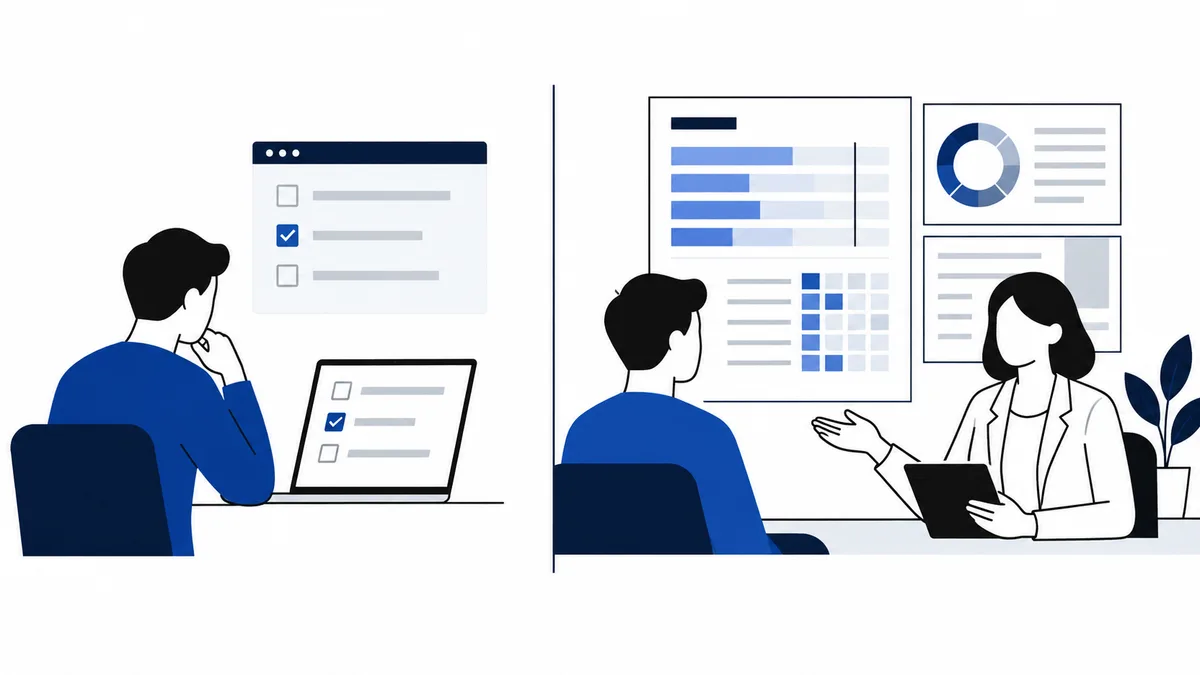
Online describes how an EQ test is delivered; professional administration describes the process around choosing, giving, and interpreting it. Either can include the other. To judge what a result can tell you, first identify what the instrument measures, then consider whether its conditions and interpretation fit your purpose. Private reflection may need little support; language, access, or a more consequential interpretation may call for professional guidance.
Why online and professional can describe the same assessment
The online-versus-professional comparison mixes two different questions. Online describes the delivery channel; professional administration describes the process around choosing, giving, scoring, and interpreting an assessment. One test can have both features. The decisive comparison is therefore not screen against room, but what evidence the instrument collects and what conditions support the conclusion drawn from it. EQ-i 2.0 is a concrete example. Its publisher, MHS, says the assessment is completed online and offers individual reports alongside practitioner training, interpretation guidance, and debrief practice. That is enough to show that online delivery and professional support can coexist. It does not independently establish the instrument’s quality or prove the outcomes the provider promotes; those claims would need separate evidence. The U.S. Office of Personnel Management’s page, “Emotional Intelligence Tests,” also distinguishes self-report from ability-test formats. That distinction concerns the response method, not whether someone sits at a computer or with an assessor. An online session might be open and self-guided, or controlled and supervised. An in-person session might follow a careful assessment process, or simply administer a questionnaire without clarifying what its result can support. This matters when a report is meant to guide a real decision. A professional can help select a measure for the question, explain its limits, and place the result in context. But a professional’s presence cannot turn a self-report into a record of observed behavior, and a formal setting cannot repair a measure that does not fit the question. Likewise, a clear online tool may be proportionate for private reflection if its model, purpose, and limits are transparent. The practical starting point is to ask what the test measures and what process supports the interpretation. Location, price, and a professional label may describe the experience; on their own, they do not tell you what conclusion the result warrants.
Sources: EQ-i 2.0 — Multi-Health Systems; Emotional Intelligence Tests — U.S. Office of Personnel Management
What kind of evidence is the test collecting?
A self-report records what someone says about their usual emotional patterns or perceived competence. An ability-oriented test scores responses to emotion problems. Observer feedback records other people’s perceptions. Each can inform a different question; changing who administers a test does not turn one kind of evidence into another.
The distinction matters because “EQ test” names a family of measures, not one shared instrument. The 2021 systematic review, “Emotional Intelligence Measures: A Systematic Review,” examined 40 instruments identified in research on professionals. Most followed skill-based, trait-based, or mixed models, and the review describes advantages and disadvantages for each. The authors searched Web of Science alone and could not estimate agreement between raters, so the count maps variety rather than proving which approach is best. A 2019 critical review in Frontiers in Psychology likewise separates ability, trait, and mixed measures, while noting that the labels and boundaries have been debated.
Here, ability-oriented means a test asks a person to solve an emotion-related problem and scores the response under a stated method. The result concerns performance on those items. Self-report asks a person to rate their typical behavior, feelings, or perceived skill. It can describe self-image or a person’s account of their habits; it does not directly observe those habits. In the U.S. Office of Personnel Management’s guidance, self-report may suit the question “How competent do people think they are?” while an ability method is more fitting when the aim is to assess responses to emotion problems. That page addresses selection contexts, so its distinction helps explain method, not justify using either output to make employment decisions.
Consider a disagreement at work. A person may report that they notice irritation early. That answer tells the reader how they view their own pattern. An ability test might instead ask how emotion could shift during a described situation and score the answer. One is a report about typical self-perception; the other is performance on a designed question. Neither is a recording of what happened in the person’s last meeting. Observer feedback would add colleagues’ perceptions, which are another source of information and may reflect what those colleagues could see. It still would not make a test result a direct transcript of the disagreement.
This is why online does not automatically mean self-report, and professional administration does not automatically mean ability testing. The OPM guidance says emotional-intelligence tests can be administered electronically or on paper; the delivery surface and the response method are separate choices. Likewise, a professionally facilitated conversation can help someone examine a self-report without changing what the questionnaire measured. The practical rule is to name the evidence before interpreting it: self-view, answers to emotion problems, or other people’s reports. Then keep the conclusion at that level and use it to choose what to notice in actual interactions.
Sources: Emotional Intelligence Measures: A Systematic Review; Emotional Intelligence: Current Research and Future Directions; Emotional Intelligence Tests — U.S. Office of Personnel Management
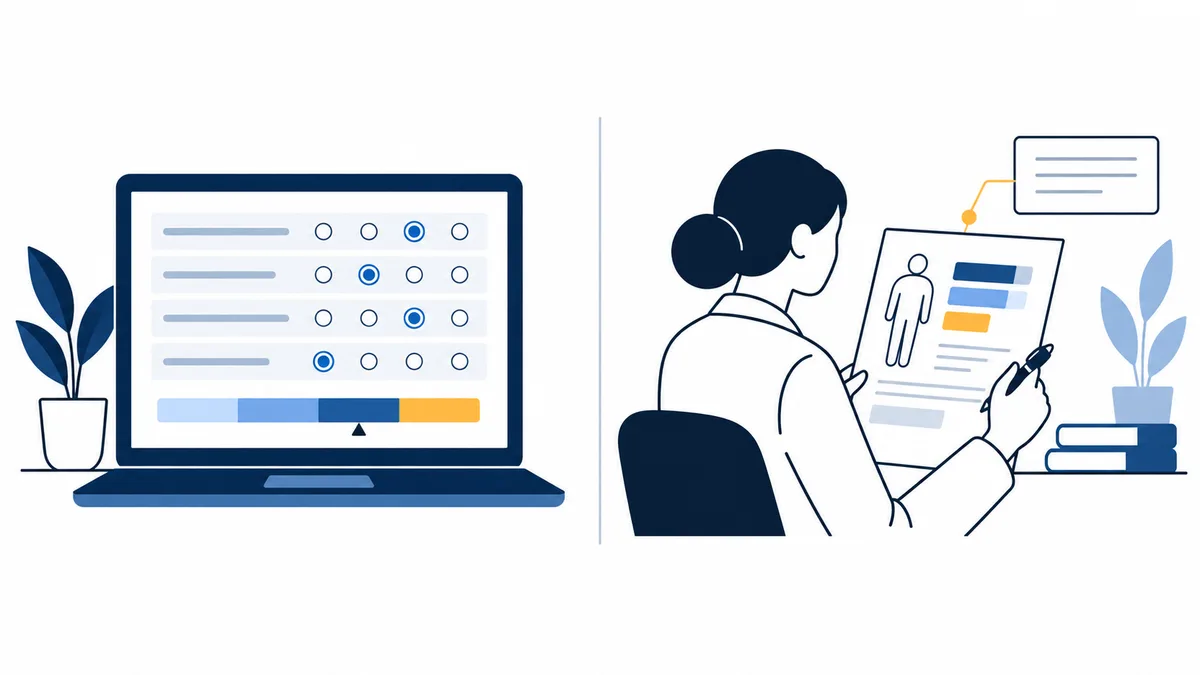
What can a professional add around the test?
A professional assessment is a chain of decisions around a test,. The American Psychological Association’s *Guidelines for Psychological Assessment and Evaluation* describes assessment as integrating tests with relevant information such as interviews or observations to address a defined question. A score can be precise about its response task and still leave the practical question unanswered. The relevant question is what evidence would clarify an emotional habit at work. The first contribution is choosing a measure for the question. The APA guidelines say practitioners should consider purpose, the person’s characteristics, and context, and work within their training and experience. They can ask whether a self-report of typical behavior, a task involving emotion problems, or another source fits what the person wants to learn. These methods do not answer the same question. “Handling feedback” may refer to noticing an emotion, describing a usual response, or selecting an answer to a designed scenario. Clarifying which is at issue can prevent a broader claim than the evidence allows. This choice affects how a result should be read. Reliability means consistency under stated conditions. Validity concerns whether evidence supports an interpretation for a particular purpose. Neither is a general stamp attached to a practitioner or test brand. The APA guidance treats test selection, administration, scoring, interpretation, as parts of competent work. It notes that the same measure may suit one purpose but fall outside a practitioner’s competence for another. A professional should explain what conclusion follows from the evidence and where it stops. A title or polished report cannot answer that question on its own. Administration can make conditions and needed adjustments visible. Instructions may need clarification; a distraction may interrupt completion; language, culture, or disability may affect how someone encounters an item. The APA guidelines call for attention to diverse populations. They also discuss documenting the effects of modifications or accommodations. This does not mean every EQ reflection needs a formal appointment. Materially different conditions should not be treated as equivalent when interpretation depends on them. A debrief can translate a result into a testable question rather than a verdict. If a report points to difficulty noticing tension, a practitioner might clarify whether that refers to self-perception, performance on a task, or another measure, then identify what information is missing.A useful next step could be observing when irritation first becomes noticeable in a later conversation. That observation is new evidence about behavior, not proof supplied by the score. The APA document is guidance for psychologists conducting psychological assessment and evaluation broadly. It does not establish that every EQ test requires a psychologist or that professional discussion makes a weak instrument sound. The practical lesson is responsibility: when the question calls for contextual judgment, language-aware adaptation, or combining information, qualified help can make the process clearer and more accountable. When a private, low-stakes reflection gives someone a sensible behavior to examine, extra process may add little. A professional is most useful when they match process to question and explain the limits of the answer.
Sources: Guidelines for Psychological Assessment and Evaluation
A workplace disagreement shows what each result can support
If a self-report suggests that someone notices tension late, it can prompt observation of a future disagreement; it cannot establish that they interrupted or misread a colleague in a past meeting. A professional conversation may add context, while an ability task answers a different question about performance on designed problems. A report describes a person’s view of a habit; it does not record that habit in action. The U.S. Office of Personnel Management’s “Emotional Intelligence Tests” distinguishes self-perceived competence from responses scored on emotion-related problems. Its guidance concerns selection, so the method distinction applies here, while its employment claims do not establish how a personal development result should be used.
Consider an illustrative, unnamed workplace disagreement about a project deadline. A self-report suggests that one person recognizes irritation late. That answer is a hypothesis about their usual experience, not evidence that they were irritated in this meeting. In the next discussion, they might notice concrete cues: their pace quickens, they interrupt before hearing the concern, or their voice becomes clipped. Those observations locate a moment worth examining. They do not reveal whether a colleague felt dismissed, whether the deadline was realistic, or whether the interruption changed the exchange.
An ability-oriented test adds another kind of evidence: it presents emotion problems and scores responses under the instrument’s rules. Its result concerns performance on designed items; it does not replay the deadline discussion or prove how the person behaves under pressure. The U.S. Office of Personnel Management describes this contrast, including tasks involving emotion recognition and scenario responses. The practical inference is limited: each method can suggest a follow-up question, but neither makes a score direct observation of a real conversation.
A professional assessment process can help decide which information is relevant and how far it can be interpreted. The American Psychological Association’s “Guidelines for Psychological Assessment and Evaluation” describes assessment as integrating tests with suitable collateral information, such as observation, interviews, or third-party reports, alongside professional judgment. A practitioner might ask about the work context and help the person choose a focused reflection question. That does not mean every disagreement calls for formal assessment, or that a practitioner knows the colleague’s experience without their account.
If the person wants another perspective, they could invite a trusted colleague to describe one observable moment, such as whether the response began before the concern was finished. That account is a perspective shaped by what the colleague noticed and by the working relationship, not an objective transcript. Broader feedback is not automatically needed. The APA guidelines discuss collateral information within professional assessment; they do not require coworker feedback for every EQ reflection. Workload, unclear decision authority, or a power difference may also help explain tension. These are contextual factors to investigate, not findings supplied by the self-report.
The useful outcome is a behavior to check and discuss, not an EQ label or a claim that a test observed collaboration. A self-report may suggest what to watch for; an ability task may show how someone answered its emotion problems; a professional may help connect relevant information to the question. For a low-stakes development goal, the next real conversation offers a chance to notice whether pace, interruption, or tone changes and what follows. Keep any conclusion tied to the evidence gathered, rather than carrying it forward as a verdict about how the person always works with others.
Sources: Guidelines for Psychological Assessment and Evaluation; Emotional Intelligence Tests — U.S. Office of Personnel Management

When does online administration need more control?
Extra control matters when the conditions around a response could change what the result means. Quiet conditions, clear instructions, a suitable language version, and appropriate accommodation can matter more than the screen. “Online” alone tells you none of these things. It does not tell you whether a session was open to anyone, supervised, or administered under consistent procedures. The American Psychological Association’s *Guidelines for Psychological Assessment and Evaluation* describes standardized administration as consistency in how responses are elicited, scored, and interpreted. The guidance discusses instructions, prompts, questions from the examinee, audio or visual materials, equipment, and placement of materials. In an online session, that might mean whether a person can hear an audio prompt, use the page with assistive technology, or avoid a notification interrupting a timed task. These details matter when they affect the particular assessment; a casual self-reflection with no timed or standardized score does not need to imitate a formal testing room. Standardized does not mean every person must face identical circumstances regardless of need. It means the procedure is defined well enough to understand what changed and whether that change affects interpretation. The APA guidelines ask practitioners to consider characteristics relevant to the person and instrument, including disability, language, culture, education, and other individual factors. They advise that research support in one language or cultural setting should not automatically be assumed to carry over to another. A translated version may need careful adaptation and evidence that it measures the intended construct comparably. If someone must work through unfamiliar wording, a low result could partly reflect the language burden rather than the emotional skill the test claims to assess. Accommodations create a related question. Changing font size or allowing more time may be straightforward for one instrument, while changing how a prompt is presented could alter the task. The APA guidelines recommend documenting how modifications or accommodations affect interpretation and considering whether evidence supports the conclusion. A professional can help when an access need, language difference, or unusual condition cannot be handled by published instructions. The role is to explain implications and limits, not erase them with a confident-sounding score. Interruptions deserve the same measured treatment. A pause to answer a call might matter if the instrument depends on sustained attention or speed; it may have little bearing on an untimed questionnaire about typical habits. Privacy can affect responses too: someone who worries that an employer or colleague will see personal answers may answer differently. Before starting, check who can access the result and whether you can complete it without an audience. A common link does not make results suitable for comparing people. Such comparisons require evidence that the instrument and its procedures support the intended interpretation for those people. If circumstances changed how you understood or completed the task, note that before drawing conclusions. For private development, you may set the result aside or treat it as a question to revisit. When controlled procedures or accommodation are necessary to answer a consequential question, seek qualified support that can select the method, document conditions, and explain what the result reasonably supports.
Sources: Guidelines for Psychological Assessment and Evaluation
What should you learn before trusting the report?
Before trusting a report, ask what question its score is meant to answer. The American Psychological Association’s *Guidelines for Psychological Assessment and Evaluation* describes assessment as a process that can combine a test with relevant information such as interviews or third-party reports. The report should identify the instrument, its model, purpose, and intended population. If those details are missing, confident labels cannot tell you whether the result fits your question.
Start with the measure itself. Does it ask you to describe how you usually respond, rate what you believe you can do, judge emotional situations, or solve emotion-related problems? Those formats provide different kinds of evidence. Ask how answers become a result: are responses summed, compared with a reference group, or interpreted another stated way? You need enough explanation to understand what the report calls a strength or development area and what responses or situations that label represents.
If the report gives a norm-based score, ask who is in the norm group and whether it fits your purpose. A norm group is the reference population used to put a score in context; it does not describe every person in that group. MHS’s EQ-i 2.0 page says the instrument offers general-population and professional norms, with regional options. That is a provider’s description, not independent proof that a particular comparison fits every reader or purpose. Ask which group appears in your report and why it was selected. Without a comparison group, find out whether the result is a descriptive profile or reflection prompt.
Language deserves a direct question when a test is translated or the available version is not the language in which you can answer comfortably. The APA guidelines advise professionals to consider language proficiency and cultural context when selecting and interpreting instruments. They caution that an unresearched translation or modification can change what a result means. A provider listing several languages tells you which versions it offers; it does not by itself explain how each was adapted or whether its evidence fits your situation. Ask which version you will take and whether interpretation accounts for it.
Find out who can see the result and whether an identifiable report will be shared. Check the service’s privacy terms For low-stakes personal reflection, you may want a private result that helps you choose one behavior to notice; a norm comparison or practitioner debrief may not be necessary. The report should still explain what it can tell you.
Ask who will explain an uncertain or unexpected result. The APA guidelines include selection, scoring, interpretation, reporting, and feedback in the broader assessment process, and emphasize that professionals should work within their training and experience. MHS describes EQ-i 2.0 user training that includes interpretation guidance and debrief practice. This documents what the provider offers; it does not show that every practitioner provides the same interpretation. Ask what support covers and whether the practitioner is qualified for this instrument and purpose.
A useful report lets you trace the path from question to measure, result, and proportionate next step. For personal reflection, that may be one behavior to observe in a coming conversation. If the report cannot explain what was measured, how comparisons work, or who can access it, pause before treating its labels as conclusions.
Sources: EQ-i 2.0 — Multi-Health Systems; Guidelines for Psychological Assessment and Evaluation
When is a private online reflection enough?
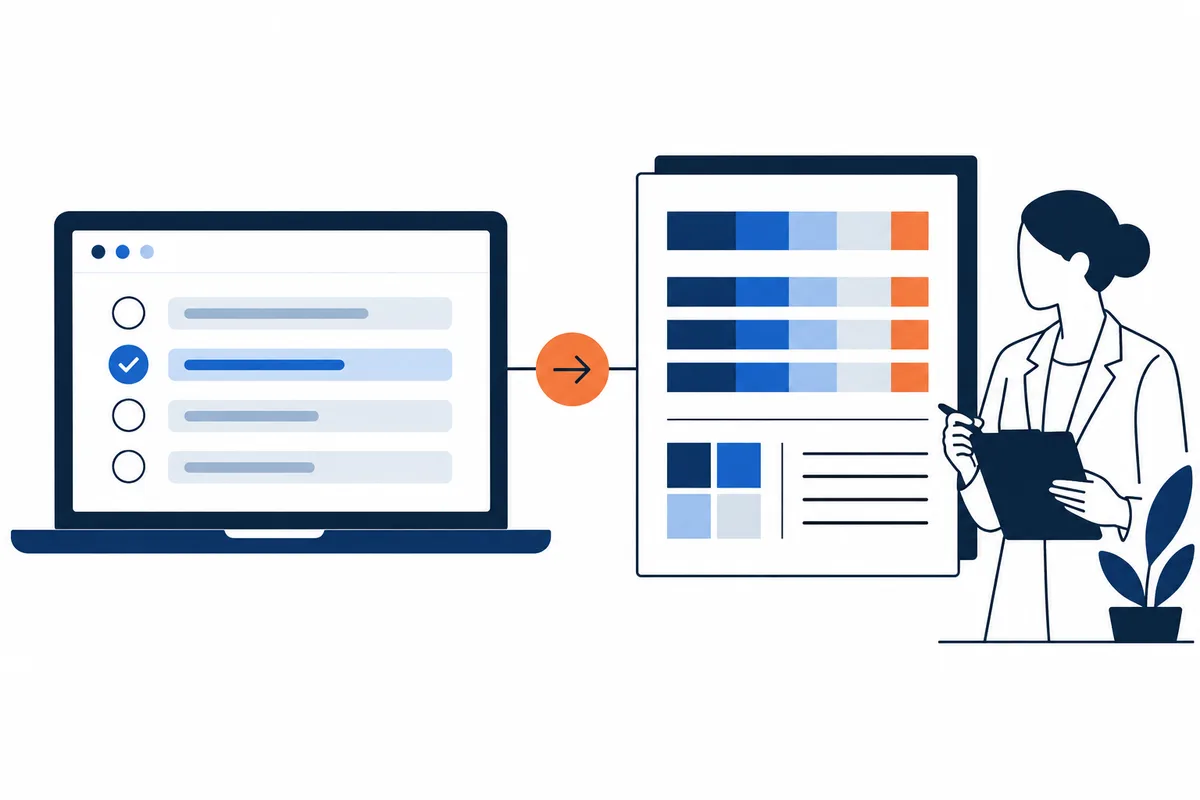
For personal development around a familiar work situation, a transparent private self-report can be enough to choose one behavior for reflection. The result is a prompt about how you describe your usual emotional habits; check it against what you notice in actual conversations. More formal assessment earns its effort when the question requires controlled conditions, interpretation across sources, or help understanding how a measure applies to your circumstances. The method should fit the inference, not the apparent seriousness of a report or the fact that it was completed online. For a low-stakes question, the useful standard is whether the result gives a clear, relevant prompt that can be checked in ordinary experience. The U.S. Office of Personnel Management’s guidance on Emotional Intelligence Tests makes a useful distinction: self-report may suit a question about perceived competence or self-image, while responses to emotion problems are used when the aim is to assess performance on those tasks. Written for selection settings, it does not establish how a development profile predicts workplace behavior. It does clarify why a self-report should be read as a report of a person’s view, rather than as direct evidence of what they did in a meeting. A systematic review indexed in PubMed examined 40 emotional-intelligence instruments and found that most followed skill-based, trait-based, or mixed models. The review searched only one database and does not establish one model as best for every purpose. Suppose feedback tends to make a person defensive. A reflection result might direct attention to the moment before replying: Was irritation noticed early? Did the person ask what the feedback referred to? Did they state a boundary or request an example? At the next relevant conversation, the person can choose one cue to notice, such as beginning to speak over the other person, then consider what response would keep the exchange useful. This makes a broad description specific enough to examine and discuss. EQ Test’s Emotional Skills Profile is a private, 32-item educational reflection tool about emotional habits and judgments on authored scenarios. It has no validated norms or standardized ability score, so its results should not be compared with a population ranking or treated as a measurement of maximum ability. Nor does the profile establish how someone behaved in a particular disagreement. Pick one behavior, notice it in context, and decide whether the observation suggests a useful practice. For example, someone reflecting on regulation might pause before answering a difficult message and note whether that pause helps them respond deliberately. A person can explore the Emotional Skills Profile at /assessment when a private structure for that reflection would help. Check what the report covers and how its information is handled. Keep the result in ordinary language: “I want to notice when I answer before I understand the concern.” Revisit the behavior in a later conversation. If the interpretation remains unclear, circumstances make a self-guided result hard to use, or the question calls for a controlled or language-aware process, seek qualified assessment support. A professional can help clarify what the chosen instrument can say and where its evidence stops; the title of the assessor alone cannot make a mismatched tool answer the right question. Start with one observation and one response to practice.
Sources: Emotional Intelligence Measures: A Systematic Review; Emotional Intelligence Tests — U.S. Office of Personnel Management; Emotional Skills Profile
The decision is about the inference, not the setting
The choice is the evidence and support needed for the conclusion you want to draw. For private reflection on a familiar work habit, a clear self-guided result may be enough to choose something to notice next. If the meaning of a result depends on controlled conditions, language, access, or several sources of information, a professional assessment process may be worth the added time. The method should fit the inference. The APA professional assessment guidelines describe matching instruments to a person’s characteristics and the assessment’s purpose, taking language and cultural context into account, and considering relevant interview information. These steps help an assessor explain how to read the result. They do not make every instrument suitable for every question. Likewise, the 2021 systematic review of 40 emotional-intelligence instruments found variation across skill-based, trait-based, and mixed models, each with advantages and disadvantages. Its authors searched one database and noted methodological limits, so the review does not settle which model is best. It does reinforce a narrower point: first identify what kind of evidence the chosen instrument produces. For example, a person who wants to understand a recurring tense exchange with a colleague might use a self-report to reflect on how they tend to notice or handle emotion. They could then name one behavior to observe in a future conversation, such as whether they pause before replying when they feel irritation. That is a modest, testable next step. The questionnaire has not established what happened in earlier meetings, what the colleague experienced, or why the exchange became tense. Those questions call for other information, such as a specific recollection, a colleague’s account, or attention to how work is organized. This is a practical inference from the limits of each information source, rather than a result reported by the review. A professional session is not automatically more useful simply because it takes place in person or ends with a formal-looking report. The EQ-i 2.0 provider documentation, for instance, describes online completion alongside practitioner training and several report options. This shows online delivery can sit inside a professionally supported process. The same page is a provider’s description of its product, however, not independent proof that a particular interpretation fits a reader’s situation. Conversely, an in-person questionnaire selected without a clear purpose does not become a better answer through location alone. The case for added support grows when circumstances could change what the result means. If a person needs an accommodation, has concerns about the language used, or completed a measure under conditions that interrupted or altered the task, a qualified professional may help determine whether interpretation should be adjusted or the assessment repeated. Integration matters too: when the question cannot be answered by a single score, an assessor may consider other relevant information and explain how it changes the conclusion. These are reasons to seek a suitable process, not reasons to assume that professional involvement guarantees certainty. The boundary becomes especially important at work. An EQ result can support reflection about an emotional habit; it should not be used as a hiring score, promotion verdict, or performance rating. If the real obstacle is unclear decision authority, excessive workload, or disagreement that carries a penalty, testing individuals may leave the main cause untouched. That is an inference about the question being asked: a measure of personal tendencies cannot by itself establish how a workplace rule or power relationship shaped an exchange. So begin by stating the question in plain terms: What do I want to understand, and what would I do with the answer? For a private, low-stakes learning goal, choose a transparent reflection tool whose model and limits are clear, and treat its result as a prompt for one observable behavior. Seek professional assessment when the conclusion depends on controlled conditions, language-aware interpretation, accommodation, or combining information beyond the test. If either the stakes rise or response conditions could materially alter the intended interpretation, the balance shifts toward added support. In every case, choose the construct and process for the question; do not let the setting make the decision for you.
Sources: Guidelines for Psychological Assessment and Evaluation; Emotional Intelligence Measures: A Systematic Review; EQ-i 2.0 — Multi-Health Systems
What is the next useful step?
Choose one recent situation that still feels unresolved today, then name a behavior you could notice next time. It might be the moment your voice speeds up, the pause before you answer criticism, or whether you ask a colleague what they meant before replying. Write down the situation, the first sign of tension you want to catch, and one response to try. That note gives you something specific to check in the next conversation; a broad score cannot tell you what happened in that particular exchange. If a private prompt would help you reflect on emotional habits and scenario judgments, explore the Emotional Skills Profile at /assessment. It is a 32-item educational reflection profile, without validated norms or a standardized ability score. Treat any suggested pattern as a question to examine, not a conclusion about how you always behave. A professional conversation may help if you need interpretation or an adapted process; the profile itself does not provide that support. Then return to the behavior you chose. Notice whether it appears, what is happening around it, and whether your planned response helps. A single interaction can sharpen what you want to practice; a larger conclusion may call for qualified interpretation.
Sources: Emotional Skills Profile
Questions readers ask
Can an EQ test be online and professionally administered?
Yes. Online describes delivery, while professional administration describes the process around the assessment. A test can be completed online with professional support.
When should I seek professional support for an EQ assessment?
Consider it when language, access, accommodations, controlled conditions, or interpretation across several sources could materially affect what you can conclude.
Sources
- EQ-i 2.0 — Multi-Health Systems
The provider describes online completion, report options, norm groups, language availability, and practitioner training.
- Emotional Intelligence Tests — U.S. Office of Personnel Management
The guidance distinguishes self-report from ability-oriented methods and describes electronic or paper administration.
- Emotional Intelligence Measures: A Systematic Review
The review examined 40 emotional-intelligence instruments and describes variation across skill-based, trait-based, and mixed models.
- Emotional Intelligence: Current Research and Future Directions
This critical review discusses differences and measurement issues across ability, trait, and mixed emotional-intelligence measures.
- Guidelines for Psychological Assessment and Evaluation
The guidelines discuss matching instruments to purpose and person, considering context, and documenting interpretive effects of modifications or accommodations.
- Emotional Skills Profile
The assignment identifies the current 32-item profile as a private educational reflection tool without validated norms or a standardized ability score.
Apply it to the real situation
Turn an EQ reflection into one behavior to notice
From this guide: The article can clarify what different assessment processes support; your own pattern still needs to be examined in context.
A result can suggest a useful question about how you notice or respond to emotion. The private 32-item Emotional Skills Profile offers a structured reflection on emotional habits and scenario judgments. Use it to choose one behavior to observe in a real conversation, then consider what you learned. It is an educational reflection tool, not a standardized ability score or population-normed result.