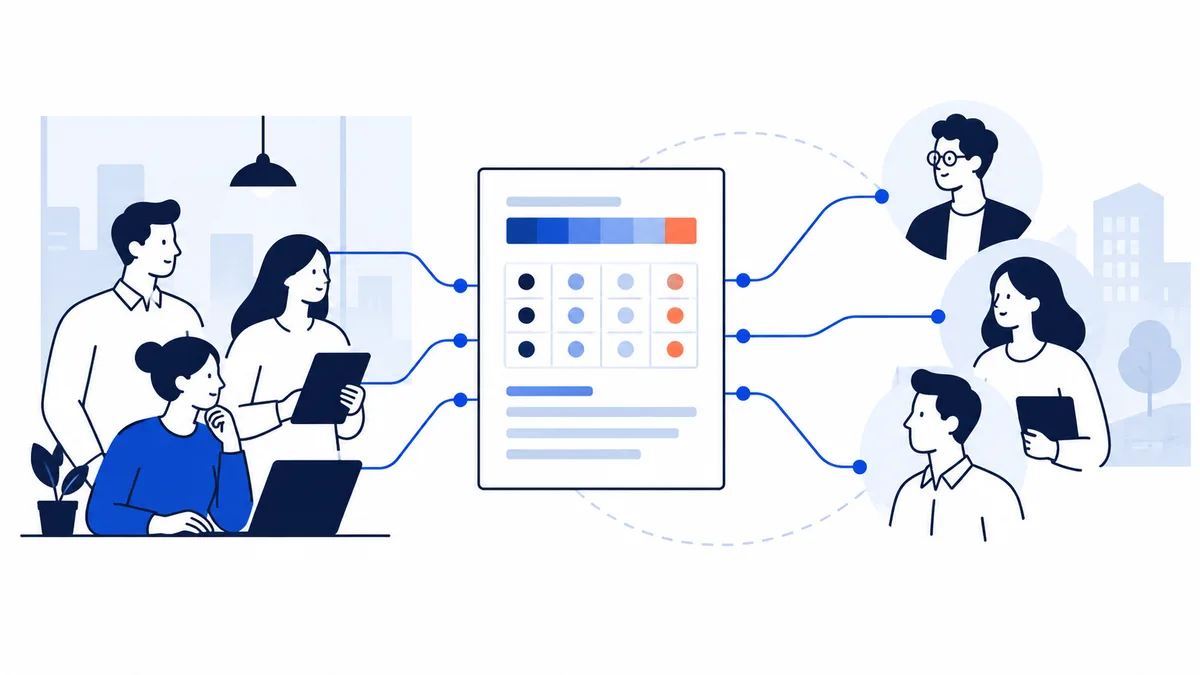
Yes, seek outside-team feedback when those people repeatedly see the behavior your immediate team cannot observe and can give specific examples. Choose raters by access to the behavior, not seniority. Treat different reports as context-bound perspectives, explain confidentiality and purpose, and collect feedback only when you can use it for a practical next step.
Should the people outside your team be asked?
Yes, when the behavior you want to understand happens mainly with them and they can recall direct examples. Multi-rater feedback gathers reports from several people who interact with you, sometimes alongside your own account. Its value comes from adding a relevant view your immediate team cannot supply, not from making the list longer. A cross-functional partner who has navigated tense handoffs with you may know more about how you respond to disagreement than a senior colleague who has seen only your presentations.
Begin with development as the purpose. The Center for Creative Leadership’s 360-degree guidance says raters need enough exposure to the work and competency to give behavior-specific examples. It also recommends explaining how the information will be used and distinguishing development from appraisal or promotion decisions. The document is practice guidance based on literature reviewed through 2001, not a controlled test of outsiders or proof that every 360 instrument is valid. Its useful principle is straightforward: purpose and opportunity to observe come before a score.
If your question is whether you interrupt people in cross-team planning, your immediate team may rarely see that meeting. If the question is how you repair after conflict with a close colleague, a distant client may have no relevant evidence. Invite an outside observer when their view fills a real gap and the process can protect candor. For one specific exchange, a direct request for feedback may be clearer than a formal survey.
A useful comparison is the coverage each source offers. Self-report can tell you what you notice about your own response; an immediate teammate can report what they encounter in routine work; an outside collaborator can describe the behavior in a different setting. These are not interchangeable votes on the same hidden quality. If the target is responding to a client’s frustration, a colleague who has only heard your internal debrief cannot supply a direct observation. The client may be able to describe the exchange, but may not know what happened in your internal follow-up. Each account has a boundary.
This also means the reader can decline a broad process and still learn something. A manager might ask one trusted project partner about a particular handoff instead of launching a company survey. An individual can ask a colleague, “What did you notice after I pushed back on the timeline?” A specific question is easier to answer from memory than “How is my empathy?” The answer remains one person’s account, yet it can provide a starting point for a practice the reader can observe again.
Sources: 360-Degree Feedback: Best Practices to Ensure Impact
Who has actually seen the behavior?
Map the behavior before choosing raters: where does it happen, with whom, and how often? This observation map is a practical synthesis of guidance on rater exposure and research showing that multisource feedback draws on distinct contexts. It changes “How emotionally intelligent am I?” into a question another person can answer: “When a partner team raises a late risk, do I ask what they have seen before defending the plan?” The second question identifies an action and a setting.
Check each candidate against the map. Have they seen the behavior more than once? Was it recent enough for an example? Did they witness the exchange itself or only its polished result? Can they describe what happened and its effect? CCL recommends raters familiar with the work and sufficiently exposed to the competency to provide examples. Its category guide defines an ‘Other’ as someone who knows the person well and has had a good opportunity to observe their working style. These are sensible screening criteria, not guarantees of accuracy.
Organizational distance is a poor shortcut in either direction. A colleague in another function may work with you every week; a manager two levels above may not. A client could see how you listen under pressure but have no basis for judging your internal repair after disagreement. The relevant relationship is the one that gave the observer access to the behavior. A person’s title does not create experience they did not have.
The map also helps you decide when not to ask. If someone saw one unusual incident, ask about that incident instead of asking them to rate your general pattern. If the behavior is rare, private, or invisible, an observer survey cannot fill the gap. A person whose contract or standing depends on you may also find it hard to be candid. In those circumstances, ask a narrow, low-stakes question only if you can make the purpose and boundaries clear.
Recency matters because people can confuse a lasting pattern with the last memorable event. A difficult launch may dominate a colleague’s memory even if it was not typical. Ask for a bounded observation period or name the kind of situation you mean. A prompt such as “Think about the last two project reviews where we disagreed” narrows recall without suggesting what the person should report. Do not ask them to reconstruct a score from memory or compare you with other colleagues.
Opportunity can also vary within a role. Two peers may both attend planning meetings, but one joins only the first ten minutes while the other works through decisions and follow-up with you. A direct report may see your response to bad news but not your behavior with a customer. The rater map should therefore follow the behavior, not the organization chart. The study of MBA feedback found that some observer categories did not meet its criteria for some competencies, a reminder that a role label alone cannot establish relevant knowledge.
Sources: 360-Degree Feedback: Best Practices to Ensure Impact; What are the definitions of the various rater categories?; Multisource Assessment for Development Purposes: Revisiting the Methodology of Data Analysis
What does a multi-rater EQ report add?
It can add accounts of conduct other people experienced, which a self-report cannot supply by itself. Behavioral emotional intelligence means emotional skills expressed through actions, such as noticing a change in tone, asking a clarifying question, or responding constructively to criticism. An observer can describe what they saw in a setting they shared. The result remains an account of behavior in that relationship and context; it is not a direct test of maximum emotional ability or a universal EQ number.
The distinction matters because tests labelled EQ do not all ask the same thing. A self-report typically asks about perceived habits. An ability measure asks a person to solve emotion-related problems under test conditions. A multi-rater tool asks others to report behavior they observed. One method cannot stand in for the others simply because they share a label. The question here is not which format is universally best, but which source can see the behavior that matters.
The 2005 paper “Multi-Rater or 360-degree Emotional Intelligence Assessment” describes a workplace 360 measure designed for development. It reports workplace studies examining rater-form consistency and differences between self- and other-ratings, and discusses leadership development. That is a precedent for collecting observer reports about emotional competencies. The abstract does not establish broad validity for every such tool or for unrelated profiles, and it does not tell an individual which outsider to invite.
A more detailed example appears in “Multisource Assessment for Development Purposes.” Its 360 survey covered 14 emotional, social, and cognitive competencies among MBA students in a European business-school leadership program. The analyzed sample contained 887 full-time students, aged 25 to 37; 71% were men and 38 countries were represented. Data accumulated from 2006 to 2017. The authors argue that the competency and context should be considered together: the same person can behave differently in different settings, and observers see different parts of that behavior.
In that study, some rater groups were judged unsuitable for some competencies. Partners, friends, and family did not meet the authors’ criteria for assessing adaptability or organizational awareness in their sample; professional subgroups and classmates were not considered suitable for emotional self-awareness. This supports matching an observer group to a specific competency, not copying those exclusions everywhere. The sample came from one leadership program, and the authors note that work-specific items were less reliable in personal contexts. A different behavior or population could produce a different map.
For an individual, the comparison is practical. A private reflection profile organizes your own account of recent behavior and scenario judgments. Observers describe conduct they witnessed. A performance task shows how you handled a defined problem. If you want to know how your questions land in cross-functional meetings, a person who regularly attends those meetings may address the uncertainty better than self-rating. If you want private reflection on your own habits, a self-report may be more proportionate.
Sources: Multi-Rater or 360-degree Emotional Intelligence Assessment; Multisource Assessment for Development Purposes: Revisiting the Methodology of Data Analysis; The Behavioral Level of Emotional Intelligence and Its Measurement
What if the outside perspective changes the picture?
A difference between groups can point to a context worth examining; it does not prove that one group is right. The MBA study treats development feedback as a set of perspectives from different settings. It argues that these views can complement one another and that agreement is not always the goal. Its demonstration involved one program and one competency model, so this is a useful way to think, not a rule that every disagreement contains insight.
Consider an illustrative project lead who asks several questions when another department raises a risk. That department may experience the questions as careful listening because it gets to explain the concern. The lead’s immediate team may experience similar questions late in delivery as reopening a decision. Those are possible interpretations of one behavior in different settings, not reported study findings. To understand the difference, ask what the situation required and what happened after the questions.
‘Outside my team’ is not one uniform rater group. A customer, a peer in another function, a sponsor, and an external partner each see a different slice of work. If their responses are collapsed into one average, the setting that made each report useful may disappear. Preserve the source group and the situation in interpretation. If a tool cannot distinguish the contexts you care about, treat its combined score cautiously and ask for examples.
Frequency ratings have another limit: they say how often someone thinks an action happened, not whether its amount was helpful. CCL’s instrument guide notes that frequency alone cannot say whether behavior is good or appropriately frequent. Asking what a person would like more or less of can reveal their preference, though it cannot establish that the preference is objectively correct. ‘You pause often’ becomes more useful when the observer can describe which pause gave people time to think and which delayed a decision.
When people describe the same event differently, keep the accounts attached to the event. A comment such as “you shut down discussion” is a conclusion; ask what words or actions led the person to it and what happened next. Another observer may recall that the group had already settled the issue. The difference could involve timing, different expectations, or incomplete recall. You do not need to decide which explanation is true before identifying a small behavior to try differently.
The 360 method also has a measurement side. A numerical category average can suggest precision while hiding whether different groups interpreted an item the same way. The multisource study says comparisons between group means require evidence that the measure works comparably across groups. That is a technical requirement for formal score comparisons; the article’s practical translation is simpler: do not assume identical numbers mean identical observations. Keep examples and contexts visible, especially when reports come from people with very different access to the work.
Sources: Multisource Assessment for Development Purposes: Revisiting the Methodology of Data Analysis; The Behavioral Level of Emotional Intelligence and Its Measurement; Choosing 360
When ratings disagree, what should you do?
Take one instance apart before calling it a stable weakness or dismissing an observer as biased. Identify the behavior, ask when it happened, and invite the observer to describe what they saw and its effect. Check whether reports concern the same situation, period, and opportunity to observe. A difference that remains may suggest your behavior changes by context; it still does not decide whose preferred response is best.
The review “The Behavioral Level of Emotional Intelligence and Its Measurement” distinguishes informant reports from self-assessment and discusses relationship context in interpreting behavioral EI. It reviews particular measures and leadership populations rather than testing every form of workplace criticism. The relevant point is that an observer sees actions within a relationship, not an abstract trait. One colleague may read silence as a thoughtful pause; a newer collaborator might read it as uncertainty. Those interpretations need examples and follow-up before they become useful evidence.
A small job-performance study illustrates why self-other gaps have no single meaning. Seven task-oriented teams worked together for four to six months, then rated members through self, superior, peer, and consultant reports. The study reported low agreement between self-ratings and each of the other groups, while agreement among the other-raters was higher overall. Observable behaviors such as communication and forward planning showed more agreement than less observable cognitive variables. This study was small and not about EQ, but it cautions against reading any gap as a simple measure of self-awareness.
Use disagreement to shape a testable practice question: “In which meetings do my clarifying questions help, and when do they slow us down?” Ask for a concrete example and choose one action to try, such as explaining why you are asking before the question. Check later with people who experience the behavior. This connects feedback to conduct rather than to a label about your character.
Sources: Multisource Assessment for Development Purposes: Revisiting the Methodology of Data Analysis; The Behavioral Level of Emotional Intelligence and Its Measurement; Congruence in Job-Performance Ratings: A Study of 360° Feedback Examining Self, Manager, Peers, and Consultant Ratings
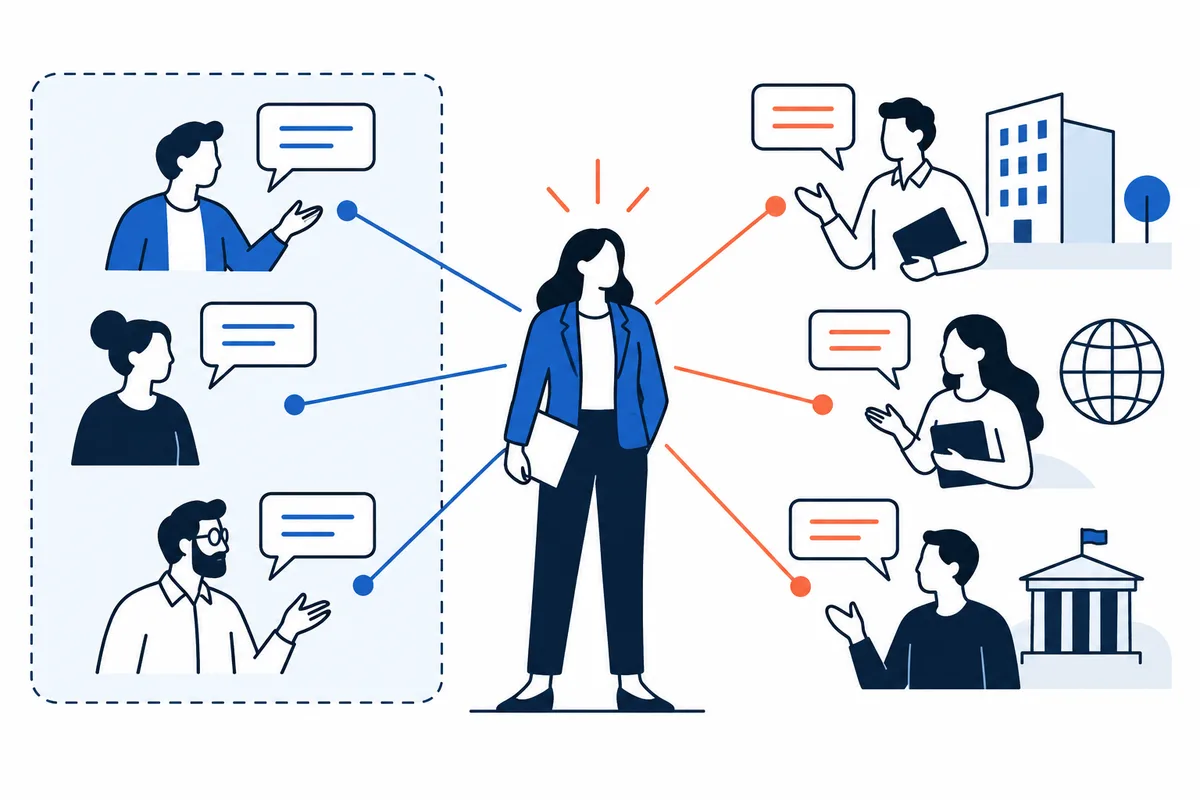
Will adding raters make the feedback more useful?
No, not by itself. Additional raters can widen coverage when they have relevant experience, but a longer list does not ensure better information or follow-through. A meta-analysis by Smither, London, and Reilly reviewed 24 longitudinal multisource-feedback studies. Average later-rating changes were generally small: corrected mean effects were .15 for direct reports, .05 for peers, and .15 for supervisors. The studies concerned multisource workplace feedback, mainly leadership and performance, rather than emotional-skills reports from outsiders. They do not support a promise of substantial improvement merely because several people contributed.
That review describes conditions thought to improve the chance of change: the recipient sees a need, responds constructively, believes change is feasible, sets a goal, and takes action. These are conditions in a theoretical model informed by research, not a guaranteed sequence or a tested result for every reader. They still suggest a practical question to ask before gathering ratings: can you name a behavior you could change and a later occasion to try it?
More names help only if they bring access to relevant evidence. An observer from another function may supply a view the home team lacks; someone who has not seen the target behavior may answer from reputation or one impression. Adding an outsider is useful when their report covers a real blind spot on the observation map. Otherwise, it adds volume without improving the decision.
Collecting reports also has a cost. Raters give time; the recipient must make sense of what they hear; and a small group may be identifiable even when names are removed. CCL recommends clarifying anonymity, preparing participants, supporting interpretation, making an action plan, and following up. Its guidance is organizational practice advice, not proof that all programs protect privacy. Before asking, explain who can see comments, whether examples will be quoted or grouped, and whether participation is optional. Do not promise anonymity you cannot ensure.
Write a possible action before you invite people. “I will be more self-aware” is difficult to observe. “When a partner team raises a concern, I will summarize it before explaining my position” gives both you and the observer something concrete to revisit. If you cannot name a plausible practice or a safe way to receive feedback, narrow the question or wait until you can act on the answer.
Feedback is also only useful relative to a genuine chance to act. If the behavior depends on a team norm, workload, authority, or a process no individual can change, a personal development goal may misplace responsibility. For instance, being described as abrupt in a handoff may reflect a rushed deadline or unclear decision rights as well as a response habit. A useful conversation can separate the part you control—such as checking understanding—from conditions a manager or team would need to address. The feedback should not turn organizational constraints into a personal EQ defect.
Likewise, a single rating should not become an identity. The meta-analysis measures changes in later performance ratings after feedback interventions; it does not say whether every participant improved or whether an individual’s emotional skills changed. It is evidence about modest average change across the studies reviewed. For the reader, the implication is to treat feedback as information that may support a development attempt, then look for observable follow-through rather than assuming a report itself changed behavior.
Sources: 360-Degree Feedback: Best Practices to Ensure Impact; What are the definitions of the various rater categories?; Does Performance Improve Following Multisource Feedback? A Theoretical Model, Meta-Analysis, and Review of Empirical Findings
When is a formal 360 process proportionate?
A formal process fits when the behavior recurs across several work relationships, several observers can speak from direct experience, and the purpose, privacy, interpretation, and follow-up are clear. It is excessive when the question is one exchange, only one person witnessed it, or people cannot tell how their comments will be used. A focused conversation may be enough: describe the situation, ask what the person noticed, and invite one suggestion for next time.
Explain anonymity realistically. Removing names does not prevent recognition when a small group or distinctive incident makes the source obvious. CCL recommends clarifying which categories are anonymous and preparing both raters and recipients. It also recommends support to interpret results and plan action. Such practices cannot guarantee candor or confidentiality, particularly in an informal request. Say who will see the responses, how examples may be shared, and whether the person can decline. If those answers are unclear, do not promise privacy.
Keep development distinct from employment judgment. CCL’s guidance says participants should understand that 360 feedback is for development, not performance appraisal, salary, or promotion. The multisource-method paper also distinguishes developmental feedback from ratings used in administrative decisions. Here, the question is how behavior lands so that it can be practiced, not whether a person should be hired, promoted, ranked, diagnosed, or included on a team. If an organization mixes those purposes, participants should know before they take part.
The EQ Test Emotional Skills Profile offers a different form of reflection: a private, original 32-item educational tool about recent behavior and judgments on authored scenarios, intended to help identify a development priority. It does not collect coworkers’ reports and has no validated population norms or established ability-test validity. It can help organize your own reflection; it cannot tell you how a cross-team partner experienced a particular exchange. For that question, ask someone who was there.
Before a formal process, ask what kind of report it produces and how the categories are handled. Are observers asked about concrete behavior or to rate broad qualities? Are responses grouped by relationship, and is a group too small to protect identity? Can a recipient see comments, and who helps them interpret a mismatch? The older CCL instrument guide discusses the importance of examining scale content and reliability; those are questions for evaluating a formal tool, not a reason to believe a branded report is automatically appropriate for an individual’s question.
Purpose affects candor. If an outside colleague thinks their answer could affect the project assignment or commercial relationship, they may soften it. If the recipient expects the feedback to justify a promotion decision, a development conversation may become difficult to separate from judgment. CCL’s recommendation to clarify intended use is therefore not just administrative. It helps both parties decide whether to participate and what conclusions the resulting comments can reasonably support.
Sources: 360-Degree Feedback: Best Practices to Ensure Impact; Multisource Assessment for Development Purposes: Revisiting the Methodology of Data Analysis; Choosing 360
What should you ask next?
Make the decision in four steps. Name one observable behavior and the setting where it matters. List who has actually seen it, including an outside-team observer if that person has repeated firsthand exposure. Explain the developmental purpose, who can see comments, and whether participation is optional. Ask for an example and its effect, then choose one feasible action to revisit after you have practiced.
Seek outside-team feedback when it fills an observation gap and you can handle the information safely. Choose a focused conversation for a narrow question; pause when purpose or confidentiality is unclear. If your uncertainty is mainly about your own habits and scenario judgments, explore the Emotional Skills Profile at /assessment.
Sources: 360-Degree Feedback: Best Practices to Ensure Impact
Questions readers ask
Should I include a client in 360 feedback?
Only if the client has enough direct experience of the behavior and can comment safely within a clearly developmental process. A client’s viewpoint may cover a real gap, but they cannot judge conduct they have not seen.
Does disagreement between teams mean my EQ is inconsistent?
Not necessarily. Groups may encounter different situations and evaluate the same action differently. Ask for examples and compare context before drawing a conclusion.
Is multi-rater feedback more accurate than self-report?
It answers a different question. Self-report captures perceived habits; observers report behavior they experienced. Neither automatically supplies a complete or universal measure of emotional intelligence.
Can the EQ Test Emotional Skills Profile gather feedback from coworkers?
No. It is a private 32-item educational reflection tool about your own recent behavior and scenario judgments. It does not collect outside observers’ reports.
Sources
- 360-Degree Feedback: Best Practices to Ensure Impact
CCL recommends adequate exposure, behavior-specific examples, clear development purpose, interpretation support, action planning and follow-up; its review concerns leadership development and literature through 2001.
- What are the definitions of the various rater categories?
CCL defines an Other rater as someone who knows the person well and had a good opportunity to observe their working style; categories depend on survey purpose.
- Multi-Rater or 360-degree Emotional Intelligence Assessment
The abstract reports development of a workplace developmental EI 360 and studies of workplace samples; claims are specific to that instrument and leadership context.
- Multisource Assessment for Development Purposes: Revisiting the Methodology of Data Analysis
An 11-year study of 887 MBA students supports competency-by-context and rater-group matching; it is a specific sample and does not validate every feedback tool.
- The Behavioral Level of Emotional Intelligence and Its Measurement
Review distinguishes behavioral EI informant reports from self-assessment and discusses relationship context; it covers particular measures and leadership populations.
- Does Performance Improve Following Multisource Feedback? A Theoretical Model, Meta-Analysis, and Review of Empirical Findings
The meta-analysis of 24 longitudinal studies reports small average changes in direct-report, peer and supervisor ratings; evidence is general multisource workplace feedback, not outside-team EQ feedback.
- Choosing 360
CCL explains frequency ratings alone do not establish appropriate amount and discusses asking what raters want more or less of; older guide about manager instruments.
- Congruence in Job-Performance Ratings: A Study of 360° Feedback Examining Self, Manager, Peers, and Consultant Ratings
Abstract reports seven project teams over four to six months, with higher agreement among other-raters than self-other and greater agreement for observable behavior; small job-performance study, not EQ.
Apply it to the real situation
Turn self-reflection into one behavior to practice
From this guide: Outside feedback can show how a behavior lands; private reflection can help you name the habit you want to examine first.
The Emotional Skills Profile is a private 32-item reflection tool about recent behavior and scenario judgments. Use it to organize a personal development question, then seek feedback from people who actually share the relevant work situations when you need their perspective. The profile does not collect coworker reports or provide a verdict about how others experience you.