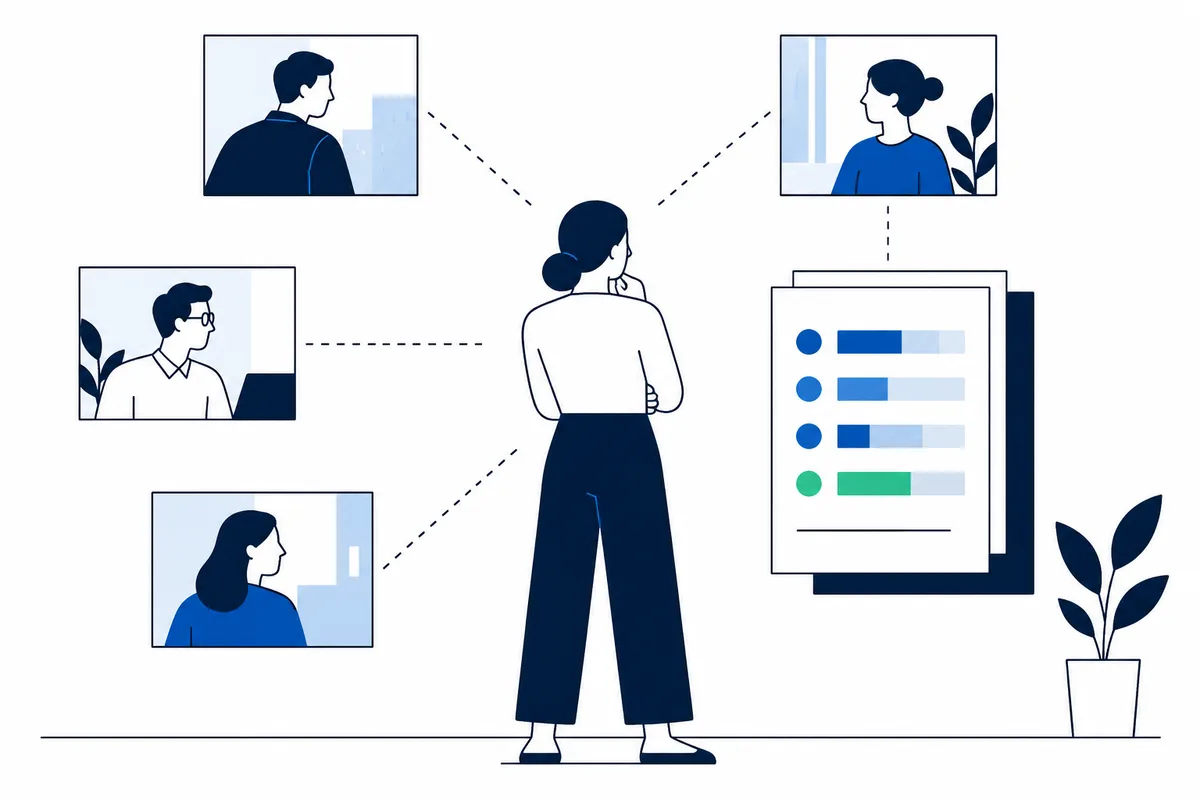
Usually, a paid multi-rater EQ assessment is a poor fit when the people invited to rate you rarely see the behavior you want to understand. Their number cannot make up for thin contact. It can be worth buying when the assessment asks about specific, visible work behaviors, the selected raters have seen those behaviors repeatedly in relevant settings, and the report gives you a sound way to interpret differences and choose a next step. A 1,194-person leadership-development study of a behavioral-EI 360 found that suitable observers differed by competency: bosses and subordinates fit some leadership behaviors, while friends, partners, or classmates fit other emotional competencies. That supports matching observers to behaviors, not a universal rater-count rule. If your contacts mostly see brief handoffs, ask about handoff behavior alone. For private emotional habits, a self-reflection tool may fit better; for one visible interaction, targeted feedback from someone who witnessed it may be enough.
When does a multi-rater EQ assessment earn its price?
The short answer is conditional: usually not as a broad paid verdict when the people asked to rate you rarely see the work behavior at issue. A multi-rater report becomes more defensible when it asks a narrow development question, its raters have recurring direct exposure to that behavior, and you have time and support to turn the answer into a specific practice. If coworkers only encounter you at occasional handoffs, they may have a useful view of those handoffs. Their replies cannot tell you much about how you handle a disagreement they never witnessed.
Multi-rater or 360 feedback means structured ratings from several people around the person being assessed, often compared with that person's own rating. Its potential value is an outside account of conduct that has an effect on other people. The evidence does not establish that a bigger group automatically sees more. In a national survey of medical students, interns, residents, chief residents, fellows, and evaluators, the [direct-observation study](https://pubmed.ncbi.nlm.nih.gov/21955772/) found that more observation was associated with a perception of more accurate knowledge, which in turn was associated with more feedback. The PubMed abstract reports no sample count, so it cannot support a numeric rule for how much observation is enough. It does support asking what each rater has actually seen.
That distinction matters when paying for an EQ-branded report. A label may suggest a broad reading of emotional intelligence, while the evidence available to an observer is narrower: what happened in the situations they saw. The workplace paper [Multi-Rater or 360-degree Emotional Intelligence Assessment](https://ejop.psychopen.eu/index.php/ejop/article/view/359) describes a development-focused EI measure and workplace research on self- and other-ratings. Its abstract discusses potential utility for leadership development, but gives no sample sizes or coefficients. It therefore supports the existence of a distinct observer-based approach, not a general claim that any purchased 360 is accurate or useful for low-contact raters.
Sources: Multi-Rater or 360-degree Emotional Intelligence Assessment; The relationship between direct observation, knowledge, and feedback: results of a national survey
What are the raters actually in a position to tell you?
Start with the behavior, then list the people who have seen it. If your question is whether you invite disagreement in planning meetings, the useful raters are people who have attended those meetings and had a chance to disagree with you. A person who sees only your polished presentation can describe how you presented. They have little basis for judging how you respond when a colleague challenges a proposal or sets a boundary.
Direct observation is plain in meaning: a person has seen the relevant behavior themselves, in a setting where it could occur. The national survey of medical trainees examined observation, evaluators' beliefs about how well they knew trainee performance, and feedback. Its abstract reports a chain of association: more observation related to perceived more accurate knowledge, which related to more feedback. It also says some evaluators provided feedback without accurate knowledge, while some who had relevant knowledge did not give feedback. Because the study was about medical education and the accessible abstract supplies neither participant counts nor effect sizes, transfer it as a design principle rather than a forecast about every workplace. Ask raters to comment only where they can recall a concrete instance.
A useful map may look uneven. A project partner may see how you explain a delay and renegotiate responsibilities. A direct report may see how you receive pushback. A client may see whether you remain attentive when expectations change. One rater need not observe every part of your work, provided the assessment and report preserve which perspective speaks to which behavior. If everyone has only occasional contact, a pooled average can look comprehensive while each item rests on a thin memory.
Before purchasing, ask whether the questionnaire allows a rater to say they do not know or have not observed a behavior. That option is meaningful data. If the process pressures people to answer every item, uncertain impressions can enter the score without becoming more informed. Ask, too, whether the report shows which rater groups answered each set of questions and whether it distinguishes a missing observation from a low rating. If it does not, you may be paying for precision in presentation that the observation process cannot supply.
Sources: The relationship between direct observation, knowledge, and feedback: results of a national survey; The Measurement of Emotional Intelligence: A Critical Review of the Literature and Recommendations for Researchers and Practitioners
Does another person’s rating measure the same EQ as a test?
No single EQ measure answers every question. Observer feedback records other people's accounts of visible conduct. A self-report questionnaire summarizes how a person describes their usual feelings, habits, or competencies. An ability-EI test samples performance on emotion-related problems. These measures can share the emotional-intelligence label while capturing different evidence.
The terms help clarify what you are buying. Ability EI refers to solving tasks that involve emotional information. Trait EI refers to a person's self-perceived typical emotional functioning. Mixed models combine emotional skills or tendencies with broader competencies, often including workplace behavior. The open-access critical review [The Measurement of Emotional Intelligence](https://www.frontiersin.org/journals/psychology/articles/10.3389/fpsyg.2019.01116/full) reviewed more than 30 widely used measures and separates ability, trait, and mixed approaches. It recommends choosing a measure for its purpose; it notes that 360 formats appear particularly in mixed workplace measures. This is a literature review, not a head-to-head trial proving one method best for every buyer.
That distinction prevents a common mismatch. If you want to know whether you notice anger early in a private moment, a colleague may not have access to the feeling itself. If you want to know whether your interruption shuts down discussion, a self-report is only your account of that effect. A structured ability task addresses yet another question: how you respond to a defined emotion problem under test conditions. Neither a 360 nor a self-report should be presented as a substitute for such a task.
The EI-specific paper [Multi-Rater or 360-degree Emotional Intelligence Assessment](https://ejop.psychopen.eu/index.php/ejop/article/view/359) discusses workplace samples, the consistency of rater forms, and comparisons between self- and other-ratings in a development context. The abstract does not state the sample sizes or statistics, which limits conclusions about reliability and generalizability. Its value here is more modest: it establishes that an observer-based EI format has been studied as a distinct developmental method. A commercial report still needs its own transparent evidence and a clear explanation of what its score represents.
So a gap between your rating and a colleague's rating is not automatically proof that one of you lacks insight. You may remember your intention or effort; a colleague may describe the impact they experienced in one setting. Both accounts can be useful, but a score difference alone does not tell you which interpretation is better. Ask what behavior and situation could explain the difference, then seek a concrete example.
Sources: Multi-Rater or 360-degree Emotional Intelligence Assessment; Multisource Assessment for Development Purposes: Revisiting the Methodology of Data Analysis; Does Performance Improve Following Multisource Feedback? A Theoretical Model, Meta-Analysis, and Review of Empirical Findings
When can several partial views add up to useful feedback?
Several partial views can help when each is relevant to a different setting and the report keeps that context visible. More viewpoints can expand the range of behavior sampled. They do not convert a weakly observed behavior into a well-observed one simply by being averaged together.
A particularly relevant example comes from [Multisource Assessment for Development Purposes](https://www.frontiersin.org/journals/psychology/articles/10.3389/fpsyg.2018.02646/full), an open-access methodological study using a behavioral emotional-intelligence 360 among 1,194 MBA students in a European business-school leadership program over 11 years, from 2006 to 2017. The researchers tested a way to account for different rater contexts and illustrated how a survey could be tailored by observer group. Their analyses suggested that bosses and subordinates were better suited to rate inspirational leadership, while partners, friends, and classmates were better suited to rate emotional self-control and positive outlook. They reduced the initial 14-competency survey to different, shorter versions for professional and personal rater groups.
This is a useful counterweight to the idea that infrequent workplace colleagues can assess every emotional skill equally well. Observer fit depended on the competency and the relationship. For a development question about how someone leads a meeting, workplace observers may have the relevant view; for emotional self-control in personal life, people closer to that setting may see more. That does not mean personal contacts are automatically appropriate raters for a workplace purchase. It means the target and setting should decide who can contribute evidence.
The study also places a boundary around its own result. Its sample consisted of MBA students in one leadership-development setting, and the authors state that their conclusions depend on the competencies, their measurement, and that sample. They say the paper was designed to illustrate a method, not establish construct or external validity for one specific tool. Its specific observer patterns should not be copied as a universal recipe. The transferable question is whether the assessment has evidence that each rater group can judge each behavior, and whether it allows the form to reflect those differences.
When the answer is yes, a multi-rater report may add something a single conversation misses: several accounts of how behavior appears across settings. When the answer is no, a higher count can add noise or hide gaps. Ask whether the report keeps ratings separated by group, whether it identifies items observers could not judge, and whether comparisons between self and others are interpreted with care. If the seller gives only one combined score, ask how a reader can tell what the score is actually summarizing.
Sources: Multisource Assessment for Development Purposes: Revisiting the Methodology of Data Analysis
Why can a fuller-looking report still mislead?
A complete-looking chart can contain unequal evidence. One group may have frequent chances to observe the behavior; another may infer it from a few short encounters. Raters can also use the same words differently. One person may call a direct response decisive, another abrupt. The report needs to help you inspect the underlying observations rather than treating agreement as proof or disagreement as a defect.
The 1,194-person MBA study makes context more than a footnote. Its authors propose treating the competency and the context together because behavior can change with setting, and people in different relationships may see different conduct. They also argue that comparing average self-ratings with other-ratings requires evidence that the item scale has comparable meaning across sources. This technical condition is called measurement invariance: roughly, the questions need to function comparably before a numerical gap can be interpreted as a difference in the underlying competency. The study's central contribution is methodological, and it did not validate every EI instrument or prove that any individual score gap reflects a true ability difference.
The findings point toward a practical reading. Suppose your self-rating says you welcome challenge, while a peer rating is lower. Instead of concluding that you are defensive, look for the situations each source had in mind. You may invite objections in a weekly design review and react poorly to last-minute changes in a client call. Both ratings might describe real moments. A useful report would prompt that inquiry; a weak one would flatten the difference into a single verdict.
Rater selection can shape the picture as well. People who work closely with you may have stronger evidence, but closeness can bring loyalty, frustration, or a long-standing impression that affects how a new interaction is read. Sparse contact has the reverse problem: less history, fewer examples, more room for inference. The research reviewed here does not let us quantify those effects for a particular EQ product. It does make it unwise to treat either closeness or distance as a guarantee of neutral judgment.
Look for a report that preserves self and rater perspectives, explains how groups are combined, and distinguishes observed behavior from interpretations of motive. When feedback identifies a specific moment, you can test it: ask what the person saw, what they thought it meant, and what response they would have found more useful. If comments stay vague, treat them as questions to explore rather than facts about your character.
Sources: Multisource Assessment for Development Purposes: Revisiting the Methodology of Data Analysis; Emotional Intelligence: A Practical Review of Models, Measures, and Applications

What would make the report worth its price?
A report earns its price when its observations can guide a behavior you can practice and revisit. Collecting ratings is only the start. The recipient needs a way to understand what the feedback means, decide which part matters, and choose an action that fits the work. Without that follow-through, the report may produce an interesting set of opinions and no change in the next difficult conversation.
The meta-analysis [Does Performance Improve Following Multisource Feedback?](https://leeds-faculty.colorado.edu/dahe7472/smither%20performance.pdf) examined 24 longitudinal studies of workplace multisource feedback. It found that improvement in direct-report, peer, and supervisor ratings over time was generally small. In its pooled results, the corrected mean effect sizes were about 0.15 for direct reports, 0.05 for peers, and 0.15 for supervisors; the uncorrected weighted averages were smaller for direct reports and peers. The evidence covered leadership and job-performance feedback, not EI-specific assessment, and the included studies varied in design. The paper's review suggests improvement is more likely when recipients see a need to change, respond constructively, set suitable goals, and take action. A purchase alone is not an intervention.
That finding should temper both extremes. It does not show that feedback never helps; small average change can coexist with meaningful progress on a narrow behavior, and outcomes varied between studies. It also does not support promises that a polished report will transform someone's leadership or relationships. Before paying, ask what is included after the scores arrive. Is there a guided interpretation, a chance to discuss a confusing pattern, or a concrete way to set a behavior goal? If follow-up is an extra cost, include it in the real price of the process.
A development goal should be observable enough to test. 'Be more emotionally intelligent' is difficult to practice. 'When a teammate disagrees, pause and ask what concern I may have missed before defending the plan' is visible to colleagues and within your control. If the concern is a boundary, the practice might be to state what you can offer and when, without adding a promise you cannot keep. Choose one behavior the raters had the chance to see, and decide how you will notice whether your next attempt is different.
The plan must also protect the purpose. A personal development assessment is not a hiring score, promotion ranking, diagnosis, or performance verdict. If a provider or employer proposes using results for those decisions, that is a different and higher-stakes use requiring a separate evidence and governance basis. This article concerns an individual choosing a reflective development tool for themselves.
Sources: Multi-Rater or 360-degree Emotional Intelligence Assessment; Emotional Intelligence: A Practical Review of Models, Measures, and Applications
If contact is sparse, what is a fairer comparison?
Compare the assessment with the question you need answered, rather than with the promise of getting a fuller picture. A self-reflection measure can organize your view of recurring habits and scenario choices. A colleague who directly observed one interaction can comment on that behavior. An ability task samples responses to structured emotion problems. Each leaves something outside its view.
The critical review of EI measurement distinguishes ability, trait, and mixed models because they do not measure one interchangeable quantity. Its recommendation is to choose a measure suited to the purpose. A self-report is more direct when the topic is how you perceive your own usual emotional habits, though memory and self-perception can limit that account. An observer report addresses visible effects in the observer's experience, not private feelings. A performance measure addresses responses to defined tasks, not the full range of everyday workplace conduct.
A practical guide by Dana Ackley, [Emotional Intelligence: A Practical Review of Models, Measures, and Applications](https://www.researchgate.net/publication/308575317_EMOTIONAL_INTELLIGENCE_A_PRACTICAL_REVIEW_OF_MODELS_MEASURES_AND_APPLICATIONS), compares three common EI models and describes assessment applications in coaching and development. It is a practice-focused review, not a systematic review or an independent trial of one current product. Its useful contribution is to keep model, instrument, and application linked: ask what the tool defines as emotional intelligence, what evidence it collects, and how a coach or reader is expected to use the result.
For sparse workplace contact, a proportionate alternative may be to ask one person who witnessed a relevant moment a single focused question: 'When I pushed back on the timeline yesterday, what did you notice about how I handled your concern?' This does not create a validated EQ score. It may answer a narrow practical question more directly than asking several people to rate behaviors they barely see. If the issue recurs across several settings and you can recruit observers with real exposure in those settings, the case for a structured multi-rater report becomes stronger.
EQ Test's 32-item Emotional Skills Profile is a private educational reflection tool covering recent behavior and emotional situations. It can help you notice habits and choose a development priority; it has no validated norms or established ability-test validity. It cannot replace observations from coworkers or tell you how they experienced a specific exchange. It may be a proportionate starting point when your immediate task is self-reflection rather than a broad observer judgment.
Sources: The Measurement of Emotional Intelligence: A Critical Review of the Literature and Recommendations for Researchers and Practitioners; Does Performance Improve Following Multisource Feedback? A Theoretical Model, Meta-Analysis, and Review of Empirical Findings; Emotional Intelligence: A Practical Review of Models, Measures, and Applications
What should I ask before deciding?
Before buying, ask the provider what behaviors the report covers and what a rater must have seen to answer each question. Ask whether people can mark an item outside their experience, whether you can select raters based on the behavior and setting, and whether the report keeps perspectives distinct. Then ask what interpretation or follow-up is included, and whether the scores are intended only for development.
The 1,194-person behavioral-EI study gives a concrete reason to ask about fit by behavior: observer groups did not suit every competency equally, and the instrument could be shortened differently for different sources. The direct-observation survey adds a basic check: raters should have observed enough to know what they are describing. Neither paper supplies a universal threshold for contact, and neither validates a product you may be considering. The seller should be able to explain the evidence for its specific measure and what its scores do and do not support.
For a quick decision, sketch a small table with three columns: the behavior you want to understand, the people who have seen it, and the action you could take after hearing from them. If the observer column is mostly blank, postpone the purchase or narrow the question. If the action column is blank, first decide what change would matter. If both are clear and the provider can explain its instrument and follow-up, the report may be worth its cost.
The most revealing next step may be a conversation rather than a checkout. Ask a colleague who sees the relevant work regularly: 'Could I ask about one recent disagreement? When I responded to your concern, what did you notice, and what would have helped you feel heard?' Their answer will not settle your EQ. It can give you a specific behavior to examine and show whether a broader assessment would add useful evidence.
Sources: The relationship between direct observation, knowledge, and feedback: results of a national survey; The Measurement of Emotional Intelligence: A Critical Review of the Literature and Recommendations for Researchers and Practitioners; Multisource Assessment for Development Purposes: Revisiting the Methodology of Data Analysis; Emotional Intelligence: A Practical Review of Models, Measures, and Applications
Questions readers ask
How many raters do I need for an EQ 360?
There is no universal count supported for every tool and workplace. Evidence suggests that raters need relevant opportunities to observe the behavior, and that suitable observer groups can vary by competency. Ask the provider how its instrument handles limited exposure and why its recommended number fits the specific measure.
Can a multi-rater EQ assessment tell me whether I am emotionally intelligent?
It can summarize how selected people describe behaviors they have observed, depending on the instrument. It cannot directly show private emotional experience or stand in for every meaning of emotional intelligence. Read the result as evidence about specified behavior and context, not a complete verdict on you.
What if my coworkers rarely see me at work?
Narrow the question to behavior they have directly observed, seek feedback from someone who sees the relevant setting more often, or begin with a self-reflection tool if your question concerns your own habits. Do not treat a low-contact group's broad ratings as representative of behavior they have not seen.
Sources
- Multi-Rater or 360-degree Emotional Intelligence Assessment
The abstract describes a workplace development-focused EI 360 and identifies research on rater-form consistency and self-other ratings, while leaving sample statistics unavailable.
- The relationship between direct observation, knowledge, and feedback: results of a national survey
The PubMed abstract reports a national survey of medical trainees and evaluators linking direct observation with perceived knowledge and feedback; it provides no sample count in the accessible abstract.
- The Measurement of Emotional Intelligence: A Critical Review of the Literature and Recommendations for Researchers and Practitioners
This review distinguishes ability, trait, and mixed EI models, surveys more than 30 measures, and recommends selecting a measure for its intended purpose.
- Multisource Assessment for Development Purposes: Revisiting the Methodology of Data Analysis
An 11-year 360 study of 1,194 MBA students found observer-group fit varied by behavioral EI competency and explicitly limits its findings to its instrument and sample.
- Does Performance Improve Following Multisource Feedback? A Theoretical Model, Meta-Analysis, and Review of Empirical Findings
The 24-study longitudinal meta-analysis reports generally small changes in supervisor, peer, and direct-report workplace ratings and discusses conditions associated with improvement.
- Emotional Intelligence: A Practical Review of Models, Measures, and Applications
This accessible practice-focused review compares common EI models, measures, and coaching applications; it is used for orientation rather than comparative efficacy claims.
Apply it to the real situation
Turn a broad EQ question into one behavior you can examine
From this guide: If you are unsure whether your question is about a private habit or an impact others can observe, start by identifying the pattern you want to reflect on.
The 32-item Emotional Skills Profile offers a private reflection on recent emotional habits and scenario judgments, with practical guidance for choosing a development priority. It can help you decide what to notice next in feedback, disagreement, or repair. It is an educational reflection tool, not a substitute for coworkers' observations or an ability score.