
Compare an EQ test’s exact promise with evidence for the score, test version, relevant test takers, and intended use. First identify whether it measures self-reported tendencies, performance on emotion problems, or observed behavior. Then check how items and scoring support the interpretation, whether the evidence fits the current test and setting, and whether it reaches the decision the report recommends. Reliability alone does not establish meaning or predict workplace behavior.
Start with the sentence the score is supposed to prove
A report says a person’s score shows they manage conflict well. Another says a high result predicts stronger work performance. Both may sound plausible; neither claim follows from a number alone. Compare the exact promise with evidence for that score, test version, relevant test takers, and intended decision. A citation or reliability figure is one part of the comparison. Evidence that a questionnaire describes self-perceived habits does not, by itself, show emotional ability or forecast workplace behavior.
The Standards for Educational and Psychological Testing frame validity around the interpretation and use proposed for test scores. Ask what the provider says the result means and what it invites you to do. Take a sentence such as ‘your score shows how effectively you repair disagreements at work.’ Separate the response that produced the number, the skill the score represents, the conclusion attached to it, and the action the report recommends. Each step adds an inference that needs support. Describing how someone rates their habits is narrower than predicting how they will act in a future conflict. Before accepting the label or advice, see whether documentation connects each step to evidence about this measure and proposed use.
Sources: Standards for Educational and Psychological Testing
What kind of result did the provider actually measure?
Before weighing an EQ score, identify how the test produced it. A self-report questionnaire asks people to describe themselves: perhaps how often they notice another person’s mood or how confident they feel managing frustration. A performance task presents emotion-related problems and scores answers under a stated rule. An observer report asks someone else to describe behavior they have seen. These methods concern emotions, but provide different evidence about a person. The distinction is easy to miss because providers use overlapping labels. “The Measurement of Emotional Intelligence: A Critical Review of the Literature and Recommendations for Researchers and Practitioners” describes ability, trait, and mixed-model traditions, alongside many measures developed to represent them. In the review’s method-based distinction, trait emotional intelligence refers to self-reported typical behavior and perceived ability; ability emotional intelligence refers to performance on emotion problems. “Mixed” measures often combine self-reported traits, social skills, or competencies, and some include reports from other people. So the label “ability” in a questionnaire’s theory does not make it a test of demonstrated ability. Ask what the respondent does to earn the score. Consider a report that says someone is skilled at receiving difficult feedback. If its item asks the person to rate how well they accept criticism, the score summarizes that person’s account of a typical tendency or perceived skill. It does not show how they responded in a meeting. A performance task might ask the respondent to choose an answer to a defined emotion scenario; that samples their answer under the task’s scoring method. A colleague’s rating describes behavior visible to that colleague in situations they shared. None automatically substitutes for the others. Self-report may support a claim about self-perception without showing consistent behavior, and a scenario answer does not establish routine behavior at work. A 2026 study, “When emotional intelligence measures disagree: discordant profiles in allied health students and why classification uncertainty matters,” makes the distinction concrete. In a cross-sectional online survey at Kuwait University, allied-health undergraduates completed two self-report measures: the SSEIT, which the researchers describe as based on an ability model but measuring self-perceived emotional skill, and a trait-model questionnaire. Among the 489 responses retained for analysis after exclusions, scores had a modest correlation (r = 0.35); analysis also identified a small group whose scores diverged. This complicates the idea that two self-reports carrying an EQ label necessarily give interchangeable accounts. The study does not compare self-report with demonstrated performance, and its student sample cannot establish how either measure works for employees or predicts workplace behavior. When a provider calls a result “EQ,” look past the umbrella term. Find the response format and ask what the score summarizes: self-perceived tendency, answers to defined tasks, or another person’s observations. Then compare that answer with the report’s claim. If the promised interpretation goes beyond what respondents reported or demonstrated, the evidence needs another link.
Sources: The Measurement of Emotional Intelligence: A Critical Review of the Literature and Recommendations for Researchers and Practitioners; When emotional intelligence measures disagree: discordant profiles in allied health students and why classification uncertainty matters
How do the items and scores earn their labels?
A subscale called ‘emotion regulation’ earns that label only if the test’s design explains what regulation means, which parts of it the items sample, and how responses become a score. The Standards for Educational and Psychological Testing say that when an interpretation depends on test content, developers should describe and justify how that content was specified and generated for the intended construct and population. That means asking whether the questions cover the stated skill or just a convenient slice of it. A few items about staying calm, for example, would not by themselves show that a score also represents recognizing an emotion, choosing when to act, or repairing a tense exchange. The same document distinguishes evidence about item content from evidence about the response process. If a report says that answering a prompt demonstrates a particular emotional skill, the developer should explain why that response is evidence of the skill. What does a person have to notice, judge, or recall to answer? Could they instead be reporting what they believe they usually do, choosing the socially approved answer, or responding to unusual wording? These possibilities do not automatically make an item poor. They identify what its score can reasonably represent. A recent-behavior self-report and a task asking someone to solve an emotion problem place different demands on the respondent; their scores need separate rationales. Next, check the scoring explanation. Does the provider show how item responses are combined, why subscales are separated, and what justifies a total score if one is offered? ‘Understanding’ and ‘regulation’ may appear as headings in a report, but those names are claims about the relationship between the items and the ideas they represent. The Standards call evidence about those relationships the test’s internal structure. In plain terms, it asks whether the pattern among items and scores fits the account the test gives of its dimensions. A factor chart can contribute to that case. It cannot, on its own, show that a person will resolve disagreement well or lead effectively; those are further interpretations that need evidence connecting the score to relevant behavior or outcomes. Scoring also matters for performance tasks, where a response may be marked against a key, expert judgment, or the answers of a comparison group. The Measurement of Emotional Intelligence: A Critical Review of the Literature and Recommendations for Researchers and Practitioners discusses consensus-based scoring as one debated feature of a widely used ability measure, alongside questions about reliability and whether the test covers the intended ability. That debate is a reason to inspect how a key was made, not to assume consensus scoring is inherently invalid. Ask what counts as a strong answer, who set that standard, and whether the resulting score supports the report’s exact description. A transparent rationale helps distinguish a measured response pattern from a polished label; if the provider gives only a graphic and a confident name, ask for the missing link.
Sources: Standards for Educational and Psychological Testing; The Measurement of Emotional Intelligence: A Critical Review of the Literature and Recommendations for Researchers and Practitioners
A consistent number can still carry an unsupported meaning
A reliability figure answers a narrower question than many score reports imply. It describes how consistently or precisely a test produces scores under stated conditions. It does not tell you whether the test measures emotional understanding, predicts a response to criticism, or supports comparison between people. The Standards for Educational and Psychological Testing treats reliability or precision as evidence needed for each intended score use. Validity concerns whether evidence supports the interpretation and use attached to a score. A consistent number can still be given a meaning the evidence has not earned.
Ask what kind of consistency the provider reports. Internal consistency examines how responses across items relate within a scale; it cannot show that the scale represents every part of the skill named in the report. Test–retest evidence asks whether scores remain similar across occasions when conditions should remain stable. Inter-rater evidence asks whether different raters give comparable judgments. That question matters for observer assessments, while a self-report has no second rater to agree with. “Highly reliable” without the method, sample, version, and conditions leaves the claim hard to interpret. The Standards cautions that an index without these details is inadequate documentation.
Suppose a profile labels one emotional skill “strong” and another “weak” because scores are close. Without subscale precision evidence, the labels may exaggerate a difference the measurement cannot resolve. The Standards says that when an interpretation emphasizes differences between an individual’s scores, precision data for those differences should be provided. Ask whether evidence is reported for each score the report interprets, not just for a broad total.
A standard error of measurement gives a more direct account of score uncertainty. It helps show how much an observed score might vary because measurement is imperfect; a confidence interval uses that uncertainty to give a plausible range. The Standards notes that precision can differ at different points on a scale. The critical review The Measurement of Emotional Intelligence: A Critical Review of the Literature and Recommendations for Researchers and Practitioners discusses reliability and validity separately across EI measures, so one statistic is not a complete quality verdict.
A strong precision result can make a score more stable for a specified purpose. It cannot turn self-description into observed behavior, establish a workplace prediction, or justify ranking without evidence for those interpretations. Read reliability as one link in the argument. If the provider will not identify the score and conditions behind it, give small score differences little weight and ask what the number can support before acting.
Sources: Standards for Educational and Psychological Testing; The Measurement of Emotional Intelligence: A Critical Review of the Literature and Recommendations for Researchers and Practitioners
Check whether the study travels to this test taker and setting
A study can be rigorous and still answer a narrower question than the report asks. To judge whether its result travels, compare the people, test form, language, administration, and setting in the study with the people and conditions covered by the score claim. The Standards for Educational and Psychological Testing say validation samples should be described in enough detail to judge who they represent, and that data-collection conditions should let users assess relevance to local conditions. That is a practical test for any EQ citation: can you tell who took the measure and what they were asked to do?
Start with the version. A finding for a full questionnaire does not automatically cover a shortened form; a result for one scoring method may not support a later report that adds a total score or changes the algorithm. Translation, revised wording, or remote administration can also matter if the change affects how people understand items or respond. None of these changes automatically invalidates a measure. The provider should explain what changed and whether it checked the consequences for the interpretation being sold. The Standards specifically note that administration conditions should be described where they may differ from ordinary testing and plausibly influence performance. A study completed under close supervision, for example, may leave an open question if the current assessment is taken alone online. That question calls for evidence or a reasoned account, not an assumption that the results must differ.
Then look at the sample. “Adults” is too broad to tell you whether findings apply to current workers, people new to a profession, or readers using a test for personal reflection. The Standards point to characteristics such as employment status, experience, education, and the way participants were recruited as details that may shape how a workplace sample should be interpreted. The 2019 review, “The Measurement of Emotional Intelligence: A Critical Review of the Literature and Recommendations for Researchers and Practitioners,” makes the issue visible in its discussion of individual studies: it notes cases where executive samples came from one industry or where undergraduate samples limited generalization to workers. Those examples do not invalidate the studies. They show why the population named in a paper belongs beside the finding when a provider cites it.
Independent replication can add a useful check on developer-led findings, but “independent” does not mean “relevant to every use.” A replication involving another language, group, version, or setting may test whether a result holds there; it does not by itself establish fit for a different score interpretation. Look for that bridge rather than a raw count of papers.
A concise audit is to record four details beside each prominent citation: which version was tested, who participated, how and where they completed it, and what conclusion the study actually supports. If the report makes a broader claim than those details justify, ask what evidence connects the study to this score and this setting. Until that connection is clear, keep the interpretation within the studied scope; an evidence gap is a reason to narrow the claim, not to assume the test fails everywhere.
Sources: Standards for Educational and Psychological Testing; The Measurement of Emotional Intelligence: A Critical Review of the Literature and Recommendations for Researchers and Practitioners
When two scores disagree, ask what question each one answered
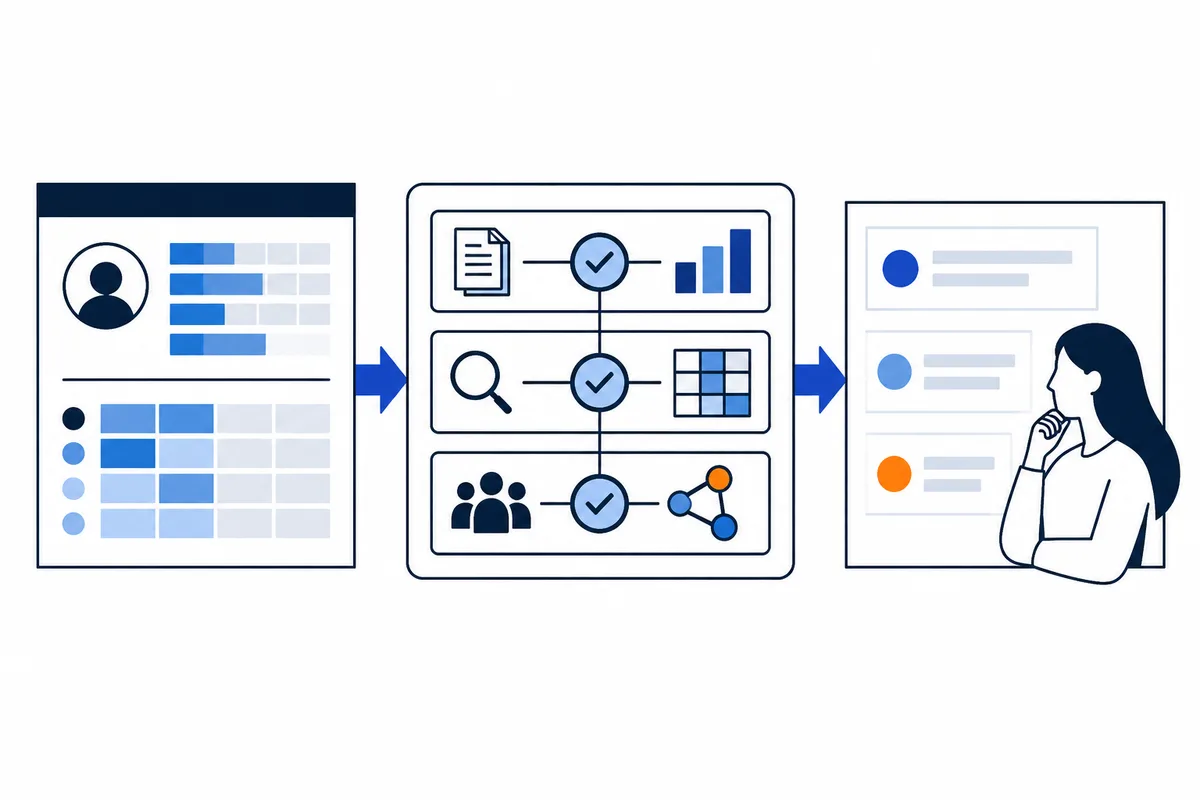
When two EQ tests disagree, the first question is what each score was designed to describe. A mismatch does not show that one result is fraudulent, or that a hidden, universal EQ number must be waiting to settle the dispute. One questionnaire may ask how capable someone believes they are at handling emotions; another may ask about recurring emotional dispositions. Those answers can diverge because the instruments make different claims about the person. A useful example comes from the 2026 study [“When emotional intelligence measures disagree: discordant profiles in allied health students and why classification uncertainty matters”](https://www.frontiersin.org/journals/psychology/articles/10.3389/fpsyg.2026.1929366/full). In a cross-sectional survey at Kuwait University, allied-health undergraduates completed two self-report measures: the SSEIT, based on an ability model but measuring self-perceived emotional skill, and the Kuwaiti-Arabic TEIQue-SF, a trait measure. After the authors excluded invariant responders, 489 students remained for analysis. The scores correlated modestly (r = 0.35); the authors’ four-profile solution included a discordant group, 4.9% of the analytic sample, whose self-perceived skill and trait score did not line up. This finding complicates the assumption that two established EI questionnaires should give interchangeable descriptions. The result has a narrow reach. It comes from one convenience sample of students in one educational setting, not a study of employees or observed workplace conduct. The authors also report that grade-point average showed no robust association with profile membership. That outcome cannot tell us whether either measure captures a person’s skill in a difficult meeting. It does show why a provider should explain a score’s construct and intended inference instead of relying on the broad label “EQ.” The question is not whether every measure must agree. It is whether a provider claiming equivalence has tested that particular relationship. A second study helps keep that point from becoming a blanket dismissal of self-report. In [“Discriminant Validity of Self-Reported Emotional Intelligence: A Multitrait-Multisource Study”](https://journals.sagepub.com/doi/10.1177/0013164409355700), Joseph and Newman examined self- and peer-reports from 280 dyads. Their analyses supported a four-factor structure for the Wong and Law Emotional Intelligence Scale and found evidence that its EI facets could be distinguished from Big Five personality traits. At the same time, some facets had strong latent correlations with particular traits, and the authors noted post hoc evidence of possible leniency in self-ratings of emotion regulation. The study therefore supports a more specific account: a scale can show distinct construct evidence while some of its components overlap substantially with neighboring concepts. Its one instrument and sample cannot settle how all EI tests relate to other traits. The 2019 review [“The Measurement of Emotional Intelligence: A Critical Review of the Literature and Recommendations for Researchers and Practitioners”](https://www.frontiersin.org/journals/psychology/articles/10.3389/fpsyg.2019.01116/full) likewise describes related but distinct EI constructs, measures, and facets. Read together, these sources make convergence a claim to evaluate, not a universal pass condition. If two scores disagree, check whether they use the same method, define the same construct, and promise the same interpretation. If a provider says its score is interchangeable with another measure, ask for evidence of that relationship in the relevant version and population. Without that link, keep the results side by side as different self-reports rather than turning them into a ranking of a person’s emotional ability.
Sources: When emotional intelligence measures disagree: discordant profiles in allied health students and why classification uncertainty matters; The Measurement of Emotional Intelligence: A Critical Review of the Literature and Recommendations for Researchers and Practitioners; Discriminant Validity of Self-Reported Emotional Intelligence: A Multitrait-Multisource Study
A workplace claim needs workplace-relevant evidence
A claim that an EQ score predicts how someone handles feedback, resolves disagreement, or performs at work needs evidence connecting that score to relevant behavior or outcomes. A test may describe what respondents say about themselves, or show how they answered defined emotion problems. Neither result alone establishes what they will do. Describing a score, finding an association, predicting an outcome, and guaranteeing what one person will do are different claims; each step needs evidence that reaches further.
The Geneva Emotional Competence Test (GECo) offers a example of a more specific chain. The University of Geneva Swiss Center for Affective Sciences describes it as a performance-based measure designed for work. Its items present workplace situations, and respondents select a response; the test covers emotion recognition, understanding, regulation, and management. The Center says its validation study found predictive validity for personal and professional outcomes beyond measures of personality and cognitive intelligence. This links a defined test method and work scenarios to reported outcome evidence. It is more informative than a page that simply calls a score “workplace EQ,” because readers can see what respondents did and what claim the study addressed.
The page is a university research-group account describing work by a study contributor, not the full validation paper or an independent evaluation. It gives no sample sizes, detailed outcome definitions, or effect sizes. GECo illustrates a more explicit evidence chain; it is not a benchmark for every EQ measure or proof that a high score guarantees success in any job. A provider making a similar claim should make the underlying study available: who took the test, which version and scoring were used, what outcome was measured, and how far ahead the test predicted it. Without those details, “predictive validity” is a label readers cannot assess closely.
The Standards for Educational and Psychological Testing frame validity around evidence for an intended interpretation and use, and emphasize the relevance of samples and settings used in validation. For a workplace forecast, ask whether the studied outcome resembles the promised one. Evidence about a broad professional outcome does not automatically show that a score predicts a specific behavior such as repairing a tense handoff. Evidence from one work context may also leave open how the result applies where responsibilities, support, or opportunities differ. Setting does not erase the evidence; it sets the reach of the conclusion.
Workplace conduct also depends on conditions around the person. A score cannot by itself separate someone's skill from whether a manager invites disagreement, a deadline permits repair, or a role gives them room to act. A useful developmental step may be to notice one behavior and the circumstances in which it appears. That does not require turning a score into an employee ranking or verdict about performance.
When a report moves from “your answers suggest a tendency” to “you will handle conflict well at work,” pause at the bridge between those statements. Look for evidence connecting this test version to defined workplace outcomes, in a relevant sample and setting. Ask what outcome was measured and whether evidence supports a broad forecast or narrower association. If the provider cannot show that connection, keep the result at the level the measure can support: a prompt for reflection and practice, not a performance prediction.
Sources: My thesis: AI eyes; Standards for Educational and Psychological Testing
Match the interpretation to the decision you will make
A useful audit ends with a sentence you can defend. Copy the test’s promise as written, then mark what kind of statement it makes: a description of reported habits, a result on an emotion task, an account of behavior seen by other people, an association with another measure, or a prediction about what happens next. These are different claims. The *Standards for Educational and Psychological Testing* frame validity around evidence for a proposed interpretation and use; they do not treat a score as meaningful in isolation. If a report moves from “you say you pause before responding” to “you will handle conflict well,” the second sentence needs evidence of its own.
Next, identify the exact version behind that evidence and who took part. A study of one language, sample, or scoring method may help explain the test, but the provider should show why it supports the version and audience in front of you. Then compare the evidence’s endpoint with the decision you are considering. Evidence that items form a coherent scale can support a claim about how the score is organized. It cannot, on its own, establish that the score predicts a particular conversation or work outcome. When documentation leaves that link unclear, ask the provider what was measured and what conclusion the evidence was designed to support.
This gives you a practical choice. If the evidence supports a description of self-reported tendencies, treat the result as a reflection prompt: choose one behavior to notice or practice, such as pausing to check what feedback means before replying. The example is a possible next step, not an outcome promised by the test. If the report instead claims to identify emotional ability, rank people, diagnose a condition, or forecast job performance, look for evidence that directly supports that interpretation and use. Without it, narrow the claim rather than letting a polished score supply the missing proof.
The private 32-item Emotional Skills Profile at EQ Test is an educational reflection tool. Its recent-behavior summaries and authored-scenario judgments are kept distinct, and neither has validated norms. Read it as a way to examine emotional habits and consider a development priority, not as an ability test or a verdict about what you will do. If you want to reflect on your own pattern, explore the Emotional Skills Profile at /assessment. The decision rule is simple: act on the narrow meaning the evidence supports, and ask for the missing link before accepting a broader one.
Sources: Standards for Educational and Psychological Testing
Sources
- Standards for Educational and Psychological Testing
Supports the article’s account of validity evidence, score interpretation, test content, precision, samples, conditions, and proposed use.
- The Measurement of Emotional Intelligence: A Critical Review of the Literature and Recommendations for Researchers and Practitioners
Reviews distinct EI traditions and measures, and supports treating their methods and evidence as measure-specific.
- When emotional intelligence measures disagree: discordant profiles in allied health students and why classification uncertainty matters
Reports a cross-sectional study of allied-health undergraduates comparing two self-report EI measures and their discordance.
- Discriminant Validity of Self-Reported Emotional Intelligence: A Multitrait-Multisource Study
The accessible publisher abstract reports findings from 280 dyads on WLEIS facets, trait overlap, and possible self-rating leniency.
- My thesis: AI eyes
A University of Geneva research-group page describes GECo’s workplace scenarios and reports validation findings for specific outcomes.
- The Standards for Educational and Psychological Testing
Identifies the Standards as a joint AERA, APA, and NCME publication and provides official publication context.
- Emotional Skills Profile
Assigned product information identifies a private developmental reflection profile; its live page was not accessible during web research.
Apply it to the real situation
Turn an EQ result into a practical reflection
From this guide: Use an educational profile to examine emotional habits and consider one behavior to notice or practice.
A test result can prompt useful questions about your emotional habits, but its value depends on what the score actually describes. The private 32-item Emotional Skills Profile offers self-reflection across emotional skills and practical guidance for considering a development priority. Explore your pattern and choose a behavior to notice or practice next.