
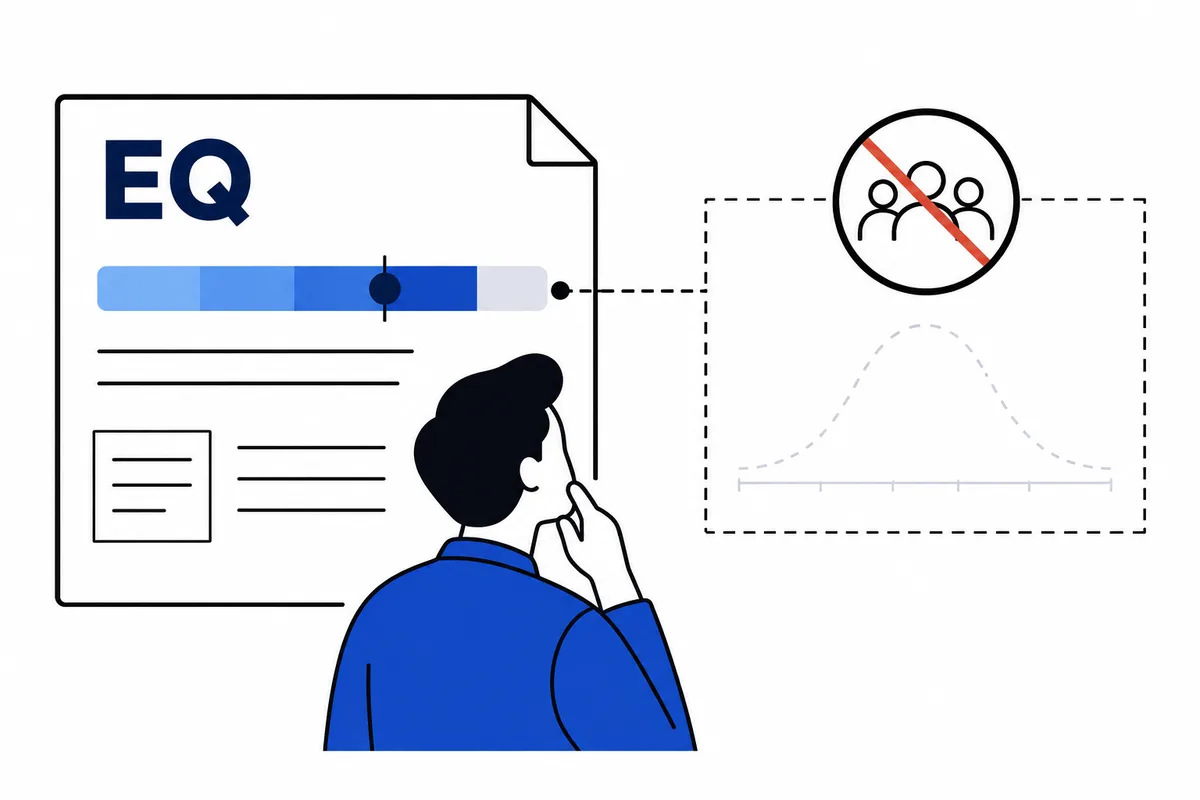
Without a disclosed norm group, an EQ score cannot show where you stand relative to other people. Check what kind of result the test produced and whether the report documents a comparison or a skill standard with evidence behind it. If it offers neither, set aside ranking labels and use any concrete behavior prompt only for private reflection.
Read the comparison claim before the number
If an EQ report gives a score but names no norm group, it cannot show where you stand in a population. The APA Dictionary of Psychology defines a norm-referenced result through comparison with other examinees; without a disclosed reference group, “above average,” “high,” and “low” have no stated population behind them. Pause those comparisons until the report documents what group supplies the reference. A score may still describe your result on that instrument: it can record the responses or performance summarized by its scoring system. That description is a statement about the result as produced, not a claim about how you compare with other people. A label such as “strong” might describe an instrument's own category, but without its stated basis it cannot fill in the missing population comparison. Keep that narrower description separate from rank. A defined performance standard could also support a different kind of interpretation, under conditions addressed below.
Sources: Norm-Referenced Test — APA Dictionary of Psychology
What does the number itself tell you?
A score’s format tells you how it is expressed; by itself, it does not tell you what comparison or judgment the report supports. The ETS memorandum record, “Scales, Norms, and Equivalent Scores,” treats raw scores, transformed scales, percentile ranks, mastery scales, and norming as distinct concepts. Its accessible abstract is enough to establish that these are different score descriptions; it does not provide grounds for claims about any particular EQ test. A polished number can therefore look more self-explanatory than it is. Before interpreting it, identify the scoring method and what the report says the scale represents.
Consider this invented report fragment: “Emotional awareness: 3.0 / 5.” It is an illustration, not an EQ result or a claim about a real instrument. If the endpoints are 1 and 5, three is halfway between those endpoints. That arithmetic alone does not make it the population average, the desired level of skill, or a threshold for competent behavior. The report would need to define the scale’s meaning before any of those readings could follow. A midpoint may be a convenient visual center, with no psychological meaning attached.
The same distinction applies when a report uses more elaborate labels. A raw total is the sum or aggregation specified by its scoring rules. A transformed scale expresses results on another numerical scale; the transformation may aid interpretation, but the label or added precision does not name a comparison group. A percentile rank, when properly defined, indicates relative standing within a reference distribution. A colored band or verbal category may summarize a range, yet its appearance cannot show whether it was built from population norms, a stated performance standard, or a design choice. Each format answers a different question, and none should be inferred from typography or color alone.
Look for three pieces of documentation alongside the number: the scoring method, a description of what the scale represents, and the report legend explaining labels or bands. If the result is a percentile, the report should say what reference distribution it uses. If it presents a skill level, it should explain the domain or standard attached to that level. The Standards for Educational and Psychological Testing distinguish score scales and interpretations, while the ETS record separately identifies raw-score scales, percentile-rank scales, mastery scales, norming, scaling, and equating. This supports a practical reading habit: trace the interpretation to its stated basis rather than treating the displayed value as its own explanation.
A documented transformation can make a score easier to read, and a performance or mastery scale may describe progress against defined content. Those possibilities do not change what the number alone tells you. In the invented 1–5 fragment, “3” supplies a position on the displayed endpoints; until the documentation explains the scoring and intended interpretation, it supplies no further conclusion. Read the legend and method first, then carry forward only the meaning they actually specify.
Sources: Standards for Educational and Psychological Testing
Who is the comparison group, and does it fit?
A norm group is the set of people whose results provide the reference distribution for interpreting a score. Its relevance depends on the comparison being made: a sample may be suitable for describing one population and a poor fit for a different age group, language, setting, or purpose. The Standards for Educational and Psychological Testing treat appropriateness of the reference group as part of the evidence for a norm-referenced interpretation. Naming a group therefore gives a reader something to examine; it does not make every comparison automatically useful.
When a report describes norms, look for the sample description and the claim attached to it. Who took the instrument? When were the responses collected? Does the report explain whether the comparison is intended for a broad population or a more specific group? Then compare that description with the use being proposed. This is an audit derived from the Standards, not a validated checklist: its purpose is to reveal whether the report supplies enough context for the particular comparison a reader is being invited to make.
The EQ-i 2.0 User's Handbook offers one instrument-specific example of documentation. It reports that 4,000 respondents completed the assessment in 2010 and describes their responses as the EQ-i 2.0 general-population norm group. The handbook also describes a separate set of EQ 360 norms. That distinction matters because results from the EQ-i 2.0 and its 360 version have different reference materials; a reader should identify which instrument and norm set the report actually uses rather than treating the product name as a complete explanation.
The handbook's description lets a reader identify a sample size, collection year, and broad population label. Those details make the comparison more inspectable, but they do not answer every question about fit. The handbook itself calls attention to age, culture, environment, and career context when interpreting results. A general-population reference may provide the comparison the report intended while remaining a limited guide to how one person's emotional skills show up in a particular workplace or relationship.
A practical read-through can stay narrow: find the norm sample description, its date, the population named, and the exact claim the report makes from that comparison. If a report says only that a score is high, average, or low, ask what group gives those words their meaning. If the report identifies its reference but that group does not match the question at hand, treat the result as a comparison to that stated group, not as a universal EQ standard. The EQ-i 2.0 example illustrates what to look for; its handbook does not establish norms for another assessment.
The intended comparison also matters. A broad group could be informative for one question and less relevant to a question about a narrower professional or cultural context. Conversely, a specifically described group is not automatically superior: a narrow sample can answer a narrow question, but may leave other comparisons unsupported. The reader needs enough information to see both who the reference includes and what conclusion the test maker draws from it. The handbook's stated year also makes time visible; it does not, by itself, tell the reader whether later changes would alter a particular interpretation.
Sources: Standards for Educational and Psychological Testing; EQ-i 2.0 User's Handbook

Can a score mean something without population norms?
Yes, a score can have a criterion-referenced interpretation: it can be compared with a defined skill domain or performance standard rather than with other people. The Standards for Educational and Psychological Testing describe criterion interpretations in terms of specified capabilities or standards and require evidence that supports the intended meaning. The question then changes from where a respondent sits in a distribution to what the score says about performance against that stated criterion. That is a distinct claim, and it needs its own explanation and supporting evidence.
A criterion claim should let a reader identify the skill or domain being judged and understand what counts as performance at each described level. The report or technical materials should explain how the standard was set and why the score supports the interpretation. The Standards also recognize that one score scale can sometimes support both norm-referenced and criterion-referenced meanings when suitable methods support each. A reader should therefore look for the actual basis of the interpretation rather than assume that a score has only one possible use.
Consider an invented illustration, not a real EQ test or validated threshold. Suppose a report defines a skill as recognizing when a conversation partner signals discomfort, describes observable behaviors that meet a stated level, and explains how the assessment's tasks were linked to those criteria. That would give a reader a criterion to inspect. The report would still need evidence for interpreting its score against that standard; the example shows the kind of claim involved, not proof that any existing assessment meets it.
A colored band does not supply that account by itself. A chart might show a score in blue or label it “strong,” but those design choices do not tell the reader what capability the label describes, where the boundary came from, or whether the assessment supports the inference. A standard can be expressed with bands, numbers, or words; the display format is secondary to the documented domain, level descriptions, and reasoning connecting the result to them.
The distinction is useful when a report has no norm sample but still describes a skill goal. Ask what the target behavior is, how the report defines adequate or advanced performance, and what evidence links the result to that description. A specific target such as summarizing another person's concern before offering a response is more inspectable than a general adjective, though naming a behavior alone does not establish a validated threshold. The interpretation becomes clearer when the material states what the behavior means within the assessment and how the score was judged against it.
This exception should be read precisely. The Standards supply general principles for score interpretation; they do not validate an EQ instrument or certify a particular set of levels. A publisher's use of words such as “developing,” “effective,” or “strong” may be a useful prompt for reflection, but the label does not reveal whether a criterion was defined carefully or supported by evidence. Where the report explains its domain and standard, a reader can evaluate that criterion claim on its own terms. Where it supplies only an adjective, the adjective remains a description from the report, not demonstrated evidence of a specific skill level.
Sources: Standards for Educational and Psychological Testing
What kind of EQ result did the test produce?
The first clue to what an EQ score can represent is the task the respondent completed. In “The Measurement of Emotional Intelligence: A Critical Review of the Literature and Recommendations for Researchers and Practitioners,” the authors distinguish ability tests, which ask people to solve emotion-related problems as a performance task, from trait measures, which use self-report to capture typical behavior or perceived ability. Mixed measures combine emotional-intelligence content with broader competencies, social skills, or traits. These labels describe different routes to a result, not interchangeable ways of finding the same underlying number.
| Method | What the respondent does | What the result can speak to | | --- | --- | --- | | Ability-based | Answers emotion problems, with performance evaluated by the instrument’s scoring approach. | Performance on those emotion tasks, within the scope of the test and its evidence. | | Trait or self-report | Reports typical behavior or perceived emotional ability. | The respondent’s account of their usual tendencies or perceived capabilities. | | Mixed competency | Responds to items spanning emotional skills and related competencies, social skills, or traits. | A broader profile whose meaning depends on which domains the instrument combines. |
The critical review’s distinction matters when two reports both use “EQ” and display a single total. If one total comes from performance on emotion problems and another from people rating their usual conduct, the numbers summarize different response processes. A mixed score may also include domains beyond the narrower abilities an ability test samples. Matching labels or similar-looking scales do not establish that a point on one report equals a point on another. Comparison would require evidence that the instruments’ constructs, scoring, and intended interpretations align; the shared abbreviation alone provides none of that.
This changes how a report should be read in practice. A performance task can show how a person responded to the particular problems presented under its testing conditions; it does not automatically describe how that person usually handles a tense conversation. A self-report can summarize the person’s account of a recurring tendency, but that is a different kind of information from a scored solution to a task. A broad mixed profile may cover useful areas for reflection, yet its total can combine unlike domains. Before drawing a single conclusion from a composite total, a reader needs to know which responses contributed and whether the report explains what the combined score means.
The categories have overlap, and the review discusses more than one way researchers classify the field. A measure’s name may suggest a model without fully describing what its items ask or how its score is built. Read the instrument’s own description: does it ask for a judged answer to an emotion problem, a report of how often or how well you act, or a wider set of competency judgments? Then limit your interpretation to that method and the claims supported for that instrument. This identifies what kind of result you have; it does not establish how the score compares with other people or whether another language version is supported.
Where an instrument combines several components, the total’s breadth can be both useful and difficult to decode. A reader may see one summary number while the underlying questions cover distinct judgments. Look for a description of the domains and whether the report presents them separately; that information helps distinguish a broad summary from a narrow result. The review supports asking what was measured, while the instrument’s documentation must support any more specific account of what its score means.
Does evidence for another EQ test travel to this one?
Evidence about a test belongs first to the instrument and version studied. A systematic review, “Emotional Intelligence Assessment in Argentina: A Systematic Review,” offers a focused example of the work needed to locate validation evidence in a particular setting. The review searched PubMed, SciELO, Redalyc, and ScienceDirect for studies involving validation, adaptation, or construction of emotional-intelligence instruments in Argentine adults. It screened 805 records and retained eight studies under its inclusion criteria.
Those eight studies concerned five ability-model instruments, two mixed-model instruments, and one trait-model instrument. That is the review’s selection result: it identifies a small set of studies that met the authors’ criteria for the population and topic they searched. The abstract does not provide enough detail to compare each study’s sample size, method, or result, so the count cannot be read as a quality ranking among instruments. Nor does the review establish that every included version performed equally well. Its useful contribution here is the map of where the reviewers found eligible adult Argentine research, not a universal verdict on EQ tests.
The review’s method also clarifies what its headline count can and cannot answer. Searching four named databases and screening a defined set of records makes the scope visible; it does not mean every possible study was captured or that the eight papers share a common design. The search result is bounded by the review’s terms, sources, eligibility decisions, and the adult population specified. Those boundaries are part of the finding, because changing them could change which evidence appears in the map.
For a reader holding a different report, the practical question derived from this review is: does the report or its technical material identify evidence for this exact instrument version, the language in which it was administered, and the interpretation now being made? That is an application of the review’s narrow scope, not a finding the review tested about every adaptation. Evidence for an instrument studied in one setting may help frame questions about another version, but the link needs to be shown rather than assumed. A translated label or a familiar model name does not itself document that link.
This is why “validated” needs an object. It may refer to one instrument, a particular translated form, one score, or one proposed use; without those details the word leaves the reader unable to tell what evidence is being invoked. The review’s included set spans three model labels, but that breadth does not make evidence for one of its instruments evidence for another. Nor does evidence that a version was studied answer whether a particular interpretation is justified; the reader needs the reported evidence and its connection to the claim being made.
The Argentina review cannot show that findings from another population are always unusable, and its abstract does not settle evidence for every language or country. It shows why specificity matters: reviewers had to define a setting, age group, eligible study types, databases, and inclusion rules before reporting what they found. When a score’s interpretation travels beyond the version and population described in the evidence, ask what supports that extension. If the report cannot identify such support, keep the conclusion close to the studied material and avoid treating evidence about a related instrument as validation of this one.
Sources: Emotional Intelligence Assessment in Argentina: A Systematic Review
What can a self-report settle about a real interaction?
A self-report can tell you how you describe your usual behavior or perceived ability. It cannot establish exactly what happened in one exchange at work. “The Measurement of Emotional Intelligence: A Critical Review of the Literature and Recommendations for Researchers and Practitioners” draws this distinction between self-reported typical behavior and a performance task. Applied to a particular meeting or handoff, the result is a prompt for inquiry: it gives you a pattern to compare with what you can observe, not a record of the interaction itself.
For the EQ-i 2.0, the “EQ-i 2.0 User’s Handbook” recommends considering other assessment results, interviews, or observations when interpreting results. That is guidance about that instrument, not proof that another person’s view is automatically more accurate. In personal development, the same idea can be used modestly: bring a broad self-description down to one recent, observable moment, then ask whether your account of it matches what was said or done. You do not need to turn the reflection into another score.
Illustration: after a difficult handoff, write down whether you summarized the other person’s concern before replying. That is an observable action. Separately note what you remember feeling or needing at the time, such as wanting to protect the deadline or clarify who owned a task. Then identify one response to try in a similar exchange, perhaps asking a brief clarifying question before explaining your own view. This is a private reflection method, not a validated audit or evidence that a score is accurate.
Keep the observation and the explanation in separate sentences. “I replied before restating the concern” describes conduct; “I was dismissive” assigns a motive or character judgment that the observation alone cannot establish. The other person’s account could add useful detail about what they heard, while your own account can identify what you noticed internally. Either account can be incomplete. A missed summary might reflect time pressure, unclear roles, or a choice made in the moment; the written note should preserve what is known and leave the cause open where it is not known.
One exchange neither validates nor disproves a profile. Its value is narrower: it can show what to pay attention to next time and make a general self-description more concrete. If the same behavior matters across several situations, you can look for a pattern by noticing when it occurs and what response follows, without counting incidents as test evidence. A colleague’s specific description of an exchange may help you check your own account, but agreement between two people still does not turn the reflection into a psychometric result. The point is to choose a response you can observe and evaluate in another conversation, while leaving the original score within the meaning its documentation supports. That keeps the reflection useful even when workload, role expectations, or the other person’s actions shaped the exchange. It also prevents a single successful repair or awkward moment from becoming a verdict about your general emotional ability. If you ask someone who was present, ask for the part they can describe: what they heard you say, or what happened immediately after. Their answer can correct a detail in your memory or show a difference in how the exchange landed. It cannot reveal your private motive with certainty, so keep that as a question for your own reflection. If you ask someone who was present, ask for the part they can describe: what they heard you say, or what happened immediately after. Their answer can correct a detail in your memory or show a difference in how the exchange landed. It cannot reveal your private motive with certainty, so keep that as a question for your own reflection.
The result is most useful here as a question about your own account: what behavior would you want to notice in the next handoff, and what would count as evidence that you did it? A specific answer makes the profile actionable without asking it to settle another person’s experience or explain every cause of a tense conversation. If no concrete behavior follows from the score, there is no need to manufacture one; the reflection can stop at that point.
Sources: The Measurement of Emotional Intelligence: A Critical Review of the Literature and Recommendations for Researchers and Practitioners; EQ-i 2.0 User's Handbook
What decisions should this result stay out of?
A score that helps someone reflect privately does not, by itself, justify using that score to hire, promote, rank, or rate another person’s performance. “Standards for Educational and Psychological Testing” ties a score interpretation to evidence for its intended use. A development profile therefore cannot be converted into an employment verdict simply because the workplace values emotional skills. The interpretation and the decision both need support; a general EQ label does not supply evidence about a person’s fit for a particular responsibility.
Imagine, hypothetically, that a manager must choose a colleague to mediate a disagreement between two teams. A person’s EQ score alone would not show whether they understand the issue, can remain fair to both parties, or have the trust of the people involved. Those are questions about this assignment and its circumstances. The score could at most suggest a topic for a private conversation about skills; using it to select the mediator would infer role-specific conduct from a number whose support for that decision has not been established. The score does not reveal whether either team would accept that person as a neutral facilitator, or whether they have handled this kind of disagreement responsibly. Those are separate facts to establish for the assignment; a number cannot answer them by implication.
The Standards’ requirement is specific to the claim being made: what does this score mean, for whom, and for which decision? Showing that an instrument can support reflection would answer only a development question. A manager would need evidence that the score meaningfully informs the particular employment decision, in the relevant population and conditions, and that the proposed interpretation is appropriate. Familiarity with EQ language does not bridge those steps. Without that support, a score cannot stand in for the decision maker’s examination of the actual responsibility or work evidence.
That inference gap matters because workplace decisions affect opportunities and how colleagues are treated. A score made for individual reflection is not a substitute for evidence tied to the actual work: the responsibilities, the situation, and relevant conduct. Under the Standards, a proposed interpretation needs evidence for the use being made of the result. Evidence for one purpose does not automatically travel to another, even when both purposes sound related. No such employment-use evidence is supplied for the Emotional Skills Profile.
The Emotional Skills Profile at /assessment is a private 32-item educational self-reflection profile. Its recent-behavior summaries and authored-scenario judgments remain separate, and the profile has no validated norms. It is intended to help an individual examine emotional habits and decisions, not to provide an employment score. For a consequential work choice, the boundary is direct: do not use this profile to decide who gets hired, promoted, ranked, or assigned a performance rating. The appropriate conclusion about a candidate or colleague must come from evidence relevant to that decision, rather than from repurposing a personal-development result.
Sources: Standards for Educational and Psychological Testing; Emotional Skills Profile
Choose one behavior question to carry forward
When a report gives no supported comparison or skill standard, leave its ranking label aside. You do not need to settle what “high” or “developing” means before deciding whether any part of the result is useful. First, note what the assessment asked you to report or judge; that tells you what kind of prompt you are holding. Then look for one specific behavior in the report that matters in a real exchange, such as pausing to understand feedback before responding. If the report offers no behavior you recognize or want to examine, stop there. There is no need to invent a practice goal just to make the score actionable.
If a prompt does matter, turn it into a small question you can carry into a relevant conversation: what would I notice myself doing, and would I like to try a different response? You might practice that response once, or ask someone who was present for a concrete description of what they heard. Keep the question about conduct, not about proving the score right. This is a choice for reflection, not a new way to score yourself.
For a more structured starting point, the private 32-item Emotional Skills Profile at /assessment offers recent-behavior summaries and authored-scenario judgments as separate outputs. Explore the profile if seeing those two kinds of reflection side by side would help you choose a behavior question to carry forward.
Questions readers ask
Can an EQ score be meaningful without a norm group?
It may summarize responses within that instrument. To interpret it against a skill standard, the report needs to define the standard and provide evidence supporting that interpretation.
Does the midpoint of an EQ scale mean average?
No. A scale midpoint is halfway between its endpoints. Without a suitable norm group, it does not show an average relative to other people.
How should I use an EQ result when no norm group is disclosed?
Identify what kind of task or questions produced the result, then look for a documented comparison or skill standard. If neither is provided, set ranking labels aside and use a concrete behavior prompt, if one is useful, for private reflection.
Sources
- Norm-Referenced Test — APA Dictionary of Psychology
A norm-referenced result describes performance relative to other examinees; the comparison depends on a defined reference population.
- Standards for Educational and Psychological Testing
The Standards distinguish norm- and criterion-referenced interpretations, require evidence for each intended interpretation and use, and explain that both interpretations can sometimes be supported for one score scale.
- Scales, Norms, and Equivalent Scores (Research Memorandum RM-70-02)
ETS treats raw scales, transformed scales, percentile ranks, mastery scales, norming, scaling, and equating as distinct score concepts, and identifies sampling and comparability as technical issues.
- The Measurement of Emotional Intelligence: A Critical Review of the Literature and Recommendations for Researchers and Practitioners
The review distinguishes ability measures using maximal-performance emotion problems from self-report measures of typical behavior or perceived ability, and describes mixed models that combine traits, social skills, and competencies.
- Emotional Intelligence Assessment in Argentina: A Systematic Review
The review searched four databases for validation, adaptation, or construction studies of EI instruments in Argentine adults; eight of 805 records met its inclusion criteria and covered five ability-model, two mixed-model, and one trait-model instruments.
- EQ-i 2.0 User's Handbook
The instrument-specific handbook describes EQ-i 2.0 norming on 4,000 respondents in 2010 and recommends considering other assessment results, interviews, or observations when interpreting results.
- Emotional Skills Profile
The assigned EQ Test product is a private 32-item educational self-reflection profile; recent-behavior summaries and authored-scenario judgments are separate, and it has no validated norms.
Apply it to the real situation
Turn an EQ result into a behavior question
From this guide: If the report leaves the score’s comparison unstated, examine whether it still points to a recent behavior you want to understand.
A score without a disclosed norm group cannot tell you where you stand relative to a population. The Emotional Skills Profile offers a private way to reflect on recent behavior and authored scenarios, kept as separate parts of the report. Use it to identify a question you want to examine in your own interactions, then choose one practical next step.