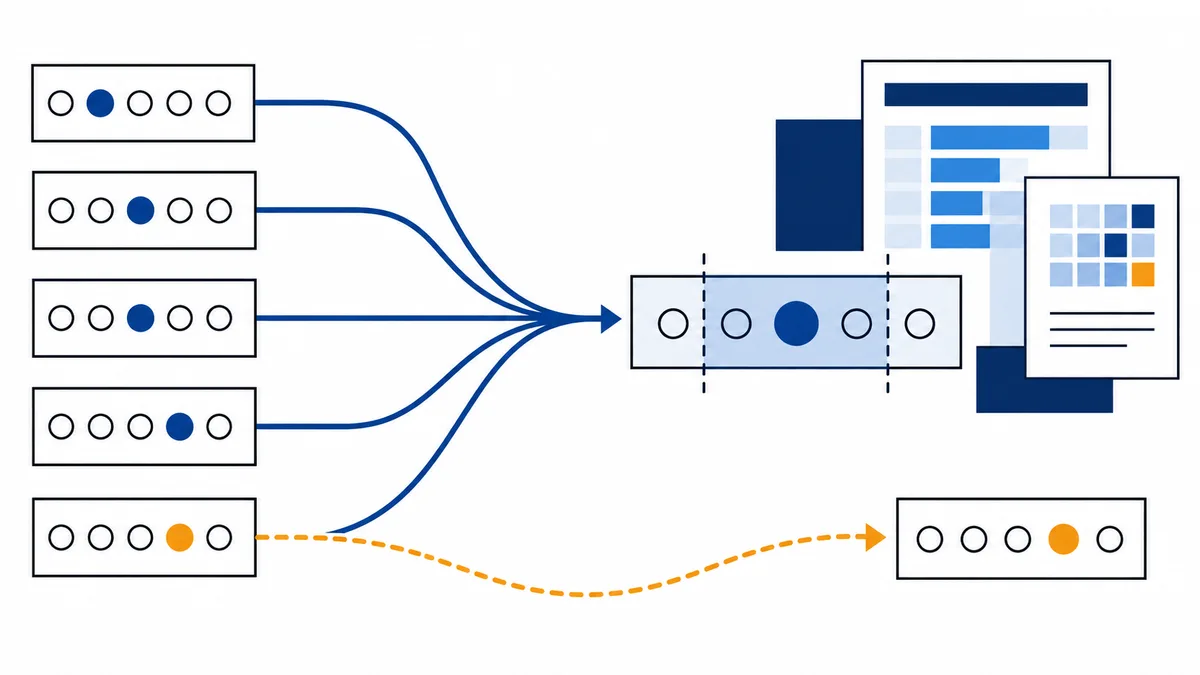
MSCEIT V2.0 consensus scoring gives item credit according to how often a defined reference group selected each response. The original validation found overlap between that group’s answers and emotion experts’ judgments, especially on items with clearer research answers. That supports the scoring reference, while leaving open how precisely particular items or scores measure ability and what a test result says about behavior in a specific work exchange.
What does consensus scoring count?
In MSCEIT V2.0, consensus scoring uses the response pattern of a standardization reference group to assign credit to each answer. The original paper, “Measuring Emotional Intelligence with the MSCEIT V2.0,” describes general consensus scoring: a response receives credit according to how often people in that reference group selected it, so the key can award graded rather than simply right-or-wrong credit. The scoring reference is therefore the group’s distribution of responses on an item, not a direct observation of how a test-taker handles emotion at work. The reference is a distribution rather than a single answer chosen by an examiner: each response option is considered in relation to the share of the group that selected it. The resulting credit reflects that observed pattern, so two answers need not be treated as equally supported merely because both appeared among respondents. The group supplies the scoring basis item by item; it does not report what this particular test-taker usually does in an ordinary disagreement or feedback exchange. The procedure makes a consequential assumption: a response pattern in the reference group can serve as a criterion for solving that emotional problem. This explains how the score is produced; by itself, the rule cannot establish that the most commonly selected response is universally correct. The claim here is specific to the V2.0 consensus method, not every test called an emotional-intelligence measure.
Sources: Measuring Emotional Intelligence with the MSCEIT V2.0
What did expert agreement actually test?
The original V2.0 validation compared the standardization sample’s answers with judgments from emotion experts. In “Measuring emotional intelligence with the MSCEIT V2.0,” the reported comparison included 2,112 people in the standardization sample and 21 experts. The study found substantial overlap between the two answer patterns. That matters because the scoring reference was checked against another kind of judgment: the result was not only that a large group tended to choose certain responses, but that experts often endorsed the same answers. The abstract supports correspondence between these two references in the studied comparison; it does not show that every keyed answer has one context-free correct meaning. Nor does the sample size turn the comparison into a second ability test: the result reported here concerns which responses the two reference groups endorsed.
The agreement was not equally strong across all items. It was higher where prior research offered clearer answers, with face perception given as an example. This pattern gives the overlap a useful interpretation: consensus and expert judgment converged most where there was a firmer basis for evaluating the emotional problem. Where the research answer was less clear, agreement was weaker. The finding therefore supports the scoring approach in a qualified way, while also showing that the strength of its criterion can vary by item. Clearer research answers gave the two references more common ground; the observed pattern does not tell us that every emotional situation has that same degree of determinacy. It would be a mistake to flatten this result into either “the group decides what is right” or “experts confirmed every answer.”
The comparison tests agreement between scoring references, not every claim one might later make from an MSCEIT result. It does not establish from this finding alone that a test score captures the full underlying ability, predicts behavior in a workplace conversation, or resolves how an answer should be interpreted in every setting. Those are further steps beyond whether the standardization sample and expert panel often selected the same responses. Agreement is relevant evidence about the answer key, but an interpretation about the test-taker’s ability needs evidence connecting test responses to that broader claim. The sample comparison answers the narrower question of whether expert judgments overlapped with the group reference in this study. For the scoring argument, the study supplies meaningful support: expert judgments aligned with the group pattern, especially on clearer items. Its own unevenness points toward the next question—what to make of items for which responses do not converge as clearly.
Sources: Measuring emotional intelligence with the MSCEIT V2.0
When does agreement stop short of validity?
Agreement between two answer keys addresses how responses are credited; validity asks what the resulting score warrants someone saying about the person who took the test. The inference runs through several steps: a person responds to emotional problem-solving tasks, a scoring rule summarizes those responses, and an interpretation treats that summary as evidence of an emotional-intelligence ability. A match between consensus and expert keys bears on the scoring reference. It cannot, by itself, establish every later link from task response to score meaning. Each link needs evidence suited to the claim being made. A score can be calculated consistently under a specified key and still invite a separate question about what that score represents. For example, the scoring rule may faithfully summarize a person’s choices on the tasks, yet the leap from those choices to a general ability depends on whether the tasks and the resulting pattern support that interpretation. Evidence for one step does not automatically carry the next.
In “The Validity of the Mayer–Salovey–Caruso Emotional Intelligence Test (MSCEIT) as a Measure of Emotional Intelligence,” Maul challenges the interpretation of MSCEIT performance as evidence for the underlying ability. His question is about the reasoning that connects observed responses with the construct the score is meant to represent. That is a different challenge from asking whether experts and a standardization group selected similar answers: even close agreement between those references leaves open whether success on the tasks supports the broader ability interpretation. The critique therefore presses on the bridge from test performance to what the score is said to measure, rather than simply erasing the reported agreement. This matters because the intended conclusion is broader than the observable event of selecting an option. The response itself is available to score; the ability is inferred from performance. Maul’s challenge asks whether that inference has been justified, rather than treating the existence of an answer key or agreement around it as sufficient. In practical reading, the distinction keeps a reader from treating the score label as if it were a direct recording of emotional skill in every situation.
The developers’ reply, “The validity of the MSCEIT: Additional analyses and evidence,” reports reanalyses of the 5,000-person standardization sample and organizes findings from four papers examining relations between MSCEIT scores and other tests. Those analyses and reported relations are affirmative evidence in the instrument’s defense. They address the critique with additional evidence about the score structure and its connections to other measures; they are not an independent adjudication, since the response comes from the developers. The available abstracts establish the shape of the disagreement and the kind of evidence each side invokes, but do not provide enough detail to resolve every disputed premise here. The defensible reading is that scoring-reference agreement supports one part of the case, while the interpretation of the score remains an argument tested by a wider body of evidence. The reply also means the dispute is not fairly summarized as “consensus has no support”: the earlier overlap with expert judgments and the developers’ additional analyses both count as support for parts of the case. At the same time, evidence that scores relate to other tests must be evaluated for what those relationships show; their mere inclusion in a response does not settle the meaning of the score. Since the records available here are abstracts rather than a full examination of each analysis and objection, a firm verdict would outrun the material. The useful boundary is narrower: agreement tests correspondence among scoring references, whereas validity concerns the full interpretation drawn from the test result.
Sources: The validity of the MSCEIT: Additional analyses and evidence; The Validity of the Mayer–Salovey–Caruso Emotional Intelligence Test (MSCEIT) as a Measure of Emotional Intelligence
Where did responses fail to converge?
A focused analysis of the MSCEIT V2.0 subscales Changes and Blends shows why a consensus distribution can be less decisive on some items than on others. In “Consensus scoring, correct responses and reliability of the MSCEIT V2,” 206 participants completed the two subscales. The researchers found that response convergence varied: on many items, numerous answer options were selected by only a few participants. Where responses are spread across options, the reference pattern offers a thinner signal about which answer should receive stronger credit. That makes the consensus interpretation more dependent on the particular response distribution for that item; a diffuse pattern is less compelling evidence of one clearly shared solution than a concentrated one. In a concentrated distribution, the reference group’s pattern gives a more visible center of gravity for that item; when selections are scattered, the same scoring procedure still produces weights, but the distribution itself offers less evidence that one response represents a shared judgment. A test-taker’s credit can then reflect a less settled group pattern. This is an interpretation of the observed dispersion, not a claim that every low-frequency response is equally defensible or that no option was more common.
The study also tested optimal scaling, a way of assigning weights from the observed response data to improve the consistency of the two subscale scores. The authors reported improved reliability for both subscales, with a larger improvement for Blends than for Changes. This was a focused scoring exercise using their local sample’s response weights, not a replacement of the instrument’s standard US norm weights. It shows that a different treatment of responses can affect score consistency in these analyses; it does not establish that the locally derived weights are a better general key. Because the investigation covered 206 participants and two subscales, its observed dispersion is a specific item-level concern, not evidence that every V2.0 response option or consensus key is ambiguous. Reliability improvement answers a different narrow question from whether a response is unquestionably correct: it concerns how consistently the weighted responses functioned as subscale scores in these analyses. The reported difference between Blends and Changes also cautions against treating the intervention as one uniform result across both subscales. The local exercise is informative precisely because it keeps the response data and the scoring choice visible, but its weights come from this study’s participants. They cannot be silently substituted for the standard US norm key when describing an ordinary V2.0 score.
Can a reliable total be equally precise for everyone?
A total can summarize responses consistently while providing more information about some ability levels than others. Item response theory makes that distinction visible: item information describes how strongly an item helps distinguish people at different points on the measured scale. It is about where a set of items carries discriminatory detail, rather than whether the scoring rule gives the same credit each time. A broad reliability coefficient compresses performance across items and people into one summary. That summary cannot, on its own, show that information is spread evenly from lower to higher levels. The practical question is therefore not only whether a total is internally consistent, but where the tasks make the most precise distinctions.
“What Is the Ability Emotional Intelligence Test (MSCEIT) Good for? An Evaluation Using Item Response Theory” examined the French-language MSCEIT V2.0 completed by 729 French-speaking Belgian participants. The study recruited a convenience sample, then used item-response analyses to examine how the items functioned across the scale. Its results showed uneven item information: the test did not provide the same level of distinguishing information throughout the range examined. The authors consequently questioned whether the instrument measured ability adequately across the scale. Their result concerns the pattern found in this analysis, rather than a universal precision curve for every MSCEIT administration.
That finding changes what a single consistency figure can answer. Even when a total has a satisfactory overall consistency estimate, that one number does not establish that every item contributes equally or that test-takers at every ability level are distinguished with equal precision. A score can be useful as a summary and still rest on an item set that is more informative in some regions than others. Item information also should not be translated directly into a definitive confidence interval for a particular person: the study’s uneven pattern identifies a measurement issue in the analyzed sample, not an individualized uncertainty estimate for every report. The French convenience-recruited sample makes this a focused warning to examine precision by level; it does not establish the same pattern for every language, population, score, or administration. A user comparing broad reliability claims should ask whether the evidence also shows where along the scale the test is most informative.
The distinction matters when a report invites fine-grained interpretation. If the available evidence summarizes consistency across the instrument, it may support a statement about the total as a whole, but not automatically a claim that a small difference near any point on the scale is equally dependable. The French analysis gives a concrete reason to keep those claims separate: item information varied across ability levels in the studied version and sample. Determining whether the same unevenness appears elsewhere would require evidence from those other settings. Until then, the study supports a narrower reading of reliability: overall consistency and precision at a particular level are related measurement questions, but one does not answer the other.
Sources: Consensus scoring, correct responses and reliability of the MSCEIT V2
Does the reference travel across languages?
A consensus key depends on the responses used to build it, so translation raises a question about the reference as well as the wording. “Developing an international scoring system for a consensus-based social cognition measure: MSCEIT-managing emotions” examined translated Managing Emotions scenarios in six languages using representative national samples. The study compared response patterns across countries and found discrepancies between the national samples. In this setting, a scenario that is translated faithfully can still produce different distributions of selected answers across language contexts. Since consensus scoring draws its reference from response distributions, differences in those patterns can affect how well one group’s reference represents another group’s responses.
The researchers tested an international scoring adaptation that excluded items contributing to cross-country discrepancies. The abstract reports that this adapted version showed less regional discrepancy than the original norms, while its scores were comparable to local norms. That result makes reference choice a practical part of interpreting consensus scores: a key built from one norming context and an adaptation designed across several contexts did not behave identically in the reported regional comparison. The study’s finding is specific to the Managing Emotions branch and the six language settings it examined. It does not establish that every MSCEIT branch has the same response-pattern differences or that a single international key resolves every question raised by translating emotional scenarios.
The evidence is useful because it tests transport directly rather than assuming that translation alone carries the scoring reference with it. For an individual reading a result, the relevant question is which reference was used and whether the report identifies it; an international adaptation and local norms are distinct choices, even when the abstract reports comparable scores for this study. The accessible abstract does not provide enough methodological detail to assess every translation decision or explain each regional discrepancy. Its supported conclusion is bounded: in these representative samples and this branch, excluding discrepant items reduced the reported regional discrepancy relative to the original norms. That result shows why a consensus key’s population and language setting matter, without establishing a general claim that one culture interprets emotion correctly and another does not.
Why must V2.0 stay separate from MSCEIT 2?
An MSCEIT 2 paper cannot settle what an older MSCEIT V2.0 score means, because the revision changed how answers were keyed. “Measuring emotional intelligence with the MSCEIT 2: theory, rationale, and initial findings” describes an expert-assisted veridical approach: Ph.D.-level experts judged the appropriateness of responses to emotional problems, and those judgments informed the key. A veridical key is intended to credit responses according to expert judgments about the problem, rather than to derive credit from how frequently a norm group selected each response. Experts’ work was part of developing the key; it does not mean that the resulting test directly observes a person’s behavior during an ordinary work exchange. The paper presents this as the rationale for MSCEIT 2’s scoring, not a restatement of V2.0’s consensus method. The scoring rule itself therefore makes a version distinction before anyone interprets a result: a group-derived response pattern and an expert-assisted judgment are different bases for assigning credit.
The same paper reports a five-study development program, with different samples serving different purposes. Eight people contributed to key development; a pilot involved 523 participants; the normative study included 3,000; and a comparison study included 221. The authors describe overall reliability, acceptable reliability for three of four subscales, and precision across most ability levels as initial findings. The sample sizes do not describe one pooled validation group: the small expert-assisted key-development group and the larger pilot, normative, and comparison studies answer different development questions. Reading them as separate stages makes the paper’s evidence easier to place. Its results concern the revised instrument and the analyses the author team reports for it. They are meaningful evidence about MSCEIT 2’s development, while the label “initial findings” matters: they are not a new analysis of V2.0 responses or a resolution of every prior question about that instrument.
The paper’s author team includes instrument developers and publisher research staff, so its report is developer-involved evidence rather than independent adjudication. That involvement does not erase the reported methods or results; it is relevant when weighing how much one paper can establish. If an existing report is labeled V2.0, the MSCEIT 2 key-development study cannot be used to explain its points as though the older score had been produced by expert-assisted veridical scoring. Nor can the revised test’s initial reliability and precision findings be transferred backward to the earlier scoring system. The older result must be read in light of the scoring method and evidence for V2.0 itself. MSCEIT 2 is useful context for seeing that developers changed the scoring rationale and then studied the revision, but the versions remain separate evidence cases. A reader should first identify the version on the report; without that, even a well-described finding can be attached to the wrong instrument.
Sources: Measuring emotional intelligence with the MSCEIT 2: theory, rationale, and initial findings
What does a score level let you say at work?
The MSCEIT overview from the Consortium for Research on Emotional Intelligence in Organizations describes an ability-based instrument with results at total, area, branch, and task levels. A total is the broadest summary; area and branch scores narrow the focus, and task scores point to performance on particular kinds of emotional problems. These levels help locate what a report summarizes. They do not change the kind of evidence the score contains: responses to standardized test tasks. For a work question, the distinction matters because a result can suggest a topic to examine, while describing what happened in a specific exchange requires evidence from that exchange. A task result may prompt a question about emotion reasoning—for example, what cues a person attends to when interpreting an emotional situation. It cannot by itself supply the details of how that person handled a colleague’s feedback yesterday.
Consider an explicitly illustrative handoff: a colleague flags a risk in a project update, and the recipient replies by defending the schedule before asking what evidence prompted the concern. Looking at the exchange itself, an observer could note the cue that was available—the colleague raised a risk—the response that followed, and a possible impact: the concern may remain unexplored while the discussion turns to defending the timeline. A repair might begin by returning to the signal: ask which dependency looks most uncertain, then agree on who will check it and when. Those observations describe this imagined exchange; they are not a study result or a claim about any MSCEIT test-taker. A task score could make emotional interpretation a useful subject for reflection, but it cannot establish that this response occurred, why it occurred, or what effect it had in a real meeting.
The practical boundary is between a standardized problem and a workplace event. A score can support a bounded statement about performance on the tasks and at the reporting level shown. To describe behavior in a handoff, feedback conversation, or disagreement, start with what the people did: what cue was present, what response followed, what happened next, and whether anyone repaired the interaction. That account might reveal a missed cue, a rushed decision, a competing project constraint, or some combination; the event itself gives the evidence needed to distinguish those explanations. This is not a second score interpretation. It is a different question with a different source of information. Keep the MSCEIT result as a prompt for inquiry into emotion reasoning, and let the observed exchange carry claims about what happened at work. In practice, that means asking about the exchange before attributing a pattern: Was the risk stated clearly? Did the recipient have authority to change the schedule? Did the conversation return to the concern after the initial defense? Answers can sharpen the account of this one event without converting it into a claim about someone’s stable ability.
Sources: Mayer, Salovey, Caruso, Emotional Intelligence Test (MSCEIT)
How should you read the report you already have?
Start with the version printed on the report. An MSCEIT V2.0 result and an MSCEIT 2 result come from different scoring approaches, so the interpretation should name the version rather than borrowing explanations from the revised test. If the report does not make the version clear, pause before applying a scoring description to it and ask the issuer what was administered.
Next, locate the level of the result you are reading. The Consortium for Research on Emotional Intelligence in Organizations’ overview describes MSCEIT results at total, area, branch, and task levels. A total is broad; a task result concerns a narrower set of test problems. Keep the sentence about your result at that same level: “This is my reported performance on the branch” is more faithful to the report than a sweeping conclusion about how you handle emotions generally.
Then check what reference the report itself identifies: for example, whether it names a norming or scoring reference, and whether it gives a technical explanation of the score. Reports may not show enough detail to independently evaluate the key or any adaptation. Record what is visible and leave missing information as a question for the provider; do not fill it in from a different version or assume that a familiar label means the same reference was used. A named reference tells you what comparison the report invokes; it does not, by itself, show how well that comparison fits your particular question.
Finally, connect the result to the question that brought you to the report. A score can describe performance on the test’s tasks at the stated score level. If you want to understand a real disagreement, feedback exchange, or repair at work, use relevant observation and feedback about that interaction. The report can help you decide what to examine; the event supplies the evidence about what you actually did.
Sources: Mayer, Salovey, Caruso, Emotional Intelligence Test (MSCEIT)
What is a useful next step after the score?
Choose one behavior to notice in a future conversation: for instance, whether you ask a clarifying question before defending your first response to feedback. Afterward, write down what was said, what you did next, and what changed in the exchange. If appropriate, ask someone who was there what they noticed. Compare their account with yours: did you hear the concern, check your understanding, and return to the issue before the conversation ended? Pick one small response to try next time, such as summarizing the other person’s point before proposing a solution. That gives you a specific moment to reflect on instead of trying to turn an MSCEIT score into a complete account of your work relationships.
For a separate self-reflection prompt, the private 32-item Emotional Skills Profile asks about recent behavior and authored scenarios. It is a different product from the MSCEIT: it does not corroborate or reinterpret an MSCEIT result, and it has no validated norms or ability-test claim. You can use it to organize questions about emotional habits and possible next steps, then compare those reflections with relevant feedback from your own interactions. The point is to make reflection concrete: choose a behavior, notice it in context, and decide whether another response would serve the conversation better.
Explore the Emotional Skills Profile at [/assessment](/assessment).
Questions readers ask
Does MSCEIT consensus scoring mean the most popular answer is always correct?
No. In MSCEIT V2.0, item credit reflects how often the standardization reference group selected each response. The original validation found overlap with expert judgments, but that agreement does not establish universal correctness or show how someone will behave in a particular work interaction.
Sources
- Measuring emotional intelligence with the MSCEIT V2.0
The original validation compared answers from 2,112 standardization participants and 21 emotion experts, reporting substantial overlap and stronger expert agreement when research supplied clearer answers; it also examined reliability and factor structure.
- Mayer, Salovey, Caruso, Emotional Intelligence Test (MSCEIT)
Describes the MSCEIT as an ability-based measure and outlines its four branches and total, area, branch, and task score levels.
- The validity of the MSCEIT: Additional analyses and evidence
The instrument developers describe reanalyses of the N=5,000 standardization sample and organize evidence from four papers in response to Maul's validity critique.
- The Validity of the Mayer–Salovey–Caruso Emotional Intelligence Test (MSCEIT) as a Measure of Emotional Intelligence
Maul's critique questions whether MSCEIT score interpretations warrant the intended claim about emotional intelligence, focusing on the reasoning linking observed responses to the underlying ability construct.
- Consensus scoring, correct responses and reliability of the MSCEIT V2
In a focused analysis of Changes and Blends, 206 participants supplied local consensus weights; response convergence varied, some options had few selections, and optimal scaling improved reliability more for Blends than Changes.
- What Is the Ability Emotional Intelligence Test (MSCEIT) Good for? An Evaluation Using Item Response Theory
An item-response analysis of the French MSCEIT V2.0, completed by 729 French-speaking Belgian participants, found uneven item information and questioned whether the test measured ability adequately across the scale; this was a convenience-recruited sample and the authors' interpretation is not a universal estimate for every version or population.
- Developing an international scoring system for a consensus-based social cognition measure: MSCEIT-managing emotions
The study evaluated translated Managing Emotions scenarios in six languages using representative national samples, identified cross-country response-pattern discrepancies, and reports that an item-excluding international scoring version had less regional discrepancy than original norms and scores comparable to local norms.
- Measuring emotional intelligence with the MSCEIT 2: theory, rationale, and initial findings
The 2025 development paper describes MSCEIT 2's expert-assisted veridical scoring and five studies (including N=8 for key development, N=523 pilot, N=3,000 normative, and N=221 comparison); authors report overall reliability, acceptable reliability for three of four subscales, and precision across most ability levels.
- Measuring Emotional Intelligence with the MSCEIT V2.0
The accessible paper gives the original study's consensus and expert scoring setup and reports its sample comparison; its study supports agreement of scoring references, while sample agreement alone cannot prove that every keyed option is universally correct.
Apply it to the real situation
Turn an EQ insight into one behavior to observe
From this guide: Compare a test-based reflection prompt with one emotional habit you want to notice in a real conversation.
An MSCEIT result describes responses to standardized emotion tasks. If you want a separate prompt for reflecting on recent emotional behavior and scenarios, the private 32-item Emotional Skills Profile offers a practical starting point. It is an educational reflection tool, distinct from the MSCEIT and without validated norms. Use it to identify a behavior to notice or practice, then consider what happens in an actual interaction.