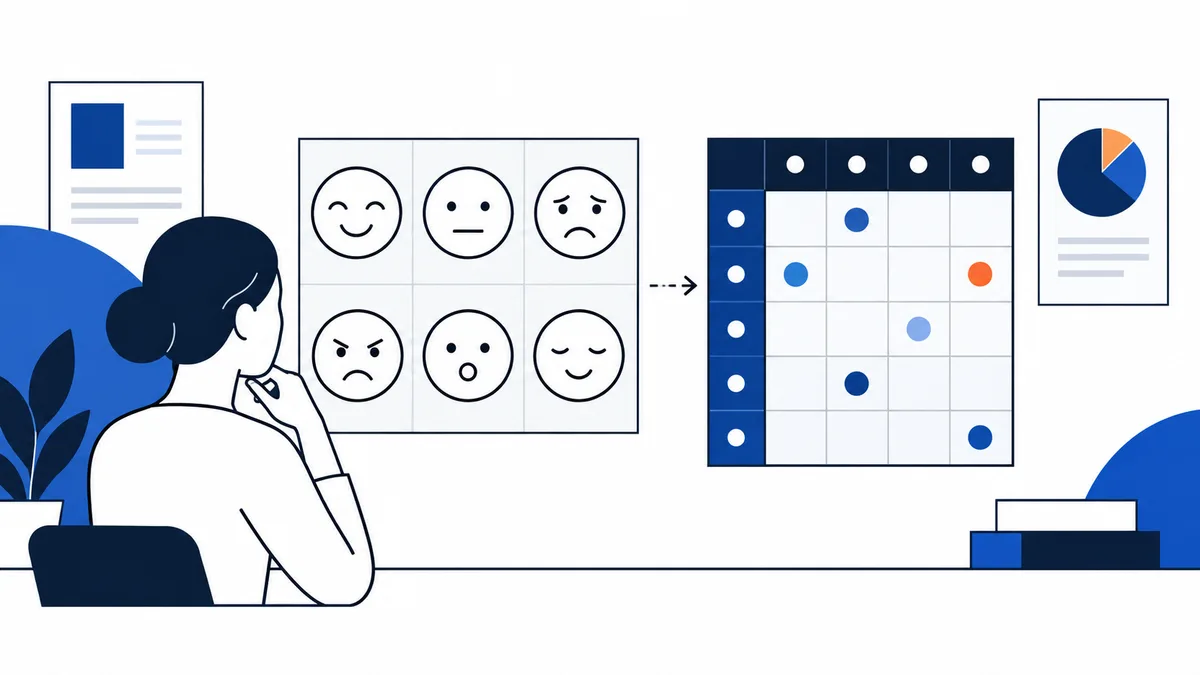
An emotion-recognition task records how someone responds to selected cues and scores that response against a defined criterion. It measures performance on that task, not another person’s private feelings. A self-report answers a different question: how someone describes their typical habits. To interpret either result, check what the instrument asked, how it scored answers, and which people and language its evidence covers.
Why the words “EQ test” do not tell you what was measured
“EQ test” names a subject area, not a single measurement. Before interpreting a result, find out what the person taking the test actually did. A performance task asks for an answer to emotional material and scores that answer against a rule. A self-report asks someone to describe their usual behavior, feelings, or perceived skill. The first records a response under test conditions; the second records a person’s account of themselves. Neither directly observes a private feeling, and they should not be read as interchangeable evidence.
The systematic review “Emotional Intelligence Measures: A Systematic Review” examined 40 instruments and distinguished skill-based, trait-based, and mixed approaches. That range matters because the same broad label can sit above different tasks and different claims. A score from one format cannot automatically answer the question another format asks. The review maps the measures it included; it does not establish that every instrument is sound or that each measure within a category works alike.
So an EQ result can initially tell you only that a particular answer or self-description received a particular interpretation under that instrument’s model and scoring method. Even “emotion recognition” is shorthand: the test records how a respondent interpreted selected material, not the other person’s feeling itself. The result may still be useful evidence about performance on that task, especially when the task and scoring rule are clear enough to say what a stronger response means. But the label alone cannot tell you whether someone solved a problem, described a habitual tendency, or rated their own capability. To understand its reach, inspect the prompt or activity, what the score summarizes, and the comparison used to interpret it before carrying the result into a workplace conversation.
Sources: Emotional Intelligence Measures: A Systematic Review
What does a scored answer actually observe?
A scored emotion-recognition answer sits at the end of a chain. Someone experiences an emotion; the test presents some record or cue connected with that experience; a respondent selects or rates an interpretation; and a scoring rule compares that answer with a reference. The score directly concerns the last two steps: what the respondent answered and how closely it matched the chosen reference. The earlier experience and the meaning of the cue have to be inferred from the material available.
The 2019 study “How Well Can We Assess Our Ability to Understand Others’ Feelings? Beliefs About Taking Others’ Perspectives and Actual Understanding of Others’ Emotions” used more than one kind of reference. In its first three studies, participants completed established nonverbal recognition tasks. In Studies 4–6, perceivers watched two-minute videos of people describing genuine emotional experiences and rated those people’s emotions; researchers compared the perceivers’ ratings with the targets’ own ratings across multiple scales. The target report therefore supplied a reference tied to that recorded episode, rather than asking a general group which answer seemed most appropriate.
The target’s experience is not itself the stimulus in an unfiltered form. A test presents a trace of it: a face, a voice, a chosen description, or a recording framed for the task. Selection and framing determine which parts of an event the respondent can use. The respondent then converts those available cues into an answer, often through options or rating scales designed by the instrument. Each link introduces a boundary between the lived event and the score. A high match tells you how the recorded answer lined up with the selected reference after those choices; it cannot recover cues the task never showed or meanings the response format never allowed.
A fixed-key task and an episode-specific target rating answer related but different questions. A fixed key asks whether a response matches the instrument’s preselected criterion. That can make responses comparable under a common rule, but the key represents the test’s account of the correct answer. A target rating asks how closely the respondent’s reading matched what that person said they experienced in that particular recording. It brings the person’s own account into the comparison, though it remains a report made through the study’s rating procedure. Neither comparison gives the assessor unmediated access to an inner state.
This distinction matters when the score is called “accuracy.” Accuracy is always relative to the criterion used: an answer can match a key, or resemble a target’s episode-specific ratings, and earn a stronger match on that measure. That is a concrete result about the respondent’s interpretation of the presented material. It is not proof that the respondent would correctly identify the same person in a later conversation, where cues, stakes, history, and opportunity to ask may differ. The 2019 study’s target-video method narrows the reference to a recorded experience; it does not turn the rating into an objective reading of private feeling.
For an individual result, read “more accurate” as “more consistent with this task’s stated reference,” unless the report defines a different comparison. Then ask what the reference represents and whether the test’s material resembles the situation you care about. A target’s own rating is especially informative when the question concerns that target’s recorded episode. It still describes what the target reported in that setting, not every possible meaning of the emotion or every future interaction. Keep the conclusion attached to the answer, material, and reference actually scored.
What changes when the test changes the cue?
A recognition score describes performance on the cues the test actually supplied. In “How Well Can We Assess Our Ability to Understand Others’ Feelings? Beliefs About Taking Others’ Perspectives and Actual Understanding of Others’ Emotions,” the 2019 study used several formats: photographs showing only the eye region, photographs of faces, acted audiovisual clips, and videos of people describing personal emotional experiences. Each format gives a respondent a different slice of information. The study therefore lets us compare tasks with different cue samples; it does not arrange them from artificial to valid or from easy to hard.
The eye-region photographs in the RMET leave out the lower face, voice, timing, and surrounding scene. The respondent must choose among words for what a pictured person might be thinking or feeling from a tightly cropped still image. That score concerns interpreting a small visual region under a forced-choice format. It cannot tell us whether the respondent would read a whole face, hear uncertainty in someone’s voice, or ask what is happening when the cue is ambiguous. Its narrowness is also a source of clarity: the task specifies which visual material was available to everyone taking it.
The AERT facial photographs show more of the face than the eye-region task, but remain still images. More facial area gives the judgment a different visual sample; it does not add movement, vocal tone, or a history of interaction. A person may recognize a posed or selected expression in a photograph and still face a different interpretive problem in a conversation. The score’s meaning should therefore stay attached to the photographed faces and response choices, rather than being treated as a general measure of reading people.
The GERT uses acted audiovisual clips, so respondents can draw on changing facial movement and sound, including voice, within a short scene. Compared with a still photograph, the clip supplies temporal and auditory cues. It also supplies a staged scene with a beginning and end chosen for the task. A stronger response on that material describes judgments about those clips under their scoring rule. It does not show that the same person would interpret a colleague’s emotion accurately amid competing work demands, an incomplete conversation, or a relationship with shared history.
The later target videos in the 2019 study show people describing personal emotional experiences. They offer speech, facial behavior, and a longer stretch of context than a single photograph, and the task asks perceivers to rate the targets’ emotions. That combination changes the available evidence: a respondent hears what the person says while observing them over time. Yet the camera, chosen recording, prompt, rating scales, and target’s own report still shape the comparison. The added channels make the task richer in information, while the observed performance remains specific to the selected recording and rating procedure.
These formats answer different practical questions about cue use. A cropped still asks whether someone can interpret a visual fragment; a face photograph adds facial area; an acted audiovisual clip adds movement and voice; a target video adds a recorded account alongside visible and audible behavior. This is a comparison of what the respondent could use, not a validity ladder. In a workplace, a test made from clips may feel more lifelike than a word choice about a photograph, but resemblance in one feature does not establish transfer to live feedback or disagreement. To interpret a result, name the format first, then describe the performance narrowly: what cues were present, which response was scored, and what kind of conclusion the task can support.
Who decides which answer earns credit?
When an instrument scores an answer as more or less accurate, its key represents a decision about which answer should count as better. In a consensus key, the reference comes from answers endorsed by a group; in an expert key, it comes from judgments by people selected for relevant expertise. Both approaches make scoring possible, but each identifies a source for the criterion rather than revealing a target’s private feeling directly. The useful question is how the key was built and what evidence supports that particular rule.
The 2003 study “Measuring Emotional Intelligence with the MSCEIT V2.0” examined agreement between 21 emotion experts and 2,112 members of the instrument’s standardization sample. Its abstract reports that the two groups endorsed many of the same answers, with stronger expert agreement for emotion perception in faces where research offered clearer answers. That convergence matters: for this instrument and these groups, expert judgment and broad sample agreement often pointed toward overlapping responses. It makes the scoring basis less like one researcher’s unexamined preference and more like a criterion with observable support from two reference groups.
The overlap still has a defined scope. The result concerns endorsement patterns on MSCEIT V2.0 items by those experts and that standardization sample. Agreement cannot establish that a majority is always right about an individual depicted person, nor that experts can settle every emotional interpretation. The reported stronger agreement where research answers were clearer also suggests that some items admit firmer reference judgments than others. A reader should not turn convergence into a universal guarantee of accuracy; it is evidence that the key has support from these groups for these items.
The later paper “Measuring Emotional Intelligence with the MSCEIT 2: Theory, Rationale, and Initial Findings” describes a different key-development approach. Its authors call the approach veridical scoring and report consulting experts and research, discussing alternative interpretations, and removing six of eight items flagged during review. This account makes the item key a deliberate product of review: the authors describe how they tried to resolve competing readings before assigning credit. That is useful information about the construction process, but it is not a direct check against what every person in a scene privately felt.
The difference also matters for how a reader evaluates transparency. A list of expert consultations and item removals lets a reader see that alternatives were considered; it does not show, by itself, how consistently independent reviewers would make the same choices or how the final key performs in new settings. The paper reports its authors’ process, so the defensible claim is about that reported development history. Evidence about a scoring key’s operation must remain tied to the instrument and results actually examined.
The MSCEIT 2 paper’s authors include publisher-affiliated researchers, a relevant detail when weighing an account of their own instrument’s development. Their description documents the rationale and initial review process they report; it does not amount to independent confirmation of every scoring decision. Nor should the MSCEIT 2 process be retroactively treated as the method behind the 2003 MSCEIT V2.0 findings. These are separate instrument-specific accounts: one reports convergence between experts and a standardization sample, while the other describes how its authors developed and reviewed a veridical key.
Together, the examples show why a scoring criterion needs a provenance. Consensus can show that a keyed answer reflects common endorsement in a defined reference group; expert review can bring research knowledge and structured deliberation to ambiguous items. Convergence between sources strengthens the case that a key is not arbitrary, while a documented review process lets readers inspect how alternatives were handled. Neither source settles the emotional truth of every pictured or recorded person. A score tells you how a response matched a rule, and the rule’s quality depends on the evidence and judgment behind it. When a report says “correct,” look for whose judgments define correctness and whether the evidence is specific to the instrument and material being scored.
Sources: Measuring Emotional Intelligence with the MSCEIT V2.0; Measuring Emotional Intelligence with the MSCEIT 2: Theory, Rationale, and Initial Findings

What does a translated version have to show?
A translated test has to earn its interpretation in the version people actually take. A familiar EQ label or a polished translation cannot show that respondents understood each item in comparable ways, that the scoring key behaves as intended, or that the same score carries the same meaning. The relevant evidence depends on the claim: item review addresses wording and response patterns; reliability asks whether scores hold together or remain reasonably stable; factor analyses examine whether the proposed structure fits; comparisons of scoring references test whether a translated key aligns with other criteria. These checks answer different questions, so one favorable result cannot stand in for all the others.
The study “The Factor Structure and Psychometric Properties of the Spanish Version of the Mayer-Salovey-Caruso Emotional Intelligence Test” reports three studies of a Spanish MSCEIT version. Its abstract describes close convergence between Spanish consensus scores and general and expert consensus scores calculated from earlier data. It also reports internal-consistency and 12-week test-retest evidence, a three-level factor model, and analyses of invariance across gender. Together, those findings provide several kinds of evidence for the version examined: its scoring showed a relationship to other stated reference scores, its results had reported consistency, and its structure and gender comparisons were examined. The convergence finding is about scoring references; the reliability findings concern consistency. Neither alone establishes that every translated item is interpreted identically.
A separate study, “Developing an International Scoring System for a Consensus-Based Social Cognition Measure: MSCEIT-Managing Emotions,” looked at Managing Emotions items translated into six languages. The researchers found response-pattern differences at the item level and developed an international scoring approach. The PubMed abstract reports that this approach produced less regional discrepancy than applying the original norms. That result shows why translation and scoring belong in the same investigation: even when items have been rendered in multiple languages, response patterns can differ enough that the original scoring reference creates regional discrepancies. The adjusted approach is evidence that researchers tested an alternative scoring method for this instrument branch.
These studies therefore establish different things. The Spanish-version work reports convergence, consistency, a factor structure, and gender-invariance analyses for the version and samples it examined. The six-language adaptation identifies item-level differences and compares an adjusted international scoring approach with original norms. The former does not establish equivalence across every Spanish-speaking population; the latter does not show that all regional differences disappeared. Neither finding means translated EQ tests are inherently defective. They show what version-specific evaluation can look like, and why the evidence should be named at the level it supports.
For a reader comparing a translated result with an English-language report, the practical question is whether evidence covers that specific version and the intended comparison. A study may support the reliability of one translation without establishing cross-language score equivalence. It may show close convergence with a reference key without showing that respondents in every workplace interpret each scenario the same way. Before treating two scores as directly comparable, look for the version named in the research, the population or language groups actually studied, and the particular property tested. Also check whether the report uses the same scoring reference across versions; changing norms can alter what a numerical difference appears to mean. If that evidence is absent, use the result as a reflection prompt within its own version rather than as a precise cross-language ranking.
Sources: Measuring Emotional Intelligence with the MSCEIT V2.0; The Factor Structure and Psychometric Properties of the Spanish Version of the Mayer-Salovey-Caruso Emotional Intelligence Test
How far can a result travel across groups?
Cross-cultural emotion-recognition evidence supports neither a universal score interpretation nor blanket skepticism. In “On the Universality and Cultural Specificity of Emotion Recognition: A Meta-Analysis,” recognition across cultures was above chance in the studies included, while people recognized expressions from their own group more accurately than expressions from other groups. Both findings matter. Above-chance performance means that cross-group judgments carried information under those study conditions; the in-group advantage means that performance was not identical across group boundaries. A test result can therefore reflect some shared recognition alongside a difference associated with group membership.
The meta-analysis also found that estimates varied with research design and stimulus type. The apparent size of cross-cultural recognition depends partly on what researchers present and how they ask people to respond. A set of posed expressions, a particular response format, and a particular comparison group define a different task from other materials or scoring choices. When those design choices change, the estimated performance can change too. The result is not a single cultural adjustment that can be applied to any test; it is a warning to inspect the conditions that produced a reported effect. A percentage from one study therefore cannot be carried over as a correction factor for a different assessment. The meta-analysis establishes a pattern in its included research, not a conversion table for individual scores.
That distinction matters when someone carries a group-level finding into a workplace. The meta-analysis does not tell a manager how accurately one colleague reads another, and it does not assign a cultural penalty to an individual score. Its findings summarize patterns across studies with particular participants, expressions, and methods. Applying that pattern to a new team would require evidence that the test’s materials, response options, scoring reference, and relevant groups resemble those examined. Without that match, a group average cannot explain what happened in one conversation.
Consider a score based on photographs of posed expressions. The meta-analysis may make it reasonable to ask whether the stimulus groups and response design fit the people whose scores are being compared. It does not justify presuming that a colleague from a different background misunderstood an expression because of culture. The observed interaction might also turn on the image, the available labels, or context that the task omitted. Those are questions about the measure and event; a group-level average cannot settle them for a person.
A narrow transfer rule follows: keep an interpretation attached to the groups, stimuli, and scoring method studied. To extend it to another population or a workplace, seek validation or comparison evidence using that version and relevant groups, with materials close to the situation in question. Evidence from a matched comparison would need to show how the measure performs across the groups of interest, rather than relying on a general claim that emotion is universal. If the available evidence comes from different populations or laboratory-style stimuli, treat transfer as uncertain and let the score describe performance on the tested material. The above-chance result keeps cross-group recognition meaningful; the in-group advantage and design sensitivity limit claims that the same score means precisely the same thing everywhere.
Sources: On the Universality and Cultural Specificity of Emotion Recognition: A Meta-Analysis
Why can confidence and task performance disagree?
A person can describe themselves as attentive to other people’s perspectives and still miss an emotion in a test task. Those results concern related but distinct things. A self-report records how someone sees their usual tendency: for example, whether they believe they try to understand another person’s point of view. A performance task records a response to particular emotional material and compares it with a scoring rule or reference. Neither result is a window into a person’s inner character; each is evidence about a different kind of answer. In “Emotional Intelligence Measures: A Systematic Review,” the authors group 40 instruments into skill-based, trait-based, and mixed approaches. The categories matter because the label “EQ” alone does not tell a reader whether a report summarizes perceived habits, performance on supplied problems, or a combination.
The 2019 study “How Well Can We Assess Our Ability to Understand Others’ Feelings? Beliefs About Taking Others’ Perspectives and Actual Understanding of Others’ Emotions” compared self-reported perspective-taking with performance across six studies. Its reported association was r = 0.20: people who said they more often took others’ perspectives tended, on average, to do somewhat better on the study’s emotional-understanding tasks. That is a positive relationship, but a modest one. The two measures moved together to a degree; they did not become interchangeable. A self-description could carry some information about performance while leaving substantial variation unexplained.
That number belongs to this research program, not to every EQ questionnaire or recognition test. The study used 1,347 US participants recruited online, and its measures and task formats varied across studies. An association does not show that reporting more perspective-taking causes higher task performance, or that practicing a self-described tendency would change a recognition score. It also does not establish how closely either result predicts what someone will notice in a live work conversation. The evidence supports a narrower reading: in these studies, self-reported perspective-taking and tested emotional understanding had a modest relationship.
A mismatch therefore need not be settled by choosing which score reveals the “real” person. A high self-rating alongside a weaker task result can prompt two separate questions: what does the person mean by being perspective-taking in ordinary life, and which cues or response demands made the test task difficult? A stronger task result alongside a lower self-rating raises a different pair: does the person discount a skill they can demonstrate on supplied material, or does the task capture an ability they do not often use in daily situations? These are hypotheses for reflection, not conclusions the scores establish.
Keep the follow-up tied to the measure. If the result came from a questionnaire, inspect the reported behavior and ask whether a recent example supports that self-description. If it came from a recognition task, inspect the material and the answer that was scored before generalizing to everyday conversations. The disagreement can help locate a useful question about habits or cues; it cannot, by itself, decide how a colleague experiences someone or which person in a disagreement is right.
Sources: How Well Can We Assess Our Ability to Understand Others’ Feelings? Beliefs About Taking Others’ Perspectives and Actual Understanding of Others’ Emotions; Emotional Intelligence Measures: A Systematic Review
What can you do with the result in a real conversation?
Use a result to choose a small behavior to try, then attend to the other person’s response. In an illustrative project handoff, a colleague goes quiet after a deadline changes. You might say, “I noticed you paused when I moved the date. I may be reading that wrong; would it help to talk through the workload or the revised plan?” The cue is observable, the interpretation remains tentative, and the question gives a work-focused way to answer. If there is a power imbalance, asking about feelings may feel costly; make disclosure optional, accept a practical answer or silence, and do not treat either as confirmation.
The Emotional Skills Profile offers private reflection through 32 items about reported recent behavior and authored scenarios. It can help a reader consider habits and possible next steps; it is not a recognition accuracy test. If you want a structured prompt for that reflection, [explore the Emotional Skills Profile](/assessment). After completing it, choose one reported habit or scenario response that connects to a conversation you want to handle differently. Decide what observable action you will try, such as checking your understanding before offering a solution, and notice what happens. The value is in the specific reflection and practice you take from the report.
Questions readers ask
Does an EQ test read someone’s emotions directly?
No. A recognition task scores a respondent’s interpretation of selected cues against a defined criterion. That result does not directly measure the private feelings of the person represented.
Why can emotion-recognition test results differ?
Tests can use different cues, response options, scoring rules, languages, and reference groups. Each choice shapes what the result describes.
Is self-report the same as an emotion-recognition task?
No. Self-report records how someone describes their typical habits or perceived skills. A performance task scores responses to supplied emotional material. The results may be related, but they answer different questions.
Does EQ Test’s Emotional Skills Profile measure emotion-recognition accuracy?
No. Its 32 items support private educational reflection on reported recent behavior and responses to authored scenarios. It is not an emotion-recognition accuracy test.
Sources
- Emotional Intelligence Measures: A Systematic Review
The review distinguishes skill-based, trait-based, and mixed approaches among 40 emotional-intelligence measures; the umbrella label does not identify one interchangeable construct or response format.
- How Well Can We Assess Our Ability to Understand Others’ Feelings? Beliefs About Taking Others’ Perspectives and Actual Understanding of Others’ Emotions
Across six studies, 1,347 US participants recruited through Amazon Mechanical Turk completed recognition tasks and, in later studies, rated targets’ emotions in videos of personal experiences; the study reports a modest association between self-reported perspective-taking and task performance and compares distinct stimulus and reference formats.
- On the Universality and Cultural Specificity of Emotion Recognition: A Meta-Analysis
The meta-analysis reports above-chance cross-cultural recognition alongside an in-group advantage, with estimates varying by research design and stimulus type.
- Developing an International Scoring System for a Consensus-Based Social Cognition Measure: MSCEIT-Managing Emotions
The study examined translated MSCEIT Managing Emotions material in six languages and developed an international scoring approach after identifying item response differences; the abstract reports less regional discrepancy than the original-norm approach.
- Measuring Emotional Intelligence with the MSCEIT 2: Theory, Rationale, and Initial Findings
The authors describe a veridical scoring-key development process involving expert review, research consultation, discussion of alternative interpretations, and removal of six of eight items flagged during review.
- Measuring Emotional Intelligence with the MSCEIT V2.0
The 2003 study examined whether an expert group and a standardization sample endorsed the same answers; its abstract reports 21 emotion experts and 2,112 sample members endorsed many of the same answers, with stronger expert agreement where research offered clearer answers, and reports reliability and factor analyses.
- The Factor Structure and Psychometric Properties of the Spanish Version of the Mayer-Salovey-Caruso Emotional Intelligence Test
The 2016 study reports close convergence of Spanish consensus scores with general and expert consensus scores calculated from earlier data, reliability evidence, a supported three-level factor model, and cross-gender invariance analyses for its Spanish MSCEIT version.
Apply it to the real situation
Turn an EQ result into one behavior to notice
From this guide: A recognition task and a reflection profile answer different questions; the profile can help you examine your reported recent behavior and scenario judgments.
A recognition score describes responses to selected cues. EQ Test’s private 32-item Emotional Skills Profile offers a different prompt: it separates reported recent behavior from judgments on authored scenarios. Use it to reflect on a habit or response that connects to a conversation you want to handle differently, then choose one observable behavior to notice or practice.