
A company can keep an EQ assessment developmental by defining its purpose and access rules before participation, keeping individual results out of employment decisions, and letting each participant choose a behavior to practice. Evaluate whether the program offered useful practice and whether the intended work interaction changed, not whether employees’ EQ scores rose. If results will affect hiring, pay, promotion, ranking, or formal ratings, the company needs a separate process supported by evidence appropriate to that use.
A developmental result needs a boundary before it needs a score
A company can keep an EQ assessment developmental by deciding its purpose, result access, and employment boundaries before anyone begins. “EQ assessment” does not name one common measure. The 2019 review “The Measurement of Emotional Intelligence: A Critical Review of the Literature and Recommendations for Researchers and Practitioners” distinguishes ability tests, which ask people to solve emotion-related problems, from self-report questionnaires about typical behavior or self-rated ability. A result needs to be described in the instrument’s own terms; it is not a universal EQ level for comparing colleagues. The participant should be able to use a result as a question about their own work: does this description fit a recent exchange, and is there one response they want to try differently? A manager can support that chosen practice without requesting a private report or treating it as proof of competence. Reflection, an observed interaction, and an employer’s judgment about performance are separate things. Collapsing them changes what the assessment is doing. Set access rules plainly: who receives answers and reports, how long information is kept, and whether it can enter employment decisions. The 2019 review discusses how assessment context, including who may see self-report answers, can affect responding. Privacy removes one reason to tailor answers for an influential reader; it cannot guarantee candor or make a measure valid. If a company uses a result for hiring, promotion, pay, ranking, or a formal rating, it has moved into an employment decision. U.S. EEOC guidance addresses validation in relation to the job and the procedure’s actual use. A sound plan keeps that boundary while evaluating whether the development activity and chosen practice were useful.
Sources: The Measurement of Emotional Intelligence: A Critical Review of the Literature and Recommendations for Researchers and Practitioners; Questions and Answers to Clarify and Provide a Common Interpretation of the Uniform Guidelines on Employee Selection Procedures
What does an EQ result actually represent?
An EQ result describes the kind of evidence an instrument collected. The label alone does not tell a company whether it is looking at a person’s account of their habits, answers to emotion-related problems, or other people’s observations. They are not interchangeable readings of one employee score. A self-report asks people to describe their usual reactions or how capable they believe themselves to be in emotional situations. It records self-perception and reported typical behavior. “I pause before replying when frustrated” reports a tendency. It does not show how they perform on an emotion task or what a colleague saw in a meeting. The 2003 ETS review, “Psychological Assessment of Emotional Intelligence: A Review of Self-Report and Performance-Based Testing,” makes this distinction central: self-report and performance-based tests pose different measurement questions. Read it as the participant’s account, useful for reflecting on perceived habits. An ability or performance-based measure asks someone to solve emotion-related problems. The 2019 critical review “The Measurement of Emotional Intelligence” describes these as maximal-performance measures: responses are scored as correct or incorrect under the test’s method. This is evidence about task performance. It does not automatically describe what the person usually does when a meeting becomes tense. Strong task performance may not describe behavior under pressure; each answers a different question. A mixed competency inventory can combine emotional skills with reported behaviors or related competencies. The 2019 review notes that mixed models may include traits, social skills, and competencies, and may overlap with other constructs. Its breadth may suit reflection, but the summary can cover several kinds of self-perception. “Mixed” does not mean every tool uses the same ingredients or that a higher total has one common interpretation. Observer or 360-degree feedback adds another source: selected colleagues describe behaviors they believe they have seen. The BMC Psychology review “Training emotional competencies at the workplace” distinguishes self-report, peer-report, and ability measures, and notes that 360-degree ratings can contribute information when interpreting training effects. An observer report is still a report from a particular relationship and setting. It may show how an interaction landed, not private intent or complete ability. Observers may have had unequal opportunities to see it. These methods can diverge without one result erasing the others. The BMC review says self-report and performance-based EI measures tend to correlate only weakly, suggesting they may assess distinct facets, while noting that the exact constructs remain difficult to define. Specify the question first. If the aim is to examine a reported habit, use a measure that records self-perception. If the aim is feedback about conduct, discuss specific observed interactions with context. Neither output becomes a fair employee rating merely because it arrives as a number. Select the assessment for the reflection it can support, and keep its result attached to that limited question.
Sources: Psychological Assessment of Emotional Intelligence: A Review of Self-Report and Performance-Based Testing; The Measurement of Emotional Intelligence: A Critical Review of the Literature and Recommendations for Researchers and Practitioners; Training emotional competencies at the workplace: a systematic review and metaanalysis

Why does access change the assessment?
Access rules shape what an employee thinks the questions are asking. When a supervisor will receive the answer, the employee may also wonder which response will look safest to that manager. The 2019 critical review, “The Measurement of Emotional Intelligence,” identifies this as a response-distortion risk. It says people can answer strategically to appear high in emotional intelligence when they believe a supervisor or potential employer will see their results; people completing self-reports for self-development or research are less likely to do so. It summarizes prior work rather than reporting a new workplace trial, so the risk is not a guarantee about any particular employee. That distinction matters especially when the assessment asks people to describe their usual habits. Add a plausible employment consequence and candor has a cost: acknowledging difficulty might be interpreted as evidence against the employee. The review’s point is narrow but practical: who may see a response can affect the incentive to shape it. A privacy promise cannot make a measure more accurate by itself, yet unclear or consequential access can introduce pressure that a developmental exercise does not need. Before anyone begins, the organization should be able to describe the actual route from response to reader. Who receives raw answers? Does a vendor or internal administrator see them? Who can open the individual report, and can a manager request it? What information is retained, where is it held, and for how long? Can it flow into a personnel file, HR system, promotion discussion, or performance review? Confidentiality means access is restricted under stated rules; anonymity means the answers cannot be linked to a person. A named personal report can be confidential without being anonymous. Employees should not have to infer the difference after submitting their answers. The notice should also explain whether the participant can choose what to discuss with a manager, and whether that choice changes access to any employment opportunity. The 2024 systematic review and meta-analysis, “Training emotional competencies at the workplace,” examined intervention studies and notes substantial variation in the emotional-intelligence measures they used. Self-report and performance-based measures tend to correlate only weakly, suggesting they may capture distinct facets. That finding concerns measurement, not data privacy. An “aggregate” label does not itself prevent identification. In a small group, a distinctive role or combination of responses may make a person obvious to colleagues; this is an implementation risk to assess, not a result established by either review. If the company cannot prevent individual reports from reaching decision-makers, or cannot explain retention and access plainly, it should say so before participation and stop calling the activity private development. Before sharing a group summary, it should also ask whether colleagues could infer whose responses it describes, especially in a small team or a distinctive role. The boundary only helps when the system and the promise match.
Sources: The Measurement of Emotional Intelligence: A Critical Review of the Literature and Recommendations for Researchers and Practitioners; Training emotional competencies at the workplace: a systematic review and metaanalysis
When does development become an employment decision?
Development becomes an employment decision when an assessment result helps determine who is hired, promoted, paid, assigned, retained, ranked, or formally rated. The label attached to a meeting does not settle the question. If a manager says an EQ profile is only for coaching but uses its score to justify a promotion decision, the score is functioning as part of that decision. The company should therefore define the boundary by what people do with the result and what consequence follows, not by the program name.
A live recommendation makes the boundary easy to blur. The commercial article “Integrating EQ Assessments in Performance Management” advocates bringing assessment insight into performance conversations, coaching, and goal setting. It also acknowledges employee concerns about how scores will be used and advises leaders to explain purpose and access. A conversation can sound developmental while affecting a person's standing if the manager controls ratings, pay, or opportunities. Discussing a specific interaction is different from handing a manager a private assessment report or comparing employees' profiles. One addresses describable work; the other adds a personal measurement to a consequential judgment.
In the United States, the Equal Employment Opportunity Commission’s “Questions and Answers to Clarify and Provide a Common Interpretation of the Uniform Guidelines on Employee Selection Procedures” describes procedures used to make employment decisions. Its examples include hiring, retention, promotion, transfer, demotion, dismissal, and referral. It says the guidelines cover more than written tests, including interviews and performance evaluations, and discusses validity evidence in relation to the procedure and its use. The document does not say every coaching conversation is a selection procedure or make a general claim about EQ tools. Its narrower relevance is that a developmental label does not settle how a result is being used. This guidance is U.S.-specific; obligations depend on circumstances and applicable law.
Evidence that emotional-intelligence measures relate to job performance does not erase the distinction. The PubMed record for “Why Does Self-Reported Emotional Intelligence Predict Job Performance? A Meta-Analytic Investigation of Mixed EI” reports a meta-analysis of mixed measures and supervisor-rated performance. It gives a corrected association of rho = .29, then a near-zero conditional coefficient after controlling for overlapping constructs. This complicates broad claims about what the association represents; it is not a finding about every EQ test or workplace. An association across studies also does not show that a company's developmental instrument can rank its employees for a particular decision. Evidence must fit both the measure and the proposed use.
Before launch, the sponsor should state which decisions are excluded from access to individual results and what separate process would apply if the company later needed to make one. To discuss a missed handoff, a manager can ask what was agreed, what happened, and what made the work harder without consulting a private EQ result. If a result will influence a formal rating or advancement, the company has crossed the boundary and must assess that purpose directly, with appropriate evidence and governance, rather than quietly expanding a developmental exercise.
Sources: Questions and Answers to Clarify and Provide a Common Interpretation of the Uniform Guidelines on Employee Selection Procedures; Integrating EQ Assessments in Performance Management; Why Does Self-Reported Emotional Intelligence Predict Job Performance? A Meta-Analytic Investigation of Mixed EI

How can a score become one useful practice?
A result becomes useful when the person who completed the assessment connects it to a moment at work and decides what, if anything, to try. A self-report may point to a perceived habit, such as holding back during disagreement. It cannot establish what happened in a meeting or what response would fit next time. Reflection bridges that gap. For example, imagine an employee sees answers suggesting they often delay raising concerns. Treat this as a question, not a weakness label. A facilitator might ask, “Was there a recent discussion where you wanted to disagree but waited? What made speaking up difficult?” The employee might mention an unclear decision, a rushed agenda, or concern about how dissent is received. These are details from the employee’s account, not facts proved by the score. The employee could choose a small experiment: when a decision is still open, ask one clarifying question before the group moves on. This illustration is not a prescribed interpretation of any particular test result. Name the assessment output accurately before the conversation. The Educational Testing Service review, “Psychological Assessment of Emotional Intelligence: A Review of Self-Report and Performance-Based Testing,” distinguishes self-report measures from performance-based tests. A self-report records what someone says about typical reactions or perceived abilities; it does not observe the meeting. The participant should be able to say the result does not fit, or choose another situation to examine. A chosen practice needs an opportunity. If the employee has no time to raise a concern or lacks access to the decision-maker, individual effort may not be the main barrier. The facilitator can ask what support would help, such as an agenda that identifies decisions still open to input. A manager can help remove a practical obstacle without receiving the private report. Later, the participant can review what they tried and what followed: Was there room to ask the question? What did they learn about timing, wording, or the meeting? A short note might record the practice and the participant’s reflection, rather than a manager-assigned rating. This supports learning without creating a second score under another name. The 2024 systematic review “Training emotional competencies at the workplace” combined 50 studies in its pre–post analysis and 27 controlled studies. It reported moderate average changes that persisted beyond three months, alongside high heterogeneity and low methodological quality. The studies cover varied training programs and measured competencies. They do not show that one self-report profile identifies the right goal for a particular employee, or that a score increase proves better work performance. The useful follow-up is a participant-led account of one chosen behavior, the conditions that made it possible, and what the person learned. If the assessment does not fit the experience, that too can guide reflection. The personal result stays with its participant under the access rules explained before collection; a shared practice record should contain only what the participant agrees to discuss.
Sources: Psychological Assessment of Emotional Intelligence: A Review of Self-Report and Performance-Based Testing; Training emotional competencies at the workplace: a systematic review and metaanalysis
What can a workplace situation explain that a profile cannot?
An assessment cannot tell a manager why an employee stayed quiet in a particular meeting. It may record how someone describes their usual response or what they believe they would do in an emotional situation. The meeting offers other evidence: who held authority, whether the agenda left room for dissent, whether the employee had needed information, and what happened the last time someone challenged a decision. These facts do not prove that the person has or lacks a particular EQ skill. They help define a situation the profile cannot observe.
Keep four accounts separate in a debrief. First is the report: what the instrument asked and returned. Second is the participant’s account of a scene, including what they noticed and chose. Third is another person’s observation, tied to something visible, such as an interruption or an unanswered question. Fourth are the conditions around the exchange: workload, role clarity, meeting structure, status, and the likely cost of disagreement. Mixing these sources turns interpretation into verdict. A report is not an eyewitness account; an observer sees an action, not the private feeling or motive behind it.
Suppose a team member raises concerns only after a decision is made. A manager might call this poor communication and assign an individual goal. But if meetings move quickly, comments are invited only at the end, or earlier objections were treated as disloyal, the pattern also points to a team practice. This is an illustration, not evidence about a particular employee. The manager can ask what made it hard to speak earlier, then change the meeting: circulate the proposal in advance, name when dissent is wanted, and explain how objections will be handled. The employee might choose a practice too, such as stating the concern before offering a solution. Both changes can be tried without requesting a private profile.
Workplace training research supports taking development seriously while leaving room to examine conditions. “Training emotional competencies at the workplace: a systematic review and metaanalysis” combined 50 studies in its pre-post analysis and 27 controlled studies. It found moderate average changes in measured competencies, alongside high heterogeneity and substantial risk-of-bias concerns. It cannot explain why one person acted a certain way in one meeting. The critical review “The Measurement of Emotional Intelligence” discusses how self-report answers may depend on assessment context, including whether an employer can see them. Access expectations matter to interpretation, though privacy cannot explain an observed event by itself.
Afterward, a record can note the agreed meeting change, the participant’s chosen action, and what happened when each was tried. One exchange should not become a lasting trait label. If behavior changes when dissent has a clear opening, the organization has learned something about its process. The manager’s role is to make practice possible and review conditions they control, without asking the employee to defend a score.
Sources: Training emotional competencies at the workplace: a systematic review and metaanalysis; The Measurement of Emotional Intelligence: A Critical Review of the Literature and Recommendations for Researchers and Practitioners
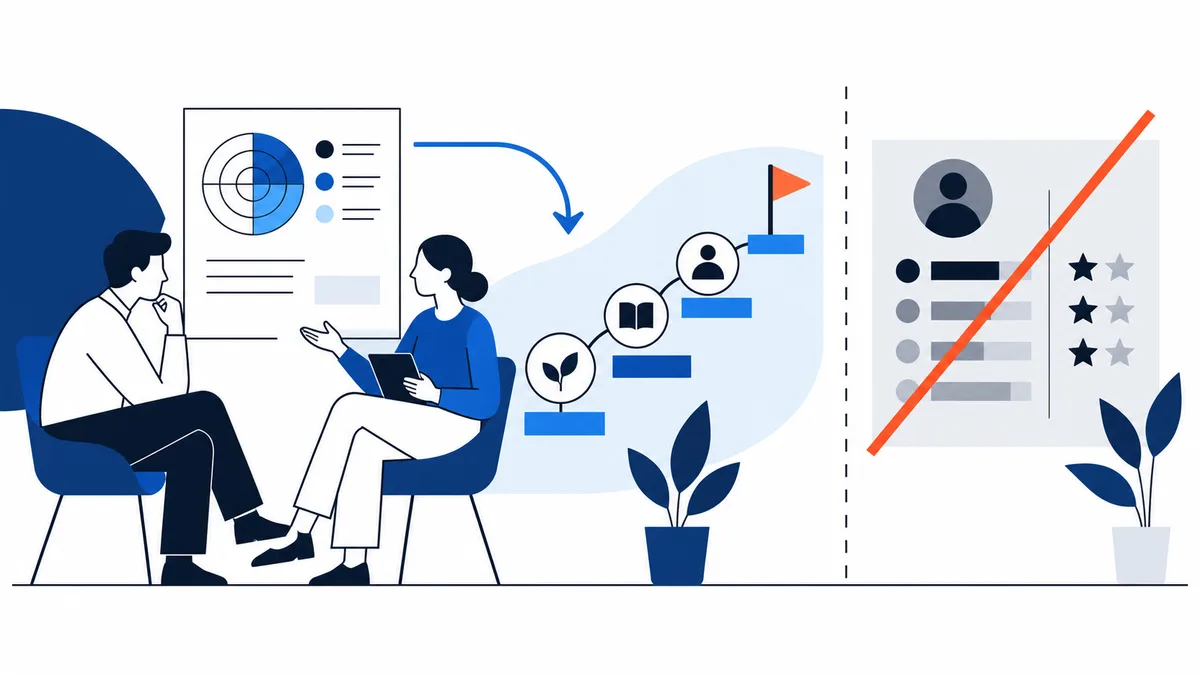
Does an association with performance justify a performance score?
No single association establishes that a particular developmental EQ score is suitable for ranking employees. The evidence does matter: it argues against dismissing emotional intelligence as unrelated to work. But a relationship found across studies is not a permission slip for turning one person’s reflection into a performance rating. The 2011 meta-analysis “The Relation Between Emotional Intelligence and Job Performance” combined studies from three research streams: ability-based tests with objective items, self- or peer-report measures based on a four-branch model, and mixed emotional-competency measures. The authors reported corrected correlations from .24 to .30 between these streams and job performance. Across included studies, differently defined EI approaches were associated with job-performance criteria. It does not establish that a developmental instrument is validated for ranking staff. A later analysis makes the distinction especially important for broad self-report inventories. In “Why Does Self-Reported Emotional Intelligence Predict Job Performance? A Meta-Analytic Investigation of Mixed EI,” researchers re-examined mixed EI measures and reported a corrected association of ρ = .29 with supervisor-rated job performance. They also found that the mixed measures’ content overlapped substantially with other constructs, including self-efficacy, self-rated performance, personality traits, and general mental ability. After controlling for that set of overlapping constructs, the estimated mixed-EI relationship was β = −.02, effectively near zero in their analysis. It does show why a single headline correlation cannot tell an employer what a score means or what it adds for a specific decision. The practical boundary follows from that gap. Meta-analytic results describe patterns across groups of studies; they do not establish that a company’s chosen questionnaire, interpretation, or cutoff is job-relevant. Nor does an association prove that changing the score through a development program will improve job performance. A self-report may capture how someone sees their typical conduct. Even when that account is useful for reflection, it is not equivalent to an observed work result or an ability-test performance. For U.S. employment selection procedures, the EEOC’s “Questions and Answers to Clarify and Provide a Common Interpretation of the Uniform Guidelines on Employee Selection Procedures” describes validation strategies suited to the procedure, job, and employment situation. Its guidance discusses prediction of job performance and appropriate job-related evidence; the relevant requirements depend on the actual use and circumstances. Applicable rules differ by jurisdiction. A company should therefore resist two easy conclusions: that EQ has no relationship to work, and that a group-level relationship licenses an employee scorecard. If the purpose is development, use results to support a participant’s chosen practice and evaluate the program with an outcome suited to that purpose. If the company intends to rank, pay, promote, or formally rate people by an EQ result, it has changed the decision. It needs evidence for that instrument and use, not a correlation borrowed from a different measure or study.
Sources: The Relation Between Emotional Intelligence and Job Performance; Why Does Self-Reported Emotional Intelligence Predict Job Performance? A Meta-Analytic Investigation of Mixed EI; Questions and Answers to Clarify and Provide a Common Interpretation of the Uniform Guidelines on Employee Selection Procedures
What can a company evaluate instead of employees?
A company can evaluate whether a development program offered relevant practice, whether people had a chance to use it, and whether a defined work interaction changed in the intended direction. Decide in advance what evidence would answer those questions. A rise in self-reported emotional skill may show changed perceptions; by itself, it does not establish broader ability or improved job performance. The evaluation asks whether the learning design helped, not which employees improved most. “Training emotional competencies at the workplace: a systematic review and metaanalysis” examined 50 studies of employed adults, with 3,233 participants in the pre-to-post analysis, and 27 controlled studies. Across controlled comparisons, the authors reported a moderate average effect on measured emotional competencies (standardized mean difference 0.47), with effects also found at follow-up beyond three months. This supports the conclusion that workplace training can improve measured emotional competencies on average. It does not show that every program works or that an EQ score predicts effective work. The review combined training in emotional intelligence, empathy, and emotion regulation, so a company should specify what its activity is meant to change. The spread around the average matters. In controlled trials, the prediction interval ran from -0.34 to 1.29 and heterogeneity was substantial (I² = 68%). A prediction interval estimates where an effect from a comparable new setting might fall; it cautions that the pooled average may not describe one company. The review also found publication-bias signals and judged many studies at serious or critical risk of bias. Participants or assessors often knew training had occurred, and outcomes frequently relied on self or peer reports. The authors called for stronger studies, including randomized controlled trials. Their findings support checking local results while leaving the size and durability of a local effect uncertain. Name one intended interaction before the program begins. If the aim is clearer project handoffs, define what clarity would look like, then ask whether people had an opportunity to use the practice and what they observed. A self-report before and after can show changed descriptions of habits. A performance task can show change on that task. Structured observation can record whether the specified interaction occurred. These are different evidence streams, not three grades of an employee. Specify the target, timing, and method beforehand; a later difference alone does not establish that training caused it. Workload and manager support may contribute. The company can check whether the program made practice possible: Was there time to try the skill? Did a meeting provide an opportunity? Did the manager’s response allow people to use it? If few participants could practice, the next decision may concern the program or work setting rather than an employee’s supposed lack of ability. For organizational learning, summarize access to practice and the chosen outcome in a way that protects individuals. Small groups can make aggregate results recognizable, so check who will see the report and what data are available. Do not publish a league table, compare pre/post scores, or feed responses into a rating. The company can learn whether training supported a defined practice without making employees’ lives the program’s performance metric.
Sources: Training emotional competencies at the workplace: a systematic review and metaanalysis; Training emotional intelligence: a meta-analysis of workplace interventions
A rollout should end with a practice agreement
Before asking anyone to complete an assessment, the sponsor should put the developmental question and the handling of answers in plain language. The question might be whether a participant wants to reflect on how they respond when a colleague challenges an idea. The notice should name the kind of output the instrument provides, who can see individual responses and reports, how long they are retained, whether participation is optional, and which employment decisions are excluded. These are operating terms for the exercise, not fine print to settle after results arrive. The reason access belongs in the agreement is practical. The critical review “The Measurement of Emotional Intelligence: A Critical Review of the Literature and Recommendations for Researchers and Practitioners” discusses how assessment context, including the possibility that an employer will see self-report answers, can affect how people respond. That does not show that every employee will alter an answer, or that a privacy promise guarantees candor. It does mean participants should know the audience for their answers before they decide what to say. A document saying “development only” will not settle the issue if a manager receives individual reports or if the same files remain available to people making promotion decisions. A workable sequence gives the participant a private chance to read the result and decide what, if anything, feels relevant. They can bring a question or a recent work situation to a conversation, explain their own interpretation, and choose one behavior to try. The manager’s part is to discuss the work setting and make room for that practice. A later check-in can ask what happened, what made the action easier or harder, and whether the chosen focus still matters. It should not ask the participant to disclose answers they were told would remain private. The company can also ask whether the learning activity gave people a real opportunity to practice. “Training emotional competencies at the workplace: a systematic review and metaanalysis” reports average improvements in measured emotional competencies, while describing substantial variation across studies and limits in the evidence. That review supports interest in development; it does not establish that one organization’s program worked, or that an individual score should enter an employee rating. Program learning and personnel evaluation are separate questions. Before participation, people need a clear way to ask who can access their information or raise a concern if actual handling differs from the stated terms. If the company cannot keep individual results away from employment decisions, it should pause the developmental rollout or describe its purpose accurately before collecting responses. The agreement matters only when the people operating the process can follow it.
Sources: The Measurement of Emotional Intelligence: A Critical Review of the Literature and Recommendations for Researchers and Practitioners; Training emotional competencies at the workplace: a systematic review and metaanalysis
Start with reflection, not a company scorecard
For an individual who wants a private starting point, EQ Test’s Emotional Skills Profile offers 32 items for reflecting on emotional habits and authored situations. The assignment describes it as an educational reflection tool, with recent-behavior questions and scenario judgments kept distinct. It has no validated norms or established ability-test validity, so its result cannot tell a company how employees rank against one another or predict who will perform well. The assessment is a prompt for personal inquiry, not a company scorecard or substitute for a job-related employment process. That distinction matters in a workplace program. A participant might use a reflection to choose one concrete behavior to practice, then decide what to share in a coaching conversation. The manager can discuss the work situation and help make practice possible without requesting the individual report. No score needs to travel into a review, promotion discussion, or comparison table for the exercise to have a useful next step. The value lies in the participant identifying a question worth exploring and selecting an action that fits their own circumstances. The profile should not be presented as a hiring measure, rank, diagnosis, fixed ability, or guarantee of workplace outcomes. Those uses claim more than this educational tool is designed to establish. A company considering the activity should preserve the private, participant-led purpose described here; an individual can explore the profile and decide whether its reflections point toward a behavior they want to develop. To begin that personal inquiry, [Explore the Emotional Skills Profile](/assessment).
Sources: EQ Test Emotional Skills Profile
Questions readers ask
Can a company use an EQ assessment in performance reviews?
Using an assessment result to influence a formal rating, pay, promotion, or another employment decision changes its purpose. A company should keep individual developmental results out of those decisions and use a separate process with evidence suited to the employment decision.
How can a company measure whether EQ development was useful?
Define the practice and outcome before the program. Check whether participants had a chance to use the practice and whether the specified work interaction changed. A change in self-report alone does not establish broader ability or improved job performance.
Sources
- The Measurement of Emotional Intelligence: A Critical Review of the Literature and Recommendations for Researchers and Practitioners
Supports distinctions among EI measures and explains how assessment context and anticipated access can affect self-report responding.
- Questions and Answers to Clarify and Provide a Common Interpretation of the Uniform Guidelines on Employee Selection Procedures
Supports the U.S.-specific discussion of selection procedures and validation evidence in relation to job and use.
- Psychological Assessment of Emotional Intelligence: A Review of Self-Report and Performance-Based Testing
Supports the distinction between self-report measures and performance-based emotional-intelligence tests.
- Training emotional competencies at the workplace: a systematic review and metaanalysis
Reports workplace training outcomes and describes heterogeneity, measure variation, and methodological limits.
- Integrating EQ Assessments in Performance Management
Shows a live commercial recommendation to integrate EQ assessments into performance conversations; not evidence of outcomes.
- Why Does Self-Reported Emotional Intelligence Predict Job Performance? A Meta-Analytic Investigation of Mixed EI
Reports associations for mixed EI measures and their attenuation after controlling for overlapping constructs.
- The Relation Between Emotional Intelligence and Job Performance
Reports corrected correlations between three emotional-intelligence research streams and job performance.
- Training emotional intelligence: a meta-analysis of workplace interventions
Assigned in the plan as a source for workplace intervention outcomes and program-evaluation context.
- EQ Test Emotional Skills Profile
The assignment identifies the current 32-item profile as an individual educational reflection tool.
Apply it to the real situation
Choose one emotional skill to reflect on and practice
From this guide: A company’s assessment result cannot decide which behavior matters to an individual; the participant needs room to interpret their own habits and choose a focus.
If you want a private starting point for that reflection, the Emotional Skills Profile offers questions about emotional habits and authored situations. Use the result to consider one behavior you may want to develop, then decide what, if anything, to discuss at work. It is an educational reflection tool, not a hiring score or workplace ranking.