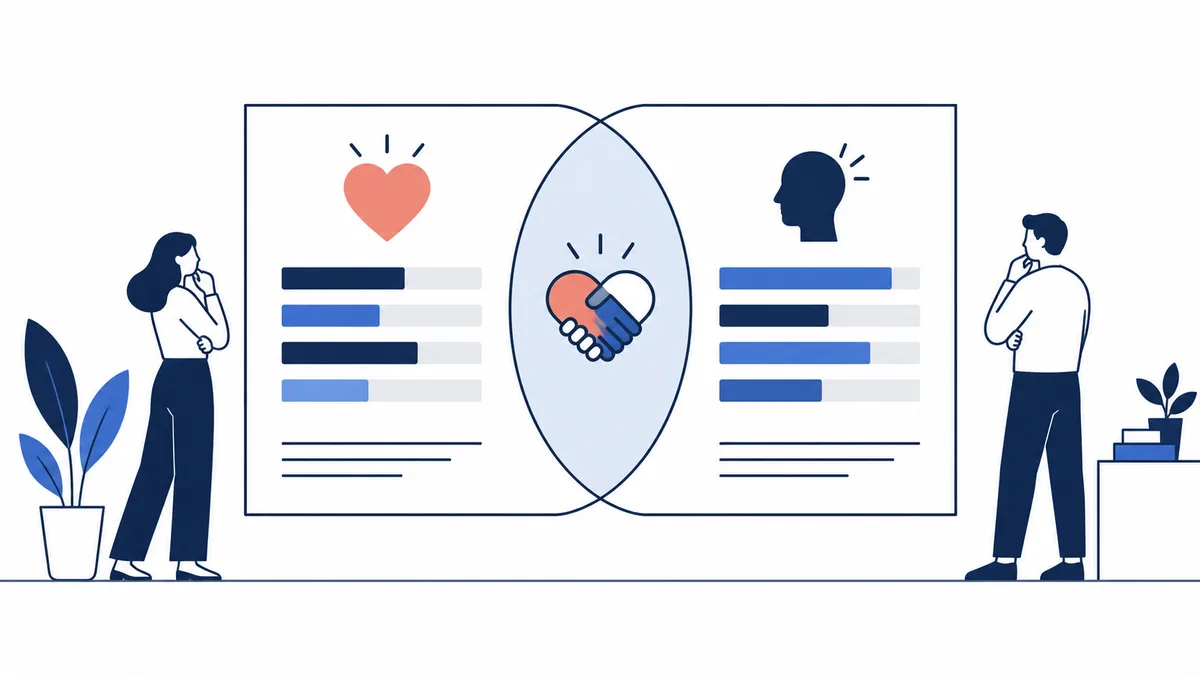
Empathy overlaps with emotional intelligence when an EI model includes perceiving, understanding, or managing emotion. A study of 242 employees found an association between questionnaire measures, but it did not establish a universal overlap percentage or explain what happened in any one exchange. A broad EQ result can prompt reflection; the colleague’s account is more relevant to whether they felt understood.
How closely are empathy and emotional intelligence related at work?
Empathy and emotional intelligence overlap, especially where emotional intelligence includes noticing and making sense of another person’s feelings. Workplace research has found an association between measured emotional intelligence and empathy, but it does not give a universal percentage for how much the two are the same. The answer depends partly on what an EQ model includes and partly on what a particular study measured. For a reader interpreting an EQ result, the practical point is to check the model and method before treating a broad score as evidence about empathy. A competency model may include empathy-related skills by definition; a task or questionnaire may capture a narrower slice. The relationship is real enough to matter, but the label alone cannot tell you how close two measures are. Read the score as an answer produced by a specified model and method, not as a direct empathy rating for every workplace situation.
The overlap changes with the model behind the EQ label
Before comparing an EQ result with empathy, ask what the test calls emotional intelligence. The label covers different ideas. In an ability model, the question is whether someone can solve problems involving emotional information. In a self-report, the question is closer to how someone sees their usual emotional habits. A mixed competency approach may define the subject more broadly, incorporating capabilities such as understanding or responding to other people. Those approaches can all be discussed as emotional intelligence while producing evidence about different things.
The four-branch ability model makes the potential overlap visible without making empathy a synonym for EI. In [The Ability Model of Emotional Intelligence: Principles and Updates](https://sites.usnh.edu/jdmayer/wp-content/uploads/sites/261/2024/03/rp2016-mayer-caruso-salovey.pdf), the model’s authors describe perceiving emotion, using emotion to support thought, understanding emotional information, and managing emotion. Perceiving and understanding another person’s emotional cues are plainly relevant to empathic responding. Managing emotion can matter when deciding how to respond to what one has noticed. Yet the branches extend beyond empathy: using emotion to guide thought, for example, is not simply understanding another person’s perspective. The authors also discuss revisions and empirical challenges, including variation in how test tasks represent the branches. The model is a useful map of possible overlap, not proof that every EI test measures empathy in the same way.
The measurement method adds another distinction. [Emotional Intelligence in Organizations](https://doi.org/10.1146/annurev-orgpsych-031413-091233) distinguishes performance-based approaches from self-report questionnaires. A performance task records responses to emotion problems under the conditions of that test. A questionnaire records a person’s account of their tendencies. Neither result automatically answers whether a colleague’s emotion was read accurately in a particular meeting: the first samples task performance, and the second samples perceived usual behavior. A useful report should therefore identify whether it asks respondents to describe themselves or asks them to work through emotional problems, and explain what its score represents. Without that information, “high EQ” can conceal a change in method rather than a meaningful difference in empathic skill.
That difference matters when an EQ report is used for development. A self-report can give someone language for reflecting on patterns they believe they bring to feedback, disagreement, or a tense handoff. It can help frame a question for reflection: what do I tend to notice, and how do I usually respond when emotions rise? It cannot, by itself, establish that those patterns match how others experience them. A performance result can speak to the tasks and scoring approach used, but should not be translated into a general claim about someone’s everyday empathic conduct without evidence connecting the measure to that conclusion. The issue is the inference from a score, not the usefulness of reflection.
So an EQ score has no fixed relationship to empathy independent of its definition and method. If empathy-related competence is part of a model’s definition, some overlap is built in. If a measure samples emotional problem-solving or self-described habits, its connection to empathy depends on the content it actually captures. Two tests with the same EQ label may therefore support different conclusions. A reader should look for the stated construct and method before treating an EQ result as a measure of empathic ability or behavior.
Sources: The Ability Model of Emotional Intelligence: Principles and Updates; Emotional Intelligence in Organizations
Empathy itself has more than one moving part
The word empathy can describe at least two different operations. Cognitive empathy is understanding another person’s perspective or emotional state: inferring what they may feel and why. Affective empathy is an emotional response that resonates with what the other person appears to feel. The distinction is useful because understanding a colleague’s concern does not require feeling the same emotion, and sharing an emotion does not prove that its cause has been understood. [Empathy: A Review of the Concept](https://nectar.northampton.ac.uk/id/eprint/17038/1/Cuff_etal_ER_2014_Empathy_a_review_of_the_concept.pdf) maps these competing definitions and related concepts; it supports using these as working distinctions, not treating them as universally settled compartments.
Consider an explicitly illustrative exchange: a colleague says a last-minute change has made their workload unmanageable. A listener might infer that the concern is about lost time and competing commitments. That is perspective-taking. The listener might also feel the colleague’s frustration; that is affective resonance. They could then acknowledge the pressure, ask what can move, or offer practical help. Those are responses chosen after interpreting the situation. They may be considerate, but they are not identical to either understanding or sharing the feeling. Nor does an offer of help by itself show that the listener grasped the concern the colleague meant to express.
Keeping these steps distinct makes the workplace question more precise. A person can recognize distress yet misread its source; understand the source without experiencing a matching feeling; or feel strongly and still respond in a way the other person does not want. A rating that combines perspective-taking and emotional resonance can therefore conceal different patterns. One person may be good at inferring another’s point of view while remaining emotionally detached; another may resonate readily but find it harder to sort the other person’s feeling from their own. These are different descriptions of an interaction, not a ranking of who is kinder or more capable overall.
This distinction also matters when reading research that uses the broad word empathy. The cited review describes a contested field in which authors do not always use the term for the same process, and measures need not separate cognitive and affective components cleanly. The division here is an analytical aid: it helps ask whether a finding concerns understanding, emotional sharing, or what someone did afterward. It should not be mistaken for proof that those processes operate independently in every person or can always be isolated by a questionnaire. With that boundary in view, workplace evidence can be read for which part of empathy it actually captures, rather than treating empathy as a single quantity that automatically means helpful behavior.
Sources: Empathy: A Review of the Concept
What did the 242-worker study actually find?
The direct employee study gives evidence of a relationship, but no percentage for how much emotional intelligence and empathy are the same. The PubMed abstract for [“Are emotional intelligent workers also more empathic?”](https://pubmed.ncbi.nlm.nih.gov/23786638/) reports a questionnaire study of 242 employees from public- and private-sector organizations. The researchers examined measured empathy in relation to emotional-intelligence dimensions. In the reported ordering, emotion regulation accounted for the most variance in empathy, followed by understanding emotions and managing others’ emotions. That is the result the accessible abstract supports; it does not report a universal overlap figure.
“Accounts for variance” describes a statistical model’s ability to explain differences in its measured outcome within the data analyzed. It is not a statement that the same percentage of two concepts is shared, that one person has that percentage of empathy, or that one construct caused the other. The abstract’s ordering says which EI dimensions contributed most in the reported analysis. Without a reported coefficient or fuller model details in the accessible record, turning that ordering into a correlation number would add precision the source does not provide. The defensible reading is narrower: in this employee sample, questionnaire scores on those EI dimensions were associated with variation in questionnaire-measured empathy, with regulation leading the reported order. The finding belongs to those measures and that analysis, not every EQ instrument a reader may encounter.
The sample makes the result relevant to work: the participants were employees in public and private organizations, rather than a student group or a laboratory-only sample. But the method shapes what the association can mean. Both sides were assessed through questionnaires at one point in time. The result therefore concerns reported scores under those measures. It cannot establish whether emotional regulation improves empathic understanding, whether empathic tendencies help people regulate emotion, or whether a third factor contributes to both. A cross-sectional association leaves those directions open.
Questionnaire overlap is another live interpretation. The study’s result may reflect emotional capacities that genuinely connect regulation and empathy. It may also partly reflect how the instruments define or phrase the constructs: a self-report about handling emotion and one about empathic tendencies can share content or response habits. The available abstract does not let a reader separate those explanations. This is not a reason to discard an employee finding; it is a reason to keep the conclusion at the level the design can bear. The association is evidence that measured EI and empathy moved together in this sample, not a demonstration that the measures capture one underlying ability.
The distinction matters when someone applies the study to an actual colleague. A group-level questionnaire pattern cannot tell a manager whether a particular person understood a concern in a meeting, and it cannot convert a broad EQ result into an empathy score. The study also does not show that raising one dimension will produce a specified change in empathy. The order of contributions is not a prescription to train regulation first, nor does it show that regulation is more important in every workplace or for every form of empathy. It ranks dimensions inside this analysis of these questionnaire responses. It establishes a useful empirical connection in one workplace sample and leaves the mechanism unresolved. Broader claims would need evidence using clearly specified measures and designs that can test alternative explanations; the current finding alone supports neither a universal percentage nor a causal promise.
Sources: Are emotional intelligent workers also more empathic?
Workday diaries separate stable tendencies from that day’s response
Does empathy’s form matter in ordinary workplace situations? The two studies in [Empathy in the Workplace: Disentangling Affective from Cognitive Empathy](https://link.springer.com/article/10.1007/s41542-024-00197-9) suggest that it does, and that a person’s general tendency can differ from what they report on a particular workday. The distinction is useful because a stable self-description and a response during one day answer different questions. Neither diary study measured emotional intelligence, so they cannot tell us how closely an EQ score tracks empathy. They do show why treating empathy as one uniformly beneficial quality can flatten different workplace patterns.
The authors used two samples of Swiss employees and collected repeated reports rather than relying on a single questionnaire occasion. Study 1 retained 119 participants from 182 invitees; Study 2 retained 179 from 244 recruited. Participants reported on workday experiences, allowing the analyses to distinguish trait empathy—the person’s more general level—from state empathy reported in daily work. The design follows variation across days, but its evidence remains employees’ own reports about themselves and their work. The final samples and the repeated measurement matter: these are not two estimates of an identical population parameter, nor observations of every interaction as it happened.
For the more stable, trait-level measures, affective empathy was associated with fatigue, while cognitive empathy was associated with support participants said they provided. That pairing complicates the simple assumption that a stronger empathic tendency always feels easier or leads to the same helpful action. Feeling with another person may carry a different relationship to one’s own fatigue than understanding their perspective has to providing support. These are associations in the study’s measures. They do not show that affective empathy causes exhaustion, or that perspective-taking reliably produces support in every workplace.
The day-level results were not a miniature copy of the trait findings. On days when participants reported more affective or cognitive empathy, both forms were associated with more support; cognitive state empathy was also associated with lower fatigue. The state distinctions were weaker, however, and the authors note concerns about measuring momentary empathy and the study’s ability to detect effects. A day-level association also does not establish which experience came first: a supportive interaction could shape a person’s report of empathy, just as empathy might accompany a supportive response. The diary method adds a timescale, not a causal sequence. For a reader, this cautions against collapsing a person’s usual tendency into the emotional texture of one demanding day. A measure asking about general habits and a diary asking about today’s response can produce different descriptions without either being incoherent. The timeframe belongs beside the empathy label when interpreting a reported association.
The researchers also tested whether observing workplace conflict strengthened the expected links between empathy and outcomes. It did not: the hypothesized moderation was unsupported. Conflict was not linked to a specific episode, which limits how sharply that test can distinguish a response to conflict from the broader experience of a workday. This null result should stay a null result; it does not establish that conflict never changes empathic behavior. It says these studies did not find the proposed interaction under their measurement and design.
Taken together, the diaries give a more specific workplace picture than a single ‘more empathy is better’ claim: form and timescale both matter to the associations reported. Affective and cognitive empathy did not line up with the same outcomes at the trait level, and daily reports showed a different pattern. That is a reason to ask what kind of empathy and what period a measure captures before translating its result into a workplace judgment. It remains evidence about empathy and reported work outcomes, not evidence that any EQ assessment measures these distinctions or predicts a colleague’s behavior.
Sources: Empathy in the Workplace: Disentangling Affective from Cognitive Empathy
Why does the receiver’s experience matter?
What does empathy from one person establish about how another person felt? A giver’s intention or self-description cannot answer that by itself. In [Where Is the Take in Give and Take? A Review of Empathy Effects on Workplace Outcomes for Both Givers and Receivers](https://onlinelibrary.wiley.com/doi/full/10.1002/job.70093), the review team organized workplace empathy research around two parties: the person giving empathy and the person receiving it. This distinction makes the receiver’s response a separate outcome to investigate, rather than something that can be inferred from the giver’s report of trying to understand.
The review covered 234 articles: 188 empirical and 46 conceptual. Its framework considered whether a study examined empathy as something given or received and whose outcomes it measured. The authors identify an imbalance in this coverage: workplace research more often examines the giver side than the receiver side. That is a description of the review’s literature and coding, not a claim that empathy generally benefits givers more, or that receivers usually feel misunderstood. A gap in what researchers measure cannot be converted into a result about what workers experience.
This matters when someone uses a workplace study to make a claim about an exchange. A finding about the giver’s fatigue, satisfaction, or reported conduct tells us about that person or that outcome as measured. It does not establish that the recipient felt heard, understood, or helped. Conversely, a receiver’s favorable reaction would not by itself establish the giver’s internal state or a general skill. The two perspectives provide different evidence because they concern different people and outcomes. The review’s framework helps keep those claims from being silently substituted for one another. For example, a study that records how empathic employees believe they acted has not thereby established whether recipients experienced support. That missing receiver measure is a limit on the conclusion available from that study, even when its giver-side result is carefully measured.
The review maps a body of research; it does not test a feedback technique. Asking a colleague whether a response captured their concern is therefore a practical check derived here from the distinction between giver and receiver evidence, not a validated intervention established by the review. After a difficult conversation, a person might ask, ‘Did I understand what was weighing on you, or did I miss something?’ The answer can clarify how that particular exchange landed and point to a possible repair. It cannot, on its own, measure a stable empathy trait or settle every disagreement about what happened.
A receiver’s account is situated: memory, expectations, the relationship, and the stakes of the conversation can shape what they say. Still, it supplies direct information about their experience that the giver’s self-rating cannot provide. The useful inference is modest and concrete: if the question is whether someone felt understood in one exchange, ask that person rather than treating the giver’s intention or broad EQ result as the answer. That check adds a perspective to the conversation; the review does not establish that asking always improves an outcome. In practice, the question should stay close to the exchange: which part of the response met the need, and which part missed it? That specificity makes the account useful for reflection while keeping it attached to the event the colleague is describing.
Can an EQ result tell you how empathic someone is in one exchange?
No. A broad EQ result cannot establish how empathic a person was in one particular exchange. The workplace study discussed above found an association among questionnaire scores across a group of employees; its result does not locate what happened between two people in a meeting. The distinction is between a pattern across measured respondents and a judgment about one moment. Even a real association can help explain why two measured qualities may travel together in a sample without telling us whether one colleague recognized another’s concern, understood its source, or responded in a way that met the need. Those are questions about a specific interaction, and the score does not contain that exchange’s evidence.
The same boundary applies to causation. Because the employee scores were collected at one time, their association cannot show that a higher EQ score produced more empathy, or that empathy produced the measured EQ pattern. A relationship between measures gives a reason to examine their overlap; it does not provide a sequence of events inside a person. A broad profile may be useful for deciding where to reflect, but it cannot turn that reflection into a causal explanation of why a conversation went well or badly. In particular, a manager should not use the association as a basis for labeling a colleague’s emotional capacity or treating a score as evidence about a disputed exchange.
Consider a hypothetical report that summarizes a person’s self-described tendency to pause before responding under pressure. A careful reading might be: “This profile gives me a prompt to notice whether I pause when a colleague disagrees with me.” It would overreach to conclude: “I am empathic in difficult conversations,” or “My colleague was not empathic because their profile is lower.” The first statement ties the result to a behavior the person can observe. The second turns a broad pattern into a claim about another person’s inner response, while the third converts a development profile into a verdict. No actual result or score is implied by this illustration; the point is the difference between a reflection question and a conclusion the measure has not established.
To choose a useful reflection question, start with the measure’s named construct and method. If it summarizes reported habits, ask what recent behavior those habits invite you to notice. If it samples performance on specified emotion problems, keep the interpretation attached to those tasks unless evidence links them to the behavior you want to understand. If empathy itself is measured, identify which component the instrument covers: understanding another perspective, emotional resonance, or a defined response. A measure aimed directly at a narrow empathy component may answer a narrower question, but its result still depends on that instrument’s evidence and does not stand for every way empathy appears at work.
The practical decision rule is therefore simple: use a broad EQ score to select a personal question for reflection, not to assign an empathy score to yourself or a colleague in a specific exchange. If the concern is how your own response landed, examine the exchange and ask the other person what they experienced. If the purpose is a consequential workplace judgment, a development profile is not a defensible substitute for evidence suited to that decision. This keeps three things distinct: what a group-level association says, what a particular measure captures, and what the people in one conversation can report about that conversation. The narrower the conclusion, the more closely its evidence should match the behavior and moment being judged.
Choose a next conversation, then choose one practice
After a recent conversation that felt strained, ask the colleague: “When I responded, what helped you feel understood, and what did you still need from me?” Listen for the specific behavior they describe before explaining what you meant. Their account can show how that response landed; choose one action to try in a similar exchange, such as pausing to check your understanding before offering a solution. If the answer is difficult to hear, ask one follow-up about the moment they mean and let them finish before you respond. You do not need to agree with every interpretation to learn which part of your response helped or added pressure. This is a practical reflection, not a test of who was right.
For a more structured look at your own habits, the [Emotional Skills Profile](/assessment) is a private 32-item reflection on recent emotional situations and authored scenarios. Its report can help organize what you notice and what you might practice next; it is not an empathy score or a measure of how a particular colleague experienced you. The colleague’s account remains the relevant evidence about that exchange. Explore the profile if guided self-reflection would help you choose a behavior to work on.
Sources: Emotional Skills Profile
Questions readers ask
Can an EQ score tell you how empathic someone was in a particular conversation?
No. A broad EQ result cannot establish how someone responded in one exchange. It can prompt reflection on emotional habits, while the other person’s account can help clarify how that response landed.
Sources
- Are emotional intelligent workers also more empathic?
One-time questionnaire evidence from 242 public- and private-sector employees: emotion regulation accounted for the most variance in measured empathy, followed by understanding emotions and managing others’ emotions. Supports an association in this sample, not a universal overlap estimate or a causal claim.
- The Ability Model of Emotional Intelligence: Principles and Updates
The authors describe the ability model’s emotional perception, facilitation, understanding, and management domains, while discussing revisions and empirical challenges including variation in how test tasks represent the branches. Supports model-specific conceptual overlap and cautions against treating one operationalization as the construct itself.
- Emotional Intelligence in Organizations
Organizational review distinguishes performance-based and self-report EI measurement approaches and surveys workplace context. Supports explaining why observed task performance and self-described typical tendencies answer different questions.
- Empathy: A Review of the Concept
Conceptual review argues that empathy has multiple definitions and discusses affective response, cognitive perspective-taking, and related concepts. Supports defining the article’s chosen distinctions and avoiding a single undifferentiated empathy score.
- Empathy in the Workplace: Disentangling Affective from Cognitive Empathy
Two Swiss employee diary studies (final samples 119 and 179) collected repeated workday reports. Trait affective empathy was associated with fatigue and trait cognitive empathy with provided support; at state level both forms were associated with support, while cognitive state empathy was associated with lower fatigue. The expected conflict moderation was unsupported.
- Where Is the Take in Give and Take? A Review of Empathy Effects on Workplace Outcomes for Both Givers and Receivers
Systematic review of 234 articles (188 empirical, 46 conceptual) categorizes workplace empathy by giving/receiving and whose outcomes are measured. Supports treating the receiver’s experience as a separate empirical question and locating a research imbalance; the review does not validate a specific feedback script.
- Emotional Skills Profile
Official product page describes the private 32-item Emotional Skills Profile as educational self-reflection on recent emotional situations and behavior, with report guidance. Supports a proportionate optional next step, not an empathy score, validated norms, or ability-test validity.
Apply it to the real situation
Turn an EQ reflection into one behavior to practice
From this guide: A broad result cannot tell you whether a colleague felt understood in one exchange; structured reflection can help you notice which emotional habit to examine next.
The private 32-item Emotional Skills Profile offers reflection on recent emotional habits and judgments about authored scenarios. It can help you choose a behavior to consider, such as checking your interpretation or pausing before responding. Use it as an educational reflection tool, then draw on feedback from someone you trust to consider how your response landed.