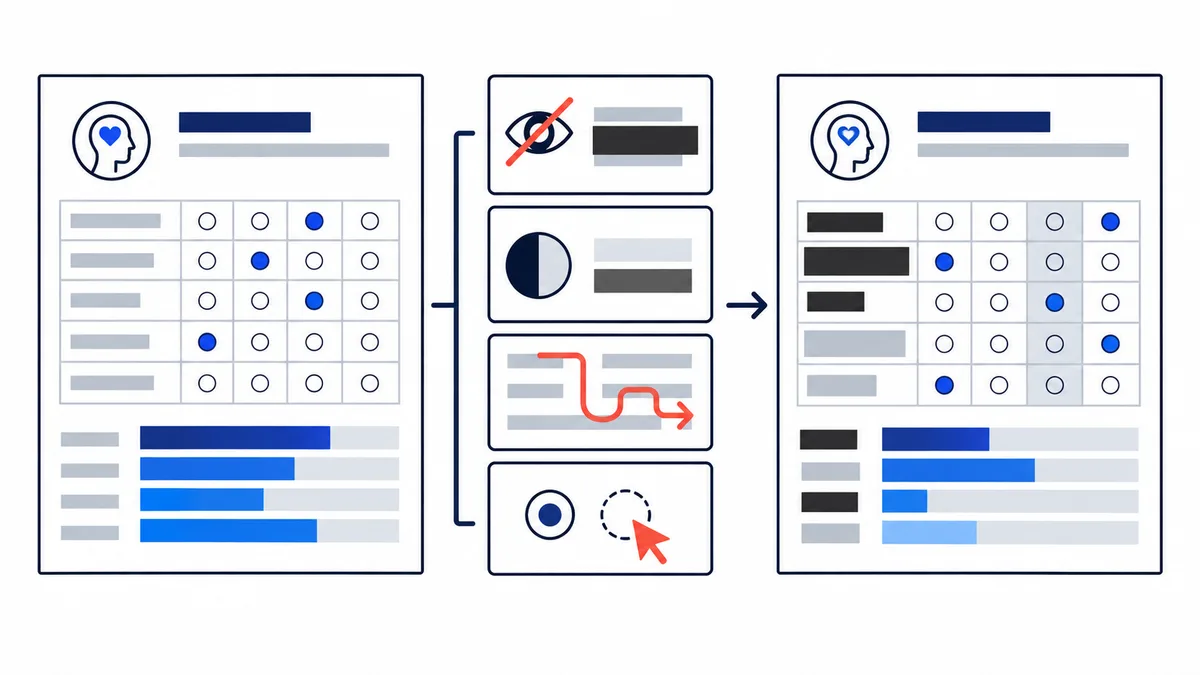
Accessibility problems can affect an EQ result when wording, timing, sensory presentation, or response controls interfere with answering. The meaning depends on the test: a self-report asks someone to describe behavior, while an emotion task asks them to respond to emotional material. Before treating a low result as evidence about emotional skill, identify the barrier, the response it affected, and the test’s intended interpretation.
A low result can reflect the route to the answer
A low EQ result can point to an emotional skill worth attention. It can also reflect difficulty reaching the answer the test asked for. The score alone cannot distinguish these explanations. Ask what the instrument intended to measure, then whether the person could perceive the prompt, understand its wording, use the response controls, and finish under the conditions provided. If one step failed, the answer may reflect that access problem alongside the intended skill. This is a question about interpretation, not a reason to declare a result false. “A Framework for Improving the Accessibility of Assessment Tasks” describes access as an interaction between test features and a person’s characteristics. It explains how inaccessible items can weaken conclusions drawn from responses, using educational assessment and a Dutch driving theory exam as examples. The chapter does not estimate effects on EQ scores. U.S. Department of Justice guidance makes a related point for covered high-stakes tests: scores should reflect the skill being tested, except when the impaired skill is itself part of the test. For an EQ result, start with the observable event: a label could not be read, an item was skipped, or a response could not be entered.
Sources: ADA Requirements: Testing Accommodations; A Framework for Improving the Accessibility of Assessment Tasks
What kind of EQ answer was the test asking for?
Before interpreting an EQ result, ask what kind of answer the test requested. A self-report asks someone to describe their typical or recent behavior: for example, how often they notice frustration before responding. A performance-based task asks them to work with emotional material, such as identifying an emotion or judging how a situation might unfold. These formats can both concern emotional intelligence, but they do not collect the same evidence. The U.S. Office of Personnel Management’s “Emotional Intelligence Tests” overview makes this distinction: self-reports can describe a person’s self-perceived competence or self-image, while ability measures ask respondents to solve emotion-related problems and may score answers by expert judgment or group consensus. That difference matters when access gets in the way. On a self-report, dense wording can make a question harder to understand; an unclear frequency scale can make “sometimes” difficult to distinguish from “often”; and a response control that is hard to operate can interrupt the choice. Any of these may affect how a person describes a habit. If the question asks about recent behavior, the answer also depends on identifying the relevant period and recalling examples. Trouble with a scale or a long sentence does not show that the person lacks emotional awareness. It shows that the reported answer may have been shaped by the route used to give it. A performance task has a different vulnerability. If a task presents an emotional cue in an image or audio clip, a person must be able to access that cue before responding to it. If the cue is unavailable through their sensory access, the answer may reflect missing information as well as the emotional judgment the test intends to elicit. A response channel can create a similar problem: someone may form a judgment but have difficulty entering it with the available controls. Which step failed, and whether that step is part of the intended skill, both matter. The OPM overview includes tests that ask respondents to interpret faces, consider emotional scenarios, and solve emotional problems. Its examples clarify why the stimulus and response path deserve attention; they do not establish that every ability test uses faces or that facial expression is the only meaningful evidence of emotional understanding. The relevant question is whether the person could perceive and respond to the information that this particular task uses to support its claim. A written scenario can pose a different access demand from a visual cue, even when both are intended to elicit an emotional judgment. The current EQ Test offering needs its own description. The 32-item Emotional Skills Profile is an educational reflection tool. It keeps summaries of recent behavior separate from judgments about authored scenarios, and it has no validated population norms. Those scenario judgments should not be described as results from a standardized ability test. A reader can therefore ask which part of the report they are interpreting: a description of habits, a response to an authored situation, or another output. A difficulty with wording or a response control may bear differently on a recent-behavior answer than a sensory barrier would bear on an emotion stimulus in a performance task. This comparison does not tell us the size of any accessibility effect on an EQ result. The available evidence here distinguishes methods; it does not test the effect of a particular access barrier on this profile or another named instrument. For a reader facing a troubling result, the first useful question is concrete: was the test asking me to report how I usually behave, or to make a judgment using emotional information that I could access? Once that is clear, the access problem can be described at the right point in the response process, without turning a score into a fixed statement about emotional capacity.
Sources: Emotional Intelligence Tests; Emotional Skills Profile
How does a barrier enter the answer?
An answer is produced through a sequence of small tasks. The respondent has to orient to the question, take in its information, decide what it means, form a judgment, enter a response, and sometimes check or revise that response. A barrier at any point can shape what reaches the score. The problem may arise before the person has made the emotional judgment the test is meant to capture. A 2019 chapter, “A Framework for Improving the Accessibility of Assessment Tasks,” describes accessibility as an interaction between task features and a person’s characteristics. Its framework separates the intended challenge of an item from extra demands created by presentation, access skills, or sensory and motor requirements. The chapter concerns educational assessment and illustrates the framework with Dutch driving theory exams; it does not estimate accessibility effects on EQ scores. Its useful point here is about the route from item to answer: when a task adds demands unrelated to its target, the score may reflect those demands as well as the intended skill. Consider a self-report item with a row of response choices whose labels are unclear to a screen reader. The respondent may understand the question about handling frustration but cannot reliably tell which choice means “often” and which means “sometimes.” Selecting a response now requires guessing at the interface as well as describing a habit. A visual scenario that cannot be enlarged creates another break: a person may miss information needed to judge what is happening. With a keyboard, an unexpected focus jump can move past the response control; a motor-intensive interaction can make selecting an answer slow or difficult. Each example is illustrative, not evidence that a particular EQ assessment has these defects. The International Test Commission’s “Guidelines for Technology-Based Assessment” notes that mouse, trackpad, or touch interactions can interfere with a target skill for people who have difficulty using those devices. It also discusses keyboard navigation and assistive technology, including screen readers and refreshable Braille displays. The guidance recognizes that navigating content with access supports may require additional time or breaks. This matters because delay can change an answer indirectly: someone may rush, leave an item blank, or lose the thread of a long prompt while managing the controls. The guidance establishes a general delivery concern, not that any one EQ response was altered. Assessment researchers call score variation caused by demands outside the skill a test intends to assess “construct-irrelevant variance.” did the answer show the emotional judgment, or did it partly show the effort of accessing the question? The distinction is not always obvious. Reading comprehension may be incidental in a test about recognizing emotion, for example, but a test that explicitly measures understanding a written emotional account may depend on reading. The intended interpretation determines which demands count as extra. Web standards can help locate interface problems. WCAG 2.2 includes requirements addressing keyboard operation, focus order, and adjustable time limits. Those criteria can guide an audit of how a digital item is delivered; they do not establish that an EQ instrument measures its claimed skill or that a score under a particular accommodation is comparable with another score. When asking for help, describe the failed step: the label was not announced, the focus skipped a choice, the image could not be enlarged, or the timer expired while navigating. That concrete account gives a provider something to investigate and keeps interpretation tied to the response process.
Sources: A Framework for Improving the Accessibility of Assessment Tasks; Guidelines for Technology-Based Assessment; Web Content Accessibility Guidelines (WCAG) 2.2
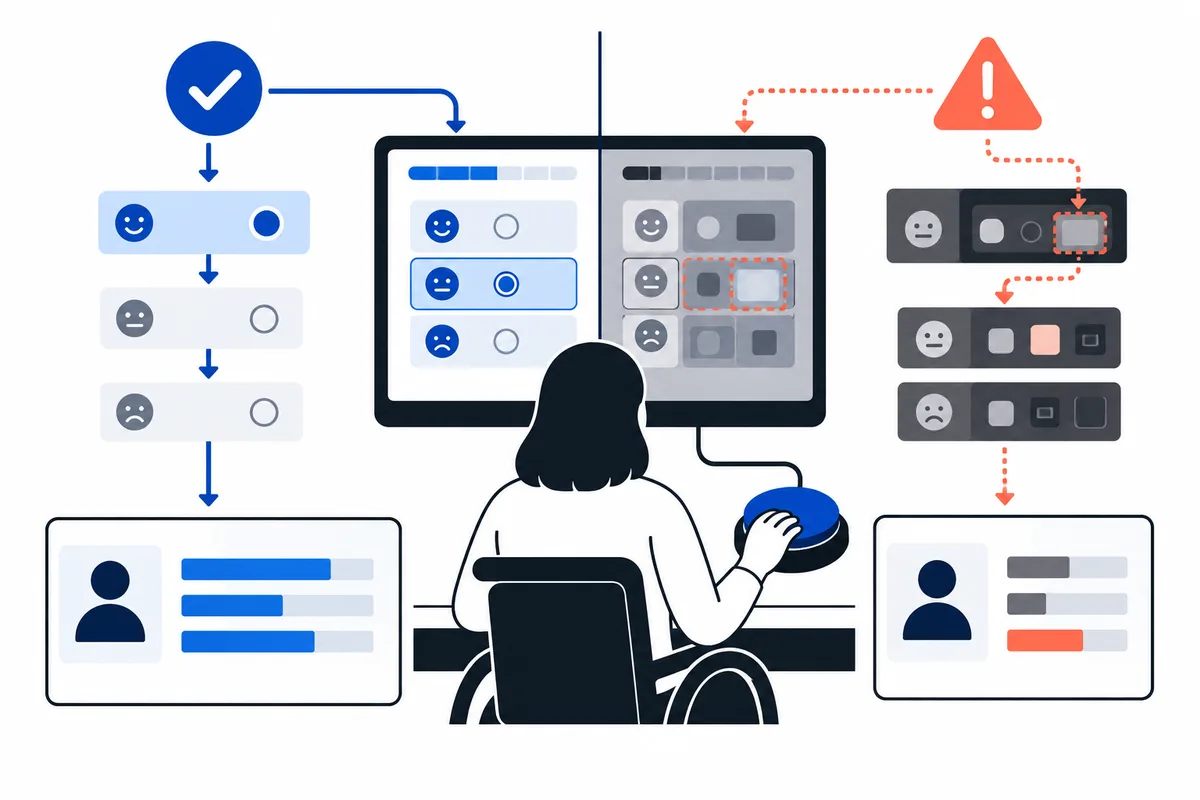
The same barrier can change a self-report and an emotion task in different ways
A self-report and an emotion task can both produce an EQ-related result, yet they ask the respondent to do different things. The U.S. Office of Personnel Management’s “Emotional Intelligence Tests” overview distinguishes questionnaires about a person’s self-perceived competence from ability measures that ask them to solve emotion-related problems. That difference matters when an item is hard to access: one format may make self-description harder, while another may prevent the person from receiving the evidence on which a judgment depends. Consider a habits questionnaire with a long workplace scenario followed by a frequency scale whose labels are difficult to distinguish. The respondent is asked how often they notice tension before responding in a disagreement. If the scale’s labels are unclear or difficult to navigate, they may select a neighboring option without being sure what it means. The answer still describes the respondent’s estimate of their own behavior, but the route to that estimate has become less reliable as a description of what they intended to report. This is a plausible mechanism, not a measured finding about EQ questionnaires; the available sources do not quantify such effects for a particular instrument. Now imagine that an ability task presents an emotional stimulus, such as a face, and asks the respondent to judge what emotion it conveys. OPM describes this kind of task as one way ability-based EQ tests may work. If a visual barrier prevents the respondent from perceiving the relevant expression, the problem occurs before the emotional judgment can be made. A response can then reflect missing stimulus information as much as the intended task. The interpretation must follow the specific task: did the visual information reach the respondent in a usable form? The contrast is between reporting an estimate of typical behavior and responding to emotional material supplied by the assessment. A self-report item may be answerable from memory, though dense language or confusing response labels can alter what the person says about that memory. In a performance task, the person may be asked to work through information provided in the item; if a sensory barrier blocks a relevant cue, the task may no longer elicit the same evidence. These are applications of OPM’s distinction, not evidence that one format is generally more accessible or accurate. A keyboard-only navigation difficulty shows why the channel itself needs examination. Suppose an item describes a disagreement in text and asks which response best recognizes another person’s concern. If the person can read the scenario, understand its choices, and make that judgment, changing the way they move between answer controls may leave the emotional judgment intact. If keyboard focus skips choices or lands unpredictably, however, the person may be unable to enter the answer they chose. The International Test Commission’s “Guidelines on Technology-Based Assessment” discusses assistive-technology compatibility and motor interactions as parts of digital assessment delivery. It notes, for example, that a double click can add response time and stress. The guidance supports checking the interaction path; it does not report effects for a specific EQ test. The web interface adds another layer. The World Wide Web Consortium’s “Web Content Accessibility Guidelines (WCAG) 2.2” sets criteria for features such as keyboard access, labels and instructions, resizing, contrast, focus behavior, and adjustable timing. They can help identify delivery problems such as unusable labels, controls unreachable by keyboard, or content that cannot be enlarged. They do not tell us whether a given EQ score changed, nor do they establish that the emotional construct was measured well. A technically accessible route is useful evidence about the interface, not a substitute for interpreting the item and response. So ask where the barrier entered this particular answer. Did it make the emotional content hard to perceive, make the prompt or response options hard to understand, or make an otherwise clear judgment difficult to enter? The first may mean the task did not supply its intended evidence; the latter may leave the judgment intact but the recorded answer uncertain. This distinction is an interpretation of the response process, not a correction formula. Without instrument-specific evidence, neither a score increase nor an unchanged score can be attributed to the access change alone.
Sources: Emotional Intelligence Tests; Web Content Accessibility Guidelines (WCAG) 2.2; Guidelines for Technology-Based Assessment
When does an accommodation preserve the EQ task?
An accommodation is more likely to preserve the intended task when it changes the route to an answer while leaving the emotional judgment the test is meant to elicit intact. If the change alters the emotional information itself, the response may answer a different question. Unless the provider has evidence that the changed and standard forms support the same interpretation, the modified result should be read on its own terms. The U.S. Department of Justice’s “ADA Requirements: Testing Accommodations” explains this distinction with a calculator. If an exam is intended to measure algebraic reasoning, allowing a calculator for basic arithmetic may remove an incidental demand; if the exam measures arithmetic computation, the same aid changes the skill being tested. That is a useful measurement principle for thinking about EQ tasks, not legal advice about a voluntary self-reflection profile. For example, keyboard navigation through a written workplace disagreement scenario could change how a person enters an answer while leaving their judgment about the disagreement available. By contrast, replacing a visual expression or other emotional stimulus with a verbal description could change what information the respondent receives. Whether that substitution preserves the target depends on the test’s claim: if interpreting that visual cue is part of the intended task, a description is not automatically equivalent. A provider can make this decision by tracing the claim from item to response. The 2008 ETS report “Evidence-Centered Assessment Design for Reasoning About Accommodations for Individuals With Disabilities in NAEP Reading and Mathematics” describes using evidence-centered design to reason about how accommodations and accessibility features affect validity. In plain terms, the designer asks what conclusion a response is meant to support, what evidence in the item would support it, and what conditions could shape the answer. ETS reports that the approach was useful in examples from the National Assessment of Educational Progress in reading and mathematics. It does not report an EQ study. Applied here as a framework, the questions are practical: does the change remove a barrier to showing the intended emotional judgment, or supply different emotional evidence? What should the resulting answer be allowed to mean? The chapter “A Framework for Improving the Accessibility of Assessment Tasks” makes the delivery question concrete through a Dutch driving-theory exam. Its examples concern hazard prediction and traffic-rule application, not emotional intelligence. The framework shows why an item’s presentation and interaction can be part of its task demands; it cannot tell us whether any particular EQ accommodation preserves a score. Transfer from that example is therefore a way to inspect an EQ item, not evidence about EQ outcomes. Nor does the word “accessible” guarantee that a score will stay the same or improve. The University of Minnesota’s National Center on Educational Outcomes reviewed 58 studies published in 2015 and 2016 on accommodations in school and postsecondary testing. In the 23 studies examining performance effects, findings varied by accommodation and setting. For oral delivery, the review reports positive, null, and negative findings across studies; extended time also produced mixed patterns, including studies with no apparent effect. These results concern educational tests, not EQ measures. They complicate any blanket assumption that an accommodation has one predictable score effect, but they cannot quantify an effect on an EQ result. A provider should therefore explain which access demand a change removes, which part of the item it leaves intact or alters, and what interpretation the response can support afterward. If that explanation is unavailable, the accommodation may still make participation possible; the score simply needs a narrower reading until the test’s intended claim and the changed response conditions are clear.
Sources: ADA Requirements: Testing Accommodations; Evidence-Centered Assessment Design for Reasoning About Accommodations for Individuals With Disabilities in NAEP Reading and Mathematics; A Framework for Improving the Accessibility of Assessment Tasks; The Impact of Accommodations on the Performance of English Learners on 2015–2016 State Tests
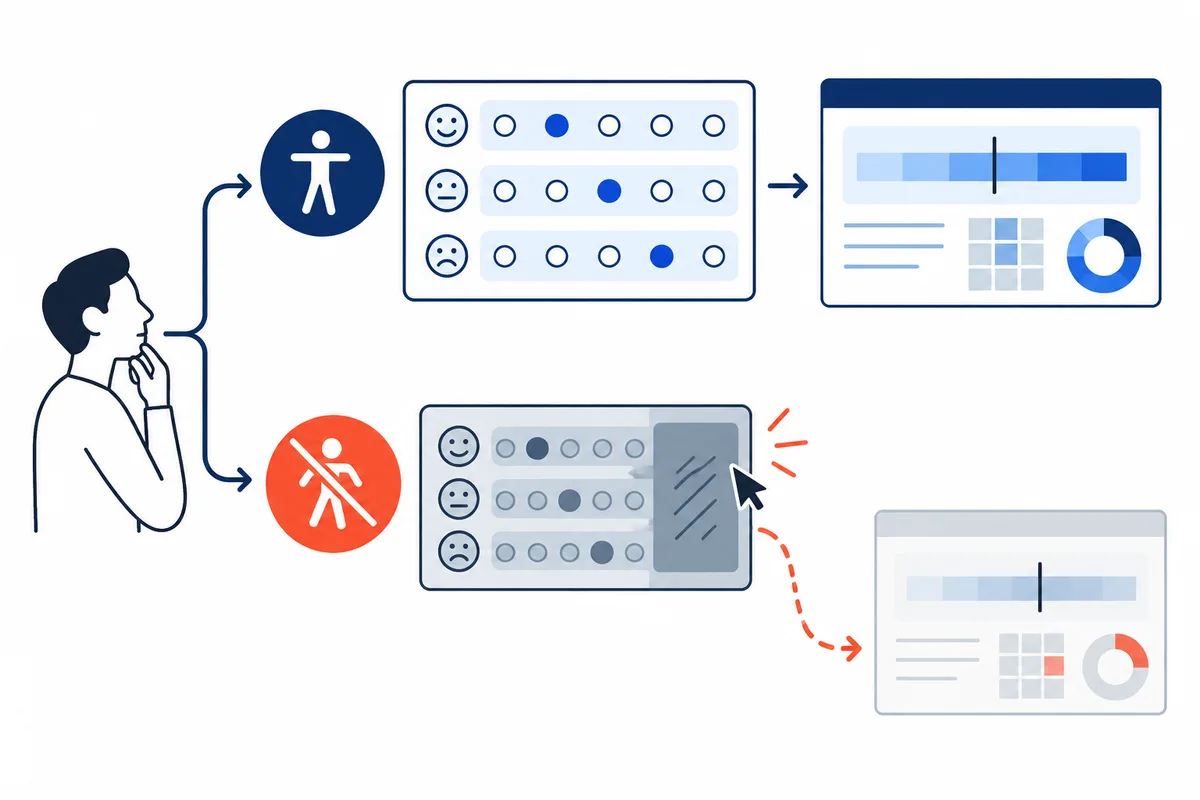
Can a retest settle the question?
A retest can answer a limited question: did the response pattern differ when the access conditions changed? It cannot, by itself, tell you why. A higher or lower result after repairing a barrier is consistent with an access effect, but it does not isolate access from practice, memory for the item format, fatigue, mood, the testing environment, or ordinary measurement error. Nor does a changed score establish that emotional skill changed between administrations.
The International Test Commission’s Guidelines on Test Use advise test users to consider whether an impairment contributes no score variance, variance relevant to the measured construct, or variance unrelated to it. The distinction matters for a retest. If a person could not operate a response control and later uses an accessible control, the second administration may provide a more usable response. Yet the guidelines caution that modified tests are rarely normed on sufficiently large samples of people with equivalent disabilities to establish comparability with a standardized version. They recommend documenting changes and their rationale; when information about performance on modified tests is scarce, they say results may be better used qualitatively and supported with other information. The same appendix says there is no simple rule that makes every test fair for every disability; users should consult the manual and publisher about modifications and alternatives. That limitation matters when a provider offers no comparison evidence for its own format. These are general test-use recommendations, not findings about an EQ instrument.
That advice changes what the retest can reasonably do. It may help the person and provider identify whether the earlier task was blocked by a specific feature, and whether the new route permits a considered answer. It does not supply a correction factor for the earlier score. Comparing two numbers as if only accessibility changed would require evidence that the instrument, scoring, conditions, and relevant response process support that comparison. Without such evidence, the scores are records from two administrations with different conditions, rather than a clean before-and-after estimate of access’s effect.
The ETS report “Evidence-Centered Assessment Design for Reasoning About Accommodations for Individuals With Disabilities in NAEP Reading and Mathematics” illustrates a more careful way for designers to think about changes. Its 2008 report uses examples from the U.S. National Assessment of Educational Progress in reading and mathematics, and reports that evidence-centered design techniques were useful for analyzing how accommodations and accessibility features relate to validity. That is a design approach, not a retest study and not evidence about EQ scores. Applied cautiously, it suggests asking what claim the item is meant to support, what answer would count as evidence for that claim, and whether the accommodation changes that evidence. A provider who can answer those questions gives the reader more than a pair of unexplained scores.
For an individual, a short record can keep the comparison honest: note the barrier in the first sitting, the feature changed for the retest, and any differences in timing, setting, or familiarity. Ask the provider whether the modified administration has guidance for interpretation and whether a qualitative reading or another format is more appropriate. If no guidance is available, treat the second result as a clearer opportunity for reflection under its stated conditions, not as proof that the first score was wrong or that the new score is the corrected one. Record what happened and read each result only as far as its administration and supporting evidence allow.
Sources: International Test Commission Guidelines on Test Use; Evidence-Centered Assessment Design for Reasoning About Accommodations for Individuals With Disabilities in NAEP Reading and Mathematics
Does one inaccessible item explain a whole result?
One affected answer does not automatically explain an entire EQ result. Its reach depends on how the instrument uses the response, whether the access barrier recurred, and what the report summarizes. Without scoring documentation, a reader cannot estimate the effect from the displayed result. Separate an uncertain answer from an interpretation built on several answers or completion. Neither warrants a numerical correction by guesswork.
If one scale label was unclear, the answer may be less informative about the behavior the item was meant to capture. It might matter chiefly to one report description, if the instrument links that response to it. Report headings do not disclose scoring rules: the response could contribute to a domain summary, a total, both, or neither. Provider documentation is needed to establish the link.
Repeated friction changes the question. Someone who must reread dense wording, recover after focus shifts, or work around a difficult response control may face the same demand across many items. Ask whether the answers reflect the intended emotional judgments throughout, rather than one isolated choice. The available evidence does not quantify such effects on EQ scores, and recurring friction does not prove every answer changed. It does give the respondent a reason to describe the administration conditions when asking how to interpret the result.
A barrier that prevents an answer raises another issue: how did the system handle the missing response? The result may be marked incomplete, the item omitted from some interpretation, or another rule applied. These are possibilities, not claims about the current profile. Unless the provider explains the rule, a reader cannot assume a blank had no effect or was treated as a particular answer. Ask whether the response was recorded, skipped, or changed after the access problem.
The International Test Commission’s Guidelines on Test Use advise accounting for administration deviations and measurement error, and avoiding claims about characteristics a test does not measure. Here, that supports narrowing interpretation to the evidence the instrument provides. It does not show how much an inaccessible EQ item changes a score. A result may inform a specific reflection while remaining insufficient for a broad statement about emotional capacity. Difficulty with one response should prompt a question about the interpretation it may affect, not a conclusion about every report section.
The Emotional Skills Profile keeps recent-behavior summaries separate from authored scenario judgments and has no validated population norms. Neither output is a population rank or diagnosis of general ability. If access affected a scenario response, ask how it contributes to that portion; do not assume it changes the recent-behavior summary. If friction recurred across behavior questions, ask whether those answers remain interpretable as intended. These are questions for the provider, not deductions from a score label. This separation does not reveal the scoring formula.
Ask the provider which result or interpretation depends on the affected response, and how an omitted or changed answer is handled. Describe the problem functionally: which response step was difficult, whether the answer was completed, and whether the difficulty recurred. The provider may explain the scoring rule or suggest an accessible way to answer. Until then, keep the uncertain response attached to the interpretation it may affect, rather than discarding the whole result or letting one answer define it.
Sources: International Test Commission Guidelines on Test Use; Emotional Skills Profile
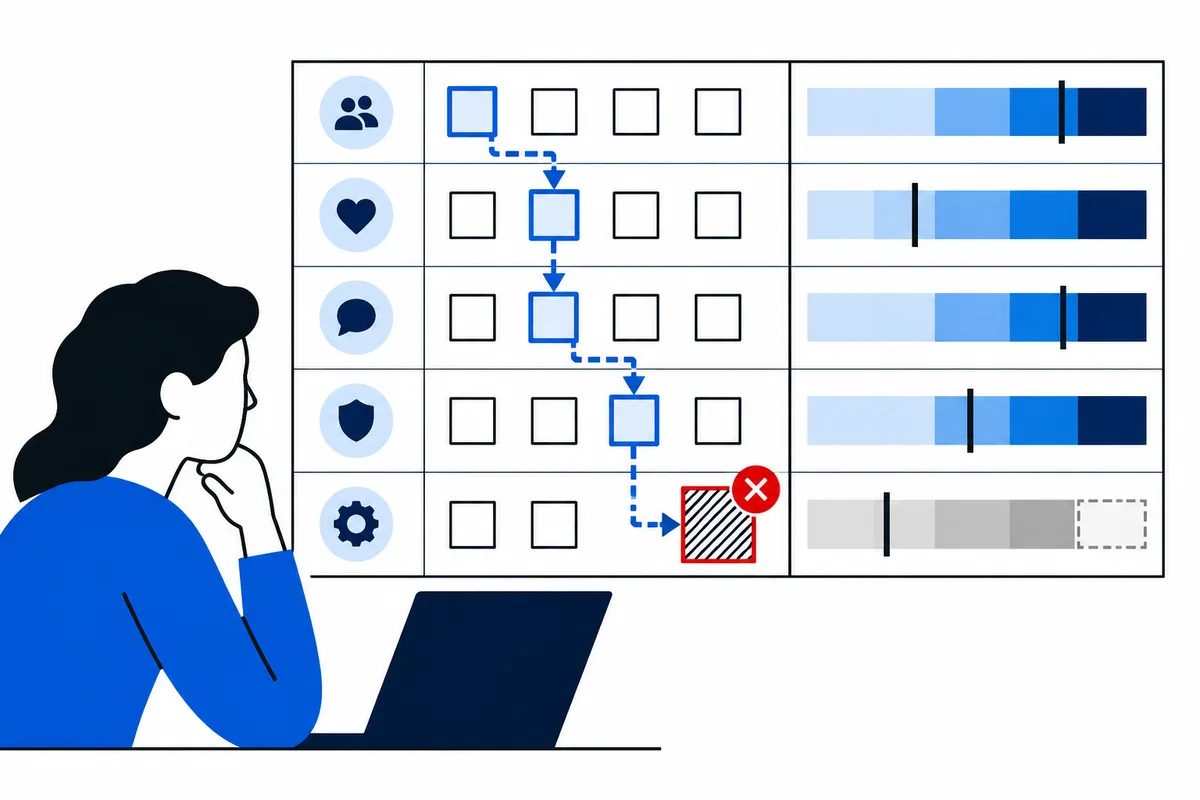
What should a provider and respondent record?
A useful record starts with the task, not a diagnosis. Note which item or screen caused difficulty and what the item appeared to ask the respondent to judge: for example, noticing an emotion, describing a recent response, or choosing how to handle a disagreement. Then describe the access demand in plain, observable terms. Was the wording difficult to read or understand? Could a screen reader identify the response labels? Did keyboard navigation move predictably? Was a visual or audio element unavailable, did the test impose a time limit, or was selecting an answer physically difficult? The [Web Content Accessibility Guidelines (WCAG) 2.2](https://www.w3.org/TR/WCAG22/) provide criteria for web features such as text alternatives, keyboard operation, labels, focus, and timing. They help frame a report about the interface; they cannot tell a provider whether an emotional-skill score is valid.
Next, note what happened to the response. Say whether it was completed, skipped, guessed, changed after rereading, or entered only after another person helped. Record the point in the process where the problem arose, rather than summarizing it as “the test was hard.” A respondent might report: “On the scenario item, I could hear the prompt but could not distinguish the unlabeled choices with my screen reader, so I selected one without knowing which response it represented.” That description gives the provider something specific to investigate. It does not require the respondent to disclose a medical history. The International Test Commission’s *Guidelines on Test Use* advises that questions about disability should focus on a person’s ability to complete the test activities and that privacy should be respected. For routine troubleshooting, the functional barrier and the help requested are usually the relevant details.
If the test conditions changed, record what changed and when: extra time, a different input method, enlarged text, a text alternative, a break, assistance, or a different format. Keep this brief and factual. The same ITC guidelines advise test users to observe and record departures from procedures, seek relevant professional advice when a modification exceeds their experience, tailor necessary changes to minimize effects on score validity, and pass information about modifications to people interpreting the score when withholding it could lead to biased interpretation. Its advice is general guidance, not a rule that every personal reflection tool needs a formal accommodation file. For an informal EQ profile, the practical point is simpler: a reader and provider should be able to tell what conditions produced the answers.
The provider’s reply should address the interpretation, not merely confirm that a feature exists. Ask which response or part of the report may depend on the affected item; whether the requested change preserves the emotional judgment the item is intended to elicit; and whether the result under changed conditions can be read in the same way. If the provider cannot answer, that uncertainty belongs beside the result. The ITC’s guidance says users should consult the test manual and publisher about modifications and alternative formats. Its technology-based assessment guidance also discusses interface interactions that can interfere with the targeted skill and the value of supporting keyboard navigation. Those points justify asking how the administration worked; they do not establish that any particular EQ result has been corrected or validated.
A short note can therefore contain five things: the intended judgment, the access demand, what happened to the answer, the change made, and the provider’s interpretation guidance. Share only details needed to investigate the task. Then ask for a specific next step, such as a supported way to complete the item or an explanation of how to treat the affected response.
Sources: Web Content Accessibility Guidelines (WCAG) 2.2; International Test Commission Guidelines on Test Use; Guidelines for Technology-Based Assessment
Use the result as a development prompt only when its conditions are clear
If an access barrier may have affected an answer, pause before turning the score into a skill goal. Decide whether the administration was usable for private reflection. If the problem was clear and the provider offers a supported route, ask how to retest or use another format, and record what changed. The International Test Commission’s Guidelines on Test Use advises documenting modifications and considering them when interpreting scores; it does not establish that a modified EQ result is equivalent to the original. A retest may improve access while leaving the comparison uncertain.
If the provider cannot explain what the task measures or what the change preserves, treat the result as a question to observe rather than a conclusion about your emotional capacity. In a difficult conversation, notice whether you made a clear request for feedback and returned to repair a disagreement. That behavior can guide reflection; a score alone does not predict how you will work with others.
The private 32-item Emotional Skills Profile offers reflection on recent emotional behavior and authored situations, with guidance for choosing a development focus. It has no validated population norms or established ability-test validity. If that format fits your purpose, explore the Emotional Skills Profile at /assessment. Keep the access conditions beside your interpretation, and let a specific behavior guide the next conversation.
Sources: International Test Commission Guidelines on Test Use; Emotional Skills Profile
Questions readers ask
Can an accessibility barrier make an EQ score lower?
It can affect an answer when it interferes with perceiving the prompt, understanding its wording, using the response controls, or finishing in the available time. The available sources do not quantify how much a particular barrier changes an EQ score.
Does an accommodation preserve the meaning of an EQ test?
It is more likely to preserve the intended task when it changes the route to answering while leaving the relevant emotional judgment intact. If it changes the emotional information or skill being assessed, the result may need a different interpretation.
Can retaking an EQ test after fixing an access problem prove the first result was wrong?
No. A changed result may reflect changed access conditions, but practice, memory, fatigue, mood, environment, or measurement error can also contribute. Record what changed and ask the provider how to interpret each administration.
What should I tell a provider about an inaccessible EQ test?
Describe the item or task, the access demand that failed, what happened to the response, any change made, and what interpretation guidance you need. A functional description can help investigate the problem without requiring unnecessary personal disclosure.
Sources
- A Framework for Improving the Accessibility of Assessment Tasks
Supports the framework that task presentation and access demands can affect assessment interpretation; its examples are educational and do not quantify effects on EQ scores.
- ADA Requirements: Testing Accommodations
Supports the general principle that covered test scores should reflect the intended skill, except when the impaired skill is itself measured.
- Emotional Intelligence Tests
Distinguishes self-report emotional-intelligence measures from ability-based measures that ask respondents to solve emotion-related problems.
- Web Content Accessibility Guidelines (WCAG) 2.2
Specifies web-content criteria for features including keyboard access, labels, resizing, contrast, focus behavior, and adjustable timing.
- Evidence-Centered Assessment Design for Reasoning About Accommodations for Individuals With Disabilities in NAEP Reading and Mathematics
The accessible report record says evidence-centered design techniques were useful for analyzing accommodation and accessibility effects in reading and mathematics examples.
- Guidelines for Technology-Based Assessment
Discusses assistive-technology compatibility, motor interactions, practice with delivery platforms, and technical conditions in technology-based assessment.
- International Test Commission Guidelines on Test Use
Recommends recording test modifications and administration deviations and considering them when interpreting results; its guidance is general, not EQ-specific.
- Emotional Skills Profile
Supports the assigned product description: a private 32-item reflection profile with recent-behavior summaries and authored-scenario judgments kept separate.
- The Impact of Accommodations on the Performance of English Learners on 2015–2016 State Tests
Summarizes 58 studies published in 2015–2016 on educational testing accommodations and reports varied, accommodation-specific performance findings.
Apply it to the real situation
Turn an EQ result into a behavior you can observe
From this guide: Use the profile to reflect on recent emotional habits and authored situations, while keeping any access conditions beside your interpretation.
When the response conditions are clear, a result can help you choose a specific behavior to notice in feedback, disagreement, or repair. The private 32-item Emotional Skills Profile offers reflection on recent emotional behavior and authored situations, with guidance for choosing a development focus. Explore it as a starting point for personal reflection.