
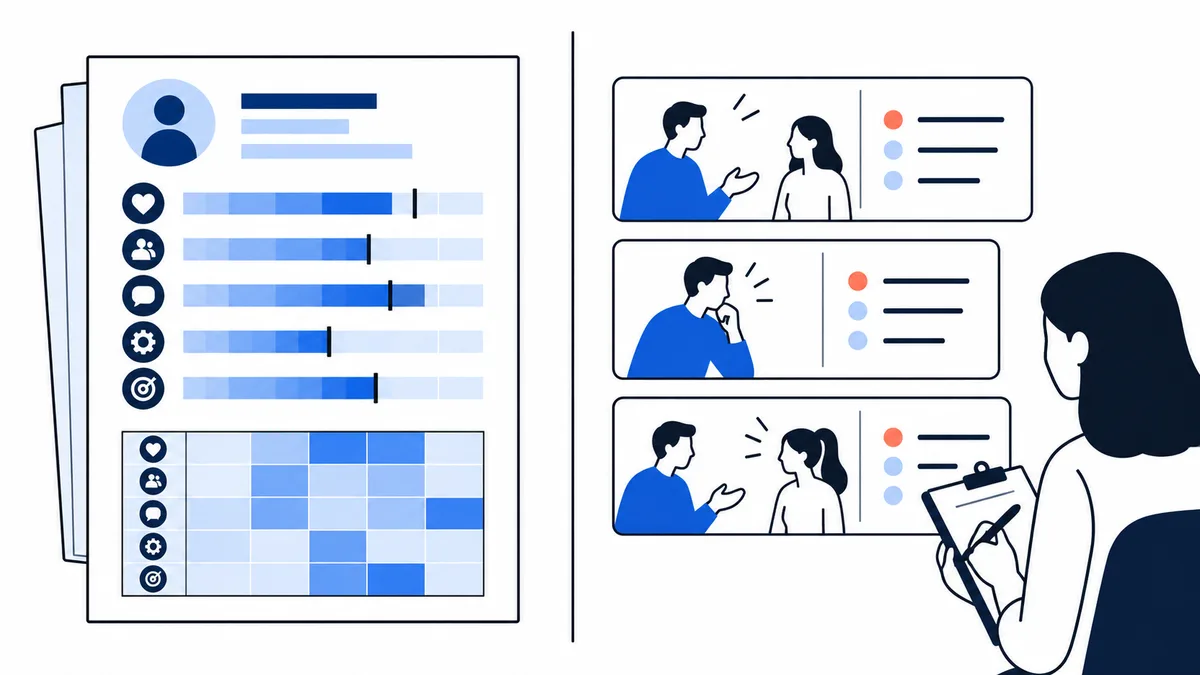
An EQ test score and a behavioral observation are different kinds of evidence. A score is a standardized summary produced from answers or performance on a specified instrument. It reflects the construct, instructions, scoring method, and comparison frame chosen by that instrument. A behavioral observation is a record of what someone did in a defined situation, such as whether they paused before replying to criticism, asked a clarifying question, or acknowledged the effect of a sharp comment. The score can suggest a useful area for reflection; the observation shows how a behavior appeared in one context. Neither should be treated as a complete portrait or a hiring verdict. For workplace development, the most useful sequence is to read the score as a hypothesis, identify an observable behavior, and review more than one relevant situation over time.
The same label can hide different measurements
The phrase EQ test does not name one universal procedure. A systematic review of emotional-intelligence measures separates three broad approaches: ability-based measures, trait measures, and mixed models. Ability-based instruments ask a person to solve emotion-related problems, sometimes with answers treated as more or less correct. Trait measures commonly ask people to rate their usual tendencies. Mixed instruments combine emotional competencies with other self-described characteristics. The resulting scores answer different questions.
That matters before anyone compares a score with an observation. A self-report score may describe how capable or consistent a person believes they are in emotion-related situations. An ability score may describe performance on selected emotion problems. A workplace observation describes conduct that was visible to someone, under conditions that should be recorded. Calling all three an EQ score makes the evidence look more interchangeable than it is.
Sources: Emotional Intelligence Measures: A Systematic Review; Psychological Assessment of Emotional Intelligence: A Review of Self-Report and Performance-Based Testing
A score is a summary made under rules
Every test score is an answer to a measurement design. The items, response options, timing, instructions, scoring key, and reference group determine what the number can mean. Even when an online questionnaire feels conversational, its result is still a summary of the answers given in that format. It is not a recording of every conversation, disagreement, or decision the person has handled.
The distinction is easiest to see with a self-report item. Someone might report that they notice when another person is uncomfortable. That response supplies information about self-perception or a reported tendency, depending on the instrument. It does not show whether the person noticed discomfort in yesterday's meeting, what signal they noticed, or what they did next. An ability-based task makes a different kind of claim because it asks the person to perform on a task. Neither format directly supplies a record of ordinary workplace conduct.
Sources: Emotional Intelligence Measures: A Systematic Review; Psychological Assessment of Emotional Intelligence: A Review of Self-Report and Performance-Based Testing
An observation is narrower, closer to the scene
A behavioral observation records an event or pattern using a defined description. Instead of writing “has high empathy,” an observer might record, “after a colleague objected to the plan, the person asked what concern the objection was based on and summarized the answer before responding.” The second statement stays close to what could be seen or heard. It does not claim to know the person's inner state.
Observation can occur in a natural meeting, a role-play, a structured exercise, or another setting. The setting changes the inference. A role-play can make a behavior easier to compare across people because the prompt is more controlled. A natural meeting may reveal how work actually unfolds, but the topic, power relationship, workload, and history between colleagues also shape what happens. Cambridge's research-methods handbook describes observation as spanning settings from natural environments to tightly controlled situations and emphasizes coding, observer agreement, reliability, and validity.
Sources: Behavioral Observation and Coding
The worked example: one score, two possible readings
Suppose a self-report EQ result points toward difficulty with emotional clarity. That result does not establish that the person regularly mishandles disagreement. It gives a question worth testing: when a discussion becomes tense, can the person name what they are feeling and separate it from the problem being debated?
A team lead who wants to explore the question could agree in advance to watch for a small set of behaviors during relevant meetings: naming the issue under discussion, distinguishing an observation from an assumption, asking for clarification before attributing intent, and returning to the topic after a pause. The lead would record the situation and the behavior, rather than assigning a global label. A different meeting might show a different pattern because the person has more time, a different role, or a safer relationship with the other participants.
The observation can therefore refine the score's meaning. It may show that emotional clarity is already visible under ordinary conditions, that it breaks down mainly under public criticism, or that the original self-description was too broad to guide practice. The score did not predict the scene. It helped select a scene to examine.
Sources: Emotional Intelligence Measures: A Systematic Review; Behavioral Observation and Coding

Why the two sources may disagree
Disagreement between a score and an observation is not automatically an error. A person may know what they want to do and still fail to do it when a deadline, status difference, or unexpected emotion narrows their attention. A self-report may also capture confidence, self-image, or a typical pattern that is not visible in one short exchange. The systematic review notes that trait-based measures usually assess typical behavior, while ability-based measures are designed as maximum-performance tests and are not designed to predict typical behavior directly.
The observer has limits as well. People notice some behaviors more readily than others, interpret the same pause differently, and may carry prior impressions into a rating. The act of being watched can change conduct. A review of behavioral observation methods identifies observer influence, observer bias, coding complexity, and the need to establish reliability and validity. A manager's memory of a difficult meeting is useful context, but it is not the same as a carefully defined observation record.
Before resolving a disagreement, ask what each source actually sampled. Was the score self-report or performance-based? Was the observation one event or repeated across comparable situations? Did the observer record actions, or infer motives? Those questions usually clarify the conflict faster than arguing over which source is more authentic.
Sources: Emotional Intelligence Measures: A Systematic Review; Behavioral Observation and Coding
A behavior is evidence of a situation, not a permanent trait
An observation has a useful closeness to action, but it remains bounded. One interrupted colleague does not prove a stable lack of listening. One thoughtful repair does not prove that every difficult conversation will go well. The observed behavior may depend on the task, the relationship, the language being used, the person's authority, or whether the group has enough time to respond.
This is why a good observation record includes context: what happened immediately before, what the person did, what followed, and what opportunity the person had to respond. “Was abrupt” is an interpretation. “Interrupted twice while the other person was explaining the delivery risk, then moved to a new agenda item” is more usable. It can be discussed, checked against another account, and connected to a practice goal without turning one meeting into an identity claim.
The same care applies to a score. A result may identify a perceived strength or a possible development area. It should not be stretched into a diagnosis, a measure of worth, or a prediction of who belongs on a team.
Sources: Emotional Intelligence Measures: A Systematic Review; Behavioral Observation and Coding
How to make observation more dependable
If a workplace uses observation for development, define the behavior before the meeting. Keep the list short enough to use. For a feedback discussion, the team might look for whether the recipient lets the speaker finish, checks the meaning of the feedback, states their own view without attacking the person, and agrees on a next step. These are behaviors, not scores in disguise.
Use more than one relevant instance when possible, and separate the record from the interpretation. If several observers are involved, they need the same definitions and a way to compare how they coded what they saw. Cambridge's overview identifies interrater agreement, meaning the degree to which observers record behavior similarly, as one part of observational reliability. Agreement does not prove that the behavior label is valid, but poor agreement is a warning that the label is too vague or the evidence too thin.
Privacy and purpose matter just as much as method. A developmental observation should be discussed with the person who was observed, with a clear explanation of what is being recorded and who can see it. It should not quietly become a performance ranking or a permanent employee file.
Sources: Behavioral Observation and Coding
What to do with a mismatch at work
Treat the mismatch as a prompt for a specific conversation. Start with the score's method: “This is a self-report result about how you describe your usual response.” Then name the observation without exaggeration: “In the last project review, you answered the concern before the other person had finished.” Ask whether the person recognizes the event, sees relevant context, or remembers a different sequence.
A useful next step is small enough to observe. The person might agree to pause and summarize the concern before defending a proposal. A colleague might agree to note whether that happens in the next two relevant discussions. The point is not to chase a higher EQ number. It is to make the proposed skill concrete, practice it, and examine what changes in the exchange.
When the mismatch points to workload, unclear authority, language barriers, or a meeting design that rewards interruption, the remedy may belong to the team rather than the individual. Emotional skill development cannot substitute for workable roles, time, or psychological safety.
Sources: Emotional Intelligence Measures: A Systematic Review; Behavioral Observation and Coding
The responsible choice is usually a sequence
For private reflection, an EQ questionnaire can help a person choose a question they might otherwise leave vague. Read the result according to the instrument's model, notice whether it describes self-perception or task performance, and select one behavior that would make the result useful in daily work. EQ Test's own browser-based reflection is a non-validated self-report for development; it should be used in that limited spirit, not as an ability test or employment decision.
For a team rollout, keep individual answers private by default and make the shared discussion about observable behavior. A team lead can invite people to choose their own practice target, agree on what respectful feedback sounds like, and review examples without publishing individual rankings. The /teams offering is designed for private individual reflection followed by a structured conversation about behavior, which fits this use when consent and purpose are explicit.
The decision point is simple: if you need a starting question, a score may help. If you need to understand what happened in a meeting, examine the meeting. If the decision affects hiring, promotion, or formal performance judgment, neither a casual EQ score nor an informal observation is enough evidence.
Sources: Emotional Intelligence Measures: A Systematic Review; Behavioral Observation and Coding
Questions readers ask
Is a behavioral observation more accurate than an EQ test score?
It is closer to behavior in the situation that was observed, but it is not automatically more accurate. The observation still depends on clear definitions, suitable sampling, observer training, agreement, and the context. A self-report score and an observation answer different questions, so accuracy depends on the inference you want to make.
Can an EQ test score predict how someone will behave at work?
That depends on the instrument. A self-report trait measure describes reported typical tendencies, while an ability-based test measures performance on emotion-related tasks. Neither should be treated as a direct prediction of conduct in every workplace situation. Use the result to form a development question, then examine relevant behavior.
How should a manager use EQ scores and observations together?
Keep the individual result private, explain the score's method, and agree on one observable behavior to examine. Record the situation and action rather than a global judgment, review more than one relevant instance, and discuss context with the employee. Use the process for development, never for ranking, hiring, promotion, or diagnosis.
Sources
- Emotional Intelligence Measures: A Systematic Review
Supports the distinction between ability, trait, and mixed emotional-intelligence measures, including self-report and performance-based formats.
- Psychological Assessment of Emotional Intelligence: A Review of Self-Report and Performance-Based Testing
Identifies the peer-reviewed review and its focus on self-report and performance-based emotional-intelligence assessment.
- Behavioral Observation and Coding
Supports the need for defined observation contexts, coding, interrater agreement, reliability, validity, and attention to sampling frequency.
Apply it to the real situation
See how you respond when work gets emotionally difficult.
From this guide: Choose one behavior from this guide to observe in the next relevant conversation.
Build a private profile across ten emotional-work continuums, then choose one observable behavior to practise.