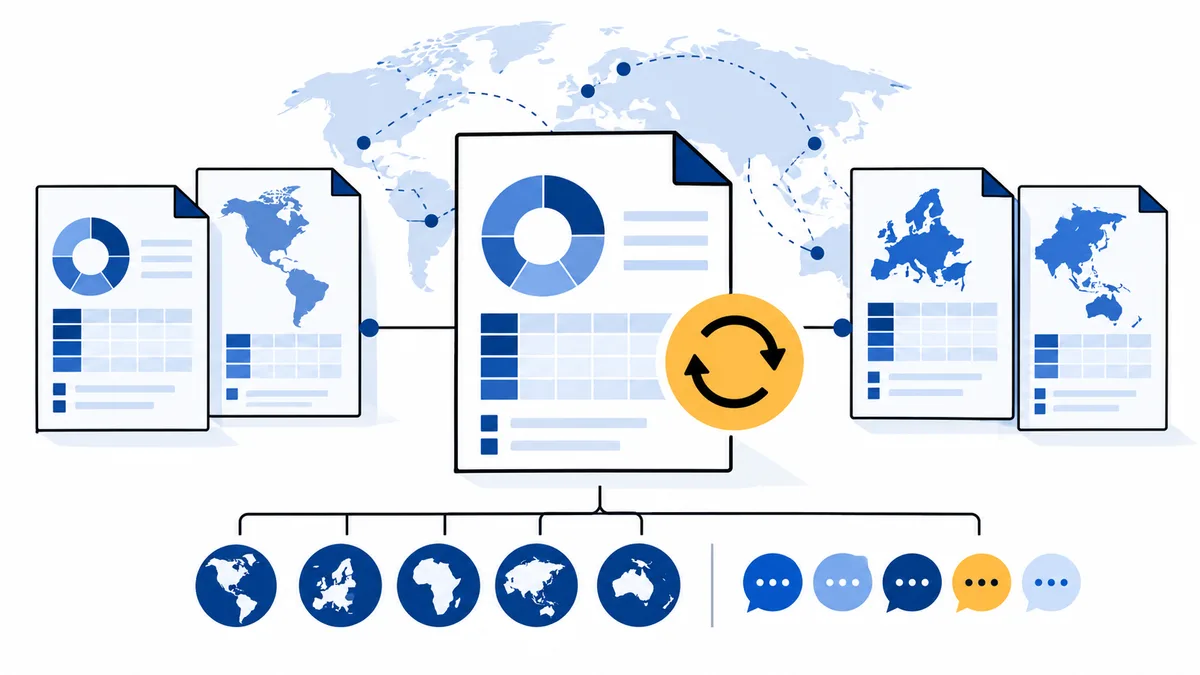
MHS describes EQ-i 2.0 Updated Norms as a parallel version. It refreshes listed norm groups for Global professional, US/Canada, and UK/Ireland, and currently includes Workplace and Leadership reports in two English variants. The broader EQ-i 2.0 catalog lists other regions, reports, and languages, but does not establish their availability in Updated Norms. Confirm the version, norm group, report, language, and required features before ordering.
Why the release is a parallel version, not a universal upgrade
An administrator choosing between EQ-i 2.0 and EQ-i 2.0 Updated Norms needs to know which comparison and report the assessment will produce. MHS says the updated release does not replace the existing version; its storefront advises selecting it when assessing people in regions aligned with the refreshed norm groups. So the answer is not simply “the norms are newer.” The new version has a defined regional scope and different included products and features. Whether it fits depends on those details. A norm group is the reference population against which a result is interpreted. The norm region identifies the regional reference context, while the norm type identifies the comparison population, such as general population or professional. Naming a country alone may not specify which comparison is intended, and “updated” does not name the report or language delivered. MHS’s “Comparison of EQ-i 2.0 and EQ-i 2.0 Updated Norms Version” guide lays out norm changes alongside language, report, and feature differences. A refreshed norm group may be relevant while a required report or language remains outside the new version. The wider EQ-i 2.0 catalog lists products and languages that the specific release notice says are not available in Updated Norms; family-level listings should not be read as version-specific availability. Before discussing a result, confirm the exact version and norm comparison named for the assessment. Then check that the requested report and language are included. This fit check is more useful than treating release date as a quality verdict: the publisher’s descriptions establish what changed and what is offered, not that one version is universally preferable. Availability statements reflect MHS’s pages as accessed October 7, 2026.
Sources: EQ-i 2.0® - Multi-Health Systems (MHS), storefront release page; The EQ-i 2.0® Updated Norms includes, MHS reference guide
Which norm groups changed, and what does 'updated' mean here?
The 2026 EQ-i 2.0 Updated Norms guide lists five refreshed comparison groups: Global professional; US/Canada general population and professional; and UK/Ireland general population and professional. In these three regional entries, the release removes age-and-gender norm options. MHS reports the sizes of the refreshed groups, but the change described is a change in the reference comparisons available to administrators. Those counts and labels alone do not show that a result is more valid, nor do they establish how a score from this version compares with one from the earlier EQ-i 2.0. A norm group is the reference set against which an assessment score is compared. It gives a score a relative context: the question is how the reported result sits beside results from a specified group, not what the score means in isolation. A norm region identifies the geographic grouping used for that reference. Within a region, the norm type identifies the comparison population. The MHS portal help page, “Choosing a norm type,” distinguishes general-population norms from professional norms: one compares a client with the general-population reference group, the other with the professional reference group. Those comparisons answer different questions, even when they cover the same region. Selecting “US/Canada,” for example, does not by itself settle which of those two reference populations is intended. The release guide reports a Global professional sample of N=20,000. For US/Canada, it lists N=5,000 for general-population norms and N=4,000 for professional norms. For UK/Ireland, the reported counts are N=2,500 and N=4,000, respectively. These are the sample counts MHS publishes for the updated groups; N refers to cases in the norm sample, not the number of people who will take the assessment. A larger count can describe how many cases are in a reference sample; on its own, it cannot tell a reader who took part, how participants were recruited, or how well the group represents the people to whom a result will be compared. Nor does the count specify the score a particular person should receive. That depends on the assessment responses and the selected comparison, details the sample-size figure cannot substitute for. The guide’s table does not provide those details alongside the counts, so the numbers should not be treated as a complete evaluation of the norm groups. The older portal documentation helps clarify what has changed in the choice presented to an administrator. “Choosing a norm type” describes overall norms and age-and-gender-specific norms for the older version, with availability varying by region and by general-population or professional group. The Updated Norms guide says the age-and-gender options were removed for each of its three refreshed regions. It does not give a reason for removing them, so the change should be described without attributing a rationale to MHS. Nor should readers assume that another demographic adjustment has replaced those options; the cited release table does not say that. For an order or feedback discussion, “updated norms” is too broad to confirm the comparison being used. Ask for the exact region and norm type, then check whether the intended reference is general population or professional. If age-and-gender comparison is important to the purpose of the assessment, confirm directly with the administrator what the selected version offers; the Updated Norms guide does not list that choice in the refreshed regions. This matters because a score’s comparative meaning depends partly on the reference group named for it. The release materials establish which updated groups MHS lists and their stated sizes. They do not, by those facts alone, establish a universal improvement in measurement or a direct bridge between old and new scores.
Sources: The EQ-i 2.0® Updated Norms includes, MHS reference guide; Choosing a norm type
Which regions remain on the existing norm version?
The Updated Norms guide marks Australia, Denmark, the Netherlands, South Africa, and Sweden as “No update.” That label refers to the 2026 release’s norm refresh. It does not mean that MHS has no EQ-i 2.0 norms for those regions. On its current EQ-i 2.0 page, MHS still lists all five among the family’s region-specific norm groups. The two statements describe different layers of the catalog: one is a comparison between versions, the other a description of the broader assessment family.
The distinction matters because the Updated Norms guide places the older EQ-i 2.0 and Updated Norms in adjacent columns. For the five regions, “No update” appears in the new-version column; it is not a new norm option and does not move an existing regional norm into Updated Norms. MHS’s EQ-i 2.0 page, by contrast, answers which regional groups are listed for the product family. Reading the latter as a feature list for every version would erase the comparison the guide is making.
The guide’s table also separates region from norm type. A region identifies the reference context, while a norm type identifies the comparison population. MHS’s portal help, “Choosing a norm type,” describes general-population and professional comparisons and the older overall and age-and-gender choices. That helps explain why a region appearing in the family catalog does not tell an administrator which comparison is available in a particular version, report, or platform. The release table is the relevant source for whether that region’s norms were refreshed in Updated Norms; the broader page is useful for checking the family-level list. Neither should be made to answer the other question.
There is a second limit to the word “Global.” In the guide, Global is its own row and the Updated Norms entry is a professional norm. The document does not say that every person outside the named updated regions is best compared with that group. A global option is a listed reference category, not a blanket instruction for selecting a norm for any country. Nor does the family page establish that each regional norm continues unchanged in every report or administration route. Availability must be confirmed for the exact version being ordered.
For a respondent in Australia, Denmark, the Netherlands, South Africa, or Sweden, the practical question is therefore specific: which EQ-i 2.0 version and which currently available norm group will the administrator use? Ask for the version name and norm type, then confirm the region in that version’s current catalog. The broader product page is evidence that MHS lists region-specific norms in the family; it is not evidence that those norms were refreshed in Updated Norms. Selecting the newer label solely because a country appears on the general page confuses catalog coverage with release coverage.
Sources: The EQ-i 2.0® Updated Norms includes, MHS reference guide; EQ-i 2.0®; Choosing a norm type
Which reports and report languages can be ordered in this version?
For EQ-i 2.0 Updated Norms, MHS currently lists two individual reports: Workplace and Leadership. Each is available in English (North America) and English (United Kingdom), according to the Updated Norms comparison guide. The storefront describes these as English (US) and English (UK). Both sources therefore point to two English report variants, though their North American labels differ slightly. Confirm the exact report label with the administrator when placing an order. The release notice says this version does not include EQ 360, the Group Report, scored datasets, paper forms, or the EQ-i 2.0 Workbook and Emotionally Effective Leader Workshop. The guide also says translations and the ability to import EQ-i 2.0 results into EQ 360 are not currently included. Its first-page note says additional languages, norms, and functions may be added over time; that is a statement of planned expansion, not a date or a present availability guarantee. The broader MHS EQ-i 2.0 catalog answers a different question: what the product family offers across versions. Its general product page lists Workplace, Leadership, Group, Higher Education, and two EQ 360 reports. The same page lists twelve assessment languages, including Arabic, French, German, Spanish, and Simplified Chinese, as well as English variants. Those entries establish family-level listings only. They do not show that a translated assessment produces a translated Updated Norms report, or that a report listed for the family can be ordered with the refreshed norms. In fact, the release guide’s version-by-version table gives the Updated Norms report column only the two English variants for Workplace and Leadership. It lists a larger set of languages in the existing EQ-i 2.0 column, so combining the columns would wrongly make the new version appear to have those translations. These catalog dimensions answer separate questions. Assessment language concerns the language in which the respondent completes the assessment. Report language concerns the language of the resulting document. Norm region identifies the reference context used for comparison; the product version determines which features and combinations are currently offered. Availability in one dimension cannot be carried across the others by inference. For example, seeing French in MHS’s general assessment-language list does not establish that a French Workplace report using Updated Norms can be ordered. The guide explicitly says translations are not currently included in this version, while its table specifies the English report variants. That distinction matters most when a request depends on a report outside the two named options, feedback from multiple raters, a group summary, a scored dataset, paper administration, or a companion resource. The release notice identifies these exclusions for Updated Norms; MHS’s general catalog describes some of the same products as part of the wider family. Neither page says that choosing Updated Norms automatically provides the broader catalog. Ask the administrator or MHS to confirm the exact version, report title, and language that will be delivered before ordering. If a non-English report, Group Report, or EQ 360 is essential, ask whether the existing EQ-i 2.0 version or another current option fits that requirement. This is a catalog-fit question, not a judgment that one version is better for every respondent.
Sources: EQ-i 2.0® - Multi-Health Systems (MHS), storefront release page; The EQ-i 2.0® Updated Norms includes, MHS reference guide; EQ-i 2.0®
What changed inside the assessment and reports?
The release guide describes changes to the assessment, its reports, and the materials around them. Some affect what a respondent sees; others change what an administrator can include in a report. MHS says the updated assessment contains 29 additional experimental items. The guide says those responses are not scored, do not appear in reports, and are not visible to administrators. It also says the items are included to inform possible future item updates. Optional research questions appear at the end and, according to the guide, do not affect the score. These descriptions tell an administrator what the publisher says happens to the responses; they do not provide a separate account of how the research data are governed.
The report changes are more immediately visible in a feedback session. In the Leadership Report, the Leadership Potential section is always on in Updated Norms; the older version allowed it to be switched on or off. The page on leading a multigenerational workforce now includes Generation Z. The guide also describes a larger set of comparisons in Balancing EI Subscales: three comparisons for each subscale in the Client report, where the older version had one. These are changes in report content and configuration. A reader who uses the Leadership Report should inspect its sample before ordering, especially if the Leadership Potential section will change how the feedback conversation is framed.
Score display is another practical change. In the older version, numerical scores and score ranges could be turned off. Updated Norms displays them with no option to turn them off, according to the guide. That setting matters for an administrator choosing a report for a particular feedback process: if the process depends on a narrative report without numerical results, the updated format may not fit. The guide does not describe this display change as a new scoring method, and it should not be read as evidence that a score has become more informative or precise.
Several changes affect report administration rather than the assessment itself. MHS says the Negative Impression Index was rarely flagged and has been removed from the coach report; the Honest Responding indicator appears under a new label, “Honest Responding Item.” The updated version also does not allow cover-page customization. The Action Plan, EI Development Commitment, Follow-up Questions, and Coach’s Guide to an EQ-i 2.0 Debrief pages have moved out of the report and are listed as separate resources on the Talent Assessment Portal. This means an administrator accustomed to a single report containing those pages should confirm how they will be accessed and used in the revised workflow.
The storefront and the reference guide give complementary checks. MHS’s EQ-i 2.0 release notice lists the Workplace and Leadership reports for Updated Norms, while the guide details changes within the Leadership Report and says certain report controls differ. The MHS Product Resource Center continues to show materials for several EQ-i 2.0 report families, but a resource listing alone does not establish that each item belongs to Updated Norms. For a concrete decision, inspect the sample report for the exact version and ask whether its score display, included sections, and separate coaching resources suit the intended session. The guide presents accessibility and interface redesign as release features; these descriptions document the publisher’s stated changes, not an independent evaluation of their effect.
Sources: The EQ-i 2.0® Updated Norms includes, MHS reference guide; EQ-i 2.0® - Multi-Health Systems (MHS), storefront release page; EQ-i 2.0 Product Resource Center
What can sample counts tell a reader—and what remains unknown?
A norm sample count tells you how many cases the publisher reports using to build a comparison group. MHS’s EQ-i 2.0 Updated Norms guide lists 20,000 cases for Global professional norms; 5,000 for US/Canada general-population norms; 4,000 for US/Canada professional norms; 2,500 for UK/Ireland general-population norms; and 4,000 for UK/Ireland professional norms. These figures describe the stated size of each reference sample. They do not tell a reader, by themselves, how closely those people resemble a particular respondent or whether the resulting score is more accurate.
The scale of the figures can be hard to interpret without the older figures beside them. MHS’s EQ-i 2.0 product page reports a legacy US/Canada general-population norm sample of 4,000 and a global professional sample of 10,000, which it says was updated in 2014. The new guide’s 20,000 Global professional cases are more numerous than that earlier figure, while its US/Canada general-population figure is 1,000 higher. Larger N can reduce sampling noise in some circumstances, but size alone cannot show whether recruitment reached the relevant population or whether one score scale can be translated onto another.
The materials opened for this comparison do not establish the sampling frame, response rate, weighting, or subgroup composition behind the updated counts. Nor do they provide results from a score-linking study demonstrating that old and updated scores can be treated as equivalent. The six-page Updated Norms guide presents a release comparison and product features; it is not, in the material available here, a full technical account of norm development. That is a limit of what these sources establish, not evidence that MHS has never documented the methods elsewhere. The product page makes a representativeness claim about the older US/Canada sample, but that statement does not answer the unanswered questions about the distinct updated groups.
One distinction matters whenever someone compares reports taken at different times. A person's score can change because their responses changed, because the comparison group changed, or because both changed. The available release guide gives updated sample counts and identifies which norm groups changed, but the counts do not separate those possibilities. A higher or lower result across versions therefore cannot, from these pages alone, be read as a measured change in the person's emotional skills.
MHS’s legacy Group Report help page concerns a separate report workflow, and Updated Norms explicitly excludes the Group Report. A group summary and an individual score-linking study answer different questions; the former would not demonstrate that scores from two versions are interchangeable. For this comparison, the relevant evidence would be documentation specific to score comparability, rather than a sample count or a feature from another report.
For a repeat assessment or a discussion of change, ask the qualified administrator to identify the version used for each report, the norm region and type selected, and any evidence supporting comparisons across those versions. If the purpose is to track a person's development, also ask whether both reports use the same scoring basis. Until that information is supplied, treat a difference as a reason to ask how the reports were produced, not as proof that the person improved or declined. The published N values are useful for describing the updated reference groups; the method and score-linking information determine what conclusions those groups can support.
Sources: The EQ-i 2.0® Updated Norms includes, MHS reference guide; EQ-i 2.0® - Multi-Health Systems (MHS), storefront release page; Choosing a norm region (Group Report); EQ-i 2.0 Manual
How should you compare versions before an assessment is ordered?
Use a requirement match before ordering: Updated Norms fits when its refreshed norm region and norm type, available report, English variant, and report settings meet the purpose. If one requirement falls outside that set, ask what the existing EQ-i 2.0 version or another current option can supply. This is a catalog-fit judgment, not a claim that one version measures emotional intelligence more accurately. Start with the comparison that governs the rest: which reference group will frame the result? The MHS guide names the regions and norm types refreshed in Updated Norms, while its wider catalog covers different combinations. A region identifies the reference context; the norm type identifies the comparison population. Confirm both in the order record. If the person’s region is marked “No update,” ask which current norm group the administrator intends to use and whether it belongs to Updated Norms or the existing version. Do not infer that a general family catalog entry has been carried into the new release. The guide presents two versions that can coexist, so “newest” alone does not settle the choice. Next, match the requested output to the version. The release notice on MHS’s EQ-i 2.0 storefront lists Workplace and Leadership reports for Updated Norms. It says EQ 360, the Group Report, scored datasets, paper forms, and named companion products are not included. MHS’s broader EQ-i 2.0 catalog lists additional report families. That list helps identify what to ask about, but does not establish that those reports are available with Updated Norms. If a project needs multi-rater feedback, group-level output, or a companion resource, confirm the exact version and deliverable before payment. Language needs the same check. The Updated Norms guide lists English (North America) and English (United Kingdom) for both Workplace and Leadership reports. The storefront describes the release as English US and UK, while its general catalog lists more assessment translations. These are separate facts: a translation shown for the product family does not prove that a translated Updated Norms report is available. Ask the administrator to name the report language, not simply confirm that the assessment can be administered in a language the participant understands. Check report settings as well as the title. The Updated Norms guide says numerical scores and score ranges appear with no option to turn them off. It also says the Leadership Potential section is always on in the Leadership Report, and Balancing EI Subscales has three comparisons for each subscale. Those details may matter to a feedback process that expects a different display or configuration. Ask for a current sample report and review its sections and score display before ordering; design changes are not evidence of better measurement. A repeat assessment needs one extra question. The MHS release guide and storefront describe refreshed norms and product differences, but their catalog comparison does not establish that scores from the two versions can be directly compared. A later score difference could reflect the person, the norm reference, or both. Before treating a difference as evidence of development, ask the qualified administrator which version and norm group were used each time, and what supports interpreting the scores together. Sample counts alone cannot answer that question. A short order check makes the decision concrete. Ask: “Which EQ-i 2.0 version will be administered? Which norm region and norm type will frame the result? Is the report Workplace or Leadership, and in which English variant? Does this version include the features and resources we need? If we are comparing with an earlier result, what supports that comparison?” For a region without refreshed norms, a non-English report, Group or EQ 360 output, or an unavailable display option, ask MHS or the administrator to identify a current alternative. Proceed once the version, comparison group, and deliverable are explicit.
Sources: EQ-i 2.0® - Multi-Health Systems (MHS), storefront release page; The EQ-i 2.0® Updated Norms includes, MHS reference guide; EQ-i 2.0®
What to confirm before choosing a report
Before ordering, ask the administrator to name version, norm region and type, report, language, and required features. MHS’s “EQ-i 2.0 Updated Norms” guide lists Workplace and Leadership reports in English (North America) and English (United Kingdom); its “EQ-i 2.0®” storefront release notice says the updated version does not include Group Report, EQ 360, scored datasets, paper forms, or companion products. The broader family catalog does not promise those options in Updated Norms. Confirm the specific combination in writing before purchase. A useful question is: “Which EQ-i 2.0 version and norm group will be used, and can you confirm the report language and required features in that version?” If this is a repeat assessment, add: “What evidence supports comparing this result with the earlier version?” MHS’s release pages do not establish direct comparability across versions. If the aim is personal reflection rather than choosing an EQ-i 2.0 norm product, EQ Test’s separate 32-item Emotional Skills Profile supports private reflection and practical development priorities. It is an educational tool without validated norms or established ability-test validity, and it cannot answer questions about MHS availability or score comparability. Explore it when that is the need; otherwise, let the administrator’s version and feature confirmation settle the order.
Sources: EQ-i 2.0® - Multi-Health Systems (MHS), storefront release page; The EQ-i 2.0® Updated Norms includes, MHS reference guide
Questions readers ask
Which reports are included in EQ-i 2.0 Updated Norms?
MHS currently lists Workplace and Leadership reports, each in English (North America) and English (United Kingdom). The release notice excludes EQ 360, Group Report, scored datasets, paper forms, and named companion products.
Can EQ-i 2.0 and Updated Norms scores be compared directly?
The release guide and storefront do not establish direct score comparability across versions. For a repeat assessment, ask which version and norm group were used for each report and what evidence supports interpreting the results together.
Sources
- EQ-i 2.0® - Multi-Health Systems (MHS), storefront release page
MHS describes Updated Norms as an additional version and lists its included reports, language variants, excluded products, and legacy norm sample counts.
- The EQ-i 2.0® Updated Norms includes, MHS reference guide
The guide lists refreshed norm groups and sample counts, report and language availability, and assessment and report changes.
- Choosing a norm type
MHS portal help distinguishes general-population and professional comparisons and describes older norm options.
- EQ-i 2.0®
MHS's family-level catalog lists a wider set of regions, reports, and assessment languages than the Updated Norms release.
- Choosing a norm region (Group Report)
Legacy Group Report help describes its workflow and interpretation considerations; it does not establish Updated Norms score equivalence.
- EQ-i 2.0 Manual
The manual is an EQ-i 2.0 reference; the cited release materials do not establish cross-version score linking.
- EQ-i 2.0 Product Resource Center
MHS's resource center lists materials for multiple EQ-i 2.0 product families, which does not establish their inclusion in Updated Norms.
Apply it to the real situation
Turn reflection into a practical emotional-skill next step
From this guide: If your goal is to reflect on your own emotional habits rather than choose an EQ-i 2.0 norm product, use a separate tool designed for personal development.
The EQ-i 2.0 release guide helps clarify which version, norm group, and report an administrator can provide. For personal reflection, EQ Test’s private 32-item Emotional Skills Profile offers practical development priorities. It is an educational reflection tool without validated norms or established ability-test validity, so it does not answer MHS catalog or score-comparability questions.