
When team friction may stem from workload or role design, trace capacity, priorities, ownership, authority, and handoffs first. If a specific behavior remains consequential under workable conditions, a person may choose a suitable EQ method for private reflection. An EQ result cannot identify the cause of a work-design problem.
What can the same tense exchange tell you about the work?
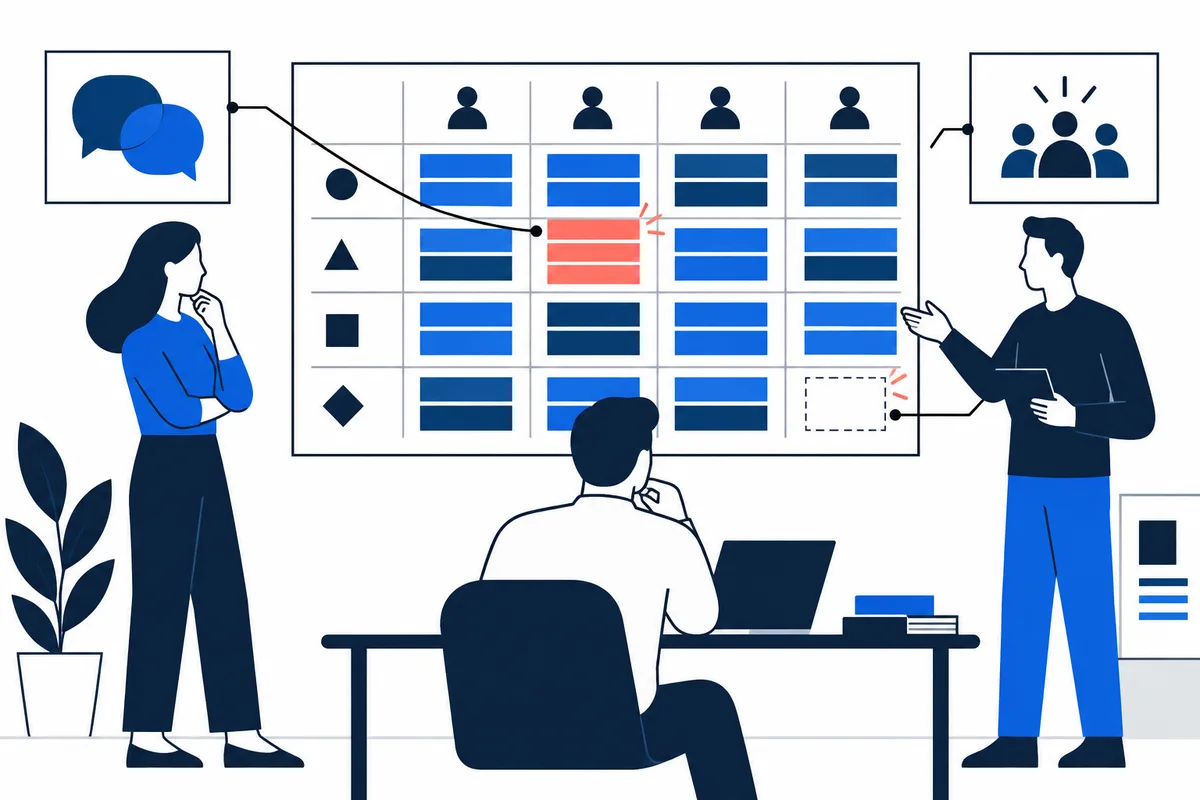
Illustration: an approval sits unanswered as a deadline approaches. One colleague asks for a decision; another replies sharply that the request arrived too late. The exchange is observable. Its cause is not yet clear. Perhaps the approver ignored a known responsibility; perhaps nobody had been named to approve; perhaps a late priority change left too little time, or the workload made the handoff easy to miss. The tense reply matters, but it cannot by itself distinguish among those explanations.
That distinction matters when a leader is considering an EQ assessment. Seeing frustration, silence, or a blunt response does not establish that an individual lacks emotional skill. Nor does a strained workflow prove that conduct had no effect. The same scene can contain both a design problem and behavior that colleagues experience as harmful. Keep the observation close to what happened, and treat the explanation as a question to investigate.
In “Psychosocial Hazards,” the National Institute for Occupational Safety and Health identifies factors such as work overload, inadequate staffing or scheduling, lack of control, and role ambiguity as work-organization hazards associated with stress, strain, or interpersonal problems. That guidance makes work conditions relevant possibilities; it does not show that any one of them caused a particular tense exchange. A leader should therefore inspect the conditions around the interaction while still being specific about the conduct and its effect.
A useful sequence is to establish what work failed, inspect the conditions and decision rights around it, and map who owned each task and handoff. Then consider what the available evidence can and cannot say about behavior. Only after that should a leader ask whether individual reflection on a specific emotional habit would help. The question is not whether the scene was emotional; it is which part of the problem an EQ measure could actually illuminate. This order keeps a score from becoming a substitute for understanding the work.
Repeated harmful conduct still deserves attention when workload or authority is unclear. A colleague who is repeatedly interrupted, blamed, or denied information can be harmed regardless of why the workflow is strained. Naming a possible structural contribution should sharpen the inquiry, not excuse the behavior or erase its consequences.
Sources: Psychosocial Hazards
What exactly is failing in the work?
Before calling a problem poor communication, name the work outcome that failed. Was a decision late? Did a task return for correction? Did a handoff have no clear recipient? Did a new priority displace work already promised? Those are different descriptions of a process. “People are not communicating” is an interpretation that may fit, but it does not yet tell a leader where to look or what to change.
A practical trace follows one piece of work from request to consequence. Record, in plain language, when it arrived, what information came with it, who was expected to act next, what decision or input was needed, and where progress stopped or changed direction. Note when ownership moved and whether the next person knew the work had arrived. The point is not to build a universal scorecard. It is to make one local failure concrete enough that people can discuss the same sequence rather than defend competing labels. Keep the notes factual, brief, and tied to this instance.
Consider an explicitly illustrative case: an approval is delayed after a priority change. Start with the sequence. A request reaches an approver; another task is then made urgent; the approval waits; the dependent work cannot proceed on its original schedule. Ask who changed the priority, whether that person could make the tradeoff, who owned the approval, and what the requester knew about the new order of work. These questions describe the arrangement and information available at the time, without assuming that anyone intended to obstruct the task.
Next locate the cost in the work itself. Did the delay leave another task waiting, require someone to repeat a handoff, or force a decision to be revisited? Did the priority change replace a different commitment, and was that consequence visible to the person making the change? A leader can distinguish a delay caused by waiting for authority from a delay caused by missing information or competing demand. The distinction may remain uncertain, but naming it tells the next conversation what needs clarification.
Use the trace to choose a precise follow-up: clarify who owns the approval, establish how changed priorities reach affected people, or identify which commitment should move when a new urgent task arrives. Ask people involved to correct the sequence if it is incomplete. That is a practical inquiry, not a formal measurement method, and it does not make the first account automatically accurate. Its value is narrower: it replaces a broad character judgment with a checkable question about a particular piece of work.
A workflow trace also has a boundary. It can show where a task waited or changed hands while missing how someone raised a blocker, dismissed a request, or responded to a colleague. Those actions can affect whether a handoff succeeds, even when the process is poorly designed. Keep the conduct question available, but make it specific: what was said or done, in which exchange, and with what effect? A clearer sequence does not settle the interpersonal explanation; it gives that explanation a more useful place to begin.
How do you map a role before naming a skill gap?
Start with the work that must be done, then ask what capability it requires. The U.S. Office of Personnel Management’s “Job Analysis” guidance links tasks to the competencies needed to perform them and notes that job-analysis information can inform training needs. For a leader investigating a stalled handoff, that linkage offers a useful order: define the task and its expected result; identify who owns each decision and what authority comes with that responsibility; then ask whether the person needs a skill to carry out an otherwise workable assignment. A general label such as “needs better communication” skips the steps that would show what communication the role actually requires.
A short work map can make those steps visible. For one consequential task, write down the expected output, the person accountable for moving it forward, who may approve or change it, what inputs must arrive first, the handoff condition that signals the next person can act, and the deadline. Add the priority authority: who can change the order of work, and how that decision reaches the people whose commitments move. Finally, record what gets displaced when this task is treated as urgent. The map is a leader’s diagnostic aid, not a formal or validated job analysis. Its purpose is to expose unanswered design questions before someone converts a missed expectation into a personal deficit.
Imagine a report depends on a data extract, a review, and a final approval. If the reviewer owns quality but cannot obtain the data, the immediate issue is an input dependency. If two managers each believe they can set the deadline, the task has competing priority authority. If everyone agrees who approves the report but the approver is carrying more urgent work than can fit, clear ownership has not created capacity. These cases may produce the same visible delay; they call for different questions. A needed skill is plausible when the expected task, required inputs, authority, and time are sufficiently clear, yet the person still needs instruction or practice to perform it. When ownership conflicts, a prerequisite is absent, or the deadline exceeds available capacity, the task arrangement needs attention before training is named as the answer.
This distinction also protects the meaning of an EQ question. A leader can describe an observable behavior in a defined task—for example, whether a person raises a dependency before a handoff deadline—and ask whether that behavior is something the person wants to develop. But a reflection about emotional habits cannot decide who owns the approval, supply missing information, or grant authority to reset priorities. OPM’s task-to-competency linkage is guidance for making the work requirement explicit; it is not an endorsement of using an EQ measure to select, rank, or diagnose workers. Keep the work map and any individual development question separate, so a personal practice goal does not silently become a remedy for a structural gap.
A paper map is only a starting point. Check it against how requests actually arrive, which interruptions change the plan, and whether the person named as owner can act when the decision is due. Ask what was waiting and what was pushed aside on the relevant occasion. A role may appear clear in a procedure while day-to-day priorities collide or the authority to resolve them sits elsewhere. If the map exposes that mismatch, clarifying the sequence or decision right is a more direct next question than assigning an emotional-skill label. If the arrangement holds up and a specific behavior remains consequential, the leader has a more precise basis for a separate conversation about development.
Sources: Job Analysis
Why team-level research does not identify your team's cause
Evidence about groups can tell a leader which work conditions deserve attention; it cannot name the cause of one team’s missed handoff. “Beyond the Individual: A Systematic Review of the Effects of Unit-Level Demands and Resources on Employee Productivity, Health, and Well-Being” examined 202 papers published through December 2018. Its abstract reports an uneven pattern: support was stronger for beneficial relationships between shared, supraindividual job resources and productivity or work-related well-being than for harmful relationships between unit-level demands and those outcomes. Most reported links between unit-level conditions and health were nonsignificant. The review therefore gives a more qualified picture than the broad claim that team workload reliably produces poor health or interpersonal failure.
The asymmetry matters when a leader moves from general research to a local explanation. Findings about shared resources can make it reasonable to inspect whether a group has what it needs to do the work. Weaker support for unit-level demands as a source of detrimental productivity or well-being outcomes means the review does not establish the opposite causal story either: that a demanding workload explains this particular conflict. A team-level association summarizes patterns across studies and settings. It does not identify whether one incident began with too much work, unclear authority, a missing input, a behavior during disagreement, or several of these together.
The review’s scope also sets a boundary on what can be carried into a workplace conversation. Its evidence was searched through December 2018, and the accessible abstract supports the review-level pattern, not a detailed account of every included sample or mechanism. A leader should not turn the 202-paper count into a claim about the size of an effect, the prevalence of a problem in a particular occupation, or the success of a proposed redesign. Nor do mostly nonsignificant health relationships establish that work conditions never matter. They mean the reviewed evidence did not consistently show those links at the unit level. The conclusion belongs at that level of generality.
For a concrete case, suppose an approval was late and the exchange around it became tense. The review supplies a reason to examine the arrangement of shared work, especially what resources and support were available, but it cannot determine whether overload or role ambiguity contributed to that event. That is a local hypothesis. Test it with the sequence of requests, decisions, dependencies, and priority changes already relevant to the task, alongside accounts from the people involved. If those sources show a plausible work-design problem, it becomes a grounded question for the leader to address; if they point elsewhere, the broad literature should not override them.
This is why group evidence and individual reflection answer different questions. A review can inform what conditions are worth checking across a team. It cannot tell whether one person’s emotional habits caused a breakdown, and a private EQ result cannot fill that gap by identifying the team’s cause. Keep the broader evidence as context for inquiry, then let local workflow records and participant accounts shape the explanation of the incident. Any resulting judgment remains provisional until it fits the actual task and the way work arrived.
What should change before you reconsider the diagnosis?
Make one bounded adjustment that follows from the work map, then review the signal that the adjustment was meant to affect. If approval waits because nobody knows who can decide, clarify the decision right and name the owner. If two urgent requests compete for the same capacity, make the priority tradeoff explicit and tell affected people what moves. If a handoff repeatedly stalls because a required input is missing, assign responsibility for supplying it and define when it must arrive. Each change addresses a different bottleneck; changing all three at once would make the next account harder to interpret.
The choice should be narrow enough that employees can describe what is supposed to become easier in the work. A clearer approval owner should reduce uncertainty about where a request goes. A priority rule should make it possible to know which commitment yields when new work arrives. A named input owner should make missing information visible before the dependent task is due. These are expectations about process, not promises of improvement. If the work map does not support one explanation more than another, the leader can first clarify the unresolved responsibility or dependency rather than treating a guess as a diagnosis.
The U.S. Office of Personnel Management’s “Assessment Strategy” guidance says assessment content should connect to critical competencies identified through job analysis. That is a useful alignment principle here: first specify the work requirement, then choose an action that actually addresses it. OPM’s guidance concerns assessment strategy and personnel applications; it does not establish that a local work redesign will succeed. In this article, the proposed adjustment is an applied judgment based on the observed bottleneck, not an intervention result reported by OPM.
Before making the change, state what trace would help you review it. For a clarified approval right, note whether requests still wait without a known decision owner. For a priority rule, check whether displaced commitments are communicated and whether the same collision returns. For an input handoff, look for repeated returns because the required material was absent. The relevant signal depends on the change: counting every delay would blur different causes, while an arbitrary target such as a fixed percentage reduction would imply a precision the local evidence does not provide. Use the signal to ask what happened in the work, not to grade a person.
Then ask the people affected what became easier or harder. Someone whose approval path is clearer may still face an unworkable volume of requests; a new priority rule may move interruptions onto a colleague with less authority; a handoff fix may create extra work for the person supplying the input. Those accounts add detail about how the adjustment landed and whether the burden shifted. They should be considered alongside the process signal, because a cleaner log can miss a cost that employees experience, while a person's account alone may not show how often the workflow event occurred.
A change and a later improvement can occur together without the change being the reason. Demand may fall, staffing may change, or the timing of work may be different. Review the specific signal and accounts for evidence that fits the expected mechanism, and record what else changed during the period. If the signal improves but employees report a new bottleneck, the adjustment needs another look. If neither changes, revisit whether the original bottleneck was identified correctly. This review helps refine the work arrangement; it does not turn a local observation into proof of causality or a verdict about anyone’s EQ.
Sources: Assessment Strategy
Which EQ method could answer a remaining behavior question?
If the work arrangement is clearer and a particular behavior still matters, choose evidence that corresponds to that behavior question. A self-report asks what someone believes about their own habits or typical responses. A performance task examines how they answer emotional problems under a specified scoring model. An observer report records how behavior appears to other people in a setting they share. These approaches can all concern emotional intelligence, but they do not produce interchangeable versions of one universal EQ number.
Suppose the development question is whether someone usually pauses before answering during disagreement. A self-report can prompt reflection on whether that is how the person sees their own habit; it cannot establish that they do so in every live exchange. A performance measure poses emotional problems and evaluates responses according to its scoring approach. It addresses performance on those tasks, which is different from a claim about the person's usual conduct in a meeting. Neither target, by itself, identifies whether a delayed handoff came from role design or competing work.
A different question might concern a specific handoff: do colleagues experience requests as clear, timely, and open to clarification? An observer report can collect accounts from people who encounter the behavior in that work context. As “Choices and Challenges in Measuring Emotional Intelligence in the Workplace” explains, observer approaches are aimed at competencies as used in daily life, while self-report and ability testing have different strengths and trade-offs. That workplace framework helps match a method to a purpose; it does not establish that observer ratings are neutral or that one method is generally superior.
Observer feedback is situated evidence. A colleague sees only some interactions and interprets them through the role, expectations, and pressures of that setting. Several colleagues may share a perspective because they work on the same handoff, or disagree because they encounter different parts of the process. Their reports can point to a behavior worth discussing, but they are not objective ground truth about a person's emotional capacity. Ask what event or pattern each account refers to, and keep the description tied to observable conduct rather than converting a rating into a broad label.
The distinction matters when a leader is tempted to use a single score to settle a work disagreement. A person’s self-rating might show confidence in listening, while a coworker’s account points to a missed acknowledgment during a particular handoff. Those statements need not conflict: one concerns the person’s general self-view, the other a colleague’s experience in a specific exchange. A performance-task result would address a third question, shaped by the task and its scoring model. First ask which of these observations is relevant to the development goal; only then decide whether another source of information would clarify it.
The method should follow the intended use. For private development, self-report may help someone notice a habit they want to examine and choose a practice question. A performance task is relevant when the question concerns responses to emotional problems under its scoring rules. Observer feedback may be useful when the person wants to understand how a repeated action is experienced in a shared setting. Elfenbein’s article sets out these workplace measurement trade-offs; it is a review and interpretation of approaches, not a head-to-head result showing which one best predicts success in a particular job.
Sometimes these perspectives disagree: a person may report pausing during conflict while a coworker describes interruptions, or a task response may differ from both accounts. That gap can be a useful subject for a voluntary development conversation, but it does not prove dishonesty or incompetence. The measures may refer to different situations and targets. Before adding another instrument, name the uncertainty it could resolve and who will use the information. Combining methods takes time and can add little if each one merely repeats the same broad judgment; it is most defensible when the difference between self-perception, task performance, and observed behavior is itself the question.
Sources: Choices and Challenges in Measuring Emotional Intelligence in the Workplace

Why an EQ result cannot stand in for observed behavior
A useful test of whether two EQ measures can be substituted for each other comes from “The Assessment of Emotional Intelligence: A Comparison of Performance-Based and Self-Report Methodologies.” In a diverse community sample of 223 people, Goldenberg, Matheson, and Mantler compared the Mayer-Salovey-Caruso Emotional Intelligence Test (MSCEIT), a performance-based measure, with the Schutte self-report scale. The PubMed abstract reports that the two scores were unrelated in this sample. That is a concrete warning against assuming that a person’s account of their usual emotional habits and their performance on emotion problems are simply two readings of the same quantity.
The association patterns also differed. The study’s abstract reports that Schutte self-report scores showed consistent associations with self-reported coping and depressive affect, while MSCEIT scores showed stronger associations with age, education, and receipt of psychotherapy. These are relationships reported for those measures in that sample; they do not establish that one instrument caused a life outcome, or that the named background factors explain an individual’s score. They show why interpreting “EQ” without naming the method can conceal what evidence a number represents.
The result has a narrow reach. It comes from one community sample and two particular instruments, so it cannot establish that every self-report and performance measure will be unrelated. The measures may diverge because they operationalize emotional intelligence differently: one asks for self-judgment about typical responses, while the other scores responses to emotional problems under its own method. A lack of correlation therefore does not make either measure useless, show that emotional skills cannot develop, or prove that a respondent is misrepresenting themselves. The study tests interchangeability between these scores; it does not test whether workload, role ambiguity, or a specific handoff caused a team problem. The pattern also shows why a correlation with a related self-report should not be silently translated into evidence about conduct that colleagues witnessed. The study did not compare either score with a record of how participants handled a real workplace disagreement, nor did it examine a leader’s explanation for a delayed task. Even when a measure relates to another outcome, the association answers only that comparison in the study; it does not supply the missing observation in a particular workplace.
For a leader, the practical question should come before the number: what behavior is at issue, in which situation, and what decision would this evidence inform? If the concern is an interruption during a particular disagreement, describe that exchange and its effect before comparing a self-report with a performance result. The scores may differ because their questions differ, while both can still be accurate descriptions of their respective targets. If the concern is a late approval, neither score identifies who had authority, what work was competing, or which input was missing. A score cannot replace the work evidence needed to examine those conditions.
This keeps disagreement informative without turning it into a character verdict. A gap between measures can prompt a closer look at what each instrument asked and what the person wants to understand; it is not proof of dishonesty or dysfunction. The study’s contribution is a specific empirical example of why a result must stay attached to its measure and question. The leader still has to define the observed behavior and setting, and investigate the work sequence on its own evidence.
Where does the 32-item Emotional Skills Profile fit?
For an individual who wants to reflect on their own work habits after a specific behavior question has emerged, the current EQ Test product is the private 32-item Emotional Skills Profile. Its questions concern recent behavior and emotional situations across recognition, understanding, regulation, and responding to others. It offers separate summaries: one about reported habits and another about judgments on authored scenarios. These views can help a person name an area to examine and choose a practice question that feels relevant to their work.
The two summaries answer different reflective prompts. A recent-behavior summary gives the individual a structured way to consider how they say they tend to respond; it is not an observation of every meeting or handoff. A scenario summary reflects how they judge authored situations; it is not an established ability test, and should not be read as a direct measure of maximum emotional ability. Keeping the summaries distinct prevents a scenario judgment from being treated as confirmation of a reported habit, or either one as proof of what happened in a team interaction.
Those areas make the reflection more specific than a general question about being “good with people.” Someone considering a tense handoff might ask what emotional cue they noticed, how they understood the exchange, what helped them regulate their first response, or how they responded to the other person. These are prompts for examining a personal pattern, not findings that the profile has observed a handoff. A person can take one prompt into a future conversation and decide what they want to try; the article should not imply that completing the questions itself changes behavior or that every reader needs the same practice.
The product is an optional personal development route, not a team diagnostic. It does not measure workload, establish whether role design caused conflict, or determine who should change a work process. The profile has no validated population norms or established ability-test validity, so its summaries should not be interpreted as standardized comparisons or an estimate of where someone ranks. Those questions call for the workflow evidence and documented methods suited to them; the profile can instead support an individual’s reflection on emotional habits and situations they may want to handle differently. Keeping that next step self-directed also leaves process decisions with the people responsible for the work.
Privacy is part of that use: an individual may choose to complete the profile for their own reflection, and a leader need not collect or inspect the answers to clarify ownership, capacity, or decision rights. If someone wants a structured prompt for considering their own behavior and possible next practice, they can explore the Emotional Skills Profile at [/assessment](/assessment). The value is a more focused self-reflection starting point; whether a behavior changes depends on the person’s choices and the conditions in which they work.
Sources: EQ Test Emotional Skills Profile assessment

Choose the next step that matches the evidence
Start with one failure in the work: a delayed approval, a returned handoff, or a priority that displaced an agreed task. Trace what happened around it. Was the owner clear, was the needed input available, and could that person make the decision on time? Choose one adjustment that fits the answer, such as clarifying who approves the work or agreeing how a new urgent request changes existing priorities.
Keep the adjustment small enough to observe. Review the signal connected to it, such as whether the same handoff still waits, and ask the employees affected what changed in practice. Listen for whether the change removed the bottleneck or simply moved waiting to another role; that distinction matters when deciding whether the work arrangement is now workable. Keep that conclusion about the workflow. If a specific, unwanted behavior still recurs under workable conditions, the person involved can decide whether they want to practise a different response. The private Emotional Skills Profile at [/assessment](/assessment) offers an individual reflection starting point for that question; it does not decide what the team should change. Where a serious conduct or safety concern needs action, address it through the appropriate workplace process rather than an assessment.
Questions readers ask
Should leaders use an EQ assessment to diagnose a workload problem?
No. Examine workload, priorities, decision authority, role clarity, and handoffs directly. An EQ method may support private reflection on a specific behavior that remains relevant under workable conditions, but it cannot establish why a work-design problem occurred.
How can a leader tell whether team friction reflects workload or an EQ issue?
Trace the task: who owns it, who can decide, what inputs it needs, what other work competes for capacity, and where it waits or gets displaced. If a particular behavior remains consequential after the work conditions are workable, consider that behavior separately.
Which EQ assessment method could support workplace development?
Match the method to the question. Self-report prompts reflection on perceived or typical behavior; ability-oriented tasks assess responses to emotional problems under a stated scoring approach; observer reports describe conduct as experienced in a particular setting. They do not provide interchangeable versions of one universal EQ score.
Sources
- Psychosocial Hazards
NIOSH identifies overload, inadequate staffing or scheduling, lack of control, and role ambiguity as work-organization psychosocial hazards associated with stress, strain, or interpersonal problems; its page also reports a 2019 ANA nurse survey, which should be omitted unless nurse-specific prevalence is needed.
- Job Analysis
OPM describes job analysis as examining tasks, competencies needed for those tasks, and their connection; it says this information may inform training needs and other personnel practices.
- Beyond the Individual: A Systematic Review of the Effects of Unit-Level Demands and Resources on Employee Productivity, Health, and Well-Being
This systematic review included 202 papers through December 2018 and found stronger support for beneficial relationships between supraindividual job resources and productivity/work-related well-being than for detrimental relationships between unit-level demands and those outcomes; most health relationships were nonsignificant.
- Emotional Intelligence Tests
OPM distinguishes ability-oriented EI tasks scored against expert or consensus responses from self-report, which is appropriate when the target is self-perceived competence or self-image but does not directly establish ability.
- The Assessment of Emotional Intelligence: A Comparison of Performance-Based and Self-Report Methodologies
In a diverse community sample of 223, the study compared MSCEIT performance-based testing with the Schutte self-report scale; the two measures were unrelated, and their reported associations differed. This shows that the two named measures should not be treated as interchangeable, not that all EI measures are unrelated.
- Choices and Challenges in Measuring Emotional Intelligence in the Workplace
This peer-reviewed workplace measurement article organizes EI measures as self-report, ability testing, and observer report, describes distinct strengths and trade-offs, and argues method should match purpose; it characterizes self-report as useful for developmental reflection and observer reports as reports of competencies in daily use.
- Assessment Strategy
OPM says assessment strategy should start from critical competencies identified through job analysis and that assessment content should connect to job requirements; this supports matching an assessment to a defined question, not using an EQ profile to diagnose work design.
- EQ Test Emotional Skills Profile assessment
The assigned publication's current product is a private 32-item Emotional Skills Profile for individual reflection, with recent-behavior summaries kept distinct from authored scenario judgments; publication guidance states it has no validated population norms or established ability-test validity.
Apply it to the real situation
Choose one emotional habit to practise at work
From this guide: Once workload and role conditions are clear, a person may still want to examine how they respond during a specific disagreement, handoff, or feedback conversation.
The Emotional Skills Profile offers an individual way to reflect on emotional habits and authored scenarios, then choose a behavior to practise. It does not explain a team's workload or determine why a conflict occurred. If you want a structured starting point for your own reflection, explore the profile and decide which behavior you would like to examine.