
Yes. An EQ assessment can support leadership development by prompting someone to examine a possible emotional habit, choose one behavior to practice in a recurring work situation, and review what happens. Research finds associations between emotional intelligence and leadership outcomes, but measures and contexts vary. Those associations do not establish that a particular assessment predicts an individual’s future leadership success.
Can EQ assessment support leadership development?
A leadership assessment can leave a person with a tempting question: does this result mean I will be good at leading? It cannot answer that. An EQ result can support development when it helps someone notice a possible emotional habit and decide what to examine in a real work situation. Its value is a more focused question about behavior, not a forecast of future leadership success.
That distinction matters because development and prediction ask different things. Development asks what a person might learn or practice: for instance, whether they can pause before replying to challenging feedback, or check what a colleague understood after a tense exchange. Prediction asks whether a score can tell us how effectively that person will lead in the future. A prompt for practice needs to be specific enough to test in an interaction. A forecast would need evidence that the particular measure predicts a relevant future outcome for an individual. The first does not establish the second.
There is a positive research signal behind taking emotional skills seriously. The meta-analysis “Emotional Intelligence and Leadership Effectiveness: A Meta-Analysis” combined 98 papers, 110 effect sizes, and 27,330 participants. Across those studies, emotional intelligence and leadership effectiveness had a moderate positive association (r = 0.39). In plain terms, studies tended to find that higher measured emotional intelligence went with higher measured leadership effectiveness. The authors also reported that the association varied by organizational context, leadership level, the emotional-intelligence model, the outcome measure, and whether researchers analyzed individuals or groups. Those differences matter when a reader tries to move from an overall pattern to one person's prospects.
The result can still be useful without carrying that heavier meaning. Treat it as a private lead: choose one recurring situation, identify one behavior to observe, and see what happens when you try a different response. The next question is why a group-level association, even a meaningful one, cannot by itself tell an individual whether they will succeed.
Sources: Emotional Intelligence and Leadership Effectiveness: A Meta-Analysis
Why does an association still fall short of a forecast?
EQ and leadership effectiveness are associated across studies, but an association describes patterns among groups; it does not show that a particular assessment can forecast one person's future success. In the 2018 meta-analysis, leaders with higher emotional intelligence tended, on average, to have higher leadership-effectiveness outcomes. That is a meaningful reason to take emotional behavior seriously in development. It is not a probability that an individual will succeed, or evidence that one assessment can sort future leaders from others. The included research varies in what it calls EQ, leadership effectiveness, and how each is measured.
The scale of the evidence is substantial for an association question. “The relationship between emotional intelligence and leadership effectiveness: A meta-analysis” combined 98 papers, 110 effect sizes, and 27,330 participants. Its pooled correlation was r = 0.39, which the authors described as moderate and positive. A correlation summarizes how two measured variables move together across the studies; it does not tell us that one caused the other. The result means that, across these samples and measures, higher leader-EQ scores generally coincided with more favorable leadership-effectiveness measures. It does not mean that 39 percent of leaders with high EQ succeed, that EQ accounts for 39 percent of a person's performance, or that raising a score would produce a corresponding change in effectiveness.
The meta-analysis also shows why the pooled number cannot travel unchanged into a personal forecast. The relationship differed by leadership level: associations were stronger for senior leaders than for middle and frontline leaders. It also differed across nonprofit and for-profit settings, and between the Eastern and Western cultural samples included in the review. Method mattered too. Mixed-model EQ measures had stronger associations with effectiveness than ability-model measures; correlations were larger when effectiveness was represented by objective indicators rather than subjective ratings; and the relationship was stronger at group level than individual level. These are not minor footnotes. They indicate that “EQ and leadership” does not name a single stable pairing whose value can be applied to any role, workplace, or person.
The group-to-person gap matters. A group-level relationship describes an overall pattern; an individual forecast asks whether a particular score identifies which person will later meet a defined standard. Those are different claims. The second would require evidence connecting the same instrument and scoring approach to a specified leadership outcome over time, in a relevant role and population, and showing how accurately it forecasts individuals. Neither the pooled correlation nor a broad claim that EQ matters supplies that evidence. This distinction does not make emotional skills irrelevant to leadership.
A 2025 review, “Emotional Intelligence and Leader Outcomes: A Comprehensive Review and Roadmap for Future Inquiry,” reaches a compatible conclusion from a wider map of leader outcomes. It systematically reviewed 101 empirical studies published from 1990 through 2021. Across them, leader EQ was positively associated with several outcomes, including leadership styles and behaviors, well-being, and performance. The review includes encouraging findings about task-related outcomes such as leader effectiveness, alongside relationships with more directly relational styles. Its authors explicitly state that the reviewed results do not establish causal relations. They also place the positive pattern within continuing debate about whether EQ is distinct from related ideas and whether the available measures validly capture it.
That review could not pool the studies into one common estimate: its authors report 35 different ways to measure EQ. They also note variation in how researchers define outcomes such as performance, with some studies reporting positive associations and others null findings. A broad synthesis can show that positive relationships recur across a field; it cannot make unlike measures interchangeable or resolve what one instrument predicts. The evidence supports a measured claim: EQ, as operationalized in this diverse research, is often related to leadership outcomes. It does not support the stronger claim that an assessment identifies an individual's leadership potential or forecasts later success.
There is a practical distinction between a capability being relevant and a score being predictive. Leaders may need to notice emotion, regulate a response, or understand another person's concern. Research linking EQ with leader behavior gives a reason to include such skills in reflection and practice. But self-described habits, performance on emotion tasks, and broad competency models capture different things. A correlation involving one measure does not automatically transfer to another test, role, or future decision; the assessment's own evidence would need to support that transfer.
For an individual, the appropriate conclusion is narrower and more useful. An EQ result can suggest a behavior worth examining, such as how someone responds when a colleague challenges a decision. The result cannot establish what will happen in that exchange, how others will respond, or whether the person will become an effective leader. Those questions require evidence from the work itself and a defined developmental aim. The research supports attention to emotional behavior; the forecast remains unearned until an instrument has been tested for that specific predictive purpose.
Sources: Emotional Intelligence and Leadership Effectiveness: A Meta-Analysis; Emotional Intelligence and Leader Outcomes: A Comprehensive Review and Roadmap for Future Inquiry
What can the assessment method tell you?
An EQ result is only as clear as the kind of evidence behind it. A self-report records how someone describes their usual emotional habits. An ability test samples how they handle emotion-related problems under test conditions. Observer feedback records behavior others say they have seen. These methods answer different questions, so their scores are not interchangeable readings of one universal EQ quantity. Before interpreting a result, name the method and ask what it was designed to capture.
That distinction matters when a report uses confident language. A self-report may say that someone usually notices frustration early or tends to pause before reacting. This is evidence about their perception of typical behavior. It can offer a useful question: What happens when a colleague challenges my proposal? Do I recognize irritation before I answer? It does not show how accurately they read another person’s emotion in a particular exchange, or how they would perform on a task with a correct answer. The 2025 review “Choices and Challenges in Measuring Emotional Intelligence in the Workplace” describes self-reported EI as closely related to confidence and motivation, and correlated with personality traits such as agreeableness. The review says it can still aid development, especially when compared with other measures to notice gaps in self-awareness. That preserves what self-report can offer without turning self-perception into demonstrated skill.
An ability measure presents emotion-related problems and assesses responses. In the same review, ability-tested EI is described as better able to distinguish EI from personality and related constructs. That helps when the question concerns performance on those tasks. The review also notes practical demands and difficulty defining the right answer for some problems. Even a well-designed task samples bounded performance: recognizing a pattern in a test item is not the same as listening during a tense project meeting, choosing what to say, and adapting to the response. A task result can add evidence about one kind of capacity without recording everyday leadership behavior. Moving from test performance to a broad workplace conclusion requires a relevant example from work itself.
Observer reports bring workplace behavior closer to view. A colleague, direct report, or supervisor may describe what they have seen: whether someone asks for another perspective, interrupts, names a concern, or follows up after a difficult exchange. This is a report from a particular vantage point, shaped by the situations that person witnessed. One observer may see formal meetings; another may work with the leader during handoffs or conflict. Accounts can differ because observers saw different behavior, because the behavior changed by setting, or because they interpreted the same exchange differently. Ask which concrete situations the ratings refer to.
The 2005 research report “Multi-Rater or 360-degree Emotional Intelligence Assessment” discusses a workplace instrument designed for development and studies using workplace samples. Its abstract says the studies examined consistency across rater forms, compared self-ratings with other-ratings, and explored how people rated themselves and others. The authors discuss the measure’s potential for leadership development. That makes self-other differences material for a specific conversation, not proof that one side is correct. The evidence concerns this paper’s instrument and studies; it does not establish that every 360-degree tool has the same properties or that a multi-rater score predicts leadership success.
Suppose a self-report suggests that a leader sees themself as open to disagreement, while a colleague describes meetings where objections receive little discussion. The discrepancy does not settle whether the leader is open-minded or dismissive. It prompts sharper questions: Which meeting, what objection, and what response did each person have in mind? A follow-up could examine whether the objection was restated accurately before a decision. That detail is more useful for development than averaging unlike sources into a single label. The accounts may also refer to different meetings or expectations about participation.
The practical comparison is about fit. Self-report can surface a perceived habit worth checking. An ability test shows performance on emotion-related tasks. Observer feedback points toward behavior visible in a work setting. A leader does not need every method before taking a next step; more measures do not automatically make a conclusion stronger. For private development, a self-report prompt can be enough to select one behavior to examine. When a broad claim rests on it, seek a concrete work example or a perspective from someone who observed the relevant interaction.
Sources: Choices and Challenges in Measuring Emotional Intelligence in the Workplace; Multi-Rater or 360-degree Emotional Intelligence Assessment
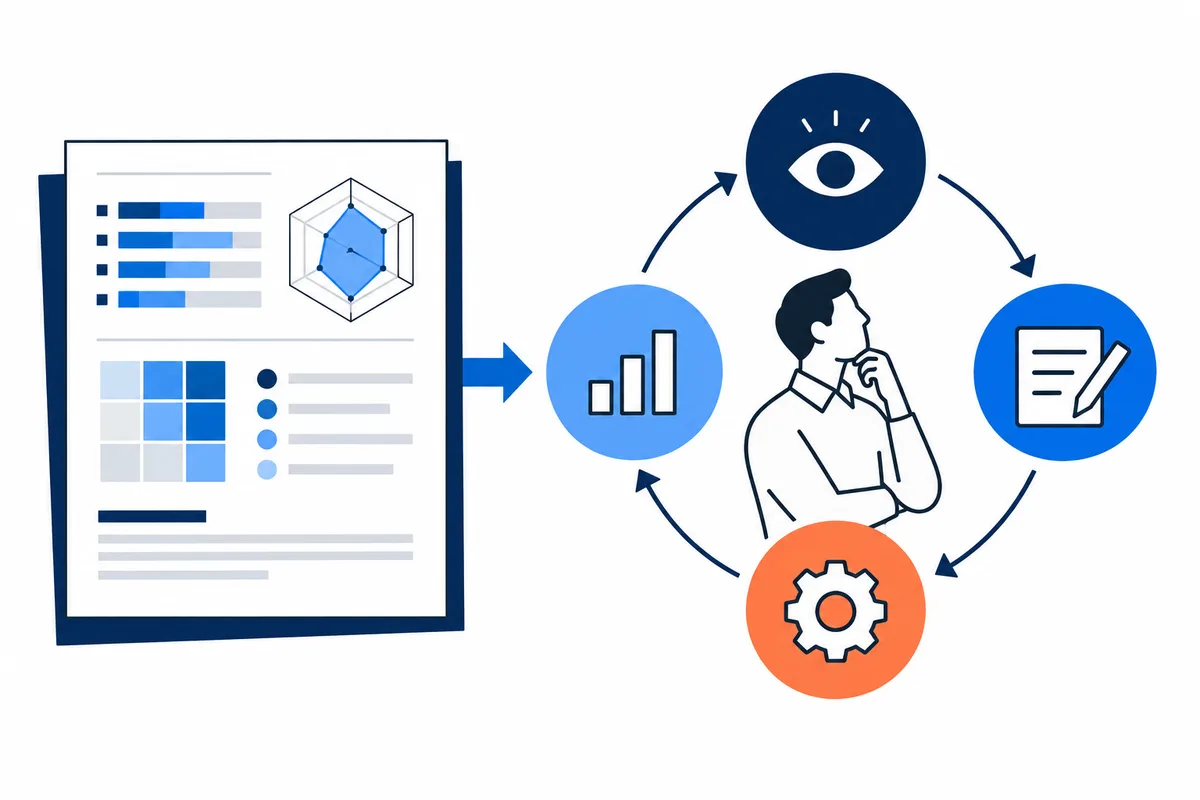
Turn one result into a behavior you can observe
A result becomes useful when it points to something a person can notice in a real exchange. “Difficulty regulating emotion,” for instance, is too broad to practice directly. It could mean speaking sharply when interrupted, going quiet after criticism, or carrying frustration into the next conversation. The report supplies a hypothesis about a pattern; an observable moment helps determine whether that pattern fits and what response might be worth trying.
Consider an illustrative situation: during a project meeting, a colleague challenges a recommendation and asks for more evidence. The leader notices an urge to defend the proposal immediately. A small practice is to ask, “Which part would you like me to support first?” and then summarize the concern before responding. The cue is a challenge to the proposal; the action is a question followed by a short summary; the observable response is whether the colleague confirms that their concern was understood before the leader makes the case.
This translation matters because broad profile language can invite a broad judgment: “I am bad under pressure,” or “I am not suited to lead.” Neither conclusion follows from a self-description. In “Choices and Challenges in Measuring Emotional Intelligence in the Workplace,” the measurement review describes self-reported EI as closely tied to confidence and motivation, and says it can be useful for development, especially alongside other measures that may reveal gaps in self-awareness. That makes a self-report a reasonable source of questions about perceived habits. The specific meeting still has to supply evidence about what the person said and what happened next.
After the exchange, the leader can record a few concrete details while they are fresh: what prompted the defensive impulse, whether they asked the question, how the colleague responded, and what they did after hearing the answer. If the colleague clarified the evidence needed and the discussion moved to that point, the leader has learned something about this response in this setting. Neither outcome changes the original assessment score; both can shape the next practice.
Feedback can add another view, provided the request stays close to the event. Instead of asking, “Am I emotionally intelligent?” or “Would I make a good leader?”, the person might ask someone who was present, “When I paused to summarize the objection, did it reflect what you heard? What did I do that helped or made it harder to continue?” Such questions invite a description of one exchange, not a verdict on character. The 2005 report “Multi-Rater or 360-degree Emotional Intelligence Assessment” discusses a workplace instrument built for development and studies comparing self-ratings with ratings from others. It frames those perspectives as useful in leadership development. Its findings concern that instrument and workplace samples, so they do not validate every feedback process or establish future success.
The next experiment can remain modest: keep the same response for another relevant meeting, or adjust one part of it after considering the feedback. A pause before replying may suit a moment of rising frustration; naming uncertainty may help when the evidence is incomplete; checking how a comment landed may be useful after giving difficult feedback. The point is not to perform a prescribed style. It is to test a chosen action in the situation where it matters, then look at the exchange and its effect. The leader can assess that behavior on its own terms, without treating a repeat assessment score as proof that leadership ability or prospects have changed.
Sources: Choices and Challenges in Measuring Emotional Intelligence in the Workplace; Multi-Rater or 360-degree Emotional Intelligence Assessment
What changes after a result becomes practice?
Development comes from practice and feedback, not from completing an assessment. Workplace intervention research offers a reason to take that seriously: emotional competencies can change on average after structured training. It does not show that an EQ result itself changes behavior or guarantee a career outcome. An assessment can help someone choose where to look; the learning happens in what they do next and what they notice in real interactions.
In “Training emotional competencies at the workplace: a systematic review and metaanalysis,” researchers pooled pre-training and post-training results from 50 studies involving employed adults, with 3,233 participants in the pre-post analysis. A separate analysis included 27 studies with control groups. The average change in the pre-post analysis was moderate (standardized mean difference, or SMD, 0.44); the controlled comparison was also moderate (SMD 0.46). The authors report that effects persisted beyond three months. These results support a measured conclusion: workplace programs can help people improve emotional competencies on average. The controlled estimate matters because it compares participants receiving an intervention with a comparison group, rather than attributing every before-and-after change to training alone.
The category in that review is broad. Included programs addressed emotional intelligence, empathy, or emotion regulation, and their methods varied. They could include practice, role-play, coaching, group discussion, feedback, or lectures. In the 50-study set, 29 studies included role-play, 27 group discussion, and 13 feedback based on test results. Only two interventions focused on emotion regulation, and no eligible studies trained emotional awareness or conflict management as defined by the review. The average is not a precise estimate for every leadership skill, nor evidence that an assessment is an effective intervention.
The authors identify high variation among study results and low methodological quality as important limits, and call for more rigorous trials. The spread was substantial: in the full pre-post analysis, heterogeneity was 88 percent. Many studies also relied on self- or peer-reported outcomes, and the review found that most had serious or critical risk-of-bias concerns. The average summarizes uneven evidence; it is not a promised result for each participant. The review makes a case for the possibility of learning; it does not provide a timetable or guarantee that a skill will transfer to a leadership role, improve colleagues’ experience, or alter a performance rating.
A second review, “Emotional Intelligence and Leader Outcomes: A Comprehensive Review and Roadmap for Future Inquiry,” examines a different question. It synthesized 101 empirical studies published between 1990 and 2021 and found positive associations between leaders’ emotional intelligence and outcomes such as leadership styles and behaviors, well-being, and performance. Its authors explicitly say that their findings cannot establish causal relationships. Together, the reviews suggest emotional competencies can be developed and are associated with leadership outcomes. Neither says that taking an assessment causes better leadership; training provides opportunities to learn and practice.
For an individual, a useful way to connect those findings is to turn one result into a small, reviewable practice cycle. First, pick a recurring situation where the result might matter, such as receiving a challenge to a proposal or giving difficult feedback. Choose one action that can be seen or heard: pause before replying, ask what concern sits behind the objection, or summarize the other person’s point before explaining your own. Keep the action narrow enough to remember while the conversation is happening. This practical cycle follows the distinction between assessment and intervention; it was not tested by either review.
After the interaction, record the event rather than a verdict about yourself. What was said? What did you do? What happened next? If useful, ask someone who was present about that exchange: “When I heard the objection, did I make room for your concern before responding?” That question can produce more actionable feedback than “Am I a good leader?” Try the behavior again in a later situation and compare what you observe. A colleague’s view is one situated perspective, but it can help identify whether the behavior was visible and what to adjust. If the situation does not offer a fair chance to practice, choose another one rather than treating the absence of an opportunity as failure.
This cycle keeps each kind of evidence in its proper place. The assessment can suggest a development question. The interaction supplies an example. Feedback can add another perspective. Repeated practice gives the person a basis for deciding whether to keep or change the behavior. A later assessment result may be worth reflecting on, but a higher score by itself would not show that colleagues experienced a change or that leadership became more effective. They require evidence about behavior and its consequences. The practical progress measure is therefore the action the leader can observe and revisit, not a score treated as a certificate of improvement.
Sources: Training emotional competencies at the workplace: a systematic review and metaanalysis; Emotional Intelligence and Leader Outcomes: A Comprehensive Review and Roadmap for Future Inquiry

When should you question the result?
Question the interpretation when the assessment, the person's account, and a specific work example do not line up. A report may suggest that someone reacts quickly under pressure, while a colleague recalls an exchange in which they interrupted. That mismatch deserves inquiry. It does not establish who is right or that the report has found a stable leadership flaw. First establish what happened and what each source could observe.
The 2025 review, “Emotional Intelligence and Leader Outcomes: A Comprehensive Review and Roadmap for Future Inquiry,” examined 101 empirical studies published from 1990 through 2021, covering leader behavior, well-being, and performance. It found positive associations between leaders’ EQ and outcomes including effectiveness, but says the evidence cannot establish causal relations. It also identifies unresolved questions about what EQ means, how distinct it is from related ideas, and how it should be measured. The review included 35 measures, one reason its authors chose a systematic review rather than a meta-analysis. Patterns across studies cannot settle what one score means in one role.
That measurement variation matters when a result conflicts with daily experience. Self-report summarizes how someone sees their typical reactions; an ability task samples answers to emotion-related problems; an observer report records behavior others say they have seen. A shared label such as “regulation” can rest on unlike evidence. The review’s measurement debate is a reason to check the method before deciding that one source has failed. Ask what situations were sampled, whether the behavior was visible to the rater, and what the result describes. A broad result can prompt reflection without identifying the cause of one interaction.
Observer feedback can add detail, depending on who observed what. “Multi-Rater or 360-degree Emotional Intelligence Assessment,” a 2005 report on a workplace instrument, describes studies comparing self-ratings with ratings by others and discusses multi-rater assessment for leadership development. It supports exploring self/other differences in a development conversation about that instrument. It does not show that every 360-degree tool works the same way or that ratings forecast leadership success. A colleague who sees project meetings may not see private one-to-ones. Treat the report as one situated account and ask for an example.
Suppose a manager hears that they leave too little room for dissent. Before turning this into a trait, they could ask which meeting and response prompted the feedback. Did they answer before the other person had finished? Was there time on the agenda for objections? Had the decision already been settled? These questions point to different actions. The issue is whether an observable behavior occurred, in what conditions, and what followed. This is an illustration, not a reported case or assessment result.
Work conditions also shape what behavior is possible. Authority, time pressure, workload, role expectations, and the consequences of disagreement may affect what someone does or what observers see. This is a contextual inference, not a result established by the sources above. It matters because a score should not become a complete explanation of leadership performance. If someone often cuts off discussion, they might practice inviting a challenge and listening through the response. If the decision process leaves no time for dissent, meeting design may need attention too.
The review calls for research into a potential “dark side” of EQ. That is an open question, not evidence that a particular leader uses emotional skill harmfully. It cautions against assuming emotional fluency guarantees ethical judgment or good leadership: understanding a colleague’s reaction and deciding how to use that information are separate matters. When accounts conflict, keep the inquiry close to the event. Note the situation, an action that could be seen or heard, and what followed. Ask someone present for an example, not a verdict on leadership potential. If examples point to recurring behavior, choose one response to practice and review a later exchange. If they do not, the mismatch may reflect different slices of behavior. Use it to choose the next question, not label someone deficient or naturally suited to lead.
Sources: Emotional Intelligence and Leader Outcomes: A Comprehensive Review and Roadmap for Future Inquiry; Multi-Rater or 360-degree Emotional Intelligence Assessment
Keep development separate from employment prediction
A development profile belongs in a conversation a person chooses to have with themselves: What behavior do I want to understand, and what could I try next? The Emotional Skills Profile is described in this assignment as a private, 32-item reflection tool. Its questions cover recognition, understanding, regulation, and responding to others. Its report keeps recent-behavior summaries separate from judgments on authored scenarios. These distinctions can help a reader select a topic for reflection; they do not turn the result into a forecast of leadership success. The distinction matters because the decision changes the claim. Voluntary practice asks whether a person can notice a habit and test a different response in a real situation. Hiring, promotion, ranking, or performance decisions ask whether a score can support a consequential judgment about someone. Evidence for the first purpose would not, by itself, establish the second. The product description supplies no validated population norms or established ability-test validity, and the assessment is not presented as an employment instrument. Its result cannot warrant a leadership verdict. Keep the result close to its scope. If a report raises a question about regulating emotion, a reader might watch how they respond when a colleague challenges a proposal. The useful record is what happened and what the person tried, not a label attached to their leadership potential. This is an illustrative reflection, not a claim about what the profile predicts. The work situation itself also matters. Someone who wants structured private reflection can explore the [Emotional Skills Profile](/assessment). The report may help identify a behavior to examine, while the person decides whether that behavior is relevant to their work and what to practice. No result from this profile establishes who should lead, who will succeed, or who is fit for a role.
Sources: https://eqtest.org/assessment
What should you do with a result this week?
Pick one leadership situation that is likely to recur: a project handoff, a disagreement about priorities, or a difficult feedback conversation. From the result, choose one behavior to try there. If it points you toward noticing others’ reactions, make the practice specific: ask a clarifying question before proposing a solution. Test the response in real work; do not use the exchange to prove the profile was right.
Afterward, note what prompted your response, what you did, and what followed. Ask someone who took part for feedback on that moment, rather than whether you are a good leader. Then decide whether to repeat the behavior, adjust it, or try another. “Training emotional competencies at the workplace: a systematic review and metaanalysis” found moderate average changes after workplace interventions, including at follow-up beyond three months, alongside high variation and low study quality. The findings support practice as a development route; they do not show that assessment produces change.
For structured reflection, the private 32-item Emotional Skills Profile can offer a starting point at [/assessment](/assessment). It covers recent behavior and emotional situations across recognition, understanding, regulation, and responding to others. Select one behavior to notice, then judge progress from exchanges and feedback you can revisit. That is a practical next step without treating a score as a forecast of leadership success.
Sources: https://eqtest.org/assessment; Training emotional competencies at the workplace: a systematic review and metaanalysis
Questions readers ask
Can an EQ assessment predict whether someone will become a successful leader?
The evidence in this article does not establish that. Studies report associations between emotional intelligence and leadership outcomes, but measures, settings, and outcomes vary. An association across studies is not an individual forecast.
How can a leader use an EQ result?
Use it as a prompt to examine one possible habit. Choose a recurring work situation, try one behavior that can be observed, and review a concrete exchange afterward.
Are self-report, ability, and observer EQ measures interchangeable?
No. Self-report describes perceived typical habits, ability tests sample responses to emotion-related problems, and observer feedback describes behavior others say they have seen. They provide different kinds of evidence.
Does taking an EQ assessment improve leadership skills?
The cited workplace intervention review found moderate average changes after emotional-competency training, alongside high variation and low methodological quality. It does not show that assessment alone changes behavior or guarantees leadership outcomes.
Sources
- Emotional Intelligence and Leadership Effectiveness: A Meta-Analysis
Supports a moderate association across 98 papers, 110 effect sizes, and 27,330 participants, with variation by context, leadership level, model, outcome, and analysis level.
- Emotional Intelligence and Leader Outcomes: A Comprehensive Review and Roadmap for Future Inquiry
Reviews 101 empirical studies and reports varied positive associations, while identifying measurement debates and stating that causal relations cannot be established.
- Choices and Challenges in Measuring Emotional Intelligence in the Workplace
Supports distinguishing self-report, ability testing, and observer report by the kinds of evidence they provide; the accessible record exposes the abstract.
- Multi-Rater or 360-degree Emotional Intelligence Assessment
Describes a workplace instrument and studies comparing self- and other-ratings; supports contextual development discussion, not universal validity or future prediction.
- Training emotional competencies at the workplace: a systematic review and metaanalysis
Reports moderate average changes after workplace interventions, with high heterogeneity and low methodological quality; supports cautious discussion of practice, not assessment effects.
- https://eqtest.org/assessment
Product details and limits come from the saved assignment specification; the product page was inaccessible during research and is not independently verified here.
Apply it to the real situation
Turn a result into one behavior to practice
From this guide: Choose a recurring work situation where an emotional habit may matter, then decide what you want to observe in the next exchange.
The article gives you a way to move from a broad result to one behavior you can notice and review. If you want structured private reflection on recent behavior and emotional situations, the 32-item Emotional Skills Profile can offer a starting point across recognition, understanding, regulation, and responding to others. Use the result to choose a question for practice, not to forecast leadership success.