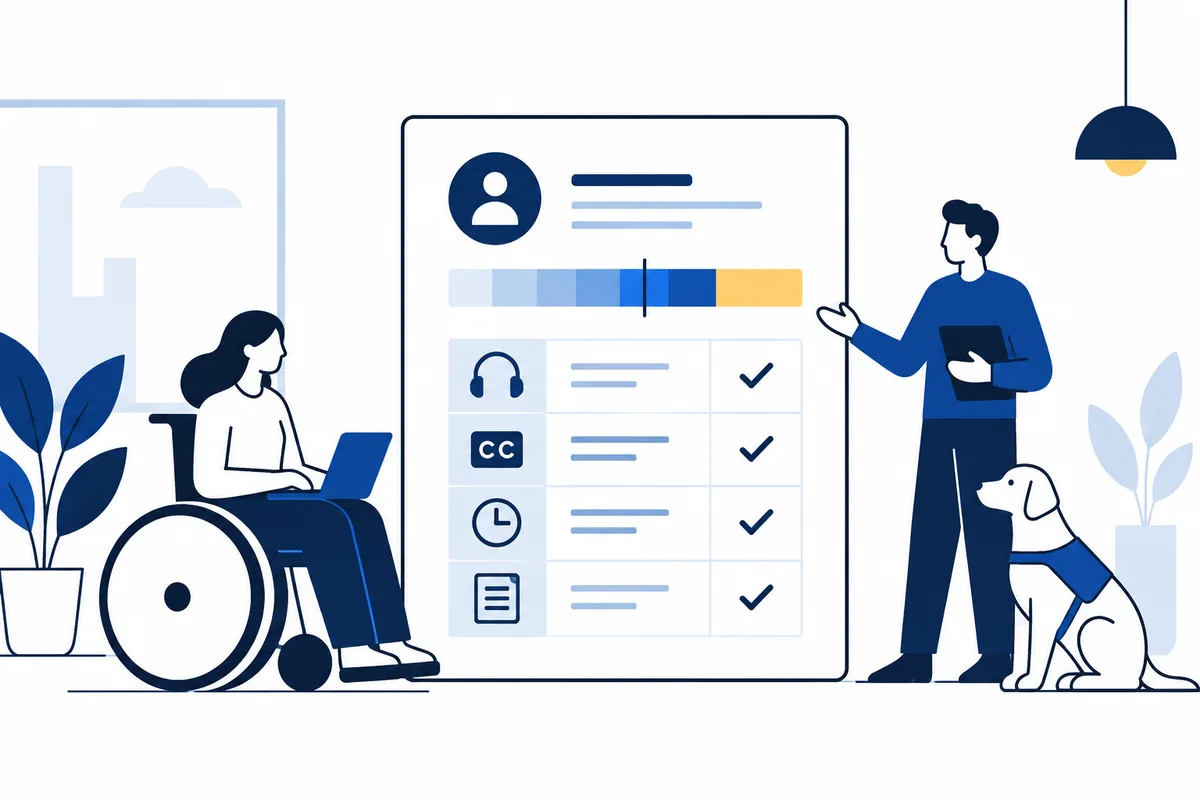
Before a workplace EQ session, the invitation should explain what participants will do, how results will be used and who to contact about access needs. A private, practical request route lets people ask about a barrier without turning a general development invitation into a diagnostic form. Formal employment assessments may follow different rules.
What should I check about the assessment format?
An invitation is useful when it lets a participant picture the activity before deciding how to take part. It should say what they will read or respond to, whether there is a time limit, whether pausing is possible, what device or setting is expected, and whether a follow-up discussion is included. Avoid vague promises such as “accessible format”; name confirmed options and give a contact for questions about anything not covered.
If a detail is missing, ask about that detail first: “How long should I allow, and can I pause and return later?” If you already see a barrier, connect it to the task: “Reading the screen for that long may be difficult; is a different way to access the questions possible?” The organizer can then check what the platform and session can support. These examples are prompts, not a promise that a particular feature is available.
A short notice can make the essentials easy to scan: “This activity takes about [confirmed duration]. You will [confirmed task] using [confirmed response method]. [State whether timing and pausing apply.] Your answers will be seen by [named role] and used for [stated purpose]. For an access question, contact [person or channel] by [date, if relevant].” Fill in only details the organizer has verified; if a format option is uncertain, invite a private question instead of implying it is available.
The U.S. Department of Justice’s ADA guidance discusses standardized and other high-stakes tests, including the principle that covered tests should measure the intended skill rather than an impairment. Canadian Public Service Commission guidance addresses assessment accommodations in public-service employment and explains that decisions depend on both a person’s needs and the instrument’s demands. Those settings differ from a voluntary EQ development session. They support paying attention to task demands, but do not establish which adjustment is suitable for this profile. [1] [2]
Sources: ADA Requirements: Testing Accommodations; Guide for Assessing Persons with Disabilities: Principles for Assessment Accommodations
How can I ask for an adjustment without oversharing?
For an informal development activity, a participant can usually begin with the practical issue rather than medical history: what part of taking part is difficult, and what change might help? For example: “I may need more time to read the questions. Could we discuss options privately?” If the person does not know what would help, they can say that and ask to talk it through. The organizer should explain who will receive the request and how to follow up.
This is a communication approach, not a universal legal rule about what information may be requested. EEOC guidance describes individualized accommodation in covered U.S. employment contexts and recommends collaboration when the effective adjustment is unclear. It does not prescribe the wording or disclosure process for every voluntary workshop. If participation is tied to hiring, a regulated test or another formal process, the organizer should use the requirements that apply to that setting and jurisdiction. [3]
A request may concern the questionnaire, the later conversation, or both. Someone might be able to complete an activity but prefer not to read personal reflections aloud. The invitation can make clear whether discussion is optional and offer a private way to address that preference. Separating these choices helps the organizer respond to the actual participation barrier without asking for irrelevant personal details.
Sources: The ADA: Questions and Answers
What should I know about results and the session afterward?
Before taking part, look for a plain statement of purpose and access: who can see individual answers or reports, whether results are shared automatically, and whether the follow-up is private or group-based. If the invitation leaves one of these unclear, ask before submitting responses. Do not infer confidentiality or employment use from the label “EQ assessment”; the organizer should state the actual arrangement.
A useful purpose statement answers three distinct questions: why the activity is being offered, what decisions its results can inform, and who receives the individual report. For example, “This is for personal development; your manager will not receive individual answers” is appropriate only if that accurately describes the arrangement. If results will be shared, identify with whom and whether the participant can choose what to discuss. Clarity here lets a reader judge the consequences of participating before deciding whether to proceed.
The invitation should also distinguish development from evaluation. If results could affect an employment decision, participants need to know that before completing the activity, and the organization must consider the applicable employment and testing rules. The DOJ material concerns standardized and high-stakes testing, while EEOC guidance concerns covered employment practices; neither turns a developmental EQ profile into a validated selection measure. The Canadian guide is likewise specific to public-service assessment. None of these sources tests accommodations for this EQ profile.
For a development session, the practical decision is narrower: understand the task and result handling, identify any obstacle, and contact the named person with a focused question. The organizer can confirm whether an adjustment is workable and explain any limits before the session. Keep the answer concrete—what can be changed, what remains the same, and how the participant can choose whether to continue—without claiming the adjustment preserves a score interpretation that has not been studied.
Sources: ADA Requirements: Testing Accommodations; Guide for Assessing Persons with Disabilities: Principles for Assessment Accommodations; The ADA: Questions and Answers
Questions readers ask
Should an EQ assessment invitation ask for a diagnosis?
For a general, voluntary development invitation, it is usually clearer to describe the activity and provide a private contact for access questions than to ask every participant for diagnostic information. That is practical wording guidance, not a universal rule about formal processes. Employment or regulated testing may have specific requirements, so organizers should follow the applicable procedure.
Does asking for an accommodation change an EQ result?
A request identifies a possible access need; it does not itself describe a person’s EQ. Whether a specific change affects interpretation depends on the assessment and the change. The cited sources do not validate any adjustment for this EQ profile.
Sources
- ADA Requirements: Testing Accommodations
U.S. DOJ guidance gives examples of test accommodations and says covered tests should reflect the skill measured rather than an impairment.
- Guide for Assessing Persons with Disabilities: Principles for Assessment Accommodations
Canadian public-service guidance matches accommodation decisions to functional limitations, assessment features and the qualification being assessed.
- The ADA: Questions and Answers
EEOC guidance says covered employment accommodations are individualized and encourages collaborative problem-solving when the requested adjustment is unclear.
Apply it to the real situation
Turn reflection into one practical EQ skill to work on
From this guide: After access questions are settled, a participant may want an individual reflection prompt for choosing a development priority.
The Emotional Skills Profile is a private reflection tool with guidance for choosing a behavior to practice. Use it to frame a question for your next feedback or disagreement conversation, then decide what is relevant to your own work.