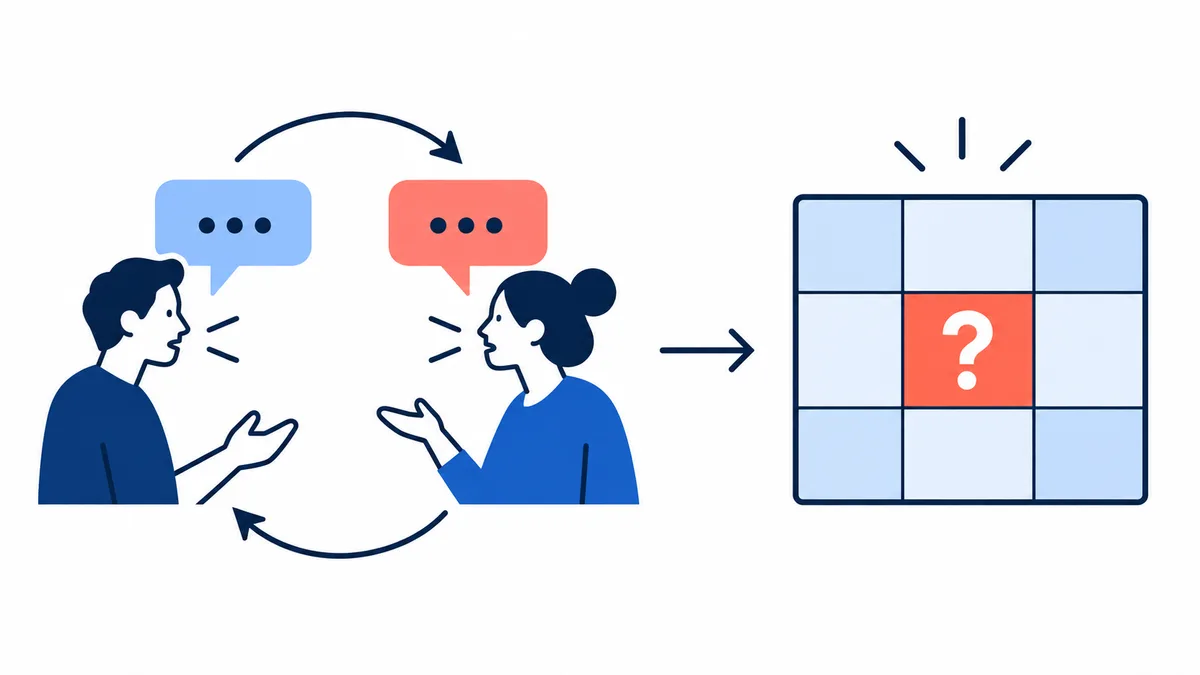
An Emotional Skills Profile can help by offering reflection prompts, while the recurring disagreement supplies a real moment to examine. Identify one point where the exchange turns, choose one action you can observe there, and frame it as a question for the next comparable conversation.
What does a recurring disagreement reveal, and what does it leave open?
Repetition identifies a conversation worth examining, but the repeated event is not itself an explanation. Describe the turn without assigning motive: a concern goes unasked, frustration rises before a reply, a boundary stays implicit, or the exchange ends without a shared next step. Compare two or three instances and note what was similar and what changed. That distinction can keep a single vivid episode from standing in for a pattern.
Emotion regulation describes ways people influence which emotions they have and how they experience or express them. In five studies, Gross and John assessed individual differences in habitual reappraisal and suppression and examined their associations with affect, relationships, and well-being. They reported better interpersonal functioning alongside reappraisal and worse functioning alongside suppression. The PubMed abstract does not give detailed sample composition, and these associations do not predict a particular disagreement; the studies did not test workplace conflict or this profile. Authority, timing, workload, and the other person's response may also shape an exchange. [1](https://pubmed.ncbi.nlm.nih.gov/12916575/)
A useful first note is a short sequence: what happened immediately before the turn, what you noticed, and what you did next. For example, in a handoff dispute, the observable moment might be hearing an objection and immediately defending the decision. That description is more actionable than a label such as ‘bad communication’: it marks where a different response could be tried, while leaving the work question itself open. If ownership or priorities are unclear, those need attention alongside any communication practice.
Can a profile point to one behavior worth practicing?
The private 32-item Emotional Skills Profile is an educational reflection tool covering recognition, understanding, regulation, and responding to others. Its recent-behavior summary asks how you describe your usual behavior; its authored-scenario judgments show how you assess a described situation. These are different kinds of prompts, not interchangeable measures. The profile has no validated population norms, so use its themes to choose what to inspect rather than to rank ability.
Turn a theme into a question with three parts: a recognizable cue, an action under your control, and a result you can notice. If a colleague questions your feedback, for example, ask: ‘When I hear that my feedback missed the point, can I ask which part felt unclear before I explain what I meant?’ The action is asking one clarifying question; whether you learn what was unclear is observable. ‘Be more empathetic’ has no cue or check, so it is difficult to learn from.
Keep the trial small and repeatable. After the next comparable exchange, record whether the cue appeared, whether you tried the action, and what happened next. If no similar moment occurred, there is no result to interpret. If the action was tried but the conversation remained stuck, note the unresolved issue—perhaps ownership, timing, or a decision that needs agreement—rather than changing several behaviors at once. A brief record helps separate whether the question was usable from whether the work problem was settled.
The product can give you a private starting point for that reflection; the example question is yours to formulate. Explore the Emotional Skills Profile at [/assessment](/assessment) if you want its report as another source of development prompts.
What does practice evidence let you conclude?
Workplace training research makes skill development plausible on average. A 2024 systematic review and meta-analysis found a moderate effect on measured emotional competencies in controlled trials (SMD 0.46, 95% CI 0.30–0.63), alongside high heterogeneity and methodological limitations. The authors found no eligible workplace interventions specifically training conflict management or emotional awareness. The result supports cautious claims about measured competencies, not a forecast for a recurring disagreement. A pooled estimate averages outcomes across studies and participants; it does not say that every participant improved or identify which single practice produced a change. [2](https://link.springer.com/article/10.1186/s40359-024-02198-3)
A broader 2018 meta-analysis combined 24 studies and 28 samples of healthy adults receiving emotional-intelligence training. Hodzic and colleagues report a moderate standardized pre-to-post change in measured EI and a stable pre-to-follow-up effect, with results varying by EI model, dimensions, training length, and publication type. Because these estimates compare measured scores before and after training across varied studies, and the abstract does not establish workplace behavior change, they cannot show that a particular behavior changes, that this profile causes change, or that a disagreement will be repaired. [3](https://journals.sagepub.com/doi/abs/10.1177/1754073917708613)
The practical verdict is to treat one trial as information for your next decision, not as a pass-or-fail test. If the action was possible and the exchange shifted, you have a candidate behavior to keep observing. If it was not possible, or the same dispute continued around a concrete work condition, the next useful step may be clarifying the agreement or responsibilities with the people involved. Research supports neither a promised conflict outcome nor a conclusion from one conversation; it supports a measured, proportionate experiment in reflection.
Sources: Training emotional competencies at the workplace: a systematic review and metaanalysis; How Efficient Are Emotional Intelligence Trainings: A Meta-Analysis
Questions readers ask
How do I choose which moment to examine?
Choose a repeatable point you can describe in observable terms, such as an objection followed by an immediate defense. Avoid starting with a judgment about either person's intent.
How do the profile's two kinds of prompts differ?
The recent-behavior summary reflects how you describe your usual actions; a scenario judgment reflects how you assess an authored situation. Both can suggest a topic for reflection.
What makes a practice question specific enough?
Name a cue and one action you can try when it occurs: ‘When I hear an objection, can I ask what concern it raises before replying?’ Then note whether you tried it and what followed.
What if the disagreement continues after I try the behavior?
Record what happened and check whether the unresolved issue involves responsibilities, timing, workload, or a decision that needs shared agreement. A communication experiment cannot settle those questions by itself.
Sources
- Individual differences in two emotion regulation processes: implications for affect, relationships, and well-being
The PubMed abstract reports five studies and says reappraisal was associated with better interpersonal functioning while suppression was associated with worse interpersonal functioning. The abstract does not test workplace disagreements or this profile, and does not report detailed sample composition.
- Training emotional competencies at the workplace: a systematic review and metaanalysis
The accessible publisher article reports a controlled-trials effect of SMD 0.46 (95% CI 0.30–0.63), high heterogeneity and low methodological quality; it found no eligible workplace intervention studies training conflict management or emotional awareness. It does not establish effects on recurring disagreements or this profile.
- How Efficient Are Emotional Intelligence Trainings: A Meta-Analysis
The accessible SAGE abstract reports 24 studies with 28 samples of healthy adults, a significant moderate standardized pre-to-post change, a stable pre-to-follow-up effect, and significant moderators including EI model, four-branch dimensions, training length, and publication type. It does not establish effects on workplace behavior, this profile, or disagreement repair.
Apply it to the real situation
Turn a broad result into a behavior you can notice
From this guide: The profile can help you compare how you describe recent habits with how you judge emotional scenarios, then choose one question to explore in a real conversation.
A recurring disagreement leaves one personal question open: what do you tend to notice or do at the moment the conversation turns? The private 32-item Emotional Skills Profile separates recent-behavior reflections from judgments about authored scenarios, giving you two prompts to consider as you choose one observable behavior to practice. Use it for development and reflection, then check your question against real conversations and the work conditions around them.