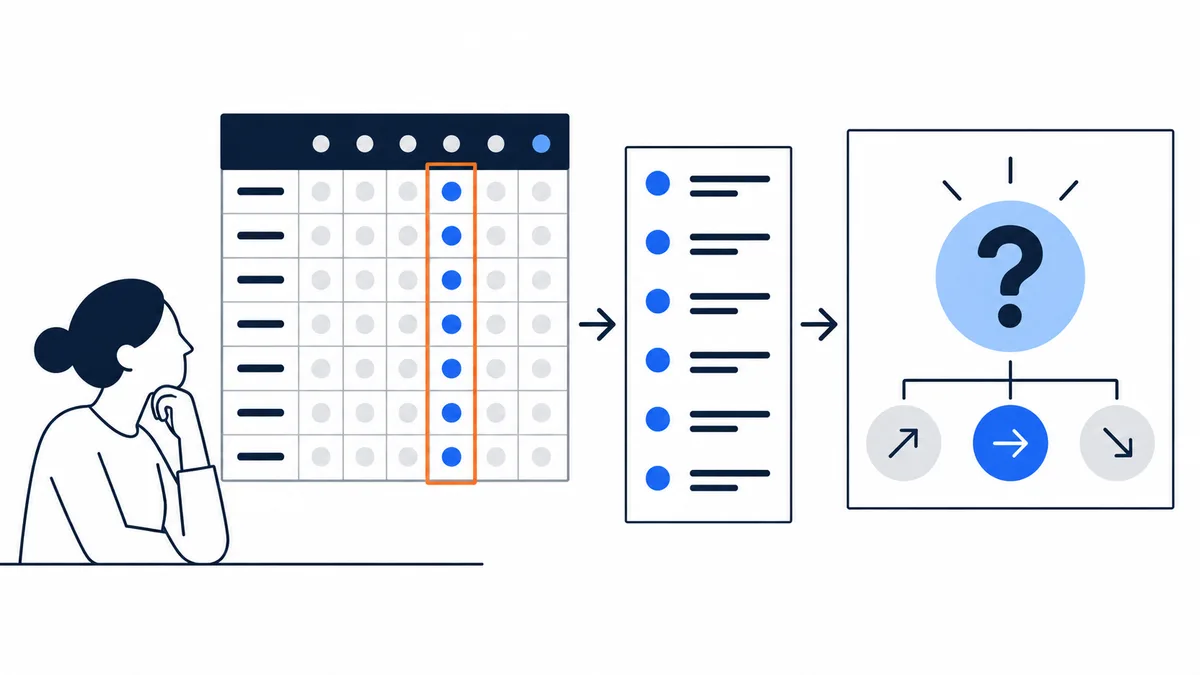
The Emotional Skills Profile can help you identify an emotional-skill area to examine and shape it into a question about one observable work behavior. It summarizes self-reported recent behavior and judgments about authored emotional situations; it does not explain why a reaction recurs. Connect a prompt to a specific episode, try a small action in a comparable situation, and consider the work conditions when reviewing what happened.
What can the profile tell me about a recurring reaction?
After critical feedback, someone may begin explaining the decision they made before asking what needs revision. That sequence is observable; “defensive,” “confident,” or “poor at handling emotion” are interpretations. The feedback may have been clear and proportionate, or vague, surprising, public, or tied to a shifting priority. The response alone cannot settle which account fits. A useful reflection starts with what happened, then asks what would be worth trying next time. The Emotional Skills Profile can help choose where to look. Its 32 items cover recognition, understanding, regulation, and responding to others. The profile separates summaries of recent behavior from judgments about authored emotional situations. Those are two kinds of self-reflection, not observations of what happened in a particular meeting. The supplied product brief describes the profile as an educational development tool without validated norms or established ability-test validity. It is not a diagnosis, hiring signal, or explanation of why a response recurs. A result can give a reader a starting point, but it cannot identify the cause of a work pattern. This distinction matters because emotional-intelligence measures do not all ask the same question. The accessible summary of “Emotional Intelligence” in *The Cambridge Handbook of Intelligence* distinguishes ability models, which treat emotional intelligence as a set of mental abilities, from mixed models that combine abilities and traits. An ability test samples performance on emotion-related problems. A self-reflection profile instead summarizes how someone describes their recent habits and responds to authored situations. One result cannot stand in for the other, and neither by itself explains an exchange at work. A third source is the exchange itself: what was said, what the person did, and what followed. That account is closer to the recurring episode, though a single recollection still reflects one viewpoint. The public page “Emotional Intelligence (EQ) Test: See Your Profile Across Five EQ Skills” offers a self-report profile and a general prompt to recall a disagreement. It does not show how to distinguish a recurring work response from possible causes or turn it into one bounded practice question. Here, the profile’s useful job is narrower: help select a skill area for reflection, then let a specific episode supply the detail. So after seeing a profile result, ask: “What is one real moment when this showed up, and what did I do?” Describe the cue and action before naming a trait or motive. In the feedback example, that might mean noting that an explanation came before a request for a concrete change. The next question is not what this says about identity; it is which response could be examined in a comparable situation. That keeps the profile useful as a prompt while leaving the explanation open to evidence from work itself.
Sources: Emotional Skills Profile; Emotional Intelligence; Emotional Intelligence (EQ) Test: See Your Profile Across Five EQ Skills
What happened in the work episode besides my reaction?
A recurring response has several possible inputs: the emotion itself, what was said, how clearly it was said, the timing, the stakes, workload, authority, and the other person’s conduct. A profile cannot sort these causes out. Before deciding what to practice, reconstruct one specific episode in plain terms: what was happening, what exact cue caught your attention, what you did next, and what followed. This is a reflection aid, not a diagnostic or validated measurement protocol. It makes the event precise enough to examine without turning repetition into a verdict about character. Consider an illustrative workplace exchange: someone receives critical feedback and quickly explains why they made a decision before asking what should change. The observable behavior is the quick explanation. “I was defensive” is already an interpretation; “the other person meant to undermine me” is another. Neither follows automatically from the sequence. Perhaps the feedback was clear and the explanation habitually arrived before the person had taken it in. Perhaps the request was vague, priorities had shifted, or criticism was delivered publicly. Those details do not prove a cause, but can change the next step. A short reconstruction can keep observation and explanation apart. Write down the event, the words or action immediately preceding the reaction, the response you could see or hear yourself make, and its immediate consequence. Was the requested change clarified? Did the exchange stop? Did a decision become harder to make? Keep the account close to what happened; avoid guessing at motives. Notice what information is missing before choosing a practice target. That missing context matters especially at work, where expectations and power are shared. “Emotion Regulation at Work: A Social Perspective,” a 2026 review published online ahead of its final issue, organizes social influences into relational factors such as interaction partners, professional factors such as occupational and organizational norms, and societal expectations related to culture, race, and gender. Its abstract argues for examining intrapersonal and interpersonal regulation together. It does not diagnose one employee’s response; it gives a reason to include the relationship and setting. The review “Integrating Emotion Regulation and Emotional Intelligence Traditions: A Meta-Analysis” also treats emotion regulation as a process shaped by individual differences, while describing effective regulation as flexible and leaving room for emotions to emerge. A strong reaction can therefore carry information about a concern worth clarifying. If feedback is unclear, a useful first move may be to ask which specific change is needed. If the request is clear but an explanation comes out before the person can consider it, a pause or one clarifying question may be worth trying. These are options to investigate, not causes. When the same response appears mainly under shifting priorities, public criticism, or risky disagreement, include that condition in the question; changing the work arrangement or setting a boundary may matter as much as changing a response.
Sources: Emotion Regulation at Work: A Social Perspective; Integrating Emotion Regulation and Emotional Intelligence Traditions: A Meta-Analysis
When might the work setting need attention too?
If a reaction appears mainly under a repeated work condition, include that condition in the practice question. Unclear ownership, clashing priorities, disrespectful delivery, or too little time to clarify can shape what a person feels and can safely do next. A private emotional-skills profile may help select an area to reflect on; it cannot repair an arrangement that repeatedly sets people against one another. The useful question may concern a request or process rather than how to feel less. Check the setting before treating a recurring response as an individual shortcoming. “Emotion Regulation at Work: A Social Perspective,” a 2026 review article, organizes social influences at three levels: interaction partners, occupational and organizational norms, and wider societal expectations. Its abstract places social influence across phases of regulation, from choosing an emotional goal to the outcome. The article is in press, and its abstract offers a framework rather than a test of an individual reaction. Consider feedback on a task when two people have given incompatible instructions. Asking the reviewer for one concrete example may help if the feedback is unclear and that person can answer. But if priorities keep changing or no one owns the final decision, a calmer explanation will not settle which instruction takes precedence. The next step could be to identify who decides, ask which task comes first, or request the priority in writing. Interaction norms matter. In a group where questions are welcomed, asking what outcome is expected may be ordinary coordination. Where disagreement is punished, the same question can carry a different cost. The Annual Review authors’ framing supports attending to partners and workplace norms alongside personal regulation. It does not establish that a particular meeting is unsafe; that judgment requires details about the pattern and what happens when someone asks for clarification. A recurring response is a clue, not a diagnosis. A focused question can keep both sides visible: “When the deadline and requested work conflict, can I ask who sets the priority, and what happens after I do?” The action is specific; the observation includes the response and whether the conflict gets resolved. If speaking directly is not appropriate, document competing requests, consult a trusted colleague, or name a boundary through a suitable channel. The 2015 review “Integrating Emotion Regulation and Emotional Intelligence Traditions” describes regulation as flexible, leaving room for emotions to emerge rather than treating control as the only goal. Irritation or hesitation can draw attention to a conflict in expectations. The review does not study this profile or show that a particular workplace response will work. Practice need not suppress a feeling when the more relevant action is to understand its cause and address that condition. When a reaction clusters around the same unclear authority, shifting demand, interaction pattern, or constraint, include that condition in the question. Choose one feasible request or behavior and observe what changes. If clarification resolves the issue, asking sooner may help. If the condition remains, an individual exercise alone will not answer the practical problem; discuss the process, set a boundary, or seek appropriate support. Emotional awareness can identify the moment, but the worker is not solely responsible for circumstances beyond their control.
Sources: Emotion Regulation at Work: A Social Perspective; Integrating Emotion Regulation and Emotional Intelligence Traditions: A Meta-Analysis
Which part of the episode is a useful practice target?
Emotion regulation is not a single instruction to “calm down.” It is the set of ways people influence which emotions arise, when they arise, and how they are experienced or expressed. In “Emotion regulation: Affective, cognitive, and social consequences,” James Gross describes responses as unfolding over time. That timing gives you a practical way to choose a target: look for a point where a different action is possible and useful for the work at hand. Before emotion has fully shaped your response, you may be able to change something about the situation. If feedback is vague, asking for a concrete example can make the request clearer. If a meeting is moving quickly, directing attention to the specific decision on the table may help you respond to that decision rather than to every implication at once. These actions change the conditions or focus of the exchange; they do not require you to decide that your first reaction was wrong. When a response is already underway, the available action may be smaller. You might pause long enough to name the feeling privately, take a breath, or choose one concise question before explaining your position. The point is not to hide every sign of emotion. Gross distinguishes reappraisal, which changes how a situation is understood, from expressive suppression, which inhibits outward signs of feeling. In his review, regulation strategies differ in when they act and can have different consequences. His discussion centers on particular strategies and research available at the time; it does not establish one ideal response for every workplace exchange. That distinction matters when the emotion carries information. Reappraisal does not have to mean telling yourself that an unfair request is reasonable. You could instead ask whether the criticism concerns the work itself, its timing, or an expectation that was never made explicit. If the concern remains valid, the useful action may be to state a boundary or request a decision, rather than reduce the feeling. Regulation includes influencing expression, but the goal of a work conversation may be clarity, accountability, or repair, not looking composed. Research connecting emotional intelligence and regulation also cautions against treating one strategy as universally effective. “Integrating emotion regulation and emotional intelligence traditions: a meta-analysis” describes regulation as flexible and responsive to the moment. It reviews broad research traditions; it does not test this profile or prescribe a particular workplace technique. For a recurring reaction, flexibility means considering whether the target should come earlier in the episode, once the reaction begins, or in the surrounding process. Compare three possible targets. “Feel calm” describes an internal state that may be hard to judge and may not be necessary. “Ask which part needs revision before defending the work” names an observable action and a practical purpose. “Agree on who gives final feedback and by when” changes the process that may be producing repeated uncertainty. None is automatically superior. The right choice depends on what is happening and what would make the exchange more workable. A useful practice target should improve information, preserve a needed boundary, or help the next interaction proceed. It need not make you quieter or less visibly affected. Choose one action you can recognize afterward, then consider whether the conditions made it possible and whether it served the purpose. That gives you a focused question to carry into a later comparable episode, without treating composure as the measure of emotional skill.
Sources: Emotion regulation: Affective, cognitive, and social consequences; Emotion regulation: Affective, cognitive, and social consequences; Integrating Emotion Regulation and Emotional Intelligence Traditions: A Meta-Analysis
How do I write one focused practice question?
Turn a broad intention into a question with three parts: the situation that tends to recur, one response you can choose, and an effect you can notice. “Improve regulation” names a large area but gives you nothing to do when the moment arrives. “When feedback is unexpected, can I ask for one specific example before explaining my decision, and does that clarify what needs to change?” identifies a cue, an action, and a useful result. Keep the question close to what happened. If the feedback was vague, asking which part needs revision may help distinguish a specific request from a general expression of dissatisfaction. If the feedback was already precise, the same question may add little; a pause before responding might be the more relevant action. It is to choose one response that fits the episode and can be recalled in it. James Gross’s review “Emotion Regulation: Affective, Cognitive, and Social Consequences” describes regulation as influencing how an emotional response unfolds and distinguishes actions that happen earlier in a situation from those that shape a response already underway. For a work practice question, that distinction can help locate the action: clarify the request before interpreting it, or choose what to say after frustration has begun. Gross’s review examines reappraisal and suppression in particular; it does not establish that either is the right move in every workplace exchange. Name the purpose, such as getting enough detail to respond accurately, rather than assuming feeling less is always the goal. Avoid questions that quietly decide the cause in advance. “Am I defensive because I lack empathy?” turns a response into a trait verdict and assumes an explanation the episode cannot establish. “When I disagree with feedback, can I first ask what concern it is meant to address?” keeps attention on an action. If empathy is the focus, ask whether you understood the other person’s concern instead of guessing what they feel. If you still disagree after understanding it, listening does not require dropping your own view or boundary. The Consortium for Research on Emotional Intelligence in Organizations’ 1998 report, “Bringing Emotional Intelligence to the Workplace,” argues that understanding a desired behavior is different from learning to enact it and emphasizes practice and feedback in workplace development. Its distinction is still useful here: a profile prompt may help you select a behavior to examine, while a focused question makes the next attempt concrete. Keep the question small enough to carry into the moment. “When someone interrupts my update, can I finish the sentence and then ask what they need to add?” may help test whether a handoff can continue clearly. “How can I become more emotionally intelligent?” cannot guide one exchange. A practical question does not need a numerical score. Afterward, notice whether the cue occurred, whether you tried the response, and whether it served its stated purpose. If the situation differed sharply or the action was unsuitable, revise the question. A clearer request, boundary, or change in the work setting may be the more useful next step.
Sources: Emotion regulation: Affective, cognitive, and social consequences; Bringing Emotional Intelligence to the Workplace
Why might insight fail to change the next response?
Knowing what response would help does not ensure it will be available under pressure. A familiar reaction can arrive quickly, before a person has worked out what the moment requires. A profile may bring a possible skill area into view, but the next step is to connect that insight to a cue and rehearse a small response that fits. The aim is preparation, not a promise that a particular sentence will work in every exchange.
The Consortium technical report on workplace emotional learning makes a useful distinction between knowing about a behavior and learning to carry it out. Its guidance argues that emotional behavior change involves practice and habit development, rather than information alone. The report is older and offers broad training guidance, not a controlled estimate of what one brief personal exercise will achieve. It supports a modest point: recognizing a pattern is not the same as having a response ready when the pattern appears. A result can tell someone where to look; it cannot supply the experience of trying a different action in the actual situation.
Gross’s process model helps locate where that practice might fit. In his review of emotion regulation, Gross describes strategies that can enter at different points: changing a situation, shifting attention, changing how an event is interpreted, or influencing the response after emotion has begun. The model is a way to think about timing, not a rule that a person should always calm down or reinterpret what happened. If feedback is vague, for example, asking for a concrete example may improve the information available before a defensive explanation starts. If a request is clear but the first response tends to come too quickly, pausing before answering may be the more relevant action. The choice depends on the event and what needs to be protected or understood.
A short if-then plan can make the action easier to recall: “If feedback is unexpected, then I will ask what specific change is needed before giving my explanation.” This is an editorial aid for turning reflection into a practice question, not a validated EQ intervention. It names a cue and a behavior the person can notice later. Compare it with “I will be less reactive.” That intention gives no clear sign of when to act, and “less reactive” could mean listening, asking a question, setting a boundary, or hiding a valid concern. The more concrete plan is easier to review because the reader can ask whether the cue occurred and whether the chosen question was useful.
Rehearsal should leave room for judgment. If a colleague’s conduct is abusive, a request crosses a boundary, or the exchange is not safe, asking for more detail may be the wrong response. The useful action may be to pause, leave the conversation, seek support, or address the boundary through an appropriate channel. A plan is preparation, not an obligation to accommodate every interaction. Gross’s account allows regulation at different stages; it does not make one strategy suitable for every purpose or setting.
The practical distinction is between naming a possible pattern and preparing for a particular moment. A profile can help someone select an area to examine. Rehearsal connects that area to a cue and a response, while later experience shows whether the action fit. If the cue never appears, the situation changes, or the action proves unsuitable, revise the question. That is useful information about the practice and its setting, not a reason to blame oneself for failing to obey a profile.
Sources: Bringing Emotional Intelligence to the Workplace; Emotion regulation: Affective, cognitive, and social consequences
What does development research let me expect?
Workplace studies support the possibility that emotional competencies can improve through training on average. They do not tell one reader whether a self-chosen practice will change a recurring response, and they do not test whether the Emotional Skills Profile causes improvement. The useful expectation is modest: a practice is reasonable to try, while its value has to be judged in the situations where the person uses it. The 2024 systematic review “Training emotional competencies at the workplace” brought together interventions aimed at emotional intelligence, empathy, and emotion regulation among employed adults. Its pre-post analysis included 50 studies with 3,233 participants. A separate comparison of controlled trials included 27 studies. Across the controlled comparisons, the pooled standardized mean difference was 0.46, with a 95% confidence interval from 0.30 to 0.63. In ordinary terms, the groups receiving training tended to score higher on the measured emotional-competency outcomes than comparison groups. These are group summaries across different programs and measures, not estimates of what a particular person will gain from trying one behavior. The range of studies matters as much as the pooled average. Most interventions focused on emotional intelligence: 41 studies, compared with seven empathy interventions and two focused on emotion regulation. No eligible studies in the review trained emotional awareness or conflict management, despite those topics being part of its original search scope. Professions, intervention formats, and outcome measures varied. The authors found high heterogeneity, meaning the observed effects differed substantially among studies; the controlled-trial analysis had I² of 68%. The pooled result therefore compresses a varied collection of programs into one average. It cannot say which small practice is most useful for a given person or workplace. The authors also documented reasons for caution in how outcomes were measured. Of the 50 studies, 18 had critical risk of bias, 28 serious risk, three moderate risk, and two low risk. Many relied on participants’ or peers’ reports, and participants knew they had received an intervention. Those conditions can affect how people describe change. This does not erase the evidence of possible development; it limits how confidently the average can be translated into a promise about a particular practice or an individual result. A further complication is what researchers mean by emotional intelligence. The review distinguishes ability models, which assess performance on emotion-related problems, from trait approaches based on self-perceived emotional abilities and mixed models that combine emotional skills with other characteristics. It also notes that emotion regulation and empathy overlap with, but are not identical to, EI. Its findings therefore do not all describe the same capacity or use interchangeable tests. The Cambridge Handbook of Intelligence chapter “Emotional Intelligence” likewise distinguishes ability and mixed conceptions and reviews their associated measures. Neither source establishes that a self-reflection profile measures performance on emotion problems. The Emotional Skills Profile belongs to a different practical task: it summarizes a person’s recent-behavior descriptions and judgments about authored situations so they can select an area to reflect on. That boundary separates evidence about training from evidence about this profile. The meta-analysis supports cautious optimism that emotional competencies can be developed in workplace programs on average. It does not evaluate the 32-item profile, its prompts, or a one-person practice cycle. Nor does it establish that a change in a profile summary would mean a change in behavior at work. A reasonable practice question should leave room for a mixed result. Perhaps the action is easier in a private conversation than in a public meeting. Perhaps it improves clarity but does not resolve a genuine disagreement. A changed deadline, unclear ownership, or different feedback style can also alter what happens. These differences are not noise to discard automatically; they may reveal the conditions under which an action helps or where a work issue needs attention. Repeated attempts in roughly comparable situations provide more useful reflection than treating one successful or unsuccessful exchange as a verdict. The practical expectation, then, is possibility rather than prediction. Development research makes it reasonable to try a small, purposeful behavior and review what follows. The profile can help the reader identify a question worth asking, but the reader’s observations must carry the judgment about whether that practice helped, needs revision, or should give way to a conversation about the work conditions.
Sources: Training emotional competencies at the workplace: a systematic review and meta-analysis; Training emotional competencies at the workplace: a systematic review and meta-analysis; Emotional Intelligence
How should I review what happened and choose a next step?
After the next comparable moment, make a short note while the details are fresh: what cue appeared, what response you tried, and what happened next. Add one line about conditions that could change the meaning, such as who had authority, how clear the request was, or how much time was available. Ask whether your action improved clarity, protected a needed boundary, or changed the exchange. The point is to decide whether the action helped in that situation, not to award yourself a score. A single attempt cannot establish lasting change, and a different outcome may reflect a different request or setting rather than a changed skill.
If the cue did not appear, or the action was unsuitable, revise the question. If it helped, you might try it again when a similar situation arises. A trusted colleague can sometimes describe a specific part of an interaction you missed; treat that as one perspective, not a workplace rating. The 2024 systematic review and meta-analysis of workplace emotional-competency interventions found average gains across varied studies, while also reporting substantial variation and methodological concerns.
The private 32-item Emotional Skills Profile can offer a structured prompt for choosing an emotional-skill area to examine, through summaries of recent behavior and judgments about authored situations. It does not explain a reaction’s cause or measure an established ability score. If that prompt would help you choose what to observe, explore the Emotional Skills Profile at /assessment. The useful question is no longer whether a profile can explain a recurring reaction. It is whether it helped you identify one response worth examining in the conditions where it occurs. Your next step may be a behavior to try, a work condition to clarify, or both.
Sources: Training emotional competencies at the workplace: a systematic review and meta-analysis; Emotional Skills Profile
Questions readers ask
Can the Emotional Skills Profile explain why I react a certain way at work?
No. It can help you select an emotional-skill area for reflection, but it does not establish why a reaction recurs. Examine a specific episode and consider both your response and the work conditions around it.
Sources
- Emotional Skills Profile
The supplied publication brief describes the 32-item profile and its reflection purpose; it does not establish norms or ability-test validity.
- Emotional Intelligence
The accessible publisher summary distinguishes ability and mixed emotional-intelligence models and their associated measures.
- Emotional Intelligence (EQ) Test: See Your Profile Across Five EQ Skills
The opened page provides a self-report profile and general disagreement reflection prompt for coverage comparison.
- Emotion Regulation at Work: A Social Perspective
The accessible abstract frames work emotion regulation through relational, professional, and societal influences.
- Integrating Emotion Regulation and Emotional Intelligence Traditions: A Meta-Analysis
The review distinguishes regulation processes from individual differences and describes effective regulation as flexible.
- Emotion regulation: Affective, cognitive, and social consequences
Gross's review describes emotion regulation strategies that can operate at different points as an event unfolds.
- Emotion regulation: Affective, cognitive, and social consequences
The accessible review PDF supports the distinction between reappraisal and expressive suppression and their timing.
- Bringing Emotional Intelligence to the Workplace
The consortium report argues that emotional learning involves practice and behavior change, not information alone.
- Training emotional competencies at the workplace: a systematic review and meta-analysis
The review reports workplace intervention findings, substantial study variation, and methodological concerns.
- Training emotional competencies at the workplace: a systematic review and meta-analysis
The PubMed record supports the review's study scope and reported pooled workplace intervention results.
Apply it to the real situation
Turn a work reaction into a question you can examine
From this guide: Use a profile prompt to identify an emotional-skill area, then connect it to one specific work episode and an observable next action.
The Emotional Skills Profile offers a structured way to reflect on recent behavior and judgments about emotional situations. If a result points to an area you want to examine, connect it to a real work episode: what happened, what response might help, and what would you notice afterward? The profile can help you choose where to look; your experience in context helps you decide what to practice.