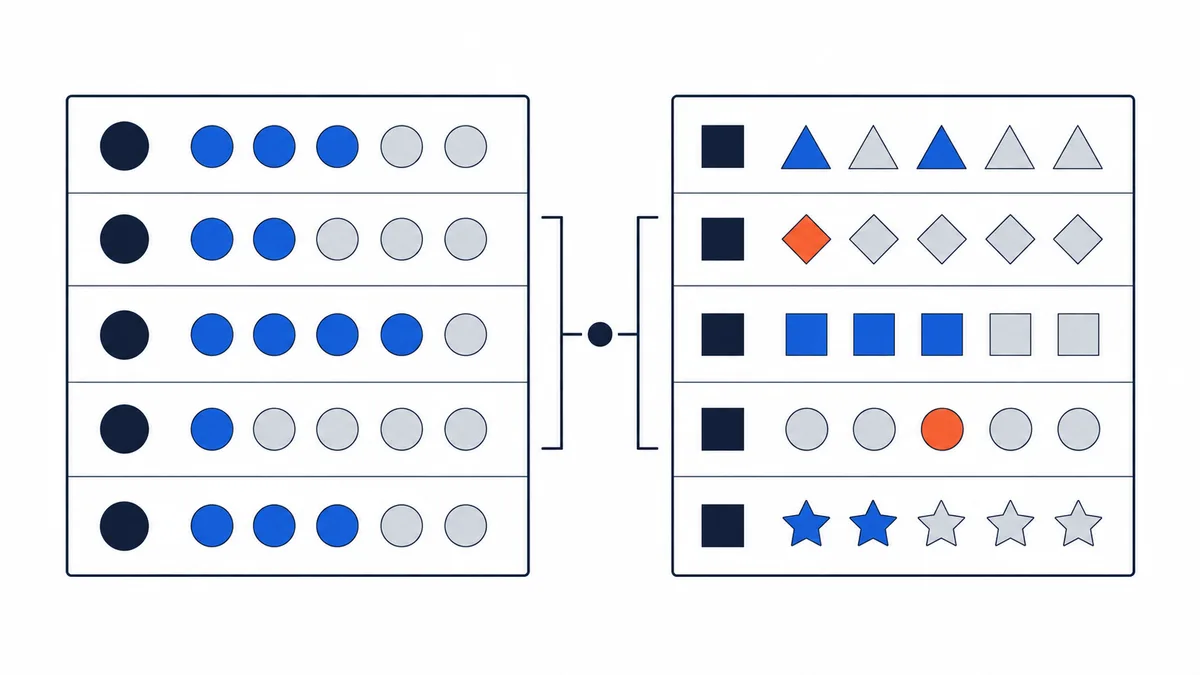
The Emotional Skills Profile separates recent-behavior self-reports from choices made in authored emotional situations. The first describes habits you report; the second records a response to a written prompt. Read them as complementary reflection prompts, not competing estimates of one ability. A match or gap can suggest what to notice in a real interaction, but neither confirms the other or predicts what you will do.
What the profile gives you to work with
The Emotional Skills Profile places two kinds of answers side by side: what you say you have tended to do recently and what you would choose in an authored emotional situation. Its description says the 32 items cover recognition, understanding, regulation, and responding to others. The report keeps recent-behavior summaries separate from scenario judgments, so each view can be read on its own terms rather than as an interchangeable reading of one ability. A self-report is a person’s account of their own recent tendencies. It can help name a familiar habit, such as waiting before replying when frustrated. A scenario judgment is the response selected for a situation written into the profile. It shows which choice seems fitting under those stated conditions. The prompt may leave some details unspecified; your answer belongs to that described situation, not to a record of what you did in a particular meeting. The Emotional Skills Profile is an educational reflection tool. Its outputs have no validated norms or established ability-test validity, so they are not a normed EQ score, forecast of future conduct, or proof that one answer is truer. Their value is narrower: one view gives language for a reported habit, while the other offers a situation-specific choice to consider. Before comparing them, keep that difference in view. A match or gap calls for interpretation in light of experience, not a verdict from the profile.
The two profile views start from different questions
A habit response asks what you believe you have typically done; an authored scenario asks which response you choose for the situation as written. One is a retrospective self-description and the other is a judgment about a prompt, not a record of conduct. The distinction matters because emotional-intelligence (EI) measures do not all ask people to do the same thing. In “The Measurement of Emotional Intelligence: A Critical Review of the Literature and Recommendations for Researchers and Practitioners,” the authors distinguish self-report measures, which ask people to rate behavioral tendencies or perceived abilities, from ability measures that ask them to solve emotion-related problems. Their review describes ability EI as maximum-performance testing: respondents answer problems under a scoring approach that treats some responses as more correct than others. Self-report, by contrast, captures what a person says about their usual behavior or emotional self-view. Neither method silently converts into the other. Someone may describe how they tend to respond under everyday conditions, while a problem-solving test asks what they can identify or understand when the question is presented directly. That difference is useful even when both questions concern a familiar skill such as recognizing frustration. A recent-behavior item asks the respondent to look back across experience and summarize a tendency. Memory and personal interpretation shape that answer. An authored scenario narrows attention to one written situation and asks for a choice within it. The response shows how the person reads the prompt or what action they select. Unless the scenario has been designed and scored as a validated performance measure, however, choosing an answer is not evidence that the person would act that way in a live exchange. The format alone does not establish a correct answer, a measured ability, or a prediction. “A review and critique of emotional intelligence measures” likewise distinguishes self-report, informant report, and ability-based approaches, and reviews how major EI instruments differ in their methods. Ask what each response refers to: a reported pattern over time, another person’s view, or a task response. The profile’s two views are the first and third of these only in a limited everyday sense: its habit summary is self-report, while its authored-scenario judgment records a choice for a prompt. It is not an observer rating or a keyed ability-test result. For this profile, therefore, neither view automatically outranks the other as the “true” EQ answer. A habit summary can help name what you think you usually do; a scenario choice can surface what seems appropriate when a particular situation is described. Read each in its own terms, then use an actual interaction to ask whether either account fits what happened. The comparison is most useful when it prevents a false truth-check: a scenario answer does not correct a self-report merely because it feels more concrete, and a self-report does not prove that a selected response is what would happen in practice.
Sources: The Measurement of Emotional Intelligence: A Critical Review of the Literature and Recommendations for Researchers and Practitioners; A review and critique of emotional intelligence measures
Why might a habit and a scenario choice disagree?
They can diverge because recalling typical behavior and choosing a response in a simplified prompt use different information. A mismatch identifies a question to investigate; by itself it does not identify a mistaken answer or a deficit. The Emotional Skills Profile places a person’s account of recent habits beside judgments about authored situations. Those answers have different reference points: one asks what seems usual across experience, while the other asks what response fits the scene presented. Neither is a direct check on the other.
A comparative study, “The assessment of emotional intelligence: a comparison of performance-based and self-report methodologies,” illustrates why answers from different methods need not line up. The researchers assessed 223 people from a diverse community sample with the MSCEIT, a performance-based test presenting emotion problems thought to have correct responses, and the Schutte self-report EI measure. Their scores were unrelated. The two measures also showed different patterns of association: self-reported EI related consistently to self-reported coping styles and depressive affect, while the performance measure related more strongly to age, education, and receiving psychotherapy. This is evidence about those two instruments and that sample. It does not explain any individual’s profile results, or establish the meaning or quality of the Emotional Skills Profile’s authored-scenario judgments.
The difference is useful because a gap can arise before anyone acts. A broad habit answer compresses memories of several occasions into one account. A scenario answer responds to one described moment. It may also invite a preferred or socially acceptable response, while a person’s account of habits may be shaped by which occasions come readily to mind. These are possibilities to check, not conclusions a score comparison can settle. The 2019 review “The Measurement of Emotional Intelligence: A Critical Review of the Literature and Recommendations for Researchers and Practitioners” distinguishes self-reports of tendencies or perceived ability from maximum-performance tests that present emotion problems. The method changes what an answer represents; the review does not say why a particular pair of profile answers differs.
Consider an illustrative work situation: feedback arrives just before a deadline. A person may describe a usual habit of asking questions before responding, yet choose a scenario option that first acknowledges the colleague’s concern. That difference could reflect the prompt’s missing details. Is the feedback urgent? Is the deadline shared? Has the concern already been discussed? Does the scene ask about understanding the other person, regulating an immediate reaction, or deciding what to say? In an actual exchange, those details can shape the next action. The example is not evidence about how people generally respond; it shows how a scene’s framing can narrow the information available to the person answering.
When the two views differ, read the wording again before reading a deficit into the result. Ask what each response refers to, which real situations came to mind when describing a habit, and what the authored scene leaves unspecified. A mismatch may point toward a context worth noticing, such as time pressure or an unclear request. It may also remain unexplained. The profile alone cannot distinguish among these possibilities. Treat the gap as a starting hypothesis: in a relevant conversation, notice what happens after feedback arrives and what you do next. One exchange will not establish a stable pattern, but it can give the next reflection a concrete event to examine. That is more informative than choosing one answer as the truer measure of EQ.
Sources: The assessment of emotional intelligence: a comparison of performance-based and self-report methodologies; The Measurement of Emotional Intelligence: A Critical Review of the Literature and Recommendations for Researchers and Practitioners
A scenario format alone does not make an ability test
A situational judgment test (SJT) is a format: it presents a situation and asks what someone would do, or what response they judge effective. The format alone does not tell you what ability is measured, how a response is scored, or whether the resulting score has evidence behind it. The Emotional Skills Profile’s authored situations are useful prompts for reflection, but its choices are not keyed or validated as an ability score. A stronger comparison starts with how each method treats an answer. In an ability-based emotional-intelligence test, a person solves emotion problems and responses are scored under a defined approach, sometimes against expert or consensus judgments. A self-report asks the person to describe their own typical behavior or perceived skill. The profile places a person’s recent-behavior account beside their choices in authored scenarios; those are two kinds of self-reflection, rather than a self-report checked against an objective answer key. Purpose-built tests show what additional work an SJT requires. In “Development and Validation of a Situational Judgment Test of Emotional Intelligence,” researchers began with 80 situations and three response options per situation. Their analysis of responses from 213 participants yielded a 46-item test with three factors: using one’s own emotion, sensing another person’s emotion, and understanding emotional context. The abstract reports additional reliability and factor-structure work, along with associations with academic achievement and life satisfaction. Those findings concern that test, its items, scoring and study samples. They do not establish properties of the profile’s authored prompts. The distinction matters even when a scenario sounds realistic. “Situational Judgment Tests: Constructs Assessed and a Meta-Analysis of Their Criterion-Related Validities” treats SJTs as a method that can assess different constructs. Its review classified the domains examined in the literature; the meta-analysis found relatively high validity for tests of teamwork and leadership in relation to overall job performance. The authors also found, on a small number of studies, that matching the measured construct to the criterion facet improved validity. A test intended to assess teamwork and judged against teamwork evidence has a clearer interpretive link than an unspecified scenario score. That is a point about design and evidence, not a claim that every SJT predicts performance. There is meaningful counterevidence to any suggestion that scenarios have no predictive value. “Use of Situational Judgment Tests to Predict Job Performance” meta-analyzed 102 coefficients covering 10,640 people and reported a generalizable validity estimate of .34 for job performance. This employment literature concerns studied tests and work criteria. It does not license using every scenario questionnaire for selection, and it says nothing specific about the Emotional Skills Profile. So the useful dividing line is not “scenario versus self-report.” Ask what a response represents and what evidence supports that interpretation. A keyed emotional problem, a developed SJT with a stated construct and studied scoring, and an educational profile’s authored prompt may all involve emotion, yet they do different measurement work. For this profile, compare the scenario choice with the reported habit as a pair of reflections. If they differ, the gap can prompt a question about what each asked you to consider; it cannot be settled by borrowing validation from another instrument.
Sources: Development and Validation of a Situational Judgment Test of Emotional Intelligence; Situational Judgment Tests: Constructs Assessed and a Meta-Analysis of Their Criterion-Related Validities; Use of Situational Judgment Tests to Predict Job Performance
What can agreement tell you—and what can it miss?
Agreement between the Emotional Skills Profile’s recent-behavior summary and a choice on an authored situation gives you a behavior to check in ordinary work. It does not establish that the self-description is accurate, that the scenario answer predicts what you will do, or that the two outputs independently confirm one underlying ability. Both responses come from your own answers. They may reflect the same expectation about how you handle emotion, including a preferred picture of yourself, rather than separate evidence of what happens in practice. Consider a match around pausing before replying to criticism. The habit summary and scenario choice may both suggest that a pause feels typical or appropriate. That convergence makes the behavior a useful question for a real exchange: did you pause, what happened just before you responded, and what did the pause allow you to do? The answer might be visible in a meeting or a written reply. It might also depend on the stakes, the relationship, the time available, or whether the criticism included enough detail to answer. The profile’s agreement alone cannot settle those conditions. This distinction follows from what the measures ask. The critical review, *The Measurement of Emotional Intelligence: A Critical Review of the Literature and Recommendations for Researchers and Practitioners*, describes self-report measures as ratings of perceived ability or typical behavioral tendencies, while ability measures ask people to solve emotion problems under a performance-based scoring approach. The review’s discussion helps explain why a result has to be interpreted for the method and intended purpose that produced it. It does not evaluate this profile or establish that agreement between its two views has a particular psychometric meaning. In this article, treating a match as a prompt for observation is an editorial interpretation, not a property demonstrated by the review. A comparison of named measures reinforces the limit. In *The assessment of emotional intelligence: a comparison of performance-based and self-report methodologies*, researchers studied 223 people in a diverse community sample and found that MSCEIT performance scores and Schutte self-report scores were unrelated. Those were different instruments, and the abstract does not explain why any one person’s answers might diverge. It therefore cannot validate this profile or show that agreement between its outputs is more accurate than disagreement. The study does show why method labels matter: results from separate approaches need not behave as interchangeable readings. So use agreement to select one observable action, then look for an actual instance before calling it a habit. Repeatedly describing yourself as someone who pauses is still self-description. Seeing a pause in one conversation adds an example, not proof of a stable pattern; another exchange may have different pressures. If your observation conflicts with the profile, keep the conflict in view and ask what the situation contained. A match is useful when it sharpens what you will notice next. It is not a certificate that the answers are true, independent, or predictive.
Sources: The Measurement of Emotional Intelligence: A Critical Review of the Literature and Recommendations for Researchers and Practitioners; The assessment of emotional intelligence: a comparison of performance-based and self-report methodologies
What can a real work exchange add?
A profile response cannot tell you what was happening around an exchange. A work interaction can supply that missing scene: what prompted the response, what you noticed, what you did next, and what followed. That account does not settle which profile response is more accurate. It gives you something concrete to compare with each one. Take a disagreement about a project handoff as an illustration, not as evidence about how people generally behave. A colleague says that a file arrived too late to use. Before deciding what this says about your emotional habits, record the sequence . What constraints mattered at that moment, such as how much time remained or whether the other person could still change the work? Describe your action in observable language: you asked when the file was needed, explained the delay, went quiet, or proposed a next step. “I was defensive” is an interpretation. “I interrupted twice and explained the schedule before asking what was missing” is an account another person could check. Then note what happened immediately and whether either person returned to the issue later. Did the conversation move to a workable handoff? Did the colleague clarify what they needed? Was there a later message that repaired a misunderstanding, or did the issue remain open? A quick explanation might help clarify responsibility in one exchange and crowd out useful feedback in another. Now place that account beside the profile’s two views. If your recent-behavior response suggests that you usually pause before reacting, ask whether this exchange included a pause you could identify, or whether the answer instead reflects what you intend to do. If your scenario choice favored asking a clarifying question, check whether you asked one here and what information it produced. A mismatch can sharpen the next question: perhaps the prompt described a calmer situation, while this exchange involved a deadline; perhaps your recalled habit covered several kinds of conversation, while this example involved one colleague and one task. Those are possibilities to examine, not causes established by the profile. One exchange is an example, not a representative sample of a stable tendency. It can show that a certain action occurred under the conditions you recorded. It cannot establish how often you act that way across different people, pressures, or kinds of disagreement. The Measurement of Emotional Intelligence review distinguishes self-report, informant-report, and ability-based approaches, underscoring that each source of information has a different scope. It does not validate this profile or turn a personal note about one meeting into an independent rating. Goldenberg and colleagues’ comparison of the MSCEIT and Schutte self-report scale likewise found unrelated scores in a community sample of 223 people. It concerns those instruments, not this profile, and gives no rule for choosing one response over the other. If another recent exchange points the other way, keep both accounts. Perhaps you asked questions during one disagreement and shut down during another. Rather than averaging those into an informal “true” score, compare the conditions you actually recorded and choose one upcoming conversation in which to notice a specific action. This check is a practical reflection method, not a procedure validated by those studies. Its value is narrower: it lets a real event add context that the two profile responses alone cannot provide.
Sources: The assessment of emotional intelligence: a comparison of performance-based and self-report methodologies; A review and critique of emotional intelligence measures
What the workplace evidence can—and cannot—settle
Research on emotional intelligence (EI) and job outcomes can help explain why measures that sound similar may support different conclusions. It cannot show that the Emotional Skills Profile predicts how someone will collaborate, perform, or respond in a future disagreement. The profile’s recent-behavior summaries and authored-scenario judgments are educational reflection prompts; the supplied product specification reports no validated norms or established ability-test validity for them. Findings about other instruments therefore provide context for interpreting measurement, not evidence about this profile’s outcomes. The meta-analysis “Why does self-reported emotional intelligence predict job performance? A meta-analytic investigation of mixed EI” examined mixed EI measures, which combine emotional skills with self-perceptions and other content. The researchers reported that these measures overlapped substantially with several established constructs (multiple R = .79). Across studies, the estimated association with supervisor-rated job performance was ρ = .29. After controlling for the listed overlapping constructs, the relationship became close to zero (β = −.02). This result qualifies a broad claim that a self-report EI score independently predicts work performance: some of its apparent association may reflect what else the measure captures. It does not show that every self-report measure is useless, that emotional skills never matter at work, or that the profile has the same content as the mixed measures studied. The analysis concerns aggregate associations across measures and studies, not a forecast for one person or a test of this product. There is a useful counterpoint in “Use of situational judgment tests to predict job performance: a clarification of the literature.” That meta-analysis combined 102 coefficients from 10,640 people and reported a generalizable validity estimate of ρ = .34 for situational judgment tests in employment research. Those are tests developed and evaluated for particular purposes, with scored responses and job-related criteria. The finding shows that scenario-based assessments can carry evidence when their design and intended use have been studied. A scenario format on its own does not supply that evidence. A plausible workplace prompt in an educational profile is not thereby equivalent to a validated selection test, and the employment result offers no support for using this profile in hiring or performance scoring. The broader review “The Measurement of Emotional Intelligence: A Critical Review of the Literature and Recommendations for Researchers and Practitioners” makes the same measurement point from another direction: ability, trait, and mixed EI are distinct approaches, and the appropriate measure depends on the question being asked. That distinction matters here because a reported habit, a chosen response to an authored situation, and a task scored as an ability measure do not become interchangeable simply because all concern emotions. Evidence about one interpretation or purpose cannot automatically justify another. The responsible conclusion is narrower and still useful. The profile can organize reflection around habits a person reports and choices they make in described situations. A reader may use either view to select a behavior to notice in an actual conversation, then consider the circumstances before drawing meaning from it. Research on other EI and situational tests cannot establish that this profile predicts collaboration, guarantees improvement, or identifies how someone will act next time. Its value here is a structured starting point for observing behavior, not a workplace verdict.
Sources: Why does self-reported emotional intelligence predict job performance? A meta-analytic investigation of mixed EI; The Measurement of Emotional Intelligence: A Critical Review of the Literature and Recommendations for Researchers and Practitioners; Use of Situational Judgment Tests to Predict Job Performance
How should you use a match or a gap?
Start with the behavior, not the apparent size of the gap. If both profile views point toward taking time before responding, name that action precisely: pausing long enough to understand the concern before replying. Then choose one upcoming conversation where you can notice whether it happens. Agreement gives you a focus for observation; it does not prove that the habit is consistent or that the scenario answer predicts your response. The 2019 review, “The Measurement of Emotional Intelligence: A Critical Review of the Literature and Recommendations for Researchers and Practitioners,” explains why a result depends on what a measure asks and how it is designed. Its conclusions concern established approaches and measures, not a confirmation rule for this profile. Treat a match as a useful question to carry into experience, rather than a certificate that the pattern is settled.
When the answers diverge, keep both in view and ask what condition might account for the difference. Perhaps the habit response describes what usually happens during routine exchanges, while the authored situation implies urgency or a particular relationship. Perhaps the scenario leaves out a history that would change which response seems appropriate. Those are possibilities to check against the wording and an actual event, not explanations the profile has established about you. In “The assessment of emotional intelligence: a comparison of performance-based and self-report methodologies,” a study of 223 people in a diverse community sample found that scores on the MSCEIT performance measure and the Schutte self-report scale were unrelated. The study compared two other instruments; it did not test this profile or explain why any individual’s responses differ. Its practical relevance is narrower: different methods can produce different information, so a discrepancy alone does not tell you which answer is mistaken. Pick a setting where the missing condition matters, then notice what you do there.
If neither answer connects to a concrete experience, wait before choosing a practice goal. A prompt can be too general to guide a useful next step, and one remembered incident may not represent a recurring pattern. When an example is clear, describe the trigger and constraint in plain terms, then name what was observable: the words you used, whether you asked a question, or whether you returned later to repair a misunderstanding. Keep the description factual enough that someone present could recognize the action; “I was bad at feedback” is a judgment, while “I interrupted before the concern was finished” names something to examine. This is a reflection aid, not a validated procedure or a way to calculate a more accurate score. If two situations lead to different actions, retain the difference and ask what changed between them rather than averaging the episodes into a personal rating. Choose one small action for the next relevant exchange: pause before replying, ask one clarifying question, state a boundary, or return to repair a misunderstanding. The aim is to notice what happens and refine the question, not to prove that you have improved or that one profile view was the real result.
Sources: The Measurement of Emotional Intelligence: A Critical Review of the Literature and Recommendations for Researchers and Practitioners; The assessment of emotional intelligence: a comparison of performance-based and self-report methodologies
Choose one behavior to notice next
If the habit you report and the response you choose in a scenario point in the same direction, take that as a lead for observation. Pick one conversation where the behavior could matter and notice what you do: do you pause to ask a clarifying question before answering? One exchange will not establish a lasting pattern. It can show what to look for next time, and whether it changes across settings.
When the two views differ, keep both answers in view and ask what the scenario left out. Was there time pressure, a power difference, or a history with the other person that would change your response? Choose one condition to watch in a future interaction. If no concrete behavior or context comes to mind, leave the gap open rather than turning it into a score to reconcile. The profile’s views are starting points for reflection; an observable exchange gives them context, not a standardized result.
The Emotional Skills Profile is a private 32-item reflection tool that separates recent-behavior summaries from judgments on authored situations, as described in the publication’s assessment information. Explore it at [/assessment](/assessment) as a starting point for noticing your habits and scenario choices.
Questions readers ask
What is the difference between a habit response and a scenario choice?
A habit response is your account of recent tendencies. A scenario choice records what you select for an authored situation. They refer to different things and neither is a record of conduct in a particular meeting.
Does a mismatch mean one of my answers is wrong?
No. The mismatch alone does not identify a mistaken answer or a deficit. The two responses use different information: one summarizes experience, while the other addresses a written prompt.
Does agreeing with a scenario answer prove I will act that way?
No. Agreement can identify a behavior to check in an actual exchange, but it does not prove the self-description is accurate or predict what you will do.
How can I use a gap between the two views?
Read each response according to the question it asked. Consider what the scenario left out, then choose a relevant interaction in which to notice one observable behavior.
Sources
- The assessment of emotional intelligence: a comparison of performance-based and self-report methodologies
Supports the distinction between two named EI instruments: in a diverse community sample of 223 people, MSCEIT and Schutte self-report scores were unrelated.
- The Measurement of Emotional Intelligence: A Critical Review of the Literature and Recommendations for Researchers and Practitioners
Explains distinctions among ability, trait, and mixed EI measures and why the method affects what a result represents.
- Situational Judgment Tests: Constructs Assessed and a Meta-Analysis of Their Criterion-Related Validities
Supports the point that situational judgment tests can assess different constructs and that construct-to-criterion matching matters.
- Development and Validation of a Situational Judgment Test of Emotional Intelligence
Describes development and study of a distinct EI situational judgment test; its reported evidence applies to that instrument.
- Use of Situational Judgment Tests to Predict Job Performance
Reports a meta-analysis of employment situational judgment tests; this does not establish validity for the Emotional Skills Profile.
- A review and critique of emotional intelligence measures
Reviews differences among self-report, informant-report, and ability-based approaches to EI measurement.
- Why does self-reported emotional intelligence predict job performance? A meta-analytic investigation of mixed EI
Reports findings about overlap and job-performance associations for mixed EI measures, not this reflection profile.
- Emotional Skills Profile assessment information
The assigned publication specification describes a 32-item educational reflection profile with separate recent-behavior summaries and authored-scenario judgments.
Apply it to the real situation
Turn two perspectives into one useful observation
From this guide: Compare a reported emotional habit with a scenario choice, then choose a real interaction where you can notice that behavior.
The profile keeps recent-behavior summaries separate from judgments on authored situations, giving you two starting points for reflection. Use them to identify one behavior to notice in a relevant work conversation. Explore the private Emotional Skills Profile for a structured way to examine those responses and choose a practical next question.